See our right-hand column for announcements and news briefs. Scroll down the right-hand column to access the Archives -- links to articles posted in the main column since 2007. See details about our site, including a way to comment, in the yellow text above the Archives.

Saturday, October 15, 2016

Artist Bonnie Peterson's new work is on exhibit at Northern Great Lakes Visitor Center

Detail: On the Nature of Fire, 65″ H x 85″ W. Embroidery on silk, velvet, by Bonnie Peterson. This is a detail of one of her textile embroideries now on exhibit at the Northern Great Lakes Visitor Center near Ashland, Wis. (Photos courtesy Bonnie Peterson)

ASHLAND, Wis. -- The Northern Great Lakes Visitor Center is hosting Michigan-based artist Bonnie Peterson’s handcrafted textile embroideries and story quilt exhibit through Dec. 12, 2016.

Peterson’s Stitching Explorations Through Time and Place exhibition consists of 12 textile embroideries and two maps that illustrate paddling, skiing and hiking trips to Lake Superior locations which include Isle Royale National Park, Apostle Islands National Lakeshore, Pukashwa National Park and the Keweenaw Peninsula.

The maps, photos and stories from her journeys are transferred on to silks and satins with embroidery on velvets and brocades. The results are collages capturing Peterson's own journeys and the  expeditions of Wisconsin and the Upper Peninsula by Marquette and Joliet in 1673. Peterson also explores the 1880s journeys of former Raspberry Island Lighthouse Keeper Francis Jacker, who was Peterson’s great-great grand uncle.
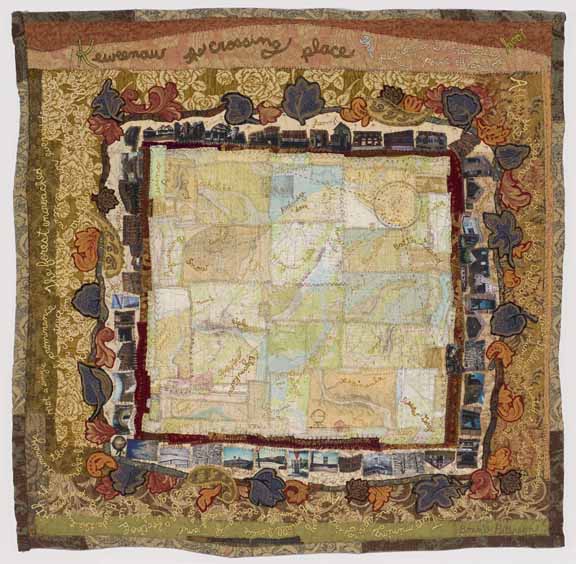
Keweenaw, 50" H x 48" W. Heat transfers and embroidery on satin, silk, velvet and brocade, by Bonnie Peterson.

Peterson describes here the work titled "Keweenaw," which means the crossing place, or the place where we traverse a point of land on foot:

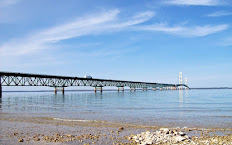
"Keweenaw waterway charts and topo maps are surrounded by red sandstone buildings and mining ruins I photographed in Houghton and Hancock, the twin cities at the bridge to the Keweenaw Peninsula in the Upper Peninsula of Michigan. Francis Jacker, my great great grand uncle, described Portage Lake in 1862 as he sailed from his home near Jacobsville to Raspberry Island in the Apostles where he was the lighthouse keeper."

Jacker's description makes up the text of embroidery on the border of this work: "After rounding Pilgrim's Point and skirting Dollar Bay, where Shelden's sawmill was situated, the lake narrowed rapidly and the shores rose to a greater height. Two mining towns spring into view. A medley of small houses... jumbled about as if broadcast and struggling for a foothold on the rocks. Besides the two stamp mills with their smoke-begrimed chimneys, there is not a single building of prominence or construction other than wood. The forest encroached upon the outskirts of the town in every direction." Francis Jacker, 1862.

Detail: Keweenaw, 50" H x 48" W. Heat transfers and embroidery on satin, silk, velvet and brocade, by Bonnie Peterson.

"I use embroidery to investigate cultural and environmental issues," Peterson writes in her artist's statement. "Mixing a variety of source materials such as scientific data and early explorer’s journals, I stitch words and phrases on velvet and silk fabrics to make large narrative wall hangings. My recent projects examine geophysical climate issues. Instigated by a series of collaborations with scientists, I began to look for simple explanations for some of the important principles in climate and environmental science to use in my projects. The artist/scientist interactions are invaluable for interpreting and extracting key concepts and clarifying their context and relevance."

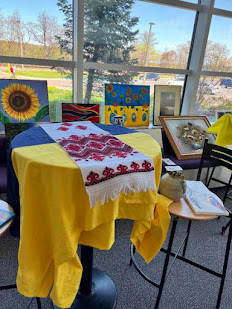
Bonnie Peterson is pictured here with her current exhibit at the Northern Great Lakes Visitor Center near Ashland, Wis.

Peterson’s wilderness experiences can be seen in her works, too. Lengthy trips are woven into displays which show impacts of wilderness, contemporary society and historical context.

Peterson was an artist-in-residence at Yosemite, Rocky Mountain, Isle Royale and Crater Lake National Parks. Her work is in the collection of the New York City Museum of Art and Design and in private collections.

Detail: Chicago Portage, 65 H x 68 W. Embroidery and heat transfers on satin, velvet and brocade, stitched, by Bonnie Peterson. The story of Marquette and Joliet's historic 1673 exploration of Wisconsin and Illinois, is embroidered and surrounds early Lake Michigan maps. The French explorers used a faster way for the return part of their journey to the northern part of Lake Michigan. They carried the canoes across a portage from the Des Plaines River to the Chicago River and returned via Lake Michigan, instead of paddling up the Mississippi to the Wisconsin River, and portaging to the Fox. The outer embroidery is from Joliet's journal.

The Northern Great Lakes Visitor Center is located two miles west of Ashland, Wis., on U.S. Highway 2. The Center is open daily from 9 a.m. to 5 p.m. This collection can be seen in the visitor center’s gallery. It is free and open to the public.

For more information about this exhibition, please contact Linda Mittlestadt or Susan Nelson at (715) 685-9983.

The Northern Great Lakes Visitor Center is owned by the U.S. Forest Service and operated through partnership with the National Park Service, U.S. Fish and Wildlife Service, Wisconsin Historical Society, University of Wisconsin-Extension and Friends of the Center Alliance Ltd. It is open to the public at no charge with opportunities for visitors to experience human and natural history of the Chequamegon Bay region in the building and on the 180-acre grounds.

Editor's Note: See more of Bonnie Peterson's work on her Web site.

Friday, October 14, 2016

Joint Hancock-Houghton City Council Meeting to be Oct. 17

HANCOCK -- A special joint City Council Meeting of the cities of Hancock and Houghton will be held at 6 p.m. Monday, Oct. 17, at the Lake Shore Center Community Room 123, 600 E. Lake Shore Dr., Houghton, MI  49931.

The meeting will include the following:

A.    Call to order by Mayor Lisa McKenzie and Mayor Robert Backon,  Roll Call and Verification of a Quorum.
B.    Houghton Council -- Robert Backon, Robert Megowen, Craig Kurtz, Mike Needham, Rachel Lankton, Dan Salo and John Sullivan
C.    Hancock Council -- Mary Tuisku, Joe Bauman, Gregory Markkanen, Lisa McKenzie, Ted Belej, John Slivon and Ron Blau.
D.    Address The Flag

AGENDA  AS  POSTED:

1.  Public Hearing on the 15 year MTEC SmartZone Tax Increment Financing and Development Plan Extension 2018/19 to2032/33
2.  Receive MTEC SmartZone update from Marilyn Clark, CEO,
3.  Consider motion adopting Resolutions approving the 15 year Tax Increment Financing and Development Plan by both Cities.

Motion to adjourn.

Note:  Posted this 14th day of October, 2016.
All Councilors were properly notified on 10-14-2016 at 11 a.m. and by e-mail.
18 hour minimum notice.

Monday, October 10, 2016

Keweenaw Climate Community to hold second Climate Café Oct. 13 at Orpheum Theater; large turnout at Sept. 8 event

By Michele Bourdieu

A diversified crowd of more than 80 people attended the Sept. 8, 2016, Climate Café, sponsored by the Keweenaw Climate Community (KCC) and held in the Orpheum Theater in Hancock. Besides enjoying free pizza and beverages, participants asked questions and held discussions following presentations on "What's the Deal with Climate Change? Here KCC member Linda Rulison, third from right, leads one of the small group discussions. The second event of a four-part series will be held Thursday, Oct. 13, at the Orpheum. (Photos by Keweenaw Now)

HANCOCK -- The Keweenaw Climate Community (KCC) will present "What's the Deal with Climate Change? How Did We Get Here?" from 6 p.m. to 8 p.m. on Thursday, Oct. 13, at the Orpheum Theater (Studio Pizza), 426 Quincy St. in Hancock. This is the second in a four-part "Climate Café" series of free information and discussion events on climate change. Free pizza and soft drinks! Everyone is welcome! Donations are accepted.

This event will center on causes and impacts. Here are some questions that will be addressed:
  • How do humans impact the climate?
  • Why are we so energy dependent?
  • What choices do we have as individuals?
This slide by Sarah Green, Michigan Tech professor of chemistry, who has done extensive research on climate change, was part of her presentation at the Sept. 8, 2016, KCC Climate Café event, "What's the Deal with Climate Change?" The second event in the series, to be held on Oct. 13 at the Orpheum Theater in Hancock, will center on causes and impacts, some of which are illustrated here. Click on photo for larger version. (Photo by Keweenaw Now)

Environmental Historian Fred Quivik will give a short presentation, followed by small-group and general discussions.

September Climate Café event attracts large, diverse crowd

The KCC organizers of the series were delighted with the turnout at the first Climate Café held on Sept. 8, 2016, at the Orpheum. More than 80 people attended -- an audience diversified in age and background.

Jessie Knowlton, Michigan Tech research scientist in forestry and chair of KCC's publicity committee, said she was surprised and happy with the turnout.

"It's a nice mix of people from Michigan Tech and from the community -- which I think we need more of," Knowlton said. "We were very happy to have to order more pizza than we had anticipated."

At the Sept. 8 event, the audience enjoyed free refreshments while they wrote down a question to submit for the discussion. Following some humor by Chuck Wallace, Sarah Green, Michigan Tech professor of chemistry, who has done extensive research on climate change, involved the audience immediately with a visual comparison of heating a house in the U.P. and heating the planet. As Green asked questions of the audience, Erin Pischke, Michigan Tech graduate student and KCC member, sketched the comparison in a pair of cartoons:

Inviting audience participation, Sarah Green, Michigan Tech professor of chemistry, who has done extensive climate change research, and Michigan Tech graduate student Erin Pischke offer an illustration of how to heat a house in the U.P. (Videos by Keweenaw Now)

Green and Pischke offer a comparison of heating a house and heating the planet.

Green also showed some slides illustrating some of the warming effects of climate change on land, water and ice.

This slide shows some of the effects of temperature changes. The white arrows show increases, while the black, downward arrows show decreases or melting.

Next the audience members participated in small-group discussions with people at their tables.

Suggested questions for the table discussion were these:
  • What's unclear to you about climate change?
  • What's your biggest fear about climate change
  • What information would help you talk to friends and family members about the importance of climate change?
Linda Rulison, president of FOLK (Friends of the Land of Keweenaw) and KCC member, said she found audience members to be very engaged as listeners and participants.

"The discussion with the college students I was sitting with centered around the fact that climate change is real and the consequences are serious," Rulison noted. "So they wondered, 'How does a person talk to another person about the impacts of climate change if you are talking to a person who does not agree with you and whose opinion is religion-based and not science-based?'"

Sarah Green offered some science-based answers to questions from the audience. Here she answers a question on the types of greenhouse gases:

Sarah Green compares CO2 and methane, the two biggest greenhouse gas contributors, and mentions other greenhouse gases such as freon and nitrous oxide. She also answers a question on possible ways to remove CO2 from the atmosphere.

Following the small-group table discussions, individuals spoke about what their group had talked about:

Following the table discussions, participants report on their groups' concerns.

John Forslin (who speaks in the above video) and his wife, Marge Forslin, of Marquette traveled to Hancock to participate in this event because the issue is important to them.

"We did the climate reality training with Al Gore in Iowa in 2015," Marge Forslin said.

She noted Gore was in Iowa for three days of discussion that they attended. The event was free and the only cost was personal transportation.

"Frankly, it was a life-changing event," John Forslin added.

Melissa Davis, project manager of HEET, the Houghton Energy Efficiency Team, gave an update on HEET's work in helping local residents with home insulation and HEET's project as a semi-finalist for the $5 million Georgetown Energy Prize.

Greyson Morrow of Wakefield spoke briefly about the Citizens' Climate Lobby and their efforts to work with legislators to put a price on carbon pollution.*

Finally, Kathy Halversen, Michigan Tech professor of natural resource policy and KCC organizer, asked Sarah Green to display a visual that shows the rate of global warming from the mid-19th century to 2016:

Sarah Green concludes the Sept. 8, 2016, "What's the Deal with Climate Change?" with a graphic that shows the rate of global warming from the mid-19th century to 2016. Click on YouTube icon for larger screen.

Donna Des-Jardins of Lake Linden said she liked the graphs and visuals, especially this last one. Des-Jardins said she had learned about climate issues especially while living in Florida, where she became aware of the efforts to save the Everglades.

Bill Narki of Lake Linden said he found the event interesting.

"It hit a lot of spots," Narki noted. "Polluting the air is the problem."

Sharon Levine, KCC member, also commented on the presentations and discussion.

"The presenters spoke about complicated processes and developments in a way that people could understand," Levine said. "Dynamic and interested conversations among the participants took place in small groups and continued in questions and comments people asked. I look forward to the next presentation (on Oct. 13)."**

Levine, who collected some free-will donations for KCC at the end of the event, was very pleased with the generosity of participants. The donations helped pay for the pizza.

Following the Sept. 8 Climate Café, Kathy Halversen created a Facebook page for Keweenaw Climate Community, an open group.

"Our group was created to build regional awareness of climate change and help catalyze local action to slow and respond to climate change," Halvesen posted on Sept. 9, 2016.

The third and fourth KCC Climate Café events are tentatively scheduled as follows: Nov. 3, Climate Change Solutions; and Dec. 1, Next steps, local action to slow and respond to climate change. These events will also be held from 6 p.m. to 8 p.m. at the Orpheum Theater.

Notes:

* Click here for info on the Wakefield Chapter of the Citizens' Climate Lobby.
 
** Originally the second KCC event was scheduled for Oct. 6, but the date was changed to Oct. 13. Click here for the event Facebook page.

Wednesday, October 05, 2016

UPDATED: Activist historian Roxanne Dunbar-Ortiz to speak at Michigan Tech Oct. 10

Poster announcing visit of acclaimed historian and activist Roxanne Dunbar-Ortiz, author of An Indigenous Peoples' History of the United States, on Monday, Oct. 10, 2016. She will give a presentation, with discussion, at 5 p.m. in Michigan Tech's MUB Ballroom A. (Poster courtesy Michigan Tech University)

HOUGHTON -- Roxanne Dunbar-Ortiz, author of An Indigenous Peoples' History of the United States, will speak on "Settler Colonialism and the U.S. Policy of Genocide: Decolonization and Reparations" at 5 p.m. Monday, Oct. 10, 2016, in Michigan Tech's MUB Ballroom A. The presentation will include discussion. It is free and open to the public.

Before earning both a masters and a Ph.D. in history, Dunbar-Ortiz grew up in an Oklahoma sharecropper family. She describes her mother as "part Indian, most likely Cherokee," who, at sixteen, married her father, who was "of Scots-Irish settler heritage, eighteen, and a high school dropout who worked as a cowboy on a sprawling cattle ranch in the Osage Nation."

Dunbar-Ortiz became an activist for social justice in the 1960s in California. After the Wounded Knee siege of 1973, she began her national and international work with the American Indian Movement (AIM) and the International Indian Treaty Council. She has taught in Native American Studies programs and was visiting director of Native American Studies at the University of New Mexico, where she worked directly with Native communities, faculty and students in developing a research institute and a training program in economic development.

An Indigenous Peoples' History of the United States is the winner of 2015 American Book Award and the 2015 PEN Oakland-Josephine Miles Award for Excellence in Literature. In this book, the word "settler" takes on a colonialist, imperialist connotation -- far from the image of the "courageous" and patriotic, often religious, pioneers so many young Americans read about in traditional school history books. An Indigenous Peoples' History of the United States is, as Dunbar-Ortiz describes it, "a history of the United States as experienced by the Indigenous inhabitants." Its narrative form is intended to make this book, which is extensively documented, accessible to the general reader. It is about settler colonialism, genocide and Native Americans' survival of genocide through their resistance.

The book is an eye-opening -- and shocking -- account of the injustice and cruelty against Native peoples perpetrated by political, military and religious leaders and followers. Dunbar-Ortiz describes the theft of land, resources and culture -- from government-sanctioned slaughter to illegal termination or disregard of treaties to forced assimilation inside the Indian boarding school system.

Dunbar-Ortiz seeks to create awareness of the colonial past in order to inspire Native and non-Native Americans to work toward a future in which treaties made with Indigenous Nations will be honored, their sacred sites and ancestral remains will be respected, and their history will be taught in schools.

Dunbar-Ortiz, who lives in San Francisco, is also the author or editor of seven other books.

This event is sponsored by Michigan Tech's Center for Diversity and Inclusion and the Indigenous Peoples' Day Campaign Committee.*

UPDATE: KBIC, KBOCC to host Roxanne Dunbar-Ortiz at noon Oct. 10

BARAGA -- The Keweenaw Bay Indian Community (KBIC) Natural Resources Department and Keweenaw Bay Ojibwa Community College (KBOCC) will host a presentation by Roxanne Dunbar-Ortiz as part of their Lunch and Learn series and the Indigenous Peoples' Day Campaign* at noon on Monday, Oct. 10. The presentation will include a lunch at KBOCC's Niiwin Akeaa Rec Facility on Beartown Road in Baraga. (Inset photo: Roxanne Dunbar-Ortiz. Photo courtesy KBIC)

Dunbar-Ortiz will present "The Doctrine of Discovery, Treaty Rights and Native Nations Sovereignty." The "Doctrine of Discovery," which Dunbar-Ortiz writes about in a chapter of her book, An Indigenous Peoples' History of the United States, is a 15th-century papal law presumed to mandate the right of European Christian monarchies to claim non-Christian parts of the world and enslave or displace the inhabitants.

For lunch planning purposes, anyone wishing to attend this lunchtime presentation is asked to RSVP to Valoree Gagnon at vsgagnon@mtu.edu.

*The Indigenous People's Day Campaign is an ongoing effort to officially recognize Oct. 10 as Indigenous Peoples' Day (replacing Columbus Day). This campaign is aligned with a nationwide effort in several cities and towns throughout the country. It was launched locally by Michigan Tech's Indigenous Issues Discussion Group with the support of Michigan Tech's Center for Diversity and Inclusion and rapidly spread to include the larger Tech community, Keweenaw Bay Ojibwa Community College and many community members from Houghton and Baraga counties.

Tuesday, October 04, 2016

Three Questions for the Michigan DEQ on the Back Forty Project

By Louis V. Galdieri*
Posted Sept. 27, 2016, on Louis V. Galdieri's blog
Reprinted here with permission

Early in September 2016 the Michigan Department of Environmental Quality announced its intention to permit the Back Forty Project, an open-pit gold and zinc sulfide ore mine that Aquila Resources, a Canadian company, plans to develop near the headwaters of the Menominee River. In response to the MDEQ’s request for public comment by November 3rd, I’ve submitted these three questions. I’m posting them here so that others might consider them in the run up to the public hearing with the MDEQ in Stephenson, Michigan, on October 6th.**

1. In determining that the Back Forty Project application meets the requirements for approval under Part 632, did MDEQ take into account the cumulative effects of sulfide mining throughout the Lake Superior watershed? We know that the Back Forty project poses a significant risk to the Menominee River all by itself. With the mine in close proximity to the river, a flood, berm collapse, subsidence or a slide could destroy the Menominee River; to answer these serious concerns by asking the company to add a “synthetic, manmade liner under their waste/tailing rock facility,” as the DEQ has proposed, is to trivialize them. Other development that the mine will inevitably bring, including haul routes, power lines, lights, fueling stations, exhaust and machine noise, will leave a large industrial footprint and disturb the Menominee River and its environs in countless ways. At the same time, this mine will heighten the risk, in the long term, of large-scale environmental destruction posed by the resurgence of sulfide mining not just in Michigan’s Upper Peninsula, but in Minnesota and Canada as well -- all around the lake and throughout the Lake Superior watershed. Has the DEQ completed or participated with neighboring state agencies and tribal authorities in a scientific study of the cumulative impacts of sulfide mining around Lake Superior? Has the DEQ issued guidance on how cumulative environmental effects should factor into its decision-making process for permitting new mines in Michigan?

2. Has MDEQ made any determination about the human rights implications of its decision to allow the Back Forty project to go forward? Human rights are not outside the DEQ’s bailiwick, no matter how hard it may try to exempt itself. Witness Flint. In the present case, the DEQ’s oversight is inextricably bound up with the state’s obligation to protect human rights abuses by third parties. Aquila’s Back Forty project is sure to disturb, and likely to desecrate, lands traditionally belonging to the Menominee and still held sacred by them; and making provisions for archaeological recovery and preservation of mounds and other sacred sites does not adequately address the basic human rights issues involved here. The headwaters of the Menominee River are central to the tribe’s creation story, marking the place where the Menominee people originated. Their very name derives from manoomin, or wild rice, which will not survive changes in sulfate levels or degradation of overall water quality. As tribal member Guy Reiter has said, "It’s no different than if an open-pit sulfide mine was put in Bethlehem for the Christians." Seen from this perspective, the Back Forty is not only an affront to Menominee history; it also puts the cultural survival of the Menominee people at risk. How will the DEQ factor such human rights considerations into its decision-making process?

3. What has the DEQ done to restore trust in its authority, and reassure the Menominee and people living downstream from the Back Forty project in Michigan and Wisconsin that it will exercise appropriate care? The Flint water crisis cast a long shadow, and reinforced the perception that "politics and poverty are big factors" in DEQ decision making. "The same attitude of disregard for citizens and the environment has repeated itself in DEQ decisions across our state for well over a decade," said Marquette attorney Michelle Halley after news of the Flint water crisis broke; controversy over the renewed Groundwater Discharge Permit issued by MDEQ at Eagle Mine and legitimate concerns about lax oversight at Eagle East help make her case. Like all government agencies, the Michigan DEQ should operate in sunlight. Already, however, troubling questions have been raised about the transparency of the Back Forty permitting process. For example, Al Gedicks, Executive Secretary of the Wisconsin Resources Protection Council, asks why the DEQ appears to be in a "rush" to grant the Back Forty permit. So as things now stand, the DEQ enjoys de jure authority in Michigan under Part 632, but it is unclear whether the DEQ still enjoys de facto authority, which could only derive from demonstrations of regulatory competence. How does MDEQ intend to quell public concern that it is compromised or incompetent, and reassure the public that it is a responsible steward?

Editor's Notes:

* Guest author Louis V. Galdieri is a filmmaker based in New York City. He and fellow filmmaker Ken Ross visited Houghton, Mich., in October 2013 and screened their documentary 1913 Massacre, about the Italian Hall tragedy. Since then he has posted several articles on his blog about present-day mining issues in the Upper Peninsula. (Inset photo: Louis V. Galdieri. Photo courtesy Louis V. Galdieri)

** The public hearing will be held from 6 p.m. to 10 p.m. CST on Thursday, Oct. 6, at Stephenson High School gymnasium, located at W526 Division Street, Stephenson, Mich., to accept public comment on the proposed decisions. Click here for details on making comments.

Thursday, September 29, 2016

Congressional Candidate Lon Johnson to hold 5 local Town Halls and attend Oct. 4 Candidate Forum

HANCOCK -- Next week Lon Johnson, U.S. Congressional Candidate for Michigan's First District, will be holding five Town Halls in the Keweenaw, in addition to participating in the Oct. 4 Candidate Forum in Ontonagon. Johnson, a Democrat, is running against Republican Jack Bergman  for the Congressional seat now held by U.S. Rep. Dan Benishek, who is not running for re-election.

Here is Lon's schedule:

Tuesday, Oct. 4: 10 a.m. - 11 a.m.  Chassell VFW, 42103 Wilson Memorial Dr, Chassell

Tuesday, Oct. 4: 12 p.m. - 1 p.m. Tina’s Katalina Restaurant, 59 Trimountain Ave, South Range

Tuesday, Oct. 4: Candidate Forum at Ontonagon High School Cafeteria, 701 Parker Ave, Ontonagon, MI 49953. The event begins at 6 p. m. ET with a "meet and greet," which will give voters the opportunity to meet forum candidates as well as candidates in Ontonagon County contested races. The Forum begins at 7 p. m. ET and will include 1st Congressional District candidates Lon Johnson (D) and Jack Bergman (R) and Michigan’s 110th State Representative candidates Scott Dianda (D) Greg Markkanen (R). The forum moderator is Ontonagon District Court and Probate Judge, Janis Burgess.

Wednesday, Oct. 5: 10 a.m. - 11 a.m. Carmelita’s Restaurant, 618 Oak St, Calumet

Wednesday, Oct. 5: 1 p.m. - 2 p.m. Slim’s Café, 8 Mohawk Dr, Mohawk

Wednesday, Oct. 5: 5:30 p.m. - 6:30 p.m. The Downtowner, 100 Shelden Ave, Houghton

For information about Lon Johnson and his campaign, visit his Web site: http://www.lonjohnson.com/meet-lon/.

(Inset photo: Lon Johnson. Photo courtesy Lon Johnson's campaign)

Tuesday, September 27, 2016

UPDATE: DEQ Public Hearing will take place Sept. 28; L'Anse Warden Electric Co. addresses maintenance issues

By Michele Bourdieu

This photo shows a hole in the top of the L'Anse Warden Electric Co. (LWEC) "biomass" plant in L'Anse. According to DEQ, the hole does not affect emissions. The plant is temporarily "off-line" -- not operating. This will not affect the DEQ Public Hearing scheduled for Sept. 28. LWEC is working on maintenance but not sharing the reason for not operating. (Photo courtesy Doug Welker)

L'ANSE -- Keweenaw Now received word today, Tuesday, Sept. 27, 2016, that the L'Anse Warden plant is presently "off-line," i.e., temporarily not operating. Ed Lancaster, DEQ Air Quality Division environmental quality analyst, said today that the Public Hearing scheduled for 7 p.m. Wednesday, Sept. 28, with an information, question-answer meeting at 6 p.m., will take place as announced. The hearing will be held at the L'Anse High School Cafetorium.*
 

"The maintenance issues they're having are not related to the public hearing," Lancaster told Keweenaw Now today. 

The hearing is only about the draft Consent Form and the draft Permit to Install, he explained. Only comments on these will be taken during the hearing beginning at 7 p.m. From 6 p.m. to 7 p.m. the public may ask general questions.

Lancaster confirmed that there is a hole in the structure of the stack at the plant -- near the top, near the exit of the stack.

"It's not going to affect the emissions at all," he said.

Lancaster said he was not sure what problems caused the plant to cease operations recently.

Steve Walsh, CEO of Traxys Power Group, which operates L'Anse Warden Electric Co. (LWEC), told Keweenaw Now today he could not comment on the reason for the plant being "off-line," but the company is working on the maintenance so that operations can resume as soon as possible.

"We're in the process of getting back on line as soon as possible because we know the people of Michigan need a local source of generation to maintain good grid stability," Walsh said.

Asked if the L'Anse Warden plant supplies electricity to the local area, Walsh said, "It certainly does."

* See our article posted yesterday, Sept. 26, 2016: "Video Report: Concerned citizens challenge DEQ, EPA officials on L'Anse Warden Plant pollution; DEQ Public Hearing to be Sept. 28."

Monday, September 26, 2016

Video Report: Concerned citizens challenge DEQ, EPA officials on L'Anse Warden Plant pollution; DEQ Public Hearing to be Sept. 28

By Michele Bourdieu

Michigan Department of Environmental Quality (DEQ) Air Quality Division officials hold an informational meeting on the L'Anse Warden Electrical Company's "biomass" plant on Sept. 7, 2016, at L'Anse High School. The purpose of the meeting was to take questions from the public related to the recent Administrative Consent Order based on the company's permit violations of Hydrogen Chloride (HCL) emission limits and fugitive dust in the community. A DEQ Public Hearing on the Consent Order will be held this Wednesday, Sept. 28, 2016. (Photos by Keweenaw Now)

L'ANSE -- The Michigan Department of Environmental Quality (DEQ) will hold a public hearing Wednesday, Sept. 28, 2016, on L'Anse Warden Electric Company's proposed Consent Order and proposed Permit to Install (PTI). The proposed PTI is for removal of pentachlorophenol (PCP) treated wood from the fuel portfolio of the existing 324 million British thermal unit per hour boiler at the facility, located at 157 S. Main St., L'Anse, Mich. The public hearing will take place at  L'Anse Area Schools Cafetorium. DEQ will answer questions from 6 p.m. to 7 p.m. and will accept public comments after 7 p.m.*

The hearing follows two informational meetings -- one with DEQ on Sept. 7, 2016, and an earlier meeting with both EPA (Environmental Protection Agency) officials and DEQ held on May 9, 2016. At both meetings officials discussed the Hydrogen Chloride (HCL) exceedance at the plant, which violates their permit, as well as a fugitive dust violation of enforceable laws and odors from the plant as reported by local residents. Following are some video clips from both meetings.

At the Sept. 7, 2016, informational meeting Chris Hare, DEQ Air Quality Division Upper Peninsula District supervisor, states the reason for the meeting:

DEQ Air Quality Division U.P. District Supervisor Chris Hare speaks about the L'Anse Warden Electric Company's HCL exceedance. (Videos by Keweenaw Now)

At the Sept. 7 meeting the public was provided with several documents, including the Consent Order and a list of Questions and Common Concerns with answers provided by DEQ. Several questions concerned railroad ties -- some treated with pentachlorophenol which will no longer be allowed as fuel in the plant -- and some treated with creosote, which is a concern because of odors and because of its carcinogenic properties. The DEQ's question-answer sheet states that EPA considers both pentachlorophenol and creosote as "probable" human carcinogens. Referring to each of these, DEQ states, "cancer risk depends on exposure concentration and duration."

Here Jim Haun of Skanee questions whether the railroad ties and tire derived fuel burned in the plant should be considered biomass:

Jim Haun of Skanee asks DEQ's Chris Hare why the plant cannot just burn wood chips if it is really considered a biomass facility.

The Question-Answer sheet begins with a question on whether DEQ Air Quality Division has the authority to shut down operations at a facility because of violations. DEQ mentions several standards for air quality that determine emission limits, but notes they can only order a plant to shut down a facility or its operations if it "is emitting pollutants that put the public's health or environment in imminent danger." Doug Welker of the Upper Peninsula Environmental Coalition (UPEC) and FOLK (Friends of the Land of Keweenaw) asks about these standards:


Doug Welker asks a question on the standards used to determine public health risk from air quality violations by the plant.

Another question on the DEQ's question-answer sheet notes that "the proposed consent order requires LWEC to pay up to $10,000 per violation per day, depending on which condition of the consent order is violated." L'Anse area resident and retired attorney Frank Kohl challenged DEQ on the vague wording of the amount, since "up to" opens a possibility of a very low fine. Hare replied that the language is meant to encourage the company to agree to the consent order.

FOLK members challenge DEQ on lack of permit enforcement

During the Sept. 7 public meeting, Catherine Andrews, local resident and member of Friends of the Land of Keweenaw (FOLK), who has often expressed concerns about the L'Anse Warden plant's air emissions, asked DEQ officials about the toxicity of air pollution from the plant.

Catherine Andrews questions DEQ toxicologist Michael Depa on the measuring of toxicity in the L'Anse Warden plant's air emissions, noting the effects of its location near the lake.

Andrews, who has written more than one letter to the editor to local media expressing her concerns about the plant's air pollution, states the following in a recent letter to the editor:

"L'Anse Warden Electric Company (LWEC) claims they failed a stack test last September [2015] because they inadvertently fed too many chipped PCP treated railroad ties into the boiler. A June 2016 Addendum to Emissions Test Protocol sent from Steve Walsh, [LWEC] CEO, to EPA states, 'LWEC wishes to clarify that the boiler operator does not have the ability to separately weigh and feed the various fuels on an hourly basis.' This statement is an admission that they can't meet permit requirements and makes the permit unenforceable, and therefore illegal.

"In the same document Walsh states that, 'repairs were needed on the upper portion of the stack' and that 'access to the top of the stack could not be obtained consistent with OSHA requirements for worker safety.' This is a weak excuse for requesting an exclusion from an EPA testing requirement to measure stack gas exit velocity and stack gas temperature at the exit from the stack. EPA should force LWEC to repair the stack.

"DEQ was asked on September 7th, 'Would you have done anything if you hadn't gotten any complaints?' Their response was, 'No.'"

Linda Rulison, president of FOLK, asked DEQ officials if citizens would need to continue reporting their complaints to DEQ in order to have rules and regulations enforced.


A concerned citizen notes the offensive odors coming from the plant. Linda Rulison of FOLK asks if they must continue to report the same complaints over and over in order to see enforcement. Chris Hare and Ed Lancaster, DEQ Air Quality Division environmental quality analyst for the Upper Peninsula, reply that they need citizen reports of odors in order to act on this problem with inspections.

DEQ: Carcinogens below limits are "O.K."

Some members of the public submitted written questions to the DEQ officials to be addressed during the meeting. One question concerned creosote:

DEQ toxicologist Michael Depa answers a question on PAHs, creosote and carcinogens.

More questions on the odors and fugitive dust from the plant led to the DEQ's announcement that, although EPA officially requested that L'Anse Warden Electric Co. (LWEC) put air monitors at their property line, EPA is now delaying that request until after the company closes conveyors and other equipment to "wait and see" how effective that is:

John Vial, DEQ permit engineer, reacts to citizens' complaints about odors, admitting he has noticed them as well. Jeffery Loman of the Keweenaw Bay Indian Community asks why the air monitors ordered by the EPA have not been put in place yet.

DEQ notes on their question-answer sheet, "EPA has agreed to an extension of installing air monitors to monitor particulates at the property line until the enclosures of conveyors and fuel receiving area is built. At that time EPA will reevaluate their request to install the monitors."

Philip Keyes of Baraga asks DEQ officials why they don't have something to measure ambient air quality. He mentions a mountain of creosote logs at the plant.

Finally, Horst Schmidt, president of the Upper Peninsula Environmental Coalition and member of FOLK, asked DEQ officials if the Department of Environmental Quality has the willingness and capacity to monitor the plant and enforce the rules in a meaningful way:

>
Horst Schmidt, president of the Upper Peninsula Environmental Coalition, questions the system of self-monitoring on the part of the company. DEQ's Chris Hare answers with "checks and balances."
 
Following the Sept. 7 meeting, DEQ officials answered individual questions for a few minutes.

Following the Sept. 7, 2016, meeting, FOLK members Doug Welker, left, and Catherine Andrews chat with DEQ Toxicologist Michael Depa, right, and DEQ Permitting Engineer John Vial, both from the Air Quality Division Lansing office. 

Vanessa Dietz, Daily Mining Gazette reporter, interviews Ed Lancaster, DEQ Air Quality Division environmental quality analyst for the Upper Peninsula, who does inspections at the L'Anse Warden Plant.

EPA, DEQ address citizens' concerns at May 9, 2016, meeting

The L'Anse High School Cafetorium was filled with a large crowd of concerned citizens for the May 9, 2016, EPA/DEQ informational meeting on the L'Anse Warden plant. (Photos by Keweenaw Now)

On May 9, 2016, EPA Region 5 officials came from Chicago to host, along with DEQ officials, a similar informational meeting on the L'Anse Warden plant. At that time EPA was requiring the air monitors and anticipating further testing this summer. A stack test was conducted in July 2016.

Here Molly Smith, EPA Region 5 environmental scientist, speaks about dust wipes taken by DEQ near the plant and what analysis of these can or cannot indicate. She also speaks about the air monitors and requiring a stack test:

Molly Smith, EPA Region 5 environmental scientist, speaks about EPA's collaboration with DEQ to address the problem of fugitive dust by ordering L'Anse Warden Electric Company to install air monitors and to conduct a stack test which will be used to determine health risks to the community. (Videos by Keweenaw Now)

Smith told the audience at the May 9 meeting that results from the stack test this summer would be sent to the Agency for Toxic Substances and Disease Registry (ATSDR) so they may use that data to assess health risks to the community.

According to an email today, Sept. 26, from Francisco Arcaute, U.S. EPA press office, EPA has not yet received the health risk assessment from ATSDR. Arcaute also told Keweenaw Now that EPA officials will not be attending the DEQ Public Hearing this Wednesday, Sept. 28, in L'Anse.

During the May 9 meeting, several local residents expressed concerns on written comment cards and verbally as well.

During the May 9 meeting local residents express more concerns about non-compliance and human health. DEQ's Chris Hare answers a question on enforcing the L'Anse Warden Electric Company's compliance and on potential impacts of the plant's air pollution on human health. L'Anse resident Lori Johnson asks about odors she believes come from the grinding of the railroad ties.

At the May 9 meeting, Patricia Toczydlowski of the Keweenaw Land Trust asks whether any testing is being done to determine whether the pollution from the plant is impacting the water. Steve Casey, DEQ Water Quality Division supervisor for the Upper Peninsula, replies:

Steve Casey says both EPA and DEQ officials have visited the plant and, based on their observations, did not notice problems. Permit requirements offer protection, he adds. Jim Seavoy of L'Anse, who lives near the plant, holds up a sample of pollution from the plant and mentions impacts on children playing in the snow as well as elderly residents who cannot go outside because of effects on their breathing. Jeffery Loman calls for "real substantial inspections."

After the meeting Casey told Keweenaw Now, "We're going to make sure that storm water (runoff from the railroad ties) gets tested."

More recently, Casey said Randy Conroy, senior geologist in the DEQ Water Resources Division, did do some testing this summer. He noted L'Anse Warden needs a water permit as well as air permits.

"The water permit for Warden is an NPDES (National Pollution Discharge Elimination System) Industrial Stormwater permit," Casey told Keweenaw Now in a Sept. 23 email. "Randy did sample the stream that flows near the RR tie piles and no contaminants were detected.  Unfortunately, the sample was not analyzed by the laboratory in a timely fashion, so the holding time for the sample was exceeded. We have required the company to conduct additional sampling after rain events which result in runoff from the property."

Following the EPA meeting, Ed Lancaster, who inspects the plant for DEQ Air Quality Division, said, "Whenever I get a phone call -- if I can make it -- I'll respond with a site visit. Timing is everything on odor complaints."

L'Anse resident Jim Seavoy said, "I don't want them to shut down. I just want them to clean it up. I want fresh air and the ability to open windows on my own house."

Notes:

* Click here for links to DEQ documents on the L'Anse Warden Plant -- including the Consent Order and public participation documents.

** See this article by Catherine Andrews, "Citizens still concerned about community health hazards from L'Anse Warden Electric Company plant," published in Keweenaw Now Apr. 3, 2016.

Sunday, September 25, 2016

"State of the Union" opera to feature Helsinki Chamber Choir Sept. 29 - Oct. 6

On their first U.S. tour, the Helsinki Chamber Choir will present State of the Union, a new opera by Eugene Birman and Scott Diel, in performances from Marquette to Houghton to New York City from Sept. 29 to Oct. 6. The opera will be performed at the Rozsa Center for the Performing Arts in Houghton at 7:30 p.m. on Sunday, Oct. 2. (Poster courtesy Rozsa Center)

HOUGHTON -- In their new work, State of the Union, an opera of economic inequality and obliviousness, composer Eugene Birman and librettist Scott Diel have turned their attention to everything that ails the planet.

Part opera seria, part satire, State of the Union is an opera for 12 singers which considers environmental sustainability, economic inequality, and the general obliviousness of society.

The 40-minute work will be premiered by the Helsinki Chamber Choir, which composer Jonathan Harvey has termed "probably the best choir anywhere in the world, particularly for contemporary music." The choir will be touring the United States for the first time.

Michigan Tech's Rozsa Center for the Performing Arts will present State of the Union at 7:30 p.m. Sunday, Oct. 2, 2016. State of the Union will tour the United States starting Sept. 29 and 30 in Marquette, with the final performance on Oct. 6 in New York City at Wall Street’s Trinity Church (see Schedule below).

An island off the Keweenaw Peninsula gave birth to State of the Union. Commissioned by the Rabbit Island Foundation, the work was conceived and composed on Michigan’s Rabbit Island, 91 acres of solid bedrock and forest that has never been developed, has no electricity or modern comforts, and is accessible only by small craft. Birman and Diel created the opera over a period of two weeks of seclusion on the island.

Librettist Scott Diel, left, and composer Eugene Birman are pictured here on Rabbit Island, where they created the opera State of the Union. (Photo © Andrew Ranville and courtesy Scott Diel)

Rabbit Island, located in Lake Superior three miles east of Michigan’s Keweenaw Peninsula, is held under a conservation easement granted by the Keweenaw Land Trust and supports programs fostering science, art, preservation and recreation. Rabbit Island is a laboratory for artists to consider the modern relationship between art and the environment, and this is what Birman and Diel have done.

View of Rabbit Island from Michigan Tech's Research Vessel Agassiz. (2014 Keweenaw Now photo) 

According to the Rabbit Island Foundation, "The opera condemns no one and everyone, yet its finale doles out redemption to those open to it. State of the Union is four characters -- the environment, the rich, the middle class, and the poor -- meeting and interacting over seven movements. It reflects a belief that many of our problems stem from how we view and treat one another. As a society we too often equate wealth with wisdom, and poverty with personal shortcomings. This work pushes forward the genre of classical music and also advances the medium to underscore a new subject: humanity’s relationship to its natural environment in the context of modern society."

The Koch brothers, Dick Cheney, Russell Brand’s Revolution, hedge fund tycoons, the middle class, the social safety net and those who depend on it: no one comes out unscathed.

The work has been brought to life thanks to generous support from the Rabbit Island Foundation, Northern Michigan University’s Northern Nights concert series, DeVos Art Museum, and the U.P. Beaumier Heritage Center.

State of the Union is the fourth work by Birman and Diel. Their first, Nostra Culpa, which dramatized the austerity-stimulus Twitter feud between economist Paul Krugman and Estonia President Toomas Hendrik Ilves, was quickly labeled the "Twitter opera" by the international press. It was featured by CNN’s Fareed Zakaria, was the subject of a BBC documentary by Tanya Beckett, as well as covered in most every international newspaper.

Birman/Diel followed up with No. 289, an opera about the Russian border treaty of 1920 (Peace of Tartu), and a reworking of Erlkönig, both music and libretto, for the Oxford Lieder Festival.

The Helsinki Chamber Choir (Helsingin kamarikuoro) was founded in 1962 as the Finnish Radio Chamber Choir and assumed its current name in 2005. It is currently Finland’s only professional chamber choir.

The Helsinki Chamber Choir. (Photo courtesy Rozsa Center for the Performing Arts)

The choir’s Artistic Director from 2005–2007 was Kimmo Hakola. Since 2007 Nils Schweckendiek has been responsible for the group's artistic planning. While its wide-ranging repertoire includes music from the Renaissance to the present day, the Helsinki Chamber Choir is particularly highly regarded for its work with new music. The choir regularly commissions new works and has given over 50 world premieres in the seasons since 2005, as well as more than 30 Finnish first performances. The choir appears frequently at major Finnish music festivals and collaborates with orchestras and Baroque and contemporary music ensembles. Recent touring has included concerts in Russia, Estonia and Belgium.

Here is the Performance Schedule for State of the Union:

Sept. 29, 7:30 p.m. and Sept. 30, 7:30 p.m. -- Forest Roberts Theatre, Northern Michigan University campus, Marquette, Mich.

Oct. 1, 7:30 p.m. -- Interlochen Center for the Arts, Interlochen, Mich.

Oct. 2, 7:30 p.m. -- Rozsa Center, Michigan Technological University, Houghton, Mich.

Oct. 4, 7:30 p.m. -- Arts Center, Lake Superior State University, Sault Ste Marie, Mich.

Oct. 6, 6 p.m. -- Trinity Church, Wall Street, New York City

For more information or tickets for the Rozsa performance, contact Michigan Tech Ticketing Services at the Central Ticket Office (SDC), at 906-487-2073, or go online at rozsa.mtu.edu.

Wednesday, September 21, 2016

Celebrate Michigan's 2016 French Canadian Heritage week with music, dance, folk songs, storytimes, more ...

"Je te plumerai la tête ...Alouette!" sing the members of Maple Sugar Folk during their recent concert of French Canadian folk songs at the Portage Lake District Library. The group, led by Dave Bezotte, fourth from left, will sing again this Saturday, Sept. 24, at the Lake Linden Farmers' Market -- a preview of Michigan's coming French Canadian Heritage Celebration next week. (Photo by Keweenaw Now)*

LAKE LINDEN -- Maple Sugar Folk will offer a preview of next week's French Canadian Heritage Celebration with Live music and French-Canadian Folk Songs from noon to 1 p.m. and possibly later during the Lake Linden Farmers' Market Saturday, Sept. 24. The market is open from 10 a.m. to 2 p.m. Bring a blanket and enjoy the goods and the music.

Another preview event will be Portage Lake District Library's Children's Storytime with French-Canadian stories and crafts and French-Canadian Folk Songs at 11 a.m. Saturday, Sept. 24. The library is at 58 Huron St. in Houghton.

During the 2015 French Canadian Heritage Celebration, children at the Portage Lake District Library Storytime enjoy a story about voyageurs read by Chris Alquist, the library's community programs coordinator. This year the library will host a French Canadian Children's Storytime at 11 a.m. Saturday, Sept. 24, and at 10:15 a.m. Wednesday, Sept. 28, and Thursday, Sept. 29. (Keweenaw Now file photo)

Here is a schedule of the 2016 French Canadian Heritage events coming up next week:

September 28 (Wednesday)

10:15 a.m. CHILDREN’S STORYTIME AT PORTAGE LAKE DISTRICT LIBRARY, 58 Huron St., Houghton. French-Canadian stories and crafts. 

7 p.m. -9 p.m. DANCE at the Finnish American Heritage Center, 435 Quincy, Hancock. Celebrate Finlandia University’s Festival Ruska and Michigan’s French-Canadian Heritage Week by dancing to Finnish and French-Canadian music by the Thimbleberry Band: folk dances, waltzes, schottisches, polkas and other favorites. $6 admission.

September 29 (Thursday)

10:15 a.m. CHILDREN’S STORYTIME AT PORTAGE LAKE DISTRICT LIBRARY, 58 Huron St., Houghton. French-Canadian stories and crafts. 

7 p.m. - 8 p.m. CONCERT AT THE CHASSELL HERITAGE CENTER, 42373 Hancock Ave, Chassell. Lively fiddle tunes and step dancing by Emma and Susan Dlutkowski and French-Canadian folk and response songs lead by Maple Sugar Folk. Doors open at 6 p.m., so come early to view the exhibits. Free admission - donations appreciated.

During the 2015 French Canadian Concert at the Chassell Heritage Center, Emma Dlutkowski performs on the fiddle with lively step dancing, accompanied by her mother, Susan Dlutkowski on keyboard and her dad, Dave Harmon, on percussion. This year Emma and Susan will perform at the Chassell Heritage Center on Thursday, Sept. 29, along with Maple Sugar Folk. (Keweenaw Now file photo)  

October 2 (Sunday)

3:00 p.m. ORGAN RECITAL BY FR. CORBIN EDDY AT ST. JOSEPH’S CHURCH, 701 Calumet St., Lake Linden. Performed on the Quebec-made Casavant Frères pipe organ, the recital will feature organ compositions by French-Canadian and French composers and will include vocal soloists and Gregorian Chant. There will be no admission charge, but a free-will offering will be taken.

For more information, contact David Bezotte at dbezotte@yahoo.com or 906-370-4956.

* Visit the Maple Sugar Folk Facebook page for more photos and videos of their performances.

In Marquette, French Canadian Heritage will be celebrated on Saturday, Oct. 1, 2016, in the Beaumier Heritage Center at Northern Michigan University. Click here for the events.

Sunday, September 18, 2016

U.P. Breaking News: Coast Guard leads air, water search for boating family missing on Lake Superior

By Greg Peterson
Posted on U.P. Breaking News Sunday, Sept. 18, 2016
and updated at 3:15 p.m. today

[Editor's Note: See below for updates to this article.]

BARAGA -- U.P. Breaking News has confirmed that a massive air and water search using dozens of boats, airplanes and helicopters has been launched to find a family -- two adults and one child -- who are missing on Lake Superior.

The US Coast Guard (USCG) tells U.P. Breaking News that their largest plane -- C-130s from North Carolina -- flew in last night and returned back to North Carolina, leaving the search to Canadian Coast Guard with similar planes. The C-130 from North Carolina is returning to the scene.

The search is on Lake Superior along the Keweenaw Peninsula, since the boat left from the Portage area.

Click here to listen to U.P. Breaking News exclusive interviews with USCG officials in Sault Ste. Marie and USCG Ninth District HQ out of Cleveland, Ohio.

U.P. Breaking News is withholding the name of the family that was reported missing about 5 p.m. Saturday, Sept. 17, 2016, when they failed to return to shore to attend a fish fry. Their trailer and truck have been found.

Anyone with information about this case is asked to contact the Coast Guard at (906) 635-3233.

Update from U.P. Breaking News: At 10:45 a.m. Monday, Sept. 19, the USCG again issued its all-mariners broadcast looking for the 14-foot boat with a canvas top that left Portage area of the Copper Country. These are the missing people on Lake Superior: 61-year-old Keith Karvonen of Atlantic Mine, Mich., 43-year-old Steven Chartre of Negaunee/Ishpeming area and his 9-year-old son Ethan.

Another Update from U.P. Breaking News: On Monday afternoon, Sept. 19, Commander Carolyn Moberley, Chief of Response, USCG Sector Sault Ste. Marie, has stated the search will continue tonight and into tomorrow, Tuesday, Sept. 20. She reports the 140-foot U.S. Coast Guard Cutter Biscayne Bay from St. Ignace joined the search today. Commander Moberley requests that anyone who talked to the occupants of the boat, or saw them before their trip, needs to call the U.S. Coast Guard since even a small piece of information may be valuable. Click here for the interview. 

Editor's Note: Click here for a photo of the missing boat on Marquette's TV 6 News.

Friday, September 16, 2016

27th annual Parade of Nations is Sept. 17

Indian students walk across the Portage Lift Bridge during the 2015 Parade of Nations. This year's Parade of Nations begins at 11 a.m. Saturday, Sept. 17, 2016, in Hancock. Construction on Quincy Street has progressed and the parade will follow the usual route from Hancock to Houghton, ending at Dee Stadium for the Multicultural Festival of international food and entertainment. (2015 Keweenaw Now photo).

By Jennifer Donovan, Michigan Tech Director of News and Media Relations
With photos by Keweenaw Now 

HOUGHTON -- Passport to the World is the theme of the 2016 Parade of Nations. The 27th annual Parade of Nations this Saturday, Sept. 17, is a celebration of the international heritage and flavor of our community.

It kicks off at 11 a.m. with a parade from Hancock to the Dee Stadium in Houghton, with floats, bands and marchers in traditional dress carrying the flags of their countries.

Students and community members from many countries carry their flags and wear colorful traditional dress in the Parade of Nations. Here they cross the Portage Lift Bridge on the way to Houghton. (2015 Keweenaw Now photo)

Floats in the parade will compete for $500 in cash prizes. Anyone who brings an "I Love Parade of Nations" sign to the parade will be entered in a Chicago Weekend Family Getaway drawing for a prize package that includes airfare, hotel and entertainment.

During the 2015 Parade, this young representative of Kyrgyzstan carries an "I love Parade of Nations" sign to be eligible for a prize. (2015 Keweenaw Now photo)

Ever eaten Moroccan food? Food from Bangladesh? How about Turkey? Those are just a few of more than 20 nations whose cuisines you can sample at the Multicultural Festival in Dee Stadium, following the parade.

Admission is free; meals or snacks can be purchased at the food booths.

Dee Stadium in Houghton is the scene of the Multicultural Festival. Booths with a variety of international cuisines welcome visitors. (2015 Keweenaw Now photo)

During the Multicultural Festival, entertainers representing many countries and traditions will perform on a raised stage. They include the Kivijat Dancers; cloggers; music and Bollywood dancers from the Michigan Tech Indian Students Association; Bells on the Bay, a group of handbell performers; singer Jan Arnold, who accompanies herself on the guitar; the Michigan Tech Dance Squad; and Bob Hiltunen, a singer who plays guitar, bass and keyboards. The Michigan Tech Pep Band will march in the Parade.

The Copper Country Cloggers are a favorite part of the entertainment in Dee Stadium. (2015 Keweenaw Now photo) Click below to see a slide show with more Keweenaw Now photos of the 2015 Parade of Nations.

Jam-skating at Rozsa Center

The headline act this year is Breaksk8, a professional jam-skating team that likes to push the limits of dancing with wheels under your shoes.

They have toured the world and appeared in films. Breaksk8 will skate in the parade on Saturday, Sept. 17, and put on a colorful show at the Rozsa Center for the Performing Arts on the Michigan Tech campus at 7:30 p.m. that evening.

BreakSk8 has amazed audiences around the globe with their unique style of entertainment on wheels. Never before have roller skating and break dancing been combined in such an acrobatic, athletic, artistic and precise display of talent. Tickets are on sale now, $10 for adults, $5 for youth, and free for Michigan Tech Students with the Experience Tech Fee. Call (906) 487-2073 or purchase tickets on line at rozsa.mtu.edu.

Parade of Nations is sponsored by Michigan Technological University, Finlandia University, the cities of Houghton and Hancock, and a wide variety of local civic organizations and businesses.

Editor's Note:

Click here to see Keweenaw Now's photo album with more photos of the 2015 Parade of Nations.To view it as a slide show, click on the first photo and follow the arrows to the right. Click on the info icon to see the captions.