By Vanessa Dietz *
Pictured from the left, Sarah Cheney and Cynthia Drake conduct a grief workshop at Little Brothers Friends of the Elderly in Hancock on May 14, as Sandra Lewin and other participants look on. (Photo © and courtesy Vanessa Dietz)
"When suffering knocks at your door and you say there is no seat for him, he tells you not to worry because he has brought his own stool." - Chinua Achebe
"When you are sorrowful, look again in your heart, and you shall see that in truth you are weeping for your delight." - Kahil Gibran
HANCOCK - Nothing has the power to diminish the tremendous love that binds us to one another -- even death.
Yet, the more we love someone, the harder it can be to learn to live without them, especially in societies where we suppress grief and avoid talking about death.
Two women are bringing light to the dark place in which we find ourselves after a loved one dies by talking about grief, most notably in a series of area workshops.
"What is the common denominator we all have that is one of the hardest things we have to do?" Cynthia Drake asked rhetorically.
In addition to being a life coach in Ripley and an avid volunteer, Drake helps Sarah Cheney facilitate grief workshops. Cheney is researching grief in the Upper Peninsula in pursuit of her master’s degree in social work from New York City’s Columbia University.
"Grief is a normal and natural response to loss and the most challenging, painful, and often traumatic experience in our lives," answered Cheney in a research summary she presented at a May 14 grief inservice workshop at Little Brothers Friends of the Elderly in Hancock. "Grieving is more than sadness and tears, it is the essence of our love. It serves as an important function to continue the love relationship -- the love and relationship don’t die."
Sarah Cheney, left, and Cynthia Drake display one of the posters for their workshop on grief at Little Brothers Friends of the Elderly in Hancock. Click on photo for larger version. (Photo courtesy Cynthia Drake)
"People we love are literally part of us," said Cheney. "They affect our heart rate, blood pressure, immune system function, inflammatory responses, pain, and temperature sensitivity, even gene function."
According to Cheney’s research summary, her ongoing grief research project involves studying community members’ experiences of grief, perspectives of difficult emotions, and effects of community grief support.
"There is a huge need in the community," Cheney said, based on her local research. "We’ve learned that people in our community want better grief support from friends and family and want to provide better support to others, but don’t know how."
Cheney and Drake are teaching people how to talk about, understand and accept grief and death as a way to make their families and the community less traumatized by the common experience. After all, no one lives forever.
"Grieving is both public and private," Cheney informed about 10 interested staff and volunteers at Little Brothers. "It’s a dual problem."
It’s something we tend to struggle with silently, she added. Confronting grief this way can reduce the pain it causes.
"To help others in grief, we need to start with our own grief and acknowledge our own suffering," Cheney said. "Acknowledging our shared suffering and focusing on compassion and empathy can help us grow and change throughout life transitions."
Grief workshops to continue at Omega House hospice
Cheney will be talking about grief to an even wider and younger audience in the next year. She’s going to be a mental health counselor at Houghton-Portage Township Schools for the 2018-19 school year, while continuing to facilitate individual and monthly community grief workshops at Omega House, a hospice in Houghton, where she recently completed one internship. In addition to providing excellent end-of-life care, Omega House recruits and trains grief support workers to help the dying and their families through this difficult time.**
Sandra Lewin, of Calumet, attested to this fact at the workshop. She said she has helped raise funds for Omega House, where she learned to cope with death.
"It really helped me when my own parents died," Lewin said.
Lewin noted she felt less afraid than she might have without her hospice experiences and welcomed the peace she felt in the aftermath.
"It’s a gift to be able to be there," Drake said about seeing people and their families through the passage.
Experience from work at Little Brothers
Drake moved to the area in 1990 to work for Little Brothers, where she got plenty of hands-on experience grieving "forever" friends.
"This is big in my heart," she told fellow volunteers looking for ways to deal with the grief they face everyday in the aging community Little Brothers serves. "I remember working here. You go to a lot of funerals."
Finding one’s path after a loss, and/or responding to others who experience the death of a loved one, follows no prescribed course, but can become clearer with the guidance Cheney and Drake offered in the hour-plus Little Brothers inservice workshop.
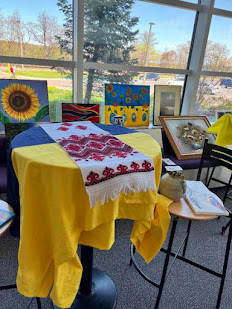
This table set-up greeted participants in the recent grief inservice at Little Brothers Friends of the Elderly in Hancock. (Photo courtesy Cynthia Drake)
"There are no stages," Cheney said, wanting to get one thing straight. "These myths create unnecessary judgment and suffering."
She said the current philosophy and research on grief debunks the five stages popularized by Elizabeth Kubler-Ross: denial, anger, bargaining, depression and acceptance.
Those and other feelings might all come and go as we grieve. Being compassionate in the knowledge that grieving involves a unique whirlwind of emotions is important whether dealing with our own losses or helping someone else who is going through the process.
"Feelings are never right or wrong. They’re just feelings," offered Lee Parker, of Baltic.
Parker noted she’s been lucky in not having to experience the death of younger family members so far in her long life.
"It’s gone in the order it’s supposed to," she said, which helped ease her suffering.
No matter the intensity of our grief, Cheney suggested the best path is to notice all your thoughts and emotions and attend to the ones that drive you toward your true values and loved ones.
"Take that pause moment to reflect on whether or not to approach someone," advised Drake, telling tales of having done both. "Lean into that discomfort. Notice what you want to do. Try something new. Try a different way of approaching people. Be present with the one you’re with. This relationship doesn’t look a certain way."
Drake said one grieving woman tired of the barrage of concerned people she ran into after a loved one died and simply wanted to hear, "It’s nice to see you."
Said Cheney, "You were taking her cues. You paused and noticed."
She advised people inclined to talk to someone who is grieving to ask themselves some questions: "Is this about you or is this about them? Are you just trying to cross something off your list or do you support them?"
While there’s no one way to offer compassionate support, people should be aware of their own emotions going in, listen carefully, and act accordingly.
Cheney advised "being comfortable to be uncomfortable," and using "creative discreteness" to know when and how to approach someone who is having a rough time after someone they love dies. Often, less is more in these interactions. "Attend to the emotion that needs to be attended to."
The fingertrap exercise
Using fingertraps as a tool, workshop participants experienced being stuck in the woven contraptions.
During the May 14 Little Brothers Friends of the Elderly grief workshop, Sarah Cheney demonstrates how a classic Chinese fingertrap works as Julie Beck ponders her plight. Beck, the Forever Friends program coordinator at Little Brothers, participated in this exercise illustrating the struggle of life and thinking outside the box. Your index fingers remain stuck in the braided bamboo finger traps when you try to pull your fingers out. (Photo © and courtesy Vanessa Dietz)
"The fingertrap is the struggle of life," Cheney said, as people unsuccessfully attempted to pull their forefingers out.
Smiling, she reminded them that sometimes the harder you fight to pull away from something, the more you remain stuck. While it may seem counterintuitive, pushing the fingertips toward each other loosens the weave, allowing release -- much like how leaning into our complex feelings about grief can bring much-needed relief.
Grieving is a cultural phenomenon guided by social norms that can seem to impose limitations on how and how long we do it.
"There was this idea that you were supposed to move on," Cheney said. "You need to spend time grieving. It’s hard work. Focus on the grieving, then go back to your life."
European volunteers offer their perspectives
Two young women visiting from Europe who are volunteering at Little Brothers in Hancock shared their observations of death rituals.
Pictured from left, Little Brothers Friends of the Elderly volunteers Selina Lutzel of Germany and Alois Moisson of France say Europeans grieve a little differently than their American counterparts. (Photo courtesy Little Brothers)
"Usually we don’t talk about that because (the) person might be sad or depressed," said Alois Moisson of France. "Each person settles their own individual way. We try to be positive. We’re just more shy (and) stay quiet at (the) funeral in church to respect the family. We don’t sing. I was shocked (about the) songs and how loud."
Facing death for just the third time in her life, Selina Lutzel of Germany was troubled by a recent funeral.
"It wasn’t what I expected," Lutzel said, adding it was "more sad. No one really talked about her."
More grief workshops available to groups
Cheney and Drake are also willing to tailor grief workshops for other businesses and organizations, as they did at Little Brothers.
For more information on individual, group, or organizational grief workshops, contact Cheney at (906) 281-5558 or sac2250@columbia.edu. Drake can be reached at (906) 370-6686 or cynthiamdrake@gmail.com.
"We’re building legacy," Drake said. "They continue on through their memories, their stories, their legacies. How things have shifted in history because they were here. The love never ends. The love never dies."
Editor's Notes:
* Guest writer Vanessa Dietz is a freelance journalist, formerly feature editor and reporter for The Daily Mining Gazette.
** This is the second article in our series on community support in times of death and grieving. See the first article, also by Vanessa Dietz, "Omega House offers quality hospice care for terminally ill, welcoming atmosphere and counseling for families," posted May 14, 2018.
Wednesday, May 30, 2018
Sunday, May 20, 2018
Isle Royale Winter Study celebrates 60 years
60 years. Two wolves. A lot of moose. (Photo courtesy Michigan Tech University)
By Allison Mills, Michigan Tech Associate Director of Research Communications
Posted on Michigan Tech News May 17, 2018
Reprinted in part with permission
HOUGHTON -- The 2018 report is out: two wolves, almost 1,500 moose and an ecosystem in transition. In its 60th year, the research is the longest running predator-prey study of its kind.
Researchers from Michigan Technological University have released the annual Winter Study report detailing updates on the ecology of Isle Royale National Park. For the third year in a row, the Isle Royale wolf population remains a mere two, while the moose population continues to stay above the historic average. Without the pressure of predation, the expanding moose population will have a greater impact on the island's forest ecology.
The study co-authors include Research Professor Rolf Peterson, Professor John Vucetich and Assistant Research Professor Sarah Hoy. They say the heart of the study's success has been the more than 1,000 citizen science volunteers who have bolstered the study's fieldwork efforts in small teams totaling about 40 people each year for the last 30 years. Together, they helped gather enough skulls to document the shrinking moose of Isle Royale, observe seasonal wolf activity and earned more than their fair share of hiking boot blisters....
The National Park Service has proposed introducing 20-30 wolves to the island over the next three years. The final environmental impact statement was completed and the identified preferred alternative is to restore wolf predation, but the final decision on the plan is pending as of the Winter Study report publication.*
Click here to read the rest of this article on the Michigan Tech News.
* The National Park Service's Final Environmental Impact Statement to Address the Presence of Wolves (plan/FEIS) evaluates whether and how to bring wolves to Isle Royale to function as the apex predator within a changing and dynamic island ecosystem. The NPS preferred alternative is Alternative B, which calls for the introduction of 20 to 30 wolves over a three-year period. The goal of this alternative is to provide an introduction of wolves that has the potential to become a self-sustaining population.
By Allison Mills, Michigan Tech Associate Director of Research Communications
Posted on Michigan Tech News May 17, 2018
Reprinted in part with permission
HOUGHTON -- The 2018 report is out: two wolves, almost 1,500 moose and an ecosystem in transition. In its 60th year, the research is the longest running predator-prey study of its kind.
Researchers from Michigan Technological University have released the annual Winter Study report detailing updates on the ecology of Isle Royale National Park. For the third year in a row, the Isle Royale wolf population remains a mere two, while the moose population continues to stay above the historic average. Without the pressure of predation, the expanding moose population will have a greater impact on the island's forest ecology.
The study co-authors include Research Professor Rolf Peterson, Professor John Vucetich and Assistant Research Professor Sarah Hoy. They say the heart of the study's success has been the more than 1,000 citizen science volunteers who have bolstered the study's fieldwork efforts in small teams totaling about 40 people each year for the last 30 years. Together, they helped gather enough skulls to document the shrinking moose of Isle Royale, observe seasonal wolf activity and earned more than their fair share of hiking boot blisters....
The National Park Service has proposed introducing 20-30 wolves to the island over the next three years. The final environmental impact statement was completed and the identified preferred alternative is to restore wolf predation, but the final decision on the plan is pending as of the Winter Study report publication.*
Click here to read the rest of this article on the Michigan Tech News.
* The National Park Service's Final Environmental Impact Statement to Address the Presence of Wolves (plan/FEIS) evaluates whether and how to bring wolves to Isle Royale to function as the apex predator within a changing and dynamic island ecosystem. The NPS preferred alternative is Alternative B, which calls for the introduction of 20 to 30 wolves over a three-year period. The goal of this alternative is to provide an introduction of wolves that has the potential to become a self-sustaining population.
Monday, May 14, 2018
Omega House offers quality hospice care for terminally ill, welcoming atmosphere and counseling for families
By Vanessa Dietz *
The sign outside Omega House in Houghton beckons people to visit the hospice. (Photos © and courtesy Vanessa Dietz)
HOUGHTON -- There’s a doorbell, but you don’t have to ring it at Omega House in Houghton. Through its figurative revolving door, the 24-7 hospice welcomes visitors, most of whom come to see their loved ones -- quite possibly for the last time.
Here's the main entrance of Omega House, located at 2211 Maureen Lane in Houghton.
Music plays in the background of the renovated house, where terminally ill patients are treated with compassion, respect and dignity by professional, volunteer and family caregivers.
"This is their home," said Omega House Executive Director Mike Lutz, who joined the staff as the first executive director in January 2016. Governed by an 18-member board, Omega House has been in operation since 2005.
"They’re all at different stages of dying," Lutz explained. "People come in all day long or any time (without) restriction. Those kinds of things enhance the quality of life."
The team at Omega House provides around-the-clock services to people who need more care than is available at home in the final phases of their lives.
Eight patient rooms sport private bathrooms, recliners, cable television, individual heating and cooling controls, ample seating for visitors, and large, low windows with a view of the surrounding gardens and trees so even those who are bedridden can take in the scenery. One of the rooms is set aside to provide temporary respite care for individuals recuperating from surgery, illness or hospitalization whose caregivers need a break for whatever reason.
In addition to staff office space and commercial laundry facilities, the house has a living room with a television, VCR, laptop computer and piano, as well as a quiet, meditation room, kitchen, and dining area, all of which are open to patients and their families. The house also has two specially designed bathrooms with walk- or wheel-in showers and whirlpool baths.
Omega House is beautiful inside and out, with an inviting outdoor patio easily accessed through a side door. Comfortable wicker furniture beckons residents and visitors to enjoy the outdoors when the weather is nice.
Omega House Executive Director Michael Lutz enjoys the spring sunshine on the patio of the Houghton hospice.
The staff regularly perform housekeeping duties and prepare home-cooked meals that are served any time of the day or night to patients. Families are welcome to cook their own favorite dishes there as well.
"You eat when you want to eat," Lutz said. "We’re not that structured here. At home, we eat when we we’re hungry. We encourage families to come in and use our stove. We want our residents to be comfortable."
While the numbers vary, Lutz said an overall average of 5.5 residents stay about 10 days. The house has had around 500 residents, with about 40 new patients coming through the door each year.
"I’d like to see people come to Omega House earlier," he said, because it would allow caregivers to work with patients and families longer to help them all more fully prepare for their loved one’s death. That’s a family choice. Some spend a year here. This year we’re training for a record year. As baby boomers start aging, we may need to add rooms. This is an elderly area."
The Copper Country’s aging population is expected to drive the need for hospice services in the western Upper Peninsula.
Addressing each family's physical, emotional, spiritual, psychological and social needs, caregivers help control pain and symptoms so residents can live each day more comfortably.
Generous community support enables Omega House to care for people with limited insurance and finances. No one is turned away from Omega House due to lack of financial resources.
Covered by Medicare, Medicaid and most private insurances, fees are based on a sliding scale. Residents are charged a daily rate from $30 to $260 per day, depending on their insurance coverage and financial resources. Lutz said the average cost is $120.
"What makes up the difference is community donations," Lutz said. "Donations need to be strong."
Donors' names are etched in glass panes inside Omega House in Houghton.
Logging about 3,000 hours per year, volunteers help Omega House make ends meet.
"They provide us another level of care," Lutz said.
People can give of their time, or contribute in other ways.
"We get lots of donations," Lutz added, gesturing to a stack of cookies and other bakery he said was typical of the fare available at any given time. Biggby Coffee owner Landon Palmer and his wife, Abby Palmer, recently stopped by with samples of their delicious coffee, shortly before a couple showed up with their little dog in tow to visit a loved one.
Biggby Coffee owner Landon Palmer and his wife, Abby Palmer, recently delivered coffee to Omega House in Houghton.
"You see so much good," Lutz said. "The community organizations are working together."
And it’s not just the financial and food donations that make a difference in residents’ everyday lives. Tadych’s Econo Foods sends fresh flowers to each patient weekly.
"As a dedicated community partner, Econo Foods seized the opportunity to enhance the final days of Omega House residents," said Econo's Houghton Store Manager Scott Rubich.
Art from Calumet High School and Michigan Technological University students has graced the walls in the past and new exhibits are always welcome.
"We try to showcase things, to try to drive foot traffic," Lutz said, adding Omega House also relies on several fundraisers to raise money each year.
Upcoming fundraisers to include golf, music events
In addition to a yearly vacation raffle, the 16th annual Joe Evans Golf Classic will be June 9 at the Portage Lake Golf Course in Houghton. And for a $10 suggested donation, people can enjoy the 12th annual Omega House summer concert at 7 p.m. on July 24 at Saints Peter and Paul Lutheran Church in Houghton. Another musical fundraiser tentatively set for Sept. 29 will feature an out-of-town band at the Calumet Theatre.
Lutz noted these events are really part of efforts to raise awareness of what the hospice has to offer.
Facilitators, counselors help patient and family
Getting residents and their families through the dying process in the best way is another focus at the Omega House.
Trained facilitators broach often difficult discussions with patients and their families, including advance care planning. The planning process entails the patient choosing an advocate to speak for them when they no longer can, telling the staff and family how they want to be treated, including the specific medical care they want and don’t want -- all aimed at reducing the burden on the family to make hard choices at a difficult time.
The staff also provides bereavement counseling to meet the social, emotional and spiritual needs of patients and families and welcomes members of the clergy anytime.
"People don’t like to talk about death and dying, but they’ll listen," Lutz said.
The Rice Memorial Foundation recently awarded Omega House a $6,400 grant and the Portage Health Auxiliary just chipped in another $1,000 to help fund a community grief support program which provides for a ongoing series of grief workshops and free counseling for community members, including the youngest members of the family.
"These children are suffering out there," Lutz said, whether due to the loss of a loved one, or other family upset like divorce. "They get lost and they have no one to turn to."
Any remaining funds will be used to augment the library selection of the house.
Potential volunteers and donors can contact Omega House, located at 2211 Maureen Lane in Houghton, next door to The Bluffs Senior Community. For more information, call (906) 482-4438, visit www.omega-house.org, or email michael.lutz@omega-house.org.
* Guest writer Vanessa Dietz is a freelance journalist, formerly feature editor and reporter for The Daily Mining Gazette.
The sign outside Omega House in Houghton beckons people to visit the hospice. (Photos © and courtesy Vanessa Dietz)
HOUGHTON -- There’s a doorbell, but you don’t have to ring it at Omega House in Houghton. Through its figurative revolving door, the 24-7 hospice welcomes visitors, most of whom come to see their loved ones -- quite possibly for the last time.
Here's the main entrance of Omega House, located at 2211 Maureen Lane in Houghton.
Music plays in the background of the renovated house, where terminally ill patients are treated with compassion, respect and dignity by professional, volunteer and family caregivers.
"This is their home," said Omega House Executive Director Mike Lutz, who joined the staff as the first executive director in January 2016. Governed by an 18-member board, Omega House has been in operation since 2005.
"They’re all at different stages of dying," Lutz explained. "People come in all day long or any time (without) restriction. Those kinds of things enhance the quality of life."
The team at Omega House provides around-the-clock services to people who need more care than is available at home in the final phases of their lives.
Eight patient rooms sport private bathrooms, recliners, cable television, individual heating and cooling controls, ample seating for visitors, and large, low windows with a view of the surrounding gardens and trees so even those who are bedridden can take in the scenery. One of the rooms is set aside to provide temporary respite care for individuals recuperating from surgery, illness or hospitalization whose caregivers need a break for whatever reason.
In addition to staff office space and commercial laundry facilities, the house has a living room with a television, VCR, laptop computer and piano, as well as a quiet, meditation room, kitchen, and dining area, all of which are open to patients and their families. The house also has two specially designed bathrooms with walk- or wheel-in showers and whirlpool baths.
Omega House is beautiful inside and out, with an inviting outdoor patio easily accessed through a side door. Comfortable wicker furniture beckons residents and visitors to enjoy the outdoors when the weather is nice.
Omega House Executive Director Michael Lutz enjoys the spring sunshine on the patio of the Houghton hospice.
The staff regularly perform housekeeping duties and prepare home-cooked meals that are served any time of the day or night to patients. Families are welcome to cook their own favorite dishes there as well.
"You eat when you want to eat," Lutz said. "We’re not that structured here. At home, we eat when we we’re hungry. We encourage families to come in and use our stove. We want our residents to be comfortable."
While the numbers vary, Lutz said an overall average of 5.5 residents stay about 10 days. The house has had around 500 residents, with about 40 new patients coming through the door each year.
"I’d like to see people come to Omega House earlier," he said, because it would allow caregivers to work with patients and families longer to help them all more fully prepare for their loved one’s death. That’s a family choice. Some spend a year here. This year we’re training for a record year. As baby boomers start aging, we may need to add rooms. This is an elderly area."
The Copper Country’s aging population is expected to drive the need for hospice services in the western Upper Peninsula.
Addressing each family's physical, emotional, spiritual, psychological and social needs, caregivers help control pain and symptoms so residents can live each day more comfortably.
Generous community support enables Omega House to care for people with limited insurance and finances. No one is turned away from Omega House due to lack of financial resources.
Covered by Medicare, Medicaid and most private insurances, fees are based on a sliding scale. Residents are charged a daily rate from $30 to $260 per day, depending on their insurance coverage and financial resources. Lutz said the average cost is $120.
"What makes up the difference is community donations," Lutz said. "Donations need to be strong."
Donors' names are etched in glass panes inside Omega House in Houghton.
Logging about 3,000 hours per year, volunteers help Omega House make ends meet.
"They provide us another level of care," Lutz said.
People can give of their time, or contribute in other ways.
"We get lots of donations," Lutz added, gesturing to a stack of cookies and other bakery he said was typical of the fare available at any given time. Biggby Coffee owner Landon Palmer and his wife, Abby Palmer, recently stopped by with samples of their delicious coffee, shortly before a couple showed up with their little dog in tow to visit a loved one.
Biggby Coffee owner Landon Palmer and his wife, Abby Palmer, recently delivered coffee to Omega House in Houghton.
"You see so much good," Lutz said. "The community organizations are working together."
And it’s not just the financial and food donations that make a difference in residents’ everyday lives. Tadych’s Econo Foods sends fresh flowers to each patient weekly.
"As a dedicated community partner, Econo Foods seized the opportunity to enhance the final days of Omega House residents," said Econo's Houghton Store Manager Scott Rubich.
Art from Calumet High School and Michigan Technological University students has graced the walls in the past and new exhibits are always welcome.
"We try to showcase things, to try to drive foot traffic," Lutz said, adding Omega House also relies on several fundraisers to raise money each year.
Upcoming fundraisers to include golf, music events
In addition to a yearly vacation raffle, the 16th annual Joe Evans Golf Classic will be June 9 at the Portage Lake Golf Course in Houghton. And for a $10 suggested donation, people can enjoy the 12th annual Omega House summer concert at 7 p.m. on July 24 at Saints Peter and Paul Lutheran Church in Houghton. Another musical fundraiser tentatively set for Sept. 29 will feature an out-of-town band at the Calumet Theatre.
Lutz noted these events are really part of efforts to raise awareness of what the hospice has to offer.
Facilitators, counselors help patient and family
Getting residents and their families through the dying process in the best way is another focus at the Omega House.
Trained facilitators broach often difficult discussions with patients and their families, including advance care planning. The planning process entails the patient choosing an advocate to speak for them when they no longer can, telling the staff and family how they want to be treated, including the specific medical care they want and don’t want -- all aimed at reducing the burden on the family to make hard choices at a difficult time.
The staff also provides bereavement counseling to meet the social, emotional and spiritual needs of patients and families and welcomes members of the clergy anytime.
"People don’t like to talk about death and dying, but they’ll listen," Lutz said.
The Rice Memorial Foundation recently awarded Omega House a $6,400 grant and the Portage Health Auxiliary just chipped in another $1,000 to help fund a community grief support program which provides for a ongoing series of grief workshops and free counseling for community members, including the youngest members of the family.
"These children are suffering out there," Lutz said, whether due to the loss of a loved one, or other family upset like divorce. "They get lost and they have no one to turn to."
Any remaining funds will be used to augment the library selection of the house.
Potential volunteers and donors can contact Omega House, located at 2211 Maureen Lane in Houghton, next door to The Bluffs Senior Community. For more information, call (906) 482-4438, visit www.omega-house.org, or email michael.lutz@omega-house.org.
* Guest writer Vanessa Dietz is a freelance journalist, formerly feature editor and reporter for The Daily Mining Gazette.
Wednesday, May 09, 2018
Landowners alarmed by Highland Copper subsidiary's mineral lease requests; Highland completes Copperwood 2018 winter exploration in Porkies
By Michele Bourdieu
With information from UPEC's Mining Action Group and the Michigan Department of Natural Resources
More than 3,800 acres of the requested mineral leases would be located in Champion, Michigamme, Negaunee, Ishpeming and Marquette townships, and include sensitive and scenic areas. Some mineral lease requests could impact the Noquemanon Trail Network in the Forestville Trailhead area, Echo Lake Nature Preserve, Teal Lake -- and the Vielmetti-Peters Conservation Reserve, owned by the Upper Peninsula Land Conservancy.*
This map shows some of the state-owned parcels requested for mineral leasing by UPX. Click here and go to p. 15 in the parcel list and maps document for a larger version of this map. (Map courtesy Michigan DNR)
Pepin also explained that a lease is not a permit.
"If a lease is granted by the DNR, the lease grants only the exclusive right to pursue exploration and development," Pepin said. "It does not provide a permit for any of these activities. Any and all needed permissions from the DEQ, the State mining regulatory agency, and local government would need to be acquired by the lessee before any surface or subsurface work occurs. The lease is only the first step to allow the Lessee the exclusive right to assess the mineral potential to the parcels under lease."
Northern Shrub Thicket along the Mulligan Creek. (Photo courtesy Michigan DNR)
Julie Hintsala, a local landowner, commented on the scenic beauty in the area of wooded lands near the McClure Basin and Neejee Road, where her family built a home in 1992.
"Other people appreciate the scenic beauty of the region also, because the old steel bridge and the new high bridge on Co. Rd. 510 over the Dead River are two of the most photographed areas in Marquette County," Hintsala said. "Imagine having a mine in the background of your next bridge photo! It is shocking to consider. This would also impact the Noquemanon Ski Trail, the Hoist and McClure Basins, and the nearby Ore to Shore bike race."
Hintsala described herself as "a life-long Yooper" who appreciates the importance of mining to the area, but who believes in the current importance of tourism and recreation as well.
"Tourism, mountain biking and cross country skiing in this area would be devastated by possible mining operations," Hintsala said. "Is it worth forever changing our landscape and risking our environment, including the nearby Dead River basin, for a short-term mining operation? Why would the State of Michigan consider allowing mineral rights to be leased for exploration so near a community in Negaunee township in an area that will impact recreation and tourism?"
When asked why the company wanted to conduct mining exploration in residential areas, a UPX representative contacted by phone replied, "We’re just trying to tie areas together that we already have rights to."
In 2017, UPX Minerals acquired nearly 500,000 acres of mineral properties in the Central Upper Peninsula of Michigan -- lands formerly owned by Rio Tinto and Kennecott. UPX is reviewing historic mineral exploration data, and conducting "field exploration" in search of orogenic gold, magmatic nickel-copper and zinc-copper deposits in the various properties. Their goal is to "define drilling targets" this year, creating a "pipeline" of future mining projects.
Approximately 119 acres of the lease requests are located in the Crystal Falls Township of Iron County, adjacent to the East Branch of the Fence River, and underneath Wilson Creek and wetlands.
"Iron County communities and watersheds continue to feel the impacts of the iron ore mines that have been closed for more than 40 years," said Maggie Scheffer, a board member of the Upper Peninsula Environmental Coalition, who resides in Iron County. "The parcels identified for mineral exploration, and potential mining in Iron County, are remote, water-rich sites. It is in our best interest to protect our watersheds from wide-scale ecological disruption, and look instead toward a future that allows our local economies to thrive because of the natural beauty that attracts people to our area."
Richard Sloat, also a resident of Iron County, commented on Highland Copper's wetlands and soil erosion violations during their 2017 winter exploration in and near the Porcupine Mountains Wilderness State Park during last year's spring thaw.
"Granting the mineral lease rights allowing exploration could lead to a possible mishap such as what occurred in the Porcupine Mountains wilderness area," said Sloat. "Degradation at that exploration site could have been prevented had there been proper oversight and inspection by the DNR and DEQ."
This April 26, 2017, photo shows sediment-filled muddy water passing through fiber rolls (erosion control) on an access road left chewed up by Highland Copper's drilling equipment in early spring last year. Muddy water was flowing into ditches of CR-519, which conveyed the water to a ravine that feeds the Presque Isle River. (Keweenaw Now file photo © Steve Garske and courtesy Mining Action Group)
Last year UPEC's Mining Action Group alerted the public when the DNR, DEQ and the Gogebic County Road Commission did not monitor the contractor during a period of rapid thawing, causing significant damage to public property along CR-519 or 510.****
Highland Copper's Copperwood Project: more exploration in Porcupine Mountains Wilderness State Park
Highland Copper is currently developing projects in Gogebic and Ontonagon counties, and in the Keweenaw Peninsula. They own the Copperwood Project, where they propose to mine adjacent to the Porcupine Mountains Wilderness State Park (aka the Porkies) and potentially underneath the park itself.
In April, the DNR announced that Copperwood Resources Inc. -- a subsidiary of Highland Copper -- had completed its 2018 winter exploration of a 1-mile section of the westernmost portion of the Porkies.
Exploratory drilling was conducted in this part of Gogebic County to see if the eastern extension of a mineral deposit first explored in the 1950s might feasibly be mined, which could potentially enlarge the mining company’s Copperwood Project beyond its currently-permitted boundaries.
Drilling and testing will determine hydrologic and geologic composition of the bedrock beneath the surface. Copperwood Resources is leasing the mineral rights from another company, which owns those rights beneath this part of the park. The state of Michigan manages the land surface features.
Earlier this winter, the Michigan DNR granted a land use permit for the work, allowing the mining company to resume exploration begun last winter at the park. The Gogebic County Road Commission granted a separate permit. Additional permits were required from the Michigan Department of Environmental Quality (DEQ) for two of the drilling sites situated in wetland areas.
The Gogebic County Road Commission and DNR permits included several provisions aimed at protecting land surface features.
"All of the stipulations in the use permit were followed," said Doug Rich, western U.P. district supervisor for the DNR’s Parks and Recreation Division.
Steve Casey, Upper Peninsula district supervisor of Michigan DEQ Water Resources Division, told Keweenaw Now that Highland Copper restored the wetlands they had damaged last year and obtained wetland permits for this year's drilling.
"We're not aware of any problems this year," Casey said. "They did what they were supposed to do according to the permit to prevent problems like those they had last year."
Three holes were drilled this winter on park land. A separate land use permit was granted by the Gogebic County Road Commission for drilling work at three sites that took place on county property, within the right-of-way of County Road 519.
Two additional test holes were drilled to the ore body from Copperwood Resources property situated west of the park. The mining company has completed winter exploration on its lands.
"We are pleased to have completed the drilling program on our Copperwood project, and would like to thank the DNR, DEQ, and the Gogebic County Road Commission for their cooperation over the last few months," said Justin van der Toorn, exploration manager of Copperwood Resources Inc. "The winter conditions have held out well for us and allowed us to finish all eight drill holes as planned. The information and assays that are derived from this work will now be incorporated into our ongoing feasibility study that is still on schedule for completion this summer."
UPEC President Horst Schmidt commented on Highland Copper's and state agencies' improved oversight of the winter exploratory drilling.
"This year the DNR, fearing negative public reaction, has had a carefully orchestrated PR campaign to show the public they are monitoring the drilling activity," Schmidt said. "I applaud them for it. This is what should be done at all times in all places by both the DNR and DEQ as well as by county agencies."
Schmidt added, "The real problem is the state's destructive severance of surface and subsurface rights -- which gives the extractive industries carte blanche to remove minerals, oil, gas and water almost anywhere. The DEQ gave permits for mining right next to Lake Superior for the Copperwood project and the DNR can allow them to mine under the Porkies, a supposedly development-free wilderness park. There must be a change in the way 'resources' are removed. 'Resources' are inextricably linked to the essential constituents necessary for all creatures to survive: water, air, land. UPEC has conveyed this message for over four decades. The lesson has still to be learned."
Public urged to comment on UPX mineral lease requests by June 11, 2018
Dennis and Kim Ferraro of Marquette, who formerly lived in Chicago and Indiana, said they relocated to the U.P. last year because they fell in love with the natural beauty, clean air and water, and opportunities for outdoor recreation.
"However, we now face a grave threat to that environment because UPX, Inc., subsidiary of Canadian conglomerate, Highland Copper, has targeted Marquette County for exploration and potential development of sulfide ore mining, a form of extraction that may leave the air, streams and groundwater polluted with toxic by-products," the Ferraros said. "We ask our fellow citizens to join us in urging DNR to reject this corporate poaching of our environment by submitting comments before the public comment period expires."
The public is urged to submit written comments expressing their concerns and providing additional information "relative to the request to lease the specified mineral rights" by June 11, 2018, to DNR, Office of Minerals Management, P.O. Box 30452, Lansing MI 48909, or DNR-Minerals@michigan.gov.
"If Highland Copper / UPX succeeds in taking even a fraction of these sulfide-mineral deposits from exploration to development, the risk to the Lake Superior watershed will be significantly heightened," warned Louis Galdieri, a writer and filmmaker interested in the history and long-term prosperity of the Lake Superior basin.
Asked if the DNR might hold a public hearing in addition to extending the public comment period, Karen Maidlow replied, "The lease only allows the Lessee the exclusive right to assess the mineral potential to the state-owned parcels under lease. The majority of leases expire without exploration or development occurring. Separate permissions to explore or mine must be obtained from the DEQ. In the event a metallic ore body is discovered, a mining plan must be submitted to the DEQ (and to the DNR if state land is involved). At that stage, public hearings are held so the public can be informed of the specifics of the proposed mining plan and provide valued feedback."
Notes:
* See the Michigan DNR: UPX Mineral Lease Request: Parcel List and Maps
** Click here for the Rocking Chair Lakes ERA Plan.
*** Click here for the DNR's definitions of Metallic and Nonmetallic Minerals Lease Classifications.
**** See our May 12, 2017, article, "DEQ cites Highland Copper's wetlands, soil erosion violations from mining exploration in Porkies, along CR 519."
With information from UPEC's Mining Action Group and the Michigan Department of Natural Resources
Granite Cliff Community along (North) Rocking Chair Lake -- an area included in recent mineral lease requests to the State of Michigan by UPX Minerals, a subsidiary of Highland Copper. (Photo courtesy Michigan Department of Natural Resources)
MARQUETTE -- Landowners and residents in Marquette and Iron counties are expressing alarm at mineral lease requests to Michigan's Department of Natural Resources (DNR) by Highland Copper Company's subsidiary UPX Minerals, leading to an extension of the comment period on the leases to June 11, 2018. Meanwhile the DNR has announced completion of this year's winter mineral exploration by Highland's subsidiary Copperwood Resources Inc.
Landowners, environmentalists concerned by UPX mineral lease requests
According to the Upper Peninsula Environmental Coalition's (UPEC's) Mining Action Group, local property owners are expressing alarm over mineral lease requests made by UPX Minerals, a wholly owned subsidiary of Highland Copper. UPX is seeking to lease nearly 4,000 acres of State-owned minerals in Marquette and Iron counties. Most of these mineral properties are in Marquette County; and many are underneath private property, homes, camps, rivers and streams, lakes, wetlands -- even nature reserves.
"We opened our mail and found a notice from UPX Minerals requesting a direct metallic minerals lease from the Department of Natural Resources (DNR) -- under our own home," said Sue Beckstrom Noel, a concerned local resident. "We were horrified! The owner of mineral rights can access your property, conduct exploration or drilling, or potentially develop a mine under your home or camp, and as the landowner you have very little control over that. Doesn’t that seem outrageous?"
According to Karen Maidlow, DNR property specialist in the Office of Minerals Management, "The State of Michigan, as a severed mineral owner, does have the right to lease the severed minerals when the surface is not owned because the mineral estate is considered the dominant estate. DNR staff review parcels for lease classification and determine the most appropriate lease classification for resource protection as if the State owned the surface. The lease applicant is required to notify the surface owner during the public notice period. If a Lessee of State minerals wants to explore or develop the minerals, they need to work with the surface owner regarding the anticipated reasonable use of the land surface, in addition to working with the Michigan Department of Environmental Quality (DEQ), the State mining regulatory agency. The lease provides that the Lessee shall pay damages to the surface owner should any damages occur directly or indirectly from mining operations."
Local residents and landowners have been meeting recently to discuss their concerns about the proposed leases.
After hearing from concerned citizens, the Mining Action Group, Upper Peninsula Environmental Coalition (UPEC), Superior Watershed Partnership and others requested an extension of the public comment period, originally scheduled to expire early in May. It has been extended to June 11, 2018.
The UPX mineral lease request also targets the Rocking Chair Lakes -- considered by the DNR to be one of Marquette County’s wild gems, and recently nominated to become "The Rocking Chair Lakes Ecological Reference Area." This remote area of state land includes four different Ecological Reference Areas (ERAs): Northern Shrub Thicket, Dry Mesic Northern Forest, Mesic Northern Forest, and Granite Cliff. The rugged terrain of the Mulligan Escarpment is also the heart of Michigan’s moose range.**
Dry Mesic Northern Forest along (South) Rocking Chair Lake. (Photo courtesy Michigan DNR)
John Pepin, DNR deputy public information officer, offered Keweenaw Now this information on the leases: "Parcels under lease request have been reviewed by DNR field staff to determine if there are resources on the parcel that need protecting. Based on the review, DNR staff have recommended the most appropriate classification for surface use for each parcel under lease request should the lease be approved. The recommended lease classification for parcels in the Rocking Chair area is Leasable Nondevelopment. This means the lease would not allow the parcel’s surface to be used for metallic minerals exploration or development without separate written permission from the DNR."
This map shows some parcels requested by UPX for mineral leasing in Marquette County. Section 10 includes the Rocking Chair Lakes area. Note that 8 of the parcels in Section 10 are marked with an X for nondevelopment, while the other 4 have an R for restricted development.***
Pepin also explained that a lease is not a permit.
"If a lease is granted by the DNR, the lease grants only the exclusive right to pursue exploration and development," Pepin said. "It does not provide a permit for any of these activities. Any and all needed permissions from the DEQ, the State mining regulatory agency, and local government would need to be acquired by the lessee before any surface or subsurface work occurs. The lease is only the first step to allow the Lessee the exclusive right to assess the mineral potential to the parcels under lease."
Northern Shrub Thicket along the Mulligan Creek. (Photo courtesy Michigan DNR)
Julie Hintsala, a local landowner, commented on the scenic beauty in the area of wooded lands near the McClure Basin and Neejee Road, where her family built a home in 1992.
"Other people appreciate the scenic beauty of the region also, because the old steel bridge and the new high bridge on Co. Rd. 510 over the Dead River are two of the most photographed areas in Marquette County," Hintsala said. "Imagine having a mine in the background of your next bridge photo! It is shocking to consider. This would also impact the Noquemanon Ski Trail, the Hoist and McClure Basins, and the nearby Ore to Shore bike race."
Hintsala described herself as "a life-long Yooper" who appreciates the importance of mining to the area, but who believes in the current importance of tourism and recreation as well.
"Tourism, mountain biking and cross country skiing in this area would be devastated by possible mining operations," Hintsala said. "Is it worth forever changing our landscape and risking our environment, including the nearby Dead River basin, for a short-term mining operation? Why would the State of Michigan consider allowing mineral rights to be leased for exploration so near a community in Negaunee township in an area that will impact recreation and tourism?"
When asked why the company wanted to conduct mining exploration in residential areas, a UPX representative contacted by phone replied, "We’re just trying to tie areas together that we already have rights to."
In 2017, UPX Minerals acquired nearly 500,000 acres of mineral properties in the Central Upper Peninsula of Michigan -- lands formerly owned by Rio Tinto and Kennecott. UPX is reviewing historic mineral exploration data, and conducting "field exploration" in search of orogenic gold, magmatic nickel-copper and zinc-copper deposits in the various properties. Their goal is to "define drilling targets" this year, creating a "pipeline" of future mining projects.
Approximately 119 acres of the lease requests are located in the Crystal Falls Township of Iron County, adjacent to the East Branch of the Fence River, and underneath Wilson Creek and wetlands.
"Iron County communities and watersheds continue to feel the impacts of the iron ore mines that have been closed for more than 40 years," said Maggie Scheffer, a board member of the Upper Peninsula Environmental Coalition, who resides in Iron County. "The parcels identified for mineral exploration, and potential mining in Iron County, are remote, water-rich sites. It is in our best interest to protect our watersheds from wide-scale ecological disruption, and look instead toward a future that allows our local economies to thrive because of the natural beauty that attracts people to our area."
Richard Sloat, also a resident of Iron County, commented on Highland Copper's wetlands and soil erosion violations during their 2017 winter exploration in and near the Porcupine Mountains Wilderness State Park during last year's spring thaw.
"Granting the mineral lease rights allowing exploration could lead to a possible mishap such as what occurred in the Porcupine Mountains wilderness area," said Sloat. "Degradation at that exploration site could have been prevented had there been proper oversight and inspection by the DNR and DEQ."
This April 26, 2017, photo shows sediment-filled muddy water passing through fiber rolls (erosion control) on an access road left chewed up by Highland Copper's drilling equipment in early spring last year. Muddy water was flowing into ditches of CR-519, which conveyed the water to a ravine that feeds the Presque Isle River. (Keweenaw Now file photo © Steve Garske and courtesy Mining Action Group)
Last year UPEC's Mining Action Group alerted the public when the DNR, DEQ and the Gogebic County Road Commission did not monitor the contractor during a period of rapid thawing, causing significant damage to public property along CR-519 or 510.****
Highland Copper's Copperwood Project: more exploration in Porcupine Mountains Wilderness State Park
Highland Copper is currently developing projects in Gogebic and Ontonagon counties, and in the Keweenaw Peninsula. They own the Copperwood Project, where they propose to mine adjacent to the Porcupine Mountains Wilderness State Park (aka the Porkies) and potentially underneath the park itself.
In April, the DNR announced that Copperwood Resources Inc. -- a subsidiary of Highland Copper -- had completed its 2018 winter exploration of a 1-mile section of the westernmost portion of the Porkies.
Exploratory drilling was conducted in this part of Gogebic County to see if the eastern extension of a mineral deposit first explored in the 1950s might feasibly be mined, which could potentially enlarge the mining company’s Copperwood Project beyond its currently-permitted boundaries.
Drilling and testing will determine hydrologic and geologic composition of the bedrock beneath the surface. Copperwood Resources is leasing the mineral rights from another company, which owns those rights beneath this part of the park. The state of Michigan manages the land surface features.
Earlier this winter, the Michigan DNR granted a land use permit for the work, allowing the mining company to resume exploration begun last winter at the park. The Gogebic County Road Commission granted a separate permit. Additional permits were required from the Michigan Department of Environmental Quality (DEQ) for two of the drilling sites situated in wetland areas.
The Gogebic County Road Commission and DNR permits included several provisions aimed at protecting land surface features.
"All of the stipulations in the use permit were followed," said Doug Rich, western U.P. district supervisor for the DNR’s Parks and Recreation Division.
Steve Casey, Upper Peninsula district supervisor of Michigan DEQ Water Resources Division, told Keweenaw Now that Highland Copper restored the wetlands they had damaged last year and obtained wetland permits for this year's drilling.
"We're not aware of any problems this year," Casey said. "They did what they were supposed to do according to the permit to prevent problems like those they had last year."
Three holes were drilled this winter on park land. A separate land use permit was granted by the Gogebic County Road Commission for drilling work at three sites that took place on county property, within the right-of-way of County Road 519.
Two additional test holes were drilled to the ore body from Copperwood Resources property situated west of the park. The mining company has completed winter exploration on its lands.
"We are pleased to have completed the drilling program on our Copperwood project, and would like to thank the DNR, DEQ, and the Gogebic County Road Commission for their cooperation over the last few months," said Justin van der Toorn, exploration manager of Copperwood Resources Inc. "The winter conditions have held out well for us and allowed us to finish all eight drill holes as planned. The information and assays that are derived from this work will now be incorporated into our ongoing feasibility study that is still on schedule for completion this summer."
UPEC President Horst Schmidt commented on Highland Copper's and state agencies' improved oversight of the winter exploratory drilling.
"This year the DNR, fearing negative public reaction, has had a carefully orchestrated PR campaign to show the public they are monitoring the drilling activity," Schmidt said. "I applaud them for it. This is what should be done at all times in all places by both the DNR and DEQ as well as by county agencies."
Schmidt added, "The real problem is the state's destructive severance of surface and subsurface rights -- which gives the extractive industries carte blanche to remove minerals, oil, gas and water almost anywhere. The DEQ gave permits for mining right next to Lake Superior for the Copperwood project and the DNR can allow them to mine under the Porkies, a supposedly development-free wilderness park. There must be a change in the way 'resources' are removed. 'Resources' are inextricably linked to the essential constituents necessary for all creatures to survive: water, air, land. UPEC has conveyed this message for over four decades. The lesson has still to be learned."
Public urged to comment on UPX mineral lease requests by June 11, 2018
Dennis and Kim Ferraro of Marquette, who formerly lived in Chicago and Indiana, said they relocated to the U.P. last year because they fell in love with the natural beauty, clean air and water, and opportunities for outdoor recreation.
"However, we now face a grave threat to that environment because UPX, Inc., subsidiary of Canadian conglomerate, Highland Copper, has targeted Marquette County for exploration and potential development of sulfide ore mining, a form of extraction that may leave the air, streams and groundwater polluted with toxic by-products," the Ferraros said. "We ask our fellow citizens to join us in urging DNR to reject this corporate poaching of our environment by submitting comments before the public comment period expires."
The public is urged to submit written comments expressing their concerns and providing additional information "relative to the request to lease the specified mineral rights" by June 11, 2018, to DNR, Office of Minerals Management, P.O. Box 30452, Lansing MI 48909, or DNR-Minerals@michigan.gov.
"If Highland Copper / UPX succeeds in taking even a fraction of these sulfide-mineral deposits from exploration to development, the risk to the Lake Superior watershed will be significantly heightened," warned Louis Galdieri, a writer and filmmaker interested in the history and long-term prosperity of the Lake Superior basin.
Asked if the DNR might hold a public hearing in addition to extending the public comment period, Karen Maidlow replied, "The lease only allows the Lessee the exclusive right to assess the mineral potential to the state-owned parcels under lease. The majority of leases expire without exploration or development occurring. Separate permissions to explore or mine must be obtained from the DEQ. In the event a metallic ore body is discovered, a mining plan must be submitted to the DEQ (and to the DNR if state land is involved). At that stage, public hearings are held so the public can be informed of the specifics of the proposed mining plan and provide valued feedback."
Notes:
* See the Michigan DNR: UPX Mineral Lease Request: Parcel List and Maps
** Click here for the Rocking Chair Lakes ERA Plan.
*** Click here for the DNR's definitions of Metallic and Nonmetallic Minerals Lease Classifications.
**** See our May 12, 2017, article, "DEQ cites Highland Copper's wetlands, soil erosion violations from mining exploration in Porkies, along CR 519."
Thursday, May 03, 2018
WUPPDR offers program to help reduce small business energy costs
Logo courtesy WUPPDR.
HOUGHTON -- Businesses looking to lower their energy bills can now make more informed investment decisions thanks to a grant awarded to the Western Upper Peninsula Planning and Development Region (WUPPDR). WUPPDR, which received the grant from the United States Department of Agriculture (USDA), will pay up to 75 percent of the cost of commercial energy audits and assessments to help local businesses identify opportunities to reduce energy expenses and target resources to pay for energy waste reduction investments.
The program is a partnership between WUPPDR and Michigan Energy Options, a nonprofit organization dedicated to enhancing communities’ access to energy efficiency and renewable energy. The program reviews both common energy conservation measures (ECMs) such as lighting and building envelope improvements, as well as more advanced ECMs like smart thermostats, building control technologies, and renewable energy. In addition to receiving a report with specific energy efficiency recommendations and cost saving projections, participating businesses with be connected with existing resources to help finance energy efficiency investments.
"There are a number of programs out there to help businesses reduce their energy expenses, but it can be confusing and time-consuming to track them down, find the right fit, and complete the necessary paperwork," said Brad Barnett, program coordinator. "At the end of the day, we want to help businesses save energy and money, so we plan to work with them to capitalize on the audit’s recommendations."
Participating businesses can choose from two different program options: a Level I energy assessment or a Level II energy audit. The Level I assessment offers an on-site consultation with an energy services professional to identify energy waste-reduction best practices and is geared toward small businesses looking to better understand their utility bills and opportunities for improvement. The Level II audit is a data-intense evaluation of on-site energy consumption and analysis of fuel, electricity, and water bills and usage for trend analysis and industry benchmarking. Return on investment (ROI) and payback period calculations are also provided to help businesses evaluate trade-offs of different energy efficiency investments.
"Investing in energy waste reduction is a safe and predictable way to improve a business’s bottom line," says Barnett. "Spending less on energy frees up capital for other forms of business investment, and the savings from some projects pay for themselves in a year or two."
To obtain more information about the program or to schedule an audit, visit www.wuppdr.org/energy-audits; or contact Brad Barnett, Program Coordinator, at (906) 482-7205, ext. 316 or bbarnett@wuppdr.org.
HOUGHTON -- Businesses looking to lower their energy bills can now make more informed investment decisions thanks to a grant awarded to the Western Upper Peninsula Planning and Development Region (WUPPDR). WUPPDR, which received the grant from the United States Department of Agriculture (USDA), will pay up to 75 percent of the cost of commercial energy audits and assessments to help local businesses identify opportunities to reduce energy expenses and target resources to pay for energy waste reduction investments.
The program is a partnership between WUPPDR and Michigan Energy Options, a nonprofit organization dedicated to enhancing communities’ access to energy efficiency and renewable energy. The program reviews both common energy conservation measures (ECMs) such as lighting and building envelope improvements, as well as more advanced ECMs like smart thermostats, building control technologies, and renewable energy. In addition to receiving a report with specific energy efficiency recommendations and cost saving projections, participating businesses with be connected with existing resources to help finance energy efficiency investments.
"There are a number of programs out there to help businesses reduce their energy expenses, but it can be confusing and time-consuming to track them down, find the right fit, and complete the necessary paperwork," said Brad Barnett, program coordinator. "At the end of the day, we want to help businesses save energy and money, so we plan to work with them to capitalize on the audit’s recommendations."
Participating businesses can choose from two different program options: a Level I energy assessment or a Level II energy audit. The Level I assessment offers an on-site consultation with an energy services professional to identify energy waste-reduction best practices and is geared toward small businesses looking to better understand their utility bills and opportunities for improvement. The Level II audit is a data-intense evaluation of on-site energy consumption and analysis of fuel, electricity, and water bills and usage for trend analysis and industry benchmarking. Return on investment (ROI) and payback period calculations are also provided to help businesses evaluate trade-offs of different energy efficiency investments.
"Investing in energy waste reduction is a safe and predictable way to improve a business’s bottom line," says Barnett. "Spending less on energy frees up capital for other forms of business investment, and the savings from some projects pay for themselves in a year or two."
To obtain more information about the program or to schedule an audit, visit www.wuppdr.org/energy-audits; or contact Brad Barnett, Program Coordinator, at (906) 482-7205, ext. 316 or bbarnett@wuppdr.org.
Tuesday, May 01, 2018
MDEQ to hold public meeting, hearing on permit application to dredge stamp sands in Houghton County TODAY, May 1, at Michigan Tech
[EDITOR'S NOTE: This press release was sent by the Michigan Department of Environmental Quality on April 30, 2018. We regret this last-minute posting.]
What: The Michigan Department of Environmental Quality (MDEQ) is hosting an information session to answer questions and a public hearing to receive comment on a permit application by Torch Lake Industries, Inc., regarding proposed dredging of Lake Superior stamp sands.
When: 2 p.m. to 4 p.m. Tuesday, May 1, 2018: Public information session including an opportunity for Q and A with MDEQ staff, MDEQ presentations regarding the permit application process and Part 325 statute and a presentation by a Michigan Tech official regarding previous studies on stamp sands.
6 p.m. to 9 p.m.: Public comment period.
9 p.m.: Public hearing concludes.
Where:
Michigan Technological University
Alumni Lounge, Memorial Union Building
1400 Townsend Drive
Houghton, MI 49931
NOTE: Michigan Tech has provided for a "call in" line for multiple people unable to attend the meetings to call and listen in to today's Info Session from 2-4 p.m. and to the hearing from 6-9 p.m. The number is 906-487-1627.
Background:
Torch Lake Industries, Inc. is requesting a permit to mechanically and/or hydraulically dredge an estimated 33,528,422 cubic yards of stamp sands waterward of the ordinary high water mark of Lake Superior in Stanton Township, Houghton County (extending from the Graveraet River approximately 13 miles northeast to the North Portage Entry). The company applied for a Great Lakes Submerged Lands permit (under Part 325 of Michigan’s NREPA, 1994 PA 451) in October of 2015 with MDEQ’s Water Resources Division.
Written public comments that pertain to the proposed Lake Superior submerged lands project are being accepted by MDEQ through May 11, 2018. Comments may be submitted online through MiWaters or by mail to the Michigan Department of Environmental Quality, Upper Peninsula District Office, 1504 W Washington Street, Marquette, MI 49855.
Please note this information session and hearing pertain to Stanton Township stamp sands only. These meetings will not address projects proposed in other stamp sand areas.
For links to the public notice and application in MiWaters, please visit www.mi.gov/wrd or https://miwaters.deq.state.mi.us/.
What: The Michigan Department of Environmental Quality (MDEQ) is hosting an information session to answer questions and a public hearing to receive comment on a permit application by Torch Lake Industries, Inc., regarding proposed dredging of Lake Superior stamp sands.
When: 2 p.m. to 4 p.m. Tuesday, May 1, 2018: Public information session including an opportunity for Q and A with MDEQ staff, MDEQ presentations regarding the permit application process and Part 325 statute and a presentation by a Michigan Tech official regarding previous studies on stamp sands.
6 p.m. to 9 p.m.: Public comment period.
9 p.m.: Public hearing concludes.
Where:
Michigan Technological University
Alumni Lounge, Memorial Union Building
1400 Townsend Drive
Houghton, MI 49931
NOTE: Michigan Tech has provided for a "call in" line for multiple people unable to attend the meetings to call and listen in to today's Info Session from 2-4 p.m. and to the hearing from 6-9 p.m. The number is 906-487-1627.
Background:
Torch Lake Industries, Inc. is requesting a permit to mechanically and/or hydraulically dredge an estimated 33,528,422 cubic yards of stamp sands waterward of the ordinary high water mark of Lake Superior in Stanton Township, Houghton County (extending from the Graveraet River approximately 13 miles northeast to the North Portage Entry). The company applied for a Great Lakes Submerged Lands permit (under Part 325 of Michigan’s NREPA, 1994 PA 451) in October of 2015 with MDEQ’s Water Resources Division.
Written public comments that pertain to the proposed Lake Superior submerged lands project are being accepted by MDEQ through May 11, 2018. Comments may be submitted online through MiWaters or by mail to the Michigan Department of Environmental Quality, Upper Peninsula District Office, 1504 W Washington Street, Marquette, MI 49855.
Please note this information session and hearing pertain to Stanton Township stamp sands only. These meetings will not address projects proposed in other stamp sand areas.
For links to the public notice and application in MiWaters, please visit www.mi.gov/wrd or https://miwaters.deq.state.mi.us/.
Wednesday, April 25, 2018
Finlandia's International School of Art and Design 2018 BFA Diploma Works Exhibition to open April 28
Abigail Tembreuil, Finlandia International School of Art and Design intermedia senior, prepares one of her diploma works for the exhibit opening Saturday, April 28, at the Finlandia University Gallery in Hancock. (Photos courtesy Finlandia University)
HANCOCK -- Finlandia University’s International School of Art and Design (ISAD) 2018 Bachelor of Fine Arts Diploma Works Exhibition is featured from April 28 to May 31, 2018, at the Finlandia University Gallery, located in the Finnish American Heritage Center in Hancock.
A reception for the artists will take place from 7 p.m. to 8:30 p.m. Saturday, April 28, at the gallery. The artists will be introduced at 7:20 p.m. The reception is free and open to the public. Refreshments will be served.
Zong Deng, graphic design senior, works on one of his pieces.
The artworks featured in the annual Diploma Works Exhibit represent the final body of student work for each graduating bachelor of fine arts (BFA) student. The works include intensive research projects, series of individual artworks, and design prototypes. A variety of media is represented, including drawing, painting, sculpture, ceramic design, textile design and graphic design.
William Thompson, ceramics senior, installs his ceramic piece.
The 2018 International School of Art and Design graduating seniors are Zong Deng (Graphic Design), Levi Grannis (Intermedia), Olivia Leukuma (Graphic Design), Taylor Ruotsala (Fiber and Fashion Design), Hannah Scott (Graphic Design), Mark Siminski (Graphic Design), Abigail Tembreull (Intermedia), William Thompson (Ceramics), Clancy Tunstall (Graphic Design), and Sara Williams (Intermedia).
HANCOCK -- Finlandia University’s International School of Art and Design (ISAD) 2018 Bachelor of Fine Arts Diploma Works Exhibition is featured from April 28 to May 31, 2018, at the Finlandia University Gallery, located in the Finnish American Heritage Center in Hancock.
A reception for the artists will take place from 7 p.m. to 8:30 p.m. Saturday, April 28, at the gallery. The artists will be introduced at 7:20 p.m. The reception is free and open to the public. Refreshments will be served.
Zong Deng, graphic design senior, works on one of his pieces.
The artworks featured in the annual Diploma Works Exhibit represent the final body of student work for each graduating bachelor of fine arts (BFA) student. The works include intensive research projects, series of individual artworks, and design prototypes. A variety of media is represented, including drawing, painting, sculpture, ceramic design, textile design and graphic design.
William Thompson, ceramics senior, installs his ceramic piece.
The 2018 International School of Art and Design graduating seniors are Zong Deng (Graphic Design), Levi Grannis (Intermedia), Olivia Leukuma (Graphic Design), Taylor Ruotsala (Fiber and Fashion Design), Hannah Scott (Graphic Design), Mark Siminski (Graphic Design), Abigail Tembreull (Intermedia), William Thompson (Ceramics), Clancy Tunstall (Graphic Design), and Sara Williams (Intermedia).
Sunday, April 22, 2018
State Certified, secure electronic recycling returns to the Keweenaw
HOUGHTON -- The Copper Country Recycling Initiative (CCRI) -- in partnership with Michigan Tech, Goodwill Industries, and the cities of Hancock and Houghton -- has recently received funding from the Michigan Department of Environmental Quality (DEQ) for electronic waste recycling. Spring and fall collection events are planned for 2018, in addition to the development of two permanent collection sites in the area.
The spring collection will be from 2 p.m. to 6 p.m. Friday, May 4, and from 9 a.m. to 2 p.m. on Saturday, May 5, at Goodwill Industries at the airport. The following items are among those that will be accepted: cell phones, computer monitors, copy machines, cordless phones, fax machines, laptop computers, keyboards and mice, microwave ovens, printers, scanners, stereo equipment, televisions, and VCR and DVD players.
The CCRI is committed to providing environmentally and socially conscious recycling services for your unwanted electronics. The Keweenaw electronic recycling events are in collaboration with Comprenew, a Grand Rapids recycling company that is now expanding to the Upper Peninsula and northern Wisconsin.*
Comprenew is a Michigan DEQ-inspected and nationally certified facility. By working with a Michigan based company we are helping to create jobs for UP families. The company has a "no landfill" policy that is strictly enforced.**
Free film on electronic recycling to be shown April 30
CCRI, along with Portage Lake District Library and the Michigan Tech Center for Science and Environmental Outreach, will sponsor a free showing of the film Death by Design (2016) at 6:30 p.m. Sunday, April 30, at Portage Library. A discussion will follow the film, and a recycler of the year award will be presented. ($3 suggested donation)
We love and live on smartphones, tablets and laptops. By 2020, four billion people will have a personal computer. Five billion will own a mobile phone. But this revolution has a dark side. From factories in China, to high tech Silicon Valley, the film tells of environmental degradation, health tragedies, and the fast approaching tipping point between consumerism and sustainability.
* See: "Comprenew announces expansion into Upper Peninsula and northern Wisconsin."
** For a sample list of Comprenew's items acceptable for electronic recycling click here.
The spring collection will be from 2 p.m. to 6 p.m. Friday, May 4, and from 9 a.m. to 2 p.m. on Saturday, May 5, at Goodwill Industries at the airport. The following items are among those that will be accepted: cell phones, computer monitors, copy machines, cordless phones, fax machines, laptop computers, keyboards and mice, microwave ovens, printers, scanners, stereo equipment, televisions, and VCR and DVD players.
The CCRI is committed to providing environmentally and socially conscious recycling services for your unwanted electronics. The Keweenaw electronic recycling events are in collaboration with Comprenew, a Grand Rapids recycling company that is now expanding to the Upper Peninsula and northern Wisconsin.*
Comprenew is a Michigan DEQ-inspected and nationally certified facility. By working with a Michigan based company we are helping to create jobs for UP families. The company has a "no landfill" policy that is strictly enforced.**
Free film on electronic recycling to be shown April 30
CCRI, along with Portage Lake District Library and the Michigan Tech Center for Science and Environmental Outreach, will sponsor a free showing of the film Death by Design (2016) at 6:30 p.m. Sunday, April 30, at Portage Library. A discussion will follow the film, and a recycler of the year award will be presented. ($3 suggested donation)
We love and live on smartphones, tablets and laptops. By 2020, four billion people will have a personal computer. Five billion will own a mobile phone. But this revolution has a dark side. From factories in China, to high tech Silicon Valley, the film tells of environmental degradation, health tragedies, and the fast approaching tipping point between consumerism and sustainability.
* See: "Comprenew announces expansion into Upper Peninsula and northern Wisconsin."
** For a sample list of Comprenew's items acceptable for electronic recycling click here.
Thursday, April 19, 2018
Rozsa Center to host two concerts, art exhibit opening this weekend
Michigan Tech's Choirs will present "Beyond the Veil" at 7:30 p.m. Friday, April 20, at the Rozsa Center. (Photo courtesy Rozsa Center)
HOUGHTON -- Michigan Tech's Rozsa Center will offer art and music lovers three events featuring talent from the local community this Friday and Saturday, April 20 and 21.
Michigan Tech Choirs to present "Beyond the Veil" April 20
The Rozsa Center for the Performing Arts and Michigan Tech's Department of Visual and Performing Arts will present a concert by the Michigan Tech Choirs -- conScience: Michigan Tech Chamber Singers and the Michigan Tech Concert Choir at 7:30 p.m. on Friday, April 20, in the Rozsa Center.
According to Jared Anderson, chair, Visual and Performing Arts Department, and choirs director, "The choirs at Tech have been working hard to prepare a concert that includes a number of interesting themes. The title of the concert, 'Beyond the Veil,' refers to themes that seem to be opposites as if on two sides of a veil: love and loss, life and death, health and sickness, slavery and freedom, youth and old age. There will be something for everyone at the concert this Friday -- love songs, spirituals, folksongs, and sacred motets."
Tickets for "Beyond the Veil" are on sale now, $13 for adults, $5 for youth, and no charge for Michigan Tech students with the Experience Tech fee; tickets are available by phone at (906) 487-2073, online at mtu.edu/rozsa, in person at the Central Ticketing Office in the Student Development Complex, or at the Rozsa Box Office the evening of the performance. Please note the Rozsa Box Office only opens two hours prior to performances.
"From There to Here": Opening Reception Friday, April 20
The Rozsa Center and the Department of Visual and Performing Arts (VPA) invite the public to visit their semi-annual student showcase, "From There to Here," featuring works of art created by Michigan Tech students who are participating in Project Learning Lab, an innovative arts classroom based inside Rozsa gallery b.
Work on display was created by students in Lisa Gordillo’s Traditional Sculpture, Advanced Sculpture, and 3D Design classes. Students from many campus disciplines are represented, including Materials Sciences, English, and Theatre Arts.
The exhibition continues through this Friday, April 20. A reception will be held from 5 p.m. to 6:30 p.m. Friday, April 20, in Rozsa Gallery b. The reception is free and all are welcome.
Students in Traditional Sculpture study traditional ways of making art around the globe, including Guatemalan kites, Zimbabwe-Shona carving, and metal casting, with help from Michigan Tech’s department of Materials Sciences. Students in Advanced Sculpture are encouraged to work with the gallery’s architecture and to create large-scale installations in the gallery. Students in 3D Design have designed and built a tree house for a local, three-year old client.
Student artists represented: Shane Arnold, Rebecca Barkdoll, Jalen Beck, Jessica Boelcke, Alyssa Cinder, Scott Davison, Holly Eyrich, Charlie Heckel, Mads Howard, Aaron Kruzel, Alex Kuehn, Haylee Lakenen, Miles Lefevre, Dakota Lowrance, Michael Miller, Adam Mitchell, Evan Monko, Zack Nelson, Neal Nordstrom, Via Ouellette Ballas, Justin Pearl, Ted Smith, Matt Tascarella, Gabe Toczynski, Makenzi Wentela, Kitty Williams, and Amanda Wils.
For more information please contact Lisa Gordillo, Assistant Professor, Visual and Performing Arts, 906-487-3096, lijohnso@mtu.edu.
Superior Wind Symphony to celebrate contemporary composers Saturday, April 21
The Rozsa Center for the Performing Arts and the Department of Visual and Performing Arts will present a concert by Michigan Tech's Superior Wind Symphony and Campus Concert Band, titled "Right Now," a celebration of music written by contemporary composers. They will perform at 7:30 p.m. Saturday, April 21, in the Rozsa Center.
According to Michael Christianson, Michigan Tech director of bands, "The Superior Wind Symphony and Campus Concert Band combine once again for their year-end wind concert: 'Right Now!' -- the music of living composers. These 14 composers are people who walk among us and who you could conceivably meet. I have met five of them and performed with two of them. Two of them have been on this campus!! Two of them are jazz bassists! They range in age from 33 to 94 and write in a wide range of styles, so there is bound to be something you will love. Composers include: John Mackey, Shelley Hanson, Chris Brubeck, Eric Whitacre, Michael Daugherty, Fred Hersch, Rufus Reid, Esperanza Spalding, Radiohead, Bjork, Andrew Boysen, Jr., Tan Dun, and Sammy Nestico! Join us for a fresh and invigorating evening!"
Tickets for "Right Now" are on sale now, $13 for adults, $5 for youth, and no charge for Michigan Tech students with the Experience Tech fee; tickets are available by phone at (906) 487-2073, online at mtu.edu/rozsa, in person at the Central Ticketing Office in the Student Development Complex, or at the Rozsa Box Office the evening of the performance. Please note the Rozsa Box Office only opens two hours prior to performances.
For more information please contact Mike Christianson at mchristi@mtu.edu, 906-487-2825, or visit mtu.edu/rozsa.
(Inset photos courtesy Rozsa Center)
HOUGHTON -- Michigan Tech's Rozsa Center will offer art and music lovers three events featuring talent from the local community this Friday and Saturday, April 20 and 21.
Michigan Tech Choirs to present "Beyond the Veil" April 20
The Rozsa Center for the Performing Arts and Michigan Tech's Department of Visual and Performing Arts will present a concert by the Michigan Tech Choirs -- conScience: Michigan Tech Chamber Singers and the Michigan Tech Concert Choir at 7:30 p.m. on Friday, April 20, in the Rozsa Center.
According to Jared Anderson, chair, Visual and Performing Arts Department, and choirs director, "The choirs at Tech have been working hard to prepare a concert that includes a number of interesting themes. The title of the concert, 'Beyond the Veil,' refers to themes that seem to be opposites as if on two sides of a veil: love and loss, life and death, health and sickness, slavery and freedom, youth and old age. There will be something for everyone at the concert this Friday -- love songs, spirituals, folksongs, and sacred motets."
Tickets for "Beyond the Veil" are on sale now, $13 for adults, $5 for youth, and no charge for Michigan Tech students with the Experience Tech fee; tickets are available by phone at (906) 487-2073, online at mtu.edu/rozsa, in person at the Central Ticketing Office in the Student Development Complex, or at the Rozsa Box Office the evening of the performance. Please note the Rozsa Box Office only opens two hours prior to performances.
"From There to Here": Opening Reception Friday, April 20
The Rozsa Center and the Department of Visual and Performing Arts (VPA) invite the public to visit their semi-annual student showcase, "From There to Here," featuring works of art created by Michigan Tech students who are participating in Project Learning Lab, an innovative arts classroom based inside Rozsa gallery b.
Work on display was created by students in Lisa Gordillo’s Traditional Sculpture, Advanced Sculpture, and 3D Design classes. Students from many campus disciplines are represented, including Materials Sciences, English, and Theatre Arts.
The exhibition continues through this Friday, April 20. A reception will be held from 5 p.m. to 6:30 p.m. Friday, April 20, in Rozsa Gallery b. The reception is free and all are welcome.
Students in Traditional Sculpture study traditional ways of making art around the globe, including Guatemalan kites, Zimbabwe-Shona carving, and metal casting, with help from Michigan Tech’s department of Materials Sciences. Students in Advanced Sculpture are encouraged to work with the gallery’s architecture and to create large-scale installations in the gallery. Students in 3D Design have designed and built a tree house for a local, three-year old client.
Student artists represented: Shane Arnold, Rebecca Barkdoll, Jalen Beck, Jessica Boelcke, Alyssa Cinder, Scott Davison, Holly Eyrich, Charlie Heckel, Mads Howard, Aaron Kruzel, Alex Kuehn, Haylee Lakenen, Miles Lefevre, Dakota Lowrance, Michael Miller, Adam Mitchell, Evan Monko, Zack Nelson, Neal Nordstrom, Via Ouellette Ballas, Justin Pearl, Ted Smith, Matt Tascarella, Gabe Toczynski, Makenzi Wentela, Kitty Williams, and Amanda Wils.
For more information please contact Lisa Gordillo, Assistant Professor, Visual and Performing Arts, 906-487-3096, lijohnso@mtu.edu.
Superior Wind Symphony to celebrate contemporary composers Saturday, April 21
The Rozsa Center for the Performing Arts and the Department of Visual and Performing Arts will present a concert by Michigan Tech's Superior Wind Symphony and Campus Concert Band, titled "Right Now," a celebration of music written by contemporary composers. They will perform at 7:30 p.m. Saturday, April 21, in the Rozsa Center.
According to Michael Christianson, Michigan Tech director of bands, "The Superior Wind Symphony and Campus Concert Band combine once again for their year-end wind concert: 'Right Now!' -- the music of living composers. These 14 composers are people who walk among us and who you could conceivably meet. I have met five of them and performed with two of them. Two of them have been on this campus!! Two of them are jazz bassists! They range in age from 33 to 94 and write in a wide range of styles, so there is bound to be something you will love. Composers include: John Mackey, Shelley Hanson, Chris Brubeck, Eric Whitacre, Michael Daugherty, Fred Hersch, Rufus Reid, Esperanza Spalding, Radiohead, Bjork, Andrew Boysen, Jr., Tan Dun, and Sammy Nestico! Join us for a fresh and invigorating evening!"
Tickets for "Right Now" are on sale now, $13 for adults, $5 for youth, and no charge for Michigan Tech students with the Experience Tech fee; tickets are available by phone at (906) 487-2073, online at mtu.edu/rozsa, in person at the Central Ticketing Office in the Student Development Complex, or at the Rozsa Box Office the evening of the performance. Please note the Rozsa Box Office only opens two hours prior to performances.
For more information please contact Mike Christianson at mchristi@mtu.edu, 906-487-2825, or visit mtu.edu/rozsa.
(Inset photos courtesy Rozsa Center)
Sunday, April 15, 2018
Kathleen Heideman -- activist, artist, poet -- honored as Freshwater Hero
Kathleen Heideman of Marquette, Upper Peninsula Environmental Coalition (UPEC) board member, active in UPEC's Mining Action Group, has been named a Freshwater Hero by Freshwater Future. (Photo © Christine Saari and courtesy UPEC)
MARQUETTE -- Last week, environmental group Freshwater Future announced the winners of their annual Freshwater Hero awards, which they "bestow upon unique and pioneering water protectors in the region."
Among the recipients of this year’s award is Kathleen M. Heideman of Marquette -- writer, artist, and environmentalist -- who’s been defending clean water and wild places from the dangers of sulfide mining for years. Heideman serves on the board of the Upper Peninsula Environmental Coalition (UPEC) and works with the UPEC Mining Action Group, previously known as Save the Wild U.P.
Freshwater Future has supported Heideman and her colleagues for their work related to the Aquila Back Forty project and the Eagle Mine and for their efforts to educate the public about the hazards of sulfide mining.
Freshwater Future also recognizes Heideman's artistic talents: "Kathleen’s stewardship and sense of place is evident in her paintings and her poetry, and she incorporates her experiences with water into media that are accessible to a much broader population."*
Freshwater Future recognizes the power of citizen activism, noting that "in every community around the Great Lakes, you’ll find thoughtful, committed residents taking action to protect our lakes, rivers, streams, wetlands, shorelines, and drinking water. Small, individual actions can make a big difference, and at Freshwater Future we’re inspired by those who devote their time to making things better. It’s this collective involvement that helps keep our waters safe, clean, and accessible to all."
Freshwater Future is a watershed-wide organization dedicated to supporting the needs of community-based groups such as UPEC and the Mining Action Group, who work to protect Great Lakes land and water resources.**
Each year, Freshwater Future awards recognize "a handful of the good people doing good things to protect the water in our Great Lakes region. From social justice activists in Detroit, Michigan, to tribal leaders on the remote shores of Lake Superior, every one of these Freshwater Heroes is not only working to safeguard their water, but also caring for the people in their communities and serving as an inspiration to us all."
UPEC President Horst Schmidt notes Heideman's hard work in environmental protection.
"I applaud Kathleen’s diligent efforts, working along with other talented individuals in the Mining Action Group," Schmidt said. "She urges us to work collaboratively and stay vigilant. She understands that what we have up here are not merely natural resources, but waters that are the wild and sustaining essence of our lives."
Heideman among Marquette poets to launch new book at Portage Library April 17
In addition to her activism, Heideman finds time for art, photography and poetry. She is a member of the Marquette Poets Circle, who will celebrate the launch of their anthology Maiden Voyage with readings from the book from 6:30 p.m. to 8 p.m. this Tuesday, April 17, at the Portage Lake District Library in Houghton. Along with Kathleen Heideman, poets Beverly Matherne, Jesse Koenig, Janeen Rastall, John Taylor, and Richard Rastall will read from their poems, offering a great variety of themes and images.
Notes:
* Click here to read more about Kathleen Heideman and her work.
** Click here to read more about Freshwater Future's Freshwater Heroes.
MARQUETTE -- Last week, environmental group Freshwater Future announced the winners of their annual Freshwater Hero awards, which they "bestow upon unique and pioneering water protectors in the region."
Among the recipients of this year’s award is Kathleen M. Heideman of Marquette -- writer, artist, and environmentalist -- who’s been defending clean water and wild places from the dangers of sulfide mining for years. Heideman serves on the board of the Upper Peninsula Environmental Coalition (UPEC) and works with the UPEC Mining Action Group, previously known as Save the Wild U.P.
Freshwater Future has supported Heideman and her colleagues for their work related to the Aquila Back Forty project and the Eagle Mine and for their efforts to educate the public about the hazards of sulfide mining.
Freshwater Future also recognizes Heideman's artistic talents: "Kathleen’s stewardship and sense of place is evident in her paintings and her poetry, and she incorporates her experiences with water into media that are accessible to a much broader population."*
Freshwater Future recognizes the power of citizen activism, noting that "in every community around the Great Lakes, you’ll find thoughtful, committed residents taking action to protect our lakes, rivers, streams, wetlands, shorelines, and drinking water. Small, individual actions can make a big difference, and at Freshwater Future we’re inspired by those who devote their time to making things better. It’s this collective involvement that helps keep our waters safe, clean, and accessible to all."
Freshwater Future is a watershed-wide organization dedicated to supporting the needs of community-based groups such as UPEC and the Mining Action Group, who work to protect Great Lakes land and water resources.**
Each year, Freshwater Future awards recognize "a handful of the good people doing good things to protect the water in our Great Lakes region. From social justice activists in Detroit, Michigan, to tribal leaders on the remote shores of Lake Superior, every one of these Freshwater Heroes is not only working to safeguard their water, but also caring for the people in their communities and serving as an inspiration to us all."
UPEC President Horst Schmidt notes Heideman's hard work in environmental protection.
"I applaud Kathleen’s diligent efforts, working along with other talented individuals in the Mining Action Group," Schmidt said. "She urges us to work collaboratively and stay vigilant. She understands that what we have up here are not merely natural resources, but waters that are the wild and sustaining essence of our lives."
Heideman among Marquette poets to launch new book at Portage Library April 17
In addition to her activism, Heideman finds time for art, photography and poetry. She is a member of the Marquette Poets Circle, who will celebrate the launch of their anthology Maiden Voyage with readings from the book from 6:30 p.m. to 8 p.m. this Tuesday, April 17, at the Portage Lake District Library in Houghton. Along with Kathleen Heideman, poets Beverly Matherne, Jesse Koenig, Janeen Rastall, John Taylor, and Richard Rastall will read from their poems, offering a great variety of themes and images.
Notes:
* Click here to read more about Kathleen Heideman and her work.
** Click here to read more about Freshwater Future's Freshwater Heroes.
Friday, April 13, 2018
Richard J. Koubek elected Michigan Tech’s next president
Michigan Tech President-Elect Richard Koubek and his wife, Valerie Koubek. (Photo courtesy Michigan Tech University)
By Stefanie Sidortsova, Michigan Tech Director of Communications and Public Relations
Published 10:15 a.m., April 13, 2018, on Michigan Tech News
Reprinted in part with permission
President-elect Richard J. Koubek will lead the University as its 10th president, the Michigan Technological University Board of Trustees announced today.
Koubek, who is executive vice president and provost of Louisiana State University, begins his tenure at Michigan Tech on July 1, 2018. He succeeds Glenn D. Mroz, who has served as president since 2004 and is stepping down to rejoin the University’s faculty.
"Rick Koubek is a man of unquestioned integrity, character and leadership," said Terry Woychowski, chair of the Michigan Tech Board of Trustees. "He has a profound and passionate vision of the role Michigan Tech will play in our nation's prosperity, and the betterment of the world, as he leads this historic University in developing and delivering -- on a global scale -- the solutions to some of society's most vexing challenges. I believe that Dr. Koubek was born for this time, this place and this position."
The Board of Trustees selected Koubek from a pool of four semi-finalist candidates brought forward for consideration by a 14-member Presidential Search Committee (PSC) that included student, faculty, staff, alumni and community representatives....
Click here to read this full story on Michigan Tech News.
By Stefanie Sidortsova, Michigan Tech Director of Communications and Public Relations
Published 10:15 a.m., April 13, 2018, on Michigan Tech News
Reprinted in part with permission
President-elect Richard J. Koubek will lead the University as its 10th president, the Michigan Technological University Board of Trustees announced today.
Koubek, who is executive vice president and provost of Louisiana State University, begins his tenure at Michigan Tech on July 1, 2018. He succeeds Glenn D. Mroz, who has served as president since 2004 and is stepping down to rejoin the University’s faculty.

"Rick Koubek is a man of unquestioned integrity, character and leadership," said Terry Woychowski, chair of the Michigan Tech Board of Trustees. "He has a profound and passionate vision of the role Michigan Tech will play in our nation's prosperity, and the betterment of the world, as he leads this historic University in developing and delivering -- on a global scale -- the solutions to some of society's most vexing challenges. I believe that Dr. Koubek was born for this time, this place and this position."
The Board of Trustees selected Koubek from a pool of four semi-finalist candidates brought forward for consideration by a 14-member Presidential Search Committee (PSC) that included student, faculty, staff, alumni and community representatives....
Click here to read this full story on Michigan Tech News.
Tuesday, April 10, 2018
Tech Theatre to present "A Midsummer Night’s Dream" April 12-14 at Rozsa
Tech Theatre will present Shakespeare's magical comedy, A Midsummer Night's Dream, this Thursday through Saturday, April 12-14, at the Rozsa Center. (Photo courtesy Rozsa Center for the Performing Arts)
HOUGHTON -- Love abounds! Trickery and magic reveal lovers and fools. A Midsummer Night’s Dream brings together some of Shakespeare’s most memorable characters in a romantic and hilarious adventure. Tech Theatre presents the classic Shakespeare comedy of love, magic, and mixed signals, A Midsummer Night’s Dream, for three nights at the Rozsa Center for the Performing Arts. The play will run Thursday, April 12, through Saturday, April 14, at 7:30 p.m. each night.
Lysander loves Hermia, but Hermia loves Demetrius. The trouble is Demetrius loves Helena who believes she loves Lysander! This is what happens when a love potion gets into the wrong hands. How does it end? Happily, of course! But the mad romantic romp won’t end until magic restores the lovers’ senses. In Shakespeare’s words:
"Ay me! for aught that I could ever read,
Could ever hear by tale or history,
The course of true love never did run smooth."
Play director Patricial Helsel describes the production: "A Midsummer Night’s Dream features actors from all across campus, as well as community and staff members. Christopher Schwartz, lecturer in the Kinesiology and Integrative Physiology Department, plays Oberon, the King of the Fairies. Mark Wilcox, news writer for University Marketing and Communications, joins the cast as Quince, leading the comedic troupe of artisans. The play features original music created by instructor Libby Meyer and student Devin Deal. The fairies sing beautiful harmonies and the show has lovely incidental music composed by Deal. The forest comes alive with a robust ambiance created by student sound designer Samantha Palumbo. A Midsummer Night’s Dream is sure to delight with spectacle, sound, love, and humor."
Tickets for A Midusmmer Night's Dream are on sale now, $15 for adults, $6 for youth, and no charge for Michigan Tech students with the Experience Tech fee. Tickets are available by phone at (906) 487-2073, online at mtu.edu/rozsa, in person at the Central Ticketing Office in the Student Development Complex, or at the Rozsa Box Office the evening of the performance. Please note the Rozsa Box Office is only open one hour prior to performances.
HOUGHTON -- Love abounds! Trickery and magic reveal lovers and fools. A Midsummer Night’s Dream brings together some of Shakespeare’s most memorable characters in a romantic and hilarious adventure. Tech Theatre presents the classic Shakespeare comedy of love, magic, and mixed signals, A Midsummer Night’s Dream, for three nights at the Rozsa Center for the Performing Arts. The play will run Thursday, April 12, through Saturday, April 14, at 7:30 p.m. each night.
Lysander loves Hermia, but Hermia loves Demetrius. The trouble is Demetrius loves Helena who believes she loves Lysander! This is what happens when a love potion gets into the wrong hands. How does it end? Happily, of course! But the mad romantic romp won’t end until magic restores the lovers’ senses. In Shakespeare’s words:
"Ay me! for aught that I could ever read,
Could ever hear by tale or history,
The course of true love never did run smooth."
Play director Patricial Helsel describes the production: "A Midsummer Night’s Dream features actors from all across campus, as well as community and staff members. Christopher Schwartz, lecturer in the Kinesiology and Integrative Physiology Department, plays Oberon, the King of the Fairies. Mark Wilcox, news writer for University Marketing and Communications, joins the cast as Quince, leading the comedic troupe of artisans. The play features original music created by instructor Libby Meyer and student Devin Deal. The fairies sing beautiful harmonies and the show has lovely incidental music composed by Deal. The forest comes alive with a robust ambiance created by student sound designer Samantha Palumbo. A Midsummer Night’s Dream is sure to delight with spectacle, sound, love, and humor."
Tickets for A Midusmmer Night's Dream are on sale now, $15 for adults, $6 for youth, and no charge for Michigan Tech students with the Experience Tech fee. Tickets are available by phone at (906) 487-2073, online at mtu.edu/rozsa, in person at the Central Ticketing Office in the Student Development Complex, or at the Rozsa Box Office the evening of the performance. Please note the Rozsa Box Office is only open one hour prior to performances.
Saturday, April 07, 2018
Keweenaw March for Our Lives: videos, photos
By Michele Bourdieu
Videos by Allan Baker for Keweenaw Now
Photos by Allan Baker and guest photographers
Participants in the March 24, 2018, Keweenaw March for Our Lives against gun violence gather in Houghton before marching across the Portage Lift Bridge to Hancock and back. (Photo by Allan Baker for Keweenaw Now)
HOUGHTON-HANCOCK -- On Saturday, March 24, local participants of all ages gathered for the Keweenaw March for Our Lives against gun violence, crossing the Portage Lake Lift Bridge from Houghton to Hancock and back to show support for changing gun laws to protect our students and schools.
"I counted over 200 people at the Keweenaw March for Our Lives," said organzier Erin Burkett, Michigan Tech PhD Student in Environmental and Energy Policy.
During the Keweenaw March for Our Lives, organizer Erin Burkett, right, Michigan Tech PhD Student in Environmental and Energy Policy, is joined by Hongmei Lu, center, and Sophia Ford --fellow graduate students in Michigan Tech's Department of Social Sciences. (Photo © Hongmei Lu and courtesy Erin Burkett)
This march was held in solidarity with the March for Our Lives that took place in Washington, D.C., and in many other cities that same day.
The event was created, inspired, and led by students across the country who have been speaking out and acting to stop the epidemic of school shootings. Students, teachers, families, and allies are demanding better gun regulations. An average of 23 children are shot every day. School shootings are now the third leading cause of death for American children.
VIDEOS:
Preceding the Keweenaw march, participants gathered near the bridge in Houghton to hear some brief comments by organizers. Allan Baker captured these introductions on video:
Erin Burkett, organizer of the March 24, 2018, Keweenaw March For Our Lives, welcomes participants gathered to march across the Portage Lift Bridge from Houghton to Hancock to protest gun violence. (Videos by Allan Baker for Keweenaw Now)
Preceding the march, Barry Fink of the League of Women Voters reminds participants of the importance of voting.
Ilya Holden, Houghton High School student, speaks about gun violence in the U.S. and reasons for the Keweenaw March for Our Lives.
PHOTOS: New slide show
More than 200 participants in the Keweenaw March for Our Lives form a long line as they head across the west side of the Portage Lift Bridge toward Hancock. (Photo by Allan Baker for Keweenaw Now)
Click here to see our new slide show, Keweenaw March for Our Lives: Houghton, Michigan, with photos by Allan Baker and several guest photographers. Click on the lead photo and follow arrows to the right for the slide show. Click on info icon for captions and photo credits.
For more information on the March for Our Lives and ways you can join the movement, click here.
Videos by Allan Baker for Keweenaw Now
Photos by Allan Baker and guest photographers
Participants in the March 24, 2018, Keweenaw March for Our Lives against gun violence gather in Houghton before marching across the Portage Lift Bridge to Hancock and back. (Photo by Allan Baker for Keweenaw Now)
HOUGHTON-HANCOCK -- On Saturday, March 24, local participants of all ages gathered for the Keweenaw March for Our Lives against gun violence, crossing the Portage Lake Lift Bridge from Houghton to Hancock and back to show support for changing gun laws to protect our students and schools.
"I counted over 200 people at the Keweenaw March for Our Lives," said organzier Erin Burkett, Michigan Tech PhD Student in Environmental and Energy Policy.
During the Keweenaw March for Our Lives, organizer Erin Burkett, right, Michigan Tech PhD Student in Environmental and Energy Policy, is joined by Hongmei Lu, center, and Sophia Ford --fellow graduate students in Michigan Tech's Department of Social Sciences. (Photo © Hongmei Lu and courtesy Erin Burkett)
This march was held in solidarity with the March for Our Lives that took place in Washington, D.C., and in many other cities that same day.
The event was created, inspired, and led by students across the country who have been speaking out and acting to stop the epidemic of school shootings. Students, teachers, families, and allies are demanding better gun regulations. An average of 23 children are shot every day. School shootings are now the third leading cause of death for American children.
VIDEOS:
Preceding the Keweenaw march, participants gathered near the bridge in Houghton to hear some brief comments by organizers. Allan Baker captured these introductions on video:
PHOTOS: New slide show
Click here to see our new slide show, Keweenaw March for Our Lives: Houghton, Michigan, with photos by Allan Baker and several guest photographers. Click on the lead photo and follow arrows to the right for the slide show. Click on info icon for captions and photo credits.
For more information on the March for Our Lives and ways you can join the movement, click here.
Subscribe to:
Posts (Atom)