See our right-hand column for announcements and news briefs. Scroll down the right-hand column to access the Archives -- links to articles posted in the main column since 2007. See details about our site, including a way to comment, in the yellow text above the Archives.

Thursday, September 02, 2021

Events in Mackinaw City to bring awareness to Line 5 threats Sept. 3, 4, 6; press conference held in Detroit on Canada and Line 5

By Michele Bourdieu

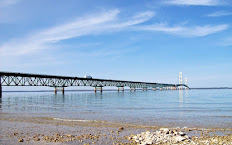
During a previous Pipe Out Paddle flotilla against Line 5, Native and non-Native water protectors gather near the Mackinac Bridge with their kayaks and canoes, display their banners and sing songs about the water. This year the event will take place Saturday, Sept. 4, followed by a Water is Life Festival, both in Mackinaw City. (Keweenaw Now file photo © and courtesy Miguel Levy)

MACKINAW CITY -- Native and non-Native groups opposed to Enbridge's Line 5 oil pipeline under the Straits of Mackinac will gather in Mackinaw City this Labor Day weekend -- Sept. 3, 4 and 6 -- for several events bringing awareness to the threats posed by Line 5 -- an aging pipeline beneath the Straits of Mackinac -- as well as the potential threat to Great Lakes water and bottomlands should a tunnel be built for Line 5.  

Line 5, which carries light crude oil and natural gas, is owned by the same company (Enbridge) that allowed the Kalamazoo River oil spill to occur. This 68-year-old dual pipeline poses too great a risk to the Great Lakes. If Line 5 breaks under the Straits, it will devastate the pristine waters of Lake Michigan for centuries. Many people are unaware of the danger that will completely change our way of life.

Both Michigan Gov. Gretchen Whitmer and Attorney General Dana Nessel have asked for Line 5 to be shut down. In fact, Line 5 has been operating illegally since May 2021. Gov. Whitmer and the Michigan Department of Natural Resources (DNR) notified Enbridge in November 2020 that the 1953 easement allowing it to operate dual pipelines in the Straits of Mackinac to transport petroleum and other products was being revoked and terminated. They gave Enbridge six months to decommission Line 5, but the company continues to operate it.*

On Friday, Sept. 3, a Potluck Feast will be held from 6:30 p.m. to 9 p.m. at the Minogin Market, 229 S. Huron, Mackinaw City, to be followed by the Light Brigade at 9 p.m. under the Mackinac Bridge in Mackinaw City. Opponents of Line 5 can join the Light Brigade for a direct action with light panels.

On Saturday, Sept. 4, the 6th Annual Pipe Out Paddle Up Flotilla will be held from 8 a.m. to noon on the Mackinaw City side of the Mackinac Bridge, 102 W. Straits Ave. This flotilla is a large group of kayaks/kayaktivists demonstrating on the water to bring awareness to Line 5 and call for action. Tribal jimanns (large canoes) are also invited. This family and dog friendly event will include Tribal leadership, Water Ceremony, Jimaans, Pipe Ceremony, Tribal Drum, and Jingle Dancers. Food and water will be provided. Please bring your own water bottle.

Poster announcing the Sept. 4, 2021, Pipe Out Paddle Up Flotilla. Click on poster for larger version. (Poster courtesy Jannan J. Cornstalk)

Please consider making a donation to help cover event costs!
Donate via PayPal here:
https://www.paypa l.com/paypalme/paddleout2019

Donate to the Water Is Life Festival here:
https://www.waterislifefestival.org/donate 

CAMPING: Please email Jannan Cornstalk at jcornstalk@gmail.com to reserve a spot. Camping is first come first served and limited to 50 people.

Following the Pipe Out Paddle Up Flotilla on Saturday will be the Water is Life Festival from noon to 8 p.m. in Conkling Heritage Park, Mackinaw City. It will feature music, art, speakers, youth activities, food and more:

Poster announcing Sept. 4 Water is Life Festival in Mackinaw City. (Poster courtesy Jannan J. Cornstalk)

On Labor Day, Monday, Sept. 6, Oil and Water Don't Mix supporters will gather at the Bridge Walk for two purposes: 1. To welcome Governor Whitmer as she finishes the bridge crossing. 2. To spread awareness about the urgency to shut down Line 5 by handing out postcards to bridge walkers. They will gather at the corner of Nicolet and Jamet streets in Mackinaw City, just off I-75 at the south end of the bridge where many people will begin and end their bridge walk. Click here to learn more and to sign up for a shift.

Oil and Water Don't Mix holds press conference on Canada and Line 5

DETROIT -- On Sept. 1 2021, citizen groups, including tribal members, gathered near the Canadian consulate at the international Detroit River to send a message to the Canadian government: "Canada: Protect the Great Lakes from the Line 5 oil pipeline." The event, organized by Oil and Water Don't Mix, was livestreamed on YouTube.

Sean Mc Brearty, campaign coordinator for Oil and Water Don’t Mix, spoke about the need to persuade Canada to support the Line 5 shutdown. 

During a Sept. 1, 2021, press conference in Detroit, Sean McBrearty, Oil and Water Don't Mix campaign coordinator, speaks about why Canada needs to support shutting down Line 5. (Screen shot from Oil and Water Don't Mix livestream by Keweenaw Now)

"Today we have with us a container of water from the Great Lakes, from the Straits of Mackinac -- clean, pure water of the Straits of Mackinac, where the Anishinaabe people who lived here first have their creation story," McBrearty said.

Noting that Canada shares with the US and Michigan the responsibility of protecting the Great Lakes, McBrearty held up a bottle of that clean water from the Straits and announced a similar container of that clean water has been sent to Canadian Prime Minister Justin Trudeau as a reminder of that responsibility.

McBrearty continued, "Our message in a bottle to the Prime Minister is history will remember you for the choices that you make right now and the choices that you make today. You can protect our Great Lakes and our climate and support shutting down Line 5 in the Straits of Mackinac -- and you need to do so -- or you can support Enbridge and its fossil fuel agenda, but you can't do both."

McBrearty also read a statement from the National Wildlife Federation's Beth Wallace, who commented on Enbridge's proposed tunnel and Canada's support of it. According to her statement, "Enbridge created this false narrative around a tunnel alternative to divide communities and prolong the life of Line 5. With a legal strategy that's also based around creating as much delay as possible, the Canadian government is now actively working alongside Enbridge to prolong the life of a pipeline that could devastate our way of life."

Christy McGillivray, political and legislative director for the Michigan Chapter of the Sierra Club, then spoke in support of Governor Whitmer's legal plan to shut down Line 5.

Christy McGillivray, political and legislative director for the Michigan Chapter of the Sierra Club, speaks on Canada's support of Enbridge. (Screenshot by Keweenaw Now)

"Since May Enbridge has been operating Line 5 illegally in defiance of the State of Michigan and with support from the government of Canada," McGillivray said.

Pointing out that Governor Whitmer's plan to shut down Line 5 protects the health and safety of Michiganders from a "ticking time bomb" while meeting Michigan's energy needs, McGillivray noted that Canadian government officials have supported Enbridge -- the company responsible for the devastating Kalamazoo oil spill -- in their "defiant refusal" to decommission Line 5 in the 6 months (November to May) allowed by the Governor.

McGillivray also noted that at least 33 spills were reported officially along the Line 5 pipeline since the 1960s.

"That does NOT include a Line 5 spill in Michigan's Upper Peninsula, just a few miles from the Straits of Mackinac, in the Hiawatha National Forest, that resulted in 825 tons of soil being excavated and removed to a contamination site. Enbridge kept that spill secret for 30 years," McGillivray said. "Canada should work with us right now -- should work with Michigan and the Biden administration -- and prevent Line 5 from continuing to contribute to our Code Red climate crisis."

Jamie Simmons, Michigan Climate Action Network engagement director, spoke about the effects of climate change -- noting its recent impacts on Detroit, other Michigan communities and Canada.

At the press conference, Jamie Simmons, Michigan Climate Action Network engagement director, notes that Canada's support of Enbridge conflicts with its signing of the Paris Climate Accord. (Screenshot by Keweenaw Now)

"The Line 5 pipeline is a threat to our lives," Simmons said. "Every day the Line 5 pipeline carries oil, a fossil fuel, that is causing a major carbon spill in our atmosphere -- every day -- which is warming our planet at alarming rates."

Noting that Canada was one of the countries to ratify the Paris Climate Accord, Simmons cited the recent IPCC (Intergovernmental Panel on Climate Change) report, which calls for limiting warming to 1.5 degrees Celsius. The goal is to cut global emissions in half by 2030 and reach net zero by 2050 in order to limit the worst consequences of climate change. Canada agreed to that goal by signing the Paris Accord, she said.  

"Allowing Line 5 to continue to operate, or to be replaced by a new oil tunnel, as Enbridge is proposing, is not consistent with that climate goal," Simmons added.

Instead of supporting Enbridge's fossil fuel agenda, Canada should work with the US on a North American climate plan to cut emissions, Simmons concluded.

Andrea Pierce, chair of the Michigan Anishinaabek Caucus and a citizen of the Little Traverse Bay Bands of Odawa Indians, represented her tribe and read a message from her Tribal Chair, Regina Gasco-Bentley, who was unable to attend the event.

Andrea Pierce, chair of the Michigan Anishinaabek Caucus and a citizen of the Little Traverse Bay Bands of Odawa Indians, delivers a message from her Tribal Chair and speaks about Enbridge's threat to the bottomlands of Lake Michigan, where evidence of a 10,000-year-old cultural sacred site was recently observed.** (Screenshot by Keweenaw Now)

In her message, Gasco-Bentley stated, "Line 5 poses an immediate threat to our Anishinaabek homeland. This water in the Straits nourishes our people. It provides critical habitat for our fish and medicines. We depend on healthy clean water to feed our communities. We know the Enbridge pipeline leak in the Kalamazoo River has been devastating to escosystem of the river and the tributaries. We must continue on a path to make people realize the vision we want: Safe water for our next seven generations. Women, I call on you. We are the water protectors, and we must stand together. Water must be protected. It's time to shut down Line 5."

Pierce then spoke of her own experience as one of the team that recently discovered a 10,000-year-old cultural sacred site on the bottomlands of Lake Michigan.**  Enbridge could destroy those bottomlands. Her people need to research that site in order to learn about their tribal history, she explained.

"We can't do that if the water is destroyed and the bottomlands are covered in oil," Pierce said. "All of the lakes are in jeopardy. All of our water is in jeopardy. When that breaks, think about Kalamazoo."

A Q and A session, facilitated by David Holtz of Oil and Water Don't Mix, followed the speakers. To hear those questions and the full statements of the speakers see the video recording on YouTube. Since audio difficulties delayed the event, scroll to about 9 minutes, 34 seconds, for the actual beginning of the press conference.

Editor's Notes:

* See our Nov. 13, 2020, article, "Governor Whitmer, DNR take action to revoke Enbridge easement, shut down Line 5 dual pipelines through Straits of Mackinac; AG Nessel files new lawsuit."

** See: "Ancient underwater tribal cultural site discovered in Mackinac Straits near Line 5."

Wednesday, September 01, 2021

"The Spirit of the Hunt" -- ecological art exhibit reception, wolf talks Sept. 3 in MTU's Forestry Noblet Building

"Peace in the Forest," by Jim Brandenburg. (Photo © Jim Brandenburg and courtesy Michigan Tech University)

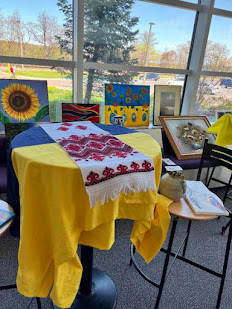
HOUGHTON -- Michigan Tech’s College of Forest Resources and Environmental Sciences (CFRES) is hosting an ecological art exhibit and public talks calling attention to local carnivore populations. The exhibit, titled "The Spirit of the Hunt," is a collaboration between CFRES, the Department of Visual and Performing Arts (VPA), and Project Coyote. 

Local and national artists are featured in the exhibit, including U.P. artists Joyce Koskenmaki and Ladislav Hanka. The exhibit is guest-curated by Catherine Plank, a graduate student in ecSeptosystem science and management at the University of Michigan, who arranged the exhibit "to create discussion and to highlight the beauty and value of native predators."

"Wolf," by Joyce Koskenmaki. (Image © Joyce Koskenmaki and courtesy Michigan Tech University)

The exhibit is open now through Oct. 15, from 9 a.m. to 4 p.m. Monday-Friday in the CFRES atrium.

At 4:30 p.m. on Friday, Sept. 3, John Vucetich (Michigan Tech, Forestry) and Tanya Aldred (Great Lakes Indian Fish and Wildlife Commission) will lead a public discussion on wolves, and the species’ history with mankind.

All events are free and open to the public:
Michigan Tech, CFRES Noblet Building, Room G002:

    Presentations and Reception -- Friday, Sept. 3, 4:30-5:30 p.m.
    John Vucetich: "On the relationship between humans and wolves"
    Tanya Aldred: "Ma'iingan (wolf): An Ojibway Perspective."      
Michigan Tech, CFRES Noblet Building, Hesterberg Hall and Atrium:   

    Exhibit -- Aug. 30 - Oct. 15, 9 a.m. - 4 p.m., Monday-Friday.

Tuesday, August 31, 2021

Live events return to Rozsa for 2021-2022 season

Michigan Tech's Rozsa Center for the Performing Arts will open its doors in September 2021 for live events. Tickets go on sale Sept. 1. (Photo courtesy Rozsa Center)

HOUGHTON -- Live events at the Rozsa are back! After more than a year of a dark theatre stage, the Rozsa Center for the Performing Arts joyfully announces that its doors will open in September to bring the U.P. incredible performances. Once again, we will celebrate the togetherness we have all missed -- complete with people scooting past you to get to their seats, the whispers of neighbors behind you, and a theatre full of laughter. Tickets will be available on September 1 through the MTU Ticket Office.

The new season will feature 70 performances and art exhibits on the Rozsa Stage, in the McArdle Theatre and the Rozsa Gallery, and in the community. This year has the whole community in mind: theatre productions, dance, community workshops, poetry, visual art exhibits, and concerts ranging from country to classical to psychedelic indie rock. 

"We’ve been looking forward to this season for two years," says Mary Jennings, Rozsa Center director. "A theatre is meant to have an audience, and I know that we’ve all been aching for live shows to come back to the Rozsa. This year is going to offer something for everyone. We’ve got a great lineup of musicians, starting with Vieux Farka Touré in September. We’re showing Rocky Horror Picture Show again, back by very popular demand. And of course, a highlight of this season is the return of the Nutcracker, which is always a community favorite."

Performances include the following:

  • Vieux Farka Touré, "The Hendrix of the Sahara," one of the top guitarists in the world
  • A screening of Rocky Horror Picture Show
  • Renowned country music performer Erik Koskinen 
  • Sinkane, a "funky, lighter-than-air global pop" band
  • The beloved Nutcracker with the Minnesota Ballet, Superior School of Dance, and the Keweenaw Symphony Orchestra
  • The world premiere of Anchorage, a dance show choreographed and composed on a remote island in Lake Superior (no, not Isle Royale)

View the full calendar of events and ticket information here.

As we rejoice in coming together again, the Rozsa Center will prioritize health and safety in its reopening plans for all so that we can all focus on the joy. The Rozsa will follow the latest public safety guidelines and release updates to its COVID policies to reflect changes. Plan your family’s year with the complete Rozsa season at mtu.edu/rozsa.

Wednesday, August 25, 2021

DNR public meeting on mineral lease application in Menominee County postponed; virtual meeting to be announced

LANSING -- The public meeting regarding the Great Lakes Exploration, Inc., metallic mineral lease application for parcels in Faithorn Township and Holmes Township, Menominee County, previously scheduled for Wednesday, September 1, 2021, in the conference room at the Menominee County MSU Extension in Stephenson, is postponed due to venue capacity concerns.

The public meeting will be scheduled to be held in a virtual format and advertised in the near future. Questions and comments regarding the direct lease application may be submitted to DNR, Minerals Management Section, P.O. Box 30452, Lansing, MI 48909 or DNR-Minerals@michigan.gov.

Watch for more details, coming soon.

Saturday, August 14, 2021

Health Department recommends increasing COVID-19 precautions, including mask wearing, as rise in transmission risk detected in Western UP counties

This report from the Western UP Health Department (WUPHD) shows the increase in COVID-19 transmission, as well as vaccination rates, in local counties between Aug. 5 and Aug. 11, 2021. Click on image for larger version.

HANCOCK --  The Western Upper Peninsula Health Department (WUPHD) announced on Friday, Aug. 13, a rise in COVID-19 cases and transmission over the past few weeks in the five counties WUPHD covers: Baraga, Gogebic, Houghton, Keweenaw and Ontonagon counties. According to state and local data, four out of five counties are now classified as having substantial or high transmission risk. The Delta variant continues to be detected in Houghton and Gogebic counties and has now been detected in Baraga county.

Aligning with updated guidance from the Centers for Disease Control and Prevention (CDC) and the Michigan Department of Health and Human Services (MDHHS), WUPHD also recommends that when the community is experiencing substantial and high transmission levels, everyone, including fully vaccinated individuals, wear a face mask in public indoor settings to help prevent spread of the Delta variant and protect others.

While vaccination continues to be the most important public health action to end the COVID-19 pandemic, the surge of the Delta variant across the U.S. prompted the CDC to issue updated recommendations for masking. These recommendations now apply to local UP counties with substantial transmission risk. Click here for details. (Image courtesy michigan.gov)

Wearing a face mask is particularly important when attending indoor public gatherings and where social distancing is not able to be maintained. Given the community transmission status change, the health department also encourages businesses, community and faith based organizations and event organizers to consider the latest public health recommendations when determining risk mitigation strategies for employees, customers, community members and events.

Vaccination is best protection

These recommendations are based on emerging science showing the Delta variant to be highly infectious and able to spread at greater rates than any other strains of COVID-19. Research shows that the COVID-19 vaccines provide protection against the Delta variant and most people who experience a breakthrough infection after being fully vaccinated report mild or no symptoms, with an extremely low risk of hospitalization and death. Past infection with COVID-19 does not assure protection from the Delta variant, so people who have had past COVID-19 infection are still strongly encouraged to get vaccinated. High vaccination coverage will not only reduce the spread of the virus, but also help prevent new, and possibly more concerning, variants from emerging.

"When providing guidance and recommendations to our community about which COVID-19 mitigation measures may need to be in place, we are taking into consideration many local factors, such as the current rate of COVID-19 transmission, our health system's capacity, vaccination coverage, testing and which populations may be at risk," said Kate Beer, Health Officer, WUPHD. "The best way to protect yourself, your family, and your community from COVID-19 and the Delta variant is to get vaccinated."

A layered protection strategy should be followed to ensure a healthy environment, allowing all WUPHD residents the best chance to remain healthy and physically present at work and in the classroom setting. Such strategy should include the following risk mitigation measures:

• Receive the COVID-19 vaccine, if eligible
• Wear your face mask while indoors
• Wash your hands frequently
• Maintain a distance of six feet from others
• Stay home when sick and get tested for COVID-19
• Adhere to isolation if you test positive for COVID-19 or quarantine if considered a close contact

At this time, 53 percent of WUPHD residents over the age of 12 have initiated vaccination for COVID-19. Vaccinations can be scheduled with local providers by calling your local health department office, your physician’s office, or by visiting www.coppercountrystrong.com/vaccine.

Vaccines and immunocompromised individuals

CDC now recommends that people with moderately to severely compromised immune systems receive an additional dose of mRNA COVID-19 vaccine at least 28 days after a second dose of Pfizer-BioNTech COVID-19 vaccine or Moderna COVID-19 vaccine. (Image courtesy Centers for Disease Control)

Currently, CDC is recommending that moderately to severely immunocompromised people receive an additional dose. This includes people who have:

  •     Been receiving active cancer treatment for tumors or cancers of the blood
  •     Received an organ transplant and are taking medicine to suppress the immune system
  •     Received a stem cell transplant within the last 2 years or are taking medicine to suppress the immune system
  •     Moderate or severe primary immunodeficiency (such as DiGeorge syndrome, Wiskott-Aldrich syndrome)
  •     Advanced or untreated HIV infection
  •     Active treatment with high-dose corticosteroids or other drugs that may suppress your immune response

People should talk to their healthcare provider about their medical condition, and whether getting an additional dose is appropriate for them. 

Read CDC's Aug. 13, 2021, statement.

Friday, August 06, 2021

COVID-19 Delta variant identified in Houghton, Gogebic counties

HOUGHTON, GOGEBIC counties --  The Michigan Department of Health and Human Services (MDHHS) has notified the Western Upper Peninsula Health Department (WUPHD) that the MDHHS Bureau of Laboratories identified the COVID-19 Delta variant in 6 Houghton County and 2 Gogebic County cases.

The SARS-CoV-2 B.1.617.2 or Delta variant is thought to have emerged in India and has since been detected in many countries and states. On June 14, 2021, the Centers for Disease Control (CDC) classified Delta as a variant of concern due to evidence of increased transmissibility and potential reduction in effectiveness of current monoclonal antibody treatments.

When a variant is identified or suspected, additional measures take place, such as a strict 14-day quarantine," said Kate Beer, Health Officer at WUPHD. "A new variant in our community is concerning since it can be related to higher transmission rates. Residents across the jurisdiction are reminded to continue practicing mitigation strategies including mask wearing in public spaces, social distancing, hand washing, and getting vaccinated. These actions help slow the spread of the virus."

The WUPHD has posted 41 new COVID-19 cases over the past two weeks: 7 in Baraga County, 22 in Gogebic County, 10 in Houghton County, and 2 in Ontonagon County.

With the high transmission rate of the Delta variant, vaccination is more important than ever. Vaccination is currently open to anyone 12 and older. Vaccinations can be scheduled with local providers by calling your local health department office, your physician’s office, or by visiting www.coppercountrystrong.com/vaccine.

Saturday, July 31, 2021

Keweenaw Now, Michigan leaders remember Senator Carl Levin, 1934-2021

Senator Carl Levin, Michigan's longest serving US Senator, passed away Thursday, July 29, at 87.

LANSING -- Keweenaw Now learned of the passing of former US Senator Carl Levin, who served Michigan for 36 years in the Senate, through email statements we received Friday from Michigan leaders -- Governor Gretchen Whitmer, Lieutenant Governor Garlin Gilchrist, Attorney General Dana Nessel, Secretary of State Jocelyn Benson, and US Rep. Andy Levin.

Their messages attest to Senator Levin's long career of public service, his accomplishments and his integrity. During some of Senator Levin's frequent visits to the Keweenaw, we had the  honor to meet the Senator, to interview him and to film some of his very down-to-earth, friendly speeches. We have memories of Carl Levin as not just a politician from Detroit, but a man who cared about the Great Lakes, conservation of our beautiful natural resources, and historical preservation. Here are some of our memories from Keweenaw Now's archives:

At 2014 Bete Grise Celebration ...

Pictured here with Sen. Carl Levin at the Aug. 17, 2014, celebration of the 10th anniversary of the Bete Grise Preserve, near Point Isabelle on Lake Superior, are Jeff Knoop, former director of land protection for The Nature Conservancy (TNC) Marquette office, and Gina Nicholas, Houghton Keweenaw Conservation District chairperson. "It was an honor to have the Senator come," Nicholas said. "He's done so much to help the Keweenaw." (Keweenaw Now file photo)* 

Former Keweenaw County Sheriff Ron Lahti chats with Senator Levin during the 2014 Bete Grise celebration near Point Isabelle. (Keweenaw Now file photo)*

Senator Levin and Amy Berglund, his Upper Peninsula regional representative, pause for a photo with the late Gustavo Bourdieu, who was proud to be a recently naturalized US citizen. Berglund had represented Senator Levin at Gustavo's citizenship ceremony in Marquette. (Keweenaw Now file photo)*

At Grand Opening of the Calumet Visitor Center (Union Building) on Oct. 27, 2011...

On Oct. 27, 2011, U.S. Sen. Carl Levin speaks outside Keweenaw National Historical Park's Union Building -- now the Calumet Visitor Center -- just before cutting the ribbon for the building, which now houses historical displays. Also pictured are, from left, Tony Bausano, Calumet Village president; Paul Lehto, Calumet Township supervisor; Mike Reynolds, National Park Service Midwest Regional director; Kim Hoagland, Keweenaw National Historical Park (NHP) Advisory commission chairperson; and Mike Pflaum, Keweenaw NHP superintendent. Following the ribbon cutting, a Naturalization Ceremony for new U.S. citizens was held on the remodeled third floor of the building. (Keweenaw Now file photo)**

Senator Levin speaks about the importance of preserving our local history through the Keweenaw National Historical Park. (Video by Allan Baker for Keweenaw Now)**

Senator Levin was instrumental in securing federal funding for the restoration of the Union Building, which now, as the Calumet Visitor Center, houses exhibits that tell the story of Calumet's mining history and of the immigrants from many countries who came here to work in the mines.**

At Small Business Roundtable Meeting on Aug. 20, 2010...

U.S. Senator Carl Levin discusses climate and energy issues with Sarah Green, Michigan Tech University Department of Chemistry chair and researcher on climate change, following Sen. Levin's visit to a Small Business Roundtable Meeting on Aug. 20, 2010, at the Franklin Square Best Western Inn Shelden Grill in Houghton. Also pictured is Ed Lahti, local inventor. (Photo by Keweenaw Now)

Since the press was not allowed at the Small Business Roundtable Meeting but only given the final 15 minutes to interview Sen. Levin, Keweenaw Now asked him about two issues -- Afghanistan and Kennecott-Rio Tinto's sulfide mine, now the Eagle Mine near Big Bay, Mich.***

At Democratic breakfast, 2009 ...

Senator Levin speaks to Democratic supporters at a breakfast organized for him on Sept. 26, 2009, during a visit to Houghton County. (Keweenaw Now file photo)****

Michigan leaders remember Senator Carl Levin

Governor Gretchen Whitmer: "Senator Carl Levin was a champion for Michigan. His 36 year tenure in the United States Senate, the longest in state history, was marked by a tireless commitment to our auto industry, Great Lakes, and men and women in uniform. Carl paved the way for a safer planet, helped pass several nuclear weapons and missile treaties, and spoke out courageously against entering the war in Iraq. He made Michigan a safer and better place for our families, securing funds to create the Detroit Riverwalk and writing the bill that established Sleeping Bear Dunes National Park. Carl would often wear his glasses on the tip of his nose, but he saw the best in us. He saw what we were capable of when we came to the table as Michiganders, as Americans, to get things done. Carl devoted his life to public service, and it us up to us to follow his example. My thoughts are with his family, many of whom are lifelong public servants, including his brother, former Congressman Sander Levin, and his nephew, Congressman Andy Levin. Carl, we miss you."

Lieutenant Governor Garlin Gilchrist: "Senator Levin was a giant whose power and dedication was felt throughout our state. Michiganders trusted Senator Levin to get the job done, which is why they continued to send him back to Washington, D.C., as our state’s longest-serving senator. And throughout all of those years, Senator Levin never backed down from putting Michigan families first. There’s not a single Michigander who hasn’t benefited from the policies and programs that Senator Levin helped to usher through Congress. His presence will be greatly missed by the untold lives that he touched, especially the young leaders like me who he continually encouraged and supported. My heart is with his family and all of the Michiganders across the state who are mourning this tremendous loss. Senator Levin set the path for all of us to continue his great work."

Attorney General Dana Nessel: "The world lost a giant today, and I lost a personal hero. Senator Levin’s decades-long dedication to representing the people of Michigan set a bar few elected officials will ever meet. His no-nonsense, brutally honest approach to politics is what gained him respect across the aisle. I greatly admired his unwavering commitment to doing what was right -- even if it wasn’t easy -- and his passionate approach to understanding every single issue he voted on. We all could learn a great deal from his service. My thoughts are with his loved ones. There will never be another Carl Levin."

Secretary of State Jocelyn Benson: "A light has gone out today in Michigan that can never be replaced. I have no words to express what Senator Carl Levin and his lifetime of dedication to our city, state and country meant to me and so many of us who seek to serve and lead during these uniquely divided times.

"My best days as Dean at Wayne State University Law School were when I got to work with and learn from him, whether it was co-teaching a class on legislation and leadership or launching the Levin Center, or simply sitting in his office asking him for advice and hearing stories from his life of service.

"When I told him I wanted to run for Michigan Secretary of State he was unhesitatingly all-in: hosting events, calling supporters, nominating me at the Michigan Democratic Party Convention. He was a constant source of wisdom and support, always encouraging me to lead courageously and always having my back.

"In our last conversation I thanked him for writing his memoirs at a time when we all desperately need to learn more of how he served 36 years in the U.S. Senate and a lifetime in politics while remaining steadfastly humble, loyal, devoted, and kind. His commitment to service was everything we need from our leaders but so rarely get. I will miss our lunches, talks, and I'll keep working every day to be more like him. If we all do that, we can honor his years of devotion to Michigan, to Detroit, and to our country."
 
US Rep. Andy Levin, nephew of Carl Levin and son and successor of US Rep. Sander Levin: "Today, my uncle, Senator Carl Levin, passed away.

"Throughout my adult life, wherever I went in Michigan, from Copper Harbor to Monroe, I would run into people who would say, ‘I don’t always agree with Senator Levin, but I support him anyway because he is so genuine, he tells it straight and he follows through.’

"Carl Levin personified integrity and the notion of putting the public good above self-interest. As he walked about the Capitol in a rumpled suit, almost always with a plain white shirt and pedestrian tie, carrying bulging files with the occasional paper flying away, Carl was the very picture of sober purpose and rectitude. In truth, he wasn’t unfun. In fact, he often pierced tense situations with self-deprecating humor, and he privately shared incisive observations about others with staff and colleagues.

"But Carl was all about the work, and the great honor the people of Michigan had bestowed upon him with their votes and their trust. He did not seek to divine their views to be popular, but rather to study the issues and advance the people’s interest to the best of his ability. Uncle Carl met with more presidents, kings, queens and other important people than all but a few of us ever will. But he treated them all the same as he did a Detroit autoworker or a beet farmer in Michigan’s Thumb -- with a full measure of dignity but no airs, ever ready to puncture self-importance, posturing, mendacity and avarice.

"He was so well-prepared for every meeting, hearing, and conference that he challenged conventional boundaries between senator and staff. He was one of the most challenging senators to work for and one of the most rewarding. Challenging, because you had better know your business in detail, since he surely did. Rewarding, because he had authentic relationships with staff, treated them with deep respect, and was loyal to them.

"Uncle Carl was above all a family man. No matter the pressing business he faced as a senator, he always centered Aunt Barbara, my cousins Kate, Laura and Erica and their families, devoted time to them and so obviously cherished them. And the way he loved and treated his family radiated out and served as a model for how he treated colleagues, staff, constituents, soldiers and the world.

"From my earliest memory to this moment, perhaps above all, he has defined with my dad how close two brothers, two siblings, two people can be. In the end, these two Jewish boys from Detroit, these grandsons of immigrants, each served 36 years in Congress, 32 of them together, becoming by far the longest co-serving siblings in the 232-year history of this place. As heartbroken as we are in this moment, I feel so grateful to have experienced this love and legacy."

Notes:

* See "Sen. Levin joins supporters, visitors at Bete Grise 10-year celebration."

** See  "Photos, videos: Grand Opening of Calumet Visitor Center (Union Building)."

*** See "Sen. Levin speaks at Small Business Roundtable in Houghton."

**** See "Photos: Local Dems, supporters greet Sen. Carl Levin at Houghton breakfast."

Tuesday, July 27, 2021

Water protectors complete 3rd Annual Menominee Canoe Trip to raise awareness of threats from proposed Back 40 mine

By Michele Bourdieu

Participants in the 3rd Annual Menominee Canoe Trip hold a water ceremony next to the Menominee River, which is threatened by the proposed Back 40 mining project. The group paddled for four days -- July 1-4, 2021 -- from 60 Islands boat landing to Menekaunee Harbor at the mouth of the Menominee River. (Photo © and courtesy Wayne Swett)

MENOMINEE RIVER, Mich. and Wis. -- Despite some very hot, humid weather and difficulty finding a campsite the first night, the 3rd Annual Menominee Canoe Trip again succeeded in bringing awareness to the proposed Back 40 mining project's potential threats to the environment and sacred cultural sites.

"People are starting to recognize us and our fight for the cause," said Wayne Swett, Menominee tribal member and co-organizer for all three annual Menominee canoe trips. "People would wave at us from shore and boaters would come by us and thank us for the fight to Save the Menominee river, so we do have a huge following on the river. We also had many, many people greet us at the Menominee bear upon finishing the trip." Inset photo: Wayne Swett in his canoe. (Photo © and courtesy Wayne Swett)

This view of the Menominee River is near the launch site for Day 1 of the 2021 Menominee Canoe Trip. (Photo © and courtesy Wayne Swett)

Since the group had some difficulty finding a suitable camping spot after paddling on Day 1, they decided to load up their canoes and camp at Tina Lesperance's dad's cabin.

The group's campsite at Tina's dad's place, where they spent two nights. (Photo © and courtesy Wayne Swett)

"The next morning (Day 2) we put back in where we pulled out and paddled to Tina's dad's place, where we camped again," Swett explained. "So we spent two nights at Tina's dad's house."

As a result, Day 2 was a longer day of paddling than Day 1. 

Campfire the evening of Day 1, at the cabin of Tina's dad. "We had a fire keeper who built a fire on June 30th and transferred the fire to the next camp as we moved by placing hot coals in a Dutch oven," Wayne Swett said. "The flame was out but we took the heart of the flame (hot coals) with us as we moved from camp to camp." (Photo © and courtesy Wayne Swett)

Tina, who was recovering from a broken foot that prevented her from participating in the trip as much as she had the previous two years, said she was happy to be able to provide the cabin again this year.

"All I really have to say is that I was honored to be able to help them with their journey and to give them a place to rest," Tina told Keweenaw Now. "I was disappointed I couldn’t join them because of the broken foot but next year I’m going to go for a couple days."

Campers are up early on Day 3 as they prepare to leave Tina's dad's cabin for another day of paddling on the Menominee River. (Photo © and courtesy Wayne Swett)

The weather was warmer and humid for the second half of the trip. Swim stops were essential, as were water fights, for cooling off.

On Day 3 paddlers stop for lunch and a swim at the Portage point at Turtle Nation. Temperatures were in the 90s. (Photo © and courtesy Wayne Swett)

Some fellow paddlers attempt a water fight ....Click on You Tube icon for larger view of videos. (Video © and courtesy Wayne Swett)

Diving from a dock is part of cooling off during a swim break:

Wayne Swett encourages water protector friends to jump off a dock during a swim stop. (Video © and courtesy Wayne Swett)

Fellow paddlers honor young Hunter Peters (center) by naming one of the swim stops after him. (Photo © and courtesy Wayne Swett)

Hunter Peters, a recent graduate of Menominee Indian High School, took many photos and videos during the Canoe Trip and posted them on Facebook. 

Hunter, one of the youngest to join the Canoe Trip, told Keweenaw Now he participated in the trip for his community and wanted to show them what fun it would be for him as a young person.

Hunter's niece, Jordan Peters, often joined him in the canoe, paddling so he could take photos and videos.

 
Jordan Peters, Hunter's niece, is an avid paddler and swimmer. (Photo © and courtesy Hunter Peters)
 
Hunter captured Jordan in action in this dive from the dock. (Video © and courtesy Hunter Peters)

Jordan as water protector. Hunter would not reveal how he captured this photo! (Photo © and courtesy Hunter Peters)

Another swimmer Hunter caught with his camera was Jwin Zillier, who was participating in the Canoe Trip for the third time.

Jwin Zillier enjoys swimming in the Menominee River. (Photo © and courtesy Hunter Peters)

Zillier told Keweenaw Now the best part of the trip for her in previous years had been the energetic Thursday night and the water ceremony on the first day.

"Getting there spending the night. Up Friday early for a sunrise  ceremony," she said. "Well this year it didn't work out. So we had our early morning ceremony the second day (when) we first put our feet in the Menominee River."

Zillier said she wished more people could realize the peace one feels in being close to Nature, especially during the first part of the trip, where there are fewer people on the river.

"So you don't get the hustle and speed boats as you do when you get closer to town," she noted. "I feel the people that far up the river understand what they will lose if that mine goes through. I feel sad about the people that are on the river strictly for the entertainment."

Dawn Wilber, co-organizer with Wayne Swett for the three annual canoe trips, also commented on the beauty of Nature along the river.

Dawn Wilber has been co-organizer, with Wayne Swett, for all three Menominee Canoe Trips. (Photo © and courtesy Hunter Peters.)

"On this third year doing this Canoe paddle, our River has not failed to show us more of her beauty in different ways," Wilber said. "Really paying attention to the wonders of Nature sure makes the trip absolutely amazing. She never ceases to amaze me. What another spectacular year!"

Hunter also captured an eagle flying above the paddlers:

The Canoe Trip participants are always reassured by the sight of eagles along the way. (Video © and courtesy Hunter Peters)

More photos by Hunter:

The beautiful Menominee River and its reflections in a calm moment. (Photo © and courtesy Hunter Peters)

Floating flora. (Photo © and courtesy Hunter Peters)
 
Time for a fishing lesson! The sign reads, "Don't Undermine the Menominee River. Pure Michigan needs pure water." (Photo © and courtesy Hunter Peters) 

Jordan and Hunter keeping cool! (Photo © and courtesy Hunter Peters)

Day 3 stop at the Meyers'

Day 3 paddling concludes as Canoe Trip participants arrive at the home of Roger and Gail Meyers, who hosted the group overnight for the third year in a row. (Photo © and courtesy Wayne Swett)

"We made it! Arrived at Roger 'n Gail's!" Wayne Swett said. "Our meal consisted of Chicken, wild rice casserole, venison stroganoff, corn, many delicious desserts."

Swett said it was great to see the Meyers again.

Hosts Roger and Gail Meyer have welcomed the Menominee Canoe Trip participants for dinner, overnight stay and breakfast each year to refresh them before they set out on the final day of the trip. (Photo © and courtesy Wayne Swett)

"I guess all I can think of is when my mom asked me why we do this for people we hardly know, my sincere comment to that was, if we’re not put on this earth to be of service to others, why are we here," Gail Lindquist Meyer told Keweenaw Now. "God spoke to us and said to do this again, they need you and we are blessed to get to know these wonderful people."

Kids enjoy swimming at Roger and Gail's. (Photo © and courtesy Wayne Swett)

Relaxing at Roger and Gail's lovely home on the Menominee River. (Photo © and courtesy Wayne Swett)

Day 4: Final day on the river

Up early on July 4, Wayne Swett records the calm mood of the river before the group sets out from the Meyers' to their final destination, Menekaunee Harbor at the mouth of the Menominee. (Video © and courtesy Wayne Swett)

Day 4 included a stop at the Menominees' Island in the river.

Water protectors stop at the Menominees' Island during Day 4 of paddling. (Photo © and courtesy Wayne Swett)

"(We) stopped off at the island that was gifted to the Menominee tribe by Tom Boerner," Swett said. "Picked up trash, took a group pic and everyone reflected on the trip."

Tom Boerner, who has property near the proposed site of the Back 40 mine, has been opposing it for several years and is involved in litigation against Aquila, the mining company.

Group photo taken on the Menominees' Island on July 4, 2021. (Photo © and courtesy Wayne Swett)

Day 4 was hot and muggy, but the water was nice and cool, Swett noted. A low railroad bridge, a half mile from their destination, was the final obstacle.

Despite having to deal with a boot on her broken foot, Tina Lesperance showed up at that bridge to record the paddlers' skills:

These made it under...

And so did everyone! (Video © and courtesy Tina Lesperance)

Asked how she managed to take the above videos, Tina said, "I laid down on the bridge and stuck my arm through the beams with my phone and prayed I didn’t drop it in the river."

After videotaping the paddlers under the bridge, Tina said she had to "hightail it to the harbor by foot and I still had the boot on."

She made it to the harbor in time to capture those same canoes arriving and their paddlers cheering:

Paddlers arrive at Menekaunee Harbor on July 4, 2021, completing the 3rd Annual Menominee Canoe Trip. (Video © and courtesy Tina Lesperance)

Also waiting to greet her fellow water protectors at the harbor was Regina Chaltry, an active opponent of the Back 40 mining project.

Regina Chaltry, water protector and outspoken opponent of the Back 40 mining project. (Photo © and courtesy Hunter Peters)

"Canoeing down the ancient water highway with family of the original people who traveled that way for millenia was an incredible experience and honor," Chaltry told Keweenaw Now. "So many amazing wonders to behold, so much laughter, good stories and even songs. I am already looking forward to next year while treasuring every memory made."

Regina Chaltry films the paddlers arriving and supporters joining them at Menekaunee Harbor on Day 4 of the 2021 Menominee Canoe Trip. Some carry signs to show opposition to the Back 40 mining project. (Video © and courtesy Regina Chaltry)

Finally, everyone gathers at the Great Bear. This statue is a replica of the original sculpture on the Menominee Reservation (in Wisconsin), 60 miles west of the Menominee River mouth. This replica marks the mouth of the river, where the Menominee people are believed to have originated from a bear that climbed out of the river.

Paddlers and their supporters gather at the statue of the Great Bear at the conclusion of the 4-day Canoe Trip. (Photo © and courtesy Wayne Swett)

Water protectors celebrate their arrival on July 4 with dinner at Murray's Irish pub/restaurant. Afterwards everyone said their goodbyes! (Photo © and courtesy Wayne Swett)

"I would like to thank Roger and Gail Meyer for the awesome meal that they and friends cooked for us! And they are awesome hosts for letting us stay at their place for the last 3 years," Wayne Swett told Keweenaw Now. "I also thank Tina for letting us camp at her dad's place. She has been an immense help!"

Editor's Note: Thanks to all who helped with this article, including Anthony J. Corey, videographer, who assisted Keweenaw Now in downloading videos and photos.

Saturday, July 24, 2021

EGLE orders Enbridge to retrieve anchor in Mackinac Straits

LANSING -- The Michigan Department of Environment, Great Lakes, and Energy (EGLE) has instructed Enbridge Energy to remove an anchor that was left on the Straits of Mackinac lakebed. The agency continues to gather facts and information on the matter.

Enbridge informed the State of Michigan Wednesday night, July 21, that the 15,000-pound anchor was left by an Enbridge contractor after equipment failed when the contractor attempted to retrieve the anchor from the bottom of the Straits where it had been placed. Enbridge reports the anchor was several hundred feet from the twin Line 5 pipelines.

Enbridge has informed EGLE it is developing a retrieval plan and expects to have the anchor removed within days.

Monday, July 19, 2021

Wolf Pups Born on Isle Royale, Moose Poised for Decline

After a hard winter with not much food -- and not much coat because of ticks -- an Isle Royale bull moose is eager to feast on new green spring vegetation in June 2021. (Photo © Sarah Hoy and courtesy Michigan Tech University)

By Kelley Christensen, Michigan Tech Science Writer and Project Strategist

Posted July 12, 2021, on Michigan Tech News
Reprinted in part with permission.

The COVID-19 pandemic halted the in-person wintertime survey of wolves and moose on Isle Royale for the first time in 63 years. Consequently, there are no estimates of wolf or moose abundance for 2021, and the next estimates are scheduled in February 2022. But though the Isle Royale Winter Study didn’t happen quite as planned, researchers were still able to visit the remote national park in the spring.

Now, fieldwork has resumed and Michigan Technological University researchers have already uncovered new information about these two iconic wildlife populations. In particular, wolves produced at least two litters of pups, and moose appear poised for decline.

In the Isle Royale Winter Study, Michigan Tech researchers share other significant developments about curating the world’s largest moose bone collection, advances in understanding of wolf foraging behavior and the nutritional health of the moose population.

Cover of the 2020-2021 Isle Royale Winter Study report, by John A. Vucetich, Rolf O. Peterson, and Sarah R. Hoy of Michigan Tech's College of Forest Resources and Environmental Science. (Image courtesy Michigan Tech University)

The 2021 Winter Study details a growing wolf population, while the moose population shrinks. Moose bones, collected over decades, are catalogued, and warming winters play a role in moose nutrition.

"We recovered footage of a group of four wolf pups taken in January 2021 by remote cameras at the east end of Isle Royale," said Sarah Hoy, research assistant professor in Michigan Tech’s College of Forest Resources and Environmental Science (CFRES). "Additionally, observations of tracks and scats left by wolf pups last fall at two different locations suggest that there were probably two different litters of pups living at the east end of the island in September 2020."

There may also have been another litter born at the west end of the island last year. With reproduction figures like that, Hoy and colleagues expect the wolf population to have grown slightly or moderately since the last survey count, so long as there hasn’t been an unusually high death rate.

Michigan Tech researchers are currently working with the U.S. National Park Service and other research collaborators to discern death rates and the number of litters produced....

CLICK HERE to read the rest of this article -- including wolves as specialized foragers; nutritional stress, climate and ticks impacting moose population; and the world's largest catalog of moose bones.

Tuesday, July 13, 2021

Menominee River Water Celebration to be July 16 in Marinette, WI

The beautiful Menominee River. (Photo courtesy Coalition to SAVE the Menominee River, Inc.)

The public is invited to a FREE event, open to all, to protect water and sacred sites from the threat posed by the Back Forty Mine project.

Join water protectors, beginning at Noon on Friday, July 16, at Stephenson Island, 1680 Bridge St., Marinette, WI, to celebrate and bless the Menominee River -- with participation by the Menominee Indian Tribe of Wisconsin, the Indigenous Caucus of the Western Mining Action Network, and the Coalition to SAVE the Menominee River, Inc.

A special ceremony will be held by members of the Menominee Nation to bless the waters of the Menominee River, which is their namesake River and the location of many sites sacred to the Tribe.

The celebration continues with updates on the mining threat facing the Menominee River, including a keynote speaker and longtime environmental advocate  -- Dr. Al Gedicks of the Wisconsin Resources Protection Council.

MUSIC -- Larry Mullins and band will present river songs and showcase the three custom-built guitars to be raffled off at 3:30 p.m. Entitled the "River’s Edge Trio," these guitars were handcrafted by Warren McKenney and appraised at $4,500. The winning ticket will receive all three guitars!  Proceeds from ticket sales go to support the mission of the Coalition to SAVE the Menominee River, Inc.

FOOD -- Dorothy’s Haven of Hope will provide food at the event. Hamburgers, cheeseburgers, brats, hot dogs, chips, soda and water will be available for sale, as a fundraiser for Haven of Hope. The first 100 people in attendance will receive a coupon for a FREE hot dog! Please go to the Coalition booth next to the stage for your coupon.

The event will conclude with a Bridge Walk -- mine protestors walking with signs to show opposition to plans that could endanger sacred sites and the health of both the River and residents or visitors to the area.

Mark your calendar for July 16 -- supporters of the Menominee River would love to see you there!

Stephenson Island is located in the Menominee River within the boundary of Marinette, Wisconsin, at a latitude of 45.1019294 north and longitude 87.6292735 west, at an elevation of 587 feet. It is named after Isaac Stephenson, a prominent politician and lumberman in Marinette at the turn of the 20th century. The island is operated as a city park and is uninhabited. US Highway 41 runs across it, providing access to the park's pavilion, gazebo, playground, and picnic areas. A footbridge to the island connects from the Marinette side of the river, adjacent to the Wisconsin Tourist Information building and the Stephenson Public Library. The island is a popular place for access to the Menominee River for sport fishing and launching recreational boats. The island's facilities host Marinette's "Sunset Concert Series" for Marinette's concerts. (Other concerts in the series are hosted by Marinette's twin city, Menominee, Michigan.)

Editor's Note: Water protectors spent July 1-4 celebrating the river with their 3rd Annual 4-Day Menominee Canoe Trip. Watch for photos and videos, coming soon!