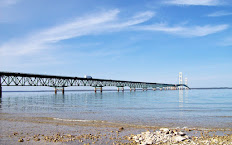
This wetland in the proposed CR 595 corridor is one of many sensitive areas that would be impacted if the proposed road were built. (Keweenaw Now file photo © and courtesy Jessica Koski)
By Yellow Dog Watershed Preserve
Posted on their Web site March 23, 2018*
Reprinted here with permission.
MARQUETTE -- The battle between the U.S. Environmental Protection Agency and the Marquette County Road Commission concluded on March 20th in the U.S. 6th Circuit Court over County Road 595, the proposed road leading from Eagle Mine to Humboldt Mill. For those who need a refresher, the permit for CR 595 was submitted to the MDEQ (Michigan Department of Environmental Quality) in 2012 and as part of the review process, the U.S. EPA issued objections to the project based on the Clean Water Act. Long story short, the MDEQ did not issue the permit and the process then transferred to the U.S. Army Corps of Engineers.
The Road Commission then decided to file suit against the U.S. EPA with the crux of the lawsuit over the their perception that the EPA’s objections were "arbitrary and capricious" and that they "exceeded their authority" in the process. After review in District court, it was determined that the court cannot even decide on the case because, according to the Administrative Procedures Act, you cannot bring suit against a decision unless it is considered a "final agency decision." The case was dismissed.
The Road Commission then teamed up with a lobbying group called Pacific Legal Fund, who paint themselves as the champions of the little guy against the Goliath of government. They decided to appeal the decision. Oral argument transpired in Circuit court, from which you can read transcripts thanks to journalist Louis Galdieri.** Ultimately Circuit court agreed and affirmed the District court’s decision. The EPA’s objections were not final agency decisions and therefore not reviewable because the permitting process could have continued, but it was abandoned by the Road Commission.
It remains to be seen what the next step is for the Road Commission. In an interview, Road Commission manager Jim Iwanicki said that they have options including asking the court to look at specific things again, proceeding with the case to the U.S. Supreme Court, or dropping the case. It is also a possibility that the permitting process could continue under the authority of the U.S. Army Corps of Engineers. While the road isn’t going to be built anytime soon, the future is still unclear. The Yellow Dog Watershed Preserve still strongly opposes building a mine road through this remote and wild area. Enough damage has already occurred from mining related activities and we don’t need anymore!
* Click here for this and other articles by the Yellow Dog Watershed Preserve.
** Click here to read Louis Galdieri's series of articles on the CR 595 controversy.
Showing posts with label Environmental Protection Agency (EPA). Show all posts
Saturday, March 31, 2018
Tuesday, September 13, 2016
EPA taps Michigan Tech as home of Regional Environmental Infrastructure Center
Michigan Tech's Great Lakes Research Center (GLRC) is one of the university's various departments, centers and institutes expected to play a role in the recently named EPA Regional Environmental Infrastructure Center. (Keweenaw Now file photo)
By Jennifer Donovan*
Posted on Michigan Tech News Sept. 12, 2016
Reprinted here with permission
HOUGHTON -- Michigan Technological University is known for both its engineering and environmental know-how and its resources.
Add to that the School of Business and Economics, the Great Lakes Research Center (GLRC) and a campus-wide commitment to multidisciplinary work, and you have just what the US Environmental Protection Agency (EPA) is looking for.
The EPA named Michigan Tech the new home of its Region 5 environmental finance center, a recognition that comes with a six-year grant of up to $5.6 million. EPA Region 5 covers Michigan, Minnesota, Wisconsin, Illinois, Indiana, and Ohio.
An EPA team is visiting Michigan Tech for a site visit today and tomorrow, Sept. 13-14.
Engineering, Business Resources
"The depth of engineering resources that we have, our business school’s involvement and the fact that a multidisciplinary approach is the norm here all made our application stand out," says Tim Colling.
The principal investigator on the EPA center, Colling also directs Michigan Tech’s Center for Technology and Training (CTT), part of the Department of Civil and Environmental Engineering (CEE). There are several co-PIs from various University departments, centers and institutes, including CEE, the Sustainable Futures Institute, Michigan Tech Transportation Institute (MTTI) and the School of Business and Economics.
The new EPA regional center -- one of 10 nationwide -- will help counties, cities, villages, and state agencies find better ways to manage and maintain their infrastructure and to minimize their impact on the environment.
Infrastructure is a term used to describe the manmade systems that make modern society possible, such as bridges and roads, water and sewer systems, landfills and power generation systems. Infrastructure and the environment interact constantly and in complex ways. Bridges span bodies of water; storm drainage from roads affects the surrounding ecosystem. Plants and wildlife as well as the quality of the air, water and soil all depend upon infrastructure that functions properly.
Preventive Maintenance
Managing infrastructure, Colling says, is somewhat like car maintenance.
"If I don’t change the oil, rotate the tires and grease the moving parts, my car is likely to break down prematurely and, as a result, I will have some expensive repairs and will have to deal with inconveniences like being stuck on the side of the road," explains Colling. "However, if I do all the required maintenance, my car is likely to last a lot longer, cost me much less over its life, and not leave me stranded. It’s the same idea for infrastructure -- we have to constantly manage it and do preventive work. Like your car, if you didn’t save to replace it and had to buy a new one suddenly, the financial burden can be staggering.
"These are the challenges engineers deal with every day," Colling goes on to say, "and there are no simple answers."
The EPA center will receive baseline funding from the grant. Colling is expecting additional funding to come through applications for various projects for which Michigan Tech is well qualified.
"Since this is a center focused on the Great Lakes area, we anticipate significant GLRC involvement," he says.
David Hall, a member of the Copper Country Recycling Initiative, recently commented on this article, saying, "Sustainability can finally start on the Michigan Tech Campus!!! Great news! Can't wait for Recycling, Composting, Sustainable facilities management heating, cooling, lighting, and everything else. Tech is way behind the curve now, but the new grant gives us hope."
* Author Jennifer Donovan is Director of News and Media Relations at Michigan Tech University.
Tuesday, May 31, 2016
Letter: EPA officials unresponsive to public concerns at meeting on l'Anse Warden Plant
Although we appreciate the EPA's willingness to respond to our plea for action with its investigation of the Warden Plant, the staff's demeanor at the May 9, 2016, public meeting was generally unprofessional and they were often unresponsive to the comments and questions of local residents.
(Inset photo: Catherine Andrews, author of this letter, speaks to EPA officials about public health concerns during the May 9, 2016, informational meeting on the L'Anse Warden Plant. Photo by Keweenaw Now)
The stack test failure in September 2015 was downplayed by the regulators even though it revealed more than twice the permit level for Hydrogen Chloride. Excessive levels of polycyclic aromatic hydrocarbons, PAHs, found in fugitive dust samples were shrugged off. We were told that PAHs can come from woodstoves, outdoor grills and cigarettes. EPA did not explain how PAHs from these sources might become attached to unburned wood fibers from ground-up, chemically-treated railroad ties (fugitive dust) that drift from the Warden property into the community and the surrounding environment.
Four fugitive dust samples and one blank sample were collected in the L'Anse area on February 1, 2016. Two South 4th Street collection sites are located about 300 feet from the Warden facility. All 20 of the PAHs tested at The EPA Regional Laboratory in Chicago were above standard limits in the samples from these two sites. Specific locations of the other two collection sites have not been disclosed.
A large crowd of local residents attended the May 9, 2016, Environmental Protection Agency (EPA) informational meeting at L'Anse High School. Here EPA and DEQ officials listen to comments from the audience. Many residents, including senior citizens living near the L'Anse Warden Plant, complained of respiratory effects from the Plant's fugitive dust. (Photo by Keweenaw Now)
According to the Encyclopedia of Health and Occupational Health and Safety the PAH, benzo(a)pyrene is a very potent carcinogen. It was found to be 1245 percent and 2140 percent above the reporting limit at the two South 4th Street collection sites.
Pentachlorophenol (PCP) is a known carcinogen that is banned in Canada and also banned in the U.S. with few exceptions. The two South 4th Street samples revealed 454 percent and 990 percent above the reporting limit for PCP. Creosote is also a known carcinogen but DEQ's Steve Casey states that it poses "no public health threat to the community."
The L'Anse Warden Electric Company (LWEC) was erroneously classified as a "biomass facility" when it was converted from a stand-by natural gas facility in 2008. LWEC is an incinerator that has been operating without a permit since December 30, 2015. It has two outstanding violations from December 1, 2015, for a failed stack test and February 8, 2016, for excessive dust, smoke and odor. Attorneys for Traxys, the owner of the facility, have been negotiating the violations and a new operating permit with DEQ attorneys since the beginning of February 2016.
The agencies assigned with the responsibility of protecting public health and the environment are instead protecting the interests of corporate capitalism. Their new purpose seems to be The Solution to Pollution is Corporate Absolution.
Catherine Andrews
Board Member, Friends of the Land of Keweenaw (FOLK)
Subscribe to:
Posts (Atom)