See our right-hand column for announcements and news briefs. Scroll down the right-hand column to access the Archives -- links to articles posted in the main column since 2007. See details about our site, including a way to comment, in the yellow text above the Archives.
Showing posts with label Great Lakes protection. Show all posts

Friday, June 30, 2017

Join "All Hands On Deck" event July 3 in Houghton to help raise awareness of Great Lakes protection

HOUGHTON -- "All Hands On Deck" is a gathering at Kestner Park in Houghton from 10 a.m. to 11 a.m. on Monday, July 3, to raise awareness of the need to protect the Great Lakes and keep them healthy. All are invited. Boats are encouraged to congregate in front of the park by 10 a.m. Local weather predictions promise it to be a sunny day.

This event will take place on the shore and on the water with boats linking along the shorelines in communities in every Great Lakes state and Canada. In the UP, there will be gatherings in Marquette, Menominee, and Drummond Island as well as on the Portage.

"Wearing blue is encouraged," said Horst Schmidt, co-organizer, with Susan Burack, of the Houghton event. "What is important is being there and linking with others. People are welcome to bring posters voicing their support for the Great Lakes, ongoing funding for removal of legacy pollution and maintaining a healthy lake ecosystem."*

Boaters may wish to bring a blue marble to share or a blue pennant to wave during this event of solidarity for the Great Lakes.

Participants in the All Hands On Deck events are invited to link hands on the beach and link boats on the water along the shorelines in communities in every Great Lakes state and Canada. (Poster courtesy All Hands on Deck Facebook page)

All Hands On Deck represents common ground that extends beyond political and geographical boundaries. Water unifies us all. In every area, the Great Lakes are essential to the environment, economy, and everyone’s way of life. The event is a way to come together in a unique, unified expression of concern on behalf of a precious resource that needs continuing attention and support -- funding, regulations, and research -- to sustain long-term vitality.

"What is the Keweenaw without water?" asks local co-organizer Susan Burack of Hancock. "All of us who live here need to show our support for protecting our part of the Great Lakes. We, on the south coast of the greatest lake, join together with people around Ontario, New York, Ohio, Illinois, Indiana and Michigan for our part."

Lakes Superior, Michigan, Huron, Erie, and Ontario together are the largest surface freshwater system on Earth; only the Polar icecaps contain more water. The Great Lakes contain 84 percent of North America’s surface fresh water, and 21 percent of all the surface fresh water in the world. According to the U.S. Environmental Protection Agency, the Great Lakes are "a dominant part of the physical and cultural heritage of North America."

This event, which is taking place in more than 50 communities, is the brainchild of Charlevoix, Michigan, resident Kimberly Simon, who conceived of All Hands on Deck in response to proposed cuts to the Great Lakes Restoration Initiative.

*For more information click here or email Horst Schmidt at horsthear@yahoo.com.

Monday, November 07, 2016

Congressional Candidate Lon Johnson holds Town Hall in Keweenaw County

By Michele Bourdieu

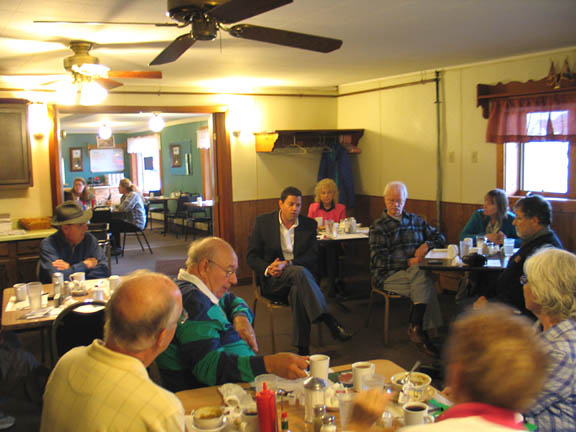
First District Democratic Congressional Candidate Lon Johnson (center in dark jacket) holds an informal Town Hall discussion at Slim's Café in Mohawk on Oct. 5. Jacqueline Jaaskelainen (in background behind Johnson), Keweenaw County Democratic Party chair, arranged the venue when Johnson expressed his wish to meet with Keweenaw County residents. (Photo by Keweenaw Now)
 
MOHAWK -- In the final weeks of the election campaign, First District Democratic Congressional Candidate Lon Johnson traveled all over the 32 counties in the district holding Town Halls and participating in candidate forums. He made a special trip to the northernmost county -- Keweenaw -- with a Town Hall visit to Slim's Café in Mohawk on Wednesday, Oct. 5. Thanks to the organizing efforts of Keweenaw County Chair Jacqueline Jaaskelainen, Slim's offered their dining room that day to fit the candidate's busy schedule -- following his participation in the Ontonagon Candidate Forum on Tuesday, Oct. 4, and a Wednesday morning Town Hall at Carmelita's in Calumet -- and preceding a Town Hall he held at the Downtowner in Houghton that Wednesday evening.

On Nov. 2, 2016, Lon Johnson posted on his Facebook page this map of his tour of the First District, showing his extensive participation in candidate forums and town hall meetings. (Map courtesy Lon Johnson for Congress)

In an email reply to Keweenaw Now, Brian Spangle, Johnson's campaign manager, confirmed Lon has visited with voters in all 32 counties of the 1st Congressional District.

"On a comparison of the mileage from his home in Kalkaska, it seems that Ironwood / Gogebic County was the furthest he traveled, with Mohawk and Keweenaw being a very close second," Spangle notes. "The great news is we covered everywhere in between Gogebic and Chippewa counties, and from coast to coast (Mason County to Alcona County) in the Lower Peninsula, and left no county unvisited."

The Mohawk event was very informal, allowing participants to ask questions and discuss issues such as fresh water, Social Security, education, renewable energy, tourism and gridlock in Congress.

Johnson began by stating some of his priorities: a better government (not divided, angry and partisan as it is now), a tax code that doesn't continually favor the wealthy, trade deals that work for us, a strong economy along with environmental protection. He noted we should be thinking 10, 20, 30 years into the future.

Lon Johnson and his wife, Julianna Smoot, are pictured here with the 1985 Coachmen RV in which they have traveled all over Michigan's large First Congressional District to attend candidate forums, debates and Town Hall meetings. (Photo courtesy Lon Johnson for Congress)

"We've got to make money here, but we also have to protect our environment," Johnson said. "That means continued sustainable logging and sustainable mining practices, but it also means a renewed effort to protect our Great Lakes. Fresh water is who we are."

Fresh water, Line 5, climate change

Johnson noted the First District has more fresh water than any district in the United States.

Ruth Mohr of Eagle Harbor congratulated Johnson for being concerned about the pipelines under the Straits of Mackinac.

"I'm not opposed to pipelines," Johnson said. "Pipelines are the safest way to move oil. We don't want oil moved on a truck or by train or, heaven forbid, on a boat."

Johnson noted there are smart places to put pipelines but putting pipelines in the Great Lakes is not smart.

"This current pipeline that we're talking about -- Line 5 -- this is a 63-year-old oil pipeline pushing a half a billion barrels a day through the Straits of Mackinac, and it hasn't been independently inspected," Johnson said. It's dangerous. And when you operate in our Great Lakes -- or anywhere on land -- you must be 100 percent transparent. If you're not willing to be transparent you forfeit the right to use our resources."

This pipeline could be shut down at the Straits and propane could still be delivered via Line 5 to the U.P., Johnson added.

Here's a video ad showing Johnson's fight to shut down Line 5 and protect the Great Lakes:

This video shows Lon Johnson speaking about Line 5 at a Town Hall in St. Ignace, near the Straits of Mackinac. (Video courtesy www.lonjohnson.com) 

Mary Byers of Eagle Harbor said she was glad to hear Johnson is looking years ahead with his concerns, because some local residents are too shortsighted in thinking Lake Superior is here forever.

"With climate change California, Arizona, the whole southwest is coveting our water," Byers noted. "They want it. And if we get the wrong people in Congress we could lose our water."

Johnson said our water is his concern because those Western states have more members of Congress than the Great Lakes states do. Besides working right now on our legal protections, we have a moral responsibility to show the world how to use and protect fresh water, he said.

"We need to create and make the U.P. and northern Michigan the hub for the use and protection of fresh water," Johnson noted.

This means, for example, showing manufacturers, farmers, the military and the energy industry how to use less water and build a better economy.

Byers noted she has met many Republicans who don't believe in climate change and don't see the problem.

"The climate's changing," Johnson said. "The question is can we do something about it, and I believe that we should."

Johnson noted his Republican opponent Jack Bergman, when asked about Line 5 on television, called it a "business decision."

"Protecting our Great Lakes is not a business decision," Johnson said.

Invest in people, not corporations

Johnson also said he wants the U.P. and northern Michigan to be a place where families can stay and succeed.

"Number one we've got to protect what you've already earned -- your Social Security, your Medicare, your V.A. benefits," Johnson said. "There is a real effort in Washington, D.C., to move those benefits of yours -- that you worked a lifetime for -- to private corporations -- to privatize them. I'm opposed to that."

Johnson said thinking years ahead means bringing high speed Internet and mobile telephone service into the whole district, investing in our infrastructure and renewable energy, funding a new Soo Lock and restoring passenger rail service to the area to promote tourism. It means making college affordable and investing in local school districts and making sure they're not privatized.

Johnson said the biggest difference between himself and his opponent Jack Bergman is that he, Johnson, believes in investing in people, our land and the Great Lakes.

"Jack Bergman wants to take basically our tax dollars and send them off to Wall Street in the hopes that it will trickle down and support us. That doesn't work. When you give these massive tax breaks to these corporations -- number one, it doesn't come back to us, and number two, they take the revenue and hide it overseas."

Jacqueline Jaaskelainen, a former teacher, said she was glad to hear Johnson supports public schools, because we have to be committed to investing in public schools to be sure children are being educated. While home schooling can be done correctly, she said, sometimes there are loopholes and the children do not receive the education they need

Gridlock in Congress

Ernest Mooney of Eagle Harbor said he believes the biggest problem in this country -- that stands in the way of education, immigration reform, building infrastructure and more -- is gridlock in Congress -- the inability to compromise.

"In the Congress nobody gets along," Mooney said. "I think what made this country great, at least up to the Civil War, was the ability to compromise and find common ground between people."

During the Oct. 5 Town Hall in Mohawk, Ernest Mooney of Eagle Harbor, left, asks Lon Johnson about gridlock in Congress and what he would do about it. Also pictured are Thomas Renier, second from left, and Gordon Jaaskelainen. (Photo by Keweenaw Now)

Mooney asked Johnson how he would combat gridlock if elected to Congress.

Johnson said it begins with example and common courtesy, civility, not questioning others' motives.

"When you're an elected officer you have an obligation to serve everyone regardless of what their party is," he said. "We also need to start looking at institutional changes to our political process."

Johnson said the way congressional lines are drawn (according to parties) elected officials have no institutional incentive to compromise -- for fear of losing re-election in a primary.

"We also have to get these billions of dollars of corporate money out of politics," Johnson said.

He noted his admiration for former First District Congressman Bart Stupak, who has endorsed him. Stupak is a good example of compromise, being able to work across party lines, Johnson noted.

Renewable energy

Ruth Mohr told Johnson there seems to be a lot of interest in solar energy locally. She mentioned the Keweenaw Research Center's finding that solar energy is feasible in this area, but the example of some electric companies that have reduced the rewards for net metering on residential solar makes her wonder what the future holds for such efforts to introduce renewable energy sources.

Johnson said people shouldn't be punished for investing in renewable energy. Policies shouldn't go backwards. Renewable energy can create jobs and lessen our dependence on foreign carbon-based energy.

"We need to start investing in renewable energy -- be that bio, geothermal, solar or wind," Johnson said. "Our nation gives an enormous amount of tax breaks to the oil and gas industry. We need to start incentivizing the same for renewable energy."

Mooney commented that the Republicans, as opposed to the Democrats, are pushing for the use of coal, and the coal and oil and gas industries have lots of money. To fight Republicans you have to fight the money they spend on legislatures, he said.

"I think we have to demonstrate to people the advantages of solar and wind," Johnson replied, "and at the same time we've got to start to move resources away from the oil and gas industry and over to solar. We're starting to see more -- as individual consumer demand goes up for it -- private industry will follow."

To a question on wind energy, Johnson said he's in favor of renewable energy, but decisions on what kind of energy and where to put it should be made by the local communities.

After Johnson left to go to his next Town Hall in Houghton, Paul Taipale of Eagle Harbor told Keweenaw Now he was very impressed with the candidate.

"He was at our level, listening carefully and answering the questions directly," Taipale said.

Mary Byers of Eagle Harbor also had a positive reaction.

"He seemed sincere,"  Byers said. "He doesn't talk just to hear himself talk. He was very open to our questions and comments, and he did seem knowledgeable about the issues that voters are concerned about."

To learn more about Lon Johnson's positions on important issues, click here.

Wednesday, September 30, 2015

Two protests near Mackinac Bridge defend Native treaty rights, oppose UP mining projects and Enbridge Line 5: Videos, photos

By Michele Bourdieu
 
During the Sept. 6, 2015, Pipe Out! Paddle flotilla protest, canoers and kayakers near the south end of the Mackinac Bridge call for shutting down Enbridge's Line 5 under the Straits of Mackinac. (Photos by Keweenaw Now)

ST. IGNACE, MACKINAW CITY -- Native and non-Native protesters spent the day before Labor Day on both sides of the Mackinac Bridge to call for shutting down Enbridge's Line 5, the 62-year-old oil pipeline under the Straits of Mackinac, and to call attention to treaty rights violations by state and local land deals that permit mining in the Upper Peninsula.

At the north end of the bridge, protesters gathered at the I-75 rest stop near the bridge and timed their walk to the bridge for 9:06 a.m. on 9/06/2015 in order to counter State Sen. Tom Casperson's naming the day "Michigan Mining Day" (906 is also the area code for the Upper Peninsula).

Native and non-Native participants march toward the north end of the Mackinac Bridge on Sept. 6, 2015, carrying signs calling for protection of the land and water threatened by mining projects in the Upper Peninsula, including the proposed state land deal for Graymont limestone mining. Leading the march and carrying the Tribal Education Staff is organizer Martin Reinhardt. The group chose this day to counter State Sen. Casperson's declaring the day (9/06) "Michigan Mining Day." Many in the group later joined protesters at the south end of the bridge for the Pipe Out! Paddle protest against Enbridge's Line 5.

Martin Reinhardt, Anishinaabe Ojibway citizen of the Sault Ste. Marie Tribe of Chippewa Indians and assistant professor of Native American Studies at Northern Michigan University, who organized the gathering at the north end of the Mackinac Bridge, said he considered the event a "protect" rather than a "protest" -- to protect the Great Lakes and treaty-ceded territory:

Martin Reinhardt, Anishinaabe Ojibway citizen of the Sault Ste. Marie Tribe of Chippewa Indians and assistant professor of Native American Studies at Northern Michigan University, addresses participants in a protest/protect event on Sept. 6, 2015, at the north end of the Mackinac Bridge. He enumerates several land and water issues of concern. (Videos by Keweenaw Now)

Antoinette (Toni) Biron of Sault Ste. Marie, Mich., who happens to be Reinhardt's mother, attended the event and participated in the walk to the bridge.

"I'm glad this is happening," Biron said. "I lack understanding (about the issues) and I'm sure other people do too. I don't see it as a fight. I see it as a re-education."

Reinhardt's brother Scott was also on hand to lead the singing and drumming that preceded the walk:

Following the Native drum and song, the walk to the north end of the Mackinac Bridge begins.

Hundreds of cyclists happened to be crossing the Mackinac Bridge at the same time as the "9/06" event. Some joined the march when they learned the reason for it.

Joining the walk to the north end of the bridge was Zoe Jackson of Lansing, a member of MICATS (Michigan Coalition Against Tar Sands), who said she originally came up to support the flotilla protest at the south end of the bridge.

"I heard about the flotilla and I also heard about this event (on the north side) in conjunction with that," Jackson said.

Zoe Jackson of Lansing, a recent Michigan State University graduate, holds a sign showing her solidarity with Upper Peninsula residents opposed to the Graymont and other U.P. mining issues. Jackson, a member of MICATS, originally traveled to the bridge to protest the Enbridge Line 5 and ended up participating in both events.

Sault Ste. Marie (Mich.) residents Nancy and Ryan Nichols and Jennifer Payment also attended both events.

"I'm speaking for the environment that doesn't have a voice," said Payment. "These waters don't have a voice without us."

Payment also commented on Graymont's proposed limestone mine in the U.P.

"The chemicals that they use get into our surface water, our ground water," she said. "They also leave limestone deposits in the ground water. Leave that where it belongs. Leave Nature as Nature."

Displaying signs at the north end of the Mackinac Bridge are, from left, Nancy Nichols, Jennifer Payment and Ryan Nichols -- all of Sault Ste. Marie, Mich. Later they joined the Pipe Out! Paddle event at the south end (Mackinaw City).

Displaying a "Shut Down Line 5 Pipeline" sign, Nancy Nichols said, "They definitely should fix the aging pipeline before an extreme disaster happens."

Ryan Nichols held a sign saying "Stop Ecocide!"

"That's pretty much what we're doing to planet Earth," Ryan said. "We could reach a tipping point with climate change. We've overshot the earth's carrying capacity."

Nancy and Jim Haun of Skanee said, "We came from Skanee because we feel it's important to show our support for Mother Earth and the other people who are here."

Nancy and Jim Haun, center, of Skanee are pictured here with Phil Bellfy of Idle No More, left, and Horst Schmidt of Friends of the Land of Keweenaw (FOLK) during the event at the north end of the bridge. They also attended the flotilla protest at the south end.

Phil Bellfy of Sault Ste. Marie, Mich., a citizen of the White Earth Nation (of Minnesota), who is the lead plaintiff in a lawsuit against DNR Director Keith Creagh over the Graymont issue, also participated in the walk to the north end of the bridge. The plaintiffs in the lawsuit are asking for an injunction against Graymont, based on treaty rights guaranteed by the 1836 Treaty of Washington.

"Keith Creagh has no right to negotiate with Graymont over the exercise of our treaty rights," Bellfy said.

In the most recent ruling, the judge dismissed the case for lack of standing. Bellfy said one problem is they are trying to do the lawsuit without the aid of attorneys because of prohibitive costs, but they would welcome help from an attorney willing to work pro bono.

"We haven't given up," he added.*

Kathy English and her husband, Al English, of Trout Lake, Mich., have been fighting the Graymont limestone mining proposal and state land deal (sale and land exchange of more than 10,000 acres) also participated in the two protests.

"The protests seemed to be well attended, however, we encountered much complacency when trying to talk to people about what the legislators and politicians are trying to take from the people!" Kathy commented in an email to Keweenaw Now. "It is very disconcerting to see how they are trampling on Treaty Rights and Consent Decrees agreed to in good faith hundreds of years ago! Does anybody's word and signature mean nothing anymore?"

Kathy and Al English of Trout Lake walk toward the north end of the Mackinac Bridge with an inspiring message from Dr. Martin Luther King, Jr.

"It is time for the People to look around and see actually see what is happening!" Kathy added. "They need to become involved in any way they can! They need to look at their 'representatives' who really are not 'representing' the People, and work for wide sweeping change!"

Margaret Comfort of Michigamme made this sign expressing her own love of the U.P.

Miguel and Anita Levy of Chassell show support for both land and water issues with signs they carried in the walk to the bridge. They also participated in the Pipe Out! Paddle event in Mackinaw City.

More drumming and song follow the walk to the north end of the bridge.

Pipe Out! Paddle Protest's message: "Shut Down Line 5!"

Shortly after 10 a.m. many of the participants drove across the Mackinac Bridge to join the Pipe Out! Paddle protest against Enbridge's Line 5, which took place in Colonial Michilimackinac Park, Mackinaw City. The paddlers were calling on Gov. Snyder and Attorney General Schuette to shut down Line 5 in order to prevent a catastrophic Great Lakes oil spill.

Protesters against Enbridge's Line 5 under the Mackinac Bridge, canoe and kayak in a flotilla near the bridge during the Sept. 6, 2015, Pipe Out! Paddle event as supporters on the beach shout cheers of protest against Enbridge. (Videos and photos by Keweenaw Now)

Participants in the Sunday morning flotilla return to shore. Another group went out in the afternoon.

Danny Fox and Scott Kelley of the Little Traverse Bay tribal group helped bring to shore the large Jiiman (tribal canoe, pictured above right and below), which holds about a dozen people. The Jiiman is used on inland lakes in the summer to give tribal youth experience with water activities, they said.

Helping to bring in one of the largest tribal canoes, called a Jiiman, are Little Traverse Bay members Danny Fox, left, of Alanson, Mich., and Scott Kelley, right, of Petoskey. Joining them (in hat) is Ellis Boal, active Green Party member, of Charlevoix County, who holds an anti-fracking sign.

Ellis Boal, Green Party activist, displayed his anti-fracking sign on the beach and collected petition signatures against fracking in the Lower Peninsula.

"I'm here for the fracking, which is a separate issue, but a related issue," Boal said.

He added he is also concerned about the pipelines under the Straits.

Matt Kern, left, and Sairy Franks of Traverse City display signs expressing their concern for the Great Lakes, treaty rights and land issues such as Graymont.

Matt Kern and Sairy Franks of Traverse City expressed their support for Native groups defending treaty rights.

"I think it's important that the U.S. stick to its agreements that it made with Native nations," Kern said. "I think that if we're going to seriously work toward healing the Great Lakes we need to follow the leadership of Native people."

Sairy noted she sees obvious concern that an oil spill from the pipeline is going to affect everyone, but first and foremost these are Native waters.

"We want it gone," she said of Enbridge's Line 5.

Native people are guaranteed fishing rights in the Great Lakes through treaties, Kern added.

"There should be no threat to Native fishing," Kern said, "and the pipeline could wipe out those fisheries."

Daabii Reinhardt, Martin Reinhardt's daughter, right, of Marquette, joined kayaker friend Wayland Willis-Carroll of Elk Rapids after the morning flotilla.

Kayaker Wayland Willis-Carroll of Elk Rapids, representing the Little Traverse Bay Band and the Grand Traverse Bay Band, said he participated in the flotilla especially because of the pipeline.

"It could burst and our whole ecosystem would be destroyed," he said.

Joining him on the beach was his friend Daabii Reinhardt, Martin Reinhardt's daughter and a student in physics at Northern Michigan University. Daabii said she believes all the issues of concern at the protest are equally important.

"I think it's important to shut the pipeline down and end the Graymont sale," Daabii said. "There are other ways we can get energy without destroying our environment."

Martin Reinhardt (standing) joins protesters on the beach during the Pipe Out! Paddle flotilla at the south end of the Mackinac Bridge (which can be seen at left).

Following the first flotilla, several tribal and environmental leaders spoke at a press conference in Colonial Michilimackinac Park.

Here are some video clips of their presentations:

At the press conference during the Sept. 6, 2015, Pipe Out! Paddle Protest against Enbridge's Line 5 under the Straits of Mackinac, Jim Lively of the Oil and Water Don't Mix campaign and Jannan Cornstalk, Kayak Flotilla organizer and citizen of the Little Traverse Bay Bands of Odawa Indians, speak about reasons for the protest.

Aaron Payment, Tribal chairperson for the Sault Ste. Marie Tribe of Chippewa Indians (representing himself as an Anishinaabe individual) comments on the need for tribal representation on Michigan Governor Snyder's Task Force and Committee dealing with pipeline issues in the Great Lakes.**

Marci Reyes, Little Traverse Bay Bands of Odawa Indians, reads a tribal resolution (excerpted here) calling for decommissioning Enbridge's Line 5 under the Straits of Mackinac. She is followed by Mariah Urueta of Food and Water Watch, who helped organize this event along with tribal groups and Oil and Water Don't Mix.**

Since the protest, some progress has been made on the pipeline issue, though not to the point of shutting down Line 5. On Sept. 23, 2015, US Senators Gary Peters and Debbie Stabenow (MI) introduced the Pipeline Improvement and Preventing Spills Act to ban shipping of crude oil by vessel on the Great Lakes and require a comprehensive, top-to-bottom review of hazardous pipelines in the region. This legislation would also assess the current status of oil spill response and cleanup plans, require ice cover be part of worst-case scenarios in response plans, increase public information about pipelines for local communities, and require the Pipeline and Hazardous Materials Safety Administration (PHMSA) to consider new criteria for identifying areas at high risk for a pipeline spill.***

Notes: 

* See Phil Bellfy's Idle No More Web site for details and updates on this lawsuit. See also our March 18, 2015, article, "Native American groups seek injunction against MDNR on Graymont land transfer proposal."

** While Enbridge conducted an emergency response drill in the Straits of Mackinac on Sept. 24, 2015, Aaron Payment and other tribal and environmental representatives spoke at a protest in Bridge View Park (on the north side of the Mackinac Bridge) again calling for Line 5 to be shut down. The protest was organized by Food and Water Watch. See the  Sault Ste Marie Evening News Sept. 25, 2015 article, "What if there was an oil spill?"
See also the Oil and Water Don't Mix Facebook page. 

*** Click here to read more about this proposed legislation on Sen. Gary Peters' Web site.