See our right-hand column for announcements and news briefs. Scroll down the right-hand column to access the Archives -- links to articles posted in the main column since 2007. See details about our site, including a way to comment, in the yellow text above the Archives.
Showing posts with label Michigan Tech delegation to COP27. Show all posts

Wednesday, May 31, 2023

Michigan Tech students speak on climate action at COP27 international conference in Egypt

By Kendra Lachcik*

The location of the COP27 climate change conference, Sharm El-Sheikh, is circled in red on this map. The city is located approximately 300 miles south of Cairo. (Map from Google Maps courtesy Kendra Lachcik)

Every year since the first COP (Conference of Parties) was held in Berlin, Germany in 1995, policymakers, activists, scientists, business leaders, academic professionals, and students from around the world have gathered to discuss and take action on the latest research, technologies, impacts, and solutions related to the climate crisis. "COP" is the most important decision-making body at the United Nations Framework Convention on Climate Change (UNFCCC), comprised of representatives from nearly every country. Many global treaties related to climate change, including the Kyoto Protocol and Paris Agreement, have been established at previous COPs. COP27, which took place November 6-18, 2022, was held in Sharm El-Sheikh, Egypt, a city located at the southern tip of the Sinai Peninsula and on the northern coast of the Red Sea.

Michigan Tech has sent students to this conference since COP25 in 2019. This year, 12 MTU delegates, including 2 undergraduate students, 7 graduate students, 1 MTU alum, and 2 faculty members, attended the conference as observers under the Research and Independent Non-Governmental Organizations (RINGO) constituency. This is the first year that undergraduates from Michigan Tech were brought to COP27. 

Michigan Tech students, from left, Anna Kavanaugh, Kendra Lachcik, and Rose Daily at a sign outside the conference center [11/10/22]. (Photo © and courtesy Alexis Pascaris)

MTU delegates were also representing the Youth Environmental Alliance in Higher Education Network (YEAH Network), a transdisciplinary, multi-institutional global network that is a charter of the National Science Foundation. The YEAH Network seeks to educate students on climate change, give them voice on these issues, and provide them with real-world experience of collaborative, evidence-based approaches to global environmental sustainability. One way is by bringing students to COP. Michigan Tech delegates were joined by students from several other schools, including Colorado State, Colorado College, and Boston University, all attending the conference on behalf of the YEAH Network.

The primary purpose of COP is for countries from all corners of the globe to come together and negotiate new climate policy. Yet, an ever-increasing number of other activities are appearing at the conference including press conferences and pavilions that are run by specific countries or organizations. There were also several protests that took place in and outside the conference center like the one pictured below. The pavilions at COP27 were vast, with each having a full schedule of events, most of which were panel discussions. There was a seemingly endless amount of information to absorb at the conference including the importance of blue carbon, the future of environmental justice, small modular reactors (a type of nuclear fission reactor), and decarbonizing food production. Although the information was at times overwhelming, I did my best to make the most of my time at the conference, attending as many panels as I feasibly could. The pavilions and press conference rooms were where MTU delegates participated most heavily and had the opportunity to share their ideas with the world. While at the conference, MTU delegates spoke at press conferences, participated in panels at the U.S. Center pavilion, and presented an art exhibit put on by YEAH also at the U.S. Center pavilion.

Kendra at the stage of the U.S. Center Pavilion [11/10/22]. (Photo © and courtesy Anna Kavanaugh)

Another view of the U.S. Center during a talk by a NASA scientist [11/10/22]. (Photo © and courtesy Kendra Lachcik)

Outside the conference center protesters' signs advocate for a vegan lifestyle and for vegan governmental policy. [11/12/22]. (Photo © and courtesy Eugene Brown Agyei)

As members of the Michigan Tech delegation, Eugene Agyei, Rose Daily, Anna Kavanaugh, Alexis Pascaris, Mark Rouleau, and I attended the first week of the conference. Aritra Chakrabarty, Ayush Chutani, Kathy Huerta, Zach Hough Solomon, and Shardul Tiwari attended the second week of the conference. MTU faculty member Sarah Green, from the Chemistry department, attended both weeks. Green is heavily involved in the YEAH Network and is the primary faculty member at MTU who brings students to COP.

Anna Kavanaugh spoke at a press conference entitled "Vanderbilt University: New NSF-supported Climate Leader’s Academy" with other YEAH students from Duke University, Colorado College, Vanderbilt University. The press conference introduced the Climate Leader’s Academy, a new 2-semester program at Vanderbilt University that will bring students from many institutions together to collaborate on climate-related projects to be presented at the upcoming COP. After this, YEAH students discussed their connection to the YEAH Network and to COP as well as what motivated them to get involved. They also discussed their individual educational experiences as well as project work related to climate change. Many commented that YEAH provides a valuable communication pathway between institutions that allows for collaboration and the sharing of knowledge.

When reflecting on her experience at COP27 as a whole, Anna remarked, "I was able to collaborate with and meet some of the most inspirational people fighting for the future of our climate around the globe. Just to be clear, there is much more work to be done in every aspect of this conference; youth want (and need) more of a voice at the table, not just a seat. My time at COP27 will be something I absolutely cherish forever."

Michigan Tech student Anna Kavanaugh speaks at the press conference [11/08/22]. (Photo © and courtesy Eugene Brown Agyei)

I spoke at a press conference entitled "Monash University: YEAH Youth Dialogues on Environmental and Climate Justice" with a group of YEAH students from Monash University, Colorado State University, and Colorado College. Each student discussed their experiences with climate justice and climate action in their own lives, but specifically on their college campuses. Many reflected on what brought them to this moment, speaking at an international climate conference.

I began my speech at the press conference by stating, "I believe that climate change and anthropogenic environmental degradation are the most pressing issues facing humankind at the moment. Climate change threatens everything that we rely on to survive -- food, water, habitable land, and air. Thus, climate change affects each and every one of us in some shape or form no matter our gender, age, ethnicity, race, or socioeconomic status."

Kendra Lachcik, center, speaks at the press conference [11/09/22]. (Photo © and courtesy Rose Daily)

Rose Daily spoke on a panel at the U.S. Center entitled "Educating the Next Generation of Climate Leaders," organized by YEAH. In addition to Rose, panelists included Dan Briggs from Colorado State University, faculty member Leah Dundon from Vanderbilt University, Brandon Jones from the National Science Foundation (NSF), and Ellen Stofan from the Smithsonian. Panelists reflected on their journey in climate action and how they are empowering the next generation through their work and through various educational programs. Many expressed the need for students of all ages to be exposed to the outdoors, to nature, and to their environment in order to build a connection with it and so feel the need and responsibility to fight for it. 

When reflecting on her experience at COP27 as a whole, Rose said, "Spending a week in the Sinai desert with like-minded people from all over the world reinforced that we are out of time. We are all responsible for climate change: governments, leaders, corporations, and individuals. Now is the time to transform our talk into meaningful action."

MTU student Rose Daily, seated at far left with microphone, speaks at the panel discussion [11/10/22]. (Photo © and courtesy Kendra Lachcik)

Alexis Pascaris participated in a pitch competition with three other climate entrepreneurs in the hopes of receiving prize money for her start-up company, AgriSolar Consulting. Her company helps solar developers, farmers, scientists, and community organizers operationalize agrivoltaics, where solar panels and crops are incorporated together on the same plot of land. All four participants were given three minutes to "pitch" their company to the panel of judges that included representatives from several corporations who were sponsoring the pitch competition.

A period of questioning from the judges followed before moving onto the next participant. After all the pitches and questioning, the judges deliberated in a separate room to decide the winner and runner-up. Despite a very strong performance, Alexis was not chosen as the winner or runner-up but did receive some money for her participation

Reflecting on her experience at COP27 as a whole, Alexis remarked, "Attending COP27 was like swimming in a sea of collective hope. While both depressing and inspiring, one thing is for sure: 1.5 C is still alive and it’s in our hands to realize it."**

Alexis Pascaris gives her "pitch" to the judges [11/10/22]. (Photo © and courtesy Kendra Lachcik)

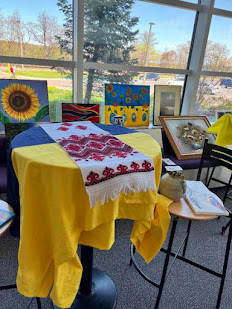
Finally, students from YEAH collaborated on the art exhibit "Voices and Visions: The Art and Science of Climate Action," which was on display at the U.S. Center pavilion. The exhibit highlighted the importance of both art and science in the fight against climate change and how both can be leveraged to make a difference. The exhibit included a compilation of photos and artwork, as well as videos that could be accessed via QR codes. Many were related to research and other academic work students were working on related to climate change and environmental issues as a whole.

The art exhibit on display at the U.S. Center pavilion [11/10/22]. (Photo © and courtesy Kendra Lachcik)

I had the opportunity to meet students from other institutions all across the U.S and the globe. Specifically, I collaborated with students and faculty from Monash University in Melbourne, Australia, for the press conference mentioned above. It was incredible to see people from all walks of life and from virtually every country on the planet gathered in one place for the sake of fighting the climate crisis. There is a lot of work that still needs to be done, but there are also so many people committed to this fight, which is very reassuring. COP27 reinforced for me that it will take every country, every sector of the economy, and every individual to combat the climate crisis. We must be all in.

The sunrise off the coast of Sharm El-Sheikh facing east toward Saudi Arabia [11/12/22]. (Photo © and courtesy Kendra Lachcik)

Notes:

*Guest author Kendra Lachcik is a 2023 graduate of Michigan Tech University with a bachelor's degree in Environmental Engineering. She is also the undergraduate winner of the  Inaugural Michigan Tech Sustainability Award for 2022 and Michigan Tech's 2023 Nicole Bloom Award for Environmental Sustainability.

For more details on COP and another perspective on COP27, see Michigan Tech delegate Aritra Chakrabarty’s guest article, "Breaking Down the Utopia of COP27," on Keweenaw Now.

**Alexis Pascaris also attended COP 26 in 2021. See her Jan. 1, 2022, guest article, "COP 26 Reflection" on Keweenaw Now.

Sunday, December 04, 2022

Guest article: Breaking Down the Utopia of COP27

By Aritra Chakrabarty*

During COP27, members of indigenous communities protest the piling climate debt on developing countries. Click on photos for larger versions. (Photo © and courtesy Aritra Chakrabarty)

Once you enter the main venue at the COP 27 climate conference (the venue referred to as the Blue zone) your eyes are greeted with swarms of people sashaying across the different meeting and conference rooms. This year COP 27 --  held in November in Sharm El-Sheikh, Egypt -- saw over 35,000 participants. Their faces look important, their attire looks sharp, their diction appears perfect, and their walk appears focused. All of that is of course with a reason -- you’re at the annual United Nations Framework Convention on Climate Change (UNFCCC) conference, popularly referred to as the Conference of Parties (COP). This year, COP was in its 27th annual meeting, held in the transcontinental country Egypt, which spans the northeast corner of Africa and southwest corner of Asia.

The COP venue can be compared to a giant amusement park with many rides, many attractions, many booths, and many sights to see. A child wants to go on every ride, make the most of the day at the park, and not lose out on any of the magic tricks. At COP, the magic happens behind closed doors where negotiations are underway to decide on the minute details of documents (in particular nouns, verbs, and phrases that require substantiation and explicit mention of rights and responsibilities across all Parties). The kid can only choose a few of the many rides because by the end of the day, you’ll exit feeling knowing less than before, more crumbled than before. 

This installation in one of the pavilions counts down the critical time window to reach zero emissions. (Photo © and courtesy Aritra Chakrabarty)

The utopia of COP as the perfect venue for climate discussions, for demystifying climate science and policy, is a veneer that gives way to the reality of organized chaos inside this amusement park.

Role of the Parties

COP is the supreme decision-making body of the UNFCCC Convention. All States that are Parties to the Convention are represented at each COP, during which they review the implementation of the agenda from previous conventions, review legal documents that have been mutually agreed upon by the Parties and take necessary decisions to promote the objective of UNFCCC. The Parties to the Convention also serve as representatives of the Parties that had signed and agreed to the Kyoto Protocol.** The Parties to the Convention also serve as representatives of the Parties that had signed and agreed to the Paris Agreement.***

The human body wearing away through time as the world heats up. (Photo © and courtesy Aritra Chakrabarty)

Entering the Blue Zone

Before you make any decision to attend one of the multitude of meetings happening concurrently, you should collect "swag" -- the goodies at COP. You’re handed a cloth satchel bag with a (glass) water bottle, another (metal) water bottle, a note pad and a pair of pencils. I’m not sure if it was only my expectations that were belied, but I was hoping for a better swag from COP -- one containing local craft and including an element of Egypt. But all that I could see was a "Made in China" tag on the bottles (sigh). Over the course of one week (or two depending on how long you plan to attend), you’ll have the opportunity to gather similar other swags from different country pavilions (these are the spaces allotted inside the Blue zone where each signatory Party showcases their agenda). This global climate change conference generates a significant number of promotional items as part of "green marketing."

The Blue zone is the important location where meetings happen, plenary sessions occur. Dignitaries, country representatives, and official representatives make statements, negotiate, give press conferences. This is where participants have the chance to make their agenda heard and to look for other stakeholders who hold similar business interests -- and, as they say in consulting parlance, where participants use this platform as a networking event to create prospective clientele. (There is another zone -- the "Green zone," situated ten minutes away by bus ride, which is the space for industry, academia, NGOs, and other private entities to piggy back on the wave of climate change keywords to pitch their work.)

Michigan Tech's Delegation

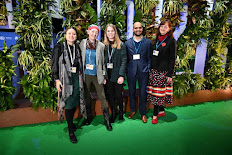
Pictured here at COP27 with author Aritra Chakrabarty, second from left, are three other members of Michigan Tech's delegation -- from left, Zachary Hough Solomon, Shardul Tiwari, and Katherine Huerta Sanchez. All are graduate students in Michigan Tech's Department of Social Sciences, Environment and Energy Policy Program. (Photo © and courtesy Shardul Tiwari)

In the Blue Zone, every day, you dress up to match the pulse of the crowd hoping that your attire will be noticed before you utter a word about your work. The question in your mind is, "How much information can I absorb today?" Because there is a gigantic amount of knowledge floating inside the venue and it is quite easy to wander off in that information cloud. As for me, I was present there as part of my college delegation from Michigan Technological University, which has an observer status under RINGO (Research and Independent Non-Governmental Organization) constituency. The RINGO constituency to the UNFCCC is one of the nine NGO constituencies recognized by UNFCCC with an observer status, and they represent 25 percent of the 2000 NGOs admitted to the conference.****

I was there along with my fellow colleagues to organize a panel session on the topic "Delocalizing Climate Policy through use of Knowledge of Local and Indigenous communities." This panel was part of the broad objective of the Paris Committee on Capacity Building (PCCB), which was established during COP 21. The PCCB was created to address current and future gaps that would emerge and would need focused capacity building in developing countries. The PCCB also serves the Paris Agreement and fosters collaboration among actors at all levels to promote knowledge and experience sharing.*****

Native Americans at COP27 protest against the funding of fossil fuel pipeline infrastructure. (Photo © and courtesy Aritra Chakrabarty)

Through the participation in the Capacity Building Hub organized by the PCCB, our objective was to inform climate policy making through local knowledge that has been the wealth of indigenous and other local communities for centuries and to show how their practices have helped in harboring a sustainable relationship between humans and the ecosystem. The intent was to advocate for local voices in adaptation strategies for utilizing the Loss and Damage climate fund productively to aid communities that are on the fringe lines of negative climate change events.

Loss and Damage related protests were the highlight of this COP. (Photo © and courtesy Aritra Chakrabarty)

There has also been substantial critique in international media regarding situating COP in a country that has a chequered history of human rights and environmental policy. There has been media backlash about curtailing freedom of expression in the form of negligible subdued protests outside the venue, compared to protests at COP 26, held in 2021 at Glasgow, UK.****** As a first-time participant, I did, however, witness a handful of "protests" that were held inside the venue this time.

Yes, I refer to it as "this" and allow me to shed light on why this is the case: One cannot hold a protest in the truest meaning of the word. Holding protests inside the venue requires approvals. If you have to organize a protest, you need to have a badge to enter the COP venue; your organization should submit a proposal that details the agenda of the protest, the duration of protest, a ball park figure of protestors, so on and so forth. From an activist point of view, this is hypocrisy and an act of surveillance. However, from a logistical perspective, it only makes sense for the organizers to know beforehand what and when you’ll be protesting in the venue.

It also made sense from an economic standpoint to have COP27 in Egypt. The event boosted the economy of the region, created the need for building infrastructure investments (roads, transport, services), created many skilled jobs for the young population, and generated an influx of foreign exchange. COP 27 saw one major victory by producing a Loss and Damage fund. But this COP saw several non-successes as well -- such as failure to commit to phasing out of fossil fuels, particularly coal; failure to raise ambition on targeting global warming below 1.5 degrees Celsius; and greenwashing through carbon trading schemes. Nonetheless, those failures do not take away the importance of this global venue as the space that creates hope for a utopian world, and we will get there -- one step at a time.

Notes: 

* Guest author Aritra Chakrabarty is a PhD Research Scholar in Environment and Energy Policy at Michigan Tech University. 

** https://unfccc.int/process-and-meetings/the-kyoto-protocol/what-is-the-kyoto-protocol/kyoto-protocol-targets-for-the-first-commitment-period   

***  https://unfccc.int/process-and-meetings/the-paris-agreement/the-paris-agreement 

**** https://ringosnet.wordpress.com/

***** https://unfccc.int/pccb

****** https://unfccc.int/conference/glasgow-climate-change-conference-october-november-2021 

Editor's Note: See also Keweenaw Now articles by members of Michigan Tech's delegation to COP 26 in Glasgow:

"Guest article: COP26 Reflection," by Alexis Pascaris. Jan 1, 2022.

"Guest article: COP26 -- An Indigenous Experience," by Kathleen Brosemer. Jan. 14, 2022.

"Guest article: Attending COP26: A lesson in distributive climate injustice," by Shardul Tiwari. Apr. 22, 2022.