See our right-hand column for announcements and news briefs. Scroll down the right-hand column to access the Archives -- links to articles posted in the main column since 2007. See details about our site, including a way to comment, in the yellow text above the Archives.
Showing posts with label US Army Corps of Engineers EIS for Enbridge tunnel. Show all posts

Sunday, April 20, 2025

Six tribes end cooperation with US Army Corps over "Energy Emergency" Line 5 tunnel fast-tracking

This map shows the location of the existing Line 5 dual pipelines -- dotted lines to the west (at left) of the Mackinac Bridge (at right, in red) between St. Ignace and Mackinaw City, Michigan. Enbridge hopes to replace the 71-year-old Line 5 with a pipeline inside a tunnel under the lakebed of the Straits. (Keweenaw Now file image courtesy US Army Corps of Engineers) 

From Native American Rights Fund and Earth Justice*:

[On April 16, 2025, the U.S. Army Corps of Engineers (USACE) announced it will not perform a full review of the Line 5 tunnel projects under the pretext of a made up "energy emergency." The proposed tunnel would pass through the Straits of Mackinac, a sacred place shared by treaty with the Bay Mills Indian Community. USACE shortened and moved review timelines for environmental impacts, endangered species, treaty rights, and cultural resources. These measures cut out Tribal Nations, the public, and state regulators from providing meaningful input -- and they make the review wildly inconsistent with federal law. In March, Bay Mills and other Tribal Nations cited the many gaps and flaws in USACE’s environmental review process prior to ending their consulting partner status in protest.]

DETROIT --  Six Michigan Tribes withdrew from Line 5 federal discussions after learning that the US Army Corps of Engineers will likely fast-track its approval for Enbridge’s massive oil tunnel project, in accordance with President Trump’s Executive Order declaring an "energy emergency." In a letter sent to the US Army Corps on March 21, 2025, the Tribes called the Corps’ actions "unacceptable."

"We participated in the process, we followed the rules, we provided the case law, we submitted the evidence, and we trusted that our voices and our treaty rights would be respected. Yet, once again, the federal government has cast us aside and failed us," said Bay Mills Indian Community President Whitney Gravelle. "Instead of protecting our waters, lands, and sacred sites, the government is forcing this dangerous project forward, ignoring the harm it will bring to the Tribal Nations and the people of Michigan. We will not stand by while our sovereignty is disregarded for the sake of foreign profits. Michigan’s leaders must act now to defend our shared waters before it’s too late."

Whitney Gravelle, president of the Bay Mills Indian Community, is pictured here before the Pipe Out Paddle Up Floatilla Against the Line 5 pipeline in Mackinaw City, Michigan, on Saturday, September 3, 2022. (Photo by Sarah Rice for Earthjustice. Reprinted with permission.) 

The Bay Mills Indian Community, Little River Band of Ottawa Indians, Sault Ste. Marie Tribe of Chippewa Indians, Grand Traverse Band of Ottawa and Chippewa Indians, Match-E-Be-Nash-She-Wish Band of Pottawatomi, and Nottawaseppi Huron Band of the Potawatomi had been engaging with the Corps’ review of the Line 5 tunnel project as "cooperating agencies" under the National Environmental Policy Act.

Under the Biden administration, the Corps was preparing a draft Environmental Impact Statement after receiving over 17,000 public comments on the tunnel project. An internal memo circulated in January by Former Assistant Secretary of the Army (Civil Works) Jaime Pinkham directed the agency to assess the risk of oil spills from approving the tunnel project, and to consider other alternatives in its review. Now, the Corps is likely to apply emergency treatment and issue a permit for the tunnel project, without completing reviews of oil spills and other environmental impacts, alternatives, and effects on cultural resources.

"It appears the U.S. Army Corps plans to short-circuit the environmental and historic properties review by announcing they intend to use the guise of an American 'energy emergency' to fast-track the legally required public comment and Tribal consultation processes, greenlighting a Canadian corporation’s project that will desecrate a sacred place and threaten Great Lakes residents’ drinking water," said Senior Staff Attorney David L. Gover with the Native American Rights Fund, which represents the Tribes.

Experts have warned that the tunnel project design, which has never been tried before anywhere else in the world, could lead to an explosion under the Straits. Along with federal approval, Enbridge still needs a permit from Michigan’s Department of Environment, Great Lakes, and Energy (EGLE) to begin construction. A public comment period is expected as part of that permitting process.**

"Resuscitating an old pipeline that carries most of its oil and gas back to Canada won’t do a thing for the US energy supply," said Earthjustice Managing Attorney Debbie Chizewer, who is representing Bay Mills. "But it might lead to the next big oil disaster. Only this time, it will happen in the middle of the largest freshwater drinking supply in North America. We can’t allow that to happen."

Read the letter: https://narf.org/nill/documents/20250321-line5-eis-withdrawal-letter.pdf

Impacts to Bay Mills Indian Community: https://narf.org/cases/enbridges-line-5-pipeline/

* About the Native American Rights Fund (NARF):

NARF is a non-profit 501c(3) organization focused on applying existing laws and treaties to guarantee that federal and state governments live up to their legal obligations to Native Americans. Since 1970, the Native American Rights Fund (NARF) has provided specialized legal assistance to Indian tribes, organizations, and individuals nationwide to assert and defend the most important Native rights. In hundreds of major cases. NARF has achieved significant results in critical areas such as tribal sovereignty, treaty rights, natural resource protection, voting rights, and Indian education. Like us on Facebook and follow us on LinkedIn to learn about the latest fights to promote justice and protect Native American rights.

* About Earthjustice:

Earthjustice is the premier nonprofit environmental law organization. We wield the power of law and the strength of partnership to protect people's health, to preserve magnificent places and wildlife, to advance clean energy, and to combat climate change.

** Editor's Note: CLICK HERE to take action through Oil and Water Don't Mix to demand that EGLE deny the Line 5 tunnel permit.

Wednesday, August 24, 2022

Corps of Engineers schedules Enbridge Line 5 EIS public meetings

From Wisconsin Citizens Media Cooperative
Posted August 24, 2022, on wcmcoop.org


This map shows the location of the existing Line 5 dual pipelines -- dotted lines to the west of the Mackinac Bridge (at right, in red) between St. Ignace and Mackinaw City, Michigan. Enbridge hopes to replace the 69-year-old Line 5 with a pipeline inside a tunnel under the lakebed of the Straits. (Image courtesy US Army Corps of Engineers)

DETROIT --The U.S. Army Corps of Engineers is hosting three public scoping meetings for Enbridge’s Line 5 Pipeline Tunnel project Environmental Impact Statement (EIS) scoping process.

The EIS’s 60-day scoping process began August 15, 2022, with the Notice of Intent (NOI) publishing in the Federal Register.*

Tribal Nations, agencies, communities, organizations, citizens and other stakeholders can provide input through October 14, 2022, via mail through the project website or at the in-person or virtual public meetings as follows:

  • Sept. 1, 2022, 5 p.m.-8 p.m. Eastern (Virtual): https://us06web.zoom.us/j/83590131384 or by phone 309-205-3325 using Webinar ID: 835 9013 1384
  • Sept. 8, 2022, 3 p.m.-8 p.m. Eastern (In-Person) at the Little Bear Arena, 275 Marquette Street in Saint Ignace, Michigan 49781
  • Oct. 6, 2022, 1 p.m.-4 p.m. Eastern (Virtual): https://us06web.zoom.us/j/82961743672 or by phone 309-205-3325 using Webinar ID: 829 6174 3672

Participation limits for the meetings are 1,000 per virtual meeting and approximately 500 for the in-person meeting. Meetings are first come and will be capped at capacity limits. RSVPs are not necessary. All comments, regardless of how they are submitted, verbal or written, by mail, email or during public meetings, are weighed equally. A Public Scoping Meeting is specific to the National Environmental Policy Act (NEPA) process where the lead federal agency gathers comments of the proposed project. The meetings will begin with the Corps of Engineers providing a brief presentation to review the proposed project, the NEPA process and methods of providing scoping comments. Attendees will then have the opportunity to provide information regarding the EIS scope. 

"Tribal, agency and public input is extremely important to help define the range of issues and potential alternatives the EIS should address," said Detroit District Commander Lt. Col. Brett Boyle. "Comments should help identify areas for in-depth review, including historic properties, water quality, general environmental effects and other public interest factors. This is a great opportunity to have an impact in the Corps of Engineers scoping process for developing the Draft EIS."

The Corps of Engineers will ensure all voices are heard in an open, transparent and public EIS process, according to Boyle.

In addition to allowing public (verbal) comments, the in-person meeting will also provide opportunity for attendees to provide comment in private to a stenographer, as well as have live computer stations to submit comments via the www.line5tunneleis.com website. Comment forms will also be available for individuals to submit written comments at the in-person meeting. Interested members of the public can provide comments anytime during the public scoping period (through October 14, 2022) via the project website or mail: Line 5 Tunnel EIS, 16501 Shady Grove Road, P.O. Box 10178, Gaithersburg, MD 20898.

For more information on developing effective scoping comments, submitting comments, or public meeting information, please visit: www.Line5TunnelEIS.com.

The Corps of Engineers previously conducted two public comment periods, May 15 - July 14, 2020, and November 6 - December 17, 2020, receiving more than 15,000 public comments and Tribal input on the proposed project during those periods. The EIS process requires additional public comment periods.

Corps of Engineers officials will consider comments received during all public comment periods in the EIS preparation pursuant to National Environmental Policy Act. Comments are also used to determine whether the activity is contrary to the overall public interest. The EIS will in turn help determine whether the Corps of Engineers issues, issues with conditions or denies the permit request.

For the Line 5 tunnel project, Enbridge Energy is proposing to construct a tunnel under the bed of the Straits of Mackinac between Point LaBarbe, St. Ignace, and McGulpin Point, Mackinaw City, Michigan. The tunnel would house a new 30-inch pipeline for light crude oil and liquid natural gas, replacing the existing dual submerged pipelines crossing the Straits of Mackinac, which have been in operation since 1953.

The application is being evaluated under Section 10 of the Rivers and Harbors Act of 1899 and Section 404 of the Clean Water Act in accordance with federal regulations and policies. Corps of Engineers authority is limited to the proposed crossing of the Straits of Mackinac and adjacent wetlands.

The Detroit District provides vital public engineering services in peace and war to secure our Nation, protect the environment, energize our economy and reduce risks from natural disasters.

Contact Detroit District Public Affairs Specialist Emily Schaefer, 313-226-4681, or Emily.R.Schaefer@usace.army.mil for further information.

* See also: "Army Corps of Engineers to open public comments on EIS of Enbridge Line 5 Tunnel Project in Michigan." (August 15 Public Notice)

Saturday, July 03, 2021

Environmental, tribal groups comment on decision to have US Army Corps conduct EIS for proposed Line 5 tunnel in Straits

By Michele Bourdieu

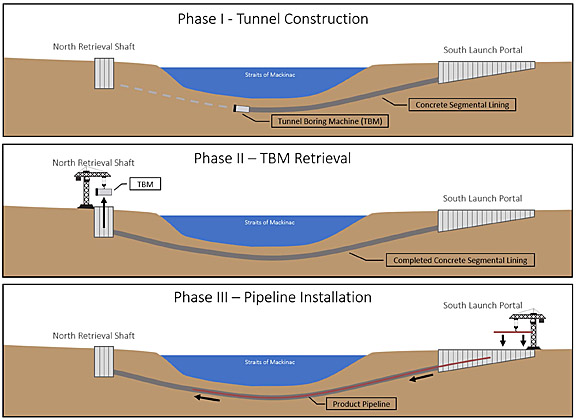
This figure showing proposed three phases of construction for the Enbridge Line 5 tunnel appears on the Feb. 1, 2021, project update from the US Army Corps of Engineers, Detroit District. (Image courtesy US Army Corps of Engineers)

DETROIT --  Environmental and tribal groups have welcomed the June 23, 2021, decision that the US Army Corps of Engineers (USACE) will conduct an Environmental Impact Statement (EIS) for Enbridge’s proposed Line 5 oil tunnel through the Straits of Mackinac, but these groups have expressed some continued concerns that the EIS include a thorough review and respect treaty rights.

A June 23 article from the US Army cites Acting Assistant Secretary of the Army for Civil Works as saying, "'USACE will ensure all potential impacts and reasonable alternatives associated with this project are thoroughly analyzed and will ultimately support a decision on the permit application. The USACE received thousands of public comments and tribal input on the proposed project, which warrant further review through an EIS, including potential impacts to navigation.'"*

Oil and Water Don't Mix (OWDM) -- a coalition of community groups, organizations and businesses concerned with the threat of Enbridge's Line 5 through the Straits of Mackinac -- calls the June 23 decision a major development. The coalition states that a project of this magnitude requires a full review under the National Environmental Protection Act (NEPA), something Enbridge has resisted. 

"Serious concerns about this massive project in the heart of the Great Lakes have been raised by engineers and other scientists," said Sean McBrearty, OWDM Coordinator.

OWDM notes the following on their Web site:

"Annual greenhouse gas emissions attributable to the oil and natural gas liquids transported by Line 5 are in the millions of metric tons and would contribute to greenhouse gas emissions for the next century if Enbridge’s plans are approved.

"The Army Corps should also take a hard look at the impacts of the Line 3 and Dakota Access pipelines, which also threaten clean water, Indigenous rights, and the climate. Boring an unprecedented tunnel through the bedrock and soils of the Great Lakes threatens to violate a host of federal, state, or local laws or requirements imposed for the protection of the environment. It is difficult to imagine how Enbridge’s tunnel project can survive the kind of thorough, independent evaluation that is now possible with this recent Army Corps decision."

Jeffrey Towner of Negaunee Township, who is a retired Corps of Engineers regulatory program supervisor, told Keweenaw Now he believes the Army Corps is making the right decision in requiring an EIS for the tunnel project. He also expressed hope for more public input.

"An EIS provides a much more detailed analysis and public interest review than the more cursory environmental assessment process," Towner said. "In order to issue a permit, among other things, the Corps must find that the project construction and operation will not be contrary to the public interest. In addition to the comment period allowing written comments, I would certainly hope that the Corps will hold several public hearings, including in communities adjacent to the Straits of Mackinac, to accept comments from agencies, non-governmental organizations, Tribes, and individual citizens."

This map shows the location of the existing Line 5 dual pipelines -- dotted lines to the west of the Mackinac Bridge (at right, in red) between St. Ignace and Mackinaw City, Michigan. Enbridge hopes to replace the 67-year-old Line 5 with a pipeline inside a tunnel under the lakebed of the Straits. (Image courtesy US Army Corps of Engineers)

FLOW (For the Love of Water), a Great Lakes law and policy center in Traverse City, Michigan, protecting the magnificent, shared waters of the Great Lakes Basin through public trust solutions, posted this on their Facebook page:

"This is big news! The Army for Civil Works, which oversees the U.S. Army Corps of Engineers, announced Wednesday (June 23) that it would require the corps to develop an environmental impact statement regarding the Enbridge permit application for a Line 5 oil tunnel in the Straits of Mackinac because of 'the potential impacts significantly affecting the quality of the human environment.'

"FLOW's legal team aided in this effort by submitting comprehensive comments to the U.S. Army Corps of Engineers calling for an environmental impact statement on behalf of a dozen organizations: Chippewa Ottawa Resource Authority (CORA), Clean Water Action - Michigan, FLOW for Water, Groundwork Center, League of Women Voters of Michigan, Michigan Environmental Council, Michigan League of Conservation Voters, NMEAC, Sierra Club Michigan Chapter, Straits Area Concerned Citizens for Peace, Justice and Environment, Straits of Mackinac Alliance, and TC 350."**

The Chippewa Ottawa Resource Authority (CORA) -- a coalition of five 1836 Treaty fishing tribes in Michigan -- Bay Mills Indian Community, Grand Traverse Band of Ottawa and Chippewa Indians, Little River Band of Ottawa Indians, Little Traverse Bay Bands of Odawa Indians, and Sault Ste. Marie Tribe of Chippewa Indians -- issued in 2017 a "Resolution in Opposition to Placing an  Oil Pipeline in Trenches or Tunnel Beneath the Straits of Mackinac," stating, in part, that "both trenching and tunneling beneath the Straits of Mackinac will have significant adverse effects to the Treaty Fishery in that area including significant disruptive effects on the bottomlands, water quality, fish spawning shoals and will require disruption of tribal commercial and subsistence fisheries" and "construction of new pipelines in the Straits of Mackinac, be they in trenches or tunnels, will not eliminate the risks of an oil spill in the 1836 Treaty ceded lands and waters." CORA is also a member of the Oil and Water Don't Mix coalition.

Beverly Carrick, CORA’s Interim Executive Director, stated CORA's reaction to the decision for an Army Corps EIS:
"CORA has been urging the Army Corps to conduct an EIS on Line 5 for many years now and we are pleased to see that they are finally going to follow through. CORA will be carefully following the EIS development to ensure that tribal treaty rights are protected. We believe that the best alternative to a tunnel and continued operation of Line 5 is to simply shut it down and decommission it."

This image showing wetland impacts of the proposed tunnel project is one of several diagrams included in the US Army Corps of Engineers Public Notice on Enbridge's tunnel application. Click here for a larger version of this diagram on p. 12 of the Army Corps Public Notice of May 15, 2020.

The Bay Mills Indian Community, a CORA member, has also opposed Line 5 and the tunnel consistently and is in litigation against Enbridge.

Whitney Gravelle, Bay Mills Executive Council chairwoman, told Keweenaw Now the decision for the Army Corps to require an EIS has great significance because of treaty rights.

"The decision by the Army Corps of Engineers to require an Environmental Impact Statement for the proposed Enbridge Line 5 pipeline carries enormous significance because it will require an in-depth analysis of the pipeline tunnel's environmental impacts," Gravelle said. "Tribal Nations are encouraged to see that the Army Corps of Engineers heeded our call to undertake a more rigorous analysis of these environmental impacts, because that also requires a more rigorous analysis of how the tunnel project will impact our treaty-protected interests in the Straits of Mackinac. As part of this EIS process, the Corps will need to honor its treaty obligations to Bay Mills and other Tribal Nations, including considering the impact of the tunnel project on tribal resources."

Concerning Bay Mills' involvement in litigation, Gravelle, noted the following: "Yes, we are an intervening party before the Michigan Public Service Commission and have filed a contested case petition against the Environment Great Lakes and Energy Department (EGLE) as well for issuance of the permits in January 2021. We have also filed an amicus brief in Governor Whitmer v. Enbridge, et. al and are actively involved in tribal consultation with several state and federal agencies."***

Lisa Patrell, spokesperson for the Michigan Anishinaabek Caucus, said the Army Corps EIS must include Treaty Rights, a prehistoric site, and endangered and threatened species.

"This (decision) satisfies one of the demands of many Tribal citizens and water advocates," Patrell stated. "Unfortunately, there is no guarantee that a completed EIS will result in the denial of the permit, but it is a delay. The delay could be several years."

Patrell pointed out that the Corps' own general definition of what areas an EIS should address leaves out facts and specifics, such as Treaty Rights.

The Corps states the following on what an EIS should consider:

"Although requirements differ between situations, an EIS must address the total impact on the environment and consider numerous factors. Examples of factors considered are:

  • the environmental impact of the proposed action
  • any adverse environmental effects which cannot be avoided should the proposal be implemented
  • alternatives to the proposed action
  • the relationship between local short-term uses of man's environment and the maintenance and enhancement of long-term productivity, and any irreversible and irretrievable commitments of resources which would be involved in the proposed action should it be implemented."****

Patrell added, "Neither are endangered or threatened species explicitly mentioned, although the first and second bullet point could be construed to include them. Endangered and threatened species are the purview of the U.S. Department of Fish and Wildlife."

While Treaty Rights guarantee the right of Tribal citizens to hunt, fish and gather in the Great Lakes ecosystem, an additional concern is the September 2020 discovery of a submerged prehistoric indigenous site under the Straits just west of Line 5.

Potential cultural site observed with side-scan sonar in late summer 2020. Note circle of stones that may have been placed in this arrangement about 10,000 years ago, near the end of the Ice Age, when the area would have been above water. (File photo courtesy Terri Wilkerson)*****

"The Corps’ EIS generic scope does not include prehistoric, historic, or cultural sites," Patrell said. "The Michigan Anishinaabek Caucus recognizes that the Corps customizes an EIS scope for every study. Thus, the Michigan Anishinaabek Caucus requests that the Corps explicitly include Treaty Rights, endangered and threatened flora and fauna, and the submerged indigenous prehistoric site in the EIS scope."

NOTES:

* See: "Acting Army assistant secretary announces USACE will conduct an EIS for Enbridge Line 5."

** You can read those joint comments here:

Dec. 15, 2020 -- Supplemental Comments to USACE permitting on proposed tunnel

July 14, 2020 -- Comments to USACE permitting on proposed tunnel

*** See our Feb. 9, 2021, article, "EGLE approves some permits for Enbridge tunnel project; tribal, environmental groups challenge EGLE decision."

**** See USACE's "What is an Environmental Impact Statement?"

***** See our Oct. 17, 2020, article by Terri Wilkerson, "Ancient underwater tribal cultural site discovered in Mackinac Straits near Line 5."

See also the Detroit Free Press article, "Group thinks it has found proof of 10,000-year-old, Ice Age culture in Straits of Mackinac."