See our right-hand column for announcements and news briefs. Scroll down the right-hand column to access the Archives -- links to articles posted in the main column since 2007. See details about our site, including a way to comment, in the yellow text above the Archives.
Showing posts with label Wisconsin Citizens Media Cooperative. Show all posts

Saturday, April 22, 2023

Line 5 ACTION ALERT: Tell Canadian Ministers to Stop Misusing the 1977 Transit Pipelines Treaty

From: Cross Border Organizing Working Group of the Line 5 Coalition
Posted on Wisconsin Citizens Media Cooperative
Shared here with permission

During the COP 15 Biodiversity Conference in Montreal last December, Indigenous communities protest against Enbridge, the company owning Line 5. (File photo © and courtesy Rebecca Kemble of the Wisconsin Citizens Media Cooperative)

The Cross Border Organizing Working Group of the Line 5 Coalition is an international group of activists and Indigenous leaders working to shut down Enbridge’s Line 5. We have drafted a letter to key Canadian Ministers asking them to stop misusing a 1977 treaty in order to keep a decrepit pipeline in service.

Canada has formally invoked Article Six of the 1977 Transit Pipelines Treaty twice to keep the 70-year-old Line 5 operating. First on October 4, 2021, in response to Michigan Governor Whitmer’s order to shut the pipeline down after a ship’s anchor strike causing significant risk to the Straits of Mackinac. They did so a second time on August 29, 2022, when the Bad River Band of Lake Superior Chippewa discovered serious erosion beneath the pipeline leaving it unsupported, and at significant risk of failure with the next severe weather event.

We intend to deliver the letter on April 24, the day after Line 5 turns 70 years old, 20 years past its planned life expectancy.

Please join us in asking the Canadian government to stop impeding the efforts to uphold the inherent rights of the Indigenous Nations of the Great Lakes while honoring all of the treaties with Indigenous Nations north and south of the border that predate and supersede the 1977 pipeline treaty. You can sign on to the letter as an organization or as an individual HERE or CLICK HERE to read a copy of the letter and sign it on the Wisconsin Citizens Media Cooperative Web site.

Wednesday, November 16, 2022

Wisconsin DNR sends Enbridge a list of demands

By Barbara With*

Posted Nov. 1, 2022, on Wisconsin Citizens Media Cooperative

Reprinted here with permission

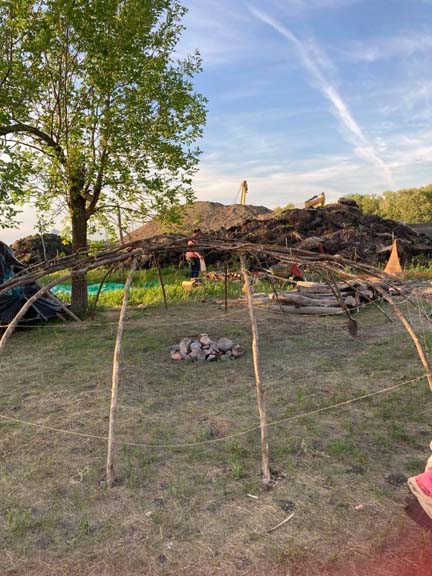
Terrain near Copper Falls State Park, Wis., where Enbridge plans to do horizontal directional drilling to build a pipeline. (Photo courtesy Wisconsin Citizens Media Cooperative)

On October 31, 2022, the Wisconsin Department of Natural Resources (WIDNR) sent Enbridge Energy a letter asking for data needed to prepare the environmental impact statement (EIS) for their proposed Line 5 reroute through the Bad River watershed. Among other things, the letter questions the drilling fluids -- how many and what other damaging additives they plan to use -- and how they will contain PFAS.

READ LETTER HERE

Just two weeks prior, Minnesota Attorney General Keith Ellison filed criminal charges against Enbridge for the damage they did in northern Minnesota when they built Line 3. Among other things, on August 10, 2021 the Minnesota Pollution Control Agency (MPCA) released a report saying there had been more frack outs of drilling fluid spilled along Line 3 than Enbridge had previously reported. The state water permit issued to Enbridge did not authorize the release of drilling fluid to a wetland or river. But between June 8 and August 5, Enbridge created 28 releases at 12 river crossings, with 13 spills into wetlands and 14 in upland areas. Enbridge brokered an $11M settlement with the State and must promise to not break the law again.

WIDNR is in the process of developing an EIS in response to Enbridge’s proposed plan to reroute their ailing pipeline out of the Bad River Band of Lake Superior Chippewa’s reservation. The Band did not renew Enbridge’s easement in 2013, but Enbridge continued to operate illegally. Bad River sued in 2019, and on September 7, 2022 Enbridge was found guilty of criminal trespass and unjust enrichment and ordered to pay financial compensation.

Instead of decommissioning Line 5, they plan to reroute it into the million-year-old watershed of the Penokee Hills. They are proposing doing horizontal directional drilling (HDD) through terrain that, in the event of a spill, would be near impossible to respond to. The watershed flows into Lake Superior through the Kakagon Sloughs, home of Bad River’s wild rice. Considering the damage done in Minnesota and their propensity to lie, Enbridge should be pressed with the hard questions of how they would plan to protect the area from their reckless practices.

In August 2022, WIDNR reported that an Enbridge contractor discovered oil-contaminated soil along the Enbridge Line 5 pipeline just south of the City of Ashland. Several thousand pounds of dirt were removed according to eye witnesses. Enbridge reported it was only about a tablespoon. Enbridge continues to demonstrate that they cannot be forthcoming with the truth.

Bad River Chairman Mike Wiggins Jr: "Deep Blue under Earth drinking water aquifers look like they are reaching out but they are actually pouring down and pouring in. Wispy areas are where surface waters and groundwaters interact, and it’s hardly a place for Earth destroyers. Water is life." Click on map for larger version. (Map courtesy Mike Wiggins, Jr.)

To make matters worse, Enbridge has already signed a contract with the Michels Corporation to build Line 5. Owner Tim Michels would profit greatly from WIDNR granting permits. The Michels Corporation, however, has been part of criminal charges recently filed by Pennsylvania Attorney General Josh Shapiro against Energy Transfer Partners (ETP) for the work they did on the Mariner East 2 pipeline. Michels was the construction company and the grand jury investigation revealed that Michels lost drilling fluid 22 different times during the drilling of the 20-inch line and another nine times during work on the 16-inch line.**

READ THE GRAND JURY REPORT

Drilling for a 16-inch line began in May 2020 with Michels as the subcontractor. Between May and August, the drill lost circulation of fluid totaling approximately 100,000 gallons. These losses were not reported to DEP (Pennsylvania Department of Environmental Protection). From August through September, drilling fluid flowed into Snitz Creek five different times, resulting in five more Notices of Violation from DEP.

Grand Jury investigation into Mariner East 2 Pipeline 

Taking all of this into account, how can Enbridge or Michels be trusted here? Does it matter how they respond to WIDNR request for information?

Enbridge should not be trusted to monitor themselves. Million-dollar fines are calculated as a cost of doing business, leaving behind damaged aquifers, contaminated soil, poisoned wells, millions of gallons of water wasted, and remediation projects that cost millions of dollars and take years to complete. In light of the evidence that Enbridge breaks the law repeatedly, WIDNR would be wise to not allow them into the watershed.

Decommission the line and let Enbridge use any of the many other lines they have running through Wisconsin to reroute their oil.

Editor's Notes:

* Guest author Barbara With is a journalist for the Wisconsin Citizens Media Cooperative.

** When Tim Michels was running for governor of Wisconsin in the recent midterm election, he promised to break up WIDNR. Since the original date of publication of this article, he lost that election to incumbent Wisconsin Governor Tony Evers.

Monday, February 14, 2022

Guest Article: Speak Up for Lake Superior’s Bad River Watershed: Work to Save What You Love!

Lake Superior. (Photo courtesy Wisconsin Citizens Media Cooperative)

Posted Feb. 13, 2022, on Wisconsin Citizens Media Cooperative (WCMC)
Reprinted here with permission

A Zoom Webinar will be held from 6 p.m. - 7 p.m. (CT) / 7 p.m. - 8 p.m. (ET) on Monday, February 14. This second Webinar in WCMC's Kairos-supported* events focuses on the following:

  • What is included and what was omitted in the Wisconsin Department of Natural Resource’s draft Environmental Impact Statement (EIS) on the proposed re-routing of Enbridge Line 5
  • What points to highlight in written responses to the WI DNR within the public response period (closing on March 18, 2022)
  • Resources and toolkits for effective letters to the WI DNR and government leaders

Guest Speakers:

Marcia Bjornerud, professor of environmental studies and geosciences at Lawrence University, is a structural geologist. She has done field research in arctic and mainland Norway, arctic Canada, Scotland, New Zealand, Italy and the Lake Superior region, including the Gogebic Range/Penokee Hills. She has worked pro bono with the Great Lakes Indian Fish and Wildlife Commission in challenging two mining projects in the Lake Superior watershed. In 2008, she was an expert witness in an administrative court case against the Eagle copper-nickel sulfide mine northwest of Marquette, Michigan. In 2012, she prepared a report for GLIFWC on the potential environmental effects of a proposed mountaintop removal iron mining project in the Gogebic Range and testified about this at a hearing at the Wisconsin State Capitol. She is a mother of three sons, an avid cross-country skier, and a wild food forager -- and once bicycled around Lake Superior with two friends (it took 13 days).

Philomena Kebec belongs to the Bad River Band of Lake Superior Chippewa. She moved home 10 years ago to advocate for protection of watershed resources. Philomena is an elected Ashland County Supervisor and runs a small nonprofit, Badriverharmreduction.org, that provides services to prevent overdose and infection for people who use drugs. (She would welcome financial support for her nonprofit.) Philomena is deeply knowledgeable about the Bad River watershed and its residents.

Register in advance for this webinar at:
https://us06web.zoom.us/webinar/register/WN_JiGj1oHTSLan_zNjBvq-hQ

After registering, you will receive a confirmation email containing information about joining the webinar.

*A Webinar sponsored by First Congregational UCC Appleton with support from the Wisconsin UCC Creation Care Team and a Wisconsin Conference UCC’s Kairos/Catalyst grant.

Editor's Note: See also this Feb. 9 guest article from WCMC: "Guest Article: Citizens expose gross inadequacies in Enbridge Line 5 draft EIS, tell DNR to do their job."

Thursday, January 27, 2022

UPDATED: Guest article: Wisconsin DNR still accepting comments on Line 5; Public Hearing on February 2, 2022

By Barbara With*
Posted Jan. 16, 2022, on Wisconsin Citizens Media Cooperative
Reprinted here with permission
See UPDATES below

Map courtesy Carl Sack.

On February 2, 2022, the Wisconsin Department of Natural Resources is holding a public hearing on the proposed reroute of Enbridge Energy’s Line 5. The hazardous liquid pipeline conveys light and synthetic crude oil and natural gas liquids from Superior, Wisconsin, to Sarnia, Ontario, through northern Wisconsin and both the Upper and Lower Peninsulas of Michigan.

Under state law, the draft Environmental Impact Statement (EIS) for Line 5 must contain information about how the project would impact people, natural resources, and the economy. It must also include an analysis of alternatives to the proposed project.

Members of the public are needed to weigh in on the draft EIS:

https://widnr.widen.net/s/pmjdl6pbpd/el5_drafteis_dec2021_vol1-deis.&nbsp

UPDATED Feb. 2, 2022: The Wisconsin Department of Natural Resources (WIDNR) has extended the public comment period for Enbridge Line 5 draft Environmental Impact another two weeks -- to March  18, 2022. The move was in response to a letter sent by the Wisconsin League of Women Voters and nine other organizations concerned that the period was too short considering the complexity of the project, including the over 400 page draft EIS that was released on December 18, 2021.

REGISTER HERE to testify at the Zoom Hearing, to be held at 4 p.m. CT / 5 p.m. ET, Wednesday, Feb. 2, 2022. 

Members of the public who do not wish to provide testimony during the hearing and only want to listen can watch a live feed of the hearing on the DNR’s YouTube channel.

Public comments should be sent:

By email: dnroeeacomments@wi.gov

By U.S. mail:
Line 5 EIS Comments
DNR (EA/7)
101 South Webster Street
Madison, WI 53707

The Danger of Enbridge

Line 5 cuts across the heart of the Bad River Reservation where it continues to operate despite ongoing litigation. Enbridge is also operating Line 5 without permits through the Chequamegon-Nicolet National Forest and under the Straits of Mackinac, where they have refused to comply with an order from the Governor of Michigan to shut down.

Enbridge proposes to build a new section of pipeline around the perimeter of the Bad River Reservation but still within the Bad River watershed. The construction project -- which would stretch for more than 40 miles and cross nearly 200 waterbodies -- would allow Enbridge to continue operating the pipeline in environmentally sensitive areas of Wisconsin that also include the Lake Superior and Lake Michigan watersheds. Their plans include blasting through the asbestos-rich million-year-old bedrock of the Penokee Hills in order to drill miles of HDD (horizontal directional drilling) under all major waterways in the watershed.

"The State of Wisconsin must ensure that Enbridge is never again allowed to show the kind of disrespect and disregard for environmental regulations they did during recent Line 3 construction in Minnesota," said Paul DeMain of Honor the Earth, "No further pipeline permits should be given to Enbridge -- anywhere in the United States -- until they clean up their mess in Minnesota, where they have ruptured aquifers and spilled chemical drilling fluids into our rivers and wetlands. Wisconsin must do better. The safety of our resources and the public trust of our water hangs in the balance."

The Enbridge Line 3 easement at the headwaters of the Mississippi River after removal of wooden planks reveals the damage they’ve incurred. Rain recharged the aquifers and pushed the drilling fluids to the surface, continually since mid-September, 2021. (Photo courtesy Ron Turney)

"The draft EIS represents a critical opportunity for the public to provide input on a controversial proposal that continues to move forward, despite the harm it will cause," stated Elizabeth Ward, executive director of Sierra Club Wisconsin. "Enbridge’s proposal, which could be devastating for the water and wetlands in the area, directly contradicts the Governor’s Task Force on Climate Change recommendation to avoid all new fossil fuel infrastructure."

"Pipeline construction in the Bad River watershed could cause significant environmental harm that must be prevented," said Midwest Environmental Advocates Staff Attorney Rob Lee. "This project would also facilitate the continued operation of the entire pipeline, which is nearly 70 years old and has already spilled at least a million gallons of oil." 

* Guest author Barbara With is a citizen journalist from La Pointe, Wis.

UPDATE: Red Cliff releases Enbridge draft EIS Fact Sheet

Posted by Wisconsin Citizens Media Cooperative

January 29, 2022

Red Cliff Band of Lake Superior Ojibwe have released a Fact Sheet concerning the Enbridge draft Environmental Impact Statement concerning Line 5 through the Penokee Hills. The Fact Sheet notes how the pipeline could affect Treaty Rights, impact wild rice (manoomin), and threaten Lake Superior fisheries and tribal commercial harvests. CLICK HERE for the Fact Sheet.

Sunday, October 10, 2021

GUEST EDITORIAL: We are all connected, and we are all being threatened by Enbridge and the politicians who support them

By Barbara With*
Posted Oct. 2, 2021, on Wisconsin Citizens Media Cooperative
Reprinted with permission

On July 19, 2021, Mary Klein, Winona LaDuke, Barbara With, Trish Weber, Cheryl Barnds, Kelly Maracle, and Flo Razowsky were arrested on an Enbridge easement running illegally through 1855 Treaty Territory at the Shell River near Park Rapids, MN. (Photo: Citizen X)

Dear friends and neighbors,

As many of you might know, I spent this past summer at Shell City Water Protector Camp in northern Minnesota, taking a stand to protect the water there from Enbridge Line 3 tar sands pipeline. The destruction this project has caused is a nightmare.

While I appreciate being thanked for my service, I would much prefer to see an engaged community who are aware of these dangers and also willing to take a stand to protect our beloved Lake Superior from the destruction this multinational corporation is bringing our way in Northern Wisconsin via Line 5.

Two months after my arrest, Enbridge is proving they are indeed a threat to us all as they destroy the waters even before they turn on their tar sands to flow through those damaged and damaging Line 3 pipes.

September 26, 2021: Near the headwaters of the Mississippi--rising drilling fluids in the wetlands caused by Enbridge Line 3. According to Minnesota licensed geologist Jeffrey Brosberg, recent rainfall may have added to the groundwater pressure causing the drilling fluids to rise weeks after their horizontal directional drilling was completed. Five drilling fluid releases were documented at this location, but only two were reported to the Minnesota Pollution Control Agency, who are in charge of Enbridge’s 401 Clean Water Permit. (Photo: Ron Turney)

September 28, 2021: Massive waste containment failure at Enbridge’s Line 3 Clearwater River crossing. Water Protectors monitoring the situation reveal what appears to be another aquifer breach with drill mud and groundwater rising from the drill pad. The waste holding tanks that have been constructed fill up fast and the excess is discharged onto the grass. A holding tank can be seen leaking and was drained into the nearby woods thru straw bales. A blueish oily residue can be seen in the grass. What is in those chemicals? (Photo: Ron Turney)

Line 3 was re-routed out of Canada and into the water-rich lands of 1855 Treaty Territory in northern Minnesota without consulting the Tribes and after Enbridge achieved what is known as "regulatory capture." Minnesota regulatory agencies have abandoned the public trust and are being dominated by the very interests they are charged with regulating. In this case, the foreign multinational corporation convinced politicians on all sides of the aisle and every level of government to protect them over protecting the water, land, wild rice, and people of the State of Minnesota.

Because of this, on August 4, 2021, the White Earth Band of Ojibwe sued the Minnesota DNR. Plaintiffs assert that the diversion of 5 billion gallons of water for an oil pipeline will interfere with both the rights of manoomin (wild rice), as well as the rights of tribal members to use Treaty lands to hunt, fish, and gather wild rice.

As of August 2021, Enbridge-funded Northern Lights Task Force has paid over $1.7 million for Minnesota county law enforcement to protect the multinational foreign corporation and to make over 900 arrests of water protectors. Task Force members were recently documented using pain compliance and rubber bullets on non-violent water protectors. Minnesota is now an oil company with a police force.

This insanity is now in Wisconsin, as Enbridge prepares to do the same over here with their proposed new Line 5 through the Penokee Hills. It’s a looming nightmare that must be stopped before it starts.

Enbridge’s proposed new Line 5 through the Penokees crosses every major river in the watershed. Plans include mile-long horizontal directional drilling -- the same that produced the many breeches in the Minnesota aquifers as they drilled under 207 waterways over there -- and blasting through the million-year-old granite, rich with asbestos, in order to install their new line. (Map: Carl Lemke Sack)

Enbridge is proposing the new Line 5 through the Bad River watershed in the Penokee Hills because their permit to operate the original Line 5 through the Bad River reservation expired in 2013. The Tribe is suing them to decommission the line and remove it from the ground. Enbridge is now operating Line 5 illegally.

Enbridge Line 5 exposure in the Denomie Creek subwatershed. Sandbags were temporarily installed under the free-standing pipeline. (Photo: MNRD)

From Bad River, Line 5 continues on into Michigan, where it is also operating illegally, as Gov. Whitmer ordered Enbridge to shut down the now 68-year-old line that is damaged and dangerously positioned under the Straits of Mackinac. They refused, forcing Whitmer to start more extreme actions to protect the Straits.

After that, Line 5 heads back to Canada via Sarnia, where it is shipped off to Canadian and foreign markets.

I live in Lake Superior, on Mooningwaanekaaning Minis (Madeline Island), the sacred center of the Anishinaabe universe. I understand that we have a paradise here, but we non-Indigenous people are the privileged who get to live here when so few Indigenous folks can afford to visit their sacred homeland, much less own property here. Because of that, we never see the economic and social struggles of the Tribes because they are systemically excluded from coming and living here. We are privileged because so many of us will never have to deal with, for example, the racist conditions of the Ashland County jail, like those our Indigenous friends and neighbors are subjected to. It’s time to recognize how our privilege to just ignore these problems stemming from centuries of genocidal US Government policies are preventing us from effectively dealing with them, and continuing to harm the Indigenous people whose homelands we inhabit.

Imagine oil washing up at Joni’s Beach, or on your own beach. Imagine your drinking water being made undrinkable because Enbridge uses PFAS -- forever chemical -- just to install the pipelines. Imagine watching the Penokee Hills get blasted apart in order to put that pipeline through.

Today [October 2] we will be celebrating the 167th Anniversary of the 1854 Treaty, signed here on the Island. It is our responsibility to learn what it means to be Treaty People. Water Protectors from Minnesota, Michigan and Wisconsin will be here all day to educate, inspire, and ask you to TAKE ACTION to stop this monstrous situation from destroying what we all hold so dear. We will be at the Harry Nelson Ballpark all day. Come learn how to help.**

THIS IS NOT ONLY A REPUBLICAN EFFORT. Our Democratic Senator Janet Bewley crafted the Felony Protest Bill, originally drafted by the American Petroleum Institute, of which Enbridge is a member. Despite huge objections from her constituents, and despite the Chequamegon Dems writing a resolution begging her, Rep. Beth Meyers and Gov. Tony Evers, all Democrats, not to support that horrible bill, they did -- they passed it. All without consulting the Tribes. Now it’s a felony to even be caught standing on an Enbridge easement. This is how regulatory capture happens.

Now Indigenous community members, whose spiritual obligations have always included protecting the water and providing for their community, are facing felony charges if they fulfill these spiritual responsibilities.

(Cartoon: William J. Krupinski)

Please familiarize yourself with Man Camps, temporary Enbridge housing for construction workers that threaten all Indigenous women. One out of every three Indigenous women will go missing or murdered. ONE OUT OF THREE. These Man Camps harbor those who prey on Indigenous women. Right now, the AmericInn in Ashland is housing the influx of Enbridge workers who have come to start building this devastating project, even before Enbridge has received permits, and before the Wisconsin DNR finalizes their Environmental Impact Statement.

This is a potential disaster we can and must prevent. Stopping the construction of Line 5 and the social, environmental, cultural and spiritual devastation it will bring is not just about our beautiful, beloved and sacred part of the world. It’s about the survival of the entire planet. We are all connected, and we are all being threatened by Enbridge and the politicians who support them.

In the end, you simply cannot drink oil.

Editor's Notes:

* Guest author Barbara With is a journalist for the Wisconsin Citizens Media Cooperative.

** Although it is too late to attend this event you can learn more and help by supporting/following the Wisconsin Citizens Media Cooperative, a volunteer organization.

Friday, July 09, 2021

Guest article: Enbridge holding the Great Lakes hostage

By Barbara With*
Illustration by William J Krupinski.

Posted July 8, 2021, on Wisconsin Citizens Media Cooperative.
Text and images reprinted with permission.

Enbridge is holding the Great Lakes hostage. The Canadian foreign multi-national oil company is being enabled and protected by the State of Minnesota to take 5 billion gallons of our water as they rip their Line 3 across our forests and rivers, basically saying F-you to us and our kids and grandkids, to the health and well-being of the planet, and life as we know it. 

Red Lake Treaty Camp. (Photo © and courtesy Barbara With)

On Nov. 16, 2020, 12 out of the 17 members of the Minnesota PCA’s Environmental Justice Advisory Group (MPCA) announced their resignation in protest of the decision to allow Line 3 to move forward. Their resignation letter criticized the pipeline’s environmental risks and the route’s violation of Indigenous treaty rights.

"The decision to approve the permit sends a clear message that the Walz Administration and the MPCA hold no regard for the well-being of Minnesotans or our relatives around the world, who depend on us to dramatically, rapidly, and justly transition our economies away from fossil fuels," the letter reads.

Water protectors during Treaty People Gathering in Minnesota June 2021. (Photo © Unicorn Riot and courtesy Barbara With)

"In this territory alone, over 800 wetlands, 200 water bodies, 22 rivers -- that’s what Enbridge seeks to contaminate with its tar sands," Tara Houska, lawyer and founder of the Giniw Collective, told Democracy Now!’s Amy Goodman. Houska noted that Enbridge bills Line 3 as a "replacement" project, but that is not the case. "It’s a brand-new pipeline and a brand-new route," she told Goodman. "They want a new corridor. There is no pipeline in the places that we’re talking about. There is nothing there. It’s just pristine ecosystems." 

Shell City Campground Water Protector camp, July 2021. (Photo © Rebecca Kemble and courtesy Barbara With)

Enbridge marches on, despite the cataclysmic danger. Despite violating treaty rights. Despite the public outcry. Despite warnings that the impact of Line 3 tar sands will be like building 50 coal plants. Despite the damage they will do to millions of lives. Despite lawsuits from the Bad River Band of Lake Superior Chippewa, who are suing to get Enbridge to take their 67-year-old Line 5 pipeline out of the Penokee watershed in northern Wisconsin. Despite the ailing pipes of Line 5 that cross under the Straits of Mackinac, on the way to Canada again to be shipped to foreign markets, currently operating illegally.

Water protectors evicting Enbridge from the Straits of Mackinac, May 13, 2020. (Photo © and courtesy Barbara With)

Enbridge is holding the planet hostage, purposefully sending us into extinction… for what? It’s not like we don’t have what we need to make the transition into a new sustainable world without fossil fuels.

Water protectors at Minnesota Governor’s mansion. (Photo © Kori Suzuki, 2021, and courtesy Barbara With)

Then there’s all those Democrats who have been claiming to care about the impending climate chaos. Why then is Gov. Walz in bed with Enbridge? As is the Fond du Lac Tribal Council, despite the 7th Fire Prophesy. Why does President Biden side with Enbridge? But even in Michigan, an order from Governor Whitmer terminating Enbridge’s permit to operate isn’t stopping the oil cartel from now operating illegally and dangerously under the Straits of Mackinac.

We are all water protectors now. Take action to help stop Line 3 and Line 5. Future generations are depending on us.

Overpass Light Brigade. (Photo courtesy Overpass Light Brigade)

* Guest author Barbara With is a journalist for the Wisconsin Citizens Media Cooperative.

Sunday, July 28, 2019

Bad River Band of Lake Superior Chippewa sues Enbridge to remove Line 5

This map includes Enbridge pipelines affecting the watersheds of Lake Superior, Lake Michigan and Lake Huron. Note that Line 5 passes through the Bad River Reservation in Wisconsin (upper left corner) and then proceeds through Michigan's Upper Peninsula, under the Straits of Mackinac and on through Michigan's Lower Peninsula to Sarnia, Ontario. Click on map for larger version. (Map courtesy Wisconsin Citizens Media Cooperative)

Posted as press release July 23, 2019, on Wisconsin Citizens Media Cooperative

ODANAH, Wis. -- The Bad River Band of Lake Superior Chippewa filed suit against Enbridge on July 23, 2019, to force the decommissioning and removal of the Line 5 pipeline, which runs across 12 miles of sensitive habitat in the Bad River Reservation. This litigation follows a failed multi-year mediation process with the company and is necessary to force the Canadian-owned company to comply with its legal obligations to decommission and remove the 66-year-old pipeline from the Bad River watershed. Enbridge has continued to operate the pipeline for six years since easements allowing it to maintain the Reservation right-of-way expired in 2013, and this present action seeks to bring the company’s unauthorized presence to an end.

This map shows the location of the Bad River Reservation, where Line 5 crosses through 12 miles of sensitive habitat. (Map courtesy Bad River Band of Lake Superior Chippewa)

The Bad River Reservation is located on the south shore of Lake Superior and includes vast wetlands interlaced with a network of rivers and streams, including the Kakagon River, the White River, and the Bad River. Those rivers give way to the Kakagon and Bad River sloughs, which are complex freshwater estuaries stewarded by the Band and internationally recognized as some of the most sensitive freshwater estuarine ecosystems on earth. They provide refuge for threatened and endangered species, support critical treaty fisheries, contain some of the last remaining wild rice beds on the Great Lakes, and supply healthful, traditional sustenance to Bad River Band members who continue to fish, hunt, and gather in these lands and waters, as they have for centuries.*

The Band passed a resolution in January of 2017 declaring that, in light of the threat posed by Line 5 to precious watershed resources, it would not consent to new easements for Line 5 across parcels of tribally-owned land. Since then, the Band has been collecting and reviewing environmental, water, and pipeline data to further assess the danger posed by the pipeline. While a significant threat of ruptures and leaks exists for the entire stretch of Line 5’s path across the Reservation, there is a looming disaster just east of where Line 5 presently crosses the Bad River. There, the river channel is migrating towards the pipeline at an alarming rate due to bank erosion: while the distance between the riverbank and the pipeline was 320 feet at this location in 1963, it now stands at only 28 feet, and the river is threatening to carve a new channel directly across the pipeline route.

This April 2019 video clip shows how Enbridge's Line 5 passes through the Bad River Reservation at the Bad River Bend. Click on YouTube icon for larger screen. (Drone footage © David Joe Bates and courtesy Wisconsin Citizens Media Cooperative)**

The river will inevitably expose the pipeline, subjecting it to stresses that it was not designed to withstand and making a rupture all but certain. Other than the decommissioning of the pipeline on the Reservation, the only options for avoiding such a disaster involve either the drilling of a new pipeline or armoring the banks of the Bad River. Neither is acceptable to the Band, as both carry their own significant risks and would involve further alteration and damage to watershed resources. More on these issues can be viewed here.

The Bad River Band has carefully reviewed alternatives to Line 5, and understands that the majority of the product on the line is for export and that ready substitutes are available for the few services Line 5 actually provides to the region. Given these realities and the threat posed to the Bad River watershed and coastal wetlands and to Lake Superior, which together serve as the lifeblood not only for the Band but for many neighboring communities, the Bad River Tribal Council cannot allow the community to shoulder the significant and unacceptable risk associated with a foreign company’s aging pipeline.

Bad River Tribal Chairman Mike Wiggins Jr. agrees with the Council’s decision.

"No amount of compensation is worth risking Wenji-Bimaadiziyaang -- an Ojibwe word that literally means 'From where we get life,'" Wiggins said. "It’s time to end the imminent threat the company is presenting to our people, our rivers, and Gichi-Gami (Lake Superior). It’s not only an infringement of our sovereignty, but a burden felt by our people having to engage in the perpetual chase for the next pipeline rupture. It’s time to stop the flow of oil immediately."

The Bad River Tribal Council would like for its constituents and local community members to know that the Tribe has weighed all options, and filing suit against Enbridge represents the best and last route for successfully decommissioning an enormous threat to the local watershed and environment.***

Bad River Tribal Council Member Dylan Bizhikiins Jennings explains, "The tribe has commenced litigation because we must stop the operation of line 5 in order to protect current and future generations from a potential catastrophe. We will not allow a foreign energy company to endanger our lifeway. As Anishinaabe, it’s really quite simple to us, 'Giishpin ganawendamang iw nibi, giga-ganawenimigomin -- If we take care of the water, it will continue to take care of us.'"

With over 7,000 members, the Bad River Band of Lake Superior Tribe of Chippewa Indians is located on an 125,000-acre reservation in an area within Ashland and Iron Counties on the south shore of Gichi-Gami (Lake Superior). The Ojibwe people have a long and rich heritage throughout the Great Lakes region prior to European contact and through to today. Treaties signed by eleven Ojibwe Tribes ceded millions of acres throughout the region, including what is currently the upper one third of the State of Wisconsin, but retained the rights to hunt, fish, and gather in the ceded territories, both on and off of their reservation land.****

Inset photo: Bad River Tribal Chairman Mike Wiggins Jr.
(Photo courtesy Wisconsin Citizens Media Cooperative)

Notes:

* Click here for the Complaint in this lawsuit.

** See another drone video of this area by David Joe Bates in our June 29, 2019, article, "Attorney General Nessel takes legal steps to decommission Line 5; Gov. Whitmer seeks to dismiss Enbridge lawsuit."

*** Click here for additional information about Line 5.

**** Learn more about the Bad River Band of Lake Superior Tribe of Chippewa Indians online at http://www.badriver-nsn.gov/.

Thursday, December 08, 2016

From Offense to Prayer: Vets change their mission at Standing Rock

Pow wow at Standing Rock, honoring the veterans with a feather ceremony. Dec. 6, 2016. (Photo © and courtesy Kellie Stewart. Reprinted with permission)

By Barbara With*
Posted Dec. 8, 2016, on Wisconsin Citizens Media Cooperative
Reprinted here in part with permission

When veterans Wesley Clark Jr. and Michael Wood Jr. organized Veterans Stand for Standing Rock, a deployment document was created and distributed through social media. In it were instructions for veterans to meet up at Cannon Ball, North Dakota, on December 4, 2016, and stand as protectors of the water protectors there.

The North Dakota governor had just issued an emergency eviction order for the camps, and the U.S. Army Corps of Engineers had set a deadline for the protectors to leave the area by Monday, December 5. Water protectors had already been subjected to violent responses from the Morton County sheriff’s department and more was expected as the day of eviction approached. ... Click here to read the rest of this article on Wisconsin Citizens Media Cooperative.

*Editor's Note: Author Barbara With is a citizen journalist and water protector from La Pointe, Wis., who traveled recently to North Dakota to visit the Standing Rock water protectors. Keweenaw Now appreciates the reports, photos and articles she shares with us. Photographer Kellie Stewart has been traveling with Barbara With and recently posted some interesting photos of the weather there on her Facebook page.

Wednesday, November 09, 2016

The Power of the Sacred Lakota Prayer

Jingle dress dancers praying in front of the road block set up by DAPL (Dakota Access Pipeline) security. (Photo © and courtesy Barbara With)

By Barbara With
Posted Nov. 5, 2016, on Wisconsin Citizens Media Cooperative
Reprinted in part with permission.


STANDING ROCK, N.D. -- It’s been eight months since LaDonna Brave Bull Allard opened her land on the Standing Rock Indian Reservation to establish the Sacred Stone Camp as a way to defend her people and their water against the Dakota Access Pipeline (DAPL) using sacred Lakota prayers.

Allard is the tribe’s Historic Preservation Officer. In 1863, her great-great-grandmother Nape Hote Win (Mary Big Moccasin) survived the Whitestone Massacre. The camp represents the continuation of her family’s long history of fighting for survival against resource extraction corporations, the Catholic Church, and the US government. But in organizing this resistance, the Lakota Dakota Nakota peoples known collectively as Oceti Sakowin or the Great Sioux Nation, seems to be at the center of an extraordinary moment in time, a perfect storm for an emerging world-wide peace movement.

Since last April, the camp has grown from a handful of Sioux to an expansive community representing over 300 tribes and various nationalities from around the world. It has also gone from a place of celebration to a war zone, complete with LRAD, rubber bullets, mace, snipers, dog attacks, helicopter and plane harassment, percussion bombs, road blocks, illegal arrests, strip searches, destruction of possessions and sacred items, tazers in the face, emotional trauma, and something called an "Active Denial System," a machine that operates like a giant microwave, heating the skin of the targeted human subjects....CLICK HERE to read the rest of this article on Wisconsin Citizens Media Cooperative.

*Author Barbara With is a citizen journalist from La Pointe, Wis., who traveled recently to North Dakota to visit the Standing Rock water protectors. 

Wednesday, July 23, 2014

Penokee Hills Education Project provides the truth amid a sea of mining misinformation

By Barbara With
Posted July 21, 2014, on Wisconsin Citizens Media Cooperative
Reprinted in part with permission

Penokee Hills Education Project (PHEP) helped sponsor this billboard south of Hurley, Wis., on Highway 51. (Photo © Bill Heart and courtesy Barbara With. Reprinted with permission.)

NORTHERN WISCONSIN -- On June 27, 2014, Penokee Hills Education Project (PHEP) offered information sessions at three locations around the proposed mine site in the Penokee Hills as a way to bring truth to the massive amounts of misinformation being spread by Gogebic Taconite (GTac), pro-mining elected officials, and state and local media. Frank Koehn, Pete Rasmussen and Mike Wiggins Jr. addressed a large crowd to share facts and answer questions that GTac and the Wisconsin DNR seem intent on avoiding.

One such misinformation session held on June 5, 2014, in Minoqua, Wis., was entitled, "Mining in the Penokee Range Forum." Ann Coakley, director of Mining and Materials Waste with the Wisconsin DNR, was asked about how much water the mine would use. Coakley’s answer, "A lot. A real lot," was indicative of the kinds of evasive answers concerned citizens receive when asking about substantial issues that will affect the entire region. ... Click here to read the rest of this article and see videos of the June 5 and June 27 meetings.

Editor's Note:
To learn more about the Wisconsin Citizens Media Cooperative, visit their Web site.

Monday, January 20, 2014

200+ Demand: Repeal of Wisconsin’s Unjust Mining Law

By Barbara With
Posted Jan. 19, 2014, on Wisconsin Citizens Media Cooperative
Reprinted in part with permission

Chris Cline, owner of Gogebic Taconite (GTac), the company hoping to develop an open-pit iron mine in the Penokee Hills of northern Wisconsin. Cline’s net worth as of 2012 was $1.5 billion. As it turns out, a member of the West Virginia legislature is vice president for business development for Natural Resource Partners (NRP), the company that Chris Cline owns a 31 percent interest in; and Russell Gordy, owner of RGGS minerals, the company that owns most of the mineral rights lease-optioned to GTAC in Iron County, is on the board of directors. (Photo: Wikimedia Commons.)

Last week, 300,000 West Virginians lost their water. Hundreds of people went to emergency rooms, which also did not have water. A state of emergency has been declared. All because of "clean" coal.

The toxin responsible was methylcyclohexanol, used for washing coal and one of the chemicals that killed the Love Canal, site of the worst chemical disaster in U.S. history. West Virginia mining companies assured residents that their operations are safe and clean. The truth is just the opposite. "It’s caused us more problems than you could ever imagine," said Danny Jones, mayor of Charleston, the state’s capital. "It’s a prison from which we would like to be released."

West Virginia’s Chris Cline, King Coal himself, owns Gogebic Taconite (GTac), the mining company that wrote Wisconsin’s new mining law and wants to set up shop in northern Wisconsin. GTac has stated over and over that the new law protects the environment. Like the lies of King Coal, the lies of iron ore mining in Northern Wisconsin have come home to roost. ...

Click here to read the rest of this article, which includes names of concerned citizens calling for the REPEAL of Act 1, Wisconsin’s unjust ferrous mining law, and Act 118, the wetlands destruction law.

Tuesday, December 31, 2013

Wisconsin Citizens Media Cooperative: Ecologists in Action to Bill Williams: “You are a liar”

By Barbara With*
Posted Dec. 31, 2013, on Wisconsin Citizens Media Cooperative
Reprinted in part with permission.

In an interview on WORT 89.9 (Madison, Wis.) on December 30, 2013, host Brian Standing and translator Martin Alvarado spoke with geologist Antonio Ramos, a member of the Spanish ecological federation Ecologistas en Acción (Ecologists in Action) who are helping to bring charges against Gogebic Taconite (GTac) President Bill Williams. Williams was general manager at Cobre Las Cruces copper mine near Seville when the company allegedly conducted unpermitted and illegal activities that caused irreparable damage to the aquifer serving Seville.

According to Ramos, once the water from the mine was exposed to oxygen, a chemical reaction took place that generated acid and liberated arsenic from the rock. This contaminated, acidic water should not have been pumped back into the aquifer. However, to save money and maximize profits, Cobre Las Cruces injected the contaminated water back into the aquifer, which was not permitted. All operations at the mine were halted, which is when the Regional Authority also discovered several illegal wells that had been drilled at the bottom of the mine. ...  Click here to read the rest of this article on the Wisconsin Citizens Media Cooperative Web site.

*Author Barbara With is a citizen journalist from La Pointe, Wis.

Sunday, December 15, 2013

Wisconsin Citizens Media Coop: Spain’s Damning Evidence on Bill Williams’ Complicity in Crimes Against Environment

By Barbara With
Posted Dec. 14, 2013 on Wisconsin Citizens Media Cooperative (WCMC)
Reprinted in part with permission

As Gogebic Taconite (GTac) President Bill Williams is being sought for alleged crimes against the environment committed while he was overseeing the Cobre Las Cruces (CLC) mine in Seville, Spain, WCMC has obtained documents that highlight the severity of those charges.

Together with other publicly available evidence, these documents reveal disturbing similarities between CLC operations in Spain and GTac’s behavior in Wisconsin, and raise serious questions about the motives of Bill Williams and his boss, the playboy coal magnate Chris Cline.
Photo inset: GTac Lobbyists, from left, Bob Seitz and Tim Myers, and President Bill Williams at Aug 13, 2013, (Wisconsin) DNR hearing on their bulk sample application. 
(Photo © and courtesy Rebecca Kemble)

CLC Investors

The CLC story begins in 1994. Leucadia National Corp., a multibillion dollar holding company, was alerted about a copper mine for sale in Spain by Frank Joklik, the former president of Kennecott Utah Copper Corporation -- owned by one of the world’s largest mining companies, Rio Tinto. Leucadia hired Joklik as president and CEO of MK Gold in 1995, despite his poor track record at Kennecott, where he concealed the dangers of a mine-waste pond in Salt Lake County, Utah. ... Click here to read the rest of this article on the WCMC Web site.

Monday, December 09, 2013

Wisconsin Citizens Media Cooperative: Ashland County Board Chair Calls for Repeal of Mining Law

By Pete Russo and Charles Ortman
Posted Dec. 8, 2013, on Wisconsin Citizens Media Cooperative
Reprinted in part with permission

[On December 7, 2013, in an editorial that ran in the Ashland Daily Press, Ashland County Board Chair Pete Russo and Board Member Charles Ortman called for a repeal of Act 1, the new (Wisconsin) ferrous mining law that was written by Gogebic Taconite and passed into law last March. - WCMC Editors]

Gogebic Taconite (GTac) President Bill Williams is wanted in Spain for his role in arsenic pollution of a river and aquifer near a mine he was involved in before coming here, despite promises that were made of "new technology" and "engineering our way out of anything." At some point engineering failed and arsenic began. Mr. Williams’ response to the Spaniards’ umbrage at arsenic in their aquifer, "It’s just opposition to the mining in that area."

Background knowledge of this area of Mr. Williams’ life would have undeniably changed the flavor of every hearing on the new ferrous mining law. Certainly his promise of new technology preventing any environmental degradation would have been met with the skepticism it deserved. ... Click here to read the rest of this article on the Wisconsin Citizens Media Cooperative Web site.

Photo (inset): Ashland County Board Chair Pete Russo, left, and Board Supervisor Charles Ortman at a press conference July 10, 2013 after GTac was caught employing
a paramilitary militia in Arizona to patrol their drill sites in the Penokee Hills. (Photo © and courtesy Rebecca Kemble)

Monday, December 02, 2013

Wisconsin Citizens Media Cooperative: Bill Williams’ Spanish Mistake Is Wisconsin’s Nightmare

By Joseph Skulan and Barbara With
Posted Nov. 30, 2013, on Wisconsin Citizens Media Cooperative

Gogebic Taconite (GTac) President Bill Williams will likely be brought to trial in Spain for his part in the environmental crimes allegedly committed by the Cobre Las Cruces (CLC) mining operation while he was a senior manager of the company, according to court documents obtained from Ecologistas en Acción (EIA).

One of the complaints filed with the Spanish courts alleges that Williams, who went to work at CLC in 2006, failed to follow official technical standards relating to the grade of mine wall slopes set forth by CEDEX (a policy, research and training agency of the Spanish Ministry of Public Works). The complaint further alleges that Williams’ decision to ignore these standards resulted in the collapse of the walls of the mine. ...

Click here to read the rest of this article on Wisconsin Citizens Media Cooperative.

Editor's Note: See also Joseph Skulan's "Letter to Spain: An introduction to GTac’s proposed Penokee Hills iron mine," posted today, Dec. 2, 2013, on Wisconsin Citizens Media Cooperative.

Editor's Update:  Also just posted today, Dec. 2, 2013, on Wisconsin Citizens Media Cooperative: "Dispatch from the Penokee Hills," by Mel Gasper. Lac Courte Oreilles tribal member and administrator fo the Harvest Educational Learning Project (HELP) near Mellen, Wis.

Sunday, October 06, 2013

Abundant Asbestos Confirmed at GTAC Bulk Sampling Site in Penokees

By Barbara With
Posted Oct. 6, 2013, on Wisconsin Citizens Media Cooperative
Reprinted in part with permission

Yesterday a group of scientists led by geologist Dr. Tom Fitz and geochemist Dr. Joseph Skulan hiked to Gogebic Taconite’s proposed Bulk Sampling Site 4 to hold a press conference concerning the deadly asbestos present at the site. Several journalists accompanied the scientists who explained that high levels of the dangerous mineral have been found where GTac has applied for a permit to remove thousands of tons of rock.

Dr. Joseph Skulan holds a piece of rock from Bulk Sampling Site 4 that contains chrysotile, another deadly form of asbestos. Chrysotile, a known carcinogen, has been recommended for inclusion in the Rotterdam Convention on Prior Informed Consent, an international treaty that restricts the global trade in hazardous materials. (Photo © and courtesy Barbara With)

Fitz, an associate professor of geoscience at Northland College, showed samples of rock from the site that contained the grunerite, one of the deadliest types of asbestos.

According to Skulan, who issued this press release earlier in the day, the DNR collected rock at Bulk Sample Site 4 in the spring which was positively identified as grunerite, and the asbestiform crystal habit was confirmed by a scanning electron microscope (SEM) last week.

"DNR hydrologist Larry Lynch sent me both reports," Skulan confirmed. "The stuff we collected is identical to the DNR sample, and is from the same location."

While the presence of grunerite asbestos at Bulk Sample Site 4 was confirmed by the DNR, the high abundance of asbestos at the site has not previously been reported. ...

Click here to see journalist Barbara With's video clip of the scientists at the press conference at GTac's proposed Bulk Sampling Site 4, and to read the rest of this article on Wisconsin Citizens Media Cooperative -- including GTac's claim that asbestos does not occur in the proposed mine site.

Woods Person, who was among the 20 or more people who attended the Oct. 5 press conference at proposed Bulk Sampling Site 4, posted his report, "What Happens Now?" -- the third in his series of articles on asbestos in the Penokees.

Tuesday, July 09, 2013

Wisconsin Citizens Media Cooperative: Our Home is Under Attack

By Ros Nelson and Allie Raven*
Posted July 8, 2013, on Wisconsin Citizens Media Cooperative
Reprinted with permission

Everything that Northern Wisconsin holds dear is gravely threatened by Gogebic Taconite (GTAC) and from out-of-control legislation coming from Madison that is selling our precious natural resources, not to mention our democracy, to the highest bidder.

The Penokee Hills would be blasted and excavated into oblivion, becoming the largest open-pit taconite mine in the world, if GTAC is allowed to continue on its present destructive course. First phase: 4.5 miles long, 1 mile wide, and 800-1000 feet deep and, over time, a "war zone" nearly twice the length of Manhattan.

The Penokee Hills above and strip mined land for iron ore in Minnesota below. (Photos © Joel Austin and courtesy Wisconsin Citizens Media Cooperative)

Where are you in this fight for your water, for Lake Superior, for the health of your children? We hear many people assume that the Bad River Band of the Lake Superior Tribe of Chippewa will block this mine. It is not wise to rely on a single strategy or to place the entire burden on one group of people.

As you read this, GTAC is drilling into the Hills to obtain core samples. Their next assault will be "bulk sampling." Vegetation and soil are removed and after holes are bored in the rock, explosives blow sections into six-inch stone and the material is hauled off for testing -- many thousands of tons. Already vehicles have left deep ruts in the roads used to access the drill sites; and drill sites, one by one, are being cleared.

Map of the Bad River Watershed where all the wastewater from the mine would flow. (Map © The Nature Conservancy and courtesy Wisconsin Citizens Media Cooperative)

HUMAN HEALTH

The watershed’s surface and groundwater provides drinking water for the towns of Ashland, Mellen, Highbridge, Marengo, Odanah and Upson. The vast amounts of water required to mine would cause a drawdown of the water table; and, when the rock is crushed to powder, it will release sulfuric acid, mercury, lead and arsenic into the soil and water.

The explosives required for mountain top removal create particles the size of a virus which transmit easily on the wind and are highly carcinogenic. The human system cannot block particles of this size. Miners on the Iron Range have higher rates of the rare mesothelioma, and higher rates of lung cancer and heart disease than the general Minnesota population.

Taconite mining is the second largest source of mercury emissions after coal power plants in the Lake Superior basin. Most northern Wisconsin waterways are already under fish advisories for mercury.

IRONY OF "THE PITCH"

GTAC proposes to offer us a 355-acre, man-made lake, as they turn their backs on the largest freshwater lake in the world, Superior, into which their acid drainage and other contaminants will flow.

The Tyler Forks, one of the "puddles" that could be legally filled in by mining waste. (Photo © and courtesy Rebecca Kemble)

LOCAL ECONOMY

If the Penokee Range, Copper Falls State Park and Bad River Watershed are effectively destroyed, significant tourist, farming, fishing and hunting income will also be lost. Mining does not bring lasting prosperity. Median household income in St. Louis County, with Minnesota’s largest taconite mines, was 22 percent below the state average between 2007 and 2011. Cliffs Natural Resources is laying off 625 workers at taconite mines in Michigan and Minnesota due to falling demand for taconite.

Mining creates a devastating boom/bust economic cycle, fostering an array of economic and social problems. Businesses created in mining towns typically include strip bars, pawn shops, massage parlors, and payday loan and bail bond offices.

NO MORE WILD RICE

The Kakagon and Bad River Sloughs (40 percent of the wetlands in the Lake Superior basin), at the mouth of the Bad River Watershed have been designated a Wetland of International Importance. They host a diversity of habitat, plants, and animals; are a spawning and nursery area for fish; and provide critical stopover habitat for migratory birds. The Lake Superior Chippewa have harvested wild rice in the sloughs for centuries and continue to enjoy it as a sacred food. Pyrite and other sulfide minerals, when exposed to water and air from blasting, produce sulfuric acid which would flow into the Bad River and the sloughs.

Lac Courte Oreilles and Bad River Bands of Lake Superior Chippewa sovereign flags. (Photo © and courtesy Rebecca Kemble)

A potential lease between GTAC and Iron County for toxic mine waste storage would affect over 1,000 acres of wetlands, many connected to trout streams. This mine would create an estimated 910 million tons of waste rock, likely producing sulfate pollution greater than that in the St. Louis River in Minnesota, where wild rice shows damage from sulfates up to 100 miles downstream from the Mesabi Iron Range.

Safe taconite mining is a myth. No taconite mine has ever operated, anywhere in the world, without producing enduring air and water pollution.

TAKE ACTION

Help to protect the Penokee Hills and waters by sending a tax-deductible donation to: Penokee Hills Education Project, P.O. Box 834, Ashland, WI 54806 or to: Defend the Bad River, P.O. Box 39, Odanah, WI 54861. Donate online at: www.badriver-nsn.gov.

Other important action steps include reading more about this critical issue at www.penokees.org, attending public meetings and community forums, voicing your concerns to local officials, and discussing the situation with your neighbors.

Our pristine environment and life-giving aquatic resources can never be replaced, but could easily be destroyed with disastrous long-term environmental, social, and economic consequences. Is this the legacy we want to leave to the future?

* Guest authors Ros Nelson and Allie Raven live in Northern Wisconsin.

Editor's Note: Wisconsin Citizens Media Cooperative notes that Wisconsin Voices interviewed Mike Wiggins, Jr., Chairman of the Bad River Band of Lake Superior Chippewa, about various aspects of the proposed mine. Click here and scroll down for the videos.