See our right-hand column for announcements and news briefs. Scroll down the right-hand column to access the Archives -- links to articles posted in the main column since 2007. See details about our site, including a way to comment, in the yellow text above the Archives.

Monday, September 12, 2011

Updated: Protect the Earth 2011, Part 2: Jessica Koski speaks on mining exploration on KBIC reservation

By Michele Bourdieu

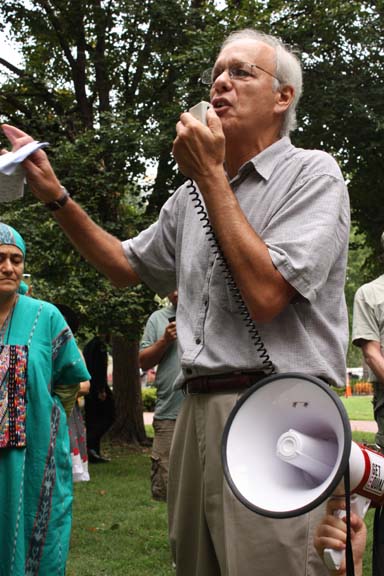
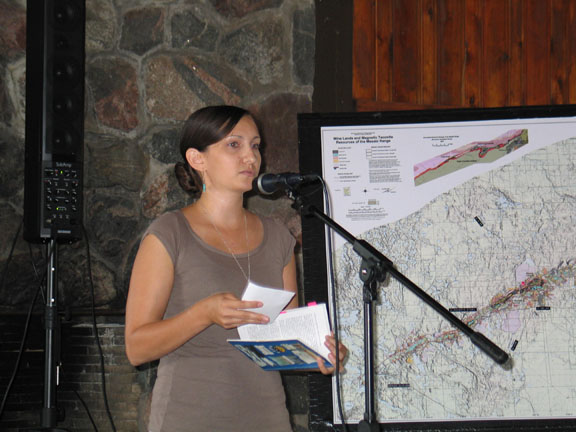
Jessica Koski of the Keweenaw Bay Indian Community (KBIC) near L'Anse, Mich., addresses participants at the Aug. 6, 2011, Protect the Earth Great Lakes Community Gathering at Van Riper State Park near Champion, Mich. Koski spoke about exploration for copper, nickel and uranium on and near the KBIC reservation. (Photo by Keweenaw Now)

CHAMPION, Mich. -- "Coming Together: Uniting for Strength and Success" was the theme of the 2011 Protect the Earth Great Lakes Community Gathering on Aug. 6 in Van Riper State Park near Champion, Mich. The line-up of speakers -- from Michigan, Wisconsin and Minnesota -- was evidence of the need for sharing experiences and seeking mutual support.

The speakers described efforts of several grassroots groups around the Great Lakes to protect this great supply of fresh water from a number of mining projects that now threaten a large area rich in minerals.

One of the speakers -- Jessica Koski of the Keweenaw Bay Indian Community (KBIC) near L'Anse, Michigan -- spoke about exploration for copper, nickel and uranium on and near the KBIC reservation. She also spoke about treaty rights and land and water protection.

Jessica Koski of KBIC speaks about treaty rights at a teaching event on Eagle Rock in May 2010 before Rio Tinto / Kennecott fenced off the rock for use as the portal to their projected Eagle Mine -- a sulfide mine for copper and nickel near Big Bay, Mich. (File photo by Keweenaw Now)*

Koski, who holds degrees from Keweenaw Bay Ojibwa Community College and Michigan Tech University, recently completed a masters degree in environmental management from the Yale School of Forestry and Environmental Studies. She currently serves as Mining Technical Assistant for the KBIC Natural Resources Department. Koski has been involved in efforts to protect Eagle Rock, a sacred Anishinaabe (Ojibwa) site where Rio-Tinto / Kennecott plans to blast a portal for their Eagle Mine project for copper and nickel, possibly this month.

This photo shows recent construction of a portal to the prospective Eagle Mine by Rio Tinto / Kennecott at Eagle Rock, an Ojibwa sacred site. Note cylinder-shaped cover over incline behind construction in foreground. Click on photo for larger version. (Photo taken Sept. 11, 2011, © and courtesy standfortheland.com)

After greeting the audience in the Ojibwa language, Koski said KBIC staff had recently (on Aug. 5, 2011) visited a site of active exploration drilling by Kennecott on land Kennecott owns within the KBIC Reservation. The site is called BIC (Bovine Igneous Complex). Its geology is similar to that of the contested Eagle Mine on the Yellow Dog Plains. According to Koski, the BIC site's target minerals, or minerals they are considering trying to mine, are metallic sulfides containing copper, nickel and platinum group elements.

"There are global mining interests that are coming to the Great Lakes region and are interested in the rich geology and rich mineral resources that we have here," Koski said, "but this is also a very rich water region -- so it's something that we have to protect."

Here is a video excerpt of Koski's comments on mining exploration and treaty rights during the 2011 Protect the Earth:


During the Aug. 6, 2011, Protect the Earth Great Lakes Community Gathering near Champion, Mich., Jessica Koski, who now serves as Mining Technical Assistant for the KBIC Natural Resources Department, speaks about mining exploration on and near the KBIC reservation and about treaty rights. (Videos by Allan Baker for Keweenaw Now)

Actually Kennecott is exploring at more than one site within the reservation, Koski noted. The following map shows exploration sites in and around the reservation as well as lakes and rivers in the area.
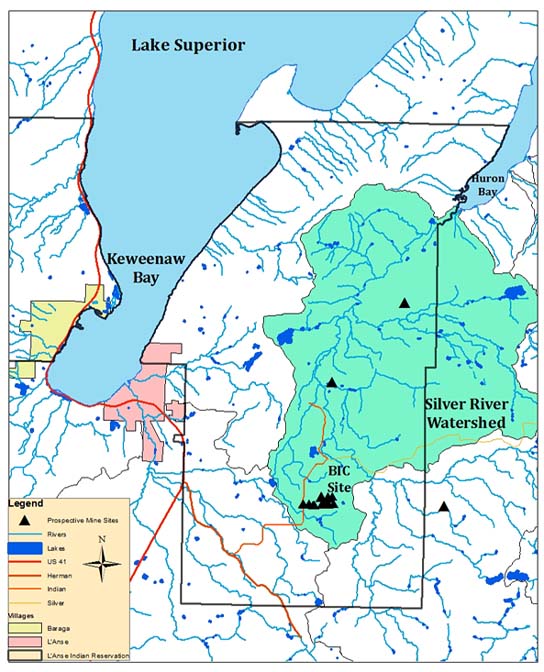
Click on this map for a larger version to see areas of mining exploration (small triangles) within and near the Keweenaw Bay Indian Community reservation. (Map courtesy Jessica Koski)

Koski told Keweenaw Now recently that KBIC did not sell land or mineral rights on the reservation to Kennecott.

"Land and mineral rights on our reservation are complicated due to history," Koski said. "While I don't know that my ancestors knew that the mineral rights would be severed from the surface and many elders and tribal members are still surprised to learn this to this day, that is how it is understood under Western law."

Koski noted the Dawes Allotment of 1887 divided up our reservation into individual allotments, and many of these allotments were unjustly taken by the state government.

"The purpose of this law was to assimilate Native Americans into American society," Koski explained. "Today, many non-Native people have settled on these allotments, and timber companies own some as well. A property ownership map of the reservation is quite complex -- consisting of KBIC land, federal trust land, BIA (Bureau of Indian Affairs) land, fee land, private ownership, etc."

The tribe does own land directly south of the BIC site, she added.

At least five additional companies are actively exploring for metallic sulfide and uranium mineral deposits in areas around the L’Anse and Ontonagon Reservations within KBIC Home Territory, Koski noted.

She also mentioned treaty rights -- legal documents that still exist today, although they have not been honored as they should be. According to legal scholars, Koski noted, Native American treaty rights -- such as the rights to hunting, fishing and gathering in the ceded territories -- could be a tool for protection of natural resources, including the Great Lakes.

Koski pointed out the recently adopted United Nations Declaration on the Rights of Indigenous Peoples -- endorsed by the United States -- could be another tool to assert as well, especially Free Prior and Informed Consent.

Koski mentioned two people who have inspired her. One was the late Walter Bressette, an Anishinaabe (Ojibwa) activist from the Red Cliff Band, who during his lifetime promoted a right to a healthy environment.

"And that's something that I really believe in," Koski said.

While the state permits give the mining companies the right to pollute, she added, we're not given the right to breathe clean air or drink clean water.

What Bressette did was look at the U.S. Constitution, the source and the preamble -- guaranteeing "the right to liberty and justice and well being to ourselves and our posterity, which means future generations," Koski said.

Koski read an excerpt by another person who influenced her -- First Nation (Canada) author Lorraine Rekmans, from This Is My Homeland: Stories of the effects of nuclear industries by people of the Serpent River First Nation and the north shore of Lake Huron, (edited by Lorraine Rekmans, Keith Lewis and Anabel Dwyer, published by the Serpent River First Nation, 2003.)

Rekmans wrote about her "bio-region" as her home -- the place where her ancestors walked -- a homeland she would defend.

"The mining companies may have a lot of mineral rights," Koski said, "but this is where we live. This is our bio-region, so we have a right to state our concerns about development."

Koski also spoke about jobs and the need for sustainable alternatives to mining, challenging the audience to come up with ideas for alternatives:


Jessica Koski speaks about jobs, challenging the Protect the Earth audience to come up with ideas for sustainable jobs for the Upper Peninsula.

During the question period following Koski's talk, Chuck Brumleve, geologist, who is working as KBIC's mining expert, answered a question on uranium exploration, noting Bitterroot Resources -- a Canadian Company whose mineral rights comprise approximately 461 square miles within Ontonagon, Houghton, Baraga and Iron Counties -- has explored for uranium west of the reservation in the Ottawa National Forest. They have three areas of exploration, Brumleve said -- the old Copper Range Mining Co. mineral rights to the north; copper, nickel, platinum exploration around Echo Lake; and uranium exploration further south near the Lac Vieux Desert reservation.

Some uranium has been found in people's wells, but Koski said she hadn't heard of a link between exploration and uranium in well water.

Brumleve pointed out the naturally occurring uranium in Jacobsville sandstone has occurred in some wells.

Another question concerned the status of the Humboldt Mill site, located about 23 miles from the L’Anse Reservation, south of US-41 in Humboldt Township, Marquette County, and within the 1842 ceded territories. The mill was originally an iron ore processing facility for the Humboldt Iron Mine and the nearby Republic Mine from 1954-1979. It consists of a large open-pit lake that naturally filled with groundwater and precipitation. Kennecott plans to use the site to process their ore from the projected Eagle Mine, thus adding 2.5 million tons of tailings to the site.

Brumleve explained the site right now is very polluted. Kennecott's own report indicated 26 contaminants that are migrating off the site.** He noted also that KBIC has requested that the U.S. Environmental Protection Agency (EPA) do a Superfund investigation of the site.


Following Jessica Koski's presentation at 2011 Protect the Earth, geologist Chuck Brumleve, who works as a mining expert for the Keweenaw Bay Indian Community, answers a question on the Humboldt Mill site, which Kennecott plans to use for processing ore from the projected Eagle Mine.

Koski also made available copies of a June 2011 map created by the Great Lakes Indian Fish and Wildlife Commission (GLIFWC), showing mines, mineral exploration and mineral leasing sites all around the Lake Superior watershed. The map was produced with funding from the Great Lakes Restoration Initiative (GLRI) and was compiled using data from various tribal, federal, state, and provincial sources. Click on this map for a larger version:

This map of Mines, Mineral Exploration and Mineral Leasing in the Lake Superior Watershed was produced by GLIFWC (Great Lakes Indian Fish and Wildlife Commission) and is dated June 21, 2011. Click on map for larger version. (Map courtesy Esteban Chiriboga, GLIFWC Satellite Office, Madison, Wis.)

In a recent article Jessica Koski wrote for a KBIC newsletter, she states the following:

"Over time, tribes have developed the capacity to play a more prominent role in natural resource protection and mining related permit activities. There is also increasing recognition of the sovereign regulatory authority tribes possess, particularly through the federal Clean Air Act and Clean Water Act. Under the Montana v. United States (1981) case, it was recognized that tribes have a right to regulate the conduct of non-Indians within their reservations when that conduct threatens or has a direct effect on the political integrity, economic security or health and welfare of its members.

"Currently, the Mole Lake Sokaogon, Fond du Lac, Grand Portage, and Lac du Flambeau bands have their own Water Quality Standards; and the Bad River band recently submitted water quality standards for which federal approval is pending. KBIC is preparing to submit an application for TAS (treatment in the same manner as a state) which will then allow the community to establish and enforce its own Water Quality Standards as well."***

Updated: Koski has also been hosting a free monthly community film series, titled "Mining Impacts on Native Lands," in order to provide greater awareness to the social and environmental impacts mining can have on Native communities. The next film, Homeland, Four Portraits of Native Action, will be shown at 6 p.m. on Thursday, Oct. 6, at the Ojibwa Casino in Baraga. (Note new date and location.)

Editor's Notes:

* Read about the 2010 Treaty Rights Teaching event on Eagle Rock in our May 19, 2010, article.

** See our updated Aug. 29, 2011, article, "Protect the Earth 2011, Part 1: Walk to Humboldt mill, Rio Tinto-Kennecott projected ore processing site."

*** To read Jessica Koski's article in the September 2011 KBIC Newsletter, click here and scroll down to p. 11.

This is the second in a series of articles on Protect the Earth 2011.

Sunday, September 11, 2011

Friends of Calumet Library to hold meeting, book signing this week

CALUMET -- Friends of the Calumet Public Library will hold their monthly meeting at 5:30 p.m. on Tuesday, Sept. 13, 2011, in the library. The meeting is open to the public. New members and new ideas are welcome. Get involved! The library offers many ways to lend a hand: programming ideas, volunteer opportunities, the Red Jacket Readers book club, and more! Come find out what's ahead this fall at the Calumet Public Library.

Presentation and book signing of South of Superior

South of Superior, Ellen Airgood's first novel, is set in a small Upper Peninsula town on Lake Superior and has received a lot of attention since its debut this past June, including interviews on NPR and in numerous publications such as USA Today and AARP Magazine. Full of heart and strong characters, South of Superior delights a wide variety of readers.

Ellen Airgood will be visiting the Calumet Public Library at 6:30 p.m. on Wednesday, Sept. 14, for a reading, presentation, and book signing of South of Superior. Come and find out how much this book parallels Airgood's life as a diner owner in Grand Marais, Mich., and what she is working on for her next novel.

Airgood’s book will be on sale at the library on the evening of the presentation. Proceeds go to the Friends of the Calumet Public Library. Books are also available in local bookstores and may be checked out from the library.

These events are sponsored by the Friends of the Calumet Public Library.

For more information, visit the library or call 337-0311, ext 1107. (In case of bad weather, when school is cancelled, all library programs are cancelled.)

Letter from U. S. Sen. Carl Levin: "a day to remember ..."

WASHINGTON, D. C. -- None of us will ever forget where we were on the morning of September 11, 2001, nor the terrible events of that day.

I wanted to share with you my statement today on the 10th Anniversary of the 9/11 terrorist attacks on our country:

Ten years ago today, mindless hatred took the lives of thousands of our fellow citizens. But if the terrorists who struck us that day thought they would defeat us, the decade since has shown how badly mistaken they were. The attacks of Sept. 11, 2001, were a terrible blow. But they could not and did not overcome America’s courage, confidence, optimism and essential decency.

This is a day to remember the lives lost on 9-11 and the loved ones who still mourn, and to remember the thousands of brave Americans who have sacrificed so much to defend us since that terrible day, especially those who have given "the last full measure of devotion" to the nation that we all hold so dear.

Friday, September 09, 2011

Nostalgic Music, Dance in Eagle Harbor Sept. 9

EAGLE HARBOR -- A Nostalgic Music and Dance Party will be held, beginning at 7:30 p.m. TONIGHT, Friday, Sept. 9, at the Eagle Harbor Community Building.

David Owens, the Nostalgia DJ of Eagle Harbor, will play music from the 1950s and earlier -- songs and dance music -- from his collection of original recordings.

Dance to original rock 'n roll, swing, foxtrot, waltz, polka! Sing along! Request favorite songs! Or just listen and reminisce.

The party is free and open to the public. It will be great if you can bring desserts, snacks, or drinks.

Info: Call (906) 289-4404 or email DOwens@pasty.com.

Thursday, September 08, 2011

Stand for the Land: Ho-Chunk elders petition EPA for protection of Eagle Rock

From Stand for the Land:
Posted Sept. 8, 2011

On August 31, 2011, members of the Ho-Chunk tribal court and other elders sent a letter to EPA’s Nancy Stoner, Acting Assistant Administrator for the Office of Water, stating their belief that the National Historic Preservation Act Section 106 Assessment involving the sacred site known as Eagle Rock, omitted key considerations.

They contend that the consultation process should have involved all Chippewa tribes, not just the Lake Superior group, and that it should have taken into consideration the significance of the site to indigenous peoples who occupied the region before the Chippewa.

A 2010 Resolution adopted by the National Council of American Indians notes that "Eagle Rock has been linked to ancient ceremonial sites in Wisconsin and Montana by local tribal history and more recently by exhaustive research and on-site surveys…"

The letter also states that the Act was not properly administered by the Michigan DEQ, since the State regulatory agency determined that Eagle Rock was not a place of worship because it did not have a building on it. ...

Click here to read the rest of this article on Stand for the Land, which has links to the letter and the resolution.

"Mining Madness" film on Eagle Project to be shown Sept. 8 at Ojibwa Casino

BARAGA -- The film Mining Madness,Water Wars: The Great Lakes in the Balance will be shown at 6 p.m. TONIGHT, Thursday, Sept. 8, in the Chippewa Room at Ojibwa Casino in Baraga.

Produced by the National Wildlife Federation, this 33-minute film highlights the controversial Eagle Project in Michigan’s Upper Peninsula. Testimonies reveal the threats that this sulfide mine poses to water, wildlife and people, including concerns of the Keweenaw Bay Indian Community.

The film is part of the monthly "Mining Impacts on Native Lands" Film Series, and it is free and open to the public. The goal of the series is to increase community awareness and capacity in the midst of growing mineral interest throughout the region. Featured films will focus on the environmental and social impacts of mining, particularly on Native communities. Mining updates will be provided and discussion welcomed.

Finlandia University Gallery to hold closing reception for Finnish textile artists' exhibit Sept. 8

HANCOCK -- The Finlandia University Gallery will host a closing reception for the exhibit "White Forests, Blue Sky: Two Generations of Art Textiles, Paper and Metal Constructions" from 7 p.m. to 8:30 p.m. TONIGHT, Thursday, Sept. 8, with an Artist Talk beginning at 7:15 p.m.

Finnish artist Anna-Riitta Haavisto talks about the "White Forest, Blue Sky" exhibit with visitors to the Finlandia University Gallery in June 2011. She will return to the gallery for the closing reception tonight, Thursday, June 8. (Photos by Keweenaw Now)

Finnish textile artists, mother and daughter Riitta-Liisa Haavisto (1930-2009) and Anna-Riitta Haavisto, transform the traditional methods and materials of the textile arts in markedly different ways. Riitta-Liisa employed an expressive, painterly approach to embroidery, using jewel-toned fabrics and threads to create scenes inspired by nature, folklore, and current events. Riitta-Liisa’s daughter, Anna-Riitta, stretches the boundaries of fiber art in thought-provoking, three-dimensional sculptural objects constructed of sand, stones, steel, plastic, fiber, silk, cotton, paper, wood -- and even water. Since 1998, the Haavistos’ work has been featured in more than 22 joint exhibitions in Finland, England, Scotland, Norway, Germany, Spain, the United States, and Canada, and dozens of group exhibitions.

Leena Vanni, Finnish journalist, who contributed articles to both the Finnish American Reporter and Keweenaw Now this year, admires some colorful textile art by the late Riitta-Liisa Haavisto during the opening of the "White Forests, Blue Sky" exhibit last June.

More information about the artists is available in Fiber Art Today, by Carol K. Russell; Schiffer Publishing Ltd., 2011.

The Finlandia University Gallery is located in the Finnish American Heritage Center, 435 Quincy St., Hancock.

Click here to read more about the "White Forests, Blue Sky" exhibit, which opened June 20, 2011.

Finlandia University Gallery announces extended hours

Starting immediately, and through the month of April 2012, the gallery is open Monday through Friday, 8:30 a.m. to 4:30 p.m., as well as on Thursday evenings until 7 p.m., and on Saturday afternoons from noon to 4 p.m.

Featured at the gallery starting Sept. 22 will be an exhibit of fiber art sculptures titled "Explorations: The Flexible Linear Element," by artists Tracy Krumm and Carol Lambert.

An opening reception for the artists will take place at the gallery from 7 p.m. to 8:30 p.m. Thursday, Sept. 22.

For additional information, please call 906-487-7500 or visit www.finlandia.edu/finlandia-gallery.

Updated: From Stand for the Land: Detroit News promotes U.P. mining

UPPER PENINSULA -- Stand for the Land posted on Sept. 7, 2011, an excerpt from the Sept. 7, 2011, Detroit News editorial promoting mining in the Upper Peninsula, in particular the Eagle Mine on the Yellow Dog Plains.

We join Stand for the Land in calling readers' attention to this editorial and the comments it immediately drew from outraged citizens aware of the truth about Rio Tinto /Kennecott's record of environmental degradation and human rights abuses.

The editorial states, "The Eagle Mine promises to be one of the most environmentally friendly mining operations in the world. If it is successful, it could revive the mining industry in the U.P. and do so in an environmentally responsible way. It could also lead the way to a much-needed employment surge in the region."

Click here to read the editorial.

Click here to read the comments.

Update: Click here to read the response from mining expert Jack Parker.

See also our Sept. 2, 2011, article, "Groups ask Judge to halt mine blasting at Eagle Rock."

Visit Stand for the Land for articles and photos on the Eagle Mine issue.

Wednesday, September 07, 2011

Community Arts Center to host sculpture installation by Ronda Jones

HANCOCK -- The Copper Country Community Arts Center will host "Imaginary Friends," a sculpture installation by Ronda Jones, in the Kerredge Gallery from Sept. 8 - Oct. 1.

Artist Ronda Jones is pictured here with one of her "imaginary friends." (Photo courtesy Community Arts Center)

The public is invited to a reception from 6 p.m. to 8 p.m. on Thursday, Sept. 8, to meet the artist and enjoy refreshments.

In her statement about the exhibit, Jones writes, "Born of long days alone in my parents’ back yard, 'Imaginary Friends' is a body of needle felted wool and mixed media sculpture that pays tribute to the magical creatures, friend and foe, I created as a five year old to keep me company and to explain the unexplainable."

Ronda Jones is a graduate of Finlandia University’s International School of Art and Design. She is a full-time studio artist and a full-time Mom to a creative child with a wild imagination of his own.

This exhibit is supported by a grant from the Michigan Council for Arts and Cultural Affairs with funding from the National Endowment for the Arts. The Community Arts Center is located at 126 Quincy Street in Hancock. For more information call 482-2333 or visit the website at coppercountryarts.com.

Tuesday, September 06, 2011

Sit-in against Tar Sands XL Pipeline concludes peacefully Sept. 3; national campaign to follow

Article and photos by Kate Flynn*

In front of the White House, protesters against the Tar Sands XL Pipeline display signs on Saturday, Sept. 3, the final day of the peaceful two-week sit-in and civil disobedience. Their signs and banners were later taken away by the United States Park Police before the police began making arrests. Click on photos for larger versions. (Photos © 2011 and courtesy Kate Flynn)

WASHINGTON, D. C. -- A White House sit-in that has been called the largest environmental civil disobedience act in decades culminated in two days of protest on Friday, Sept. 2, and Saturday, Sept. 3. The 14-day sit-in was held in objection to the proposed Keystone XL pipeline project, which would transport crude oil over a distance of 1,980 miles from Canada to the U.S.

Organizers are pledging to escalate a nationwide campaign to push President Obama to deny the permit for the pipeline.

Climate activist Bill McKibben, who helped organize the protest, encouraged attendees not to view the fight against the pipeline as over.

Bill McKibben, author and environmentalist, who was one of the first leaders arrested during the sit-in, addressed assembled protesters on Saturday., Sept. 3, the fourteenth and final day of protest outside the White House against the proposed Keystone XL pipeline. "This has turned into the biggest civil disobedience protest about anything this century," he stated.

"The next month or two are going to be absolutely crucial," he told those assembled before Saturday’s sit-in.

Hundreds of individuals took to the sidewalk in front of the White House on both days, risking arrest by the United States Park Police, while dozens more held signs, danced and sang across the street in Lafayette Square. The protest, which has been going on for the past fourteen days, has seen 1,252 arrests.

Protesters in front of the White House on Saturday, Sept. 3, display signs objecting to the Keystone XL Pipeline. "Game Over" is what NASA climate scientist James Hansen, who was arrested during the protest last week, said about the tar sands exploitation and the pipeline. A petition with more than 600,000 signatures opposing the pipeline was delivered to the White House on Sept. 3.

"Third warning, they came out and got us," said Joey Firman of Arlington, Va., who was arrested on Thursday after being asked to leave the sidewalk area three times by police. Firman and other protesters were not jailed upon arrest, but rather brought to a processing center and required to pay a $100 fine before being released. “Even my SWAT-team guy who arrested me, he was like, 'Tell me about this pipeline,'" Firman said. "So I told him about it for like three minutes and he was like, 'Thank you.'"

The protest has been largely peaceful and has seen support from people all over North America, as well as the local D. C. area. A number of indigenous leaders, many of whose communities would be directly affected by the pipeline, made their voices heard on Friday.

During the sit-in on Friday, Sept. 2, protesters hold a sign that says, "Respect Sovereignty / Honor Indigenous Rights." Several indigenous leaders addressed the crowd in front of the White House.

Chief Bill Erasmus -- of Yellowknife, Northwest Territories, Canada -- said his people are already being affected by the tar sands and pipeline.

Chief Bill Erasmus of the Dene Nation in Yellowknife, Northwest Territories, Canada, speaks to assembled protesters on Friday, Sept. 2.

"We want people to know what our concerns are. We're saying that this pipeline is not needed," Chief Erasmus said. “Our people, in some areas, can no longer eat the fish. Our people can no longer drink the water. The oil is not for America; the oil is for the highest bidder."

Deborah Whitebloom of the Oklahoma Lakota Nation addressed the fact that the pipeline would cross the Ogallala Aquifer, one of the largest freshwater aquifers in the world.

Deborah Lightbloom of the Oklahoma Lakota Nation speaks to assembled protesters on Friday, Sept. 2. She addressed the fact that the proposed Keystone XL pipeline would cross roughly 2,000 streams, lakes and creeks, as well as the Ogallala Aquifer, one of the world's largest aquifers.

"This is our territory," Whitebloom said. "We have to stand up and say no -- say no to the pipeline, say no to the corporations."

Candy Mosset spoke to assembled protesters on behalf of the Indigenous Environmental Network.

"It's going to affect all of us; it is, in fact, affecting all of us," she said, referring to the negative environmental impacts of the pipeline.

During the Sept. 2 protest, Candy Mosset speaks on behalf of the Indigenous Environmental Network.

Maryland State Sen. Paul Pinsky also addressed the protesters on Friday, Sept. 2.

"We have to move in a forward direction," said Pinsky. "We need solar, we need wind. We have to speak truth to power."

Pinsky also said that he disputes the State Department’s final Environmental Impact Statement, released on August 26th, on the proposed pipeline. The report concludes that any environmental impact of the pipeline will be minimal. Pinsky was later one of the estimated 166 people arrested on Friday, Sept. 2.

Maryland State Senator Paul Pinsky (D-Prince George's) makes a public statement before the Friday, Sept. 2, White House sit-in. He was later arrested.

Many see the pipeline issue as crucial to whether or not President Obama will receive voter support from environmentalists in the next election cycle.

Members of the Ali-Latouche family, of Berwyn Heights, Md., line up on Fri., Sept. 2, to take part in the protest.

"This is a real chance for Obama to take a stand on something," said attendee Steve Paisley, of Ithaca, New York. "He is not going to get reelected by doing what he’s been doing, which is waffling and compromising and doing nothing. No one on the left is going to support that; even people in the middle are going to recognize someone who stands up for what they believe in, even if they don’t share that belief."

The Reverend Lennox Yearwood, a D.C.-area minister and community activist, addresses assembled supporters and protesters after the sit-in on Saturday, Sept. 3.

The final State Department hearing on the Keystone XL pipeline will be held on Oct. 7, 2011. A final decision on the pipeline is expected from President Obama by the end of the year.

Editor's Notes:

*Guest reporter Kate Flynn is a graduate student in journalism at American University in Washington, D.C. She is a graduate of Hancock High School and Beloit College. Kate also worked as a journalism intern for both Keweenaw Now and the L'Anse Sentinel in 2010. This is her second article on the Keystone XL Pipeline protest. Click here to read her first article in this series, posted Aug. 31, 2011.

** See "The Indigenous Call: Take Back Our Future," a short video clip showing indigenous people at the protest, including some being arrested.

Tars Sands Action, organizers of the sit-in, will soon announce Phase 2 of the protest against the pipeline. Visit their Web site for updates.

Monday, September 05, 2011

Updated: Tall Ships Regatta photos from Turku, Finland

Editor's Update: On Aug. 29, 2011, we published this article with links to photos of the Tall Ships Regatta in Turku, Finland. Since then we received permission to publish some of the individual photos. Here is the revised article with photos of the Tall Ships and some additional photos from readers in Turku, Finland:

Aug. 28, 2011, photo of Tall Ships Regatta, Turku, Finland. Click on photos for larger versions. (Photo © 2011 Shoja Lak. Turun Tietokuva Oy. Reprinted with permission. Photos courtesy Kalle Ipatti, Photographer-in-Chief, Turun Sanomat)*

TURKU, FINLAND -- The city of Turku, Finland, celebrated a Tall Ships Regatta in late August. The Regatta was reportedly the biggest event in the celebration this summer of Turku as the 2011 European Capital of Culture.

View of one of the tall ships participating in the Tall Ships Regatta in Turku, Finland, celebrating the city as the 2011 European Capital of Culture. (Photo © 2011 Shoja Lak. Turun Tietokuva Oy. Reprinted with permission. )

Keweenaw Now reader Annukka Vepsäläinen, a resident of Turku, who directed us to these photos in the Turku newspaper Turun Sanomat, recalls her own experience at the Tall Ships Regatta a few years ago with her partner, Pasi Laihonen:

"Pasi and I had the chance to be there a few years ago when the same ships were leaving Turku. One of Pasi's friends has a beautiful boat, made according to the style of a typical archipelago boat. It was an experience I'll never forget. There were hundreds of boats there to witness the moment. I'm adding a picture from 2006 when Pasi, I and some friends were going on a short trip with that same boat."

The Tall Ships Regatta brought back memories for Annukka Vepsäläinen of Turku -- including the memory of taking a trip in this Finnish archipelago boat, in which she had also witnessed the Tall Ships Regatta in Turku. (Photo © 2006 Pasi Laihonen and courtesy Annukka Vepsäläinen. Reprinted with permission.)

Annukka Vepsäläinen and Pasi Laihonen relax in the Finnish archipelago boat. (Photo © 2006 and courtesy Annukka Vepsäläinen. Reprinted with permission.)*

Click here for a night photo with fireworks.

Click here for more photos, including close-ups of the ships.

Click here to read -- in English -- about Turku's Summer of Culture celebration held on the banks of the River Aura.

* Editor's Note: Thanks (kiitos) to our reader Annukka Vepsäläinen, a resident of Turku, for directing us to news of the Regatta in the Turku newspaper Turun Sanomat; thanks to Kalle Ipatti, Turun Sanomat Photographer-in-Chief, for permission to use photos of the Tall Ships; and to Pasi Laihonen for his photos.

Portage Library to host Survival Shelter Building Program

HOUGHTON -- David Talaga, founder of the Houghton Primitive Skills and Wilderness Survival School, will teach children and adults how to build a survival shelter at 6:30 p.m. on Tuesday, Sept. 6, at the Tech Trails in Houghton.

This program will take participants out of the library and into the woods. Participants will first walk around the Tech Trails to see various survival shelters that kids have built. The group will then work together to build a survival shelter.

In this program, participants will learn which types of trees make the best shelter, what to avoid when setting up a shelter, what are the best types of materials for covering your shelter, different types of shelter construction methods, and hands-on construction of a lean-to survival shelter.

Participants should meet at 6:30 p.m. in the Tech Trails parking lot off of Sharon Ave. Hiking shoes or boots, a light jacket, and a water bottle are recommended.

Talaga has been learning and teaching wilderness survival and primitive skills for over nine years. He studied at the Tom Brown, Jr., Tracker School and also studied under Dave Canterbury, co-host of "Dual Survival," a wilderness survival documentary television series on the Discovery Channel.

Library programs are free and everyone is welcome. For more information, please call the library at 482-4570 or visit www.pldl.org.

Mini-grants available to non-profits for arts, cultural projects

HANCOCK -- The Copper Country Community Arts Council is accepting applications from non-profit organizations for mini-grants of up to $4,000 for arts and cultural projects. The deadline for submission of applications is Tuesday, Oct. 4, 2011. Funding is for projects that take place between Feb. 1, 2012, and Sept. 30, 2012.
The Mini-grant program is a grants-giving partnership funded by the State of Michigan through the Michigan Council for Arts and Cultural Affairs (MCACA) and administered by agencies in each region of the state. The Copper Country Community Arts Council serves as the Regional Re-granting Agency for the six counties in the Western UP.

MCACA mini-grants are available to registered non-profit organizations located in Baraga, Gogebic, Houghton, Iron, Keweenaw and Ontonagon counties. These include (but are not limited to) service organizations, arts and historical organizations, churches, professional associations, public and non-public schools, and municipalities.

Mini-grants provide up to $4,000 for locally developed, high quality arts and cultural projects, which are special opportunities to address local arts and cultural needs and increase public access to arts and culture. Mini-grant funds require a 1:1 match which can be cash or in-kind.

Mini-grant applications must be submitted to the Community Arts Center by 5 p.m. on Tuesday, Oct. 4, 2011. Awards will be announced in January 2012. Applications and guidelines are available on the Copper Country Community Arts Council web site (www.coppercountryarts.com) or by phoning (906) 482-2333.

The Community Arts Center will host a grant writing workshop designed to assist organizations interested in applying for Michigan Council for Arts and Cultural Affairs (MCACA) Mini-grant funds. The workshop will take place from noon to 1 p.m. on Friday, Sept. 9, at the Community Arts Center located at 126 Quincy Street in Hancock. Please phone 482-2333 to reserve your space. Technical assistance is also available by appointment.

For more information, call Regional Re-granting Coordinator Cynthia Coté at 482-2333 or email cynthia@coppercountryarts.com.

Keweenaw Nordic Ski Club to hold meeting Sept. 7

HANCOCK -- KNSC (Keweenaw Nordic Ski Club) will hold its first meeting of the season at 7 p.m. Wednesday, Sept. 7, at the Hancock Chalet. The general public is welcome. For those new to the area, KNSC is a nonprofit club that maintains the Maasto Hiitto/ Churning Rapids classic cross country ski trail system in and adjacent to the City of Hancock.

The Hancock Chalet is at the Houghton County Fair Grounds (also called the Driving Park). More questions, call Jay Green, president, at 906-487-5411.

Friday, September 02, 2011

Groups ask Judge to halt mine blasting at Eagle Rock

By Michele Bourdieu with information from Stand for the Land:

MARQUETTE -- This week a coalition of groups asked a judge to halt imminent mining activity that would desecrate a sacred Native American site and jeopardize water quality for the Great Lakes and one of the region’s last spawning grounds for the coaster brook trout.

The Huron Mountain Club, Keweenaw Bay Indian Community, National Wildlife Federation and Yellow Dog Watershed Preserve filed the motion on Aug. 31, 2011, with the Ingham County Circuit Court to stay Rio Tinto’s permits for the projected Eagle Mine on the Yellow Dog Plains. If granted, the stay would prohibit Rio Tinto from blasting Eagle Rock -- a sacred site that sits over this proposed nickel mine.

"My people have prayed and held ceremonies at Eagle Rock since time immemorial," said Susan LaFerniere, Keweenaw Bay Indian Community Tribal Council secretary. "No one should be allowed to blast it apart. I hope the judge grants this request."

LaFerniere told Keweenaw Now recently that the tribe is waiting for the judge's decision on the appeal, since that will determine their next step.

"We've always said that we're not opposed to the mine if it doesn't harm the environment -- and we're still not convinced that it will not harm the environment," she added.

Community and conservation partners have challenged the mine in court, arguing that it presents unacceptable risks to water and air quality -- and that it could collapse, endangering workers and the river it is underneath. The court challenge is currently under appeal. The motion for a stay is necessary because the mining company intends to blast into Eagle Rock on or near September 14, 2011, even though the judge, Paula Manderfield, has not issued a final ruling on the appeal.

"Without this emergency stay, Rio Tinto could begin blasting Eagle Rock before the judge has had a chance to determine whether the mine is safe," said Andy Buchsbaum, regional executive director of the National Wildlife Federation’s Great Lakes office. "The serious questions we have about this mine need to be addressed -- and allowing the company to blast away in one of Michigan’s most pristine and important areas will only further jeopardize the region’s water quality, tourism industry, wildlife and quality of life."

Extracting nickel from the site poses extreme risks to water quality, wildlife and recreation. The metals are embedded in sulfide ores, which produce sulfuric acid when exposed to moisture and air. The resulting acid mine drainage (AMD) has devastated natural resources in other parts of the country. And the company overseeing the project -- Rio Tinto -- has broken Clean Water Act laws dozens of times in mines they have controlled in other states.

MLive.com published on Sept. 1, 2011, an Associated Press article titled "Foes make final try to stop UP nickel, copper mine," reporting the fact of the requested stay but not giving evidence to justify the word "final" in the headline.

According to Michelle Halley, National Wildlife Federation attorney and Lake Superior Project manager, the groups involved in the contested case appeal could take their case to a higher court.

"If the judge (Manderfield) rules against us we would most likely appeal to the Michigan Court of Appeals and ultimately to the Michigan Supreme Court," she said.

Halley noted the hope is that Judge Manderfield will rule in favor of this stay, or injunction, before she makes the overall decision on the appeal.

Other groups and individual concerned citizens have written letters to Michigan Governor Rick Snyder and Michigan Attorney General Bill Schuette on the illegality of the mining permit granted by the Michigan Department of Environmental Quality.*

*Editor's Note: Click here for the Aug. 1, 2011, article and links on Stand for the Land: "Environmental group asks Michigan A.G. to investigate allegations of fraud at DEQ."

Thursday, September 01, 2011

KFRC to hold Kids Consignment Sale Sept. 30-Oct. 1

HOUGHTON -- The Keweenaw Family Resource Center (KFRC) will be holding a fundraising Kids Consignment Sale from 10 a.m. to 5 p.m. on Friday and Saturday, Sept. 30 - Oct. 1, at the Copper Country Mall on M-26 in Houghton. Proceeds from the sale will benefit the KFRC Tree House Indoor Playground.

The half-price sale starts at 3 p.m. Saturday, Oct. 1. Payment must be cash or check only, no credit cards. New Moms and Moms-To-Be can sign up for the First-Time Mom's Club and shop before the sale starts (no strings attached!).

Anyone wishing to be a consignor should register by the deadline -- Friday, Sept. 23. Contact Ivette at 906-523-5295 or email KFRCKidsConsign@gmail.com. KFRC's current goal is to have 50 consignors.

Items for the sale should be high-quality and gently-used. These can include clothing, gear, sporting goods, toys, equipment, furniture, etc., for all ages, stages and sizes, as well as maternity clothes and accessories, nursing apparel, diaper bags and much more.

Musician Chuck Young to perform at Portage Library Sept. 2

HOUGHTON -- The Portage Lake District Library invites everyone to bring a lunch and enjoy "Music on the Menu," an outdoor series of events held on the dock outside the library.

Chuck Young will perform from noon to 1 p.m.on Friday, Sept. 2. He sings and plays guitar, mandolin and other folk music instruments. Young started learning these songs and tunes during the folk music revival of the 1950s and 1960s and never stopped. His music includes bluegrass, old timey, gospel, Scottish, Irish, and Caribbean. He also likes to get the audience to help with choruses on some of the songs.

Everyone is invited to eat, relax, and enjoy the lunch hour while listening to some great music. In the event of bad weather, the program will be held in the community room.

Library programs are free and open to all. For more information, please call the library at 482-4570 or visit www.pldl.org.

Pasi Cats to close final Houghton Summer Concert series TONIGHT, Sept. 1

HOUGHTON -- The final concert of the Houghton Downtown Summer Concert Series will take place at Parking Deck across from Wells Fargo from 6 p.m. to 9 p.m. TONIGHT, Thursday, Sept. 1.

The musical lineup is as follows:

6 p.m. - 6:30 p.m. -- Trio Tumpelot (Anna Gawboy (concertina), Meghan Pachmayer (bass) and Pasi Lautala (accordion and vocals)

6:40 p.m. - 7:20 p.m. -- Agate Pickers (From Corktown, MI, Kenny O'Connor on guitar; from Dodgeville "progress our goal," MI, Mary Kurttu on bass; from Iron River, MI, Spookie Lukie Dedo on drums and Randy Dandy on vox)

7:30 p.m. - 9 p.m. -- PasiCats.

Calumet galleries to offer First Friday art exhibits, events Sept. 2

CALUMET -- First Friday, Sept. 2, will offer several art events in Calumet galleries.

Omphale Gallery to present art by Daniel C. Boyer

Omphale Gallery will display a one-man exhibition of drawings and paintings by Daniel C. Boyer in September. The exhibit, titled "The Teenage Girl With Grey Hair," will run through September. A reception will be held from 7 p.m. to 9 p.m. Friday, Sept. 2.

"The Adjustment to Silence," by Daniel C. Boyer. Gouache diluted with Diet Coke. (Image courtesy Daniel C. Boyer)

The Omphale Gallery recently re-opened with a new café offering espresso drinks and a gourmet lunch menu that is predominantly vegetarian with an emphasis on raw foods -- and lots of home-made bakery items.

Barista and baker Katie Jo Wright, Omphale co-owner with Julie DePaul Johnson (not pictured), serves a gourmet lunch to Laurium residents Patricia and Bernie Koskiniemi on Aug. 20, 2011. Patricia ordered pita bread with a vegan vegetable spread while Bernie's choice was a veggie beet burger. Both ordered the Omphale's special red cabbage slaw. (Photo by Keweenaw Now)

The Omphale Gallery Café is at 431 Fifth Street in Calumet.

Ed Gray Gallery to host exhibit by Sharon Schmeltzer

The work of Sharon Schmeltzer of Kingsford, Michigan, will be featured for the month of September at the Ed Gray Gallery in Calumet. An opening reception will be held from 6:30 p.m. to 9 p.m. on Friday, Sept. 2. Schmeltzer will be available at the reception to answer questions and to describe her work.

Schmeltzer was invited to have a solo show at the gallery after she was selected from a group of artists who entered the annual juried show at the Bonifas Arts Center in Escanaba.

The Ed Gray Gallery is located at 109 Fifth Street, Calumet.

Copper Country Associated Artists to present "You Can Do This" Sept. 2

With a greeting card and a scrap of wool, discover your artist within. Pam Hecht will guide you through this creative process during a First Friday event on Sept. 2 at the Copper Country Associated Artists Gallery, 112 5th Street, Calumet.

The first presentation will begin at 6:30 p.m. All materials will be provided. Also bakery and coffee will be served. Donations are appreciated.

Vertin Gallery to host September exhibit by Ingrid Blixt

Vertin Gallery is pleased to announce its September exhibit, Ingrid Blixt’s "Hiding Places," a collection of new graphite drawings and encaustic paintings. Blixt’s work is an ongoing exploration of the common threads connecting people from varying cultural and geographical backgrounds. "Hiding Places" explores the geography of human emotions.

"Hiding places are openings into these inner spaces, sacred spaces and rolling hills," Blixt says.

"White Dress," by Ingrid Blixt. Acrylic on canvas. (Photo courtesy Vertin Gallery)

The Romanian born artist moved to the Escanaba area in 2001, after earning her MFA from the University of Art and Design, Cluj Napoca, Romania.

A reception will be held from 7 p.m. to 9 p.m. on Friday, Sept. 2. At 7:15 p.m., the artist will talk about her work, which will remain on display through the month of September.

The reception is free and open to the public. Refreshments will be served.

For more information please call the Vertin Gallery at (906) 337-2200.

Editor's Note: The new Gallerie Bohème will also present a September exhibit on First Friday, Sept. 2. Click here to read about their opening reception with three artists.

Gallerie Bohème to host new exhibit, opening Sept. 2

Artist Tom Rudd, left, and Gallerie Bohème owner Tom Dumble invite the public to the opening of a new exhibit, "Lost and Found," on First Friday, Sept. 2. The show will feature work by three artists: Bonnie Peterson, Cynthia Coté and Margo McCafferty. (Photo by Keweenaw Now)

CALUMET -- The public is invited to the opening of a new show in Calumet at Gallerie Bohème from 6:30 p.m. to 9 p.m. Friday, Sept. 2.

Margo McCafferty, Toys and Beans (detail). Oil on panel. (Images of art works courtesy Gallerie Bohème)

The exhibit, titled "Lost and Found," will feature artwork by three outstanding visual artists: Bonnie Peterson, embroidered maps; Cynthia Coté, small-format books made with found words and paper; and Margo McCafferty, still lifes of toys and found objects. The artists will be in attendance at the opening to discuss their work with interested viewers and collectors.

Cynthia Coté, Opening Light (detail). Found words and paper.

Gallerie Bohème exhibits exceptional works by Calumet and Keweenaw-area artists and craftspersons. The gallery is located in Calumet on the north end of Fifth Street at 423, near the Omphale Gallery and Café and Artis Books. Business hours are 11 a.m. to 4 p.m. Tuesday through Saturday, through October, and other times by appointment.

Bonnie Peterson, Lake Medora Quad. Mixed media.

For additional information contact Tom Rudd at (906) 369-4087 or Tom Dumble at (760) 285-5128.

Wednesday, August 31, 2011

Protesters continue White House sit-in against pipeline for tar sands oil

Article and photos by Kate Flynn*

Actress Daryl Hannah addresses an assembled group of protesters near the White House on Tuesday, Aug. 30, the eleventh day of a sit-in against the Keystone XL pipeline, a proposed project that would funnel crude oil from the tar sands of Alberta, Canada, to terminals in the Gulf Coast. Hannah was reportedly one of those arrested during the sit-in. Click on photos for larger versions. (Photo © 2011 and courtesy Kate Flynn)

WASHINGTON, DC -- Dozens of activists gathered across the street from the White House Tuesday morning to prepare for the eleventh day of protest against the Keystone XL pipeline, a proposed project that would funnel tar sands crude oil from Alberta, Canada, to terminals in the Gulf Coast.

"We’re asking the president to do something that is entirely within his power," said Bill McKibben, an environmental author involved in organizing the effort, as he addressed assembled protesters. "All he has to do is not sign this permit and this pipeline can’t be built."

Police have made 706 arrests outside the White House since Aug. 20. Activists and others opposing the pipeline are concerned that carbon emissions from the process of extracting petroleum from the tar sands will contribute to global climate change. They are also concerned about an environmental threat in the form of a pipeline rupture.

"I think that it’s important that we show Obama the seriousness of clean energy and how much we want it now, for our future and for future generations," said Rebecca Ortiz, a student activist from Virginia. "The Keystone XL pipeline is a violation of our right to clean water."

During the Aug. 30 sit-in against the Keystone XL pipeline, at the White House, young activists, from left, Rebecca Ortiz, Emma Peterson, and Nathaly Agosto Filion practice a protest song. (Photo © 2011 and courtesy Kate Flynn)

"We U.S. citizens need and want to be free from this hideously destructive fossil fuel dependence," stated actress Daryl Hannah as she addressed those assembled. "If President Obama rejects the lobbyists’ influences and does the right thing by the citizens, then we will be free so that the money and jobs can go towards safe, clean, regenerative, community-based U.S. energy and fuel."

Hannah is known for her roles in such films as Blade Runner, Splash and Kill Bill. CNN later reported Hannah was arrested during the sit-in.

Many activists saw the struggle as a personal one that would have a direct impact on their quality of life.

"My son," Suzie DeBrosse of Vermont replied when asked what her reason for protesting was. "To get a healthy and clean environment for the next generations."

Suzie DeBrosse of Vermont holds a protest sign depicting her son. (Photo © 2011 and courtesy Kate Flynn)

Ben Gotschall, a spokesperson for Tar Sands Action, organizers of the sit-in, also spoke to the crowd at the protest on Aug. 30.

"Originally that was all it was about -- not in my backyard, not in my drinking water," Gotschall said. "But as I learned more about this…I realized this is something evil that we had to stop."

Tar Sands Action spokesperson Ben Gotschall addresses an assembled group of protesters. (Photo © 2011 and courtesy Kate Flynn)

The protest has already seen solidarity from religious leaders and NASA’s Dr. James Hansen, a leading expert on climate change, who was arrested during the protest outside the White House on Monday, Aug. 29.

The New York Times reported that the pipeline is expected to open in 2013 unless delayed by lawsuits or other challenges.

Editor's Notes: Guest reporter Kate Flynn is a graduate student in journalism at American University in Washington, D.C. She is a graduate of Hancock High School and Beloit College. Kate also worked as a journalism intern for both Keweenaw Now and the L'Anse Sentinel in 2010.

Visit tarsandsaction.org for more updates on the protest.

Monday, August 29, 2011

Tar Sands Action: Largest day of arrests yet at White House Pipeline Protest

A protester is arrested in front of the White House during the peaceful demonstration and civil disobedience against the Keystone XL pipeline destined to carry oil from the tar sands in Canada to refineries on the Gulf of Mexico unless President Obama denies the permit. (Aug. 29, 2011, photo © Josh Lopez and courtesy Tar Sands Action. Reprinted with permission.)

Posted by Tar Sands Action on August 29, 2011


WASHINGTON, DC -- America’s top climate scientist and a large group of religious leaders were arrested at the White House this morning with 140 other Americans protesting to push President Obama to deny the permit for a massive new oil pipeline. To date 521 people have been arrested in this protest at the White House.

Representatives of religious groups protest in front of the White House. Several religious leaders were arrested on Monday, Aug. 29. (Photo © Josh Lopez and courtesy Tar Sands Action. Reprinted with permission.)

"If Obama chooses the dirty needle it will confirm that the President was just green-washing all along, like the other well-oiled coal-fired politicians, with no real intention of solving the addiction," said NASA’s Dr. James Hansen, who was arrested at the White House this morning.

President Obama must decide whether or not to grant a "presidential permit" for a Canadian company, TransCanada, to begin construction of the Keystone XL, a 1,700 mile pipeline from the Canadian tar sands to refineries on the Gulf of Mexico. ...

Click here to read the rest of this press release from Tar Sands Action.

Updated: Protect the Earth 2011, Part 1: Walk to Humboldt mill, Rio Tinto-Kennecott projected ore processing site

By Michele Bourdieu

Members of WAVE (Water Action Vital Earth) and SWUP (Save the Wild UP) and other concerned participants in the 2011 Protect the Earth Great Lakes Community Gathering held on Aug. 6, 2011, begin the day with a visit to the proposed site of a processing facility for Rio Tinto / Kennecott's Eagle Mine at the Humboldt mill brownfield location. Click on photos for larger versions. (Photos by Keweenaw Now)

HUMBOLDT, Mich. -- The 2011 Protect the Earth Great Lakes Community Gathering on Aug. 6 began with a walk from Van Riper State Park near Champion, Mich., to the nearby site for a proposed Humboldt processing facility intended for Rio Tinto /Kennecott's projected Eagle Mine on the Yellow Dog Plains near Big Bay.

Margaret Comfort, WAVE (Water Action Vital Earth) Steering Committee member and Save the Wild UP Board member, led the walk and introduced speakers Gail Griffith of Save the Wild UP, retired chemistry professor from Northern Michigan University, and Richard Sloat of Iron River, Mich., WAVE Steering Committee member.

As the walk participants gathered near a fence with a large "No Trespassing" sign barring entrance to the Humboldt area (site of a former mill -- a brownfield site still contaminated by iron mine tailings), a small airplane circled above, flew off and returned. A motorcycle also passed by twice. The walkers did not know whether these noise interruptions were intentional or not, but they were disturbing.

Rio Tinto / Kennecott's "No Trespassing" warning sign at the gate of the Humboldt brownfield site, where the company intends to build a processing plant for the nickel and copper ore to be transported from the projected Eagle Mine on the Yellow Dog Plains near Big Bay.

Gail Griffith spoke about Rio Tinto / Kennecott's plan to move the ore from the Eagle Mine south to the Humboldt mill for processing.

"The rock here is just going to be down to the size of talcum powder, when they get done with it," Griffith said. "And they do a flotation which floats the metal-rich material to the top."

This nickel and copper material is then floated off in a very concentrated state, she explained. The separate nickel and copper concentrates will be shipped off-site to be smelted. The remainder, a slurry of waste products (tailings), which total more than 95 percent of the rock, will be disposed of in the old Humboldt mine pit, which is presently full of water. When they put the finely ground waste rock into the pit, the water that is displaced has to go somewhere, Griffith explained.

"The water that's coming out of that area is not going to be clean so they're building a wastewater treatment plant to clean the water up before it goes into the middle branch of the Escanaba River (which goes down to Lake Michigan)."*

Since this is now a brownfield site, it has to be cleaned up before being used again. Griffith noted the company is already taking loads of material from the site to the Marquette County Landfill. She speaks about this and the proposed wastewater treatment in the video clip below.


At the Humboldt brownfield site, Gail Griffith of Save the Wild UP, who serves on the Marquette County Solid Waste Management Authority, speaks about loads of waste material Rio Tinto / Kennecott has been dumping in the landfill and answers questions from some of the Humboldt walk participants. A plane can be heard circling overhead. (Video by Allan Baker for Keweenaw Now)

Kristi Mills of Save the Wild UP noted a Kennecott report indicates 26 known contaminants that are now migrating away from this Humboldt site.

"It's a report that Kennecott did on the site because when they took it over they wanted to know exactly what was here so they wouldn't be liable for it," Mills said.

Kennecott said they are doing their best to remove "the worst of it" -- the contamination from the tailings left by the old Humboldt iron mine -- spending $1.5 million to "remediate" it before they begin their own work here, Mills added.

Richard Sloat spoke about treatment of water coming from the Buck Mine -- one of more than 70 abandoned iron mines in Iron County. Sloat's concerns stem from the fact that the Buck Mine, even though it was an iron mine, was located in an ore body with high sulfide concentration and the fact that the Buck Mine is the farthest downstream along the Iron River.


Richard Sloat of Iron River, Mich., WAVE Steering Committee member, speaks about wastewater treatment at the Buck Mine in Iron County. (Video by Allan Baker for
Keweenaw Now)

Sloat said he would like to see better, more frequent monitoring of the water coming from sites like the Buck Mine, the proposed Eagle Mine (if it goes through) and this Humboldt site.

"Concentrations of contaminants can rise and fall during certain times of the day -- sometimes as much as 500 percent difference from testing at one part of the day," Sloat said.

He said he has hired an environmental consulting firm to do some water testing twice a day and to give the results to the Michigan Department of Environmental Quality.

Sloat also spoke about the dredging of sediment that is part of the cleanup. In 2008, dredging of over 17,000 tons of sediment from the Buck Mine cost Michigan taxpayers over $1 million, he noted. As for the projected Eagle Mine, if it goes through, Kennecott has admitted a large amount of contaminated sediment will have to be hauled to landfills.

"I think we just have to start changing our lifestyles," Sloat said. "Every one of us contributes to why there's mining. We just have to change that."


To conclude the meeting at the Humboldt site, Pamela St. Germaine offers a musical blessing to the site. (Video by Allan Baker for Keweenaw Now)

The route Kennecott will use to truck chunks of ore to the Humboldt site has been a subject of discussion at Marquette County Road Commission meetings and hearings during the past year. At present they plan to use County Road 550 unless they can receive permits for the potential County Road 595, a north/south road for which the Road Commission will be holding information meetings from noon to 3 p.m. and from 6 p.m. to 9 p.m. Tuesday, Aug. 30, at Lakeview Arena in Marquette and Wednesday, Aug. 31, at the Ishpeming Township Hall.**

This route is a variation on the proposed "Woodland Road," which failed to receive federal permits because of potential impacts on wetlands, streams and wildlife in the area.***

Update: The Humboldt Mill was originally a mill for iron ore from the Humboldt mine; later it was used to process gold ore from the Ropes gold mine.

Editor's Notes: This article is the first in a series on the 2011 Protect the Earth Great Lakes Community Gathering. Watch for more articles, coming soon.

Update: The Humboldt Mill was originally a mill for iron ore from the Humboldt mine; later it was used to process gold ore from the Ropes gold mine.

* This wastewater treatment plant would be built in addition to the one that is being built at Rio Tinto / Kennecott's projected Eagle Mine site. See our May 3, 2011, article, "Residents concerned about water quality question Rio Tinto-Kennecott at community forum."

** Click here for details on these meetings and dates for consideration of public comments.

*** Click here to read a Letter to the Editor, "Road to Somewhere," by Catherine Parker, with links to other articles concerning this proposed road.