
HOUGHTON -- Regular meetings of the Gluten-Free Recipe Exchange are held from 6:30 p.m. - 7:30 p.m. on the third Monday of each month, September through May, at the Portage Lake District Library. The next meeting will be Sept. 19, and everyone is invited to participate.
Each month features a different type of food, a recipe exchange, and discussions related to gluten-free eating. September’s meeting will focus on gluten-free soups. Participants are welcome to bring their favorite gluten-free soup for sampling and are encouraged to share their recipes. Copies of the recipes will be made at the library. Please list all ingredients used in making foods that are shared at these meetings and identify the brand names of the gluten-free ingredients. Bringing food is not a requirement for attendance.
The Gluten-Free Recipe Exchange is organized by and for those who are interested in or required to follow a gluten-free diet. Gluten-free eating requires the avoidance of all wheat, rye, barley, and oats. Most people find it challenging at first, but are excited to find recipes and foods that are fun and easy to make and tasty to eat. The Gluten-Free Recipe Exchange is an opportunity to share those great recipes and learn from others. Everyone who is interested in learning more about gluten-free eating is encouraged to attend.
This program is free and open to all. For more information, please call a member of the group at 281-5216. You may also call the library at 482-4570 or visit www.pldl.org.
Friday, September 16, 2011


Finnish-American/Ojibwa medical doctor to present documentary Sept. 19, 20
HANCOCK -- Finnish-American/Ojibwa medical doctor Arne Vainio will present and discuss his Emmy-nominated documentary film, Walking into the Unknown, at 7 p.m. Monday, Sept. 19, and at 1 p.m. Tuesday, Sept. 20, at the Finlandia University Finnish American Heritage Center, Hancock.
 Finnish-American/Ojibwe medical doctor Arne Vainio will present his Emmy-nominated film, Walking into the Unknown, Sept. 19 and 20 at the Finnish American Heritage Center in Hancock. (Photo courtesy Finlandia University)
The event is free and open to the public. It is sponsored by Finlandia University and Portage Health.
Dr. Vainio is a member of the Mille Lacs Band of Ojibwe and a physician at the Min-No-Aya-Win Human Services Clinic on the Fond du Lac Ojibwe Reservation, near Cloquet, Minn.
The film depicts Dr. Vainio’s exploration of health and heritage as he undergoes the very health screenings that he had long been recommending for his middle-aged male patients, but neglected to undergo himself.
Co-produced by Ivy Vainio, Visumm Media, and presented by Native American Public Telecommunications, Inc. (NAPT), Walking into the Unknown will have viewers "building a personal connection with Dr. Arne Vainio -- feeling the health risk burdens and analyzing thought-provoking questions that are faced in the most critical turning point of one’s life," according to a press release prepared by NAPT.
For more information, contact Hilary Virtanen at 906-487-7514.
North Woods Conservancy coordinates Keweenaw Adopt a Beach September Cleanup
CALUMET -- The North Woods Conservancy (NWC) is once again coordinating the Keweenaw Adopt a Beach effort. Teams of volunteers will be going out to various beaches on Sept. 17 and 18 to collect trash and record what they find. Since Saturday, Sept. 17, conflicts with the Parade of Nations, most local groups do the cleanup on Sunday, Sept. 18; but Beach Captains may choose any date and time, plus or minus a week.
 Beach at Bete Grise Preserve: Sue Haralson of the Houghton Keweenaw Conservation District is Beach Captain for Bete Grise South. Stewards of Bete Grise and anyone else who wishes to help are invited to meet at the Bete Grise Preserve parking lot at 9 a.m. on Sunday, Sept. 18, for the cleanup. Gina Nicholas will be at the Bete Grise North Public Beach. Call Sue at 906-369-3400 if you have questions about the Bete Grise cleanup.
The Keweenaw Adopt a Beach cleanup is part of the Michigan Coastal Cleanup, which is part of the International Coastal Cleanup, which engages people to remove trash from the world's beaches and waterways, to identify sources of debris, and to change behaviors that cause litter and pollution. The ultimate goal of North Woods Conservancy is to clean the entire perimeter of the Keweenaw, from Misery Bay all the way around the Tip of the Keweenaw and down to L'Anse, at the foot of Keweenaw Bay, including the Portage Ship Canal, Portage Lake, Torch Lake, and all interior lakes and rivers.
Click here to visit the NWC Web site for photos and a list of sites with Beach Captains listed.
Many sites still need to be claimed and cleaned up. If you would like to be a Beach Captain and join this effort, call 906-370-9022 or email northwoodsconservancy@gmail.com.
Thursday, September 15, 2011
Parade of Nations brings world of food, festivities to the Keweenaw
By Jennifer Donovan, Michigan Tech Director of Public Relations
Photos of 2010 Parade by Keweenaw Now and friends
 The Cass Tech Marching Band from Detroit returned to Houghton-Hancock for the 2010 Parade of Nations. (Photo © 2010 and courtesy Roland Burgan)
HOUGHTON -- It’s become a fall tradition in Houghton and Hancock: mid-September means exotic foods, native costumes, music and dancing from around the world. In other words, it’s Parade of Nations time.
The 22nd Parade of Nations is scheduled for Saturday, Sept. 17. The annual celebration of the multicultural nature of the Michigan Tech community has been growing in popularity every year. This year's theme is "Spice is Always Nice."
 Finland and El Salvador are among the many countries represented in the Parade. (Photo © 2010 and courtesy Anita Campbell)
The parade begins at 11 a.m. in front of the old Hancock Middle School in downtown Hancock. It will cross the bridge and move east on Shelden Avenue through downtown Houghton to the Citgo gas station, where it will turn left and head for the Dee Stadium.
 Japanese students and friends from Finlandia University gather in front of the former Hancock Middle School for the start of the 2010 Parade of Nations. (Photo by Keweenaw Now)
 Indian students perform a couples dance from their country during the 2010 Parade of Nations entertainment in Dee Stadium. (Photo by Keweenaw Now)
From noon to 4 p.m., the Dee will be the site of international feasting, stage entertainment, and free pony rides, face painting and supervised arts and crafts for the children. Admission is free.
 Visitors taste a variety of exotic dishes at the international food booths in Dee Stadium after the 2010 Parade of Nations. (Photo by Keweenaw Now)
Food will be prepared by cooks representing at least 15 nations, including Thailand, Italy, India, Mexico, China, Japan, and of course, Finland. Khana Khazana ("food treasure") a group of international student cooks at Michigan Tech, will serve Thai, Middle Eastern and Indian food. Michigan Tech’s Thai Student Association will cook the Thai dish that topped the CNN poll of the 50 most delicious foods in the world: spicy, coconut-rich, sweet and savory Massaman curry.
 Thailand is always well represented by Dr. Sripaipan, third from left, his family and friends. Here they are preparing for the 2010 Parade. (Photo by Keweenaw Now)
Click here to read the rest of Jennifer Donovan's article about the 2011 Parade of Nations in the Michigan Tech News.
Photos of 2010 Parade by Keweenaw Now and friends
 The Cass Tech Marching Band from Detroit returned to Houghton-Hancock for the 2010 Parade of Nations. (Photo © 2010 and courtesy Roland Burgan)
HOUGHTON -- It’s become a fall tradition in Houghton and Hancock: mid-September means exotic foods, native costumes, music and dancing from around the world. In other words, it’s Parade of Nations time.
The 22nd Parade of Nations is scheduled for Saturday, Sept. 17. The annual celebration of the multicultural nature of the Michigan Tech community has been growing in popularity every year. This year's theme is "Spice is Always Nice."
 Finland and El Salvador are among the many countries represented in the Parade. (Photo © 2010 and courtesy Anita Campbell)
The parade begins at 11 a.m. in front of the old Hancock Middle School in downtown Hancock. It will cross the bridge and move east on Shelden Avenue through downtown Houghton to the Citgo gas station, where it will turn left and head for the Dee Stadium.
 Japanese students and friends from Finlandia University gather in front of the former Hancock Middle School for the start of the 2010 Parade of Nations. (Photo by Keweenaw Now)
The cities of Houghton and Hancock and Finlandia University partner with Michigan Tech to help make the event a community-wide gala. This year for the first time the Parade of Nations has named a community honorary chair, Houghton City Manager Scott MacInnes. Parade marshal is Michigan Tech’s retiring Dean of Students Gloria Melton.

Who are these familiar-looking guys with the Argentine flag? (Photo by Keweenaw Now)
More than 60 countries will be represented in the parade and the multicultural festival that follows at the Dee Stadium, featuring the Limanya Drum and Dance Ensemble. The West African performers showcase the musical and dance traditions of Guinea. The group is led by Mandjou Mara, a master djembe player and griot (praise singer) from Guinea, West Africa.
 Indian students perform a couples dance from their country during the 2010 Parade of Nations entertainment in Dee Stadium. (Photo by Keweenaw Now)
From noon to 4 p.m., the Dee will be the site of international feasting, stage entertainment, and free pony rides, face painting and supervised arts and crafts for the children. Admission is free.
 Visitors taste a variety of exotic dishes at the international food booths in Dee Stadium after the 2010 Parade of Nations. (Photo by Keweenaw Now)
Food will be prepared by cooks representing at least 15 nations, including Thailand, Italy, India, Mexico, China, Japan, and of course, Finland. Khana Khazana ("food treasure") a group of international student cooks at Michigan Tech, will serve Thai, Middle Eastern and Indian food. Michigan Tech’s Thai Student Association will cook the Thai dish that topped the CNN poll of the 50 most delicious foods in the world: spicy, coconut-rich, sweet and savory Massaman curry.
 Thailand is always well represented by Dr. Sripaipan, third from left, his family and friends. Here they are preparing for the 2010 Parade. (Photo by Keweenaw Now)
Click here to read the rest of Jennifer Donovan's article about the 2011 Parade of Nations in the Michigan Tech News.
Gary McDowell announces candidacy for Congress
 RUDYARD, Mich. -- Rudyard hay farmer and small business owner Gary McDowell officially announced on Wednesday, Sept. 14, his candidacy for Michigan’s 1st Congressional District to oppose incumbent Congressman Dan Benishek.
"No one in Washington is looking out for regular people in Northern Michigan and the UP. The Democrats don’t recognize we need to cut spending and the Republicans don’t care what happens to people like us who have to work for a living," said Gary McDowell. "Congressman Dan Benishek has quickly become part of the problem. He voted to end Medicare and voted against Northern Michigan’s economic interests while giving more tax breaks to big corporations."
Congressman Benishek has taken dozens of votes against the interests of taxpayers and families in the UP and Northern Michigan:
- Despite being home to the oldest population of any Congressional district outside of Florida, Congressman Benishek voted to privatize Social Security, end Medicare and force seniors to pay $6,400 more every year and buy insurance directly from the insurance companies.
- Congressman Benishek promised not to vote to increase America’s ballooning deficit; but, in a last minute deal this summer, Benishek actually supported the plan that added $8 trillion to the debt over ten years by giving even more taxpayer-funded subsidies to special interests and giving the average millionaire $200,000 a year in new tax breaks.
- Congressman Benishek voted against local jobs and our area’s critical tourism industry when he supported a plan to close seven regional airports in the 1st District in Ironwood, Houghton, Iron Mountain, Escanaba, Sault Ste. Marie, Alpena and Manistee. These airports are not only a critical link for residents but also move mail, commerce and visitors -- supporting area job growth.
A native of Rudyard, Michigan, Gary McDowell is a hay farmer and has served for over 20 years as the Treasurer for McDowell Hay, Inc., a 1,000-acre hay farming and distribution company in Rudyard, which he owns with his brothers.
"As a middle class farmer, I want to take some Northern Michigan common sense to Washington in order to cut wasteful spending and reduce the debt, focus on creating jobs here in Michigan, and to protect Social Security and Medicare," McDowell said.
After former 1st District Congressman Bart Stupak announced his retirement in the spring of 2010, Benishek won the Republican primary by only 15 votes and defeated McDowell with 51 percent of the vote in November 2010.
McDowell is a retired State Representative from District 107. Read more about Gary McDowell on his Facebook page.
Editor's Note: Gary McDowell spoke at a rally of teachers and union members in Houghton last May. See a video clip of his speech in our May 15, 2011, article, "Local teachers, union members rally for schools."
Wednesday, September 14, 2011
Jutila Center to host SEEDesign Forum and Expo Sept. 15
HANCOCK -- The SEEDesign Forum and Expo, hosted by the Finlandia University Jutila Center, will take place from 11 a.m. to 7 p.m. this Thursday, Sept. 15 in the Jutila Center.
All activities take place in the Jutila Center Auditorium on the main level of the Jutila Center building. The event is free and open to the public, and attendees are welcome to come anytime.
The Forum and Expo showcases the considerable impact that creative disciplines have on the Copper Country and western Upper Peninsula region. The events share information and tools for business innovation and offer opportunities to network with area leaders in business, design and marketing.
From 11 a.m. until 3:30 p.m., a Speaker Forum will feature several lectures, each beginning at the top of the hour. The presenters include Matthew Monte, president of Monte Consulting, Houghton, and Katrina Aho, interior designer for Gartner's Gallery, Hancock.
At 2 p.m. Keynote Speaker Maureen Monte, leadership and strategy consultant for IBM, will present a talk titled, "Driving Creativity and Innovation in the Workplace through Strengths-based Leadership."
At 4 p.m. three design teams of professional designers and marketers, each team matched with a local business, will unveil their makeover concepts for that business; and the winner of this Business Makeover Challenge will be announced. The design teams will be on hand to answer questions.
From 3:30 p.m. to 7 p.m. the Expo portion of the event includes information booths from the area’s copy editors, web developers, architects, landscape designers, large format printers, graphic designers, videographers, and interior designers.
From 5 p.m. to 7 p.m. the Keweenaw Chamber of Commerce will host their monthly Business After Hours event. Both Chamber members and non-members are welcome. Beer and wine will be served, along with hors d’oeuvres prepared by Kangas Café and Catering of Hancock.
The SEEDesign Forum and Expo is an initiative of the Finlandia University Jutila Center for Global Design and Business. Funding has been provided, in part, by the Finlandia University Campus Enrichment Committee, Thrivent Financial, and Monte Consulting. It is supported by the Copper Country Community Arts Council and is a program of the Michigan Council for Arts and Cultural Affairs.
For more information, visit www.finlandia.edu/seedesign or contact Fred Knoch at 487-7510.
NOSOTROS to host presentation on Puerto Rico Sept. 15
HOUGHTON -- NOSOTROS will host the first presentation of the series "A door to Latin culture" from 6 p.m. to 7 p.m. on Thursday, Sept. 15, in Fisher Hall, Room 138, on the Michigan Tech campus. Anieri Morales Rivera will present the culture of her country, Puerto Rico. Pizza and non-alcoholic beverages will be offered.
This event is supported by the Parents' Fund of the Michigan Tech Fund.
This event is supported by the Parents' Fund of the Michigan Tech Fund.
Tuesday, September 13, 2011
"Plugged In but Tuned Out" community presentation Sept. 15
HOUGHTON -- Herb Broda, Professor of Education, Ashland University (Ohio), will give a community presentation, "Plugged In but Tuned Out: The Need to Reconnect with Nature," from 7 p.m. to 8:30 p.m. Thursday, Sept. 15, in 135 Fisher Hall on the Michigan Tech campus.
The presentation is free and open to the public. It will be followed by refreshments and discussion.
Educators, parents, school administrators, community leaders, youth healthcare advocates are especially encouraged to attend.
Broda is the author of Schoolyard-Enhanced Learning: Using the Outdoors as an Instructional Tool and Moving the Classroom Outdoors: Schoolyard-Enhanced Learning in Action.
In this age of alluring techno-gadgetry we need to be very cautious about maintaining a balance between indoor and outdoor activity. At a time when children's natural curiosity about the outdoors is eclipsed by the demands of busy schedules and the ever-present glow of video screens, we should consider the following questions:
This event is co-sponsored by Lake Superior Stewardship Initiative with funding from an anonymous donor.
The presentation is free and open to the public. It will be followed by refreshments and discussion.
Educators, parents, school administrators, community leaders, youth healthcare advocates are especially encouraged to attend.
Broda is the author of Schoolyard-Enhanced Learning: Using the Outdoors as an Instructional Tool and Moving the Classroom Outdoors: Schoolyard-Enhanced Learning in Action.
In this age of alluring techno-gadgetry we need to be very cautious about maintaining a balance between indoor and outdoor activity. At a time when children's natural curiosity about the outdoors is eclipsed by the demands of busy schedules and the ever-present glow of video screens, we should consider the following questions:
- Why do kids need time outside?
- How does inventive play benefit kids socially and academically?
- How can we create welcoming places for outdoor play and learning at schools and in the community?
This event is co-sponsored by Lake Superior Stewardship Initiative with funding from an anonymous donor.
Portage Library offers Database Webinars
HOUGHTON -- The Portage Lake District Library is offering webinars for the public that will explain how to use its new databases -- Mango, Universal Class, and Law Depot.
 At the Houghton County Fair in August, Portage Lake District Library Director Shawn Leche offers information about the library's new databases -- Mango, Universal Class, and Law Depot. Leche has been offering Webinars to the public to explain how they can access the databases through the library.* (Photo by Keweenaw Now)
If you missed the Webinar on Sept. 13 for Mango and Universal Class, it will be offered again from 2 p.m. to 3 p.m. on Tuesday, Sept. 20.
A Webinar for Law Depot will be given from 3 p.m. to 4:30 p.m. on Thursday, Sept. 22.
Mango is an online language learning system that teaches practical conversation skills for real communication. Each lesson combines real life situations and audio from native speakers with simple, clear instructions. The courses are presented with an appreciation for cultural nuance and real-world application that integrates components of vocabulary, pronunciation, grammar and culture. It includes over 30 languages and 10 courses which teach English as a second language. Patrons can choose a level of instruction from basic to complete courses that are more in-depth. The database features a fluency button to click on to hear a word pronounced at normal speaking speed.
Universal Class offers over 500 online continuing education courses taught by real instructors with remote, 24/7 access so people can study at their convenience on their own schedule. Patrons can enroll in up to five courses at a time and have six months to finish each course. A complete list of classes is posted on the library’s website.**
Law Depot offers do-it-yourself legal assistance with creating legally binding agreements and documents. The Law Depot service guides users through the creation of their documents in a step-by-step fashion and checks their input for common errors. Users can create comprehensive state-specific legal contracts and create and print specific blank forms for non-contested transactions and agreements.
Mango, Universal Class, and Law Depot are available free of charge to all Portage Lake District Library patrons.
These webinars are free and open to all. For more information, please call the library at 482-4570 or visit www.pldl.org.
* See our Jan. 15, 2011, article, "Portage Library offers new data bases for online learning" to learn about Mango and Universal Class.
** Click here for the Portage Library's list of classes offered by Universal Class.
Letter: Response to Mining Journal editorial
[Editor's Note: On Sept. 12, 2011, the Marquette Mining Journal published an editorial, "Stay request little more than obstructionist," supporting the Rio Tinto - Kennecott projected Eagle Mine and asking Ingham County Circuit Court Judge Paula Manderfield to deny the stay request filed by groups opposed to the mine. This response to that Mining Journal editorial was sent to Keweenaw Now on Sept. 12, 2011. Click here to read the Mining Journal editorial to which this letter refers.]
Dear Editor:
Who are these people that write for the Marquette Mining Journal these days? The Upper Peninsula has a "long and noble" history of mining? Are they talking about the days when everyone could tell if you lived around Negaunee or Ishpeming because their cars were covered with red dust? It made people sick, created fish advisories and killed birds. It wasn't noble. Last time I was in Painesdale, Baltic and Calumet -- the word "noble" didn't come to mind either. "Destitute" did. In fact these communities have been destitute for my entire lifetime. That would be 56 years, my fellow Yoopers. Yes this is the noble legacy of mining in the UP. Destitute and pathetic. This is the legacy mining leaves EVERY SINGLE PLACE THEY OPERATE. But what do I know? I've only experienced, through my work, the Tri-State Mining District/Tar Creek Superfund Site, the Midnight Mine on the Spokane Indian Reservation. Bunker Hill, and about 30 other mines on or next to Indian Reservations. Oh, the Eagle Mine just happens to be next to the L'Anse Indian Reservation -- imagine that...
 View from the top of Eagle Rock, a sacred Ojibwa (Anishinaabe) site, in August 2009, before Rio Tinto / Kennecott fenced it off in June 2010. As Jeffery Loman (the author of this letter) pointed out two weeks ago to Nancy Stoner, EPA Assistant Administrator for Water, he first visited Eagle Rock in 1960 when his Grandmother brought him there to pray. (Keweenaw Now file photo)
The Mining Journal's assertion that the plaintiffs are obstructionists left out Eagle Rock all together. They mentioned the Coaster Brook Trout and the Jack Pine Warbler, but they didn't have the guts to say a thing about the Indian spiritual site they will destroy. Spineless and ignorant is what you can chalk up from this and nothing more. They don't have the guts to mention the "Indian" aspect in the regurgitation of the Rio Tinto propaganda that the Mining Journal spewed. Moreover, they talk like they actually know about environmental regulation. If they did they'd know no agency has obtained a comprehensive chemical analysis of the cores Rio Tinto obtained. The information you have to have in order to regulate their water discharges. It is obvious that the Mining Journal knows absolutely nothing about the regulation of these operations. So I ask them now -- does the Mining Journal support uranium extraction at Eagle and the production of yellowcake at the Humboldt Mill? Tell the community YOU SERVE and tell them now! Have you asked Rio Tinto if they have found an economically viable amount of uranium? If not -- why not? You're suppose to be savvy reporters, asking the hard questions that common citizens don't think of. It is a fact that Governor Granholm directed her managers and staff to take steps to get "agreement state status" from the Nuclear Regulatory Commission at about the same time Rio Tinto informed the State of Michigan they would be constructing the Eagle mine. Why? Why has Governor Snyder withdrawn that request? The Mining Journal is clueless!
 Rio Tinto / Kennecott is now constructing a portal through Eagle Rock to their prospective Eagle Mine. Note cylinder-shaped cover over incline behind the construction in the foreground. Click on photo for larger version. (Photo taken Sept. 11, 2011, © and courtesy standfortheland.com)
No Federal regulatory oversight, no adequate financial responsibility assurances, no health impact assessment, no viable transportation route even though mining is about to start. State employees who were involved in reviewing Rio Tinto permits, advocating for their approval and defending them in litigation now are on Rio Tinto's payroll along with key staff from the Governor's office. Contaminant levels in the State permit that are inconsistent with Federal law, and on, and on. It's unbelievable to me -- I've never seen anything like it and I have worked on dozens of mine cleanup projects. What did the people of the Upper Peninsula do to deserve this?
 Jeffery Loman, author of this letter, speaks at the Rio Tinto - Kennecott public forum held in April 2011 in Marquette. Click here to read the article and see a video of his comments. (Keweenaw Now file photo)
So I say to the Mining Journal -- start acting like newspaper people already and ask some questions, get the facts, and serve your community. After all that would be the "noble" thing to do. If you think you're going to sell more newspapers because people will use them when Rio Tinto starts making a mess -- it doesn't work that way...
Jeffery Loman
KBIC Tribal Member
Monday, September 12, 2011
Updated: Protect the Earth 2011, Part 2: Jessica Koski speaks on mining exploration on KBIC reservation
By Michele Bourdieu
 Jessica Koski of the Keweenaw Bay Indian Community (KBIC) near L'Anse, Mich., addresses participants at the Aug. 6, 2011, Protect the Earth Great Lakes Community Gathering at Van Riper State Park near Champion, Mich. Koski spoke about exploration for copper, nickel and uranium on and near the KBIC reservation. (Photo by Keweenaw Now)
CHAMPION, Mich. -- "Coming Together: Uniting for Strength and Success" was the theme of the 2011 Protect the Earth Great Lakes Community Gathering on Aug. 6 in Van Riper State Park near Champion, Mich. The line-up of speakers -- from Michigan, Wisconsin and Minnesota -- was evidence of the need for sharing experiences and seeking mutual support.
The speakers described efforts of several grassroots groups around the Great Lakes to protect this great supply of fresh water from a number of mining projects that now threaten a large area rich in minerals.
One of the speakers -- Jessica Koski of the Keweenaw Bay Indian Community (KBIC) near L'Anse, Michigan -- spoke about exploration for copper, nickel and uranium on and near the KBIC reservation. She also spoke about treaty rights and land and water protection.
 Jessica Koski of KBIC speaks about treaty rights at a teaching event on Eagle Rock in May 2010 before Rio Tinto / Kennecott fenced off the rock for use as the portal to their projected Eagle Mine -- a sulfide mine for copper and nickel near Big Bay, Mich. (File photo by Keweenaw Now)*
Koski, who holds degrees from Keweenaw Bay Ojibwa Community College and Michigan Tech University, recently completed a masters degree in environmental management from the Yale School of Forestry and Environmental Studies. She currently serves as Mining Technical Assistant for the KBIC Natural Resources Department. Koski has been involved in efforts to protect Eagle Rock, a sacred Anishinaabe (Ojibwa) site where Rio-Tinto / Kennecott plans to blast a portal for their Eagle Mine project for copper and nickel, possibly this month.
 This photo shows recent construction of a portal to the prospective Eagle Mine by Rio Tinto / Kennecott at Eagle Rock, an Ojibwa sacred site. Note cylinder-shaped cover over incline behind construction in foreground. Click on photo for larger version. (Photo taken Sept. 11, 2011, © and courtesy standfortheland.com)
After greeting the audience in the Ojibwa language, Koski said KBIC staff had recently (on Aug. 5, 2011) visited a site of active exploration drilling by Kennecott on land Kennecott owns within the KBIC Reservation. The site is called BIC (Bovine Igneous Complex). Its geology is similar to that of the contested Eagle Mine on the Yellow Dog Plains. According to Koski, the BIC site's target minerals, or minerals they are considering trying to mine, are metallic sulfides containing copper, nickel and platinum group elements.
"There are global mining interests that are coming to the Great Lakes region and are interested in the rich geology and rich mineral resources that we have here," Koski said, "but this is also a very rich water region -- so it's something that we have to protect."
Here is a video excerpt of Koski's comments on mining exploration and treaty rights during the 2011 Protect the Earth:
During the Aug. 6, 2011, Protect the Earth Great Lakes Community Gathering near Champion, Mich., Jessica Koski, who now serves as Mining Technical Assistant for the KBIC Natural Resources Department, speaks about mining exploration on and near the KBIC reservation and about treaty rights. (Videos by Allan Baker for Keweenaw Now)
Actually Kennecott is exploring at more than one site within the reservation, Koski noted. The following map shows exploration sites in and around the reservation as well as lakes and rivers in the area.
 Click on this map for a larger version to see areas of mining exploration (small triangles) within and near the Keweenaw Bay Indian Community reservation. (Map courtesy Jessica Koski)
Koski told Keweenaw Now recently that KBIC did not sell land or mineral rights on the reservation to Kennecott.
"Land and mineral rights on our reservation are complicated due to history," Koski said. "While I don't know that my ancestors knew that the mineral rights would be severed from the surface and many elders and tribal members are still surprised to learn this to this day, that is how it is understood under Western law."
Koski noted the Dawes Allotment of 1887 divided up our reservation into individual allotments, and many of these allotments were unjustly taken by the state government.
"The purpose of this law was to assimilate Native Americans into American society," Koski explained. "Today, many non-Native people have settled on these allotments, and timber companies own some as well. A property ownership map of the reservation is quite complex -- consisting of KBIC land, federal trust land, BIA (Bureau of Indian Affairs) land, fee land, private ownership, etc."
The tribe does own land directly south of the BIC site, she added.
At least five additional companies are actively exploring for metallic sulfide and uranium mineral deposits in areas around the L’Anse and Ontonagon Reservations within KBIC Home Territory, Koski noted.
She also mentioned treaty rights -- legal documents that still exist today, although they have not been honored as they should be. According to legal scholars, Koski noted, Native American treaty rights -- such as the rights to hunting, fishing and gathering in the ceded territories -- could be a tool for protection of natural resources, including the Great Lakes.
Koski pointed out the recently adopted United Nations Declaration on the Rights of Indigenous Peoples -- endorsed by the United States -- could be another tool to assert as well, especially Free Prior and Informed Consent.
Koski mentioned two people who have inspired her. One was the late Walter Bressette, an Anishinaabe (Ojibwa) activist from the Red Cliff Band, who during his lifetime promoted a right to a healthy environment.
"And that's something that I really believe in," Koski said.
While the state permits give the mining companies the right to pollute, she added, we're not given the right to breathe clean air or drink clean water.
What Bressette did was look at the U.S. Constitution, the source and the preamble -- guaranteeing "the right to liberty and justice and well being to ourselves and our posterity, which means future generations," Koski said.
Koski read an excerpt by another person who influenced her -- First Nation (Canada) author Lorraine Rekmans, from This Is My Homeland: Stories of the effects of nuclear industries by people of the Serpent River First Nation and the north shore of Lake Huron, (edited by Lorraine Rekmans, Keith Lewis and Anabel Dwyer, published by the Serpent River First Nation, 2003.)
Rekmans wrote about her "bio-region" as her home -- the place where her ancestors walked -- a homeland she would defend.
"The mining companies may have a lot of mineral rights," Koski said, "but this is where we live. This is our bio-region, so we have a right to state our concerns about development."
Koski also spoke about jobs and the need for sustainable alternatives to mining, challenging the audience to come up with ideas for alternatives:
Jessica Koski speaks about jobs, challenging the Protect the Earth audience to come up with ideas for sustainable jobs for the Upper Peninsula.
During the question period following Koski's talk, Chuck Brumleve, geologist, who is working as KBIC's mining expert, answered a question on uranium exploration, noting Bitterroot Resources -- a Canadian Company whose mineral rights comprise approximately 461 square miles within Ontonagon, Houghton, Baraga and Iron Counties -- has explored for uranium west of the reservation in the Ottawa National Forest. They have three areas of exploration, Brumleve said -- the old Copper Range Mining Co. mineral rights to the north; copper, nickel, platinum exploration around Echo Lake; and uranium exploration further south near the Lac Vieux Desert reservation.
Some uranium has been found in people's wells, but Koski said she hadn't heard of a link between exploration and uranium in well water.
Brumleve pointed out the naturally occurring uranium in Jacobsville sandstone has occurred in some wells.
Another question concerned the status of the Humboldt Mill site, located about 23 miles from the L’Anse Reservation, south of US-41 in Humboldt Township, Marquette County, and within the 1842 ceded territories. The mill was originally an iron ore processing facility for the Humboldt Iron Mine and the nearby Republic Mine from 1954-1979. It consists of a large open-pit lake that naturally filled with groundwater and precipitation. Kennecott plans to use the site to process their ore from the projected Eagle Mine, thus adding 2.5 million tons of tailings to the site.
Brumleve explained the site right now is very polluted. Kennecott's own report indicated 26 contaminants that are migrating off the site.** He noted also that KBIC has requested that the U.S. Environmental Protection Agency (EPA) do a Superfund investigation of the site.
Following Jessica Koski's presentation at 2011 Protect the Earth, geologist Chuck Brumleve, who works as a mining expert for the Keweenaw Bay Indian Community, answers a question on the Humboldt Mill site, which Kennecott plans to use for processing ore from the projected Eagle Mine.
Koski also made available copies of a June 2011 map created by the Great Lakes Indian Fish and Wildlife Commission (GLIFWC), showing mines, mineral exploration and mineral leasing sites all around the Lake Superior watershed. The map was produced with funding from the Great Lakes Restoration Initiative (GLRI) and was compiled using data from various tribal, federal, state, and provincial sources. Click on this map for a larger version:
 This map of Mines, Mineral Exploration and Mineral Leasing in the Lake Superior Watershed was produced by GLIFWC (Great Lakes Indian Fish and Wildlife Commission) and is dated June 21, 2011. Click on map for larger version. (Map courtesy Esteban Chiriboga, GLIFWC Satellite Office, Madison, Wis.)
In a recent article Jessica Koski wrote for a KBIC newsletter, she states the following:
"Over time, tribes have developed the capacity to play a more prominent role in natural resource protection and mining related permit activities. There is also increasing recognition of the sovereign regulatory authority tribes possess, particularly through the federal Clean Air Act and Clean Water Act. Under the Montana v. United States (1981) case, it was recognized that tribes have a right to regulate the conduct of non-Indians within their reservations when that conduct threatens or has a direct effect on the political integrity, economic security or health and welfare of its members.
"Currently, the Mole Lake Sokaogon, Fond du Lac, Grand Portage, and Lac du Flambeau bands have their own Water Quality Standards; and the Bad River band recently submitted water quality standards for which federal approval is pending. KBIC is preparing to submit an application for TAS (treatment in the same manner as a state) which will then allow the community to establish and enforce its own Water Quality Standards as well."***
Updated: Koski has also been hosting a free monthly community film series, titled "Mining Impacts on Native Lands," in order to provide greater awareness to the social and environmental impacts mining can have on Native communities. The next film, Homeland, Four Portraits of Native Action, will be shown at 6 p.m. on Thursday, Oct. 6, at the Ojibwa Casino in Baraga. (Note new date and location.)
Editor's Notes:
* Read about the 2010 Treaty Rights Teaching event on Eagle Rock in our May 19, 2010, article.
** See our updated Aug. 29, 2011, article, "Protect the Earth 2011, Part 1: Walk to Humboldt mill, Rio Tinto-Kennecott projected ore processing site."
*** To read Jessica Koski's article in the September 2011 KBIC Newsletter, click here and scroll down to p. 11.
This is the second in a series of articles on Protect the Earth 2011.
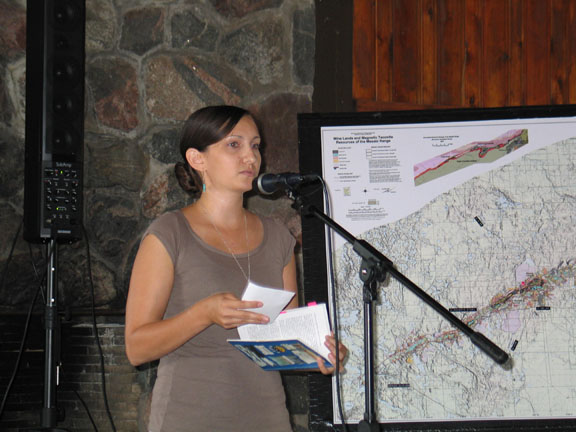 Jessica Koski of the Keweenaw Bay Indian Community (KBIC) near L'Anse, Mich., addresses participants at the Aug. 6, 2011, Protect the Earth Great Lakes Community Gathering at Van Riper State Park near Champion, Mich. Koski spoke about exploration for copper, nickel and uranium on and near the KBIC reservation. (Photo by Keweenaw Now)
CHAMPION, Mich. -- "Coming Together: Uniting for Strength and Success" was the theme of the 2011 Protect the Earth Great Lakes Community Gathering on Aug. 6 in Van Riper State Park near Champion, Mich. The line-up of speakers -- from Michigan, Wisconsin and Minnesota -- was evidence of the need for sharing experiences and seeking mutual support.
The speakers described efforts of several grassroots groups around the Great Lakes to protect this great supply of fresh water from a number of mining projects that now threaten a large area rich in minerals.
One of the speakers -- Jessica Koski of the Keweenaw Bay Indian Community (KBIC) near L'Anse, Michigan -- spoke about exploration for copper, nickel and uranium on and near the KBIC reservation. She also spoke about treaty rights and land and water protection.
 Jessica Koski of KBIC speaks about treaty rights at a teaching event on Eagle Rock in May 2010 before Rio Tinto / Kennecott fenced off the rock for use as the portal to their projected Eagle Mine -- a sulfide mine for copper and nickel near Big Bay, Mich. (File photo by Keweenaw Now)*
Koski, who holds degrees from Keweenaw Bay Ojibwa Community College and Michigan Tech University, recently completed a masters degree in environmental management from the Yale School of Forestry and Environmental Studies. She currently serves as Mining Technical Assistant for the KBIC Natural Resources Department. Koski has been involved in efforts to protect Eagle Rock, a sacred Anishinaabe (Ojibwa) site where Rio-Tinto / Kennecott plans to blast a portal for their Eagle Mine project for copper and nickel, possibly this month.
 This photo shows recent construction of a portal to the prospective Eagle Mine by Rio Tinto / Kennecott at Eagle Rock, an Ojibwa sacred site. Note cylinder-shaped cover over incline behind construction in foreground. Click on photo for larger version. (Photo taken Sept. 11, 2011, © and courtesy standfortheland.com)
After greeting the audience in the Ojibwa language, Koski said KBIC staff had recently (on Aug. 5, 2011) visited a site of active exploration drilling by Kennecott on land Kennecott owns within the KBIC Reservation. The site is called BIC (Bovine Igneous Complex). Its geology is similar to that of the contested Eagle Mine on the Yellow Dog Plains. According to Koski, the BIC site's target minerals, or minerals they are considering trying to mine, are metallic sulfides containing copper, nickel and platinum group elements.
"There are global mining interests that are coming to the Great Lakes region and are interested in the rich geology and rich mineral resources that we have here," Koski said, "but this is also a very rich water region -- so it's something that we have to protect."
Here is a video excerpt of Koski's comments on mining exploration and treaty rights during the 2011 Protect the Earth:
During the Aug. 6, 2011, Protect the Earth Great Lakes Community Gathering near Champion, Mich., Jessica Koski, who now serves as Mining Technical Assistant for the KBIC Natural Resources Department, speaks about mining exploration on and near the KBIC reservation and about treaty rights. (Videos by Allan Baker for Keweenaw Now)
Actually Kennecott is exploring at more than one site within the reservation, Koski noted. The following map shows exploration sites in and around the reservation as well as lakes and rivers in the area.
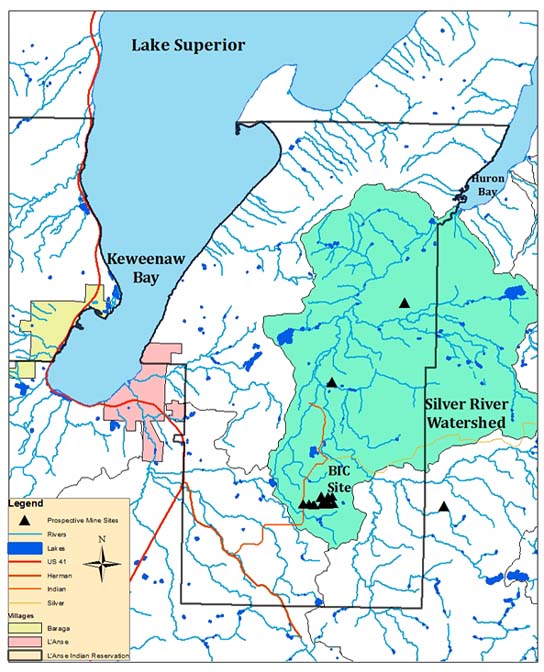 Click on this map for a larger version to see areas of mining exploration (small triangles) within and near the Keweenaw Bay Indian Community reservation. (Map courtesy Jessica Koski)
Koski told Keweenaw Now recently that KBIC did not sell land or mineral rights on the reservation to Kennecott.
"Land and mineral rights on our reservation are complicated due to history," Koski said. "While I don't know that my ancestors knew that the mineral rights would be severed from the surface and many elders and tribal members are still surprised to learn this to this day, that is how it is understood under Western law."
Koski noted the Dawes Allotment of 1887 divided up our reservation into individual allotments, and many of these allotments were unjustly taken by the state government.
"The purpose of this law was to assimilate Native Americans into American society," Koski explained. "Today, many non-Native people have settled on these allotments, and timber companies own some as well. A property ownership map of the reservation is quite complex -- consisting of KBIC land, federal trust land, BIA (Bureau of Indian Affairs) land, fee land, private ownership, etc."
The tribe does own land directly south of the BIC site, she added.
At least five additional companies are actively exploring for metallic sulfide and uranium mineral deposits in areas around the L’Anse and Ontonagon Reservations within KBIC Home Territory, Koski noted.
She also mentioned treaty rights -- legal documents that still exist today, although they have not been honored as they should be. According to legal scholars, Koski noted, Native American treaty rights -- such as the rights to hunting, fishing and gathering in the ceded territories -- could be a tool for protection of natural resources, including the Great Lakes.
Koski pointed out the recently adopted United Nations Declaration on the Rights of Indigenous Peoples -- endorsed by the United States -- could be another tool to assert as well, especially Free Prior and Informed Consent.
Koski mentioned two people who have inspired her. One was the late Walter Bressette, an Anishinaabe (Ojibwa) activist from the Red Cliff Band, who during his lifetime promoted a right to a healthy environment.
"And that's something that I really believe in," Koski said.
While the state permits give the mining companies the right to pollute, she added, we're not given the right to breathe clean air or drink clean water.
What Bressette did was look at the U.S. Constitution, the source and the preamble -- guaranteeing "the right to liberty and justice and well being to ourselves and our posterity, which means future generations," Koski said.
Koski read an excerpt by another person who influenced her -- First Nation (Canada) author Lorraine Rekmans, from This Is My Homeland: Stories of the effects of nuclear industries by people of the Serpent River First Nation and the north shore of Lake Huron, (edited by Lorraine Rekmans, Keith Lewis and Anabel Dwyer, published by the Serpent River First Nation, 2003.)
Rekmans wrote about her "bio-region" as her home -- the place where her ancestors walked -- a homeland she would defend.
"The mining companies may have a lot of mineral rights," Koski said, "but this is where we live. This is our bio-region, so we have a right to state our concerns about development."
Koski also spoke about jobs and the need for sustainable alternatives to mining, challenging the audience to come up with ideas for alternatives:
Jessica Koski speaks about jobs, challenging the Protect the Earth audience to come up with ideas for sustainable jobs for the Upper Peninsula.
During the question period following Koski's talk, Chuck Brumleve, geologist, who is working as KBIC's mining expert, answered a question on uranium exploration, noting Bitterroot Resources -- a Canadian Company whose mineral rights comprise approximately 461 square miles within Ontonagon, Houghton, Baraga and Iron Counties -- has explored for uranium west of the reservation in the Ottawa National Forest. They have three areas of exploration, Brumleve said -- the old Copper Range Mining Co. mineral rights to the north; copper, nickel, platinum exploration around Echo Lake; and uranium exploration further south near the Lac Vieux Desert reservation.
Some uranium has been found in people's wells, but Koski said she hadn't heard of a link between exploration and uranium in well water.
Brumleve pointed out the naturally occurring uranium in Jacobsville sandstone has occurred in some wells.
Another question concerned the status of the Humboldt Mill site, located about 23 miles from the L’Anse Reservation, south of US-41 in Humboldt Township, Marquette County, and within the 1842 ceded territories. The mill was originally an iron ore processing facility for the Humboldt Iron Mine and the nearby Republic Mine from 1954-1979. It consists of a large open-pit lake that naturally filled with groundwater and precipitation. Kennecott plans to use the site to process their ore from the projected Eagle Mine, thus adding 2.5 million tons of tailings to the site.
Brumleve explained the site right now is very polluted. Kennecott's own report indicated 26 contaminants that are migrating off the site.** He noted also that KBIC has requested that the U.S. Environmental Protection Agency (EPA) do a Superfund investigation of the site.
Following Jessica Koski's presentation at 2011 Protect the Earth, geologist Chuck Brumleve, who works as a mining expert for the Keweenaw Bay Indian Community, answers a question on the Humboldt Mill site, which Kennecott plans to use for processing ore from the projected Eagle Mine.
Koski also made available copies of a June 2011 map created by the Great Lakes Indian Fish and Wildlife Commission (GLIFWC), showing mines, mineral exploration and mineral leasing sites all around the Lake Superior watershed. The map was produced with funding from the Great Lakes Restoration Initiative (GLRI) and was compiled using data from various tribal, federal, state, and provincial sources. Click on this map for a larger version:
 This map of Mines, Mineral Exploration and Mineral Leasing in the Lake Superior Watershed was produced by GLIFWC (Great Lakes Indian Fish and Wildlife Commission) and is dated June 21, 2011. Click on map for larger version. (Map courtesy Esteban Chiriboga, GLIFWC Satellite Office, Madison, Wis.)
In a recent article Jessica Koski wrote for a KBIC newsletter, she states the following:
"Over time, tribes have developed the capacity to play a more prominent role in natural resource protection and mining related permit activities. There is also increasing recognition of the sovereign regulatory authority tribes possess, particularly through the federal Clean Air Act and Clean Water Act. Under the Montana v. United States (1981) case, it was recognized that tribes have a right to regulate the conduct of non-Indians within their reservations when that conduct threatens or has a direct effect on the political integrity, economic security or health and welfare of its members.
"Currently, the Mole Lake Sokaogon, Fond du Lac, Grand Portage, and Lac du Flambeau bands have their own Water Quality Standards; and the Bad River band recently submitted water quality standards for which federal approval is pending. KBIC is preparing to submit an application for TAS (treatment in the same manner as a state) which will then allow the community to establish and enforce its own Water Quality Standards as well."***
Updated: Koski has also been hosting a free monthly community film series, titled "Mining Impacts on Native Lands," in order to provide greater awareness to the social and environmental impacts mining can have on Native communities. The next film, Homeland, Four Portraits of Native Action, will be shown at 6 p.m. on Thursday, Oct. 6, at the Ojibwa Casino in Baraga. (Note new date and location.)
Editor's Notes:
* Read about the 2010 Treaty Rights Teaching event on Eagle Rock in our May 19, 2010, article.
** See our updated Aug. 29, 2011, article, "Protect the Earth 2011, Part 1: Walk to Humboldt mill, Rio Tinto-Kennecott projected ore processing site."
*** To read Jessica Koski's article in the September 2011 KBIC Newsletter, click here and scroll down to p. 11.
This is the second in a series of articles on Protect the Earth 2011.
Sunday, September 11, 2011
Friends of Calumet Library to hold meeting, book signing this week
CALUMET -- Friends of the Calumet Public Library will hold their monthly meeting at 5:30 p.m. on Tuesday, Sept. 13, 2011, in the library. The meeting is open to the public. New members and new ideas are welcome. Get involved! The library offers many ways to lend a hand: programming ideas, volunteer opportunities, the Red Jacket Readers book club, and more! Come find out what's ahead this fall at the Calumet Public Library.
Presentation and book signing of South of Superior
South of Superior, Ellen Airgood's first novel, is set in a small Upper Peninsula town on Lake Superior and has received a lot of attention since its debut this past June, including interviews on NPR and in numerous publications such as USA Today and AARP Magazine. Full of heart and strong characters, South of Superior delights a wide variety of readers.
Ellen Airgood will be visiting the Calumet Public Library at 6:30 p.m. on Wednesday, Sept. 14, for a reading, presentation, and book signing of South of Superior. Come and find out how much this book parallels Airgood's life as a diner owner in Grand Marais, Mich., and what she is working on for her next novel.
Airgood’s book will be on sale at the library on the evening of the presentation. Proceeds go to the Friends of the Calumet Public Library. Books are also available in local bookstores and may be checked out from the library.
These events are sponsored by the Friends of the Calumet Public Library.
For more information, visit the library or call 337-0311, ext 1107. (In case of bad weather, when school is cancelled, all library programs are cancelled.)
Letter from U. S. Sen. Carl Levin: "a day to remember ..."
 WASHINGTON, D. C. -- None of us will ever forget where we were on the morning of September 11, 2001, nor the terrible events of that day.
I wanted to share with you my statement today on the 10th Anniversary of the 9/11 terrorist attacks on our country:
Ten years ago today, mindless hatred took the lives of thousands of our fellow citizens. But if the terrorists who struck us that day thought they would defeat us, the decade since has shown how badly mistaken they were. The attacks of Sept. 11, 2001, were a terrible blow. But they could not and did not overcome America’s courage, confidence, optimism and essential decency.
This is a day to remember the lives lost on 9-11 and the loved ones who still mourn, and to remember the thousands of brave Americans who have sacrificed so much to defend us since that terrible day, especially those who have given "the last full measure of devotion" to the nation that we all hold so dear.
Friday, September 09, 2011
Nostalgic Music, Dance in Eagle Harbor Sept. 9
EAGLE HARBOR -- A Nostalgic Music and Dance Party will be held, beginning at 7:30 p.m. TONIGHT, Friday, Sept. 9, at the Eagle Harbor Community Building.
David Owens, the Nostalgia DJ of Eagle Harbor, will play music from the 1950s and earlier -- songs and dance music -- from his collection of original recordings.
Dance to original rock 'n roll, swing, foxtrot, waltz, polka! Sing along! Request favorite songs! Or just listen and reminisce.
The party is free and open to the public. It will be great if you can bring desserts, snacks, or drinks.
Info: Call (906) 289-4404 or email DOwens@pasty.com.
Thursday, September 08, 2011
Stand for the Land: Ho-Chunk elders petition EPA for protection of Eagle Rock
From Stand for the Land:
Posted Sept. 8, 2011
On August 31, 2011, members of the Ho-Chunk tribal court and other elders sent a letter to EPA’s Nancy Stoner, Acting Assistant Administrator for the Office of Water, stating their belief that the National Historic Preservation Act Section 106 Assessment involving the sacred site known as Eagle Rock, omitted key considerations.
They contend that the consultation process should have involved all Chippewa tribes, not just the Lake Superior group, and that it should have taken into consideration the significance of the site to indigenous peoples who occupied the region before the Chippewa.
A 2010 Resolution adopted by the National Council of American Indians notes that "Eagle Rock has been linked to ancient ceremonial sites in Wisconsin and Montana by local tribal history and more recently by exhaustive research and on-site surveys…"
The letter also states that the Act was not properly administered by the Michigan DEQ, since the State regulatory agency determined that Eagle Rock was not a place of worship because it did not have a building on it. ...
Click here to read the rest of this article on Stand for the Land, which has links to the letter and the resolution.
"Mining Madness" film on Eagle Project to be shown Sept. 8 at Ojibwa Casino
BARAGA -- The film Mining Madness,Water Wars: The Great Lakes in the Balance will be shown at 6 p.m. TONIGHT, Thursday, Sept. 8, in the Chippewa Room at Ojibwa Casino in Baraga.
Produced by the National Wildlife Federation, this 33-minute film highlights the controversial Eagle Project in Michigan’s Upper Peninsula. Testimonies reveal the threats that this sulfide mine poses to water, wildlife and people, including concerns of the Keweenaw Bay Indian Community.
The film is part of the monthly "Mining Impacts on Native Lands" Film Series, and it is free and open to the public. The goal of the series is to increase community awareness and capacity in the midst of growing mineral interest throughout the region. Featured films will focus on the environmental and social impacts of mining, particularly on Native communities. Mining updates will be provided and discussion welcomed.
Finlandia University Gallery to hold closing reception for Finnish textile artists' exhibit Sept. 8
HANCOCK -- The Finlandia University Gallery will host a closing reception for the exhibit "White Forests, Blue Sky: Two Generations of Art Textiles, Paper and Metal Constructions" from 7 p.m. to 8:30 p.m. TONIGHT, Thursday, Sept. 8, with an Artist Talk beginning at 7:15 p.m.
 Finnish artist Anna-Riitta Haavisto talks about the "White Forest, Blue Sky" exhibit with visitors to the Finlandia University Gallery in June 2011. She will return to the gallery for the closing reception tonight, Thursday, June 8. (Photos by Keweenaw Now)
Finnish textile artists, mother and daughter Riitta-Liisa Haavisto (1930-2009) and Anna-Riitta Haavisto, transform the traditional methods and materials of the textile arts in markedly different ways. Riitta-Liisa employed an expressive, painterly approach to embroidery, using jewel-toned fabrics and threads to create scenes inspired by nature, folklore, and current events. Riitta-Liisa’s daughter, Anna-Riitta, stretches the boundaries of fiber art in thought-provoking, three-dimensional sculptural objects constructed of sand, stones, steel, plastic, fiber, silk, cotton, paper, wood -- and even water. Since 1998, the Haavistos’ work has been featured in more than 22 joint exhibitions in Finland, England, Scotland, Norway, Germany, Spain, the United States, and Canada, and dozens of group exhibitions.
 Leena Vanni, Finnish journalist, who contributed articles to both the Finnish American Reporter and Keweenaw Now this year, admires some colorful textile art by the late Riitta-Liisa Haavisto during the opening of the "White Forests, Blue Sky" exhibit last June.
More information about the artists is available in Fiber Art Today, by Carol K. Russell; Schiffer Publishing Ltd., 2011.
The Finlandia University Gallery is located in the Finnish American Heritage Center, 435 Quincy St., Hancock.
Click here to read more about the "White Forests, Blue Sky" exhibit, which opened June 20, 2011.
Finlandia University Gallery announces extended hours
Starting immediately, and through the month of April 2012, the gallery is open Monday through Friday, 8:30 a.m. to 4:30 p.m., as well as on Thursday evenings until 7 p.m., and on Saturday afternoons from noon to 4 p.m.
Featured at the gallery starting Sept. 22 will be an exhibit of fiber art sculptures titled "Explorations: The Flexible Linear Element," by artists Tracy Krumm and Carol Lambert.
An opening reception for the artists will take place at the gallery from 7 p.m. to 8:30 p.m. Thursday, Sept. 22.
For additional information, please call 906-487-7500 or visit www.finlandia.edu/finlandia-gallery.
Updated: From Stand for the Land: Detroit News promotes U.P. mining
UPPER PENINSULA -- Stand for the Land posted on Sept. 7, 2011, an excerpt from the Sept. 7, 2011, Detroit News editorial promoting mining in the Upper Peninsula, in particular the Eagle Mine on the Yellow Dog Plains.
We join Stand for the Land in calling readers' attention to this editorial and the comments it immediately drew from outraged citizens aware of the truth about Rio Tinto /Kennecott's record of environmental degradation and human rights abuses.
The editorial states, "The Eagle Mine promises to be one of the most environmentally friendly mining operations in the world. If it is successful, it could revive the mining industry in the U.P. and do so in an environmentally responsible way. It could also lead the way to a much-needed employment surge in the region." Click here to read the editorial.
Click here to read the comments.
Update: Click here to read the response from mining expert Jack Parker.
See also our Sept. 2, 2011, article, "Groups ask Judge to halt mine blasting at Eagle Rock."
Visit Stand for the Land for articles and photos on the Eagle Mine issue.
Wednesday, September 07, 2011
Community Arts Center to host sculpture installation by Ronda Jones
HANCOCK -- The Copper Country Community Arts Center will host "Imaginary Friends," a sculpture installation by Ronda Jones, in the Kerredge Gallery from Sept. 8 - Oct. 1.
 Artist Ronda Jones is pictured here with one of her "imaginary friends." (Photo courtesy Community Arts Center)
The public is invited to a reception from 6 p.m. to 8 p.m. on Thursday, Sept. 8, to meet the artist and enjoy refreshments.
In her statement about the exhibit, Jones writes, "Born of long days alone in my parents’ back yard, 'Imaginary Friends' is a body of needle felted wool and mixed media sculpture that pays tribute to the magical creatures, friend and foe, I created as a five year old to keep me company and to explain the unexplainable."
Ronda Jones is a graduate of Finlandia University’s International School of Art and Design. She is a full-time studio artist and a full-time Mom to a creative child with a wild imagination of his own.
This exhibit is supported by a grant from the Michigan Council for Arts and Cultural Affairs with funding from the National Endowment for the Arts. The Community Arts Center is located at 126 Quincy Street in Hancock. For more information call 482-2333 or visit the website at coppercountryarts.com.
Tuesday, September 06, 2011
Sit-in against Tar Sands XL Pipeline concludes peacefully Sept. 3; national campaign to follow
Article and photos by Kate Flynn*
 In front of the White House, protesters against the Tar Sands XL Pipeline display signs on Saturday, Sept. 3, the final day of the peaceful two-week sit-in and civil disobedience. Their signs and banners were later taken away by the United States Park Police before the police began making arrests. Click on photos for larger versions. (Photos © 2011 and courtesy Kate Flynn)
WASHINGTON, D. C. -- A White House sit-in that has been called the largest environmental civil disobedience act in decades culminated in two days of protest on Friday, Sept. 2, and Saturday, Sept. 3. The 14-day sit-in was held in objection to the proposed Keystone XL pipeline project, which would transport crude oil over a distance of 1,980 miles from Canada to the U.S.
Organizers are pledging to escalate a nationwide campaign to push President Obama to deny the permit for the pipeline.
Climate activist Bill McKibben, who helped organize the protest, encouraged attendees not to view the fight against the pipeline as over.
 Bill McKibben, author and environmentalist, who was one of the first leaders arrested during the sit-in, addressed assembled protesters on Saturday., Sept. 3, the fourteenth and final day of protest outside the White House against the proposed Keystone XL pipeline. "This has turned into the biggest civil disobedience protest about anything this century," he stated.
"The next month or two are going to be absolutely crucial," he told those assembled before Saturday’s sit-in.
Hundreds of individuals took to the sidewalk in front of the White House on both days, risking arrest by the United States Park Police, while dozens more held signs, danced and sang across the street in Lafayette Square. The protest, which has been going on for the past fourteen days, has seen 1,252 arrests.
 Protesters in front of the White House on Saturday, Sept. 3, display signs objecting to the Keystone XL Pipeline. "Game Over" is what NASA climate scientist James Hansen, who was arrested during the protest last week, said about the tar sands exploitation and the pipeline. A petition with more than 600,000 signatures opposing the pipeline was delivered to the White House on Sept. 3.
"Third warning, they came out and got us," said Joey Firman of Arlington, Va., who was arrested on Thursday after being asked to leave the sidewalk area three times by police. Firman and other protesters were not jailed upon arrest, but rather brought to a processing center and required to pay a $100 fine before being released. “Even my SWAT-team guy who arrested me, he was like, 'Tell me about this pipeline,'" Firman said. "So I told him about it for like three minutes and he was like, 'Thank you.'"
The protest has been largely peaceful and has seen support from people all over North America, as well as the local D. C. area. A number of indigenous leaders, many of whose communities would be directly affected by the pipeline, made their voices heard on Friday.
 During the sit-in on Friday, Sept. 2, protesters hold a sign that says, "Respect Sovereignty / Honor Indigenous Rights." Several indigenous leaders addressed the crowd in front of the White House.
Chief Bill Erasmus -- of Yellowknife, Northwest Territories, Canada -- said his people are already being affected by the tar sands and pipeline.
 Chief Bill Erasmus of the Dene Nation in Yellowknife, Northwest Territories, Canada, speaks to assembled protesters on Friday, Sept. 2.
"We want people to know what our concerns are. We're saying that this pipeline is not needed," Chief Erasmus said. “Our people, in some areas, can no longer eat the fish. Our people can no longer drink the water. The oil is not for America; the oil is for the highest bidder."
Deborah Whitebloom of the Oklahoma Lakota Nation addressed the fact that the pipeline would cross the Ogallala Aquifer, one of the largest freshwater aquifers in the world.
 Deborah Lightbloom of the Oklahoma Lakota Nation speaks to assembled protesters on Friday, Sept. 2. She addressed the fact that the proposed Keystone XL pipeline would cross roughly 2,000 streams, lakes and creeks, as well as the Ogallala Aquifer, one of the world's largest aquifers.
"This is our territory," Whitebloom said. "We have to stand up and say no -- say no to the pipeline, say no to the corporations."
Candy Mosset spoke to assembled protesters on behalf of the Indigenous Environmental Network.
"It's going to affect all of us; it is, in fact, affecting all of us," she said, referring to the negative environmental impacts of the pipeline.
 During the Sept. 2 protest, Candy Mosset speaks on behalf of the Indigenous Environmental Network.
Maryland State Sen. Paul Pinsky also addressed the protesters on Friday, Sept. 2.
"We have to move in a forward direction," said Pinsky. "We need solar, we need wind. We have to speak truth to power."
Pinsky also said that he disputes the State Department’s final Environmental Impact Statement, released on August 26th, on the proposed pipeline. The report concludes that any environmental impact of the pipeline will be minimal. Pinsky was later one of the estimated 166 people arrested on Friday, Sept. 2.
 Maryland State Senator Paul Pinsky (D-Prince George's) makes a public statement before the Friday, Sept. 2, White House sit-in. He was later arrested.
Many see the pipeline issue as crucial to whether or not President Obama will receive voter support from environmentalists in the next election cycle.
 Members of the Ali-Latouche family, of Berwyn Heights, Md., line up on Fri., Sept. 2, to take part in the protest.
"This is a real chance for Obama to take a stand on something," said attendee Steve Paisley, of Ithaca, New York. "He is not going to get reelected by doing what he’s been doing, which is waffling and compromising and doing nothing. No one on the left is going to support that; even people in the middle are going to recognize someone who stands up for what they believe in, even if they don’t share that belief."
 The Reverend Lennox Yearwood, a D.C.-area minister and community activist, addresses assembled supporters and protesters after the sit-in on Saturday, Sept. 3.
The final State Department hearing on the Keystone XL pipeline will be held on Oct. 7, 2011. A final decision on the pipeline is expected from President Obama by the end of the year.
Editor's Notes:
*Guest reporter Kate Flynn is a graduate student in journalism at American University in Washington, D.C. She is a graduate of Hancock High School and Beloit College. Kate also worked as a journalism intern for both Keweenaw Now and the L'Anse Sentinel in 2010. This is her second article on the Keystone XL Pipeline protest. Click here to read her first article in this series, posted Aug. 31, 2011.
** See "The Indigenous Call: Take Back Our Future," a short video clip showing indigenous people at the protest, including some being arrested.
Tars Sands Action, organizers of the sit-in, will soon announce Phase 2 of the protest against the pipeline. Visit their Web site for updates.
 In front of the White House, protesters against the Tar Sands XL Pipeline display signs on Saturday, Sept. 3, the final day of the peaceful two-week sit-in and civil disobedience. Their signs and banners were later taken away by the United States Park Police before the police began making arrests. Click on photos for larger versions. (Photos © 2011 and courtesy Kate Flynn)
WASHINGTON, D. C. -- A White House sit-in that has been called the largest environmental civil disobedience act in decades culminated in two days of protest on Friday, Sept. 2, and Saturday, Sept. 3. The 14-day sit-in was held in objection to the proposed Keystone XL pipeline project, which would transport crude oil over a distance of 1,980 miles from Canada to the U.S.
Organizers are pledging to escalate a nationwide campaign to push President Obama to deny the permit for the pipeline.
Climate activist Bill McKibben, who helped organize the protest, encouraged attendees not to view the fight against the pipeline as over.
 Bill McKibben, author and environmentalist, who was one of the first leaders arrested during the sit-in, addressed assembled protesters on Saturday., Sept. 3, the fourteenth and final day of protest outside the White House against the proposed Keystone XL pipeline. "This has turned into the biggest civil disobedience protest about anything this century," he stated.
"The next month or two are going to be absolutely crucial," he told those assembled before Saturday’s sit-in.
Hundreds of individuals took to the sidewalk in front of the White House on both days, risking arrest by the United States Park Police, while dozens more held signs, danced and sang across the street in Lafayette Square. The protest, which has been going on for the past fourteen days, has seen 1,252 arrests.
 Protesters in front of the White House on Saturday, Sept. 3, display signs objecting to the Keystone XL Pipeline. "Game Over" is what NASA climate scientist James Hansen, who was arrested during the protest last week, said about the tar sands exploitation and the pipeline. A petition with more than 600,000 signatures opposing the pipeline was delivered to the White House on Sept. 3.
"Third warning, they came out and got us," said Joey Firman of Arlington, Va., who was arrested on Thursday after being asked to leave the sidewalk area three times by police. Firman and other protesters were not jailed upon arrest, but rather brought to a processing center and required to pay a $100 fine before being released. “Even my SWAT-team guy who arrested me, he was like, 'Tell me about this pipeline,'" Firman said. "So I told him about it for like three minutes and he was like, 'Thank you.'"
The protest has been largely peaceful and has seen support from people all over North America, as well as the local D. C. area. A number of indigenous leaders, many of whose communities would be directly affected by the pipeline, made their voices heard on Friday.
 During the sit-in on Friday, Sept. 2, protesters hold a sign that says, "Respect Sovereignty / Honor Indigenous Rights." Several indigenous leaders addressed the crowd in front of the White House.
Chief Bill Erasmus -- of Yellowknife, Northwest Territories, Canada -- said his people are already being affected by the tar sands and pipeline.
 Chief Bill Erasmus of the Dene Nation in Yellowknife, Northwest Territories, Canada, speaks to assembled protesters on Friday, Sept. 2.
"We want people to know what our concerns are. We're saying that this pipeline is not needed," Chief Erasmus said. “Our people, in some areas, can no longer eat the fish. Our people can no longer drink the water. The oil is not for America; the oil is for the highest bidder."
Deborah Whitebloom of the Oklahoma Lakota Nation addressed the fact that the pipeline would cross the Ogallala Aquifer, one of the largest freshwater aquifers in the world.
 Deborah Lightbloom of the Oklahoma Lakota Nation speaks to assembled protesters on Friday, Sept. 2. She addressed the fact that the proposed Keystone XL pipeline would cross roughly 2,000 streams, lakes and creeks, as well as the Ogallala Aquifer, one of the world's largest aquifers.
"This is our territory," Whitebloom said. "We have to stand up and say no -- say no to the pipeline, say no to the corporations."
Candy Mosset spoke to assembled protesters on behalf of the Indigenous Environmental Network.
"It's going to affect all of us; it is, in fact, affecting all of us," she said, referring to the negative environmental impacts of the pipeline.
 During the Sept. 2 protest, Candy Mosset speaks on behalf of the Indigenous Environmental Network.
Maryland State Sen. Paul Pinsky also addressed the protesters on Friday, Sept. 2.
"We have to move in a forward direction," said Pinsky. "We need solar, we need wind. We have to speak truth to power."
Pinsky also said that he disputes the State Department’s final Environmental Impact Statement, released on August 26th, on the proposed pipeline. The report concludes that any environmental impact of the pipeline will be minimal. Pinsky was later one of the estimated 166 people arrested on Friday, Sept. 2.
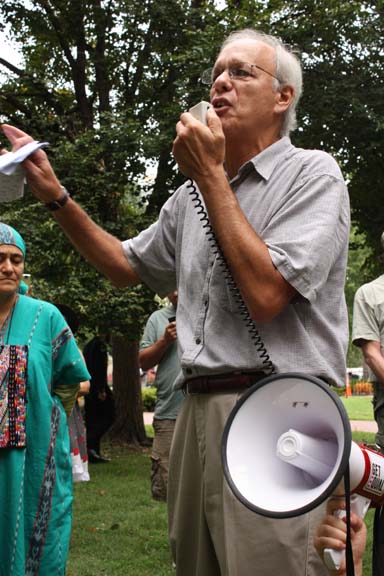 Maryland State Senator Paul Pinsky (D-Prince George's) makes a public statement before the Friday, Sept. 2, White House sit-in. He was later arrested.
Many see the pipeline issue as crucial to whether or not President Obama will receive voter support from environmentalists in the next election cycle.
 Members of the Ali-Latouche family, of Berwyn Heights, Md., line up on Fri., Sept. 2, to take part in the protest.
"This is a real chance for Obama to take a stand on something," said attendee Steve Paisley, of Ithaca, New York. "He is not going to get reelected by doing what he’s been doing, which is waffling and compromising and doing nothing. No one on the left is going to support that; even people in the middle are going to recognize someone who stands up for what they believe in, even if they don’t share that belief."
 The Reverend Lennox Yearwood, a D.C.-area minister and community activist, addresses assembled supporters and protesters after the sit-in on Saturday, Sept. 3.
The final State Department hearing on the Keystone XL pipeline will be held on Oct. 7, 2011. A final decision on the pipeline is expected from President Obama by the end of the year.
Editor's Notes:
*Guest reporter Kate Flynn is a graduate student in journalism at American University in Washington, D.C. She is a graduate of Hancock High School and Beloit College. Kate also worked as a journalism intern for both Keweenaw Now and the L'Anse Sentinel in 2010. This is her second article on the Keystone XL Pipeline protest. Click here to read her first article in this series, posted Aug. 31, 2011.
** See "The Indigenous Call: Take Back Our Future," a short video clip showing indigenous people at the protest, including some being arrested.
Tars Sands Action, organizers of the sit-in, will soon announce Phase 2 of the protest against the pipeline. Visit their Web site for updates.
Monday, September 05, 2011
Updated: Tall Ships Regatta photos from Turku, Finland
Editor's Update: On Aug. 29, 2011, we published this article with links to photos of the Tall Ships Regatta in Turku, Finland. Since then we received permission to publish some of the individual photos. Here is the revised article with photos of the Tall Ships and some additional photos from readers in Turku, Finland:
 Aug. 28, 2011, photo of Tall Ships Regatta, Turku, Finland. Click on photos for larger versions. (Photo © 2011 Shoja Lak. Turun Tietokuva Oy. Reprinted with permission. Photos courtesy Kalle Ipatti, Photographer-in-Chief, Turun Sanomat)*
TURKU, FINLAND -- The city of Turku, Finland, celebrated a Tall Ships Regatta in late August. The Regatta was reportedly the biggest event in the celebration this summer of Turku as the 2011 European Capital of Culture.
 View of one of the tall ships participating in the Tall Ships Regatta in Turku, Finland, celebrating the city as the 2011 European Capital of Culture. (Photo © 2011 Shoja Lak. Turun Tietokuva Oy. Reprinted with permission. )
Keweenaw Now reader Annukka Vepsäläinen, a resident of Turku, who directed us to these photos in the Turku newspaper Turun Sanomat, recalls her own experience at the Tall Ships Regatta a few years ago with her partner, Pasi Laihonen:
"Pasi and I had the chance to be there a few years ago when the same ships were leaving Turku. One of Pasi's friends has a beautiful boat, made according to the style of a typical archipelago boat. It was an experience I'll never forget. There were hundreds of boats there to witness the moment. I'm adding a picture from 2006 when Pasi, I and some friends were going on a short trip with that same boat."
 The Tall Ships Regatta brought back memories for Annukka Vepsäläinen of Turku -- including the memory of taking a trip in this Finnish archipelago boat, in which she had also witnessed the Tall Ships Regatta in Turku. (Photo © 2006 Pasi Laihonen and courtesy Annukka Vepsäläinen. Reprinted with permission.)
 Annukka Vepsäläinen and Pasi Laihonen relax in the Finnish archipelago boat. (Photo © 2006 and courtesy Annukka Vepsäläinen. Reprinted with permission.)*
Click here for a night photo with fireworks.
Click here for more photos, including close-ups of the ships.
Click here to read -- in English -- about Turku's Summer of Culture celebration held on the banks of the River Aura.
* Editor's Note: Thanks (kiitos) to our reader Annukka Vepsäläinen, a resident of Turku, for directing us to news of the Regatta in the Turku newspaper Turun Sanomat; thanks to Kalle Ipatti, Turun Sanomat Photographer-in-Chief, for permission to use photos of the Tall Ships; and to Pasi Laihonen for his photos.
Portage Library to host Survival Shelter Building Program
HOUGHTON -- David Talaga, founder of the Houghton Primitive Skills and Wilderness Survival School, will teach children and adults how to build a survival shelter at 6:30 p.m. on Tuesday, Sept. 6, at the Tech Trails in Houghton.
This program will take participants out of the library and into the woods. Participants will first walk around the Tech Trails to see various survival shelters that kids have built. The group will then work together to build a survival shelter.
In this program, participants will learn which types of trees make the best shelter, what to avoid when setting up a shelter, what are the best types of materials for covering your shelter, different types of shelter construction methods, and hands-on construction of a lean-to survival shelter.
Participants should meet at 6:30 p.m. in the Tech Trails parking lot off of Sharon Ave. Hiking shoes or boots, a light jacket, and a water bottle are recommended.
Talaga has been learning and teaching wilderness survival and primitive skills for over nine years. He studied at the Tom Brown, Jr., Tracker School and also studied under Dave Canterbury, co-host of "Dual Survival," a wilderness survival documentary television series on the Discovery Channel.
Library programs are free and everyone is welcome. For more information, please call the library at 482-4570 or visit www.pldl.org.
Mini-grants available to non-profits for arts, cultural projects
HANCOCK -- The Copper Country Community Arts Council is accepting applications from non-profit organizations for mini-grants of up to $4,000 for arts and cultural projects. The deadline for submission of applications is Tuesday, Oct. 4, 2011. Funding is for projects that take place between Feb. 1, 2012, and Sept. 30, 2012.
The Mini-grant program is a grants-giving partnership funded by the State of Michigan through the Michigan Council for Arts and Cultural Affairs (MCACA) and administered by agencies in each region of the state. The Copper Country Community Arts Council serves as the Regional Re-granting Agency for the six counties in the Western UP.
MCACA mini-grants are available to registered non-profit organizations located in Baraga, Gogebic, Houghton, Iron, Keweenaw and Ontonagon counties. These include (but are not limited to) service organizations, arts and historical organizations, churches, professional associations, public and non-public schools, and municipalities.
Mini-grants provide up to $4,000 for locally developed, high quality arts and cultural projects, which are special opportunities to address local arts and cultural needs and increase public access to arts and culture. Mini-grant funds require a 1:1 match which can be cash or in-kind.
Mini-grant applications must be submitted to the Community Arts Center by 5 p.m. on Tuesday, Oct. 4, 2011. Awards will be announced in January 2012. Applications and guidelines are available on the Copper Country Community Arts Council web site (www.coppercountryarts.com) or by phoning (906) 482-2333.
The Community Arts Center will host a grant writing workshop designed to assist organizations interested in applying for Michigan Council for Arts and Cultural Affairs (MCACA) Mini-grant funds. The workshop will take place from noon to 1 p.m. on Friday, Sept. 9, at the Community Arts Center located at 126 Quincy Street in Hancock. Please phone 482-2333 to reserve your space. Technical assistance is also available by appointment.
For more information, call Regional Re-granting Coordinator Cynthia Coté at 482-2333 or email cynthia@coppercountryarts.com.
Keweenaw Nordic Ski Club to hold meeting Sept. 7
HANCOCK -- KNSC (Keweenaw Nordic Ski Club) will hold its first meeting of the season at 7 p.m. Wednesday, Sept. 7, at the Hancock Chalet. The general public is welcome. For those new to the area, KNSC is a nonprofit club that maintains the Maasto Hiitto/ Churning Rapids classic cross country ski trail system in and adjacent to the City of Hancock.
The Hancock Chalet is at the Houghton County Fair Grounds (also called the Driving Park). More questions, call Jay Green, president, at 906-487-5411.
The Hancock Chalet is at the Houghton County Fair Grounds (also called the Driving Park). More questions, call Jay Green, president, at 906-487-5411.
Subscribe to:
Posts (Atom)



































