See our right-hand column for announcements and news briefs. Scroll down the right-hand column to access the Archives -- links to articles posted in the main column since 2007. See details about our site, including a way to comment, in the yellow text above the Archives.
Showing posts with label Bete Grise Preserve. Show all posts

Monday, April 08, 2019

Houghton Keweenaw Conservation District to hold Annual Meeting, Election April 10 in Hancock

This map shows parts of the Bete Grise Preserve, outlined in blue, in Keweenaw County. Stars indicate county public parks. In recent years, federal grants, private foundations and conservation organizations, including The Nature Conservancy and Keweenaw Community Forest Company, helped the Houghton Keweenaw Conservation District acquire the areas that now comprise the Bete Grise Preserve. Click on map for larger version. (Map courtesy Houghton Keweenaw Conservation District)

HANCOCK -- The Houghton Keweenaw Conservation District (HKCD) will hold its 67th Annual Meeting and Election from 5 p.m. to 7 p.m. on Wednesday, April 10, 2019, at The Orpheum in Hancock.

On the Agenda will be the HKCD Election of two board members for four-year terms. Residents of Houghton or Keweenaw Counties 18 years or older are eligible to vote. To vote via absentee ballot, please call (906) 482-0214 for instructions.

Candidates for the board election are Lydia Lytle, Rachel McDonald and Gina Nicholas.

Following the election, will be the HKCD Year-in-Review and presentations on Trout of Lake Superior:

Henry Quinlan, U.S. Fish and Wildlife Service, will speak on "Prioritization of Brook Trout Habitat Conservation and Restoration in Western UP Tributaries of Lake Superior."

Casey Huckins, Michigan Tech University professor, will present "History and Ecology of Coaster Brook Trout in Lake Superior."

A light pizza buffet will be provided. Questions? Please call Sue Haralson, HKCD Volunteer, at (906) 482-0214.

The mission of the Houghton Keweenaw Conservation District is to advise and assist the people of Houghton and Keweenaw Counties to wisely manage and use our natural resources through education, information, technical assistance, and land stewardship. Learn more about HKCD and see photos on their updated Web site.

Friday, April 21, 2017

Record number of voters elect Houghton Keweenaw Conservation District directors; residents learn about sea lamprey control

By Michele Bourdieu

Sue Haralson of the Houghton Keweenaw Conservation District (HKCD) administers the oath of office to newly elected HKCD Board Director James F. Tercha of Calumet following HKCD's 65th Annual Meeting and Election held Apr. 20, 2017, in the Orpheum Theater in Hancock. (Photos by Keweenaw Now)

HANCOCK -- A record number of Houghton and Keweenaw County residents voted to elect two new Houghton Keweenaw Conservation District board directors this week. While about 100 people attended the Apr. 20 Annual Meeting and Election, 99 of whom voted at the meeting, absentee ballots totaled 203.

James F. Tercha of Calumet, who has served for years as HKCD's attorney, received a total of 258 votes and will serve a two-year term. Steven C. Siira, incumbent board director, was re-elected for a four-year term with 250 votes. Both Tercha and Siira have participated on HKCD volunteer projects such as the Annual Tree Sale and the Annual Beach Cleanup at the Bete Grise Preserve.

Steven C. Siira, incumbent HKCD board director, recites the oath of office for his new four-year term with the assistance of HKCD's Sue Haralson.

Other candidates for the two-year term were Mark F. Ahlborn of Houghton, who received 30 votes, and Lawrence Butala of Calumet, 14 votes. For the four-year term, runner-up Thomas G. Bryant, PE, of Eagle River, received 45 votes.

Sue Haralson, HKCD volunteer and former HKCD administrator, said this year's voter turnout was the biggest she remembers.

"During the time that I worked at HKCD from 2002 to 2013, we did have some large audiences at our Annual Meetings depending on the presentation," Haralson told Keweenaw Now. "Our elections usually consisted of an estimated 30 to 50 voters. I never had any absentee ballot requests during that time."

Many people had other commitments or were out of town this week so they mailed their absentee ballots or dropped them off at the HKCD office in Houghton, she added.

Presentation on Sea Lamprey Control

Shawn Nowicki, U.S. Fish and Wildlife Service Larval Control Unit supervisor, Sea Lamprey Control Program in Marquette, displays a live sea lamprey following her presentation during the HKCD Annual Meeting Apr. 20 in Hancock.

A highlight of the HKCD meeting was a presentation on sea lamprey control by Shawn Nowicki, Larval Control Unit supervisor; Sean Lewandoski, fish biologist; and Nicholas Scripps, biological science technician -- all from the U.S. Fish and Wildlife Service Biological Station in Marquette.

According to a Great Lakes Fishery Commission brochure distributed at the meeting, sea lampreys entered the Great Lakes from the Atlantic Ocean and were first observed in the 1830s in Lake Ontario. Slowed down for a while by Niagara Falls, a natural barrier, they spread to the rest of the Great Lakes after the Welland Canal was deepened in 1919 and were present in all the Great Lakes by 1938.

The lampreys' damage to fish is described thus: "They attach to fish with their suction mouth and teeth, and use their tongue to rasp through a fish's scales and skin so they can feed on its blood and body fluids. A single sea lamprey will destroy up to 18 kgs (40 lbs.) of fish during its adult lifetime. Sea lampreys are so destructive that, under some conditions, only one out of seven fish attacked will survive. Sea lampreys prey on all types of fish, such as lake trout, salmon, rainbow trout (steelhead),brown trout, whitefish, yellow perch,burbot,walleye, catfish, and even sturgeon."

Shawn Nowicki offers residents attending the HKCD meeting an opportunity to examine a sea lamprey close up and answers a question from avid fisherman Tom Collins, HKCD board director.

Nowicki explains to a young visitor how a sea lamprey's suction mouth and teeth attack fish. To a question on whether sea lampreys are edible, she noted they bioaccumulate too much mercury to be safe to eat.

In their presentation, the visiting scientists explained the importance of sea lamprey control for the Great Lakes. The presenters explained the main methods of sea lamprey control: using lampricides to kill sea lamprey larvae, barriers to block the upstream migration of sea lampreys during their spawning phase, and pheromones that exploit lampreys' keen sense of smell in order to bait them and manipulate their behavior to disrupt reproduction.

This slide from the sea lamprey presentation explains various steps in detecting and assessing sea lamprey larvae present in streams. (Click on photo for larger version)

According to the U.S. Fish and Wildlife team, the lampricides used to kill larvae once they are identified and assessed are not harmful (at the concentration applied) to humans or other mammals and have minimal effects on other fish, aquatic plants and wildlife.

Nowicki noted more than 6,000 chemicals were tested in order to control sea lampreys.

This slide explains the importance of using lampricides responsibly to avoid risks to people or the environment.

Sean Lewandoski, fish biologist, describes the barriers used to block upstream migration of sea lampreys. Nicholas Scripps, biological science technician, operates the computer for the slide presentation, while HKCD Chair Gina Nicholas moderates. Lewandoski fielded several audience questions on the effects of removing a dam on the Otter River, one of many streams where sea lamprey need to be controlled. 

The United States and Canada created the Great Lakes Fishery Commission in 1955 to control sea lampreys and coordinate research for protecting the fishery. The following graph shows the success of their efforts in restoring lake trout to Lake Superior:

This graph shows how sea lampreys were discovered in Lake Superior in the late 1930s and began to decline after the first lampricide treatments began in the late 1950s -- allowing the return of lake trout. Click on photo for larger version. Click here for more details on sea lamprey control.

Nowicki noted the success of sea lamprey control means there is no need to stock lake trout in Lake Superior.

Handing the microphone to speaker Shawn Nowicki, Nancy Langston, Michigan Tech professor in social sciences who studies Great Lakes environmental policy and history, asks Nowicki why there was a steep increase in sea lamprey before 2012. Nowicki replied it was because they had decreased their use of lampricide before that. At left is HKCD Chair Gina Nicholas.

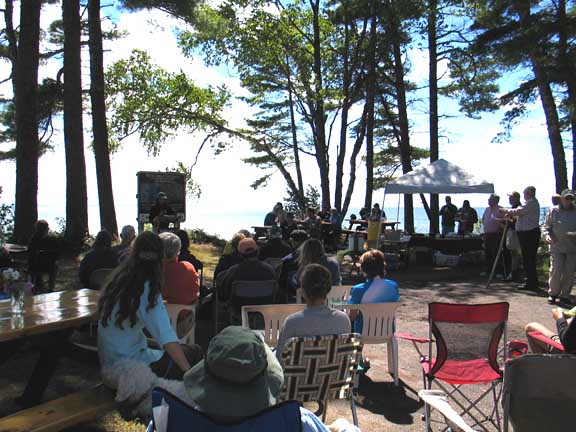
During the Apr. 20 meeting, Gina Nicholas, HKCD chair, gave a summary of the District's "Year in Review." She mentioned the Seneca No. 3 Bat Conservation Area near Mohawk, one of HKCD's current projects, is receiving new visitor turnout. Nicholas also spoke about the Bete Grise Beach Cleanup last September and the Bete Grise picnic and celebration of Deer Lake (in Keweenaw County), the newest addition to the Bete Grise Preserve.

On Aug. 21, 2016, at Point Isabelle Park, HKCD Chair Gina Nicholas speaks to visitors during the Bete Grise Preserve Dedication of Deer Lake, the newest addition to Bete Grise Preserve. The Houghton Keweenaw Conservation District and the Stewards of Bete Grise hosted the celebration and picnic.

Nicholas also reminded the meeting audience of the upcoming HKCD Annual Tree Sale, which will be held from 8 a.m. to noon on Saturday, May 6, 2017, at 711 W. Lakeshore Dr., Houghton, on a first-come, first-served basis on the day of the sale. Click here for more info on the sale.

The mission of the Houghton Keweenaw Conservation District is to advise and assist the people of Houghton and Keweenaw Counties to wisely manage and use our natural resources through education, information, technical assistance and land stewardship.

Sunday, August 14, 2016

Bete Grise Preserve Dedication to be Aug. 21 at Point Isabelle Park

Poster for Bete Grise Preserve Dedication Sunday, Aug. 21, 2016, at Point Isabelle Park. (Poster courtesy Houghton Keweenaw Conservation District)

HOUGHTON -- The Houghton Keweenaw Conservation District and the Stewards of Bete Grise will host a Bete Grise Preserve Dedication of Deer Lake, the newest addition to Bete Grise Preserve, at 2 p.m. on Sunday, August 21, 2016, at Point Isabelle Park. Music and light refreshments will be provided.

View of Lake Superior and Point Isabelle, part of the Bete Grise Preserve, from Point Isabelle Park on the Gay-Lac La Belle Road. (File photo © and courtesy Gina Nicholas)

Everyone is welcome!

If you have any questions, please call Sue Haralson at (906) 369-5023.

Thursday, August 20, 2015

Bete Grise picnic, potluck fundraiser to be Aug. 23 at Point Isabelle Park

View of Lake Superior and Point Isabelle from Point Isabelle Park. (Keweenaw Now file photo)

BETE GRISE -- The Stewards of Bete Grise Preserve will host a picnic potluck and fundraiser next Sunday, August 23, at the recently acquired Point Isabelle Park on the beautiful shores of Lake Superior.

This sign at the Point Isabelle Park lists partners and funding sources that have contributed to the Bete Grise Preserve. Click on photo for larger version. (Keweenaw Now file photo)

The event kicks off at 3 p.m. with the potluck beginning at 5 p.m. Bring a dish to share, a lawn chair and your own tableware for this great event!

Live music from talented local musicians will start at 6 p.m. The event is free and open to the public, though donations are appreciated as the Stewards of Bete Grise look to take care of this treasured natural and scenic resource.

"This is the 11th year anniversary of the Bete Grise Preserve in which a total of 4,000 acres, including 5.5 miles of sensitive shoreline on Lake Superior, has been preserved and now includes almost all of the sloughs of Lac La Belle," says Anita Campbell of Stewards of Bete Grise Preserve. "Last year we celebrated the 10-year anniversary with guest Senator Carl Levin, announcing the acquisition of several additional parcels.*  It’s been 11 years of dedicated folks writing grants, along with a large number of local, state and federal partners helping to preserve this unique land for public use, education and enjoyment. Bete Grise is also historically and culturally important to Native American communities."

A large crowd gathers at the Point Isabelle Park on Aug. 17, 2014, to dedicate new additions to the Bete Grise Preserve and celebrate its 10th anniversary. Former U.S. Senator Carl Levin is seated in the foreground, center. (Keweenaw Now file photo)*

To reach the Point Isabelle Park, take US-41 north until you reach Lac La Belle Road.  Turn on to Lac La Belle Road for 10.6 miles, then look for a roadside sign on the east side indicating you have reached Point Isabelle. Click here for directions from Calumet. For more information, contact the Stewards of Bete Grise at (906) 369-3400.

* Editor's Note: See our Sept. 1, 2014, article, "Sen. Levin joins supporters, visitors at Bete Grise 10-year celebration."

Monday, September 01, 2014

Sen. Levin joins supporters, visitors at Bete Grise 10-year celebration

By Michele Bourdieu

U.S. Senator Carl Levin (D-Michigan) addresses the audience at the Aug. 17, 2014, Bete Grise Preserve celebration near Point Isabelle, on Lake Superior. (Photo © and courtesy Bill Rose. Reprinted with permission.)

POINT ISABELLE, KEWEENAW COUNTY -- Cool breezes and partly cloudy weather didn't discourage 80 or more visitors -- and special guest U.S. Sen. Carl Levin (D-Michigan) -- from enjoying the Aug. 17, 2014, dedication and 10-year anniversary celebration of the Bete Grise Preserve.

A large crowd gathers at the Point Isabelle roadside park on Aug. 17, 2014, to dedicate new additions to the Bete Grise Preserve and celebrate its 10th anniversary. U.S. Senator Carl Levin is seated in the foreground, center. (Photos by Keweenaw Now unless otherwise indicated)

Hosted by Stewards of Bete Grise Preserve, the event featured several speakers representing the work of partner organizations and individuals and the funding involved in preserving a total of 4,000 acres, about 5.5 miles of sensitive Lake Superior shoreline and almost all of the sloughs of Lac La Belle in Keweenaw County -- for non-invasive public access, recreation (including berry picking) and education.

Gina Nicholas, Houghton Keweenaw Conservation District chairperson, welcomed visitors to the small roadside park near Point Isabelle, one of the most recent additions to the Preserve.

Gina Nicholas, Houghton Keweenaw Conservation District chairperson, welcomes more than 80 visitors to the Celebration and 10th Anniversary of the Bete Grise Preserve on Aug. 17, 2014, at Point Isabelle on Lake Superior. (Videos by Keweenaw Now)

"Today we are celebrating the 10-year anniversary of the formation of the Bete Grise Preserve, and we're also dedicating four new parcels of land," Nicholas said. "And those new parcels are Bete Grise wetlands, Point Isabelle, the mouth of the Little Gratiot and Oliver Bay."

Nicholas noted a major source of funding for the recent expansion of the Preserve with these new parcels was a  $1.7 million grant from the NOAA (National Oceanic and Atmospheric Administration) CELCP (Coastal and Estuarine Land Conservation Program), funded by the Great Lakes Restoration Initiative (GLRI).

"We still had to match that with another $1.7 million," Nicholas said.

Providing financial and in-kind support for the match were The Nature Conservancy, attorney Jim Tersha, and the Houghton Keweenaw Conservation District, Nicholas noted.

"But the lion's share of the financial  match that we needed to complete the Bete Grise wetlands project was provided by John Woollam and the J.A. Woollam Foundation," she explained.

This sign at the Point Isabelle roadside park lists partners and funding sources that have contributed to the Bete Grise Preserve. Click on photo for larger version.
 
A highlight of the afternoon was the visit by U.S. Senator Carl Levin, who has been a supporter of the Great Lakes and of the efforts to preserve the delicate wetlands and shoreline of this special area of the Keweenaw:


After some humorous comments on Keweenaw potholes (the Gay-Lac La Belle Road), U.S. Senator Carl Levin speaks about the Great Lakes Restoration Initiative and the importance of protecting and restoring lands for future generations with public funds.

Sen. Levin, who is retiring at the end of this year after serving more than 35 years in the U.S. Senate, spoke briefly with Keweenaw Now about his plans for the rest of his term, noting he has too much to do now to think about retirement plans.

"My short-term plans are to work as hard as I know how to get done what needs to be done in the next four months as a senator," Levin said. "That's my focus and I haven't looked beyond that."

Examples of his current goals include a defense authorization bill and closing loopholes that the biggest corporations in the country are using to avoid taxes they should be paying.

Asked if he would still be interested in protecting the Great Lakes after retirement, Levin said, "I'll always be interested in protecting the Great Lakes."

Pictured here with Sen. Levin at the Aug. 17 Bete Grise celebration are Jeff Knoop, director of land protection for The Nature Conservancy (TNC) Marquette office, and Gina Nicholas, Houghton Keweenaw Conservation District chairperson. "It was an honor to have the Senator come," Nicholas said. "He's done so much to help the Keweenaw."

Another long-time supporter of the efforts to protect Bete Grise, Jeff Knoop, director of land protection for The Nature Conservancy (TNC) Marquette office, gave an overview of his and TNC's involvement in protecting Bete Grise wetlands and shoreline.

During the Aug. 17, 2014, Bete Grise celebration, Jeff Knoop, director of land protection for The Nature Conservancy, Marquette office, speaks about his involvement with the Bete Grise Preserve from its beginnings in 2001.

Knoop acknowledged the work of several people who also helped with the project. The first was Steve Beyer of the Michigan Department of Natural Resources (MDNR), who put the proposal together for the first stage of the Bete Grise wetlands protection project.

Knoop said in his career of more than 30 years with TNC he has never been involved with another project with so many partners as those who have supported the Bete Grise Preserve.

In addition to Gina Nicholas and the Houghton Keweenaw Conservation District, the partners he mentioned as deserving credit for their participation and contributions include the MDNR, the MDEQ (Michigan Department of Environmental Quality), the Keweenaw Land Trust, National Coastal Wetland Conservation Program, the Great Lakes Fisheries Commission, and more.

Bete Grise is historically and culturally important to Native American communities as well. Representing the Keweenaw Bay Indian Community (KBIC) at the event was Jessica Koski, KBIC member:

During the dedication at Point Isabelle, Jessica Koski, Keweenaw Bay Indian Community member, speaking for KBIC, thanks everyone who has participated in the preservation of the Bete Grise wetlands and shoreline.

Two major sources of government grants for purchase of much of the Preserve were the DEQ Coastal Zone Management Program and the U.S. Fish and Wildlife Service (USFWS).

Laurel Hill, biological technician for the U.S. Fish and Wildlife Service, Marquette office, said it was great to be involved in the celebration ten years after USFWS helped fund the first Bete Grise acquisition in 2004.

"The U.S. Fish and Wildlife Service Coastal Program seeks to create partnerships to catalyze public action and conservation in the Nation’s coastal areas, and the Bete Grise Preserve is a perfect example of just that," Hill said. "The exemplary efforts of wide ranging collaborators are reflected in the beauty of this Preserve, which will continue to be invaluable for future generations."

Also addressing the visitors at the Point Isabelle event was Matt Warner of the DEQ Coastal Zone Management Program, who spoke about the involvement of the program in providing funding for the original Bete Grise Preserve and for management activities as well. He also spoke about the CELCP (Coastal and Estuarine Land Conservation Program) funding for Michigan through NOAA (National Oceanic and Atmospheric Administration).

During the Aug. 17, 2014, Bete Grise Celebration, Matt Warner, Michigan Dept. of Environmental Quality Coastal Zone Management Program, speaks about grants that contributed to purchase of the Bete Grise Preserve wetlands and coastal areas in the Keweenaw Peninsula.

Warner also thanked individuals, including the previous speakers, and groups for their participation in this preservation effort.

One of those was Sue Haralson, Stewards of Bete Grise secretary, who has been involved in the project for several years. She recently retired from her position as Houghton Keweenaw Conservation District administrator.

"Great turnout!" Haralson said of the day's event. "Mother Nature gave us cool weather, but dry. A cool breeze kept the bugs away."

Haralson added she thought the music, provided by the group B3, was "outstanding."

Tom Collins, left, on saxophone, Stewards of Bete Grise president, joined the local band B3 in providing a variety of lively music for the Bete Grise celebration. Pictured with him are, to his left, B3 musicians Erika Vye, Marshall Weathersby and Steve Brimm.

Tom Collins, Stewards of Bete Grise president, who, with his saxophone, joined the B3 musicians during the event, also commented on the wonderful turnout.

"A big thank you to Gina for her laser focus in making all this happen throughout the years," Collins said.

Nicholas concluded the presentations with appreciative comments and invited everyone to enjoy the copious refreshments provided by Stewards of Bete Grise. Here she points out on a map most of the protected areas of the Preserve:

Using the map on the Point Isabelle sign, Gina Nicholas points out the different parts of the Bete Grise Preserve -- from the original Bete Grise South to the recently acquired mouth of the Little Gratiot near Lac La Belle.

Several residents of the Bete Grise area were also present at the celebration and spoke with Keweenaw Now.

One couple, Dante Iacovoni and his wife, Joyce, have been residents of Bete Grise for 11 years.

"It was just great, in spite of the weather -- more than I expected," Dante said. "It just shows the enthusiasm of the people in this community."

Describing this special place, Joyce Iacovoni added, "This is as close to paradise as we're going to see and experience."

Chuck Brumleve, Stewards of Bete Grise vice president and Bete Grise resident as well, summed up the reason for the celebration: "This has been the culmination of a lot of work by a lot of people for a lot of years."

During the Aug. 17 Bete Grise celebration, Chuck Brumleve, center, Stewards of Bete Grise vice president and Bete Grise resident, chats with TNC's Jeff Knoop, left, and Charlie Eshbach of the Michigan Nature Association, who was especially instrumental in preserving the tip of the Keweenaw (a large wilderness area north and east of Bete Grise) with the help of TNC and grants from the Michigan Natural Resources Trust Fund.

More photos:

Keweenaw County Sheriff Ron Lahti was on hand for the celebration. Here he chats with Senator Levin.

Senator Levin and Amy Berglund, his Upper Peninsula regional representative, pause for a photo with Keweenaw Now photographer Gustavo Bourdieu.

Visitors enjoy a large selection of refreshments provided by Stewards of Bete Grise.

Jessica Koski of KBIC with one of the newest KBIC members -- her son, Skyler.

 Visitors line up to sign the Bete Grise guest book.
 
View of Lake Superior and Point Isabelle from the roadside park.

Wednesday, August 13, 2014

Conservation District, Partners to host Bete Grise Preserve celebration Aug. 17 at Point Isabelle

By Michele Bourdieu

Point Isabelle, seen here from a roadside park on the Gay Lac La Belle Road, is now part of the Bete Grise Preserve expansion, which will be celebrated at a Dedication Ceremony and Community Picnic hosted by the Houghton Keweenaw Conservation District and Partners on Sunday, Aug. 17. (Photos © and courtesy Gina Nicholas)

HOUGHTON -- Houghton Keweenaw Conservation District (HKCD) and Partners will celebrate the 10 Year Anniversary and recent expansion of the Bete Grise Preserve at 2 p.m. Sunday, Aug. 17, with a Dedication Ceremony and Community Picnic at Point Isabelle roadside park.

Directions: From US 41 and the Lac La Belle Road Intersection, travel 10.6 miles to the Point Isabelle roadside park on the Gay Lac La Belle Road. Watch for signs. Everyone is welcome, musicians will entertain, and Stewards of Bete Grise Preserve will provide refreshments. RSVP appreciated: Please call 906-482-0214.

This little Point Isabelle roadside park, which was previously on private land, and Point Isabelle add approximately 2.5 miles of natural beauty to the Bete Grise Preserve.

"Now it is totally protected for posterity," said Gina Nicholas, HKCD chairperson.

According to Nicholas, the new expansion gives the Bete Grise Preserve a total of 4,000 acres and about 5.5 miles of Lake Superior shoreline.

Besides Point Isabelle, other recent acquisitions to the Preserve include additional Bete Grise wetlands; the Mouth of the Little Gratiot River, which connects Gratiot Lake to Lac La Belle, thus preserving frontage on Lac La Belle; and Oliver Bay -- 2.2 miles of Lake Superior shoreline and 343 acres.*

Interior wetlands at the Lac La Belle sloughs, which are now protected as part of the Bete Grise Preserve.

"One of the new enhancements of the Preserve is the new botany trail with interpretive signs," Nicholas added.

The Bete Grise Preserve is open to the public for noninvasive recreation, research and education.

If you have any questions about the celebration, please call Sue Haralson, secretary, Stewards of Bete Grise Preserve, at 906-369-3400.

*Editor's Note: For more details on 2013 acquisitions for Bete Grise Preserve, see our June 25, 2013, article, "Conservation District purchase adds Point Isabelle, Bete Grise wetlands, Lac La Belle shoreline to Bete Grise Preserve."

Thursday, August 29, 2013

Letter: Loss of MTU Lakeshore Center office space is hardship for Conservation District

Dear Constituents and Associates:

The Houghton Keweenaw Conservation District (HKCD) is very sad to report that after almost 20 years at 600 E. Lakeshore Drive (now known as Michigan Tech's Lakeshore Center), the current landlord, Michigan Technological University (MTU), has elected to take the joint HKCD/USDA Natural Resources Conservation Service (NRCS) office for some other purpose effective September 1, 2013. MTU is unwilling to work out an ongoing lease. As a result, the office space at 600 E. Lakeshore Drive and the federal funding grandfathered for that specific location have been lost. This is a major hardship for our organizations.

At the March 21, 2013, annual meeting of the Houghton Keweenaw Conservation District (HKCD), held at Michigan Tech's Lakeshore Center in Houghton, where HKCD has had an office for nearly 20 years until this month, Gina Nicholas, HKCD chairperson and author of this letter, summarizes the District's 2011-2012 projects. (Photo by Keweenaw Now)

600 E. Lakeshore Drive has been an ideal professional setting for HKCD and NRCS to serve the natural resource conservation needs for the citizens and landowners of Houghton and Keweenaw Counties and for accomplishing collaborative grant funded projects. Many MTU students and professors have been and are included in HKCD sponsored projects. Projects include the Eagle River Watershed, Pilgrim River Watershed, Bete Grise Preserve, Bete Grise Wetlands, Hills Creek and Cliff Mine.

At the March 21, 2013, annual meeting of the Houghton Keweenaw Conservation District, Gina Nicholas, HKCD chairperson, speaks about the District's 2011-2112 projects and thanks the partners and volunteers in the community -- from Michigan Tech University faculty and students to Trout Unlimited, the Michigan Dept. of Environmental Quality and others for their help and participation. (Videos by Allan Baker for Keweenaw Now)*

During fiscal years 2012 and 2013, HKCD projects paid over $150,000 to MTU to help provide better educational and research opportunities for students and professors and to help MTU address financial challenges with its land holdings. HKCD also provides countless hours of pro bono service for MTU sponsored projects.

During her presentation at the March 21, 2013, annual meeting of the Houghton Keweenaw Conservation District, Gina Nicholas speaks about restoring fisheries to Hills Creek and Eagle River by remediating stamp sand; expanding the Lizzadro Preserve and the Bete Grise Preserve on Lake Superior; and cooperating with partners on other projects.

In order to minimize disruption to projects and partners, HKCD/NRCS will relocate to a new office at 711 W. Lakeshore Drive in early September on a temporary basis. During the interim from August 23 to a date to-be-determined after September 3, 2013, the HKCD/NRCS office will be closed. There will be times when both files and systems are unavailable and some reports will not be completed on schedule. However, planned fieldwork and construction projects will continue as scheduled. Project partners can continue to reach Sue Haralson and Rob Aho via email and cell phone.

At the March 21, 2013, Houghton Keweenaw Conservation District annual meeting, Chad Kotke, Water Resources Division of the Michigan Department of Environmental Quality, presents "Preserving Our Past, Restoring Our Future in the Eagle River Watershed." (Photo by Keweenaw Now)

Additional plans for the joint HKCD/NRCS office will be discussed at HKCD’s regular monthly public Board meeting at 12:30 p.m. on Tuesday, Sept. 17, 2013. This meeting will be held in Houghton at the Portage Lake District Library conference room.

Thank you for your understanding and support as HKCD and NRCS work through this challenging situation. Please call me at 906-370-7248 if you have questions.

Gina Nicholas, Chairperson, Houghton Keweenaw Conservation District

Editor's Notes: The above letter is reprinted with permission. We have added our video clips and photos of HKCD's 2013 Annual Meeting to illustrate Gina Nicholas's letter with some details about HKCD projects, partners and volunteers.

* HKCD helped with the Natural Resources Trust Fund purchase of  320 acres, including the summit, of Brockway Mountain. See the Aug. 25, 2013, article, "Story of Brockway Mountain -- now part of Keweenaw Coastal Wildlife Corridor," by Gina Nicholas.

See the June 25, 2013, article, "Conservation District purchase adds Point Isabelle, Bete Grise wetlands, Lac La Belle shoreline to Bete Grise Preserve."

Tuesday, June 25, 2013

Conservation District purchase adds Point Isabelle, Bete Grise wetlands, Lac La Belle shoreline to Bete Grise Preserve

Point Isabelle on the Keweenaw Peninsula, seen here from Mount Houghton, is now part of the Bete Grise Preserve and will be permanently protected in its natural state and open to the public for non-invasive recreation, research and education. On June 21, 2013, Houghton Keweenaw Conservation District (HKCD) closed on the purchase of 181.5 acres and 9100 Lake Superior shore feet (1.7 miles) at Point Isabelle. (Photos © and courtesy Gina Nicholas)

HOUGHTON -- The Houghton Keweenaw Conservation District (HKCD) has announced the final closing, on June 21, 2013, in a group of Keweenaw Peninsula land acquisitions that will double the size of their Bete Grise Preserve.

The combined land acquisitions include the following:
  • Protection for approximately 1800 acres of dune-swale and other primarily wetland habitat types
  • 9100 feet (1.7 miles) of Lake Superior shoreline
  • 3500 + feet of shoreline on Lac La Belle effectively protecting all of the slough frontage and providing a new kayak/canoe access site on the south side of Lac La Belle
  • A Roadside Park that was previously on private land and approximately 2.5 miles of natural beauty along the Gay-Lac La Belle Road
"This project protects a rich mosaic of coastal wetland habitats, Lake Superior shoreline and 3500 feet of formerly private Lac La Belle sloughs for thousands of native and migratory, aquatic and terrestrial species," said Gina Nicholas, HKCD Board of Directors chairperson. "It also provides current and future generations with permanent access to beaches, fishing, kayaking and canoe waters, roadside parks, berry picking spots, picnic
areas and one of the most beautiful scenic drives anywhere."

This photo of the shoreline on Lac La Belle -- part of Bete Grise Wetlands -- was taken from a kayak.

As part of the Bete Grise Preserve, this land is permanently protected in its natural state and open to the public for non-invasive recreation, research and education, Nicholas explained. HKCD will be working with partners to update the management plan for the expanded Bete Grise Preserve in the coming months, and a formal dedication will be held in 2014.

HKCD closed on Pt. Isabelle (181.5 acres and 9100 Lake Superior shore feet) on Friday, June 21, 2013, and on Bete Grise Wetlands (1493 acres and 3,500+ shore feet on Lac La Belle) on December 19, 2012. They also bought 120 acres from Michigan Technological University on May 17, 2013.

Present at Copper Range Abstract and Title Agency for the June 21, 2013, closing on Point Isabelle are, from left, Amanda Messner, Copper Range Abstract and Title Agency; Jim Tercha, attorney for HKCD; Trina Anderson, AFC (American Forestry Consultants) and representative for the seller, GMO; Sue Haralson, HKCD Administrator; Gina Nicholas, HKCD chairperson; and Kyle Messner of Copper Range Abstract and Title Agency.

This project was supported by the Michigan Department of Environmental Quality (DEQ) Coastal Zone Management Program, through Michigan's Office of the Great Lakes.

Funding for the project came from the Great Lakes Restoration Initiative, through the National Oceanic and Atmospheric Administration’s Coastal and Estuarine Land Conservation Program (NOAA/CELCP) -- a grant awarded in 2010. This project would not have been possible without the generous support provided by the J.A. Woollam Foundation and The Nature Conservancy.

"Significant in-kind service was provided by HKCD and Jim Tercha as well as  great guidance from Matt Warner, DEQ Coastal Zone Grant Administrator, and Liz Mountz, NOAA/CELCP Grant Administrator," Nicholas noted. "Many, many other  individuals and organizations contributed to the success of this project and HKCD sends our gratitude out to each of you."

At the closing for Bete Grise Wetlands Dec.19, 2012, are, from left, Gene Arntsen, the seller; Amanda Messner, Copper Range Abstract and Title Agency; and Jim Tercha, attorney for HKCD.

Together, these acquisitions provide significant advances toward the locally-driven initiative to protect the larger coastal wetland complex (more than 8000 acres) known as the Bete Grise Wetlands.*

This 2010 map shows the Bete Grise Coastal Wetlands Complex near Lac La Belle. Point Isabelle is in the center of the map, with Bete Grise Bay just above it. Click on map for larger version. (Keweenaw Now file map courtesy Houghton Keweenaw Conservation District.)

These wetlands contain a broad variety of habitats, hosting remarkable numbers and diversity of plant and animal species. The area is known to contain a rare type of wetland called a patterned fen. Wildlife species calling this area home include bald and golden eagles, sandhill cranes, moose, wolves and black bears.

This photo shows the interior of Bete Grise Wetlands looking toward Lac La Belle with Mt. Houghton in the background.

The Michigan Coastal Zone Management Program provides grant funds to assist in the development of vibrant and resilient coastal communities through the protection and restoration of Michigan's sensitive coastal resources and biologically diverse ecosystems. The goal of the program is to promote wise management of the cultural and natural resources within Michigan's coastal boundary by fostering environmental stewardship, furthering research to support science-based policies and regulations, and providing excellent customer service.

Funding for the program is provided by the National Oceanic and Atmospheric Administration through a state and federal partnership established under the Coastal Zone Management Act of 1972.

This photo shows a view from the south end of the new property, looking back toward Pt. Isabelle.

The Houghton Keweenaw Conservation District (HKCD), organized over 61 years ago, is a local unit of state government and part of the Michigan Department of Agriculture. In 1994, the Conservation District Law was made part of The Compiled Environmental Code. It is now Part 93 of Act 451 of 1994, as amended. HKCD's mission is to advise and assist the people of Houghton and Keweenaw counties to wisely manage and use our natural resources through education, information, technical assistance and land stewardship.

* Editor's Note: For background on these acquisitions see our Feb. 25, 2010, article, "Sen. Levin announces conservation funding for new Bete Grise Wetland area."

Tuesday, September 27, 2011

Updated: Volunteers help rid local beaches of invasive knapweed; presentation on invasives to be Sept. 29

By Michele Bourdieu

Botanist Janet Marr, left, helped McLain State Park with a project recently funded by the UP Resource Conservation and Development Council -- removing invasive spotted knapweed from areas of the Park in order to protect the beach from its spread. Here she is pictured with volunteers who helped collect these bags full of the invasive plant on July 30, 2011: from left, Marr; Jason Oyadomari, Finlandia University biology professor; Steve Albee of Hancock; Michigan Tech forestry student Alex Mehne; Chuck Mehne, Alex's Dad,visiting from Kalamazoo; and Lee Verberkmoes, McLain State Park superintendent. Marr will join Erik Lilleskov, research ecologist for the U.S. Forest Service, in a presentation on invasive species Thursday, Sept. 29, at Michigan Tech. Click on photos for larger versions. (Photos by Keweenaw Now unless otherwise indicated.)

HOUGHTON -- Janet Marr, contract botanist for the Houghton Keweenaw Conservation District, will join Erik Lilleskov, research ecologist for the U.S. Forest Service, in presenting "Invasive Species as Agents of Global Change," from 6:30 p.m. - 8:30 p.m., Thursday, Sept. 29, in Noblet 143 of Michigan Tech's Forestry building.

The presentation -- free and open to the public -- will offer the opportunity to
  • Explore the global impact of altered ecosystems
  • Find out about invasive species in the Copper Country
  • Learn how to identify invasive plants of the Western U.P. which threaten the biodiversity of the Keweenaw.
  • Discover how you can help control their spread and protect our native plants.
This event is sponsored by the Lake Superior Stewardship Initiative, Michigan Tech Center for Water and Society, Keweenaw Land Trust and the Keweenaw Unitarian Fellowship.

Photos: Pulling Knapweed at McLain State Park

Volunteers assist Botanist Janet Marr, center, in pulling invasive spotted knapweed at McLain State Park on July 30, 2011.

Janet Marr, left, and volunteers pull invasive knapweed from a hillside area near the breakwater at McLain State Park. In the foreground, second from right, is Lee Verberkmoes, McLain State Park superintendent, who worked with Marr in securing funding from the UP Resource Conservation and Development Council for spotted knapweed mapping, control/removal, and restoration in this popular Lake Superior lakeshore park.

Alex Mehne, left, Michigan Tech forestry student active in the Botany Club, invited his Dad, Chuck Mehne, who was visiting from Kalamazoo, to join the group of volunteers at the McLain State Park knapweed pull on July 30, 2011 -- a father-and-son shared effort for a Saturday morning in the Keweenaw! Alex also assisted Janet Marr with her garlic mustard removal campaigns in area neighborhoods this summer.

Steve Albee of Hancock helps Janet Marr carry a bag of knapweed up the hill to be disposed of by McLain State Park. Note protective gloves volunteers like Alex Mehne, at left, are wearing. "Spotted knapweed has a substance that is an irritant, and gloves, long sleeve shirts, and long pants should be worn," Marr advises.

Spotted knapweed on the beach at McLain State Park. This invasive plant loves dry areas and must be pulled straight up to remove the roots. It also grows along roadsides all around the Keweenaw and spreads rapidly. (Photo © and courtesy Janet Marr)

The restoration aspect of the McLain State Park knapweed removal project will include planting more of this protective dunegrass. (Photo © and courtesy Janet Marr)

Picnic and knapweed pull at Bete Grise Preserve

Members of the Houghton Keweenaw Conservation District and the Stewards of Bete Grise Preserve met for a knapweed pull, picnic and presentation by Janet Marr on Aug. 1, 2011, at the Bete Grise Preserve. They collected several bags full of the invasive plant, growing mostly along the Gay-Lac LaBelle Road. Pictured here, from left, are volunteers Evan McDonald, Chuck Brumleve, Gina Nicholas, Mark Klemp, Sue Haralson (in front of Mark), Anton Pintar, Paul and Anita Campbell, Joanne Thomas and Nick Wilson. The event was also sponsored by the Rapid Response Invasive Plant Intervention Team of the UP (RRIP-IT-UP) and organized by Sue Haralson, Houghton Keweenaw Conservation District administrator.

Gina Nicholas and Chuck Brumleve, both residents of Bete Grise, pull spotted knapweed plants along the Gay-Lac LaBelle Road at the Bete Grise Preserve.

After a potluck picnic at the Bete Grise Preserve beach, volunteers listen as Botanist Janet Marr demonstrates the best way to loosen the roots of invasive knapweed with a narrow tool. "The smaller the blade the better (that'll help assure less disturbance to the ground and exposure of seeds from the seedbank)," Marr explains. At far left is Cynthia McDonald (not pictured above), who also joined the group.

Janet Marr displays a sample of Centaurea (a relative of spotted knapweed) during her presentation at Bete Grise.

Despite the attractive flowers, this plant, Hypericum perforatum (commonly called St. John's wort), is also invasive.

Janet Marr displays some Hypochaeris radicata, also known as a false dandelion, or hairy cat's ear.

Learn more about these invasive plants and what you can do to help protect the ecology of the Keweenaw from their spread by attending the presentation by Janet Marr and Erik Lilleskov from 6:30 p.m. to 8:30 p.m. Thursday, Sept. 29, in Noblet 143 of Michigan Tech's Forestry building.