See our right-hand column for announcements and news briefs. Scroll down the right-hand column to access the Archives -- links to articles posted in the main column since 2007. See details about our site, including a way to comment, in the yellow text above the Archives.

Wednesday, September 12, 2012

EPA Hearing on CR 595: Part 2: Comments

By Michele Bourdieu

[Editor's Note: This is Part 2 in a series of two articles on the Aug. 28, 2012, Environmental Protection Agency Public Hearing on proposed CR 595 in Marquette County.]*

Listening to public comments at the Aug. 28, 2012, Environmental Protection Agency (EPA) Public Hearing on EPA's objections to a permit application by the Marquette County Road Commission for the proposed County Road 595, are, from left, Peter Swenson, EPA Region 5 (Chicago) Water Division, Watersheds and Wetlands Branch chief; Sue Elston of EPA Region 5 Watersheds and Wetlands Branch; and Steve Casey, Michigan Department of Environmental Quality Water Resources Division Upper Peninsula district supervisor. (Photos © and courtesy Jeremiah Eagle Eye, unless otherwise indicated. Reprinted with permission.)

MARQUETTE -- Following the one-hour informal question-answer session, the formal Environmental Protection Agency (EPA) Public Hearing on the Marquette County Road Commission's (MCRC's) permit application for the proposed County Road 595, a 21-mile haul road through the wilderness to connect Rio Tinto's Eagle Mine with the Humboldt Mill near US 41, lasted from 7 p.m. to 10 p.m. on Aug. 28, 2012. As the hearing began, an audience of nearly 400 filled the Great Lakes Rooms of the University Center at Northern Michigan University.

EPA Region 5 (Chicago) Water Division has objected to the permit application because of impacts to wetlands and streams and inadequate wetland mitigation plans.

EPA hears elected officials supportive of CR 595 for more than an hour before calling on concerned citizens

Those who wished to speak at the formal hearing were asked to sign in at the door. While many supporters of the EPA's objections to the road arrived and signed in early, they had to wait more than an hour while nearly all the elected officials spoke in favor of the proposed CR 595 before any names of individual citizens were called.

Jessica Koski, Keweenaw Bay Indian Community (KBIC) mining technical assistant, was one of the last called to speak. Her time was cut from the originally allowed three minutes to two minutes merely because time was running out as the clock neared 10 p.m. when she finally spoke.

At about two and a half hours into the three-hour public hearing, Jessica Koski, Keweenaw Bay Indian Community (KBIC) mining technical assistant, was called to present her comments on CR 595. After the hearing, Koski said, "The numerous politicians (who all had the privilege of going first before Ojibwa people and locally affected citizens) want the road for jobs and foreseeable future jobs the road could open up to development. Their strong-held vision is merely unsustainable resource exploitation in our treaty territory and homelands of the Upper Great Lakes region."

Koski said her community (1400 residents in Baraga and Marquette counties) asks the EPA to uphold their concerns and objections and the spirit and integrity of the Clean Water Act.

"And also please uphold federal treaty obligations to the federally recognized tribes in these territories that will be impacted," Koski said.

Koski held up photos of the mine and Eagle Rock, a sacred site for her people, where CR 595 would begin -- and the Humboldt Mill, where it would end and "where about 2.5 million tons of sulfide-bearing waste is to be deposited for eternity and left here for future generations."

The Humboldt Mill, pictured here, is the end point for the proposed CR 595. Rio Tinto changed its original plan to haul ore to a railhead close to the Eagle Mine when the company bought the mill, where, according to the Rio Tinto Web site, the ore is to be processed into separate nickel and copper concentrates and then transported via rail to an offsite smelter, while the tailings will be sent to the Humboldt Tailings Disposal Facility. (Photo © and courtesy Jeremiah Eagle Eye. Reprinted with permission.)

"It is very clear that this is a road to destruction," Koski said, "and I ask the EPA to please seriously question the project purpose and to hold Rio Tinto responsible for applying and for paying for their permit and for their project."**

Nancie Lamb, a KBIC tribal descendant, said the road could pose a considerable threat to cultural resources still used and being revitalized by the tribe. She mentioned the plants (many located in wetlands) in the proposed CR 595 area that are used by the Great Lakes Ojibwa for traditional food and medicinal purposes.

Nancie Lamb, a KBIC tribal descendant, comments on treaty rights and Ojibwa cultural resources that could be impacted by CR 595.

"The proposed road is located within the territory where KBIC and its tribal members reserve treaty rights under the treaty of 1842," she said.**

Chuck Brumleve, mining specialist for the Keweenaw Bay Indian Community, said KBIC agrees with the EPA, Fish and Wildlife Service and Army Corps of Engineers on their objections to CR 595.

"We agree with the EPA objections and find them well founded," Brumleve said. "We're mystified why MCRC (the Road Commission) and the State are so insistent on this specific haul route and so reluctant to consider perfectly practical and viable alternative ore haul routes. We're also a little mystified as to why the County is acting as developers and attempting to open the area up to development. It's a senseless, unjustifiable disruption of an undisturbed area."

Michelle Halley, National Wildlife Federation attorney and Lake Superior Project senior manager, in her letter to EPA noting potential threats to wildlife by the proposed County Road 595, also commented on the order of speakers at the hearing: "Last, I must commend Ms. Hyde on her facilitation of the public hearing held in Marquette on August 28. She handled a large and passionate crowd very well. My one concern about the evening was that while elected officials were invited to speak first, representatives of tribal sovereign nations were left with the dregs until after 10 p.m. This seemed to me a real slap in the face to the tribal nations present that evening."***
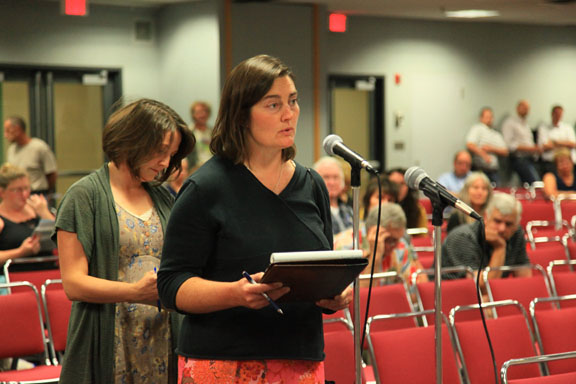
Michelle Halley, National Wildlife Federation (NWF) attorney and Lake Superior Project senior manager, delivers comments from NWF, one of the organizations involved in a lawsuit against Rio Tinto-Kennecott challenging their mining permit, was called to speak toward the end of the hearing, close to 10 p.m., when comments were limited to two minutes and many members of the audience had left. Behind her, next to speak, is Teresa Bertossi of Headwaters News, who has written extensively on the sulfide mining issue.

At the hearing, Halley gave several reasons why rail would be a better alternative than CR 595 for hauling ore and timber.

"Construction of a railway would create significant jobs," Halley said. "Rail is infinitely safer than motor vehicle traffic. Rail transportation is far more fuel efficient and air emission efficient than motor vehicle traffic probably will ever be. Rail transportation would conserve wetlands and minimize impacts to critical wildlife habitat and corridors."

With less than a half hour left for comments toward the end of the hearing, Emily Whittaker, Yellow Dog Watershed Preserve (YDWP) executive director, briefly summarized concerns in letter they sent to EPA so that others could speak.

Emily Whittaker, Yellow Dog Watershed Preserve (YDWP) executive director, summarizes YDWP's concerns about CR 595 for the EPA panel.

Whittaker said YDWP opposes CR 595 because of their concerns about sedimentation, fragmentation -- potential of increased moose-vehicle accidents, the "guise of increased recreational opportunities" (there are already plenty of recreational opportunities) and the false purpose statement in the permit application. ****

In answer to a question on how the EPA decided the order of speakers making comments, Tinka Hyde, EPA Region 5 Water Division director, told Keweenaw Now, "It is standard practice to invite elected officials to speak first as I noted in my opening remarks. The number of County and Township officials was significant. We did hold speakers to 3 minutes initially and eventually to 2 minutes to ensure all speakers were given a chance to speak."

Here are the opening remarks at the hearing from Tinka Hyde of EPA and Steve Casey, Michigan Department of Environmental Quality (MDEQ) Water Resources Division Upper Peninsula district supervisor:

In this video clip Hyde explains the EPA's procedures for reviewing all comments and making a decision on whether to maintain, modify or withdraw its objection to the permit application. Steve Casey, Michigan Department of Environmental Quality (MDEQ) Water Resources Division Upper Peninsula district supervisor, explains the MDEQ's role in the permitting process. (Video clips by Keweenaw Now)

Representatives from Michigan Senators Carl Levin and Debbie Stabenow and First District Congressman Dan Benishek were called first to read the senators' and the Congressman's letters to the EPA. Following these were more political figures -- a representative from Gov. Snyder's office, State Sen. Tom Casperson, 110th District
State Rep. Matt Huuki, and various county and township officials -- nearly all expressing support for CR 595.

Amy Berglund, Upper Peninsula representative for Sen. Carl Levin, read a letter from the Senator to the EPA. Levin noted the area of the proposed CR 595 has a long history of logging, excavating and motorized recreation and is already crossed by vehicles. He said the proposed road, by avoiding the longer route through busy Marquette roads and streets, would increase safety, save carbon-producing fuel and provide access in case of flooding that has occurred in the area in the past. He pointed out the applicant (Marquette County Road Commission) is planning to mitigate wetland impacts by preserving 25 acres of wetland for every one acre impacted.

"The protection of the wetlands is vital to the health of our water resources, including our precious Great Lakes. It is in all of our interests to protect wetlands, which filter contaminants, prevent flooding and erosion and provide habitat for a variety of birds, animals and plants; however, such protection provided for in the Clean Water Act must also consider whether there are practicable alternatives (that would have less adverse impact to the aquatic ecosystem)," Levin writes.

"In this case, it appears there may be no practicable alternative to CR 595 other than the route through the city of Marquette because funding for an alternative route is not available," Levin adds.

Toward the end of the hearing Teresa Bertossi referred to this comment by Sen. Levin.

She asked the EPA panel to "consider that so far Rio Tinto has not really shown that they will fully fund 595. Therefore by (Sen.) Levin's own definition 595 is also not a practicable alternative."

Jeremy Hoskins, Sen. Debbie Stabenow's Northern Michigan representative, read a short letter from Stabenow in which she says, "County Road 595 is strongly supported by many community leaders and is of great economic importance to the region."

A representative from First District Congressman Dan Benishek read a letter of full support for the construction of CR 595, which "will provide the most direct route between the Eagle Mine and Humboldt Mill."

He added his belief that there are no practicable alternatives and CR 595 will bring both temporary and permanent jobs to the area.

A representative for Gov. Snyder's office addressed a letter of support for CR 595 to Susan Hedman, EPA Region 5 administrator (rather than to the EPA Water Division's Watersheds and Wetlands Branch that is handling the permit) -- a letter coming apparently not from the Governor but from the directors of the Michigan Department of Agriculture and Rural Development, the Michigan Department of Natural Resources, and the Michigan Department of Transportation.

"In our opinion the public benefits achieved from permitting the construction of CR 595 clearly outweigh the resource impacts involved," the letter concludes.

State Sen. Tom Casperson appeared in person to speak of his support for CR 595, saying, "Clearly we have the support of the people to move forward on this thing."

That statement was followed by booing from the audience:

State Sen. Tom Casperson (R-Escanaba) is booed by many in the audience at the Aug. 28, 2012, EPA Public Hearing on CR 595 when he asserts that most of his constituents support the road. This video clip also includes statements of support for CR 595 by Matt Huuki, Michigan 110th District representative (R-Atlantic Mine); Jim Iwanicki, Marquette County Road Commission engineer manager (representing the permit applicant); and Debbie Pellow, Marquette County Board chair.

Matt Huuki, 110th District State Representative, like Casperson, seemed to assume his constituents are in support of CR 595.

"I want to give it (CR 595) the support from the 110th District," Huuki said in his brief comment.

Richard Sloat of Iron River, Mich., prefaced his comments by saying he resented the implications made by politicians and their representatives that they represent him.

"I think that's really unfair," Sloat said.

Richard Sloat of Iron River recalls the US Army Corps of Engineers' opinion on the earlier Woodland Road -- that the haul road should be evaluated along with the mine, mill and tailings under one project.

Sloat also noted the absence of cumulative impact studies involving the mine, haul road and mill. He pointed out that 595, a haul road for the mine, "is the Woodland Road by another name." He cited the Army Corps' comments on the Woodland Road application had stated the mine, haul road, mill and tailings disposal should be evaluated under one project.

He also said he believed hauling by rail (an earlier plan by the company that changed when they purchased the Humboldt Mill) would be preferable and consume less fuel.

Jim Iwanicki, Marquette County Road Commission engineer manager, representing the applicant, spoke about their recent wetland mitigation plan -- approximately 640 "high quality" acres of wetland being preserved and 930 acres of upland to compensate for the 26 acres of impacted wetlands.

"We believe that public safety will be increased," Iwanicki said. "We have gone through a public process at the Road Commission to determine this is best for the public here in Marquette County."

Debbie Pellow, Marquette County Board chairperson, affirmed the County Board has supported the road from the beginning.

"We support this for emergency services, economic development -- including the timber industry that really wants this badly -- recreation development," Pellow said. "Alternative[s] 2 and 3 are longer and they're more costly."

After the hearing, Catherine Parker of Marquette, an opponent of CR 595 who has attended most MCRC meetings and followed the CR 595 plans closely, expressed shock at Levin's and Stabenow's support of CR 595 and dismayed at the lack of political representation for those concerned about the environment and supportive of the EPA objections.

"I was saddened and shocked by their outright support for this project," Parker said of the messages from the two Michigan Democratic Senators. "The crowd seemed stunned into silence. The jeers accompanying comments from Tom Casperson and from Benishek's aide were much deserved, in my opinion, and a reflection of the feeling that we do not have a voice in Lansing, either."

Catherine Parker of Marquette, who has attended most Marquette County Road Commission meetings and followed federal objections to the previous Woodland Road proposal by Kennecott, comments on CR 595 at the Aug. 28 hearing. "As with the Woodland Road, the project purpose for 595 has been defined specifically to accommodate Kennecott’s wishes, to the exclusion of other, less-damaging alternatives," Parker said. "It does not have to be taken at face value by the EPA. Since the project purpose is deceptive, and road-building is not a wetland-dependent activity, the whole application should be thrown out as an obvious attempt to skirt the regulations."

Unlike most of the local officials who spoke, Marquette County Commissioner Michael Quayle asked the EPA and MDEQ decision makers to make a decision based on law and not to bow to pressure placed on them by individuals on either side because their decision will have a long-term impact on Marquette County.

"I am not a member of any organization that would have a vested interest in this matter," Quayle said. "I simply represent the citizens of Marquette County."

Quayle, a former law enforcement officer, said Rio Tinto's having the County apply for their road permit was setting a dangerous precedent where companies can pressure local governments to apply for their permits. He noted he believed Rio Tinto should be completely responsible for applying for the road or a railroad plan and bear the entire cost.

Sheriff, city officials: Road would improve safety, emergency response

Describing the difficulties of answering emergency calls in the remote areas of the northwest part of the county, Michael Lovelace, Marquette County Sheriff, spoke in support of the proposed paved road and its potential effects on emergency response.

Marquette County Sheriff Michael Lovelace speaks in favor of CR 595 because of safety issues and emergency response.

"That is one long haul back there in the woods and if you're on a rescue sled it's not fun," the Sheriff said.

The elimination of heavy truck traffic on the city roads of Marquette, Negaunee and Ishpeming would enhance public safety and reduce the potential of accidents, Lovelace added.

"If you're going to run these trucks through the cities it's going to be a nightmare," he said.

Marquette City Commissioner Don Ryan echoed the Sheriff's concerns for public safety and added a concern for the quality of life of those living along the route should the mine trucks transport the ore through city roads.

"Wetlands can be replaced," Ryan said. "Human lives cannot be replaced. The opportunity for serious traffic accidents is greatly increased without County Road 595."

Other city commissioners and township officials made similar statements about safety in their statements of support for CR 595.

John Haan, MTU graduate and mining engineer, who recently returned to Michigan, is currently the Project director for Rio Tinto's Eagle Project. He expressed support for CR 595 and said he believed it would enhance public safety. 

Joe Derocha, Humboldt Township supervisor, read a statement concerning the Humboldt Township Weight Limit Ordinance of August 2012 to direct trucks to CR FY (as part of the CR 595 route) rather than CR FX (Wolf Lake Road), a residential area. (Humboldt Township supports CR 595 and appears to welcome Rio Tinto's use of the Humboldt Mill for processing its ore in spite of the fact that the company will deposit 2.5 million tons of sulfide tailings in the Humboldt Mill pit.)

Joe Derocha, Humboldt Township supervisor, a supporter of CR 595, requests that the Road Commission's preferred route include CR FY as a truck route rather than CR FX, which is in a residential area but impacts fewer wetlands.

Residents challenge stated "purpose," "need" for road

Daryl Wilcox, outgoing Powell Township supervisor, said his township has supported CR 595, but not as a road that dead ends at the nearby Eagle Mine.

"It (CR 595) is a dead-end primary road with no connection to Powell Township, even though the mine is one mile off. Big Bay is the closest community to that mine." Wilcox
said.

Daryl Wilcox, outgoing Powell Township supervisor, says his township will suffer economically if CR 595 is built and dead ends at the Eagle Mine, isolating the Big Bay area.

Wilcox noted the Marquette County Road Commission has no plan to upgrade CR 510 or AAA for year-round traffic. He said Kennecott stated that once CR 595 is built there will be no commercial traffic allowed up to the mine from CR 550. This choice will bring serious economic harm to Powell Township, and that harm has not been addressed in any document or meeting of county government, Wilcox added.*****

Kristi Mills of Big Bay, former director of Save the Wild UP, thanked Wilcox for standing up and trying to make the point that 595 is a road to nowhere that is not going to benefit Big Bay's economy. Mills said although she had originally signed a petition against having the trucks on 550, she thought a creative solution for trucks on 550 would be preferable to the potential wetland destruction of the proposed 595.

"The common community person has not been allowed at these transportation task force meetings," Mills said. "A third lane, maybe a temporary third lane on 550, upgrades to our bridges along 550 around Marquette would be the more creative alternative -- and they haven't looked at that yet."

She told the EPA panel members, "We need you to stand firm on your objections to this road and to the wetlands destruction that it will result in. We need actually more federal oversight on this project (since the project has been piecemealed)."

Other speakers also mentioned the idea of a truck bypass around Marquette.

Constance Sherry, who was born and raised in the UP, said her family members were all in the logging and mining industries. However, she noted the diminishing wilderness of the UP.

"I oppose County Road 595 for that reason," Sherry said. "It will bring more people into an area that right now is essentially wild. I think that this road will have a very negative effect on the water, and I support a road not in Marquette but a Marquette bypass."

Most of the comments in support of the EPA's objections to the road came more than an hour into the hearing when individual citizens rather than political figures were finally called to speak.

"What will you tell your grandchildren?" asked Rosa Musket of Marquette, one of the first to comment after the township supervisors. "You work to leave a legacy of a healed community; a healthy land; the right to have untainted drinking water; fresh, breathable air -- and there is nothing so desirable to trade it all."

Gene Champagne of Big Bay received both laughter and applause for renaming Marquette County.

"First of all, thank you for being here and welcome to Kennecott County. I appreciate your patience as you sat here and listened to an hour and ten minutes of politicians' 'speak' before citizens could get up and speak," Champagne said. "I agree with all the objections you have raised and have a few more of my own that you may wish to consider."

Gene Champagne of Big Bay welcomes the EPA representatives to "Kennecott County."
 
Champagne noted other alternatives on the map start with Kennecott and end with Kennecott. He reminded the EPA and MDEQ officials that the "Kennecott County Board" didn't object to using CR 550 when the permit came out.

"And then the Woodland Road came out and a federal agency called it for what it was -- 'a haul road for Kennecott,'" Champagne noted. "Now ... Kennecott went to the Kennecott County Board, went to the Kennecott County Road Commission -- and here we have Kennecott Road 595. You can put lipstick on a pig but it's still a pig. You ... said you have to consider the purpose and need for this road. For that you would need a Justice Department here to look at a fraudulent permit. One of the stated objects was improved economy in Marquette County. I live in the northernmost community of Big Bay in Marquette County -- the northernmost township. No one up there was considered for this."

Champagne said no studies or plans were done for this (road) when the Woodland Road was dismissed.

"My township stands to lose," Champagne said."And I'm not an advocate for putting them on 550, by any means. It shouldn't be 550 or 595. It should be the least damaging consideration. And there are least damaging considerations. The area that they are proposing to go through for some temporary jobs -- and there will be jobs in other alternative roads too -- but that area will be lost for generations -- generations of hunters, fishers, berry gatherers, people in camps ... That's a rare thing that we have left and that will be lost for generations, and there's no price you can put on that."

Lloyd Matthes, director of the Central Upper Peninsula Planning and Development Commission repeated the "purpose" and "needs" stated in the MCRC permit application and said the Commission agreed CR 595 would be consistent with the master plans for the County and Humboldt Township and necessary for economic development.

On the other hand, most of those opposed to CR 595 object to the "purpose" as stated in the permit application: "The purpose of the proposed CR 595 project is to construct a primary county north-south road that (1) connects and improves emergency, commercial and recreational access to a somewhat isolated but key industrial, commercial and recreational area in northwest Marquette County to US-41, and (2) reduces truck travel from this area through the County’s population centers."
 
Big Bay resident Carla Champagne, for example, told the EPA panel she approved of their objections and had one of her own.

"That is that this road goes from the mine to the mill," she said. "The alternatives go from the mine to the mill. It is a haul road. It should be treated as a mine haul road. The permit should be denied because it is deceptive. They need to follow the law, Part 632, and whatever that entails -- be it financial assurances, reclamation plans, contingency plans, whatever it is. It is a Rio Tinto haul road and should be treated as such."

As for a "need" for the road, Margaret Comfort of Michigamme Township (and formerly of Saginaw, Mich.) said on several occasions she had asked the Marquette County Road Commission to produce a 5- or 10-year plan showing a need for a road in northwest Marquette County, but they have not produced one. There was not a plan for this road until Rio Tinto designed one for them, she said.

Margaret Comfort of Michigamme Township tells EPA representatives she believes CR 595 will help open the entire district to more mining.

"As you might know or suspect, this proposed road will not be one road. It will ultimately be -- if they have their way with us -- an entire district, a lattice work of roads from Big Bay to Keweenaw Bay -- laying waste to one of Michigan's, if not the Upper Great Lakes' last remaining wildernesses."

Comfort said she anticipated, in addition to a north-south road,  east-west routes as well -- opening the entire district to mining.

"The EPA must consider foreseeable industrial activities throughout this region as potential impacts if County Road 595 is built," Comfort said. "Ask Rio Tinto to lay its cards on the table. First there was a mine; then there was a built mill; now there's the road. They are purposely doing business piecemeal."

Residents ask EPA to retain objections, protect water

Reading her passionate letter addressed to EPA, Marquette resident Lillian Heldreth said the road would be built for one reason only -- to be a haul road for Rio Tinto. Otherwise it would be "a road through nowhere to nowhere."

Marquette resident Lillian Heldreth reads her letter to EPA and asks them to do their job and deny the permit for CR 595.

"And it will forever turn the nowhere it bisects into somewhere else where people can run their machines and throw their trash, a place where a solitary hunter can no longer walk in silence," Heldreth added.

Heldreth asked the EPA to do their job and deny this permit -- for the sake of future generations. ******

Paul Rhodea said he works for Rio Tinto as a construction manager (though he was speaking for himself) and has lived in the area for 13 years.

"I'm considered a local hire like 60 percent of the other people. Many of them are NMU (Northern Michigan University) graduates or Michigan Tech graduates," Rhodea said. "I don't feel that the villain that is being described is quite the villain people are worried about.

Rhodea said although using 550 is the most economical path, Rio Tinto prefers 595 for several reasons: public safety, social license, a petition of over 900 signatures (against having the trucks haul through Marquette), emergency access and recreational use. He mentioned the wetland mitigation and said he was impressed by Rio Tinto's sensitivity for the environment during construction and for safety. He noted Rio Tinto has talked about financing the road if construction is able to start by next June.

"If it goes later than that it's not viable. It's less attractive. It's still valuable for other users, but our value diminishes if it doesn't support the project," Rhodea said.

Kurt Larson of Marquette said he was not opposed to mining or logging, but putting a road through the 595 corridor would change a wilderness area forever. He asked the EPA to consider the alternate routes with less impact.

Esteban Chiriboga of the Great Lakes Indian Fish and Wildlife Commission (GLIFWC) gave several examples of pollution from ore dust on haul roads in an aquatic environment, including the contamination at Kennecott's Flambeau Mine in Wisconsin.

In this video clip Kurt Larson of Marquette asks EPA not to allow CR 595 to destroy the wilderness. Esteban Chiriboga of the Great Lakes Indian Fish and Wildlife Commission (GLIFWC) speaks on the danger of ore dust contamination of aquatic resources.

Barbara Bradley of Skandia thanked the EPA officials for coming to Marquette and expressed her hope that they would have the courage to protect the environment.

"From what I have seen so far the EPA has thoroughly reviewed and considered the facts in a timely and scientifically wise manner; and I hope you will continue to do so regardless of the pressure from the Michigan DEQ, the Marquette County Road Commission, certain local officials and business people and -- from behind the scenes -- Kennecott."

Bradley said the MCRC has shown an "improper use of authority" and "a serious lack of judgment" and is taking a gamble with taxpayers' money.

Lutheran Pastor Jon Magnuson, one of 100 faith leaders in Marquette County who have publicly opposed Rio Tinto's Eagle Mine since 2006, encouraged the EPA officials to
"be courageous and not be swayed by emotion." He also cited a Forest Service botanist who told him this area has species of plants and wildlife that are unique on the planet.

Lutheran Pastor Jon Magnuson reminds the EPA panel that they have a mandate under the Clean Water Act to protect the water resources that this proposed road could destroy.

Chuck Swedehorn -- former superintendent of highway safety in Anchorage, Alaska -- said he had recently returned to the Marquette area where he was born and raised. His concern is that salt added to sand on the road could damage the chemistry of the soils along the proposed CR 595. He concluded from his research that this damage could extend 650 feet on each side of the road. The area of potential damage to the soil, insects, small animals, amphibians and trees calculates up to more than 2000 acres.

"It looks to me like this road (with two 12-foot lanes and basically no shoulder) is way too narrow," he added. "Nobody's done any research on the railroads (which don't need salt and sand)."

Another local resident who spoke about the impacts of salt on the streams and trees along the road and the small size of the road was Doug Swenor.

"People are going to get hurt on that road," he said.

Swenor said he was very familiar with the proposed 595 corridor and believed this road construction would not be worth the amount of environmental damage. He mentioned the area is subject to "unbelievably huge amounts of snowfall" -- a fact that he did not see mentioned in the permit application or any of the studies by county agencies. He noted also impacts from materials used for the building of the road, such as gravel pits, have not been considered. Swenor said he believed previous environmental impact studies for the road were rushed through to completion and are deeply flawed.

"More detailed and comprehensive studies are required," Swenor said. "I suggest a two-year moratorium on the building of this road."

Lucy Wilcox of Marquette commented on a recent ad that says "Build a better UP."

"Some of us think that Mother Nature did a really fine job and that we don't have to build a better UP -- and that a huge part of that is our water," she said.

Wilcox mentioned Kennecott's mine has raised a serious concern for Lake Superior to the north and now this road raises concerns for the water to the south.

"Do we let them have the risk of the north and the south water in our community and our UP? I just don't think that we can not pay attention to wetlands and water to the south because of a road that the mine wants, that other people are now saying they need suddenly, when they didn't need this before Kennecott came here."

Cynthia Pryor of Big Bay, who lives on the current haul road near the Eagle Mine, stated Kennecott has not done a cumulative (mine to road to mill) environmental assessment required by law.

In the permit application the transportation plan was to haul the ore down CR 550 to a railhead to the Humboldt Mill, Pryor noted.

Cynthia Pryor of Big Bay speaks about Kennecott's original plan to haul ore by rail.

"The railroad is there. They can do it," Pryor said. "It would save a huge amount of dollars on their side. It would save all of the impact to cities and people -- and save our vast resources that are out in the Michgamme Highlands. Groups have worked for years to conserve, preserve the Michigamme highlands and the Yellow Dog Plains. It is now held out as a sacrifice zone."

Gabriel Caplett of Skandia said the Road Commission, the County Board, Rio Tinto and others are offering people a false choice of two options -- building 595 or driving trucks through Marquette -- but haven't told people about a potential bypass in Marquette Township (included in the township's Master Plan) and Rio Tinto's original plan to load the ore onto rail cars -- two options that would both reduce truck traffic in population centers. Many other options would create jobs -- even more than the proposed CR 595 route would, he added.

"The applicant still does not have a sound plan," Caplett said. "This road is not a public road. The County cannot produce a single piece of information showing there was a need for this road prior to  Rio Tinto getting the County to apply for them."

Laura Nagle, representing mining engineer Jack Parker, also mentioned the original rail option as the best alternative. The mill would not be needed since the waste would be shipped by rail with the ore and would be recoverable and marketable.

Nagle also spoke on behalf of Students for Sustainable Living, saying, "As native to Michigan I understand that we are in a position to be leaders of fresh water. We are unique not just for our minerals but for our fresh water, and if we cannot keep that safe then we do not have a livelihood."

Plum Creek Timber Co. representative Dave Tormohlen stated his company's support for CR 595, noting the road would serve other uses besides the Eagle Mine ore transport, including recreation, businesses and the timber industry. In addition, he noted, the road would improve access to this part of the county, remove truck traffic from populated areas and reduce fuel consumption.

On the other hand, many residents question the long-term use of the road and whether Rio Tinto will continue to pay for the road maintenance after the mine closes since the MCRC does not have enough funding for adequate maintenance of existing roads and bridges.

Dale Throenle, a resident of K.I. Sawyer, said the Road Commission's Jim Iwanicki had told his community group the MCRC was underfunded and understaffed. He said he wondered how they could handle another 22-mile road. As a hunter and fisherman he noted also that this road would mean snowmobiles and ATVs would create more trails through the woods since they would no longer have use of the present two-track.

Teresa Schwalbach, Emergency Management coordinator for Marquette County, expressed support for CR 595, offering the 2003 Dead River flood as an example of a need for access by emergency responders.

Wendy Frye, who works at Bell Hospital (in neighboring Ishpeming), said in terms of emergency responsiveness no trauma is going to come there. It will go to Marquette General Hospital. Frye told EPA representatives she believed all three options other than the present route on city roads should be rejected as unviable since she believed the additional traffic would amount to only five vehicles per hour, which could be handled. Her objection to CR 595 was based on short-term gains as opposed to long-term costs, such as the road maintenance that would fall to the taxpayers.

"It's not clear how long Rio Tinto will be actually in production," she said.

William Malmsten of Ishpeming, who said he moved to Marquette County for hiking and fishing, told the EPA he supports their objections.

"It appalls me that the moral fabric in our state has decayed to the point where powerful corporations are able to use their wealth to manipulate our state and government officials to the point that the integrity of our democracy is threatened," Malmsten said.

The youngest speaker, Jeremiah Moran of Big Bay, was one of the last to speak.

Jeremiah Moran of Big Bay speaks for future generations.

"I support your objections to 595 and I would like all this wilderness and area to stay preserved for future generations," he said.

Jeremiah's Dad, Chauncey Moran, held up photos to show where the road starts and where it ends.

Chauncey Moran of Big Bay holds up a photo showing some of the wetlands that could be impacted by the proposed CR 595. (Photo by Keweenaw Now)
 
Chauncey Moran said he has walked up and down the site of the proposed CR 595. He  expressed support for the EPA as well as MDEQ and MDNR staff who collected information in the field.

Dan Blondeau, Rio Tinto advisor, Communications and Media Relations for the Eagle Mine, attended the EPA Hearing.

"We were pleased to see the outpouring of support for CR595 during the EPA’s public hearing," Blondeau said. "We’ll continue to support the MCRC in their efforts to acquire permit approval for construction of CR 595."

Notes:
* Click here to read "EPA Hearing on CR 595 permit: Part 1, Questions."

** Click here to read KBIC's Sept. 4, 2012, letter to EPA with comments on the CR 595 permit application.

*** See Michelle Halley's "Letter: National Wildlife Federation comments to EPA on CR 595"

**** See "Resolution from Yellow Dog Watershed Preserve to EPA"

***** See Daryl Wilcox's "Letter: Truck Route alternative to CR 595 would benefit Marquette"

****** Click here to read Lillian Heldreth's letter to EPA on CR 595.

Tuesday, September 11, 2012

Portage Library to host Wellness program on essential oils Sept. 13

HOUGHTON -- The Portage Lake District Library will host its monthly program in the Natural Health and Wellness series from 6:30 p.m. to 7:30 p.m. on Thursday, Sept. 13.

Professional Massage Therapist Angel Janssen will present "Your Essential Oil First Aid Kit." Participants will learn the benefits of and uses for the following oils: Lavender, Peppermint, Lemon, Tea Tree, Ginger, and Roman Chamomile. Handouts will be available.

Janssen is a licensed and nationally certified massage therapist in practice for over 20 years in Wisconsin, Arizona, and Michigan. She is a master level LaStone Therapist, a Reflexologist, and a 2nd Degree Reiki Practitioner. The focus of her massage practice is health maintenance, stress reduction, and pain relief with advanced training in aromatherapy, massage for people living with cancer, as well as massage for the medically frail. Janssen is the proprietor of Synergy Massage and Wellness.

The Natural Health and Wellness series is held on the second Thursday of each month. All library programs are free, and everyone is welcome. For more information, please call the library at 482-4570 or visit www.pldl.org.

From Tech Today: Change in leadership for Peace Corps Master's International program

Text of this article posted on Tech Today
Sept. 11, 2012 (Reprinted with permission)

HOUGHTON -- Michigan Tech Professor Blair Orr of the School of Forest Resources and Environmental Science is stepping down as director of Michigan Tech's Peace Corps Master's International (PCMI) program, the nation's largest. Orr will be replaced by Lecturer Kari Henquinet of the Michigan Tech Social Sciences Department.

At a Portage Lake District Library presentation in June 2011, Blair Orr, Michigan Tech Peace Corps Master's International program director, speaks about his own Peace Corps experience in Lesotho. He is wearing traditional dress of this small country where snowy mountains mean temperatures more like the UP than most of Africa. (Photo by Keweenaw Now)

Orr is also a returned Peace Corps volunteer who served in Lesotho from 1978 to 1981. Orr's familiarity with the Peace Corps helped Michigan Tech and its students to negotiate agreements and find appropriate placements around the world.

"I am very sorry that Blair will no longer be working with the Graduate School on PCMI and related topics," said Jackie Huntoon, associate provost and dean of the Graduate School. "His dedication to the PCMI program has been remarkable. Blair has been an outstanding leader and has helped the University attract students who might not have considered Michigan Tech if it were not for the PCMI program. In addition, he has helped the University attract and better serve other students who have contributed time and effort in service of the United States. The National Service Graduate Tuition Fellowship, which is available to groups of students, including honorably discharged military veterans, was developed under Orr's guidance, with members of the Air Force and Army ROTC."

Forestry Professor Blair Orr, standing at left, introduces Eric Goldman, second from right, national manager of the PCMI program, at a luncheon held March 30, 2010, in the Memorial Union Building's Alumni Lounge on the occasion of Michigan Tech's celebrating 15 years of offering the PCMI program. Goldman presented an award to Orr, who started Michigan Tech's first PCMI program in 1995, the Loret Miller Ruppe Master’s International Program, and who has continued to direct the expanded program until now. (Keweenaw Now file photo)*

As the new Michigan Tech PCMI campus director, Henquinet will work with the Graduate School to oversee existing PCMI programs and assist in the development of new ones. She will serve as the primary point of contact at Michigan Tech for the Peace Corps. Henquinet earned her PhD in Anthropology from Michigan State, and her research is in the area of international development. Henquinet has been working with PCMI students from across campus for several years, and she will report to the dean of the Graduate School and represent the PCMI programs on the Graduate Faculty Council.

"Kari's prior involvement with the PCMI programs and students from across campus will be invaluable as she helps the University maintain its record of excellence in this aspect of our graduate offerings," said Huntoon. "I look forward to working with Kari in her new role."

Currently there are 67 students from eight different disciplines enrolled in the PCMI program at Michigan Tech.

* See our March 31, 2010, article, "Peace Corps lauds Michigan Tech, Portage Health for Master's International programs."

Click here for information about Michigan Tech's Peace Corps Masters International programs, which allow Peace Corps volunteers to earn a masters degree while serving in the Peace Corps.

Sunday, September 09, 2012

Rio Tinto to hold Community Forums on Eagle Mine

HUMBOLDT -- Rio Tinto will be holding a series of Community Forums on the Eagle Mine, beginning this Tuesday, Sept.11. Each forum is held from 6 p.m. to 8 p.m.

The aim of the community forum is to exchange and share information between Rio Tinto and community members about the Eagle Mine. Most important, these forums will give the public an opportunity to ask questions and provide feedback on Rio Tinto's operations.

Here are the dates and locations of the forums:

Tuesday, Sept. 11 -- Powell Township School, 101 Deutsch Avenue, Big Bay, MI 49808. Phone: 906-345-9355.

Wednesday, Sept. 12 -- Michigamme Township Hall, 202 West Main, Michigamme, MI 49861. Phone: 906-323-6608

Monday, Sept. 17 -- Humboldt Township Hall, 244 County Road FAF, Champion, MI 49814. Phone: 906-339-2927

Monday, Sept. 24 -- Ramada, 412 West Washington St., Marquette, MI 49855. Phone: 906-228-6000

Wednesday, Sept. 26 -- American Legion Hall, 115 North Front St., L’Anse, MI 49946. Phone: 906-524-7746

Rio Tinto states the public may ask questions and make comments  by emailing info-eagle@riotinto.com or by calling their Community Hotline at (906) 486-6970.

Saturday, September 08, 2012

Hancock City Council to hold Special Meeting Sept. 12; at-large Councilor vacancy to be write-in

HANCOCK -- The Hancock City Council will hold a Special Council Meeting at 5 p.m. on Wednesday, Sept. 12, in the Hancock City Hall for the following purposes:

1. Consider applications received by the City Clerk to fill a vacancy on the City Council due to the resignation of at-large Councilor Jim Hainault, who moved out of the City to Chassell.

According to the City Charter, Section 4.5:  "... a vacancy shall be deemed to exist in any elective office on the day when the officer dies, files his resignation with the City Clerk-Treasurer, is removed from office, moves from the City…."*

Since no petitions were filed to fill the vacancy left by James Hainault, this Office of one Councilor (at large) for a two-year term expiring in 2014 will have to be a write-in.

The last day for write-in candidates to file a declaration of intent form for the November general election is 4 p.m. Friday, Oct. 26. Any resident of Hancock interested in running for this vacant at-large seat can file this form.

According to City Clerk Karen Haischer, this requirement reflects a change in the law. Write-in votes count only if the candidate has submitted a declaration of intent form.

The following residents have filed nominating petitions (non-partisan) for the office of one Ward Councilor from Ward I, II, and III each for a four year term. These petitions have been certified by the City Clerk and these names will be on the ballot for re-election:
Ward 1 - Precinct 1: William D. Laitila (vote for one)
Ward 2 - Precinct 2: Jeremie R. Moore (vote for one)
Ward 3 - Precinct 3: John Slivon (vote for one)

2. Consider making a Council appoint to fill the open at-large Council seat. The appointment would be good until the November Election (the appointee would sit on the Council for the September and October 2012 regular meetings); therefore, if the person appointed wanted to remain on the Council they would have file a declaration of intent form by Oct. 26 to run as a write-in for a two-year term ending in 2014.**

In order to be considered for this temporary appointment by the Council, a person would need to submit an application of interest for the at-large seat to City Clerk Karen Haischer by 5 p.m. on Monday, Sept. 10, 2012. 

3. Consider Resolution #8-2012 MDOT (Michigan Department of Transportation) Project Authorization Resolution for support of the Hancock Transit.

Editor's Notes: 
* Click here to read the Hancock City Charter.

** Click here to read about the Hancock City Council.

Michigan LCV: Casperson bill wants ATVs on conservancy lands

From Michigan League of Conservation Voters Political Week in Review
Posted Aug. 27, 2012 (Reprinted with permission)
By Ryan Werder

Imagine walking down a path that winds through your local nature preserve. Birds are chirping, squirrels are chattering. Walking quietly, you spot a deer just off the trail upwind from you. The sounds of the forest put you at ease, but you suddenly hear a roaring motor rapidly accelerating toward you. The deer spooks, the birds fly away, and you’re splashed with mud thrown up by an ATV as it zips past on the once-peaceful trail.

This could be the new reality for nature conservancies if Sen. Tom Casperson has his way. According to excellent reporting by Bridge Michigan’s Jeff Alexander, Sen. Casperson is working on a bill that would require nature conservancies to allow motorized access in order to qualify for tax exemptions.* Nature conservancies, however, often have covenants prohibiting motorized access that the bill would require them to break in order to continue their tax status.

In the article, Sen. Casperson said that the bill was about public access, but conservancies already allow public access. All you have to do is walk in. This bill, unfortunately, continues language included in other recent bills -- like SB 1238 and the Land Cap Bill -- which attempt to restrict quiet-use areas.** There is nothing wrong with having some areas of public land open to motorized trails, but there is nothing wrong with conserving some areas for quiet uses like hiking and cross-country skiing, either. After all, since when does enjoying nature require a whirring engine?

Notes:
* Click here to read Jeff Alexander's Aug. 23, 2012, Bridge Michigan article, "Land Wars: Senator targets private land conservancies."

** Click here to read Michigan LCV's Jan. 13, 2012, article on Casperson and the Land Cap Bill.

Read more articles on the Michigan League of Conservation Voters Aug. 27, 2012, Political Week in Review.

Friday, September 07, 2012

Keweenaw Unitarian Universalist Fellowship to host Sept. 9 film, forum on persecution of Baha'i faith in Iran

By Michele Bourdieu

HOUGHTON -- The Amnesty International film Education Under Fire, a documentary about the persecution of people of the Baha'i faith in Iran, will be the subject of a Forum hosted by the Keweenaw Unitarian Universalist Fellowship (KUUF) at 10:30 a.m. Sunday, Sept. 9, in the Head Start Building in Houghton.

At the Portage Lake District Library last May, Saeid Nooshabadi, right, speaks about the persecution of Baha'is in Iran and answers questions on the film Education Under Fire, which he and his wife, Laleh Vahdat (standing in background and also pictured below), presented to a community audience. Vahdat will show the film at a Keweenaw Unitarian Universalist Fellowship Forum this Sunday, Sept. 9. (Photos by Keweenaw Now

The film tells about the Iranian government’s denial for the past thirty years of the right to higher education for all the members of its largest non-Muslim religious minority -- the Baha’is.

Laleh Vahdat, whose own family has been persecuted for their Baha'i faith, will show the film and lead the discussion. Vahdat and her husband, Michigan Tech Professor Saeid Nooshabadi, showed the film at the Portage Lake District Library last May. 

"It was really a very effective depiction of the struggles and the courage of people determined to practice their faith in spite of being denied their human rights," said Joanne Thomas, a KUUF member who watched the film last May and suggested to KUUF that they invite Vahdat to show the film.

The film and presentation are free and open to the public.

About 300,000 Baha'is still live in Iran; however, since they are non-Muslim, they are not allowed to attend Iranian universities. The film Education Under Fire shows how courageous Baha'i students and teachers founded their own underground university. They continue to educate their own people despite the fact that their schools have been attacked and many of the teachers have been put in jail.

In the film, a doctor who was not a Baha'i, but who had Baha'i friends, said, "They couldn't drink out of the same fountain as Muslim students."

Other people interviewed in the film tell stories of persecution, not only under the present government but also under the pre-Revolution government of the Shah. Some tell stories of the underground university and how assignments were transmitted from student to teacher, sometimes taking months to reach their destination.

The film also shows that Muslim friends often took risks to help Baha'is even though, as Nooshabadi noted, "[Muslims] consider the Baha'i religion to be heresy."

Founded in the 19th century, the Baha'i religion teaches the oneness of God, the oneness of the human family, the oneness of religion and the equality of men and women.

Sundra Moyyad of Atlantic Mine said of the film, "I thought it brought out the human rights issue in a very gentle way."

Moyyad has been a Baha'i for many years. She said she learned about the religion while living and working in Detroit as a public health educator.

Arno Moyyad, Sundra's son, also commented on the film.

"It was really informative, and it showed how much help they need from people from outside Iran," he said.

The KUUF Forum will be held in the Head Start Building, 700 Park Avenue, Houghton (immediately north of Econo Foods). The entrance to the Meeting Room is from Water Works Drive. For more information call KUUF at 906-482-5586.

Thursday, September 06, 2012

NOSOTROS to host free Latin dance Sept. 8

Poster for Sept. 8 NOSOTROS Latin Dance and lessons. Click on poster for larger version. (Poster courtesy NOSOTROS)

HOUGHTON -- NOSOTROS, the Latin students' organization at Michigan Tech, invites the public to join them at their first dance of the season on Saturday, Sept. 8, in MUB (Memorial Union Building) Ballroom A on the Michigan Tech campus. Latin dance lessons will be offered from 8 p.m. to 9 p.m. and Open Floor dancing is from 9 p.m. to midnight. Lessons and dance are FREE.

No partner is needed. Please bring your favorite music to share with others.

UPDATED: Calumet galleries to offer art, music, more for First Friday, Sept. 7

CALUMET -- First Friday in Calumet, Sept. 7, will offer new art exhibits, art activity and music in the galleries.

Copper Country Associated Artists to host "Quilting in Clay"

Visitors to Copper Country Associated Artists in Calumet this First Friday, Sept. 7, will be invited to use red earthenware slabs of clay similar to these for a quilting activity, with the help of artist Miriam Pickens. (Photo courtesy Copper Country Associated Artists)

At the Copper Country Associated Artists (CCAA), First Friday in September will be a celebration of quilting in a most unusual form. In preparation for the Sandstone Piecemakers' major quilt show in Calumet on Saturday, Sept. 15, the CCAA will host a "Quilting in Clay" project from 6:30 p.m. to 8:30 p.m. on Friday, Sept. 7, 2012.

Miriam Pickens is providing slabs of clay which can be cut into pieces and texturized to form a "quilt" that can afterward be used as a tabletop trivet, or the pieces can be strung together into a wall hanging. This project is suitable for all ages. CCAA will provide all materials, but you can bring your own textures if you'd like.

Pieces will be fired during the week and can be picked up on Saturday, Sept. 15, the day of the quilt show.

The CCAA Gallery and Studio is at 205 Fifth Street in Calumet.

Gallerie Bohème to feature new sculpture by Tom Rudd

Gallerie Bohème will exhibit "Some New Stuff: Sculpture by Tom Rudd" from Sept. 7 through Oct. 4, 2012.

New sculpture by Tom Rudd. (Photo courtesy Gallerie Bohème)

An opening reception will be held from 7 p.m. to 9 p.m. on First Friday, Sept. 7, in the gallery, which is located at 426 Fifth Street in Calumet. Refreshments will be served.

Vertin Gallery to feature wood carvings by Dave Stimac

The Vertin Gallery will feature the wood carving of Dave Stimac through the month of September. An opening reception will be held from 7 p.m. to 9 p.m. on First Friday, Sept. 7. Stimac will be present at the reception to answer questions and talk about his process.

Rocking chair. Wood carving by Dave Stimac. (Photo courtesy Vertin Gallery)

Stimac was the last head sawyer at Henry Ford's sawmill located in Alberta, Michigan. Self taught, Dave has been creating custom furniture and art objects for over twenty years. He works primarily in birdseye maple, an expensive and rare wood found in the northern Upper Peninsula, sometimes using accents of other beautiful, local hardwoods such as cherry and walnut.

Dave's furniture -- including a bed, rocking chairs, and tables -- will be featured in the exhibit.

In addition, Vertin Gallery is excited to welcome musician AJ Fisher, who will be gracing visitors with her musical talents throughout the opening.

If you can't make it to the reception Friday, be sure to stop in anytime this month and marvel at the beautiful wood creations on display.

Some of Dave's work can be seen on his website, www.birdseye-connection.com.

Omphale Gallery to exhibit "Teapots and Opposites: New work by Lynne Farris"

At the top of Fifth Street, be sure to stop in Friday evening and see the new exhibit at the Omphale Gallery and Café: "Teapots and Opposites: New work by Lynne Farris."

Check out the Omphale's coffee and gourmet treats. Music will be provided during evening by musician/composer Robin Oye.

Other than First Friday evening, new autumn hours at the Omphale are Monday through Saturday, 8 a.m. to 6 p.m. Closed on Sunday.

The Omphale is at 431 Fifth Street, just a few doors above Gallerie Bohème. Visit the Omphale on Facebook for more information.

UPDATE: Calumet Art Center to host pottery demonstration

The Calumet Art Center will have a demonstration in throwing clay on the potter’s wheel on First Friday evening, Sept. 7. Visit the Center and also tour their performance hall, writing room and library.

The Calumet Art Center is at 57055 Fifth Street. For more information call 906-934-2228.

UPDATE: Ziyad and Co. Gallery to host wood artistry of Bill Wiard

The wood artistry of Bill Wiard will be featured in the September show at the Ziyad and Co. Art Gallery in Calumet. An artist's reception will be held from 6:30 p.m. to 9 p.m. on First Friday, Sept. 7, at the Gallery (former Ed Gray Gallery).

Wood art by Bill Wiard. (Photo courtesy Ziyad and Co. Art Gallery)

Wiard's concept of wood turning is to work in harmony with nature. Each block of wood evolves into an adventure revealing the inherent natural characteristics of the wood. Natural elements found in wood, often called imperfections -- such as bark inclusions, distressed areas, unusual figure including birds eye and spalting along with contrasting heart and sapwood colors -- are all employed to achieve striking and unusual character that complement the finished form.

The Ziyad and Co. Art Gallery is at 109 Fifth St. Call 906-337-5970 for more information.

Wednesday, September 05, 2012

Finlandia Gallery to hold closing reception for "collectors at heART" Sept. 6

HANCOCK, MI – The exhibit, "collectors at heART" is featured at the Finlandia University Gallery, located in the Finnish American Heritage Center, Hancock, through Sept. 13, 2013.

A closing reception for the collectors will take place at the gallery from 7 p.m. to 8:30 p.m. on Thursday, Sept. 6. A gallery talk will begin at 7:15 p.m. The reception is free and open to the public. Refreshments will be served.

"collectors at heART" features artwork from the collections of eight Copper Country residents: Phyllis Fredendall, Robert and Christi Grame, Joyce Koskenmaki, Rick Loduha, Denise Vandeville, Christa Walck, and Mary Wright. Artwork media include sculpture, ceramics, paintings, mixed media, digital art, and even a piece made entirely of trash.

Historically, the "patron" has served an important role in the development of fine art, and it’s been said that today’s art patronage is tomorrow’s art history. But what role does patronage play in today’s culture? In these uncertain economic times, who collects art?

The word "patron," from the Latin "patronus," means "protector of clients" or "defender." For these eight Copper Country residents, however, the motivation to collect art grows from the heart. The artworks they have purchased, traded, or been gifted have become treasured parts of their lives.

"As I was visiting homes to help select the artwork for the show, I came to understand how much this artwork means to their owners," notes Carrie Flaspohler, director of the Finlandia University Gallery. "As they shared stories of how each piece was acquired, I sensed that their initial excitement about purchasing the pieces hadn’t diminished, but rather had been transformed into a deep respect for the artwork."

Artist and collector Joyce Koskenmaki considers herself fortunate that she can trade work with other artists. But Koskenmaki also purchases art from artists "whose work I have needed to keep with me to nurture my soul."

For community artist Mary Wright, collecting has become a life mission. "One of the reasons I am on earth is to collect art and support artists," she asserts. "It is truly my belief that artists have great power to move people positively," Wright continues. "When I first see a piece that captivates my heart, I’m done for. I am going to find a way to buy it, whatever it takes."

Wright says that she has acquired the artworks in her collection because she can’t live without them, and that she is happy to share them with others. She encourages everyone to collect art and support artists.

"As an artist, my motivations for buying art may be different from other collectors," notes Denise Vandeville, explaining that she doesn’t buy art simply because its value may increase.

"My collecting practices rely completely on emotion," Vandeville says. "I either know the artist as a person and I want a representation of them in my house (almost like a snapshot), or the form and/or content of the artwork strikes me on such a personal level that I want to live with it and see it every day."

For Phyllis Fredendall, purchasing artwork is a way to support an admired artist.

"I began collecting art years ago when a wonderful painter I knew needed money," Fredendall explains. "I bought three of his pieces, in a way to be a caretaker of the work."

An individual’s goals for art collecting may change as time passes, notes Christa Walck, whose interest in art started with "collectibles" and crafts, then moved on to fine art and design.

"I have been collecting art for over 40 years," Walck says. "I am addicted to beautiful things because they give life meaning, and I collect because I want to support artists and designers."

Walck also purchases art for public collections, including for the VanPelt and Opie Library at Michigan Technological University, Houghton, and the Copper Country Community Arts Center in Hancock.

For Robert and Christi Grame, their art collection "adds rich eclectic verb" to their lives. "We actively seek, trade, and purchase art artifacts (2d and 3d) that embrace a highly quirky narrative," says Robert Grame. "Our art is not necessarily precious, but it is vital."

"Life Without Art is Stupid," claims a popular bumper sticker. "Perhaps that bumper sticker is an overstatement, but I believe it is true," says designer Rick Loduha, proposing that the "faint of heart" could tone it down to "Life Without Art is Empty."

Loduha, who "honestly can’t imagine living without visual art" surrounding him, often barters his design expertise for the artwork of friends who are painters and sculptors.

The Finlandia University Gallery is in the Finnish American Heritage Center, 435 Quincy Street, Hancock. Gallery hours are Monday to Friday 8 a.m. to 4:30 p.m., or by appointment.

Reflection Gallery to host art by Kristin (Wanhala) Stanchina through Sept. 28

HANCOCK -- The Finlandia University Reflection Gallery, Hancock, will host an exhibition of paintings by Upper Peninsula artist Kristin (Wanhala) Stanchina through Sept. 28, 2012.

Artwork by Kristin (Wanhala) Stanchina. (Photos courtesy Finlandia University)

An opening reception for the artist will take place from 12:30 p.m. to 1:30 p.m. at the gallery on Thursday, Sept. 6.
The reception is free and open to the public; refreshments will be served.

"I am from" is a collection of work that illustrates Stanchina’s past, present, and future. Stanchina, from Tapiola, Mich, is 100 percent Finnish.

"I was interested in exploring what that means," Stanchina said of her Finnish ethnicity, adding that because Finnish traits include stoicism and a certain level of privacy, she found that collecting family photos and memories was a challenging undertaking.

As she sorted through old family photographs, exploring hazy memories and poking through her family’s history, Stanchina says she discovered a better sense of her past and present, although the journey was not an easy one.

"A lot of family history is lost, or half-recollected, simply because the Finnish are often so fiercely guarded that family secrets are not revealed, even to one another," she says.

To elucidate the snippets of family history she discovered, Stanchina used paint, collage, photography, and repurposed objects.

 Artwork by Kristin (Wanhala) Stanchina.

"I seek to invoke a sense of the past and my imagery is sometimes vague and obscured -- the way a memory often is," she explains of her artwork.

In the exhibit, Stanchina notes that objects, events, and places are all of equal importance "because that’s what our memories consist of: a jumbled assortment of imagery that forms a sense of who we were, who we are, and who we will yet become."

"I am from" includes imagery from a 1970s childhood and from family life in general. Artwork topics include depictions of the 1913 Italian Hall disaster, as well the aftermath. Stanchina’s paintings are in black and white, color, and found patterns of faded fabrics.

Stanchina spent most of her childhood in Houghton and attended high school in Iron Mountain. She holds a bachelor of fine arts, with concentrations in drawing and painting, from Northern Michigan University, Marquette. She has been teaching art at Iron Mountain Public Schools since 2001. Stanchina resides in Iron Mountain with her husband and daughter.

The Reflection Gallery is located on the second level of Finlandia’s Jutila Center campus, 200 Michigan Street, Hancock, MI 49930.

For additional information, e-mail finlandiareflectiongallery@gmail.com or call 906-487-7500.

Tuesday, September 04, 2012

Letter: Truck Route alternative to CR 595 would benefit Marquette

To the editor:

The Marquette County Road Commission (MCRC) and Kennecott Eagle Minerals Co. (KEMC) provided the Michigan Department of Environmental Quality (MDEQ) and the Environmental Protection Agency (EPA) with a list of Alternate Routes for a new road from the Yellow Dog Plains in northern Marquette County to US 41 in Humboldt. The cost of building whichever route that was to be used would be paid for by KEMC at a cost of $80,000,000 to $100,000,000. This list consisted of 4-5 different routes all in heavily wooded, wetland areas.

However, they did not include a route that utilizes the roads that already exist and would be improved to benefit our community directly. This route utilizes County Road 550, Forestville Road and US 41. This map of the general Forestville route was available at the Aug. 28, 2012, EPA Hearing on CR 595:

This map shows the Forestville Road (in green) and a suggested new truck route that would avoid congested traffic areas of Marquette. Click on map for larger version. (Map courtesy Daryl Wilcox, Powell Township supervisor)

KEMC researched and surveyed the Forestville route. They held meetings with the city and the townships about using this route if the Woodland Road doesn’t get approved. I imagine that one of the biggest reasons for not proposing this is the money KEMC would save hauling their ore to the Humboldt Mill. But another big reason for CR 595 is it allows them to operate "Out of Sight and Out of  Mind" of the general public. 

If the Forestville route were to be used there would be many benefits for the people of Marquette County. A truck route around north Marquette would stop any mining trucks from coming through the heavily populated City. Heavy logging coming from Big Bay and the limestone trucks that currently use Wright Street could use the Forestville route. Trucks going to the new Northern Michigan University Power Plant on the corner of Wright St. and Sugarloaf Ave. (up to 7 loads of wood chips per day) could use it. All the delivery trucks that go to WE Energies could use that route also.

This is a real solution for the truck traffic in north Marquette which has been a problem for the citizens of Marquette for a very long time. A Truck Route and an improved CR 550 would be a permanent for our community and our children and their children would benefit long into the future.

CR 595 is to be built as a Dead End Road ending at the KEMC Mine. The road from Powell Township to the mine, CR AAA, is a Seasonal Road which the MCRC has informed Powell Township that they would not maintain in the winter so that people who live along CR 550 could work at the mine. KEMC did say they would plow the road during the winter so the people on CR 550 could work at the mine as long as it was open. This was verbal commitment and currently no agreement is in writing. In a public meeting with the Powell Township Board, KEMC stated that once CR 595 is built there will be no commercial traffic allowed up to the mine from CR 550. This choice will bring serious economic harm to Powell Township, and that harm has not been addressed in any document or meeting of our county government.

$80,000,000 to $100,000,000 for a Haul Road to a mine that destroys more of what makes the UP special and will be gone within a short time or spend $80,000,000 to $100,000,000 to update our current roads and build a truck route that will be here for the rest of our lives and all of our children's and grandchildren's lives?

Don't let a Foreign Mining Company come in to the Upper Peninsula and tell us what is good or bad. Make up your own mind and support what you feel is right.  
Thank you,

Daryl Wilcox
Powell Township Supervisor
Resident of the UP and Marquette County

Editor's Note: Keweenaw Now received this letter today, Sept. 4, 2012. Mr. Wilcox stated some of these ideas during the Aug. 28, 2012, EPA Hearing on CR 595 in Marquette.

Resolution from Yellow Dog Watershed Preserve to EPA


[Editor's Note: The Yellow Dog Watershed Preserve of Big Bay, Michigan, sent this Resolution to the Environmental Protection Agency (EPA) Region 5 in Chicago as part of public comment on the EPA's objection to the Marquette County Road Commission's wetland and streams permit application for the proposed CR 595. The Resolution is reprinted here with permission.]

Whereas: County Road 595 has been officially recognized in County, State and Federal documents as "Kennecott’s haul road," with permitting and construction costs to be paid for by the company,

Whereas: The route for CR 595 was selected by a mining company to serve their needs, with minimal regard for sensitive wetlands areas, nesting habitat, migration patterns, and other environmental concerns,

Whereas: Kennecott has previously identified existing roads as being adequate for their purposes and stated that they would provide for the necessary upgrades,

Whereas: Improvements to existing roads would have substantially fewer negative effects on the environment,

Whereas: Construction of a bypass north of the city of Marquette would relieve truck traffic within the city limits,

Whereas: Arguments that a route must be located west of the Silver Lake Basin in case of dam failure lack support,

Whereas: There is no documented, long-standing need for a new road through this area,

Whereas: The Michigan DNR objected to construction of a south haul route as long ago as 2009, citing a long list of concerns including habitat fragmentation, an increase in secondary roads, negative impacts on birds and other wildlife, disruption of groundwater flow, and an increase in hunting and trapping pressures,

Whereas: The timber industry has operated safely and successfully on existing roads,

Whereas: Running a haul road through an undeveloped wild area would have a negative effect on tourism and quality of life in Marquette County,

Whereas: CR 595 would primarily benefit a private corporation,

Whereas: Federal law requires that environmental impacts from a proposed activity be reviewed on a cumulative basis while Kennecott is seeking permits piecemeal for exploration, mining, milling, extension of electrical, and construction of a haul road,

Whereas: Constructing a major highway in the proposed corridor would result in greater numbers of wildlife-vehicle accidents could potentially increase the number of wildfires and other incidents requiring emergency assistance,

Whereas: The Marquette County Road Commission does not have the resources to maintain another major roadway and needs $200,000,000 to reverse the deterioration of our current roads and bridges,

Whereas: 61 percent of Marquette County roads and 55 percent of bridges are in need of repair,

Whereas: According to a report by the Surface Transportation Policy Project, investments in road and bridge repair create 9 percent more jobs per dollar than building new roads or bridges,

Now therefore let it be resolved that the Yellow Dog Watershed Preserve and their membership of 484 individuals from Marquette County and across the US recognizes that it is not in the public’s best interest to construct a new primary all-season county road to run north-south in the corridor proposed for CR 595.

ADOPTED ON AUGUST 27, 2012

Editor's Note: In addition to this Resolution from Yellow Dog Watershed Preserve, similar resolutions opposing CR 595 have been sent to EPA by the following organizations and groups:  Concerned Citizens of Big Bay, Medical Professionals Against Sulfide Mining, Upper Peninsula Environmental Coalition, Sierra Club Central Upper Peninsula Group, Save the Wild UP and Friends of the Land of Keweenaw.

Letter: National Wildlife Federation comments to EPA on CR 595

[Editor's Note: Michelle Halley, National Wildlife Federation Attorney and Lake Superior Project Senior Manager, sent this letter by email today to Melanie Haveman at the Environmental Protection Agency Region 5 with comments on the proposed County Road 595 in Marquette County. The letter is reprinted here with permission.]*

Sept. 4, 2012

U.S. Environmental Protection Agency
(WW-16J)
77 W. Jackson Blvd. Chicago, IL 60604-3590
RE: Public Notice No. 11-52-0075-P, Marquette County Road Commission

Dear Ms. Haveman:

Thank you for this opportunity to offer formal comments on your agency’s objections to the Section 404 Clean Water Act permit application submitted by the Marquette County Road Commission to the Michigan Department of Environmental Quality. These comments are submitted on behalf of the National Wildlife Federation ("NWF"), an
international conservation and education organization which is keenly interested in protection of the Great Lakes, including the outstanding wetland and fresh water resources in the basin. In your oversight role, I urge you to maintain your agency’s previously-stated objections to the proposed County Road 595 in Michigan’s Upper Peninsula, particularly those related to the applicant’s failure to provide meaningful alternatives analysis.

Inadequate Alternatives Analysis

While the application considers numerous routes, it considers only one mode of transportation -- motor vehicle transportation. NWF submits that rail transportation could
serve the stated project purpose objectives much more effectively than motor vehicle traffic in any configuration. The current application in no way demonstrates that the preferred alternative is the least environmentally damaging practical alternative ("LEDPA"). Rail transportation requires a much smaller footprint than a roadway. Rail transportation results in fewer air emissions and requires less fuel than motor vehicle traffic. Rail transportation is far safer than motor vehicle traffic and would allow the route used to maintain its rural character. Using rail would allow for the transport of ore and timber, while not opening up critical wildlife habitat to development and greater fragmentation from secondary development from a new motor vehicle route.

Nowhere in the application are the effects of secondary development addressed. If a new County Road were to be developed between the Humboldt Mill and the Eagle Mine, it would open the area to further residential and commercial development. While NWF believes that the Eagle Mine was wrongfully permitted by the Michigan Department of Environmental Quality, we also recognize that, at least until this road was proposed, the footprint of the mine site was relatively small and confined. If the proposed County Road 595 is built, it will result in a sprawling array of residential development and spin-off commercial development far flung through what is now among the best of the Upper Peninsula’s wildlife habitat. This project will impact the Upper Peninsula on a landscape level, and far beyond the road right of way.

Unaddressed Wildlife Concerns

Even with rail, the applicant must address the endangered species act concerns raised by the U.S. Fish and Wildlife Service. I am personally aware of and have heard and observed Kirtland’s warbler in very close proximity to the preferred route. Canada lynx is also a species known to exist in the area for which the applicant has not addressed potential impacts. In addition to threatened and endangered species, the construction methods proposed for the wetland areas, twenty-five foot embankments, will impede movement of small rodents and amphibians. Last, the applicant must assess secondary impacts from its project. If a motor vehicle route is constructed in a previously wild area, the impacts spread far further than the project footprint due to the likely development that would follow the roadway. Large mammals like wolves, moose and bear are known to live in the project area and require large tracts; impacts on the these animals have been glossed over.

Additionally, the Michigan Department of Natural Resources (MDNR) has confirmed the presence of Puma concolor, mountain lion, in the central Upper Peninsula in recent news reports. Due to intense public interest, the exact locations of sightings remain confidential, but at a minimum, EPA should elicit information about the potential presence of mountain lions in the project area and consider impacts to them. The project simply cannot be approved in any configuration until wildlife impacts are understood and satisfactorily addressed.

Rio Tinto Must Assess Cumulative Impacts from Transportation According to Michigan Law; This Information Should Be Made Available to EPA

While I am aware that the application of state law is beyond the realm of EPA’s authority, you should be aware that Rio Tinto has an unmet responsibility under Michigan’s Natural Resources and Environmental Protection Act, Part 632, MCL 324.63201 et al, to assess impacts from "transportation of overburden, waste rock, ore, and tailings" in the cumulative impacts analysis required by Mich. Admin. Rule 425.202(b). It also must, under Part 632’s administrative rules, describe "Roads, railroads, docks, piers, and other transportation infrastructure, and provisions to prevent release of contaminants to the environment from ore or waste rock during transportation." Mich. Admin. Rule 425.203(c)(xviii). While EPA cannot enforce MDEQ’s rules or Michigan statutes, certainly if these Michigan-required analyses were actually performed, they would greatly assist EPA by providing necessary information that is so far lacking in all applications involving transportation of ore.

Hearing

Last, I must commend Ms. Hyde on her facilitation of the public hearing held in Marquette on August 28. She handled a large and passionate crowd very well. My one
concern about the evening was that while elected officials were invited to speak first, representatives of tribal sovereign nations were left with the dregs until after 10 p.m. This seemed to me a real slap in the face to the tribal nations present that evening.

In conclusion, I appreciate the opportunity to submit these comments. Please contact me at 906-361-0520 if you would like additional information.

Sincerely,
F. Michelle Halley
Attorney and Lake Superior Project Senior Manager

* Editor's Note: Today -- Sept. 4, 2012 -- is the last day to submit comments to the EPA on their objections to the Marquette County Road Commission's wetlands and streams permit application for the proposed County Road 595. The public can submit comments by email to Melanie Haveman at rd.county@epa.gov.

Sunday, September 02, 2012

EPA Hearing on CR 595 permit: Part 1, Questions

By Michele Bourdieu

A crowd of about 400 filled the Ontario, Michigan and Huron rooms in Northern Michigan University's Don H. Bottum University Center on Aug. 28, 2012, for the Environmental Protection Agency's Public Hearing on the proposed County Road 595. EPA has made objections to the wetland and stream crossing impacts in the permit application. (Photos by Keweenaw Now)

MARQUETTE -- It was standing room only in Northern Michigan University's Great Lakes rooms for the Public Hearing on County Road 595 held on Aug. 28, 2012, by the Environmental Protection Agency (EPA).

The purpose of the hearing was to take comments from the public on the EPA's objections to the Marquette County Road Commission's application for a permit to fill wetlands and construct stream crossings for the proposed CR 595, a 21-mile public road from Rio Tinto-Kennecott's Eagle Mine on CR Triple A to the Humboldt Mill near US 41.

Although the permitting authority is presently the Michigan Department of Environmental Quality (MDEQ), the EPA acts as overseer to be sure the permit application is in accordance with federal requirements under §404 Guidelines of the Clean Water Act (CWA). In a letter last April, the EPA sent the MDEQ combined comments from three federal agencies -- the EPA, the US Fish and Wildlife Service and the Army Corps of Engineers -- objecting that the permit application for CR 595 does not follow CWA 404 Guidelines because "the project would lead to the significant degradation of aquatic resources, and the proposed wetland and stream mitigation would not fully compensate for the loss of aquatic function and value."*

During the informal question session from 6 p.m. to 7 p.m. that preceded the formal hearing, staff from EPA's Region 5 in Chicago and from the Michigan Department of Environmental Quality (MDEQ) gave a brief informational presentation, noting the EPA's objections and preferred alternative routes -- and then fielded questions from the audience.

EPA presents objections to proposed CR 595 

Peter Swenson, EPA Region 5 (Chicago) Water Resources Division, Watersheds and Wetlands Branch chief, presented the EPA's objections and noted public comments would help the EPA determine whether to reaffirm, modify or remove its objection.

Under the CWA 404 Guidelines, the applicant (Marquette County Road Commission) has the responsibility to take necessary steps to avoid and minimize impacts to waters of the United States and must provide mitigation for any unavoidable impacts, Swenson explained.

The EPA also finds that alternative routes exist that would have fewer impacts to aquatic resources.

He displayed this map showing the Road Commission's preferred route, CR 595, and two alternative routes preferred by the EPA -- Mulligan Plains East/Sleepy Hollow and Red Road/Sleepy Hollow:

This map shows the Marquette County Road Commission's proposed CR 595 (green route) and two alternative routes preferred by the EPA -- Mulligan Plains East/Sleepy Hollow (brown route) and Red Road/Sleepy Hollow (red route).

Swenson also summarized the agency roles under the CWA with this slide:

This summary of the state and federal agency roles under the Clean Water Act applies to Michigan, one of two states (New Jersey is the other) in which CWA permitting authority is relegated to the state unless EPA objections are not resolved within a designated timeline. If, after the comment period on this application, EPA retains or modifies objections, MDEQ and the applicant will have 30 days to resolve them. If they do not, the Army Corps of Engineers will become the permitting authority.

Swenson pointed out reasons for concerns about wetlands, noting their functions include improving water quality, providing for floodwater storage, providing fish and wildlife habitat and representing a productive environment biologically.

"It's also important to note that Michigan has lost over half of its wetlands historically," Swenson said.

Most of the wetlands that would be impacted by the 595 route (75 percent of them) are high quality forested wetlands that are hard to replace, Swenson noted. He pointed out the important characteristics of northern forested wetlands with this slide:

One reason for the EPA's objection to the proposed CR 595 is that most of the wetlands it would impact are high quality forested wetlands, which are difficult or impossible to replace.

This chart gives a comparison of the wetland and stream impacts, as well as the costs, of the three roads:


In this chart, the figures for CR 595 have been updated from the original application. The Mulligan Plains East route would cost more than either of the other two routes because it would entail the construction of an expensive bridge.

Swenson also pointed out the differences in quality of wetlands in the EPA's recommended alternative routes:

In comparing the quality of wetlands potentially impacted by the three routes, the EPA concluded the Mulligan Plains East / Sleepy Hollow route would impact 35 percent less acreage of wetlands than CR 595 -- wetlands of similar quality. The Red Road /Sleepy Hollow route would have 25 percent less wetland impact than CR 595 while the impacted wetlands would be of lower quality than those potentially impacted by CR 595.

The federal agencies have also found the applicant's proposed mitigation for both wetlands and stream crossings to be insufficient. However, the Road Commission recently sent a revised mitigation plan, which the EPA and MDEQ are now studying, Swenson added.**

The EPA will prepare responses to the comments received by the deadline of Tuesday, Sept. 4, 2012. They will continue to review information provided by the applicant before making a decision. If EPA maintains its objection, the MDEQ would have 30 days to issue a permit that addresses EPA's concerns or to deny the permit. In that case the Army Corps of Engineers would become the permitting agency. Should EPA withdraw its objections, the MDEQ would issue the permit.

Questions from the public

After Swenson's presentation, members of the audience asked questions ranging from clarification of the choice of alternative routes to monitoring and enforcement to the stated purpose of the road and more.

In this video clip, questions pertain to mitigation, monitoring and enforcement, timeline for decision making, and CR 550 and 510 as alternatives. Members of the panel responding to questions include Tinka Hyde EPA Region 5 Water Division director; Peter Swenson, EPA Region 5 Water Division's Watersheds and Wetlands Branch chief and, seated at the table, from left, Melanie Haveman and Sue Elston, both of EPA Region 5 Water Division's Watersheds and Wetlands branch; Ginny Pennala, MDEQ Water Resources Division Upper Peninsula assistant district supervisor; and Steve Casey, MDEQ Water Resources Division Upper Peninsula district supervisor. (Video clips by Keweenaw Now)

More questions ...

In this video clip, questions include the timeline for the EPA decision, Humboldt Township's concern that CR FX is in a populated area, pollution other than wetland impacts, and clarification of permitting if EPA requires changes to address their objections.

Several questions from the audience concerned CR 550 and CR 510, which are presently being used by Rio Tinto-Kennecott, but have not been considered as alternative routes to the proposed CR 595 because the purpose of 595, as stated in the revised permit application (July 24, 2012) is the following:

"The purpose of the proposed CR 595 project is to construct a primary county north-south road that (1) connects and improves emergency, commercial and recreational access to a somewhat isolated but key industrial, commercial and recreational area in northwest Marquette County to US-41, and (2) reduces truck travel from this area through the County’s population centers."***

One question from the audience asks about the 510 alternative connecting CR 510 with US 41. See blue route on the map below:

This map, from p. 43 of the July 24, 2012, revised application for CR 595 shows several alternative routes considered for the road from the Eagle Mine on the AAA Road to the Humboldt Mill just off US 41 in Humboldt Township. The 510 alternative in blue avoids the city of Marquette, but still passes through populated areas, including Negaunee and Ishpeming. Click on map for larger version or go to the revised permit application, p. 43 of section 4.0 on the Alternatives Analysis. (Map courtesy Michigan Department of Environmental Quality Web site)***

In their questions, members of the audience express concerns about the reasons for the EPA's choice of alternative routes.

In the following video clip, Gabriel Caplett of Headwaters News asks why the EPA changed its objections from their previous objection to the Woodland Road proposal (in the same general vicinity, with similar wetland and stream impacts), in which Rio-Tinto-Kennecott was applying for a private road and EPA did not mention impacts to "population centers" as a concern.

Caplett says, "Rio Tinto or the Road Commission or whoever Rio Tinto uses to get the road pushed through can decide what their project purpose is in order to limit it to the exact geographical area where they want a project, so that really sort of restricts the EPA in what it can consider because it needs to basically consider what the applicant wants it to."****

Here Gabriel Caplett questions the project purpose as restricting the EPA. Others ask about the total number of wetlands in the area, and whether the applicant would have to submit a new application in order to substitute an alternative route. 

Noting that the Army Corps of Engineers, in commenting on the Woodland Road project, found the stated purpose of that road deceptive, Catherine Parker of Marquette asked why the EPA has not considered comments by the Army Corps of Engineers to look at existing roads as a viable alternative.

A resident of Wright Street, making a statement rather than a question, added his concerns about additional traffic on Wright Street (where traffic is already heavy) should CR 595 not be approved and existing roads through the city of Marquette continue to be used.

EPA staff members' replies seemed to accept the project's stated purpose, in spite of the fact that it does not mention the road is intended to be a haul road for Rio Tinto-Kennecott -- a fact which is evident in the text of the application.

Final questions in this one-hour session preceding the hearing ask for further clarifications on whether existing roads could be an alternative. Another question concerns the permitting procedures should the EPA retain its objections. 

The last day to provide written comments to EPA on their objections to this permit application for CR 595 is Tuesday, Sept. 4. Email comments to Melanie Haveman at rd.county@epa.gov.

Notes:
This is Part 1 of a two-article series on the Aug. 28, 2012, EPA Public Hearing. Watch for Part 2, on the formal hearing, coming soon.

* Click here to read the Apr. 23, 2012, letter from the EPA to the MDEQ.

** Click here for the (draft) revised wetland mitigation plan, dated Aug. 21, 2012.

*** Click here for the July 24, 2012, revised permit application.

**** Gabriel Caplett has written several articles on the CR 595 issue. Click here to read his May 6, 2012, article, "EPA Caving on Kennecott Road?" in Headwaters News.

Saturday, September 01, 2012

Breathe Owl Breathe to perform at Omega House Blue Moon Benefit Concert Sept. 1

HOUGHTON -- It’s Blue Moon time, and the Omega House will host Breathe Owl Breathe at its 10th Annual Blue Moon Benefit Concert at 7 p.m. TONIGHT, Saturday, Sept. 1, at the Continental Fire Company (CFC), 408 E. Montezuma Avenue in Houghton. The CFC has a night club vibe and state-of-the-art sound equipment and lighting.    

Breathe Owl Breathe performers Micah Middaugh (guitar and vocals), Andrea Moreno Beals (cello and vocals), and Trevor Hobbs (percussion) will bring their unique blend of folk, classic and rock music to the stage.

Doors open at the Continental Fire Company at 7 p.m., and Breathe Owl Breathe will perform at 8 p.m. and 9:30 p.m. Tickets are $20 ($15 for seniors). Guests 18-21 will be hand-marked.

All proceeds from the concert benefit Omega House and will help ensure continued delivery of compassionate hospice care. The concert includes a silent auction, where a number of exciting items will be offered.

Join the fun and help support Omega House!

Friday, August 31, 2012

Letter: EPA, deny CR 595, "road to nowhere," permit

Lillian Marks Heldreth of Marquette expresses her concerns about the proposed CR 595, a 21-mile wilderness road intended to connect Rio Tinto-Kennecott's Eagle Mine on the AAA Road near Big Bay with the Humboldt Mill off US 41, during the Environmental Protection Agency (EPA) Public Hearing on Aug. 28, 2012, in the Great Lakes rooms (filled to capacity with about 400 people) of the University Center at Northern Michigan University in Marquette. (Photo © 2012 and courtesy Jeremiah Eagle Eye)

[Editor's Note: Lillian Marks Heldreth of Marquette read this statement -- addressed to the Environmental Protection Agency (EPA) during the EPA Public Hearing on County Road 595 -- on Aug. 28, 2012, at Northern Michigan University. It is reprinted here with permission.]

By Lillian Marks Heldreth

MARQUETTE -- The issue here is whether or not we shall sacrifice the integrity and balance of one of Michigan’s Upper Peninsula’s few remaining open and undeveloped wetlands areas to provide a certain degree of convenience for some of the Marquette County’s citizens and to save a great deal of money for a very large, very wealthy corporation.

Personally, I do not relish the idea of dealing with heavy truck traffic on roads that I am accustomed to traveling easily.

However, I like far less the thought that if we build this road, it is being built for one reason only: to provide a haul road for Rio Tinto. Otherwise, it’s a road through nowhere, to nowhere. And it will forever turn the nowhere it bisects into somewhere else where people can run their machines and throw their trash, a place where a solitary hunter can no longer walk in silence.

Worse, it will destroy this fragile and complex ecosystem, which makes up a vital part of what sustains us. Places like this one, relatively wild and undisturbed, are the lungs and kidneys of the organism that, whether some of us realize it or not, supports our life.

We cannot live without such places where organisms both larger than we, such as trees and bears, and smaller than we, such as algae and salamanders, can live undisturbed in that complex web that keeps everything breathing. Such places can protect us against climate change, clean our air, and purify our water.

Pavement cannot do that. Mines cannot do that. Planted stands of only one kind of tree, or acres of cornfields, cannot do that. Only a mixed and healthy system of forest and wetlands can do that.

Yet we keep destroying the living mechanisms that keep us alive, so that we can have more convenience.

You are the Environmental PROTECTION Agency. Please, for the sake of future generations, for life itself, deny this permit, and require that Rio Tinto haul its ores over the available alternative routes that do not require putting a road where we, the people, do not actually need one, and where the life-systems of our peninsula will be irreparably damaged.

Please make your decision on the basis of the sound science you have, and not on popular opinion or popular politics. Thank you.

Lillian Marks Heldreth, Professor Emeritus, Northern Michigan University

Thursday, August 30, 2012

Portage Library "Music on the Menu" to feature Keweenaw Area Jazz Band Aug. 31

HOUGHTON -- The Portage Lake District Library invites everyone to bring a lunch and enjoy "Music on the Menu," an outdoor series of events on the dock outside the library this summer.

The Keweenaw Area Jazz Band Summer Combo with Pat Valencia will perform from noon to 1 p.m. on Friday, Aug. 31.

KAJB - D.J.M.I.A. is a group of local students who perform jazz with improvisation as a focus. They have learned a completely new set of cool tunes from bossa nova to the blues and will delight the audience with their talent on saxophones, keyboard, guitar, bass and drums.

"This will be the final Music on the Menu performance for the summer," said Chris Alquist, Portage Library Community Programs coordinator. "Many thanks go to all the amazing musicians who have performed and to the wonderful folks who have attended. It's been a great summer!"

Library events are free and everyone is welcome. For more information, please call the library at 482-4570 or visit us at www.pldl.org and on Facebook.

Keweenaw Adventure Co. shuttle to run Aug. 31, Sept. 1; volunteers needed for Trails Festival bike races

COPPER HARBOR -- The Keweenaw Adventure Company shuttle for downhill mountain bike runs in Copper Harbor will be running from noon-5 p.m. on Friday, Aug. 31, and from 10 a.m. to noon and again from 4 p.m. to 7 p.m. on Saturday, Sept. 1, taking a mid-afternoon break as not to interfere with the Enduro race. $10 special day pass rate for Saturday!

No shuttles on Sunday, Sept. 2, due to the Copper Country Trails Festival all day cross-country mountain bike race. Saturday and Sunday afternoon shuttle services will resume on Saturday, Sept. 8, from noon - 5 p.m. until at least mid-October.

Volunteers still needed for Copper Country Trails Festival

While the big pieces are in place, volunteers are still needed to round things out for the Copper Country Trails Festival mountain bike race Saturday, Sept. 1, and Sunday, Sept. 2, in Copper Harbor. In particular, due to the format change in which the bikers will actually be racing through Copper Harbor as opposed to the parade roll out in the past, a good number of volunteers are needed to help from 1:30 p.m. until approximately 2:15 p.m. at intersections and parking lots in town.

Please email Sam Raymond, race director, at sam@keweenawadventure.com if you can help with any of the following needs:
(28) Course Marshalls (traffic, racer and parking management...most at start, several at the end of the race)
(6) Cookout (2 p.m. - 5 p.m., 3 p.m. - 6 p.m., and 5 p.m. - 8 p.m.)
(6) Beer Garden Security (2:30 p.m. - 5:30 p.m., 5:30 p.m. - 8:30 p.m. and 8:30 p.m. - 11 p.m.)
(1) Backboard/Gurney Rescue Team (must be physically fit)
(14) Jr. Trails Festival (12:30 p.m. - 1:30 p.m., before the XC race!)
(7) Parking/Spectator Access Management for Saturday's Enduro (12:30 p.m. - 4 p.m.)

"Again thanks to everyone who has already committed!" Raymond says. "Hoping more volunteers will come forward to assist in making the Trails Festival another successful event!"

Click here to read about the Copper Country Trails Festival and see the schedule.

Click here to register on line.

Note: The band Steppin' In It will play during the After Party beginning at 11 p.m. Sunday at Zik's Bar.

Community Arts Center to host closing reception for "Art of the Book" exhibit Aug. 31

HANCOCK -- The Copper Country Community Arts Center has been hosting "The Art of the Book, 17 Artists from Minnesota Center for Book Arts" in the Kerredge Gallery through the month of August. A closing reception will be held from 6 p.m. to 8 p.m. TOMORROW, Friday, Aug. 31.

Copper Country Community Arts Center staff members, from left, Fred Knoch, Dan Schneider and Bonnie Loukus learn about letterpress printing from Sara Parr, right, artist and Adult Programs director at Minnesota Center for Book Arts in Minneapolis. Sara will be at the Arts Center's Aug. 31 closing reception for "The Art of the Book, 17 Artists from Minnesota Center for Book Arts" along with Richard Stephens, one of the artists in the exhibition. She will give a brief gallery talk. (Photo courtesy Copper Country Community Arts Center)

"The Art of the Book" is a group exhibition of prints and artist books from the current members of the Artist Cooperative at Minnesota Center for Book Arts (MCBA). The seventeen artists represent a variety of artistic perspectives, experience levels, and talents in the work they create at MCBA. The work presented in this new exhibition surveys this range, giving viewers a sense of the creative community that is MCBA.

Employing the traditional crafts of papermaking, letterpress printing and bookbinding as well as digital and modern techniques of publishing, the artists of the MCBA Co-op explore their ideas within the framework of the artist book form. Containing the elements of narrative, sequence, and reproduction of multiple originals, the question "What is an artist book?" has seemingly infinite answers. Each artist answers this question differently, creating a lively conversation through form, technique, and media used.

The Minnesota Center for Book Arts has played an important role for the Community Arts Center as it proceeds with development of its own letterpress studio and book arts programming. Last November CCCAC staff -- Bonnie Loukus, assistant director and Letterpress Studio manager; Cynthia Coté, executive director; Dan Schneider, printer in training and pressman; and Fred Knoch, CCCAC Board member attended an intensive two and a half day tutorial with five MBCA staff. They came back to Hancock invigorated with information and a connection to this nationally renowned organization.

Preparing to ink up type set in a chase on a Vandercook press. (Photo courtesy Copper Country Community Arts Center)

This exhibition is supported be a grant from the Laura Jane Musser Fund and the Michigan Council for Arts and Cultural Affairs with support from the National Endowment for the Arts. The Copper Country Community Arts Center is located at 126 Quincy Street in Hancock. For more information call (906) 482-2333 or email
ccarts@coppercountryarts.com or visit www.facebook.com/CCCAC.

Monday, August 27, 2012

Keweenaw Heritage Center to host Pipe Organ and Harp Concert Aug. 29 in Calumet

CALUMET -- A Pipe Organ and Harp Concert will be held at 7 p.m. on Wednesday, Aug. 29, at the Keweenaw Heritage Center at St. Anne's in Calumet.

Christina Harmon, of Dallas, Texas, has been smitten by the Copper Country and its historic organs so is returning again to share her talents. Twice she was the featured artist for Pine Mountain Music Festival organ recitals and has made subsequent trips here to produce a CD on eight of the historic pipe organs of the Keweenaw.

Harmon will be partnering with local harpist, Sidney Butler, principal harpist for the Keweenaw Symphony Orchestra. To add a little extra fun to the concert, a 15-minute silent comedy film will be shown: Mind the Baby, Mr. Bean with Christina Harmon providing the organ accompaniment.

The two musicians will perform Aria in Classic Style by Marcel Grandjany (1891-1975), who was a French-American harpist and a master of the instrument.

"I'm thrilled to be playing a piece that was composed especially for harp, not a transcription," Butler says. "Grandjany was known for his giant 'spatula' hands making large chords effortless. There is a left-hand chord in the piece that spans a 12th!"

Tickets are $10 -- benefit concert for maintenance of the historic organ.

"Organ Crawl" to be Aug. 30

From 1 p.m. to 5 p.m. on the following day, Thursday, Aug. 30, an "Organ Crawl" will take place at 4 venues:  1 p.m., St. Albert the Great Catholic Church in Houghton; 2 p.m.,  Trinity Episcopal Church in Houghton; 3 p.m., First United Methodist Church in Hancock; and 4 p.m. at the home of David and Carol Waisanen in Hancock. Christina Harmon will play and speak about all four historic pipe organs, along with local organists.

Audience members may also try the organs and take a closer look at how they operate.  Admission is $5 to include all 4 venues. However, an RSVP (370-0380) is requested for limited seating at the Waisanen home.

Fifth and Elm Coffee House in Houghton to host Empty Bowls event Sept. 5

By Michele Bourdieu

Outside the Kangas Café on Aug. 7, 2012, Beth Anderson, left, administrative assistant, and Sherry Rivard, regional coordinator, for BHK Great Explorations offer hand-made bowls for donations to support the Empty Bowls Project. The Kangas Café, located in the Jutila Center in Hancock, participated in the project by serving soup for a day to those who bought a $10 bowl, made by local potters and decorated by adults and children in the Calumet Art Center. The proceeds from the bowl sales help fight hunger by supporting local food pantries. On Sept. 5, 2012, the Fifth and Elm Coffee House in Houghton will be the fourth Empty Bowls business supporter to serve the soup for a day. (Photos by Keweenaw Now)

HOUGHTON -- Join the Calumet Art Center and BHK Great Explorations at the Houghton Fifth and Elm Coffee House for the fourth Empty Bowls event from 11 a.m. to 5 p.m. on Wednesday, Sept. 5.

Dolores Kangas, owner of Kangas Café and Catering in Hancock, donated soup and bread for a whole day on Aug. 7 to support the Empty Bowls Project. She set up a room near the café for serving and kept it open later after the café closed. "I believe when you're successful at business you should pass it on," Kangas said.

For a $10 donation select a bowl made by local potters and enjoy a meal of soup and bread at the Fifth and Elm Coffee House located at 326 Shelden Ave., Houghton.
100 percent of the proceeds will be donated to local organizations fighting hunger in our communities: CLK Food Pantry, St. Vincent DePaul (Hancock and L’Anse) and the Community Action Food Pantry.

By afternoon on Aug. 7, during the Empty Bowls event at Kangas Café in Hancock, Beth Anderson, administrative assistant for BHK Explorations, said they had collected more than $550 already just that day, selling more than half of the 100 bowls they exhibited for sale.

"There are so many beautiful bowls," Anderson noted. "The hardest part is for people to choose a bowl."

On Aug. 7, Sherry Rivard, regional coordinator for BHK Great Explorations, serves a hearty potato-and-bacon soup and bread to Emma Mackey, 13; Cullen Mackey, 10, and their Mom, Donna Mackey, at the Kangas Café in the Jutila Center in Hancock.

Through BHK Great Explorations, children from third through eighth grade have participated in the project by decorating the bowls. In addition, adults can drop in at the Calumet Art Center and decorate a bowl.

Since April, groups and individuals -- including children accompanied by an adult -- have been coming to the Calumet Art Center to decorate the bowls. Local restaurants and cafés have been invited to serve soup to customers who donate $10 for one of the decorated bowls. The café/restaurant serves the soup in one of their own bowls and the customer takes home the decorated bowl.

In Calumet, the Café Rosetta and the Michigan House each donated soup and bread for a day to support the Empty Bowls Project earlier this summer.

The Empty Bowls Project, an international effort to fight hunger, is a community based fundraiser designed to create awareness of food insecurity and to generate income for local food pantries.

Editor's Note: See our April 30, 2012, article, "Empty Bowls Project to fight hunger kicks off at Calumet Art Center" and visit www.calumetartcenter.com for details on the project.