See our right-hand column for announcements and news briefs. Scroll down the right-hand column to access the Archives -- links to articles posted in the main column since 2007. See details about our site, including a way to comment, in the yellow text above the Archives.

Thursday, March 10, 2022

"Rewild the U.P.": UPEC’s 13th Annual Celebrate the U.P.! event, is March 11–12 via livestream

"Rewild the U.P." is the theme for this year’s Celebrate the U.P.!, the Upper Peninsula Environmental Coalition’s 13th annual festival of everything that makes our peninsula a wonderful place to live. This year’s celebration will be held virtually via livestream on Zoom and Facebook Live from 5 p.m. to 9 p.m. ET on Friday, March 11, and from 9:30 a.m. to 4:30 p.m. ET on Saturday, March 12. The event is free and open to everyone.

Following a welcome and acknowledgement of Native American Lands at 5 p.m. by Horst Schmidt, UPEC president, and Evan Zimmermann, UPEC vice president, Friday’s activities kick off at 5:15 p.m. with a talk on Native American treaty rights by Whitney B. Gravelle, Chairwoman  of the Bay Mills Indian Community. That will be followed by UPEC’s annual membership meeting (open to all) with updates on UPEC activities, including the announcement of the Environmental Education and Community Conservation grant winners for this year. At 7 p.m. Michigan Tech Professor John Vucetich will offer an update on Wolves and the Endangered Species Act. Alex Maier, documentary filmmaker, will cap off the evening with backpacking videos in the Trap Hills along the North County Scenic Trail in the western U.P.

Beginning at 9:30 a.m. Saturday morning, a group of speakers will highlight the Next Generation of Environmental Education in the U.P. 

LATE CHANGES TO THE SATURDAY PROGRAM:

  •  Poetry reading by M. Bartley Seigel will now last from 12 - 12:15 p.m. instead of 12 - 12:45 p.m. on Saturday

  • NEW: Discussion of the war in Ukraine by led by Nadija Packauskas, 12:15–12:45 p.m. Saturday. "Free Lance Human Being" is the title Nadija Packauskas gave herself 40 years ago and despite multiple degrees, extensive travel and impressive job titles it is still the title she uses today. What does it mean to be human in the face of aggression? How are the Ukrainians defying the giant? How are they standing against the unprovoked invasion by Putin of their beloved, free, sovereign, independent, democratic nation and why we should stand with them. Join the cofounders of Yoopers for Ukraine: Lithuanian American Nadija Packauskas; Adalina Oronova, Fulbright Ukrainian scholar at Michigan Tech; Nazar Gora, Ukrainian Michigan Tech student; Zenia Vorodis, Russian student at Tech; and Nadija's 91-year-old father Vytautas Packauskas, who fled the Russians in WWII, as they lead a round-robin discussion on how Putin's recent actions should ignite and unite us to become activists against the most critical and looming humanitarian disaster of the 21st century. We are in a new world.

  • Additional participant in the panel discussion "Rewilding the U.P.: Wolves" (Saturday, 1 p.m. - 2:30 p.m.), Kerry Beheler, representing the group Hunters for Wolves, will present "Real Hunters Don’t Kill Wolves." Hunters for Wolves advocates for healthy ecosystems, scientifically and ethically managed to protect our wildlife for present and future generations.

Other members of the 1 p.m. panel are Michigan Tech Professor John Vucetich; Nancy Warren, National Wolfwatcher Coalition executive director; Molly Tamulevich, Humane Society Michigan State director; Dr. Nichole Biber, elementary school librarian and LTBB (Waganakising) Odawa Tribal Citizen; and Jeff Towner, certified wildlife biologist and UPEC board member.

At 2:30 p.m. Saturday afternoon Jenn Hill -- Marquette City Commissioner, candidate for State Representative, and energy policy advocate -- will talk about moving the U.P. away from a dependence on fossil fuels.

This year’s Celebrate the U.P.! is capped off by an update on proposed Wilderness designations on the Ottawa National Forest at 3:30 p.m. Saturday and an open discussion with the audience at 4:30 p.m.

Celebrate the U.P.! will stream live on the UPEC Facebook page, https://www.facebook.com/upenvironment/live and on Zoom:https://us02web.zoom.us/j/86075269466?pwd=OFZCTk1ERHdJSEJOUlNWbW5UaTA3QT09
Passcode: 2022

​For a complete schedule, visit https://upenvironment.org/2022-celebrate-the-up.

Recordings of the presentations will be available later on the UPEC Livestream Facebook page.

Tuesday, March 08, 2022

Breaking News: Houghton County Boil Water advisory lifted

HOUGHTON COUNTY -- The Western Upper Peninsula Health Department announces that the boil water advisory has been lifted for all previously affected areas: Atlantic Mine, City of Hancock, portions of Portage Township, and Quincy Hill area of Franklin Township that are supplied with municipal drinking water from Adams Township.

The Michigan Department of Environment Great Lakes and
Energy (EGLE) received satisfactory bacteriologically safe water sample results from Adams Township following the water main repairs indicating that the water is safe for drinking.

Water customers should flush pipes, faucets, and drinking foundations for at least five minutes unless otherwise directed by your local utility. If you experience any discolored water, continue flushing until clear.

Before serving or using water, Food Service Establishment and Retail Food Establishment operators must follow the instructions in the recovery section of their "Emergency Action Plans for Retail Food Establishments" guide.

If you have questions, contact the Western Upper Peninsula Health Department at (906) 482-7382.

Friday, March 04, 2022

Second Walk for World Peace supporting Ukraine: Participants speak out

By Michele Bourdieu

Participants in the March 2 Walk for World Peace return to Houghton after crossing the Portage Lift Bridge. Many carry signs in support of Ukraine. (Photo © and courtesy Nadija Packauskas)

On a sunny but windy Wednesday, March 2, more than 50 concerned citizens demonstrated their support for Ukraine by walking across the Portage Lift Bridge and back -- many carrying the blue and yellow Ukrainian flag or signs in support of Ukraine's struggle against Russian President Putin's aggressive war. This was the second Walk for World Peace this week, following one held last Sunday.*

Both were organized by Nadija Packauskas, a Lithuanian American who is concerned about Ukraine, partly because of her own family history.

"I organized the walks because we are Lithuanian and my father fled the Russians on foot just with the clothes on his back when they occupied Lithuania," Nadija told Keweenaw Now. "When they fled in World War II, he and his family also thought they would be home as soon as the war ended. He returned in 1992!"

Nadija's father, Vytautas Packauskas, age nearly 91, wanted to show support for Ukraine so he participated in both walks this week, crossing the bridge three times and carrying a sign.

Nadija's father, Vytautas Packauskas, crosses the Lift Bridge during the March 2 Walk for World Peace. He carries a sign showing Lithuanians' support for Ukraine. (Photo © and courtesy Nadija Packauskas)

Earlier this week Vytautas had an opportunity to ride a horse for Ukraine -- his first time on a horse in 60 years.

Nadija's father rides a horse for Ukraine. (Photo © and courtesy Nadija Packauskas)

"We know what it means to be occupied and no child should live through it," Nadija added. "No country should be forced to give up its independence. No one should stand idly by as this should be felt by everyone. We are with Ukraine because we could be Ukraine."

As participants lined up to cross the bridge from Houghton to Hancock on Wednesday, Keweenaw Now met a young Ukrainian, Tanya, with her little boy. She spoke about her family in Ukraine.

Tanya, a local resident from Ukraine, speaks with Keweenaw Now about her family. (Video by Keweenaw Now)

Linda and Jim Belote of Hancock participated because of a connection with a Ukrainian friend.

"I am really emotionally wound up about Putin's aggression," Linda said. "I have a dear Ukrainian friend who lives in Kyiv. She's posting on Facebook daily, so we're staying in close contact."
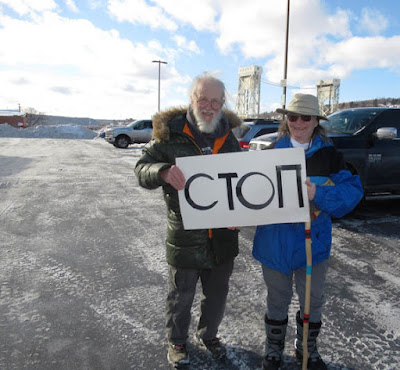
Linda and Jim Belote display a sign they brought to Wednesday's walk. "Our sign says STOP in Russian," Linda explained. "Jim saw that's what was written on signs held by the protesters in Moscow. So I made a sign like theirs."

Craig Waddell and his wife, Victoria Bergvall, of Houghton both displayed signs supporting Ukraine.

Craig Waddell said, "Yesterday, I was carrying a sign that said 'Stand with Ukraine,' and someone asked me if I was Ukrainian. I was born in the USA, and my ancestors are from England, Scotland, and Ireland. But a threat to democracy anywhere is a threat to democracy everywhere, so today, everyone who stands for democracy is Ukrainian."

Carolyn Peterson of Houghton also noted the unity of support for Ukraine shown by democratic countries around the world.

"I wanted to show my support for the people of Ukraine, who are inspiring me with their courage," Peterson said. "It feels like the entire free world is united for the first time in many years.

Carolyn Peterson, right, lines up with other participants as they prepare to walk across the Lift Bridge on Wednesday, March 2. (Photo by Keweenaw Now)

Janeen Stephenson of Houghton said the shock and sadness she felt at hearing of the invasion of Ukraine inspired her to join the walk.

"I am shocked and deeply saddened by the Russian invasion of Ukraine," Stephenson told Keweenaw Now. "The loss of lives, both Ukrainian and Russian, is brutal and unnecessary. It was important to me to show my support for Ukraine and the courageous resistance the people are exhibiting."

Janeen Stephenson, foreground with blue and yellow sign, chats with another participant as they cross the Lift Bridge on Wednesday, March 2. (Photo © and courtesy Nadija Packauskas)

Janeen was also joined in the walk by other members of the Keweenaw Unitarian Universalist Fellowship (KUUF) Justice Ministry group.

Following the Wednesday walk, Janeen Stephenson, fourth from right, is pictured here with members of the KUUF Justice Ministry. (Photo by Keweenaw Now)

Elizabeth Flynn, Michigan Tech emerita professor in Humanities, said she has been learning about Ukraine from a woman she is tutoring.

"The invasion of Ukraine by Vladimir Putin is a nightmare for Ukrainians and an outrage for the rest of the world," Flynn noted. "I tutor a woman from Ukraine in a literacy program, and she has shared footage of the attacks and says that she’s very worried about her extended family. I’m hoping that sanctions and condemnation by the world will bring the violence to an end."

Participants in the Wednesday walk cross the Portage Lift Bridge, returning from Hancock to Houghton. (Video by Keweenaw Now) 

Kateryna Lapina, a Ukrainian graduate of Michigan Tech (PhD in Environmental Engineering, 2009), who now lives in Colorado, shared news of Ukraine on Facebook recently. She has family in Kharkiv, Ukraine, and is very worried about them. Here are some of her posts:

Feb. 28, 2022: "Today rocket artillery was used twice to target civilian buildings in my city, Kharkiv. Dozens of dead/wounded."**

March 1, 2022: "The main square in my city was hit by cruise missiles today. A child is among the dead. The cruise missiles part is new. Russia is going now after civilians and infrastructure."

March 2, 2022: (some good news) "The company I work for, Degreed, just sent a company-wide email that they have ended sales discussion with a large Russian steel company. My work won't be supporting their products, currently rolling on the Ukrainian roads towards my city. My company will lose lots of money, but I am so proud of them and hope many others will follow suit."

Asked whether she and her family were surprised by Putin's invasion, Kateryna replied, "No, we were not. With all the intelligence that Biden provided on Russian war preparations we were not surprised. Of course we were hoping that this would not happen."

Kateryna recently participated in a rally in Denver in support of Ukraine.

Kateryna Lapina is pictured here (foreground wearing sunglasses, behind sign) at the Denver rally for Ukraine. (Photo courtesy Kateryna Lapina)

Organizer Nadija told Keweenaw Now she was pleased with the turnout at the Wednesday walk.

"Numbers never matter at a rally," she said. "If one shows up he impacts all who see him and all who wish him well. We stand for those who cannot stand. So we had 52, but we had the hopes and prayers of thousands -- the numbers were great. The honking, smiling, thumbs up cars were inspiring!"

Nadija, center with sunflowers, and her father, at right with sign, join friends at the end of the Wednesday walk. (Photo courtesy Nadia Packauskas)

Nadija noted also that Ukraine has stood for us with their courage and character and taught us how to love one another again.

"And we in the US have needed that," she added. "We needed a reminder that we are the free leader of the world and with that freedom comes great responsibility. We must stand up. We must use our collective voices to raise up the fight for democracy. We needed to believe in democracy again, and the courageous people of Ukraine may have just showed us the way."

Events at Michigan Tech

Nadija has been working with Michigan Tech Ukrainian graduate students Adelina Oronova and Nazar Gora, who have organized demonstrations in support of Ukraine all this week near the Husky statue in the center of campus.*

Michigan Tech students stand up for Ukraine near the Husky statue on campus Monday, Feb. 28. Similar demonstrations have continued there at noon all this week. (Photo courtesy Adelina Oronova)

The noon demonstration on Friday, March 4, near the Husky will be followed by a bake sale from 1 p.m. to 4 p.m. at the MTU library. Opportunities for donations and information on Ukraine will be available.***

At 3 p.m. on Sunday, March 6, a panel discussion on current events in Ukraine and an opportunity to show support for Ukraine will be held in the East Reading Room of the MTU Library. This event will also be livestreamed on Zoom. Watch our right column for details and a Zoom link.

Editor's Notes:

* See our March 1, 2022, article, "Photos: Yoopers, students stand up for Ukraine."

** See cnn.com, Feb. 28, 2022: "Russia bombs residential area of Kharkiv and intensifies Kyiv assault as talks with Ukraine end."

*** For useful resources on Ukraine, including ways you can help, go to https://linktr.ee/RazomForUkraine. Also, visit the Facebook page Yoopers for Ukraine.

Tuesday, March 01, 2022

Photos: Yoopers, students stand up for Ukraine

By Michele Bourdieu
Photos by Nadija Packauskas

Local residents demonstrate support for Ukraine during a Walk for World Peace at the Portage Lift Bridge in Houghton on Feb. 27. (Photo © and courtesy Nadija Packauskas)

HOUGHTON -- About a dozen concerned local residents gathered at the Portage Lift Bridge in Houghton on Sunday, February 27, to show support for Ukraine and solidarity with people demonstrating in many cities around the world in support of Ukrainians defending their country against Russian aggression.
Ukraine supporters display signs and flags during the Walk for World Peace on the Portage Lift Bridge Sunday, Feb. 27. (Photo © and courtesy Nadija Packauskas)

Nadija Packauskas, a Lithuanian American, organized the Walk on Sunday. Asked why she organized this event, Nadia said she considers herself a "free-lance human being" and a concerned citizen. 

A second Walk for World Peace in support of Ukraine will be held at 4 p.m. on Wednesday, March 2, beginning on the Houghton side of the Portage Lift Bridge. Non-political signs are welcome. Some flags, candles and signs will be available. See Keweenaw Now's right column for details.

Nadija also attended and photographed student demonstrations for Ukraine held on Monday, Feb. 28, and Tuesday, March 1, near the Husky statue in the center of the Michigan Tech campus. These demonstrations are expected to continue throughout the week.

Michigan Tech students gather near the Husky statue in the center of campus to demonstrate support for Ukraine. (Photo © and courtesy Nadija Packauskas)

The campus demonstrations were organized by Adelina Oronova, a Ukrainian Fulbright PhD candidate in chemistry at Michigan Tech.

In an email shared widely on campus, Adelina said the noon demonstrations are meant to show support especially for Ukrainian students at Michigan Tech whose families and friends are in grave danger in Ukraine.

More photos by Nadija:

Participants in the Walk for World Peace display signs and flags on the Portage Lift Bridge Sunday, Feb. 27.

Nadija is pictured here (center) with her father, Vytautas Packauskas, and Zenia Vodoris, left, a Russian student at Michigan Tech.

Several participants in the Walk display the blue and yellow flag of Ukraine.

Nadija on the bridge with sunflowers, the national flower of Ukraine.

Michigan Tech students demonstrate support for Ukraine.


Nadija Packauskas shared these photos with Keweenaw Now from the new Facebook page Yoopers for Ukraine. New members are welcome.

Sunday, February 27, 2022

Letter: Copper Country Audubon comments on seaplane project

An eagle is seen here on its nest, which is located near the site of a projected seaplane charter business -- at Portage Point (the former Onigaming property) in Portage Township. (Photo © Susan Schwenk and courtesy Copper Country Audubon)

[Editor's Note: This letter was addressed to Portage Township Board Chair Bruce Petersen, Portage Township Zoning Administrator John Ollila and members of the Portage Township Board. It is reprinted here with permission.]*

8 January 2022

Dear Mr. Petersen, Mr. Ollila and Portage Township Board,

It has come to our attention that a developer wants to create a seaplane hanger and service station near the mouth of the Pilgrim River south of Houghton where there is an active eagle nest....This would undoubtedly not be good for the eagles and other wildlife in this area.

The mouth of the Pilgrim River and its wetlands is a rich wildlife area. Nearby are Nara Nature Trail boardwalks along each side of the Pilgrim River. Many people use this area for bird watching and nature observation. Sandhill Cranes, Northern Harriers (Marsh Hawk), Trumpeter Swans and numerous migrating waterfowl frequent the mouth of the Pilgrim River and adjacent Portage Lake shoreline.

The presence of a seaplane operation would be an obvious disturbance to wildlife. The acoustic impact on both wildlife and humans wanting to enjoy the Nara trails would be quite negative. Copper Country Audubon feels the area should be protected to the fullest extent for the benefit of birds and other wildlife.

Thank you for your consideration of these concerns.

Sincerely,

Dana Richter, President
Copper Country Audubon
Houghton, Michigan

*See also the Letter to the Editor titled "Should seaplane move be OK?" by Camiel and Anne Marie Thorrez, Pilgrim Point neighbors, published in The Daily Mining Gazette on Feb. 23, 2022. In addition, see "Status of B-2/Seaplane Process," posted January 28, 2022, on the Portage Township Web site.

Wednesday, February 23, 2022

"Corrupting influence" of fossil fuels called out on WI DNR’s draft Environmental Impact Statement for Line 5

This image illustrates the threats to Great Lakes watersheds from Enbridge's pipelines. (Image courtesy Wisconsin Citizens Media Cooperative)

By Barbara With*
Posted February 22, 2022, on Wisconsin Citizens Media Cooperative
Reprinted here with permission


In January 2020, tenured professor Greg Mikkelson resigned from his position at McGill University because of the school’s failure to divest of fossil fuels.

Mikkelson taught the philosophy of biology and environmental ethics at the Canadian university. In September 2019, he brought forward a motion requesting that the school fully divest from fossil fuels.

Greg Mikkelson. (Photo courtesy Wisconsin Citizens Media Cooperative)

"Because of the subject matter I research and teach, it became clear that this kind of action is imperative," Mikkelson said. Even though the motion was approved in a majority vote of the McGill Board of Governors, their Social Responsibility Committee released its decision opposing divestment. A week later, Mikkelson resigned.

"When our board decided for the third time in seven years to defy the overwhelming democratic mandate that has developed for that divestment here on campus, I just decided to look for an organization that is both more democratic and more sincerely committed to saving the planet," said Mikkelson about his resignation.

Mikkelson recently testified at the Wisconsin DNR’s public hearing concerning Enbridge Line 5 draft environmental impact statement. His family goes back five generations in northern Wisconsin, and he said he quit his job because of the corrupting influence by the fossil fuel industry on McGill.

"Unfortunately, I read the same kind of influence at work in the draft EIS under consideration tonight," Mikkelson said at the public hearing.

He delivered a declaration dated February 11, 2022, and signed by over 30 Canadian organizations calling on the DNR to resist the pressure of regulatory capture. The declaration opposes Line 5 and supports the Bad River Band of Lake Superior Chippewa, who have sued Enbridge to remove the line from their watershed.

We, the undersigned organizations in Québec, welcome the actions, and affirm the rights, of Lake Superior Chippewa bands and the State of Michigan to shut down Enbridge Line 5. We who reside near Line 9 in Quebec or Ontario, also live and work literally downstream of Line 5 regarding the flow of both water and oil. But the whole Earth lies figuratively downstream, since the pipeline drives growth in fossil fuel production and consumption, whereas both must now shrink by 5-10 percent every year to stem climate chaos. Governments must reject obsolete assumptions about the need for oil, and work together to protect the public. The pandemic proves it is possible.

Enbridge should have stopped pumping oil and gas through Line 5 in 2017, when the Bad River Band revoked the easement for it to cross their reservation. Even more so in 2021 when Michigan revoked the easement for it to cross the Straits of Mackinac. Enbridge has defied both shutdown orders, and proposed 42 miles of new pipeline and a new underwater tunnel instead. We denounce all of these moves by the company, since they violate Indigenous and democratic rights, threaten rich local ecosystems and the Great Lakes, and would further lock in North America’s disastrous addiction to fossil fuel.

• To the Bad River Tribe, other Lake Superior Chippewa, and State of Michigan:
WE WHOLEHEARTEDLY SUPPORT your efforts to safeguard the biosphere, including the world’s largest bodies of freshwater on which we all depend.

• To Enbridge corporation:
STOP TREADING ON DEMOCRACY AND INDIGENOUS SOVEREIGNTY, ripping through woods and waterways, and undermining the future.

• To the Government of Canada:
In your attempt to prolong use of this decrepit and dangerous pipeline by invoking an outdated treaty with the United States, YOU DO NOT SPEAK IN OUR NAME.

• To the Government of Québec:
We hail your recent decision to end all production of fossil fuel in our province, and urge you to JOIN THE CALL TO SHUT DOWN LINE 5.

• To the State of Wisconsin:
We applaud the Governor’s Task Force on Climate Change for recommending to "AVOID ALL NEW FOSSIL FUEL INFRASTRUCTURE." Please now affirm the obvious fact that 42 miles of new pipeline, following a new route, would violate this recommendation. Prevent construction of this new infrastructure, and shut the old pipeline down.

Signatories as of February 11th, 2022

Organizations in Québec

Action Environnement Basses-Laurentides
Les Amis de la Chicot de Saint-Cuthbert
Association des Infirmiers et Infirmières pour l’Environnement
Citoyens au Courant
Coalition Étudiante pour un Virage Environnemental et Social
Comité de Vigilance Environnementale de l’Est de Montréal
Comité des Citoyen(ne)s de Milton Parc
Comité Vigilance Hydrocarbures Brandon
Conseil Central du Montréal Métropolitain-Confédération des Syndicats Nationaux Conseil des Canadiens
Eau Secours
Équiterre
Extinction Rebellion Québec
Fondation David Suzuki
Justice Climatique Montréal
Mères au Front
Mouvement d’Action Régionale en Environnement
Nature Hudson
Non à une Marée Noire dans le Saint-Laurent
La Planète s’Invite au Parlement
Prospérité sans Pétrole
Quit RBC
Regroupement Vigilance Hydrocarbures Québec
SOS Territoire

Allied Organizations

Aamjiwnaang and Sarnia Against Pipelines Environmental Defence
Extinction Rebellion Ottawa
Idle No More, London

Rising Tide Toronto
Shift: Action for Pension Wealth and Planet Health Toronto350.

* Guest author Barbara With is a citizen journalist from La Pointe, Wisconsin.

Thursday, February 17, 2022

Gray wolves returned to Threatened and Endangered Species list

Gray Wolf. (Photo © Tracy Brooks. Courtesy Mission Wolf / US Fish and Wildlife Service)

By Jeff Towner and Terri Bocklund*
Information from Upper Peninsula Environmental Coalition (UPEC)
Posted Feb. 15, 2022, on upenvironment.org


The Upper Peninsula Environmental Coalition and its Board of Directors are celebrating the decision last week that has returned Upper Peninsula gray wolves (and gray wolves in most of the lower 48 states) to the federal list of threatened and endangered species. On Feb. 10, 2022, a federal judge in the Northern District of California reversed and vacated a January 2021 removal of the gray wolf from the list of threatened and endangered species under the Endangered Species Act.

For UP wolves, this specifically means that for the time being, efforts by Michigan legislators to bring about a recreational season for wolf hunting and trapping will come to a halt. Sen. Ed McBroom has energetically promoted a wolf harvest through proposed legislation and resolutions. He and those who work with him and support these legislative actions have now effectively had their hands tied. Notably, Rep. Sarah Cambensy "passed" on a recent legislative action (SCR 7) that would authorize and organize an Upper Peninsula wolf hunt. UPEC acknowledges and appreciates her position.
Gray wolves. (Photo © Yannick Menard. Courtesy UPEC)

However, the ruling does not change the delisted status of gray wolves in the Northern Rockies states of Idaho, Wyoming, and Montana, where wolves are persecuted ruthlessly. This population of wolves was removed from Endangered Species Act protections by Congress in 2011 and was not part of the lawsuit. This act of Congress has proven to be ill-considered, especially in light of the wanton killing of wolves in those three states.

The Michigan Wolf Management Advisory Council will continue its work to update the existing Wolf Management Plan of 2015, and aims to make its recommendations to the Michigan Natural Resources Commission sometime in the summer or fall of 2022.  Meetings are held monthly, and are open to the public.  Members of the UPEC Board of Directors have attended some of these meetings, and have offered both spoken and written testimony in support of the best and most current science available, all of which points toward the senselessness of a wolf season in the UP. Interested persons can find specific information about these meetings at: https://www.michigan.gov/dnr/0,4570,7-350-79137_79763_106230---,00.html.

Gray wolf. (Photo © Andrew Ly. Courtesy UPEC)

UPEC will be closely following further developments, and will continue to advocate for federal protection of gray wolves in Michigan and elsewhere. Should wolves again be delisted, UPEC will continue to argue that there is no credible scientific basis for a so-called recreational season on wolves in Michigan.

* Editor's Note:

Co-author Jeff Towner is a Certified Wildlife Biologist and member of the board of directors of the Upper Peninsula Environmental Coalition (UPEC). See his Oct. 22, 2021, Keweenaw Now article, "Wolf management in Michigan should set good example," which also appeared in the UPEC Fall 2021 Newsletter.

Co-author Terri Bocklund is a professional musician, composer, and songwriter who became an advocate for wolves after her experience as an Artist in Residence on Isle Royale in 2013. That experience led her to create and perform a unique pro-wolf multi-media experience, which she has presented at the Wolf Conservation Center (NY), the Pennsylvania Wolf Sanctuary, the Upper Great Lakes Visitor Center (WI) and several state and national parks, including Isle Royale National Park.

Tuesday, February 15, 2022

Guest article: ENDANGERED: right to vote, right to fair and free elections

Voting rights advocates demonstrate at a vigil held near the Portage Lift Bridge in Houghton on Jan. 6, 2022. (Photo © and courtesy Allan Baker)* 

HOUGHTON -- Michigan is facing a deluge of voter suppression and election subversion legislation. Much of it has not become law. However, our state has an unusual system that allows citizens to circulate petitions to bypass the legislative process and the governor. The Secure MI Vote petition would create obstacles for voters and county and township clerks. Why would we want to change our voting system when it did what it was supposed to do: Run a fair and accurate election?

To find out, join a forum to discuss the Secure MI Vote petition circulating now. The forum will be via Zoom at 7 p.m. ET Wednesday, Feb. 16, when County Commissioner Glenn Anderson and County Clerk Jennifer Kelly join local citizens Susanna Peters and Faith Morrison to tell us what would happen should the petition drive be successful! Learn why you should NOT sign the petition whether or not the signature gatherers tell you its real reason. Do you want to restrict your right to vote and force onerous requirements on election officials to do their job?

Voting Rights Advocates Bill Binroth, Beth Flynn, and Horst Schmidt and the Justice Ministry of Keweenaw Unitarian Universalist Fellowship (KUUF) are sponsoring this forum.

ZOOM LINK: https://michigantech.zoom.us/j/83714962753

Or Telephone:
US: 1 312 626 6799
Meeting ID: 837 1496 2753
International numbers available: https://michigantech.zoom.us/u/kbva8pJ1q4

* Editor's Note: See excellent coverage of the Jan. 6, 2022, vigil by the Copper Beacon's Joshua Vissers: "Group forms for vigil despite cold Jan. 6 weather."

Monday, February 14, 2022

Guest Article: Speak Up for Lake Superior’s Bad River Watershed: Work to Save What You Love!

Lake Superior. (Photo courtesy Wisconsin Citizens Media Cooperative)

Posted Feb. 13, 2022, on Wisconsin Citizens Media Cooperative (WCMC)
Reprinted here with permission

A Zoom Webinar will be held from 6 p.m. - 7 p.m. (CT) / 7 p.m. - 8 p.m. (ET) on Monday, February 14. This second Webinar in WCMC's Kairos-supported* events focuses on the following:

  • What is included and what was omitted in the Wisconsin Department of Natural Resource’s draft Environmental Impact Statement (EIS) on the proposed re-routing of Enbridge Line 5
  • What points to highlight in written responses to the WI DNR within the public response period (closing on March 18, 2022)
  • Resources and toolkits for effective letters to the WI DNR and government leaders

Guest Speakers:

Marcia Bjornerud, professor of environmental studies and geosciences at Lawrence University, is a structural geologist. She has done field research in arctic and mainland Norway, arctic Canada, Scotland, New Zealand, Italy and the Lake Superior region, including the Gogebic Range/Penokee Hills. She has worked pro bono with the Great Lakes Indian Fish and Wildlife Commission in challenging two mining projects in the Lake Superior watershed. In 2008, she was an expert witness in an administrative court case against the Eagle copper-nickel sulfide mine northwest of Marquette, Michigan. In 2012, she prepared a report for GLIFWC on the potential environmental effects of a proposed mountaintop removal iron mining project in the Gogebic Range and testified about this at a hearing at the Wisconsin State Capitol. She is a mother of three sons, an avid cross-country skier, and a wild food forager -- and once bicycled around Lake Superior with two friends (it took 13 days).

Philomena Kebec belongs to the Bad River Band of Lake Superior Chippewa. She moved home 10 years ago to advocate for protection of watershed resources. Philomena is an elected Ashland County Supervisor and runs a small nonprofit, Badriverharmreduction.org, that provides services to prevent overdose and infection for people who use drugs. (She would welcome financial support for her nonprofit.) Philomena is deeply knowledgeable about the Bad River watershed and its residents.

Register in advance for this webinar at:
https://us06web.zoom.us/webinar/register/WN_JiGj1oHTSLan_zNjBvq-hQ

After registering, you will receive a confirmation email containing information about joining the webinar.

*A Webinar sponsored by First Congregational UCC Appleton with support from the Wisconsin UCC Creation Care Team and a Wisconsin Conference UCC’s Kairos/Catalyst grant.

Editor's Note: See also this Feb. 9 guest article from WCMC: "Guest Article: Citizens expose gross inadequacies in Enbridge Line 5 draft EIS, tell DNR to do their job."

Saturday, February 12, 2022

Copper Beacon: Early morning Winter Carnival photos

By Joshua Vissers
Posted Feb. 10, 2022, on Copper Beacon
Reprinted in part here with permission


Phi Kappa Tau in Hancock has once again dominated the month-long Men’s Division with its impressive collection of constructions, as well as taking 1st place overall. (Photos © and courtesy Joshua Vissers)

[Editor's Note: Joshua Vissers of Copper Beacon braved the frigid temperatures early Thursday morning to capture some great "by night" photos of Winter Carnival statue makers putting the finishing touches on their creations before the deadline and judging. This is an intro to his article, "100th Winter Carnival well underway."]

I made it out early on Thursday morning to catch teams at the tail-end of constructing their month-long snow sculptures. At about 6:30 a.m., the month-long statue teams were just hours away from their 9 a.m. deadline and were rushing to add the finishing touches to their work before the judges arrived.

Phi Kappa Tau's collection of landmarks includes an immediately-recognizable replica of the Quincy Mine’s No. 2 Shaft Rockhouse.

For more of Josh Vissers' photos see "100th Winter Carnival well underway."

For results of the snow statue competition and more see Michigan Tech's official 100th Carnival Web site.

Wednesday, February 09, 2022

Guest Article: Citizens expose gross inadequacies in Enbridge Line 5 draft EIS, tell DNR to do their job

Headwaters of the Kakagon Sloughs, Bad River. (Photo: David Joe Bates)

By Barbara With and Rebecca Kemble*
Posted Feb. 6, 2022, on Wisconsin Citizens Media Cooperative
Republished here with permission

On February 2, 2022, over 250 people attended the Wisconsin DNR public hearing to respond to the Enbridge Line 5 draft Environmental Impact Statement (EIS). The replacement pipeline is being proposed to be built through the Bad River watershed on the shores of Lake Superior.

The 10-hour hearing revealed an overwhelming opposition to the project, with 147 people (88 percent) testifying against, and 20 (12 percent) in favor.

Citizens who oppose the building of the pipeline through the Bad River watershed commented on the 400+ page statement, bringing to light the fatal flaws of Enbridge’s plan. There were repeated demands that the DNR do their job to address the myriad of deeper problems in the EIS.

These are some of the complaints about what is lacking in the draft EIS and what the DNR failed to do:

  • No meaningful consultation with all the Tribes
  • No consideration of treaty rights
  • Did not wait for cultural surveys to be completed
  • Does not address water withdrawals required for construction and pipeline testing
  • Failed to take into consideration the ramifications of the 20-year life span of the pipeline
  • Fails to adequately address impacts on endangered species
  • Failed to address the impact of blasting through bedrock
  • Failed to address water quality standards
  • Failed to verify the claims made by Enbridge
  • Failed to address the climate change impact of Line 5
  • Failed to address Enbridge’s history of spills
  • Failed to address Enbridge’s track record of environmental damage in Minnesota from Line 3 construction
  • Failed to address Enbridge’s refusal to abide by Michigan law

Enbridge seemed to have prepared a handful of construction trade unions, industry associations and pipeline contractors who read the corporation’s statement, repeating the same talking points. Although the purpose of the hearing was to receive comments on the draft EIS, none of those testifying in support addressed the EIS itself. Instead they spoke on the potential economic impact of Line 5, focusing only on "700 'good-paying' jobs," "$6 million in taxes paid" and "$36 million in potential tax revenue."

Enbridge Line 3 damage at the Mississippi in Clearwater, MN. (Photo: Ron Turney)

They also insisted that Enbridge is "honoring" the Bad River Band of Lake Superior Chippewa by moving the pipeline outside of "Tribal boundaries." However, according to Bad River Chairman Mike Wiggins Jr., the Line 5 re-route is potentially even more harmful to the Bad River people. He said, "The crux of the issue is that they are in our hydrologically connected waterways and water aquifers."**

In 2019 Bad River filed a federal lawsuit against Enbridge demanding it shut down its more than six decade-old pipeline running through the tribe’s reservation. That case is ongoing. In response to US Congressman Tom Tiffany, Wiggins said, "With all due respect to the congressman, he says this reroute proposal honors our request. The only thing we have ever asked of the oil company is to get out of our water. That has been rejected, that has been disrespected, and essentially ignored. It’s a simple request. We told them to take their $24 million they offered us to exist in our drinking water and put it into the reroute project out of our water shed, out of our hydrological connectivities. That underscores the essence of our defense and our resistance."

Mike Wiggins Jr. testifies at Enbridge Line 5 Draft EIS hearing on Feb. 2, 2022. (Video courtesy Wisconsin Citizens Media Cooperative)

The DNR is accepting written comments regarding the draft EIS through March 18, 2022. Concerned citizens can read the document here or visit the Enbridge EIS Tool Kit to learn more.

Comments can be emailed or mailed:

Email: dnroeeacomments@wi.gov

U.S. mail:
Line 5 EIS Comments
DNR (EA/7)
101 South Webster Street
Madison, WI 53707. 

Editor's Notes:

* Guest author Barbara With is a citizen journalist from La Pointe, Wis. Guest author Rebecca Kemble is a citizen journalist from Madison, Wis. Both of them write articles frequently for the Wisconsin Citizens Media Cooperative.

** See also "Enbridge puppets 'honor' Bad River; get schooled by Mike Wiggins Jr." -- a video posted by Barbara With.

Thursday, February 03, 2022

Health Department begins mask distribution on Feb. 3, 2022

HANCOCK -- The Western Upper Peninsula Health Department (WUPHD) has received KN95 masks for community distribution. Community members can pick up a package of 5 masks beginning Thursday, February 3, 2022, by coming to their local health department office during normal business hours. There is a limit of 1 package, of 5 masks per person. KN95 masks will be given on a first come first serve basis while supplies last. A face mask must be worn to enter health department offices.

As COVID-19 continues on with the presence of the highly contagious Omicron variant, getting vaccinated and boosted, as well as wearing a well-fitting mask over your mouth and nose in indoor public settings or crowds is crucial to protect yourself and others from COVID-19.

Free KN95 masks have been made available throughout Michigan as part of the state’s Mask Up, Mask Right campaign. Find additional distribution sites at Michigan.gov/MaskUpMichigan or by calling the COVID-19 hotline at (888) 535-6136.

The Western UP Health Department covers Baraga, Gogebic, Houghton, Keweenaw, and Ontonagon Counties. The main office is at 540 Depot Street, Hancock. For information visit www.wuphd.org or their Facebook page or call (906) 482-7382. For more info on mask wearing in Michigan visit Mask Up, Mask Right.

Thursday, January 27, 2022

UPDATED: Guest article: Wisconsin DNR still accepting comments on Line 5; Public Hearing on February 2, 2022

By Barbara With*
Posted Jan. 16, 2022, on Wisconsin Citizens Media Cooperative
Reprinted here with permission
See UPDATES below

Map courtesy Carl Sack.

On February 2, 2022, the Wisconsin Department of Natural Resources is holding a public hearing on the proposed reroute of Enbridge Energy’s Line 5. The hazardous liquid pipeline conveys light and synthetic crude oil and natural gas liquids from Superior, Wisconsin, to Sarnia, Ontario, through northern Wisconsin and both the Upper and Lower Peninsulas of Michigan.

Under state law, the draft Environmental Impact Statement (EIS) for Line 5 must contain information about how the project would impact people, natural resources, and the economy. It must also include an analysis of alternatives to the proposed project.

Members of the public are needed to weigh in on the draft EIS:

https://widnr.widen.net/s/pmjdl6pbpd/el5_drafteis_dec2021_vol1-deis.&nbsp

UPDATED Feb. 2, 2022: The Wisconsin Department of Natural Resources (WIDNR) has extended the public comment period for Enbridge Line 5 draft Environmental Impact another two weeks -- to March  18, 2022. The move was in response to a letter sent by the Wisconsin League of Women Voters and nine other organizations concerned that the period was too short considering the complexity of the project, including the over 400 page draft EIS that was released on December 18, 2021.

REGISTER HERE to testify at the Zoom Hearing, to be held at 4 p.m. CT / 5 p.m. ET, Wednesday, Feb. 2, 2022. 

Members of the public who do not wish to provide testimony during the hearing and only want to listen can watch a live feed of the hearing on the DNR’s YouTube channel.

Public comments should be sent:

By email: dnroeeacomments@wi.gov

By U.S. mail:
Line 5 EIS Comments
DNR (EA/7)
101 South Webster Street
Madison, WI 53707

The Danger of Enbridge

Line 5 cuts across the heart of the Bad River Reservation where it continues to operate despite ongoing litigation. Enbridge is also operating Line 5 without permits through the Chequamegon-Nicolet National Forest and under the Straits of Mackinac, where they have refused to comply with an order from the Governor of Michigan to shut down.

Enbridge proposes to build a new section of pipeline around the perimeter of the Bad River Reservation but still within the Bad River watershed. The construction project -- which would stretch for more than 40 miles and cross nearly 200 waterbodies -- would allow Enbridge to continue operating the pipeline in environmentally sensitive areas of Wisconsin that also include the Lake Superior and Lake Michigan watersheds. Their plans include blasting through the asbestos-rich million-year-old bedrock of the Penokee Hills in order to drill miles of HDD (horizontal directional drilling) under all major waterways in the watershed.

"The State of Wisconsin must ensure that Enbridge is never again allowed to show the kind of disrespect and disregard for environmental regulations they did during recent Line 3 construction in Minnesota," said Paul DeMain of Honor the Earth, "No further pipeline permits should be given to Enbridge -- anywhere in the United States -- until they clean up their mess in Minnesota, where they have ruptured aquifers and spilled chemical drilling fluids into our rivers and wetlands. Wisconsin must do better. The safety of our resources and the public trust of our water hangs in the balance."

The Enbridge Line 3 easement at the headwaters of the Mississippi River after removal of wooden planks reveals the damage they’ve incurred. Rain recharged the aquifers and pushed the drilling fluids to the surface, continually since mid-September, 2021. (Photo courtesy Ron Turney)

"The draft EIS represents a critical opportunity for the public to provide input on a controversial proposal that continues to move forward, despite the harm it will cause," stated Elizabeth Ward, executive director of Sierra Club Wisconsin. "Enbridge’s proposal, which could be devastating for the water and wetlands in the area, directly contradicts the Governor’s Task Force on Climate Change recommendation to avoid all new fossil fuel infrastructure."

"Pipeline construction in the Bad River watershed could cause significant environmental harm that must be prevented," said Midwest Environmental Advocates Staff Attorney Rob Lee. "This project would also facilitate the continued operation of the entire pipeline, which is nearly 70 years old and has already spilled at least a million gallons of oil." 

* Guest author Barbara With is a citizen journalist from La Pointe, Wis.

UPDATE: Red Cliff releases Enbridge draft EIS Fact Sheet

Posted by Wisconsin Citizens Media Cooperative

January 29, 2022

Red Cliff Band of Lake Superior Ojibwe have released a Fact Sheet concerning the Enbridge draft Environmental Impact Statement concerning Line 5 through the Penokee Hills. The Fact Sheet notes how the pipeline could affect Treaty Rights, impact wild rice (manoomin), and threaten Lake Superior fisheries and tribal commercial harvests. CLICK HERE for the Fact Sheet.

Sunday, January 23, 2022

Guest article: Election Elucidation: A look at Michigan's 2022 election calendar with County Clerk Jennifer Kelly

Copper Beacon news site is now Copper Beacon, Inc. (Logo courtesy Joshua Vissers)

By Joshua Vissers, Editor, Copper Beacon, Inc.
Posted January 22, 2022, on Copper Beacon, Inc.
Reprinted here with permission

Michigan’s 2022 election calendar is 18 pages long and full of jargon and references to state laws and other documents. It’s not particularly easy to understand.

Fortunately, Houghton County Clerk Jennifer Kelly agreed to a short interview where she helps to outline the process for people interested in running for local office. Jennifer discusses positions on the coming ballot, nominating petitions, filing deadline dates, write-ins and more. She’s also made herself available for other questions.

CLICK HERE to listen to Josh Vissers' brief audio interview/podcast with Jennifer Kelly.

Visit https://www.copperbeacon.org/ for the latest Hancock City Council meeting news, The Inside Scoop with good news for Copper Beacon, and more January articles on local news.

Friday, January 14, 2022

Guest article: COP26 -- An Indigenous Experience

By Kathleen Brosemer*

Guest author Kathleen Brosemer, Environmental Director for the Sault Ste. Marie Tribe of Chippewa Indians and Michigan Tech Ph.D. student in Energy and Environmental Policy, is pictured here at a display on ancestors along a walkway at COP26, the UN Climate Change Conference in Glasgow (November 2021). "This quote about the ancestors meant a lot to me," Brosemer writes. "WE are the ancestors to the people who will be struggling to survive. We should be better ancestors than we have been." Click on photos for larger versions. (Photos courtesy Kathleen Brosemer)

What’s COP26? It’s the 26th annual Conference of the Parties to the UN Framework Convention on Climate Change (UNFCCC). The United Nations has been brokering a climate change agreement among the nations of the world for over 26 years. It’s not controversial -- it’s settled science that humans are altering the climate of the only planet we know of that can support human life. It’s not a smart thing to do; but so far it’s been profitable, so it’s tough to get it stopped.

This mural, painted on the wall in the entrance hall going into the Conference Center, depicts most aspects of public concerns and involvement in COP26.

At COP21 in Paris in 2015, the big news was the agreement of the parties to this convention, to work to limit human-caused global warming to 1.5 degrees Celsius. That was a big deal, because there's good science that predicts if we let the warming exceed 1.5 degrees across the entire surface of the earth, not only would that be catastrophic regarding hurricanes, wildfires, and coastal inundation, but it might not be possible to prevent a runaway warming of the surface that would wipe out all life.  So the Paris Agreement was cause for celebration. But as with everything at an international level, the devil is in the details.  How would we make this come about? COP26 was significant because the parties agree to review all the details and make new commitments every five years.

The intervening six years have seen little progress. Although some nations have made great strides in reducing emissions, the global emissions keep going up. Even during the pandemic, when planes stopped flying and people stayed home, emissions kept going up. The pandemic meant the postponement of COP26 from November 2020 to 2021, which was a good thing, because in November 2020 the US representatives would have been from an administration hostile to progress in this area. The former administration had in fact withdrawn from the Paris Agreement, which the incoming administration in January 2021 immediately rectified. So there was at least a chance at some progress.

I was attending COP26 in two roles: as an observer because I'm a PhD student in Energy and Environmental Policy at Michigan Tech, and as a presenter -- to give a talk about energy justice for the Anishinaabeg, in my role as Environmental Director for the Sault Ste. Marie Tribe of Chippewa Indians.

A display of red dresses along the fence leading to the entrance to the conference center in Glasgow commemorates the lives of the Missing and Murdered Indigenous Women and Girls.

At the COP, I spent most of my time with the Indigenous Peoples’ Caucus, helping draft language for inclusion in Article 6 of the Paris Rulebook, which provides the details for implementing the 2015 Paris Agreement. Article 6 contains rules about market and non-market measures and international cooperation. What worries Indigenous peoples around the world is the possibility that states could put rules on how people are living within healthy forests, turning them into "protected areas" that exclude the people who have lived there since time immemorial. So-called "forest offsets" are false solutions for mitigating climate change -- they’re just calculators that let states pretend they’re taking action while they continue to subsidize fossil fuels.

Kathleen took this photo while working with the Indigenous Peoples' Caucus to draft suggested language for inclusion in Article 6.
  
We were able to get some good language inserted into Article 6, as well as into the final COP26 decision, recognizing Indigenous peoples’ rights and providing for a grievance mechanism when states take actions that harm Indigenous peoples. However, a grave disappointment was the failure of the parties to promise to phase out coal. Instead they used the more wishy-washy "phasing down" in the final consensus document. They also only committed to "cut back" on state subsidies to non-sustainable energy production, not to eliminate those subsidies.

At Paris in 2015, our Anishinaabeg knowledge keeper Frank Ettawageshik was there for the exciting moment when the governments of the world promised to limit warming to 1.5 degrees Celsius. The former chairman of the Little Traverse Bay Bands of Odawa Indians has been active worldwide in protecting Aki (Mother Earth) through work on the Great Lakes Commission and many other collaborative efforts.

Since 2015, he has turned his voice toward climate change.  Ettawageshik understands the drastic and terrible consequences that all of humanity faces, but that will come first and worst to Indigenous peoples if we let this get away from us. If we are to keep our Paris commitment, we must reduce emissions by 45 percent (below 2010 levels) by 2030. This is the best science we have and has been accepted by the signatories to the UNFCCC.

That’s only eight years away.

There is frankly no way to do this while governments still subsidize fossil fuels, using our tax dollars at cross purposes.

We are at a turning point.

Kathleen is pictured here at the booth for Action for the Climate Emergency, wearing her ribbon skirt and her red moccasins.

What can you do to reduce carbon emissions? There is a long list of things to try. Some of it will save you money. Other things won’t work in your life or require too much of an investment you can’t afford right now, but no matter your circumstances there is something you can do. After Glasgow, it looks as though it’s going to be up to us.

Checklist of things you might incorporate into your life to reduce carbon emissions:
- Grow some of your own food in your garden. Food from far away increases vehicle emissions.
- Hunt, fish, and gather locally.
- Buy food from local farmers.
- If you buy any new appliances, look for the EnergyStar logo.
- Switch from natural gas or propane to electric appliances.
- Start and use a backyard composter for kitchen and garden waste.
- Recycle as much as you can. Landfills emit methane, which is a potent greenhouse gas. The less we throw in, the less methane.
- Buy less stuff. Buy used items if they’ll do the job, or share with others. Manufacturing and transporting new goods emits carbon.
- Air seal your home. Clear caulk is cheap, and it will reduce drafts and save money.
- Add insulation to your home, especially the top (attic) and bottom (basement). Insulating and air sealing the top and bottom means stopping the chimney stack effect that steals your heat.
- If you do any renovations (even for just one wall or one room), plan for energy efficiency at the same time. Any extra costs will pay for themselves in energy savings.
- If a furnace upgrade is in your future, plan for ground source heat pump** and/or wood or pellet stove heat.
- When it’s time to replace a car, look into a hybrid or all electric vehicle. Prices are coming down!
- Use the car less. Combine trips, carpool, and walk or bike if that’s possible for you for some trips.
- If travelling, see if you can avoid a car rental and use public transit.
- Look into solar net metering for your home.

Next year’s COP will be in Egypt. I hope I am able to attend and be part of the Indigenous Peoples' demands for change once again. It’s incredibly important if we are to have a future on this planet.***

Editor's Notes:

* Guest author Kathleen Brosemer has been the Environmental Director for the Sault Ste. Marie Tribe of Chippewa Indians for 11 years and is presently a Michigan Tech Ph.D. student in Energy and Environmental Policy. She is a member of the Echota Cherokee, from her father, who grew up in Alabama. She is also known as Azhede-kwe (White Pelican Woman), a name given to her by an elder after Brosemer's return from Standing Rock.

** According to a recent Michigan Tech News article, "Solar-powered Heat Pumps Warm Upper Peninsula Homes for Less," heat pumps are defined thus: "A heat pump is an air conditioner running in reverse. Working at temperatures as low as minus 5 degrees Fahrenheit, the pump takes cold air from outside and produces warm air inside. It runs on electricity but is three times more efficient than the space heater under your desk. That efficiency is vital for dealing with the U.P.’s high electricity prices -- but the real savings come from using solar PV (photovoltaic). MTU studies have previously shown that solar PV is cheaper than grid electricity. The latest studies explore whether enough solar energy can be generated and used by the heat pump to keep an average U.P. home warm -- and what it will cost."

*** This is the second in Keweenaw Now's series of articles by guest authors who attended COP26 in Glasgow, Scotland, in November 2021. See also: "Guest article: COP26 Reflection," by Alexis Pascaris, posted Jan. 1, 2022.

Saturday, January 08, 2022

Group forms for vigil despite cold Jan. 6 weather

By Joshua Vissers
Posted on Copper Beacon Jan. 8, 2022
Reprinted here in part with permission
About 50 people came together to remember the Jan. 6 attack on the Capitol Thursday at 5 p.m. (Photo by Allan Baker)

Local organizations promote the importance of voters' rights, fair elections

Coinciding with gatherings across the country, around 50 people came together near the south end of the Portage Lake Lift Bridge to recognize the seriousness of the attack in Washington, D.C., on Jan. 6, 2021.

Speakers encouraged attendees to contact their representatives to encourage passage of voting rights legislation, especially at the national level with the John Lewis Voting Rights Act. Organizers said that the vigil was bipartisan and that voters' rights should not be a partisan issue. Speakers reminded attendees that Republican presidents had renewed the original Voting Rights Act of 1965 for decades until recent court cases weakened it. The new voting rights act would renew old rules and more....CLICK HERE to read this article, with more photos, on the COPPER BEACON.