See our right-hand column for announcements and news briefs. Scroll down the right-hand column to access the Archives -- links to articles posted in the main column since 2007. See details about our site, including a way to comment, in the yellow text above the Archives.

Wednesday, May 17, 2017

Michigan Tech News: The Sugarbush Diaries: 73 Taps, 500 Gallons, 12 Dozen Bottles of Made-in-Alberta Deliciousness

By Cyndi Perkins, Michigan Tech Web Writer
Posted Apr. 19, 2017, on Michigan Tech News
Reprinted in part with permission


Michigan Tech Instructor Tara Bal is pictured here with the wood-fired evaporator used to bring sap to its optimal boiling temperature. Bal, whose PhD work centers on sugar maples, and who remembers syrup-making from growing up in a tightknit Amish community, didn't like to see it sitting there unused at the Ford Forestry Center in Alberta. She wrote a development grant for a non-traditional online course, which includes a fieldwork component and has the added benefit of introducing students to forestry and biology, including how tree physiology relates to sap flow. (Photo © and courtesy Cyndi Perkins)

Plonk. Plonk. Plonk. The sap drips hitting the bottom of galvanized buckets in Preacher Park are louder than the raindrops on an April weekend at Michigan Tech's Ford Forestry Center.

The buckets aren't full yet (at time of this writing). But across US-41, Tara Bal's maple syrup management and culture class is collecting from the sugarbush maples that line the streets of Alberta Village. The trees look a little like hospital patients receiving IV drips. Some bear rectangular blue sacks; you can see the clear liquid inside. Flexible, thin blue tubing protrudes from the tap holes on others, snaking down into white plastic buckets.

Students also learn a second boiling method: In the Native American tradition, Jamie Opsahl uses heated rocks to bring sap to the boiling point in a hollowed-out maple log. (Photo © and courtesy Cyndi Perkins)

But tapping doesn't hurt the trees, says Bal, a research assistant professor in Michigan Tech's School of Forest Resources and Environmental Science (SFRES) -- you can pinpoint her location by following the smoke billowing above the Sugar Shack, out back of the research, education and conference center's dining hall and dorms. ... Ford Forestry Center, the planned community of Alberta built by Henry Ford, is graced with fine maple specimens. How long has syrup been made here?

"As long as Ford was here, and before that, the Anishinabe," says Bal....

Click here for the full article on Michigan Tech News. This article also received attention in Lake Superior Magazine's June/July 2017 issue.

Sunday, May 14, 2017

DEQ staff to hold 2017 open house on Torch Lake Abandoned Mining Wastes Project May 16 in Lake Linden

From Michigan Dept. of Environmental Quality and Amy Keranen, Abandoned Mining Wastes Project manager

During the May 2016 open house, Abandoned Mining Wastes Project Manager Amy Keranen, right, DEQ Remediation and Redevelopment Division, talks about educating the public about the project with visitors from Friends of the Land of Keweenaw (FOLK), from left, Catherine Andrews and FOLK President Linda Rulison. Keranen and DEQ staff will hold their 2017 open house on the project this Tuesday, May 16, at Lake Linden-Hubbell High School Auditorium. (Keweenaw Now file photo)
 
LAKE LINDEN -- The Michigan Department of Environmental Quality (DEQ) invites the public to an informal open house from 4:30 p.m. to 8 p.m. Tuesday, May 16, at Lake Linden-Hubbell High School Auditorium to learn about the project findings and next steps for the Abandoned Mining Wastes Project.

The focus of the Abandoned Mining Wastes (AMW) Project is the investigation of mining-era chemical containers and residues historically discarded in or near Torch Lake. Work to date has included a review of historic studies, on-land and in-lake investigative activities, and a series of remedial actions.

The DEQ Abandoned Mining Wastes (AMW) project team will be available to share their findings with the community and to answer questions during the May 16 open house.

This project team consists of staff involved in the planning, fieldwork, interim responses, and reporting for the project; the DEQ sampling crew who conducted investigative activities; and the On-Scene Coordinator from the Environmental Protection Agency (EPA) Emergency Response Branch (ERB) who is managing two projects in the Lake Linden area. Project area maps and photos will be on display to show where the team conducted their work, what they have found, and what they have planned.

Contact DEQ staff at 906-337-0389 for more information.

Notes from the Desk of Amy Keranen: Spring 2017 Newsletter

In her latest newsletter, Amy Keranen, DEQ project manager for the Abandoned Mining Wastes - Torch Lake project, gives an update on the DEQ's AMW project, including recent referrals to the EPA Emergency Response Branch. The following information is taken from this Spring 2017 Newsletter:

Lake Linden Recreation Area Sediments

Removal of contaminated sediment from Lake Linden Recreation Area. (Photos courtesy Amy Keranen)

Evaluation of results of several key studies conducted at the Lake Linden Recreation Area (LLRA) between 2005 and 2015 concluded that contamination exceeding health-based and ecological criteria extends outward from the area along the shore, which was the focus of a 2007 emergency removal (pictured above). Based on these findings, in January 2017, the DEQ requested EPA Emergency Response assistance to address the contaminated sediments at the LLRA site. The EPA is currently evaluating the existing information to determine what next steps are necessary.

Calumet Stamp Mill Asbestos

Asbestos removal near foundations of the Houghton County Historical Society Museum in Lake Linden. 

The EPA ERB from Grosse Ile, Michigan, continues to work with Honeywell Specialty Materials and the Houghton County Historical Society to remove asbestos near the foundations at the Museum in Lake Linden. Work started in October 2016, and cleanup activities will be completed by this summer. Mr. Brian Kelly, who manages these projects for the EPA ERB, will be at the May 16th Open House.

Quincy Mining Co. Mason Area: Focus of 2017 Field Investigation

 Quincy Reclamation Plant ruins in Mason.

In 2016, the AMW project team started looking at the third and final stretch of the Torch Lake shoreline -- the Quincy Mining Co. area in Mason. They reviewed existing data, completed preliminary reconnaissance activities, conducted a side scan sonar survey and recorded underwater video using a remotely operated vehicle. Based on the comprehensive review, a Sampling and Analysis Plan has been developed to assist in the identification of historic areas of contamination or data gaps requiring further assessment. This plan will be implemented during 2017; and, depending on the findings, interim response actions may be undertaken to reduce the public’s potential for exposure to mining era wastes.

2017 Remediation Projects

Investigations at the former Hubbell Smelter property and on the south side of the Tamarack Sands confirmed that debris has been buried under the soil cap constructed on the stamp sands during the Torch Lake Superfund project. Investigations also show polychlorinated biphenyl (PCB)-contaminated soils are eroding into Torch Lake at the former Hubbell Coal Dock property. To address the conditions in these three areas, interim response actions have been designed and will be implemented during 2017 following completion of contracting and permitting activities.

Drums are visible sticking out into Torch Lake from beneath the Superfund soil cap near the former Hubbell Smelter property. The drums that contain PCBs and hazardous levels of lead will be removed and disposed. This removal is planned for May 2017.

This photo shows one of the seep areas where fluid wastes are coming up from likely buried drums that have decomposed beneath the Superfund soil cap in the Tamarack Sands. The seeping wastes that contain high concentrations of solvents and chemicals, not typically associated with mining related industry, will be removed and disposed. This area will be excavated for proper disposal in May/June 2017.

This photo depicts surface water runoff and erosion of PCB-contaminated soils into Torch Lake from the Coal Dock PCB Burn Area. A project to address these concerns by capping the area and improving the drainage from the site is being planned for this summer, 2017.

Work planned for 2017 
  •  Implement the Quincy Mining Co. Mason Sampling and Analysis Plan, prepare a Site Investigation Report, and undertake interim response actions if needed.
  •  Implement interim response actions in the Hubbell Processing Area (Shoreline Drums and Coal Dock PCB Burn Area) and Tamarack Sands.
  • Prepare summary reports documenting all aspects of the 2016 and 2017 Emergency Response Actions.
  • Honeywell Specialty Materials, under EPA ERB oversight, will continue to remove asbestos near the foundations at the Museum in Lake Linden.
  • EPA ERB will proceed with removal assessment activities related to the Lake Linden Recreation Area.
  • All project documents will be posted on the Abandoned Mining Wastes Project Web site as they are finalized.*
If you have questions, any information regarding historic waste issues or concerns you wish to discuss, please contact Amy Keranen at keranena@michigan.gov.

* Click here for the DEQ Abandoned Mining Wastes Project Web site.

Friday, May 12, 2017

DEQ cites Highland Copper's wetlands, soil erosion violations from mining exploration in Porkies, along CR 519

By Michele Bourdieu

Some water remains in a ditch area between Gogebic County Road 519 and a snowmobile trail along the eastern right-of-way of the county road. The Michigan Department of Environmental Quality is investigating wetlands and soil erosion violations in this area from equipment used in an exploratory drilling effort conducted by Highland Copper in and adjacent to the Porcupine Mountains Wilderness State Park as the spring thaw arrived. (Michigan Department of Natural Resources photo taken Apr. 29, 2017.)

MARQUETTE -- The Michigan Department of Environmental Quality (DEQ) Office of the Great Lakes (OGL) recently announced the importance of the month of May as American Wetlands Month.

"Healthy wetlands are now being recognized for their ecological and functional importance, and many groups at the federal, state, and local level are working to protect and restore them," notes the OGL. "As part of the Michigan Department of Environmental Quality’s focus on protecting wetlands, the Office of the Great Lakes supports healthy wetlands ecosystems by restoring areas affected by legacy pollution, working to prevent introductions of aquatic invasive species, protecting our unique coastal environments, and promoting stewardship of our Great Lakes water resources."

The Michigan DEQ has responded to recent violations of wetlands and soil erosion statutes by Highland Copper's exploration activities in the Porcupine Mountains Wilderness State Park (the Porkies).

In an April 20, 2017, press release, the DEQ states it issued a violation notice to Highland Copper Company Inc. for soil erosion and wetlands impacts at sites on road commission property along County Road 519 in Gogebic County. The violation follows environmental damage discovered in early April.*

This April 26, 2017, photo shows sediment-filled muddy water passing through fiber rolls (erosion control) on an access road left chewed up by Highland Copper's drilling equipment. Muddy water is flowing into ditches of CR-519, which convey the water to a ravine that feeds the Presque Isle River. (Photo © Steve Garske and courtesy Mining Action Group)

The notice requires Highland Copper Company Inc. to stabilize the site, restore disturbed wetlands, obtain additional permits, and investigate previously used drill sites to determine if other wetlands have been disturbed.

According to Steve Casey, DEQ Water Resources Division district coordinator for the Upper Peninsula, the DEQ violation notice requires that the company delineate wetlands and apply for an appropriate after-the-fact permit for impacting wetlands. This permit may have penalties associated with it. They must also obtain a soil erosion control permit from Gogebic County.**

John Pepin, Department of Natural Resources (DNR) deputy public information officer, said, "Highland Copper’s exploration at the Porcupine Mountains Wilderness State Park did not cause any damage under permits issued by the DNR, which included several provisions for protection of park surface features. Highland Copper, the Michigan Department of Environmental Quality and the Gogebic County Road Commission continue to address wetlands and soil erosion concerns on road commission property, within the right-of-way of County Road 519, which were discovered in April and are currently being remedied."

Hay bales and other short-term remediation measures are in place and working along Gogebic County Road 519. This photo shows a ditched area with standing water between the county road and a snowmobile trail, along the east side of the county road. Later, long-term measures like grading and reseeding will be undertaken to help restore original surface features. (Michigan Department of Natural Resources Apr. 29 photo)

Highland Copper Company Inc. has been conducting exploratory drilling of copper minerals situated beneath the surface of a mile-square section of Porcupine Mountains Wilderness State Park, bisected by County Road 519. Drilling ceased on road commission property on April 4 after company officials were made aware of the erosion issues.*

This Apr. 26 photo shows water in a CR-519 ditch flowing north to the Presque Isle River. (Photo © Steve Garske and courtesy Mining Action Group)**

"According to the Michigan Department of Environmental Quality’s website: 'Sediment is the greatest pollutant by volume impacting our lakes, streams, and wetlands. Sediment is the product of uncontrolled erosion,'" the Upper Peninsula Environmental Coalition (UPEC) Mining Action Group recently noted in an update on the Highland Copper violations in the Porkies. "'Erosion and sedimentation result in: loss of fertile topsoil, filling of lakes and streams, increased flooding, damage to plant and animal life, and structural damage to buildings and roads.'"**

Kathleen Heideman, board member of UPEC's Mining Action Group, commented recently on Michigan's track record in wetland protection, noting her concerns for another mining project in the Western U.P. as well.

"Michigan wetlands, especially the iconic vernal wetlands where spring peepers are now breeding and singing, are extremely vulnerable," Heideman said. "Michigan's Department of Environmental Quality has a bad track record when it comes to wetlands protection, permitting them to be drained by mining projects, obliterated by roads, and intentionally filled with industrial wastewater discharges. These threats are real. The Aquila Back Forty project, for example, recently submitted a Wetland permit application, seeking the permission of state regulators to destroy and impair wetlands at the Back Forty mine site, located on the banks of the Menominee River. Will Michigan's DEQ protect these wetlands? Or will Michigan facilitate the desires of the mining industry, and sacrifice more wetlands in the process? In honor of American Wetlands Month, the Michigan DEQ should remember that it is easy to write celebratory press releases. It is more difficult to make permitting decisions that actually protect Michigan wetlands. We must encourage them to do the right thing."

Highland Copper's exploration within and adjacent to the Porkies is part of a feasibility study related to their Copperwood mining project, located near the Porkies.

According to Highland Copper's Web site, "Highland acquired the Copperwood Project from Orvana Minerals Corp. ('Orvana') in June, 2014. The Copperwood deposit is located in Gogebic County in the Upper Peninsula of Michigan, USA within the Porcupine Mountains copper district (Figure CW 1) and about 35 kilometers west of the White Pine North Project. Copperwood is a project at the final feasibility stage. All major permits required for mining the Copperwood Project were obtained or approved in 2012 and 2013, subject to certain conditions, including providing financial assurance."***

As to whether mining could take place within the Porkies, Casey noted, "Highland is doing exploratory drilling, which is a preliminary step to determining whether an ore body can be feasibly mined. They don't even know if it's feasible yet."

Highland had indicated they planned to access the ore body under the Porkies underground from Copperwood, but Casey added the DEQ does not know enough at this time to determine what permits would need to be issued or modified should they decide to do so.

"If they want to add the additional ore body that's under Porcupine Mountains State Park, there will be multiple public meetings and a comment period," Casey said.

Notes:

* See our Apr. 7, 2017, article, "State, county officials address citizens' concerns about erosion from Highland Copper mining exploration along CR 519 in Porkies." 

** Click here to see more photos from the Mining Action Group. Click here for information on Soil and Sedimentation Control under Part 91 of the Natural Resources and Environmental Protection Act (NREPA), 1994 PA 451, as Amended.

*** See Highland Copper Company's description of the Copperwood project here.

Wednesday, May 10, 2017

Local "Bergman/Trumpcare Die-In" event to expose dangers of "American Health Care Act" May 13

"Die-In" participants display signs to warn of the potential deadly consequences of the "American Health Care Act" passed last week by the U.S. House of Representatives. (Photo via @Indivisible_SAZ and courtesy Marika Seigel)

HOUGHTON -- Veteran's Park in Houghton will be the scene of a "Bergman/Trumpcare Die-In" at noon on Saturday, May 13. The Houghton County Democratic Party, in partnership with Indivisible and Houghton/Keweenaw Forward Action Michigan, will host this event in order to expose the "American Health Care Act" (AHCA, passed by the U.S. House of Representatives last week) for the harm it will do, to hold Congressman Bergman accountable to his constituents for the lives that will be lost, and to put the Senate on notice that the only way forward for the American people is Medicare-for-All.

According to the progressive group Indivisible, "A die-in is a form of nonviolent direct action protest where participants publicly pretend to die to highlight a deadly problem."*

Here is the problem:

Under the AHCA, as passed by the House, more than 24 million Americans would lose their health insurance over the next 10 years. This includes over 40,000 residents of Congressman Jack Bergman’s 1st District of Michigan. It is estimated that upwards of 44,000 Americans could die every year from lack of health insurance. Guaranteed protection for persons with pre-existing conditions would end, resulting in no coverage or premiums that are unaffordable by many Americans. Older Americans would pay far more for health insurance and health care. The tax on high income taxpayers that extended the solvency of Medicare would be repealed, throwing the future of Medicare into doubt. Medicaid would no longer be a program for anyone who qualifies but, rather, a block grant to states who would have to ration care and cut the quality of services.

The only people who come out ahead under the AHCA are the wealthy and corporations. They would get over $600 billion in tax breaks while the rest of us pay more for health care or are denied access to affordable health care. Bottom line is that the AHCA is nothing more than a tax break for the wealthy. This is the bill that Congressman Bergman -- who is supposed to represent the constituents of the 1st District -- voted for. He must now own it and all the adverse consequences that follow.

This bill now goes to the Senate but, unless the Senate adopts Medicare-for-All, there isn’t much that the Senate can do to take the harm to Americans out of the AHCA. This is an immoral piece of legislation that must be defeated.

How to participate in the Die-In:

Gather at Veteran's Park at noon on Saturday, May 13. Bring a sign shaped like a tombstone. The sign could name a pre-existing condition that would no longer be covered, comment on the AHCA, or call out Bergman/the GOP directly. A sign-making event will be held in the Michigan Room of the Portage Lake District Library from 5 p.m. to 7 p.m. on Thursday, May 11. You can drop in at any time during these two hours to make a sign. Supplies will be on hand. (If you don't have time to make a sign but would still like to participate in the die-in, please come anyway!)

Program:

The MC will make opening remarks about the AHCA, and then signal that it is time to die (lie down) with the phrase "Here are the consequences." At that point, participants lie down and hold up tombstones. (If you are not able to lie down, you could bring a folding chair to sit in or remain standing).

Several people will share brief (1-2 minute) stories about how the Affordable Care Act (ACA or Obamacare) helped them, or about how the AHCA would negatively effect them or people they love. If you would be willing to share a story, please email Marika Seigel at marika.seigel@gmail.com. Those who are sharing stories should remain standing and lined up next to the MC.

The MC will make closing remarks and then signal that it is time to stand with the phrase "We will rise."

* Click here to learn about Indivisible.

Tuesday, May 09, 2017

Noteworthy to present spring concert "On with the Show" May 11 in Calumet

Noteworthy, women's barbershop chorus. (Photo courtesy Noteworthy)

CALUMET -- The women’s barbershop chorus Noteworthy will celebrate the music of Broadway and Hollywood at its "On with the Show" spring concert, set for 7 p.m., Thursday, May 11, at Sacred Heart Catholic Church in Calumet. Admission is free. Donations will be accepted to benefit Keweenaw Random Acts of Community Kindness (Keweenaw RACK).

"The audience is going to love this concert -- who doesn’t like show tunes?" said Director Joan Petrelius. "Plus, I don’t think we’ve ever had more fun preparing for a performance. This is great music."

Keweenaw Random Acts of Community Kindness is a nonprofit that provides financial support for those in need, primarily benefiting residents of northern Houghton and Keweenaw counties. The group helps residents pay for utility bills, emergency travel expenses and groceries. All donations remain in the local area. For more information, email keweenawrack@gmail.com.

Emily Raffaelli will emcee the program, which includes "Consider Yourself," from Oliver!; "Diamonds are a Girl’s Best Friend," made famous by Marilyn Monroe; and a clever rewrite of "Get Me to the Church on Time," from My Fair Lady.

The chorus will also sing "Second Hand Rose," performed on Broadway in the 1920s and resurrected by Barbra Streisand in Funny Girl; "Send in the Clowns," from Steven Sondheim’s A Little Night Music; and "Stepsisters’ Lament" from Cinderella, which expresses the mortification of "solid girls" everywhere who languish in the shadows of their prettier siblings.

Other program highlights include the hymn "Down to the River to Pray" from O Brother, Where Art Thou? and "We Go Together," sung by John Travolta and Olivia Newton-John in Grease.

"I Feel Pretty," from West Side Story, will be performed by Kelly Ylitalo, Carla Johnson, Sharon Kisiel and Allyson Jabusch. The quartet One Accord -- including Jean Rilei, Marcia Goodrich, Sara Niemeyer and Petrelius -- will sing Abba’s "Take a Chance on Me," which was featured in Mama Mia.

Hancock High School students Vanessa Dulong, Shannon Nulf and Rachel Nulf will perform "Think of Me" from Phantom of the Opera and "Day by Day" and "Bless the Lord, O my Soul" from Godspell

Thursday, May 04, 2017

March for Science from Houghton to Hancock calls for science-based government policy

By Michele Bourdieu, with additional photos and videos by Allan Baker

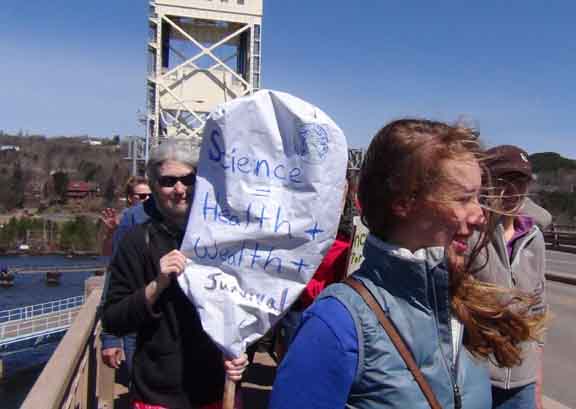
Carrying signs to show support for science, facts and scientific research, more than 400 participants in the Apr. 22, 2017, March for Science gather near the Keweenaw Waterway in Houghton before heading across the Portage Lift Bridge to Hancock and back. (Photo by Allan Baker for Keweenaw Now)

HOUGHTON -- The April 22 (Earth Day) March for Science attracted more than 400 participants of all ages, many of whom carried signs to show their support for science and love of Mother Earth. The pleasant, sunny weather added an atmosphere of celebration rather than protest. Michigan Tech faculty, researchers and students joined with concerned community members -- including families with their children -- in a demonstration of unity and support, calling on government to base policy on scientific facts and research.

Before the march, the large crowd gathered near the Houghton side of the Portage Lift Bridge for a brief rally led by organizers Emily Shaw and Nicole Wehner, Michigan Tech graduate students in Civil and Environmental Engineering.

Organizer Emily Shaw; Tim Scarlett, Michigan Tech associate professor of archaeology and anthropology (Social Sciences); and Amlan Mukherjee, associate professor in Michigan Tech's Civil and Environmental Engineering Service Systems Engineering Program speak during a brief rally preceding the April 22 March for Science. (Video by Keweenaw Now)

Pictured here just before the march begins are Rolf Peterson, right, co-director of Michigan Tech's Isle Royale Wolf-Moose Study, recently named a "Hero of Science" by Discover magazine (May 2017 issue), and Brian Hoduski, co-chair of the Houghton County Democratic Party, with his message for Donald. (Photo by Keweenaw Now)

Carolyn "Candy" Peterson of Houghton said she was happy to participate in this march after being energized by the Women's March in Washington, D.C., on Jan. 21, 2017. Peterson rode on a bus to that march and made many friends, she added.*

At the rally, waiting for the march to begin, are Carolyn Peterson, left, and Nancy Langston -- Michigan Tech professor of environmental history (Social Sciences) and member of the Great Lakes Research Center, who is also very active in the Keweenaw Climate Community, a local group concerned about climate change.

Carrying a colorful sign is Bill Deephouse, Audubon member and retired DNR official, with Marcia Goodrich, Michigan Tech senior writer -- both fishing enthusiasts. (Photo by Keweenaw Now)

Valerie Talsma, a science teacher at Watersmeet High School, made the trip to Houghton with two of her students.

Valerie Talsma, science teacher at Watersmeet High School, center, is pictured here with two of her students, who accompanied her to the Apr. 22 March for Science -- Hailey, left, a ninth grade student in physical science, and Katelyn, a tenth grader studying biology. (Photo by Keweenaw Now)

"I spent 10 years in Ann Arbor, and I'm used to protests and marching," Talsma said, "and I brought two students with me."

Valerie Talsma, Watersmeet High School science teacher, displays the "bee" hat she wore in the march -- a hat that says more than a sign about the importance of saving pollinators that are endangered. (Photo by Keweenaw Now)

More than 400 people, many displaying a variety of colorful signs, set out to walk from Houghton to Hancock across the Portage Lift Bridge. Click on YouTube icon for a larger view. (Video by Keweenaw Now and Allan Baker)

Displaying their creative signs at the head of the march are, from left, Anna-Catharina Wilhelm, Cassandra Gietek, Michael James, and Anna Kubek. (Photo by Keweenaw Now)

 
"Science is for Everyone" and "I Love Science" are the messages on this young marcher's sign. (Photo by Allan Baker)

March organizers asked participants to find fun, creative, and personal ways to engage in the march, and community sign-making events preceded the march. Marchers were also asked to use recycled materials to create their signs. (Photo by Allan Baker)

So as not to stop the flow of traffic on US-41, participants marched under the bridge and then up the hill to cross it to Hancock. They then marched under the bridge again and returned to Houghton on the opposite side of the road.

Marchers descend a stairway to cross under the bridge in Houghton, away from traffic, before crossing the bridge to Hancock. (Photo by Allan Baker)

March for Science, participants march across the Portage Lift Bridge from Houghton to Hancock.  Click on YouTube icon for a larger view. (Video by Allan Baker for Keweenaw Now)

One of the main messages of the march is expressed on this sign. (Photo by Allan Baker)

Beth Flynn, Michigan Tech emerita professor of reading and composition (Humanities), who also joined her daughter, Kate Flynn, for the Jan. 21 Women's March in D.C., enjoyed the good weather and pleasant company for the Houghton-Hancock March for Science.*

"This is great," Beth said. "The weather is perfect. There were over 400 people and only one person who yelled out something negative -- and many positive honks."

Beth Flynn greets Carolyn Peterson on the Hancock side of the bridge. Both of them participated in the Women's March in Washington, D.C., last January.* (Photo by Allan Baker)

Two Keweenaw County residents from Ahmeek -- Joan Schutte and her daughter, Rita Snabb -- joined Lynn Gerou of Hancock on the bridge, displaying their signs for passing traffic. Each of the three commented on why she came to the march.

Displaying their signs to traffic during the March for Science are, from left, Rita Snabb of Ahmeek, Lynn Gerou of Hancock and Joan Schutte of Ahmeek. (Photo by Keweenaw Now)

"We're disgusted with the way things are going," Rita Snabb said. "We don't need the Great Lakes destroyed."

Schutte, Rita's 82-year-old Mom, added, "I cannot believe this man got elected president."

Gerou noted, "We want to keep the regulations that Obama put in to protect the environment."

Marchers cross the Lift Bridge a second time, returning to Hancock. Some wear pro-science t-shirts for the event. Click on YouTube icon for larger view. (Video by Allan Baker and Keweenaw Now)
 
Following this March for Science in Houghton, Sarah Green (with sign), Michigan Tech professor of chemistry and noted climate scientist, left for Washington, D.C., to participate in the People's Climate March on Saturday, Apr. 29. (Photo by Keweenaw Now)

Pictured here after the march are, from left, Petra Hüntemeyer, Michigan Tech associate professor in astrophysics (Physics); Amlan Mukherjee, associate professor in Michigan Tech's Civil and Environmental Engineering Service Systems Engineering Program; Sarah Hoy, Michigan Tech postdoctoral scholar in Forestry; and Susan Cristanelli Stifler. (Photo by Allan Baker)

Representing Finlandia University at the March for Science and showing their concern for Mother Earth on Earth Day are Finlandia President Philip Johnson and his wife, René, Finlandia assistant professor of  religion and philosophy. René also participated in the Jan. 21 Women's March in Washington, D.C.*

March for Science organizer Emily Shaw said she and co-organizer Nicole Wehner were happy with the turnout at the march but still hopeful the demonstration would lead to further community action.

"Nicole and I are incredibly excited about the number of people that turned out for the march and we believe it is a testament to this community's positive relationship with science," Shaw told Keweenaw Now. "However, a one-hour march isn't enough. Our community needs to channel the momentum from the march into political action. We need people to get involved in the community organizations that are doing advocacy work that protects and defends STEM education (science, technology, engineering, and math) funding and supports evidence-based policy."

More photos: Portage Lake District Library offers activities before, after March for Science

Preceding the March for Science, the Portage Lake District Library invited participants, including families with children, to Hands-on Science: Activities and demonstrations, led by students and educators from the area. Following the march, the Portage Library was the scene of "What do we do next?" -- a community action meeting focusing on impacting policy decisions.

Hands on Science:

Assisted by students and educators, kids enjoy making signs and other items related to science during the Portage Library's "Hands-on Science" activity preceding the March for Science on April 22, 2017. (Photos in Library by Keweenaw Now)

Reese Gwaltney, second grader at Houghton Elementary, proudly displays her sign about protecting a favorite animal. Click on photos for larger versions.

Lillian Griffis of Hancock says her sign is about "a chemistry experiment gone wrong." 

Andrew Plummer, 6th grader at Houghton Middle School created this hoop glider, a flight experiment, during the "Hands-on Science" event at the library.

Katie Plummer, 8th grader at Houghton Middle School, holds the tiny airplane she made.

Munkaila Musah, from Ghana, a Michigan Tech Ph.D. student in forestry, checks out the science experiments and gets ready to head for the march.

After the March: "What do we do next?"

Following the march, concerned community members met at the Portage Library in small groups to discuss community action topics. Discussing climate change as well as cleanup work at the Torch Lake Area of Concern are, from left, Nicole Wehner, co-organizer of the March for Science; Horst Schmidt, president of the Upper Peninsula Environmental Coalition (UPEC); Chris Alquist, Portage Library community program director; Kyla Valenti, Michigan Tech student in social sciences; and Mark Campbell, martial arts instructor. (Photo by Keweenaw Now)

Discussing politics and policy are Houghton County Democratic Party members, from left, Anne Newcombe, Valorie Troesch, Brian Hoduski (HCDP co-chair) and Cathy Campbell Olszewski.

Residents interested in more local and sustainable forms of energy production are pictured here: clockwise from left, Kathryn, who is concerned about excessively high electric bills; Lindsey Wells, Michigan Tech student in computer science; Timothy; and Munkaila Musah, from Ghana, Michigan Tech Ph.D. student in forestry.
 
Discussing water and terrestrial resources are, from left, Stefan Hupperts, Michigan Tech graduate student in forestry; Kevin Nevorski, Michigan Tech graduate student in biology; and Petra Huentemeyer, Michigan Tech associate professor of astrophysics.

STEM education is the subject of discussion here for, from left, Joan Chadde, director of Michigan Tech's Center for Science and Environmental Outreach; Katherine Wiykovics, Michigan Tech graduate student in computer science; Stephanie Tubman, middle school science curriculum developer (Mi-STAR program**); and Rudiger Escobar of Guatemala, Michigan Tech post-doctoral researcher in geology and Stephanie's husband.

Rudiger Escobar of Guatemala, post-doctoral researcher in geology at Michigan Tech, participated in the March for Science and the discussions afterwards in the Portage Library. He had a positive reaction.

"I think it was great -- showing support for what we scientists do," Escobar said.

Most recently his research takes him to the West Coast, where he has been studying volcanoes, landslides and transportation.

Notes:

* See our Feb. 3, 2017, article, "Local mothers, daughters, friends inspired by joining Jan. 21 Women's March in D.C."

** To learn about the Mi-STAR program click here.

Saturday, April 29, 2017

Italian Hall Memorial committee seeks donations; Jim's Pizza in Calumet to match $5,000 through May 2017

This image depicts the future Italian Hall Memorial (inset at left), which will list -- engraved on black granite -- the names and ages of the victims of the 1913 Italian Hall disaster in Calumet. Next fall the memorial will be added to the park on the site of the original Italian Hall at 7th and Elm streets in Calumet. The arch from the Italian Hall now marks the site. (Image courtesy Mike Lahti)

CALUMET -- A new Italian Hall Memorial is slated to be installed in the fall of 2017 at the present Italian Hall site at 7th and Elm streets in Calumet. An Italian Hall Memorial committee of volunteers is now raising funds for the black granite monument, on which the names and ages of the 73 victims of the Christmas Eve 1913 tragedy, many in family groupings, will be engraved.

The Italian Hall Memorial will honor the memory of the victims, mostly children, who were crushed to death in the stairwell of the Italian Hall when someone yelled "Fire" -- a false alarm -- during a Dec. 24, 1913, Christmas Party for the children of striking miners.

Memorial to be funded through donations

Mike Lahti, Italian Hall Memorial committee chairperson, said the goal of the fundraiser is to raise $30,000 to finance the memorial and its installation on the site, which is a property of Calumet Village, plus other site work. So far the committee has raised about $8,000 toward the goal.

"The Calumet Village Council has been very supportive in helping us get the donations we need in order to pay for the project," Lahti said. 

Poster announcing Jim's Pizza offer to match donations up to $5,000 towards the Italian Hall Memorial through May 2017. UPDATE: Jim's Pizza will continue to match donations through June! (Poster courtesy Marc Norton, Copper Island Printing)

UPDATE: Jim's Pizza in Calumet is offering to match up to $5,000 in donations toward the monument through JUNE 2017. Donors may drop their contributions in the box at Jim's Pizza or mail them to the Village of Calumet, 340 6th St., Calumet, MI 49913.

Donation checks are to be made payable to the Village of Calumet - the Italian Hall Memorial fund. The contributions are tax deductible.

Finlandia University's Bachelor of Fine Arts Diploma Works Exhibition opens

Art Therapy Capstone by Laurin LaBonte. (Photos courtesy Finlandia University)

HANCOCK -- Finlandia University’s International School of Art and Design (ISAD) 2017 Bachelor of Fine Arts Diploma Works Exhibition is now being displayed through June 2, 2017, at the Finlandia University Gallery, located in the Finnish American Heritage Center in Hancock.

A reception for the artists will take place from 7 p.m. to 8:30 p.m. Saturday, Apr. 29, at the gallery. The artists will be introduced at 7:15 p.m. The reception is free and open to the public. Refreshments will be served.

Artwork by Jordanne Bowen.

The artworks featured in the annual Diploma Works Exhibit represent the final body of student work for each graduating bachelor of fine arts (BFA) student. The works include intensive research projects, series of individual artworks, and design prototypes. A variety of media is represented, including drawing, painting, sculpture, interior design, textile design and graphic design.

Artwork by Kelsey Dowd.

The 2017 International School of Art and Design graduating seniors are Jordanne Bowen and Kelsey Dowd.  Art therapy research by Laurin LaBonte is also on display.

Please call 906-487-7500 for more information. Learn more about this exhibit, other exhibits and the Finlandia University Gallery in general by visiting finlandia.edu/universitygallery.

Wednesday, April 26, 2017

Public invited to commemorate Workers' Memorial Day Apr. 28 in Calumet

Poster for Workers' Memorial Service to be held Friday, Apr. 28, in Calumet.

CALUMET -- On April 28, the unions of the AFL-CIO observe Workers' Memorial Day to remember those who have suffered and died on the job and to renew the fight for safe jobs.

A Workers' Memorial Service and Community Gathering will be held at 7:30 p.m. on Friday, April 28, near the Italian Hall Memorial at 7th and Elm streets in Calumet. The public is invited to attend a short ceremony to commemorate the workers and children who died in the Italian Hall Tragedy of 1913 and to draw inspiration from the brave Copper Country workers who stood up for workers' rights and safety in the workplace. All are welcome!

Speakers will include the following:

Welcome by Katie Barglind, U.P. Regional Labor Federation

Invocation by Melinda Quivik, Portage Lake United Church

Bill Wanhala, Western UP Community Labor Council

Joanne Thomas, author of the book Across a Century: Annie of Red Jacket

(Laying Flowers)

Closing by Scott Dianda, State Representative, 110th District

If anyone knows how to play the guitar or can sing, a song at the end of the memorial would be welcome. For more information contact Katie Barglind at uprlfcoord@gmail.com or call her at 906-282-1390.

Monday, April 24, 2017

Sen. Debbie Stabenow learns about Michigan Tech's Great Lakes research during visit to GLRC

By Michele Bourdieu

During her April 1, 2017, visit to Michigan Tech's Great Lakes Research Center, Sen. Debbie Stabenow (D-Michigan) is interviewed by local media. On display for the Senator, in the background, is Michigan Tech's buoy for the Straits of Mackinac.

HOUGHTON -- U.S. Senator Debbie Stabenow (D-Michigan) heard from Michigan Tech faculty and students about projects related to the Great Lakes during her April 1, 2017, visit to the university's Great Lakes Research Center (GLRC) in Houghton.

Several of the projects have received funding from the Great Lakes Restoration Initiative (GLRI), including work on invasive species and algal blooms in the lakes, removal of the Gay stamp sand threatening fish in Lake Superior, and the Great Lakes Observing System (GLOS) that includes research buoys in the Great Lakes. 

During the Senator's visit she first heard a presentation from Amy Marcarelli, Michigan Tech associate professor of biological sciences concerning research on invasive species and algal blooms in the Great Lakes and the importance of the GLRI in funding such projects. Here is a video excerpt from Prof. Marcarelli's presentation:

During Sen. Debbie Stabenow's Apr. 1 visit to the Great Lakes Research Center, Amy Marcarelli, Michigan Tech associate professor of biological sciences, speaks about mapping and controlling algal blooms and invasive species such as Eurasian Watermilfoil in the Great Lakes. (Videos by Keweenaw Now)

Senator Stabenow expressed her own concern that GLRI funding would be cut dramatically by this administration.

Following Marcarelli's presentation, Sen. Debbie Stabenow comments on the importance of GLRI (Great Lakes Restoration Initiative) funding for Great Lakes scientific projects. Seated next to her is Michigan Tech President Glenn Mroz.

Charles Kerfoot, Michigan Tech professor in biological sciences and director of the Lake Superior Ecosystem Research Center, presented an update on the Gay Stamp Sand and the U.S. Army Corps project to dredge the stamp sand (old mining waste) that has migrated into Lake Superior, threatening especially the Native American fishery at Buffalo Reef on the east side of the Keweenaw Peninsula. Here are some excerpts from his presentation:

During Sen. Debbie Stabenow's visit, Michigan Tech Professor Charles Kerfoot explains how researchers have used Lidar (laser detection) technology to detect the migration of millions of tons of stamp sand from the former mining areas near Gay, Mich., into Lake Superior. Click on YouTube icon for larger screen.

Prof. Kerfoot described negative biological and economic impacts of stamp sand destroying benthos and fish at Buffalo Reef, the GLNPO (Great Lakes National Program Office)-funded U.S. Army Corps of Engineers plans to dredge the stamp sand (using a vacuum method) and the need for funding to support continued Michigan Tech research to support that project.*

Prof. Kerfoot points out how the stamp sand kills the benthos and fish and notes projected economic losses for local tribes that depend on the fishery. He also explains how the stamp sand is moving across the Big Traverse seawall into the Traverse River. Click on YouTube icon for bigger screen.

Guy Meadows, Great Lakes Research Center director, presented an update for the Senator on the Great Lakes Observing System (GLOS), which includes Michigan Tech's buoys in the Great Lakes:

GLRC Director Guy Meadows speaks about the valuable information gathered through the Great Lakes buoys and the usefulness of Michigan Tech's Web site greatlakesbuoys.org. He also notes the fact that GLOS, which includes eight Great Lakes states, receives less funding than other regional observing systems.**

Finally, the Senator learned about Michigan Tech's research program for developing autonomous vehicles.

Sen. Stabenow hears from Brent Burns, director of industry and government relations for Michigan Tech; Michigan Tech Prof. Dan Fuhrmann, chair of electrical and computer engineering; and Jeremy Bos, Michigan Tech assistant professor of electrical and computer engineering, who will be the new faculty advisor for the university's Robotic Systems Enterprise program. Sen. Stabenow adds her own comments, based on her experience, on the need to be aware of the human side of autonomous vehicles -- how to make the person in the car feel comfortable -- as well as the technology.

Cameron Burke, Michigan Tech student in computer engineering, said he was excited to be working with the robotics program and autonomous vehicles and would probably focus on these in graduate school in the future. For example, he noted some of the experiments include sending the vehicles out into the snow or rain to determine how they could be safer than a regular car.

U.S. Senator Debbie Stabenow meets with Michigan Tech students during her visit to the Great Lakes Research Center on April 1, 2017. Students pictured with the Senator are, from left, Ryan Van Goethem, graduate student in biological sciences; Carmen Leguizamon, graduate student in biological sciences; Mitchell Anderson, computer engineering; Jennifer Ling, electrical engineering; Jacob Prins, mechanical engineering; and Cameron Burke, electrical and computer engineering. In the foreground is a Clearpath Husky, an autonomous, battery-operated ground unit created by students working on autonomous vehicle research. (Photos by Keweenaw Now)

"A lot more testing has to be done," Burke said.***

Following the presentations, Sen. Stabenow offered some closing remarks:

Sen. Stabenow comments on the need to educate the public on protecting the Great Lakes and expresses her appreciation for the research being done at Michigan Tech.

Keweenaw Now had the opportunity to ask the Senator about her views on climate change and what could be done about the present administration's plans to silence the Environmental Protection Agency and de-fund environmental projects.

She agreed citizens need to unite and "push back" against the Republicans' anti-environment agenda. The Senator said she was supportive of the March for Science (which occurred this past weekend) and the People's Climate March scheduled for April 29 and planned to participate in them.

GLRC Director Guy Meadows told Keweenaw Now he was happy the Senator was able to visit the GLRC. He noted the Great Lakes Restoration Initiative is a very important source of funding, especially for remediating damage to the lakes and protecting them.

GLRC Director Guy Meadows chats with Sen. Debbie Stabenow following the presentations.

"We greatly appreciate how hard Senator Stabenow works for the Great Lakes," Meadows said.

NOTES:

* Click here to read about the Great Lakes National Program Office (GLNPO) and the Great Lakes Restoration Initiative (GLRI) under the U.S. Environmental Protection Agency (EPA).

** The buoy was in the GLRC on Apr. 1 because the buoys come out of the water for winter in late fall so they won't be damaged by ice. They are put back in the spring. See our Sept. 13, 2015, article, "Michigan Tech/Enbridge buoy deployed in Mackinac Straits; Gov. Snyder visits GLRC."

*** Michigan Tech is one of eight universities selected to participate in a new collegiate competition -- AutoDrive Challenge, a three-year project to design, build and test a fully autonomous vehicle. See the April 12, 2017, article, "Look, Ma, No Driver: The AutoDrive Challenge," by Allison Mills, in the Michigan Tech News.