See our right-hand column for announcements and news briefs. Scroll down the right-hand column to access the Archives -- links to articles posted in the main column since 2007. See details about our site, including a way to comment, in the yellow text above the Archives.
Showing posts with label Guy Meadows. Show all posts

Friday, July 20, 2018

From Michigan Tech News: Michigan Tech Delivers Line 5 Risk Analysis Draft Report to State

Michigan Tech's Great Lakes Research Center (GLRC). Guy Meadows, GLRC director, led the team of 41 researchers who conducted an independent risk analysis of Enbridge’s two Line 5 pipelines beneath the Straits of Mackinac. Their draft report details nine different worst-case scenarios and outlines impacts for each. (Keweenaw Now file photo)

By Stefanie Sidortsova *
Published July 19, 2018, on Michigan Tech News
Reprinted here with permission


In a draft report submitted this week to the State of Michigan, a team of experts evaluates the economic, environmental and cultural impacts of a "worst case scenario" spill or release from the Straits Pipelines.

Led by Michigan Technological University’s Guy Meadows, 41 researchers conducted an independent risk analysis of the two parallel, 20-inch pipelines that form the 4.5-mile section of Enbridge’s Line 5 that runs beneath the Straits of Mackinac. The draft report details nine different worst-case scenarios and outlines impacts for each.

"I am proud of the way in which our universities have come together to provide a fact based analysis of a very complex problem, under an extremely tight time frame," Meadows said. "In conducting this work, we have also advanced knowledge about the fate and transport of oil in freshwater." **

Meadows is the Robbins Professor of Sustainable Marine Engineering and director of the Great Lakes Research Center at Michigan Tech. The Agency for Energy (MAE), Attorney General’s Office (AG), Department of Environmental Quality (DEQ) and Department of Natural Resources (DNR) contracted with Michigan Tech for the risk analysis report.

The risk analysis team included 21 researchers from Michigan Tech and 20 from external organizations. Nine universities contributed to the analysis, seven of which are within the state of Michigan: Michigan Tech, the University of Michigan, Michigan State University, Wayne State University, Western Michigan University, Grand Valley State University and Oakland University. The two out-of-state universities are North Dakota State University and Loyola University Chicago.

When and How

In keeping with the scope of work published by the State, the researchers completed the following tasks:
  • Identifying and analyzing the duration and magnitude of a "worst case" spill or release of oil or other products from the Straits Pipelines into the environment.
  • Analyzing the likely environmental fate and transport of oil or other products released from the Straits Pipelines in a worst-case scenario.
  • Analyzing how long it would take to contain and clean up the worst-case release.
  • Analyzing the short- and long-term public health and safety impacts.
  • Analyzing the short- and long-term ecological impacts.
  • Analyzing potential measures to restore the affected natural resources and mitigate the ecological impacts.
  • Estimating the amount of natural resource damages that would result from a worst-case release.
  • Estimating the governmental costs that would be incurred as a result of a worst-case release.
  • Estimating all other economic damages, public and private, that would result from a worst-case release.
Members of the team also assessed what the report calls broader impacts of a worst-case scenario spill to assess the perceived risks and concerns expressed by local communities, civil society groups, indigenous communities, governmental agencies and the public at large.

Because no oil spill as large as the scenarios analyzed in the report has ever occurred in the waters of the Great Lakes, researchers reviewed a selection of other events as analogs to evaluate the potential impacts of a Straits spill. They based their approach on an accumulation of worst-case assumptions that were consistent with the federal definition of "the largest foreseeable discharge of oil," found in Title 40, section 194.5 of the Federal Code of Regulations, to determine the maximum possible volume that could be released.

By definition, the worst-case spill size is much larger than would be expected under average or typical conditions. According to the draft report, the impacts of a spill depend on when it occurs and how meteorological conditions disperse the oil. Researchers conducted a total of 4,380 oil dispersal simulations over a one-year period of meteorological, water current and ice cover conditions that are representative of seasonal conditions in the Straits. Previous hydrodynamic modeling capabilities for the Straits were updated in this assessment to include wind transport of oil, ice-cover conditions and potential effects on oil dispersal and evaporation.

The definition of a worst-case scenario also varies depending on which impacts are being assessed. For example, a winter spill would be the most difficult to respond to safely and effectively, while a spill that occurred in the spring would generate the highest economic costs. To represent this range, a total of nine scenarios were analyzed as potential worst cases for different tasks. The spring scenario is used as the representative scenario to estimate the overall liability from a worst-case scenario spill at the Straits because a spill at that time of year, just prior to the summer tourism season in the Straits, would have the largest impact overall.

The report also considers various modes of failure for the Straits Pipelines and separates these failures into five tiers. Under this model, discharge amounts range from 4,400 barrels of oil (bbl) to 58,000 bbl. Each bbl contains 42 U.S. gallons.

Next Steps

Now that the draft analysis has been submitted, the public will have 30 days to comment on the report.*** The deadline for comments is Saturday, August 18. The risk analysis team will hold a public presentation on the draft report at 6 p.m. on Monday, August 13, 2018, at the Boyne Highlands Convention Center in Harbor Springs, Michigan. When the public comment period closes, and after responding to public and State input on the draft, the team will prepare a final report to be delivered by September 15, 2018.

When the final report is issued, the State will require Enbridge Energy Limited Partners, which owns and operates Line 5, to maintain an adequate financial assurance mechanism to cover liability for all damages or losses to public and private property in the event of a worst-case scenario. The State has the authority to do so under the 1953 easement that granted permission for pipeline construction. The draft report is to date the most comprehensive cost estimate of such a worst case scenario.

The risk analysis will be paid for by funds in an escrow account the State controls and which was set up in August 2016. The funds were provided by Enbridge, but the company has no say in how the money is spent or in the findings of the independent report.

Editor's Notes:

* Stefanie Sidortsova, author of this article, leads Michigan Tech's communications strategy and serves as a special assistant for state relations endeavors. Her professional background includes experience in law, government relations, higher education administration, and creative writing. (Inset photo of Stefanie Sidortsova courtesy Michigan Tech University)

** In addition to his role as Great Lakes Research Center Director, Guy Meadows is Michigan Tech adjunct professor in Geological and Mining Engineering and Sciences and research professor in Mechanical Engineering-Engineering Mechanics. Before coming to Michigan Tech in 2012 to help establish the Great Lakes Research Center, he served as professor of Physical Oceanography for 35 years. Click here for his biography. (Inset photo of Guy Meadows courtesy Michigan Tech University)

*** A link for posting comments is at the top of the report.

Wednesday, December 20, 2017

Michigan Pipeline Safety Advisory Board passes resolutions including temporary Line 5 shutdown

Information from National Wildlife Federation, Oil and Water Don't Mix, and Michigan Technological University

The Enbridge Line 5 Pipeline under the Straits of Mackinac. (Photo courtesy National Wildlife Federation)

LANSING -- On Dec. 11, 2017, members of Michigan’s Pipeline Safety Advisory Board (PSAB) passed formal resolutions -- including a temporary shutdown of Line 5 -- at their quarterly meeting, urging the State of Michigan to amend its agreement with Enbridge on Line 5, which Governor Snyder signed without consulting the PSAB in November.

The resolutions call for a shutdown of Line 5 until the entire line is inspected for protective coating gaps and all gaps are filled; and they modify the definition of "adverse weather conditions" to a higher standard than eight-foot waves, which triggered a temporary shut down when waves exceeded nine feet on Dec. 5. An additional resolution calls for the state to study more fully Michigan’s needs from Line 5, including alternatives that focus on the needs for Michigan over the business interests of Enbridge.

"These resolutions seek to strengthen the agreement the Governor signed with Enbridge so that it actually does what it purports to do: provide a path forward for determining the future of Line 5 while protecting the Great Lakes," said Mike Shriberg, executive director of the National Wildlife Federation Great Lakes Regional Center and a member of the Pipeline Safety Advisory Board, who co-sponsored the resolutions. "While the few services Line 5 provides to Michigan have been shown to have feasible alternatives, there is no substitute for the Great Lakes and our way of life."

On Nov. 27, Governor Rick Snyder announced an agreement with Enbridge to study a tunnel replacement for Line 5, one of the alternatives included in a state-commissioned alternatives analysis released on Nov. 20. The Pipeline Safety Advisory Board was not consulted in the agreement, which included a trigger for a temporary shutdown of flow through the pipeline in "adverse weather conditions," defined as when waves reached an average of eight feet. While those conditions were met during the recent temporary shutdown, the resolutions urge that definition to be modified to three feet and include ice cover and other conditions when the Coast Guard would be impeded from an oil spill response.

All three resolutions, introduced by Mike Shriberg, R. Craig Hupp and Jennifer McKay, were passed by the Pipeline Safety Advisory Board, with support from the sponsors, as well as Homer A. Mandoka and Chris Shepler, and the rest abstaining. There was one "no" vote on the resolution to temporarily shut down Line 5 until coating gaps are repaired. Resolutions adopted by the PSAB are advisory and not binding upon the state.

Oil and Water Don't Mix: Shutdown Line 5 as soon as possible

According to Oil and Water Don't Mix, at the Dec. 11 meeting PSAB members cited their dismay at Gov. Snyder's failure to consult with the Board on the deal with Enbridge. PSAB members also noted Enbridge's repeated failures to disclose critical information about the condition of the pipeline rationale for the votes.

Sean McBrearty, coordinator for Oil and Water Don't Mix, said, "The Pipeline Safety Advisory Board, led by members representing Michigan businesses, communities, and tribes, took a promising step forward today by acknowledging the 64-year-old Line 5 pipelines are unsafe to operate; and we look forward to continuing to work with all MPSAB members, Attorney General Bill Schuette and Governor Rick Snyder to shut down these dangerous, outdated pipelines as soon as possible."

This map from Oil and Water Don't Mix shows a North American pipeline system. Line 5, which carries oil from Superior, Wis, to refineries at Sarnia, Ontario, uses the Straits of Mackinac as a short cut, jeopardizing Great Lakes waters and nearby lands. (Map courtesy Oil and Water Don't Mix)

Sierra Club's Anne Woiwode calls the PSAB actions a major turning point in the multiyear process of considering how Michigan should address Line 5: "We applaud the MPSAB's rejection of Enbridge's increasingly hollow assurances about the damaged oil pipelines that threaten our Great Lakes, as well as the drinking water, livelihood and economy of our state. There is more to do, but these brave board members have shown the path forward to permanently shut down Line 5."

The most sweeping resolution calls for an amendment to the Snyder Enbridge deal which would require the temporary shut down of Line 5 until there has been the full inspection of and repair of all the bare steel and coating breaches in the dual pipelines on the bottom of the Straits. During the meeting Enbridge acknowledged that they don't know why more than forty gaps in the coating to the pipelines have occurred, that repairs of all of those cannot be completed until next spring at the earliest and that because of mussels, debris, and vegetation, most of the length of the pipelines have not been thoroughly inspected. The resolution also calls for Enbridge to "Ensure that propane is delivered to the Michigan markets served by Line 5 at a reasonable cost to customers," mainly residents of the Upper Peninsula.

The second resolution called for an amendment to the Snyder Enbridge deal to modify the definition of "adverse weather conditions" that dictate shutting down Line 5 so that it is consistent with the limitation of emergency response to any potential spill. The last resolution calls for the state to conduct a much more robust assessment of alternatives to Line 5 by June 25, 2018. The Snyder Enbridge deal calls for completion of the review process for Line 5 by August 2018.

Michigan Tech's role: leading risk analysis team

At the same Dec. 11 PSAB meeting, Michigan Tech Professor Guy Meadows spoke to the board on the progress of a team proposal for an independent risk analysis of the Straits pipelines.

According to a Dec. 11, 2017, article by Stefanie Sidortsova in the Michigan Tech News, Meadows, who is the Robbins Professor of Sustainable Marine Engineering and director of the Great Lakes Research Center at Michigan Tech, updated the PSAB on a team of 41 researchers from nine universities and other organizations working on a risk analysis for Line 5. Meadows estimated that the final risk analysis report could be delivered in August 2018.*

In her article, Sidortsova states, "On Sept. 18, 2017, the PSAB unanimously recommended that Michigan Tech organize and lead state universities in an independent risk analysis of the Line 5 Straits pipelines, two parallel 20-inch pipelines that form the 4.5-mile section of Line 5 that runs beneath the Straits of Mackinac. In conducting the risk analysis, Michigan Tech, state universities and other collaborators would analyze the environmental and economic impacts of a 'worst-case scenario' spill or release."*

Comment period on Line 5 Alternatives Analysis ends Dec. 22

The State of Michigan released a revised Line 5 Alternatives Analysis on Nov. 20, followed by a comment period that ends this Friday, Dec. 22. Public feedback meetings were held in early December, but the closest to our area was held in St. Ignace.**

Citizens can still submit comments on line by going to the Oil and Water Don't Mix site. Click on "Submit Your Comment." This site also has extensive information about Line 5.

* Click here to read the entire Michigan Tech News article by Stefanie Sidortsova, "Meadows Updates State Advisory Board on Line 5 Risk Analysis Proposal." 

** See our Nov. 12, 2017, article, "State announces 3 public feedback sessions on final version of Line 5 Alternatives Analysis report."

Sunday, November 12, 2017

State announces 3 public feedback sessions on final version of Line 5 Alternatives Analysis report

From: Michigan Department of Environmental Quality, Michigan Agency for Energy
Posted Nov. 8, 2017

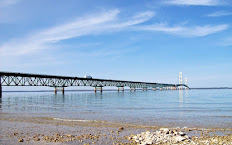
Michigan Tech's environmental monitoring buoy for the Straits of Mackinac was deployed on Aug. 18, 2015, from the NOAA (National Oceanic and Atmospheric Administration) research vessel R 5501 with the assistance of Tech's S/V Osprey, pictured here with the buoy just west of the Mackinac Bridge, which can be seen in the background. Michigan Tech's Guy Meadows, Great Lakes Research Center director, is now in discussions with the State to put together a team of academic experts from colleges and universities to perform a new risk analysis for Enbridge's Line 5 pipeline under the Straits. Click on photo for larger version. (Keweenaw Now file photo courtesy Guy Meadows)

LANSING -- Three public feedback sessions have been scheduled in December so the public can suggest the next steps the State should take regarding Line 5, Enbridge's 64-year-old pipeline under the Straits of Mackinac, based on information in the final version of the independent Alternatives Analysis. The report is scheduled to be released publicly on Nov. 20, and comments will be accepted online or by mail until Dec. 22, 2017.

The report by independent contractor Dynamic Risk Assessment Systems, Inc. analyzed alternatives to using Line 5, owned by Enbridge Energy Partners, L.P., to transport light crude oil and natural gas liquids from Superior, Wis., through the Straits of Mackinac to Sarnia, Ontario, Canada.

The draft report was released in July, followed by one public information meeting, three public feedback sessions, and a 45-day period where the public could offer comments and replies to comments on the report. All comments and replies to comments were considered for inclusion into the final report.*

After the State completes its review of the alternatives report, Enbridge has five business days beginning on Nov. 13 to review the report ahead of its public release a week later. Under Enbridge’s formal agreement with the state to provide funding for the Alternatives Analysis report, the company cannot ask for or have any changes made to the document.

Details about the public feedback opportunities:
  • Wednesday, Dec. 6, in Taylor, beginning at 6 p.m., at the Heinz C. Prechter Educational and Performing Arts Center, Wayne County Community College District, Downriver Campus, 21000 Northline Road.
  • Tuesday, Dec. 12, in St. Ignace, beginning at 6 p.m., at the Little Bear Arena and Community Center, 275 Marquette St.
  • Wednesday, Dec. 13, in Traverse City, beginning at 6 p.m., West Bay Beach Holiday Inn Resort, Leelanau Banquet Rooms, 615 E. Front St.
With the report’s release Nov. 20 on the Pipeline Safety Advisory Board website, a 30-day window opens for online comments about what the State should do regarding the future of Line 5. The Dec. 22 deadline for comments includes two additional days to account for the Thanksgiving state holidays during the comment period. Comments can also be mailed to: Department of Environmental Quality, Attn: Line 5 Alternatives Analysis, P.O. Box 30473, Lansing, MI 48909-7973.

The Michigan Agency for Energy (MAE), Michigan Attorney General’s Office (AG), Michigan Department of Environmental Quality (DEQ), and Michigan Department of Natural Resources (DNR) will use the Alternatives Analysis and a pending independent Risk Analysis to ensure the informational basis for any decision about the future of Line 5 is robust and complete.

The State of Michigan in August 2016 commissioned independent contractors to complete an alternatives analysis and risk analysis. The risk analysis was not completed after an apparent conflict of interest was discovered on the study team. Dr. Guy Meadows of Michigan Technological University is in discussions with the State to put together a team of academic experts from colleges and universities to perform a new risk analysis.**

Built in 1953, Line 5 is 645 miles long and transports up to 540,000 barrels a day of light crude oil and natural gas liquids. A 4.5-mile section runs beneath the Straits of Mackinac within an easement issued in 1953 by the State of Michigan.

During the press conference at the the 3rd annual Pipe Out Paddle protest against Line 5 on Sept. 2, 2017, in Mackinaw City, Andrea Pierce, co-organizer of the event, who is a member of the Little Traverse Bay Bands of Odawa Indians and administrator of Idle No More Michigan, announces information available about Michigan House Resolution 51, which calls for the shut down of Line 5, and Michigan Senate Bill 292, which aims to shut down oil pipelines in the Great Lakes. Pictured at right is co-organizer Jannan Cornstalk, also of the Little Traverse Bay Bands of Odawa Indians. (File photo by Keweenaw Now)***

Pipeline Safety Advisory Board meeting details

The next quarterly meeting of the state’s Pipeline Safety Advisory Board (PSAB) is Dec. 11. The location is the Causeway Bay Lansing Hotel and Convention Center, Ballrooms F-J, 6820 S. Cedar St., Lansing.

The PSAB, created by Executive Order 2015-12, is charged with making recommendations or advising the State on pipeline issues. It also advises state agencies on matters related to pipeline routing, construction, operation, and maintenance, as well as ensuring public transparency. While the PSAB advises the state on matters concerning energy pipelines, it does not have decision-making authority and it does not control the contract administration.

Keep up on PSAB activities by signing up for its listserv. 

Editor's Notes:

* Click here for the draft Alternatives Analysis report by Dynamic Risk Assessment Systems, Inc., issued in July 2017. Click here for the Dynamic Risk presentation given at the July 6, 2017, Public Information Meeting in Lansing. Note that the final report, to be issued on Nov. 20, 2017, may include changes based on public input.

** See our Nov. 5, 2017, article, "UPDATED: State agencies note Enbridge lack of transparency on Line 5 damage; Oil and Water Don't Mix calls for Day of Action Nov. 6 to demand Line 5 shutdown."

*** See our Sept. 16, 2017, article, "3rd annual Pipe Out Paddle protest against Enbridge's Line 5 under Mackinac Straits attracts Native, non-Native water protectors."

Sunday, June 19, 2016

Citizens express concerns about Enbridge Line 5 at Michigan Pipeline Safety Board meeting

By Diane Miller*

Mary Jane and Larry Helvie, Roscommon area citizens, have been educating themselves and others about the dangers of  Enbridge's Line 5 under the Mackinac Straits and have been trying to get it shut down. "This is a no brainer," Larry said. Like many participants at the June 13 meeting of the Michigan Pipeline Safety Advisory Board, the Helvies attend rallies with future generations in mind. Larry added, "If we don’t do it they’ll look at us and say, 'our parents left us a mess.'" (Photos by Diane Miller for Keweenaw Now, unless otherwise indicated.)

ROSCOMMON, Mich. -- When Michigan’s Pipeline Safety Advisory Board met in Roscommon Monday, June 13, 2016, dozens of citizens showed up to express their concerns about the safety of Enbridge Line 5, which runs under the Straits of Mackinac. Everyone who spoke challenged the approach the board is taking.

Margaret Pierson and George Formicola traveled from Traverse City to attend the meeting. "Ever since the 2013 Rally at the straits," Pierson said, "I have not been able to sleep another night. Enbridge does not have a great track record."** Pierson is a volunteer with FLOW (For the Love of Water), who makes "almost daily" calls to government officials on this issue. "Although the governor [Rick Snyder] and [Attorney General Bill] Schuette said last July that the pipeline’s days are numbered, what we’re expecting is rhetoric -- more P.R. pieces and more task forces," Pierson noted.

The 16-member board, appointed by Governor Snyder last fall, is comprised of industry, environment, and citizen representatives.***
 
It was created, according to the Department of Environmental Quality website, to "ensure safety, upkeep, and transparency of issues related to the state’s network of pipelines" as well as to advise state agencies on "matters related to pipeline routing, construction, operation, and maintenance."

The June 13 meeting agenda featured a report from the board’s technical review team. It outlined the results of a request for proposals for two projects: a Risk Analysis, and an Analysis of Alternatives to the pipeline. The team recommended the Risk Analysis be awarded to DNV and the Alternative Analysis to Dynamic Risk.

Some board members express legal and ethical concerns

Board member Guy Meadows, director of the Great Lakes Research Center and Michigan Tech professor, raised two issues about the proposals, including the fact that the study of the pipeline’s risk is recommended to be done by a company "using the Gulf of Mexico as a model" for Great Lakes work, since both DNV and Dynamic Risk are companies that have done their work in oceans.

Guy Meadows, Pipeline Safety Advisory Board member and director of Michigan Tech's Great Lakes Research Center, is pictured here with Michigan Tech's environmental monitoring buoy that was deployed on Aug. 18, 2015, in the Straits of Mackinac, just west of the Mackinac Bridge. The buoy is intended to provide real-time environmental monitoring of the water conditions and to improve safety for Enbridge's pipelines under the Straits. (Photo courtesy Guy Meadows of Michigan Tech University)

Meadows also noted the proposals fail to reference live time data that has been available via the buoy Michigan Tech deployed in the Straits last August to study the complex flows in the area of the pipeline.

"Modeling efforts should show this," Meadows said.

Board member Craig Hupp, noting that implementation of alternatives would take five to 10 years "at minimum" suggested that long-range data would be needed. Audience members later indicated that such a long time period is unacceptable

Pictured here at the June 13 meeting are Michigan’s Pipeline Safety Advisory Board members, from left, John Quackenbush, chair, Michigan Public Service Commission; Craig Pierson, president of Marathon Pipe Line LLC; and Craig Hupp of Bodman PLC.

Board Member Jennifer McKay, policy specialist with the Tip of the Mitt Watershed Council, said that none of the proposals for this work emphasized public engagement (which is one of the stated charges of this board).

As a member of the Pipeline Safety Advisory Board, Jennifer McKay,  policy specialist with the Tip of the Mitt Watershed Council, represents environmental groups. 

"I saw no reference to public meetings in either of the proposals," McKay said, noting that the plans would not allow for ample comment time.  

Homer A. Mandoka, board member and Council Chairman of the Nottawaseppi Huron Band of the Potawatomi, proposed that the exploration of proposals to assess risk and alternatives to the pipeline include an analysis of conflict of interest (both DNV and Dynamic Risk are involved in projects for Enbridge). Mandoka, who represents tribal governments, also said that the current plan does not have a direct process for consultation with the tribes.

Homer A. Mandoka, Pipeline Safety Advisory Board member and Council Chairman of the Nottawaseppi Huron Band of the Potawatomi, whose ancestral tribal lands include the Kalamazoo River basin, the area of Enbridge's 2010 oil spill, represents tribal governments on the board. His tribe was an integral part of the Kalamazoo River cleanup.***

"I have raised this issue several times," Mandoka said.

Invited guest speaker Catherine Hollowell, Council Member of the Sault Ste. Marie Tribe of Chippewa Indians and member of the National Tribal Operation Caucus-EPA Region 5, spoke further on the legal need for an "articulated consultation policy with Native tribes."

Catherine Hollowell, Council Member of the Sault Ste. Marie Tribe of Chippewa Indians and member of the National Tribal Operation Caucus-EPA Region 5, was the invited guest speaker at the June 13 meeting of Michigan’s Pipeline Safety Advisory Board.

Hollowell said, "Things that aren’t negotiated away in a treaty are retained. We have always had them, and the Federal government has affirmed that treaties are the supreme law of the land."

This means that "actual ways of life are protected," she explained. These ways include a protected right to fish and gather; and a risk assessment needs to include the consequences of a loss of traditional ecological knowledge in the event of an oil spill that ruins spawning grounds, for example.

Audience members speak up

During the June 13 meeting, Michigan Sierra Club Chair David Holtz makes several requests of the Pipeline Safety Advisory Board. He asked that the state not compromise the risk and alternative analyses by having them funded by Enbridge. He said the state should be working with all available information in as close to real time as possible; and since it is not clear, in the case of limited liability corporations, who is responsible, or when a company can walk away, Enbridge should not be able to operate without a clear path to holding Enbridge responsible for environmental accidents.

Roger Gauthier, representing the Straits Area Concerned Citizens for Peace, Justice, and the Environment, said that the proposal intends to study only four and a half miles despite the fact that the pipeline runs from Superior, Wisconsin, to Sarnia, Ontario. He said that there are 60 different communities that have passed a resolution calling on Michigan’s governor to stop pipeline oil delivery through the Straits.****

Jim Olson, president of FLOW (For the Love of Water), reminded the board that government bodies have the duty to prevent and minimize harm to public health and that the decisions made regarding the pipeline could set a precedent for future environmental work. "You stand between the citizens and the government and Enbridge," he said. 

Liz Kirkwood, executive director of FLOW, cited the 1953 easement, which is "the legal basis for the existence of the pipeline." She said that Line 5 pipeline violations include the absence of supports, the curvature, wall thickness, and the degradation of the pipe, as well as the low value insurance policy on the structure. "The state must never subordinate the needs of its citizens to any private corporation," Kirkwood said. "Since a reasonably prudent person would not operate a pipeline in this condition, the need for action is urgent." She called for halting use of Line 5 as soon as possible.

Kate Madigan, Michigan Environmental Council representative, called for decommissioning the pipeline to protect the 700 miles of vulnerable coastline. Noting that Michigan Attorney General Bill Schuette said 335 days ago that the pipeline’s days are numbered, she said it is time to end the culture of delay and inaction.
 
Leonard Page of Concerned Citizens for Peace, Justice, and the Environment had two suggestions for the board: First, he said, a third-party study of the pipeline could be done this year instead of using the drawn-out process that is making many citizens impatient. "You’re 90 miles short of Ground Zero," Page said. He invited them to visit the Straits -- twice. First, on a beautiful weekend with 30-mile-per-hour winds and four-foot waves, and again in January or February. His point was that if a pipe failed in the winter, ice would make any pipe leak cleanup very complicated.

Tim O’Brien, co-chair of the Pipeline Safety Advisory Board and associate director of the Michigan Department of Environmental Quality, said that the comments will be carefully considered. The board meets again in Lansing on Sept. 19, 2016.

Editor's Notes:

* Guest writer Diane Miller is a former Keweenaw resident and former Finlandia University communication professor. She now teaches at a community college downstate and attended the Pipeline Safety Advisory Board meeting as a reporter for Keweenaw Now.

**See Keweenaw Now's article on the 2013 Rally at the Straits, "Videos, photos: 'Oil and Water Don't Mix' rally draws hundreds concerned about Great Lakes."

***  Click here to see the original list of Pipeline Safety Advisory Board members appointed last September. Click here to read about the appointment of Homer A. Mandoka to the board as tribal government representative last November.

**** Click here to see the list of local governments and municipalities that have issued resolutions calling for the shutdown of the flow of oil in Line 5.

Thursday, August 09, 2012

Michigan Tech celebrates Dedication of Great Lakes Research Center

By Michele Bourdieu

On Aug. 2, 2012, Michigan Tech University President Glenn Mroz begins the Dedication Ceremony for the new Great Lakes Research Center by welcoming visitors and acknowledging the work of those who helped bring the project to fruition. Standing with him at right is Michigan Tech Board of Control Chair Steve Hicks. Click on photos for larger versions. (Photos by Keweenaw Now unless otherwise indicated.)

HOUGHTON -- What better location could there be for Michigan Tech's new Great Lakes Research Center (GLRC) than right on the Keweenaw Waterway, where water-related research can be conducted under natural conditions, research vessels may be launched from its year-round boathouse and K-12 teachers and students can take advantage of its teaching labs through a community education/ outreach program?

Visitors to the Dedication Ceremony for the Great Lakes Research Center observe the boat docking facility next to the Center's boathouse and the view across the Keweenaw Waterway. 

Visitors -- including alumni on campus for their reunion -- learned all this and more during the Aug. 2 Dedication Ceremony and ribbon cutting at the Center, followed by guided tours to some of its features, including laboratories and a roof garden over the boathouse. The public was also invited to socialize at a reception where gourmet hors d'oeuvre and liquid refreshments were served.

The event began with a welcome by Michigan Tech President Glenn Mroz, who acknowledged the work of faculty, staff, former State Representative Mike Lahti, former Board of Control Chair Marty Richardson, Director of the Center's Operations Mike Abbott, architects and contractors in making the GLRC project a reality.

Michigan Tech University President Glenn Mroz, welcomes visitors to the Dedication of the university's new Great Lakes Research Center on Aug. 2, 2012. (Video clips by Keweenaw Now)

The Center is a $25 million project, of which the State of Michigan contributed about 75 percent and Michigan Tech the rest, Mroz noted.

Michigan Tech Board of Control Chair Steve Hicks spoke about the Board's support of the project and the responsibility to preserve and utilize the Center correctly for today and for the future.

"It's a wonderful signal the State of Michigan has sent by entrusting Tech with this facility to be a leader not only in the state but in the world for research and education for this critical resource in our fresh water -- the Great Lakes," Hicks said.

Guy Meadows, the new director of Michigan Tech's Great Lakes Research Initiatives, described the research goals and educational outreach planned for the Center.


Guy Meadows, Great Lakes Research Initiatives director, formerly of the University of Michigan, speaks about the research and educational mission of the Center -- "a place where the general public, policy makers, scientists, researchers and students can come together and continue to act in a meaningful way."

Next Mroz summoned the members of Michigan Tech's Board of Control for the ribbon cutting:
 
Michigan Tech Board of Control Chair Steve Hicks cuts the ribbon as Board members, Michigan Tech President Glenn Mroz (second from right) and Guy Meadows (far right), director of Michigan Tech's Great Lakes Research Initiatives, look on. (Photo © and courtesy Lizmar Rodriguez Lugo)


Michigan Tech Board of Control members assemble for the official ribbon cutting at the Aug. 2, 2012, Dedication of the Great Lakes Research Center on the campus waterfront.

Visitors to the Center's roof garden above the boat house were very impressed with the native plants -- spurges -- already growing there.

Marcia Goodrich, Michigan Tech Magazine editor, commented on the spurges from a gardener's point of view.

"They soak up the water. They're very hardy and drought tolerant," Goodrich explained.. "The purpose of the green roof is to minimize runoff and cool the building."

Visitors at the Aug. 2 Dedication take a tour of the roof garden. In the foreground are the spurges, hardy native plants now growing there.

Alyson Jabusch of Hancock was also admiring the roof garden.

"It's impressive. I love the roof garden," Jabusch said. "It's about time that Tech makes a bigger connection with the Great Lakes."

This photo shows a view across the Keweenaw Waterway from the roof garden of the Great Lakes Research Center.

Amy Hughes, who works as an auditor in Michigan Tech's Lakeshore Center (former UPPCO building), was impressed with the beauty of the building and its promise of research for the future.

"I'm really hoping we can advance in research on fresh water -- for the benefit of the world, for our future," Hughes said. "I think everyone hopes that."

A view of the entrance to the Great Lakes Research Center. The boat house and roof garden are on the right.

A former Vice-President for fundraising, Ron Helman of Chassell, described the building as "magnificent."

"It will have world-wide impact, I think," Helman said. "It will be quite an attraction for students who want to come here for fresh water studies."

Ashley Coble, a Michigan Tech Ph.D. student in biological sciences, said she was impressed by the Center's laboratories.

"I think there are outstanding facilities here -- certainly great lab facilities," Coble said.

Coble's biogeochemistry research is related to nutrient export from streams into Lake Superior.

According to the GLRC Web site, interdisciplinary research at the Center will include such topics as air-water interactions, biogeochemistry, hydrodynamics and sediment transport, fisheries, invasive species and food web relationships, low impact development, and storm-water management.*

Expressing an interest in that research was Ken Vrana, director of the Isle Royale Institute in Michigan Tech's School of Forest Resources and Environmental Sciences.

He noted the building is both beautiful and functional.

"I think it's well planned out in terms of the type of research contemplated for the years ahead," Vrana said. "But what's really critical about such a space is that it provides an environment for sharing ideas and developing multidisciplinary and interdisciplinary projects -- and of course those projects focus on the Great Lakes and water resources."

He said the Isle Royale Institute places an emphasis on ecology.

"That's why I'm here -- to explore opportunities for the Isle Royale Institute," Vrana added.

He noted as examples the Isle Royale Wolf-Moose Study and other scientific research and educational programs on Isle Royale.

A visitor from Keweenaw County, Robert Haataja, born and raised in Ahmeek though now living in Dollar Bay, said he came to the Dedication because of his love of Lake Superior.

"Lake Superior is my life. That's why I live here," Haataja said. "I'm a scuba diver and rock hound and fisherman, beachcomber and explorer."

More photos ...

As visitors assemble for the Dedication, Steve Casey, left, Michigan Department of Environmental Quality (MDEQ) Water Resources Division district supervisor of the Upper Peninsula District Office, chats with Tom Rozich, right, formerly of the Michigan Department of Natural Resources, and Phil Musser, executive director of the Keweenaw Economic Development Alliance (KEDA).

MDEQ's Steve Casey, who also participated in a panel discussion at the Science Symposium held at Michigan Tech the morning of Aug. 2, preceding the Dedication, shares fishing stories with Bill Deephouse, avid fisherman, former Department of Natural Resources fisheries official and former president of the Copper Country Chapter of Trout Unlimited. Click on photo for a better view of Bill's "fish" shirt.

Michigan Tech President Glenn Mroz welcomes visitors to the Dedication of the Great Lakes Research Center on a sunny Aug. 2, 2012, afternoon.

Following the Dedication, visitors enjoy gourmet hors d'oeuvre and beverages inside the Center. The door at right leads to the roof garden.

*Click here for more information about the Great Lakes Research Center, more videos, and waterfront photos.