See our right-hand column for announcements and news briefs. Scroll down the right-hand column to access the Archives -- links to articles posted in the main column since 2007. See details about our site, including a way to comment, in the yellow text above the Archives.
Showing posts with label Michigan Environmental Council. Show all posts

Tuesday, July 05, 2016

Citizens concerned about Line 5 pipeline meet Enbridge reps at Traverse City barbecue

By Diane Miller*

Outside Enbridge's recent "barbecue" in Traverse City, Mich., Greg Reisig and June Thaden hold signs showing their solidarity with the Oil and Water Don't Mix campaign to shut down Enbridge's Line 5 pipeline under the Mackinac Straits. (Photos by Diane Miller for Keweenaw Now)

TRAVERSE CITY -- Why would the Enbridge energy delivery company host six public barbecues in three days in Manistique, Mackinaw City, Petoskey, Charlevoix, Gaylord, and Traverse City?

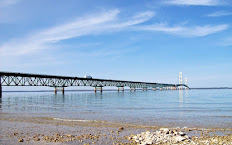
As we know, Enbridge is the Canadian company that manages the now infamous Pipeline Number 5 -- two 62-year-old pipes, about 1000 feet apart and ranging from 100 to 270 feet deep in the Mackinac Straits. These pipes are transporting 540,000 barrels of crude oil and natural gas liquids through the bottom of the lake every single day. Most of the people who live near these pipes do not want them there. But barbecues?

On June 23 I took a trip to find out. While I was driving a couple of hours to Traverse City, to check out the sixth and final barbecue of the series, I was picturing a picnic; and since I really didn’t know my way to Hemming Hall, the advertised venue, I figured I’d just follow my nose to the barbecue grill. That didn’t quite happen, but as I was negotiating Traverse City’s summer bumper-to-bumper traffic I knew I was in the right place before I saw the hall. On the lake side of the highway, dressed in blue t-shirts, were a half dozen smiling people holding something that has now become familiar: Signs with blue letters that read "Shut Down Line 5 Pipeline."

Welcoming positive reactions to her sign from passing motorists in Traverse City is Denise Sica. "This issue is a no-brainer," Sica said. "It is so obvious that there is a potential disaster that we can prevent. Our society is constantly going around cleaning up messes after they’ve occurred, which is ridiculous when we have the ability to prevent something."

In a minute we’ll find out why Enbridge was hosting the barbecues. First, why were the people in the blue shirts smiling?

It might be partly because most of the cars crawling along in the bumper-to-bumper line were either smiling, honking, waving, or holding their "thumbs up" out of their vehicle windows toward the sign-holders, indicating solidarity, or at least approval for the "Shut Down Line 5" message.

Although the sign-holders indicated they weren’t interested in entering the building to eat Enbridge’s barbecue, June Thaden of Traverse City, who is a member of Northern Michigan Environmental Action Council (NMEAC) and has been working with the Oil and Water Don’t Mix campaign, was eager to share some good news. The big news on the sign-carrying line was that Mackinac Island’s mayor, Margaret Dowd, as well as Dan Musser, the owner of Mackinac Island’s Grand Hotel, are calling for the pipeline to be shut down -- and the Detroit Free Press that very day had published Musser’s Op Ed.**

They were also smiling because President Obama had just signed a bill to reauthorize pipeline safety measures and, inspired by concerns over Pipeline 5, to extend special safety provisions for pipelines in the Great Lakes.***

Miriam Owsley of the Groundwork Center for Resilient Communities (formerly Michigan Land Use Institute) displays her sign in Traverse City. "Instead of spending billions of dollars on cleanup, why not stop imposing giant risk on people who depend on the Great Lakes?" she asked.

But why would Enbridge hold a barbecue?

Becky Haase, Enbridge’s Senior Public Relations advisor, said that Enbridge brought in about 30 employees and subcontractors to staff the event, which was arranged like an expo -- equipment on display outside, a cafeteria-style serving line and booths lining the inside of Hemming Hall, a small community event venue.

Visitors meet with Enbridge representatives inside Hemming Hall in Traverse City.

The goal of the event was to clear up what Haase called false beliefs.

"There’s been a lot of misinformation circulating about Enbridge Line 5 and how we do business," she said. "We want to share our practices with the communities near the pipeline." 

Becky Haase, Enbridge’s Senior Public Relations advisor.

What kind of misinformation?

According to Haase, people are saying the 60-year-old pipeline needs to be replaced because of its age.

"Not true!" Haase said, adding that people believe "because we had a spill in Marshall, this pipeline is ready to burst!"

If she is in the business of correcting that kind of cause and effect error, then I am very glad she is doing her work. But I’ve been talking lately with a lot of concerned people lately, and I had not heard logic that simplistic. It might be more accurate to say this: Although the state of Michigan granted the easement for the pipeline in 1953, most people didn’t pay attention to it until July 2010 when Enbridge’s Pipeline 6B broke open; and, because of a combination of structural problems and human error, it spilled more than a million gallons of crude oil into the Kalamazoo River near the town of Marshall, Mich. This spill is known as the largest inland oil spill in U.S. history. People don’t want to see another one.

Sam Getsinger, who is running for commissioner of Leelanau County, said, "We’re all on the damn planet. We need a planet to support our children. When I say that we should shut down the damn pipeline, they say 'we get it.' We get it but are they going to do it? Hell no." Her sign says, "There are alternatives to oil and gas. There is no alternative to water."

Barry Lishawa of Traverse City put it this way: "The environmental risk is unacceptable here where we have 20 percent of the world’s fresh water. Line 6B was 15 years younger; they replaced it only after it burst. We need to be proactive, not reactive."

I also heard attendees refer to a variety of details that have held up, including specifics from the 1953 easement, the amount of insurance Enbridge has, the number of manufacturing defects in the thickness of pipeline 5, the structural wear and tear that has taken place according to published photographs of the National Wildlife Federation’s 2013 inspection, and the University of Michigan research that uses knowledge of currents and other lake attributes to predict the range of a potential spill.****

Attendees pushing for the pipe to be shut down also had figures -- which I verified through the Chicago Tribune and elsewhere -- about Enbridge spills in North America, a total of 44,475 barrels over a decade. The Tribune also cited property damage valued at $928 million.

Haase, however, wasn’t able to give me the kinds of numbers I asked for. Neither could any of the other Enbridge representatives or their subcontractors I met with at the event. But she did tell me this: All releases over five gallons need to be reported (releases under that amount do not), the pipeline safety record is similar to the commercial airline industry, the pipelines are as good as new, and Enbridge has made a huge investment in safety equipment -- in part to let anyone else who has a spill use it.

This is interesting -- that the equipment would be used by someone else. Does anyone other than Enbridge move oil in the area? She didn’t know.

Stephen Lloyd, Enbridge Emergency Response manager, said, "In the unlikely event of a spill we have the best technology possible to attack the oil."

Stephen Lloyd, Enbridge Emergency Response manager, left, chats with Barry and Linda Lishawa of Traverse City.

The company has just spent $7 million on equipment, which includes eight current busters. The first two arctic brushes in the world are going to be at the straits.

The Current Buster is one of the technologies Enbridge is investing in to scoop up spilled oil.

This polypropylene brush looks like the one I have in my garage. The brushes spin around and scoop up spilled oil.

"Leave it better than you found it," is the motto, Lloyd said.

Is that possible? What about possible wildlife deaths?

"That’s remediation, and that’s a different thing -- not what we do," he replied.

Better than you found it?

"We’ve been getting good feedback from people," Haase said. "They leave commenting, 'This is not necessarily what my neighbors are saying.'"

I think I can see why.

Some attendees represented NMEAC, the Groundwork Center for Resilient Communities (formerly Michigan Land Use Institute), the Michigan Environmental Council, and Occupy Traverse City. Others were there as citizens without a formal affiliation. They did not seem misinformed; rather, their perspective was different than Enbridge’s.

David Warren of Occupy Traverse City said his group, which meets every Saturday, takes on economic, environmental and social issues, including Line 5.

"I’m just a diehard activist for the long haul," Warren said.

David Warren, an activist member of Occupy Traverse City, attended the Enbridge barbecue.

Like many of the approximately 50 guests, Bill Hansen, a member of the Northern Michigan Environmental Action Council (NMEAC), said he was there to participate as someone who has researched the pipeline issue and knows what is going on.

Bill Hansen, a member of the Northern Michigan Environmental Action Council (NMEAC), brought his expertise on pipelines to the meeting.

"It is a democracy; it is our chance to be listened to," Hansen said.

Trent Wetmore, Enbridge director of operations, said he was happy to engage in conversations with people who understand how pipelines work.

"We can take it to the next level," he said. "They leave feeling positive and people provide different perspectives."

But might Enbridge use those perspectives in their planning, I asked. Wetmore looked confused.

I, too, was flabbergasted by my own reaction to the equipment investment -- so different from what was intended. Seeing this stuff makes an eventual spill seem more like a reality, even though the technology is designed to calm our fears. The Enbridge folks delivering these messages seemed like genuinely nice people who believed in what they were doing, but they frightened me with their lack of big picture understanding.

Mark Ploen, environmental division vice president for Qualitech, an environmental cleanup company, said he provided a gap analysis for Enbridge in September 2015.

"They were lacking in open water and ice responses," Ploen noted. "They didn’t have any offshore. They were operating legally, but needed to do better."

Mark Ploen, environmental division vice president for Qualitech, an environmental cleanup company, said he provided a gap analysis for Enbridge last September.

A day later I was still trying to understand the evening -- what seemed like a visit to an alternate universe. I called Oil and Water Don’t Mix and reached Bill Latka, who told me he was at the event for a few minutes.

In that short time he got it: "They’re just doing their jobs," he said. "They don’t want an oil spill either. But there is a difference between not wanting a spill and not having a spill. What they don’t understand is that a leak is not acceptable. And the only way to prevent a leak is to not have oil there. Their job as a corporation is to make money. Our job is to protect what is priceless."

Notes:

* Guest author Diane Miller is a former Keweenaw resident and former Finlandia University communication professor. She now teaches at a community college downstate.

** Click here to read Dan Musser's Op Ed.

*** See the June 22, 2016, Detroit Free Press article, "President Obama signs bill with Great Lakes pipeline protections." 

**** Click here to see a computer simulation that demonstrates what could happen if there were an oil spill at the Mackinac Straits.

Sunday, June 19, 2016

Citizens express concerns about Enbridge Line 5 at Michigan Pipeline Safety Board meeting

By Diane Miller*

Mary Jane and Larry Helvie, Roscommon area citizens, have been educating themselves and others about the dangers of  Enbridge's Line 5 under the Mackinac Straits and have been trying to get it shut down. "This is a no brainer," Larry said. Like many participants at the June 13 meeting of the Michigan Pipeline Safety Advisory Board, the Helvies attend rallies with future generations in mind. Larry added, "If we don’t do it they’ll look at us and say, 'our parents left us a mess.'" (Photos by Diane Miller for Keweenaw Now, unless otherwise indicated.)

ROSCOMMON, Mich. -- When Michigan’s Pipeline Safety Advisory Board met in Roscommon Monday, June 13, 2016, dozens of citizens showed up to express their concerns about the safety of Enbridge Line 5, which runs under the Straits of Mackinac. Everyone who spoke challenged the approach the board is taking.

Margaret Pierson and George Formicola traveled from Traverse City to attend the meeting. "Ever since the 2013 Rally at the straits," Pierson said, "I have not been able to sleep another night. Enbridge does not have a great track record."** Pierson is a volunteer with FLOW (For the Love of Water), who makes "almost daily" calls to government officials on this issue. "Although the governor [Rick Snyder] and [Attorney General Bill] Schuette said last July that the pipeline’s days are numbered, what we’re expecting is rhetoric -- more P.R. pieces and more task forces," Pierson noted.

The 16-member board, appointed by Governor Snyder last fall, is comprised of industry, environment, and citizen representatives.***
 
It was created, according to the Department of Environmental Quality website, to "ensure safety, upkeep, and transparency of issues related to the state’s network of pipelines" as well as to advise state agencies on "matters related to pipeline routing, construction, operation, and maintenance."

The June 13 meeting agenda featured a report from the board’s technical review team. It outlined the results of a request for proposals for two projects: a Risk Analysis, and an Analysis of Alternatives to the pipeline. The team recommended the Risk Analysis be awarded to DNV and the Alternative Analysis to Dynamic Risk.

Some board members express legal and ethical concerns

Board member Guy Meadows, director of the Great Lakes Research Center and Michigan Tech professor, raised two issues about the proposals, including the fact that the study of the pipeline’s risk is recommended to be done by a company "using the Gulf of Mexico as a model" for Great Lakes work, since both DNV and Dynamic Risk are companies that have done their work in oceans.

Guy Meadows, Pipeline Safety Advisory Board member and director of Michigan Tech's Great Lakes Research Center, is pictured here with Michigan Tech's environmental monitoring buoy that was deployed on Aug. 18, 2015, in the Straits of Mackinac, just west of the Mackinac Bridge. The buoy is intended to provide real-time environmental monitoring of the water conditions and to improve safety for Enbridge's pipelines under the Straits. (Photo courtesy Guy Meadows of Michigan Tech University)

Meadows also noted the proposals fail to reference live time data that has been available via the buoy Michigan Tech deployed in the Straits last August to study the complex flows in the area of the pipeline.

"Modeling efforts should show this," Meadows said.

Board member Craig Hupp, noting that implementation of alternatives would take five to 10 years "at minimum" suggested that long-range data would be needed. Audience members later indicated that such a long time period is unacceptable

Pictured here at the June 13 meeting are Michigan’s Pipeline Safety Advisory Board members, from left, John Quackenbush, chair, Michigan Public Service Commission; Craig Pierson, president of Marathon Pipe Line LLC; and Craig Hupp of Bodman PLC.

Board Member Jennifer McKay, policy specialist with the Tip of the Mitt Watershed Council, said that none of the proposals for this work emphasized public engagement (which is one of the stated charges of this board).

As a member of the Pipeline Safety Advisory Board, Jennifer McKay,  policy specialist with the Tip of the Mitt Watershed Council, represents environmental groups. 

"I saw no reference to public meetings in either of the proposals," McKay said, noting that the plans would not allow for ample comment time.  

Homer A. Mandoka, board member and Council Chairman of the Nottawaseppi Huron Band of the Potawatomi, proposed that the exploration of proposals to assess risk and alternatives to the pipeline include an analysis of conflict of interest (both DNV and Dynamic Risk are involved in projects for Enbridge). Mandoka, who represents tribal governments, also said that the current plan does not have a direct process for consultation with the tribes.

Homer A. Mandoka, Pipeline Safety Advisory Board member and Council Chairman of the Nottawaseppi Huron Band of the Potawatomi, whose ancestral tribal lands include the Kalamazoo River basin, the area of Enbridge's 2010 oil spill, represents tribal governments on the board. His tribe was an integral part of the Kalamazoo River cleanup.***

"I have raised this issue several times," Mandoka said.

Invited guest speaker Catherine Hollowell, Council Member of the Sault Ste. Marie Tribe of Chippewa Indians and member of the National Tribal Operation Caucus-EPA Region 5, spoke further on the legal need for an "articulated consultation policy with Native tribes."

Catherine Hollowell, Council Member of the Sault Ste. Marie Tribe of Chippewa Indians and member of the National Tribal Operation Caucus-EPA Region 5, was the invited guest speaker at the June 13 meeting of Michigan’s Pipeline Safety Advisory Board.

Hollowell said, "Things that aren’t negotiated away in a treaty are retained. We have always had them, and the Federal government has affirmed that treaties are the supreme law of the land."

This means that "actual ways of life are protected," she explained. These ways include a protected right to fish and gather; and a risk assessment needs to include the consequences of a loss of traditional ecological knowledge in the event of an oil spill that ruins spawning grounds, for example.

Audience members speak up

During the June 13 meeting, Michigan Sierra Club Chair David Holtz makes several requests of the Pipeline Safety Advisory Board. He asked that the state not compromise the risk and alternative analyses by having them funded by Enbridge. He said the state should be working with all available information in as close to real time as possible; and since it is not clear, in the case of limited liability corporations, who is responsible, or when a company can walk away, Enbridge should not be able to operate without a clear path to holding Enbridge responsible for environmental accidents.

Roger Gauthier, representing the Straits Area Concerned Citizens for Peace, Justice, and the Environment, said that the proposal intends to study only four and a half miles despite the fact that the pipeline runs from Superior, Wisconsin, to Sarnia, Ontario. He said that there are 60 different communities that have passed a resolution calling on Michigan’s governor to stop pipeline oil delivery through the Straits.****

Jim Olson, president of FLOW (For the Love of Water), reminded the board that government bodies have the duty to prevent and minimize harm to public health and that the decisions made regarding the pipeline could set a precedent for future environmental work. "You stand between the citizens and the government and Enbridge," he said. 

Liz Kirkwood, executive director of FLOW, cited the 1953 easement, which is "the legal basis for the existence of the pipeline." She said that Line 5 pipeline violations include the absence of supports, the curvature, wall thickness, and the degradation of the pipe, as well as the low value insurance policy on the structure. "The state must never subordinate the needs of its citizens to any private corporation," Kirkwood said. "Since a reasonably prudent person would not operate a pipeline in this condition, the need for action is urgent." She called for halting use of Line 5 as soon as possible.

Kate Madigan, Michigan Environmental Council representative, called for decommissioning the pipeline to protect the 700 miles of vulnerable coastline. Noting that Michigan Attorney General Bill Schuette said 335 days ago that the pipeline’s days are numbered, she said it is time to end the culture of delay and inaction.
 
Leonard Page of Concerned Citizens for Peace, Justice, and the Environment had two suggestions for the board: First, he said, a third-party study of the pipeline could be done this year instead of using the drawn-out process that is making many citizens impatient. "You’re 90 miles short of Ground Zero," Page said. He invited them to visit the Straits -- twice. First, on a beautiful weekend with 30-mile-per-hour winds and four-foot waves, and again in January or February. His point was that if a pipe failed in the winter, ice would make any pipe leak cleanup very complicated.

Tim O’Brien, co-chair of the Pipeline Safety Advisory Board and associate director of the Michigan Department of Environmental Quality, said that the comments will be carefully considered. The board meets again in Lansing on Sept. 19, 2016.

Editor's Notes:

* Guest writer Diane Miller is a former Keweenaw resident and former Finlandia University communication professor. She now teaches at a community college downstate and attended the Pipeline Safety Advisory Board meeting as a reporter for Keweenaw Now.

**See Keweenaw Now's article on the 2013 Rally at the Straits, "Videos, photos: 'Oil and Water Don't Mix' rally draws hundreds concerned about Great Lakes."

***  Click here to see the original list of Pipeline Safety Advisory Board members appointed last September. Click here to read about the appointment of Homer A. Mandoka to the board as tribal government representative last November.

**** Click here to see the list of local governments and municipalities that have issued resolutions calling for the shutdown of the flow of oil in Line 5.

Friday, February 05, 2016

Oil and Water Don't Mix: More time needed to examine proposals on future of Enbridge Line 5 in Mackinac Straits

[Editor's Update: The deadline for comments on the documents mentioned below has been extended to Feb. 16, 2016. Click here for info.]

A coalition of community groups, organizations and businesses concerned with the threat of Enbridge Energy Partner’s Line 5 through the Straits of Mackinac has criticized the Michigan Department of Environmental Quality and the Attorney General’s office for giving the public less than a week to examine crucial documents that will be used to decide the future of the controversial oil pipeline. The Oil and Water Don’t Mix coalition is asking the state to extend the time for public comment from 5 days ending today, Feb. 5, to 30 days.

The Oil and Water Don’t Mix coalition has made it possible for the public to comment by using a form on their Web site.*

At issue are more than 20 pages of documents called "Independent Risk Analysis" and "Independent Alternatives Analysis" for the Straits pipelines, which Michigan Attorney General Bill Schuette and the MDEQ announced Monday, Feb. 1, along with a deadline of today, Friday, for public comment. The documents will be used in the hiring of consultants to undertake the studies and examine alternatives to Line 5 in the Straits.

Guy Meadows, director of Michigan Tech University's Great Lakes Research Center and adjunct professor in geological and mining engineering and sciences, who is a Michigan Pipeline Safety Advisory Board member, told Keweenaw Now the advisory board began considering these documents last October.

"The advisory board began considering the Independent Risk and Alternatives studies last October with members providing valuable and thoughtful input to the process," Meadows said today. "Similar input from the public is also sought and encouraged."**

However, several citizen groups have objected to the short notice given to the public -- with only five days to comment. 

"You can’t claim to want the public engaged or that you are being transparent and then turn around and give folks just five days to respond to proposals critical to the future of the Great Lakes," said David Holtz, Chair of the Michigan Sierra Club Executive Committee. "These documents will determine what is on the table and what isn’t when it comes to decisions about the future of Line 5. Enbridge and other insiders have had these documents for many weeks. We think the public should have the same opportunity as the oil industry to weigh in on them."

Sierra Club is one of 24 organizations that have endorsed the Oil and Water Don’t Mix coalition’s goal of ending the flow of oil through the Straits and keeping oil out of the Great Lakes.The coalition also has the support of more than 200 businesses and 15 local governments.

"What happens with these documents will affect the lakes for generations to come, and Michiganders deserve a fair chance to have their say," said Lynna Kaucheck, Senior Midwest Organizer for Food and Water Watch. "The health of our Great Lakes hinges on decisions about Line 5."

The citizens groups say the state’s draft documents fall short in key areas, including the following:
  • Too little attention is paid to public health. Short- and long-term human health impacts from exposure to airborne chemicals released during oil spill recovery must be examined as well as the affects of an oil spill on drinking water sources.
  • The proposed analysis of the economic impacts of an oil spill fall short of being comprehensive. Any economic impact assessment must include impacts on Great Lakes waters, aquatic and wildlife resources, drinking water supplies on the U.S. and Canadian sides, tourism, shipping, sports and commercial and recreational fishing, and tribal fishing rights. An economic impact analysis that fails to even consider the Great Lakes as a public trust resource is not credible.
  • There must be a detailed section based on a credible worst-case scenario of a Line 5 pipeline rupture that examines methodologies used by other high-hazard industries and includes assessing the cumulative impacts of small, undetected leaks.
The Oil and Water Don’t Mix coalition has called on the state to immediately halt the flow of oil through the Straits while a state Pipeline Safety Advisory Board examines alternatives, which is expected to take months if not years to complete.

Liz Kirkwood, executive director of FLOW (For Love of Water), said the need to eliminate the Line 5 risk to the Great Lakes is urgent.

"It seems the state is trying to rush these documents through because they rightly recognize the urgency of dealing with the Line 5 threat," Kirkwood said. "That’s why we think it’s prudent to stop the flow of oil through the Straits now and undertake a thorough, comprehensive review of permanent alternatives. Short-changing that by cutting out the public’s role isn’t likely to lead to a good outcome for the people of Michigan."

Kate Madigan of the Michigan Environmental Council (MEC) adds MEC favors the alternative of decommissioning Line 5.

"Michigan’s future is reliant on the health of the Great Lakes, and the state’s primary responsibility here is to protect the Great Lakes, our public health, drinking water supplies and economy from a catastrophic oil spill."

* Click here to comment immediately to Michigan Attorney General Bill Schuette and the MDEQ using the form from Oil and Water Don't Mix.

** Click here to learn about the Michigan Pipeline Safety Advisory Board.

Editor's Note: Unfortunately we only learned of this 5-day comment period today, Feb. 5. It was announced by Attorney General Bill Schuette's office on Feb. 1.

Inset Photo: Oil and Water Don't Mix sign held at Sept. 6, 2015, protest near Mackinac Bridge against Enbridge's Line 5 under the Straits. (Keweenaw Now file photo)

Monday, April 01, 2013

Yellow Dog Watershed Preserve: SB 78 removes “Conservation of Biodiversity” from state forest management goals

From Yellow Dog Watershed Preserve
Posted on their Web site Mar. 27, 2013
Reprinted with permission


The Senate Bill 78 recently passed through the Michigan Senate (26-11) on March 5, 2013, and will soon be headed for a vote in the House of Representatives. Michigan
legislators have decided to change the long-standing legal and scientifically supported definition of conservation in the bill which is called "Removes Biodiversity and
Restoration as Forest Management Goals for Department of Natural Resources." This bill will also revise state forest management goals, which will result in needless destruction of natural native communities and damage species diversity. Here are some key points about SB78 provided by the Michigan Environmental Council analysis:

The bill amends the Natural Resources and Environmental Protection Act 451 of 1994, specifically amending part 355 and part 525. It prohibits the DNR or Natural Resources
Commission from promulgating or enforcing a rule or an order that designates or classifies an area of land specifically for the purpose of achieving or maintaining biological diversity, and provides that no other state agency would be required to do so either -- the only portion specifically targeting the proposed Biodiversity Stewardship Area program (BSA). The definition of conservation will be revised, removing clauses on the topics of restoration, distribution and the "continued existence" of native species and communities. It will remove the conservation of biological diversity from the DNR’s duties regarding forest management, and requires the Department to balance its management activities with economic values. It eliminates the requirement that the DNR manage forests in a manner that promotes restoration. Additionally, the bill deletes the legislative finding that human activity causes most losses of biological diversity.

Proponents of the bill fear that including land in a stewardship area to protect its natural biodiversity will allow the DNR to restrict land uses for recreation. Sen. Tom Casperson is particularly interested in terminating the DNR’s "Living Legacies" Program (aka Biodiversity Stewardship Areas Program). In his article published Feb 28, 2013, in the Detroit Free Press, Casperson said, "This bill simply aims to stop the DNR from implementing the Biodiversity Stewardship Area Program, which would severely limit or preclude human activity on the land."

However, that is simply not what it will do. The DNR website Q and A on Living Legacies states, "It is anticipated that existing outdoor recreational uses that are already in place within Biodiversity Stewardship Areas will meet the guidelines for acceptability and will continue. If there are any situations where it is determined that the existing recreational uses are not compatible with BSA designation and the use in the place is ended, the DNR will ensure that an alternative opportunity is made available. […] The designation does not change public access to public lands. If there was public access before the designation, it remains the same. We encourage the public to visit some of these biologically diverse areas." Furthermore, the ecological repercussions caused by these legislative changes are much bigger than simply eliminating the BSA program, which is a great program anyway.

The Yellow Dog Watershed Preserve is opposed to SB 78 because maintaining biodiversity is a fundamental component of good forest management. Managing lands for biodiversity encourages ecosystem health and genetic resilience to new invasive species, such as the emerald ash borer, the spruce budworm and tent caterpillars.

A petition has formed to help stop SB78!

Click here to view and sign the petition to oppose Michigan Senate Bill 78 and keep biodiversity as an important factor in natural resource management. It will be delivered to: The Michigan State House, The Michigan State Senate, and Governor Rick Snyder!

The bill is being considered in the House Natural Resources Committee. Please contact committee members to express your concern:

Andrea LaFontaine (R) Committee Chair, 32nd District: (517) 373-8931, AndreaLaFontaine@house.mi.gov

Bruce Rendon (R) Majority Vice-Chair, 103rd District: (517) 373-3817, BruceRendon@house.mi.gov

Ken Goike (R) 33rd District: (517) 373-0820, KenGoike@house.mi.gov

Joel Johnson (R) 97th District:(517) 373-8962, JoelJohnson@house.mi.gov

Ed McBroom (R) 108th District: (517) 373-0156, EdMcBroom@house.mi.gov

Roger Victory (R) 88th District: (517) 373-1830, RogerVictory@house.mi.gov

Charles Smiley (D) Minority Vice-Chair, 50th District: (517) 373-3906, charlessmiley@house.mi.gov

Scott Dianda (D) 110th District: (517) 373-0850, scottdianda@house.mi.gov

John Kivela (D) 109th District: (517) 373-0498, johnkivela@house.mi.gov

Visit the Yellow Dog Watershed Preserve Web site to learn more about their work.
  
Editor's Note: The Michigan League of Conservation Voters (MLCV) also opposes SB 78. On March 11, 2013, they stated in their Political Week in Review (PWIR), "The 'Anti-Biodiversity Act' prevents the DNR from acting under the Endangered Species Act or a number of other laws to promote and restore biodiversity on public lands. It jeopardizes almost $22 million in federal funding for forest management and puts Michigan’s sustainable forestry certificates that cover 3.9 million acres across the state at risk. This decision is a short-sighted approach that rejects science and sustainability. It makes it harder to ensure our forests, native plants and wildlife will be here for future generations."
Click here to read the rest of this MLCV article.