
See our right-hand column for announcements and news briefs. Scroll down the right-hand column to access the Archives -- links to articles posted in the main column since 2007. See details about our site, including a way to comment, in the yellow text above the Archives.
Showing posts with label Lake Linden-Hubbell High School biology students. Show all posts

Monday, June 13, 2016

Students learn environmental stewardship through planting, monitoring, birding at Torch Lake Superfund site

By Michele Bourdieu

Lake Linden-Hubbell High School science teacher Nick Squires shows his biology students how to  plant dark-green bulrush and red-osier dogwood near the shore of Torch Lake during their field trip in May 2016. (Photos by Keweenaw Now unless otherwise indicated)

LAKE LINDEN -- Despite some chilly, windy weather and predictions for snow in mid-May, Lake Linden-Hubbell High School 10th grade students spent an afternoon on the shores of Torch Lake planting red-osier dogwoods and dark-green bulrushes, bird watching and installing nesting boxes for birds, and playing disc golf just for fun.

This is just one of several hands-on, outdoor activities their science teacher, Nick Squires, offers his students each year so they can learn about the local ecology and stewardship practices in an area that has been disturbed by mining waste and remediated as a Superfund site. Earlier in the year these students monitored the Lake Linden Village Sands (where the Torch Lake Superfund covered stamp sand from mining with vegetation) and collected data for the Environmental Protection Agency (EPA). In addition, Squires had his eighth graders monitor the Trap Rock River at four different sites.

For the spring field trip, sponsored by the Lake Superior Stewardship Initiative, students were divided into three groups and spent a half hour or more on each of the three activities.  

Linden-Hubbell High School students plant red-osier dogwoods near the shore of Torch Lake on May 13, 2016.

As he demonstrated to his biology students how deep to plant the red-osier dogwoods, Squires noted one area near the shore presented challenges.

"We're standing on rock, for the most part," he said. "You cannot over-water these once they've been planted. If we get some snow tomorrow that will help."

Micah Hornat, right, meets the challenge of digging in rocky soil as Hunter Blau prepares to plant a red-osier dogwood.

Kali La Vigne, left, digs a hoe for a red-osier dogwood plant near the shore. She is assisted with the planting by Emily Beveridge, center, and Alli Goldsworthy.

Nicole Liimatainen holds the red-osier plant in place as Ryan Heikkinen adds topsoil.

Student Laura Lyons was proud of planting the dogwood and bulrushes, which help prevent erosion along the shore and contribute to species variety.

"It's nice to give back to our community," Lyons said.

While Squires led one group in planting, Dana Richter, Copper Country Audubon Club president, led a second group of students in a birding activity -- first observing birds with binoculars and then installing nesting boxes for them in an area near both the Lake Linden water treatment ponds, where many birds gather, and the shore of Torch Lake. Richter said the nesting boxes will be used by many tree swallows in the area.

Students use binoculars to observe birds near the Lake Linden water treatment ponds (at left).

Dana Richter of Copper Country Audubon demonstrates how to dig a hole for a nesting box.

Students take turns digging the hole and installing the nesting box at the right depth -- about 18-24 inches.

Pausing for a photo after completing their nesting box installation are, from left, Sophie Codere, Jake Marcotte, Shay Holzberger and Laura Lyons.

The third group activity, disc golf, was just for fun this year, while last year it was combined with writing poetry.
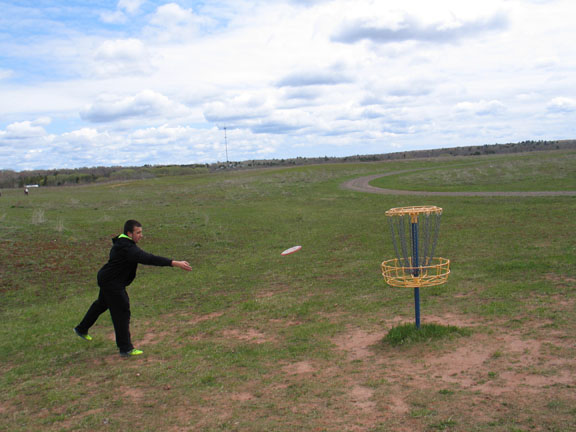
Logan Muljo tosses a frisbee into one of the disc golf basket destinations.

"We're out here just having fun right now," said Logan Muljo, who seemed to be enjoying the exercise while waiting for his group to be called for one of the other two activities.

Instead of playing disc golf, these students preferred hanging out with their English teacher, Heather French, and enjoying the cake she brought for them. Pictured here, from left, are Alli Goldsworthy, Emily Beveridge, Aidan Stahl, Ms. French, Julia McFarland, Lauren Barkell and Kali LaVigne.

Additional projects: monitoring and collecting data

Nick Squires noted his 10th-grade biology class also monitored the Lake Linden Sands last fall. The project follows EPA collection procedures for Superfund monitoring. After establishing up to 25 sample plots, students center a one-meter square (PVC) quadrat on each sampling point and divide the quadrat into quarters. The sampling is done in each quarter as follows:
  • NW corner: Collect plant biomass and measure root penetration
  • NE corner: Collect soil samples for fertility testing in lab
  • SW corner: ID every plant and collect plant vouchers
  • SE corner: Estimate overall soil coverage by vegetation   
The students follow detailed instructions for the sampling collection procedures.

"We have, in the past when they wanted it, submitted this data to the EPA," Squires said.

Each year Squires' 8th graders monitor the Trap Rock River.

Lake Linden-Hubbell 8th grade Earth Science students look for macroinvertebrates in the Trap Rock River. (Photo courtesy Nick Squires)

"We get data on dissolved oxygen, copper, pH, temperature, width, depth, flow rate, velocity, and macroinvertebrate count," he explained. "Historically, out of the 4 monitoring sites, the only spot that has some minor issues is the Scales Creek (tributary of the Trap Rock) site."

Collected macroinvertebrate samples from the Trap Rock River. (Photo courtesy Nick Squires)

Squires said he believes the students' experience in EPA monitoring and planting has many positives.

"It gets them out of the classroom and into the field doing real science," he noted. "It piques their interest in research-based science. The monitoring combined with the planting gives them a real sense that they have an understanding of their local environment as well as a genuine feeling of stewardship (the goal!)."

In early 2003, EPA sought the cooperation of educators and enlisted the assistance of local high school students to continue the monitoring begun by EPA in the first year following the re-vegetation of the Torch Lake site. Students from five area schools now perform long-term monitoring of bird and plant diversity and soil fertility on post-cleanup portions of the Torch Lake Superfund site.

Coordinated by Michigan Tech's Center for Science and Environmental Outreach, along with EPA and the U.S. Fish and Wildlife Service, the students’ monitoring assists EPA’s efforts in charting the progress of the vegetation cap and habitat reconstruction done under the Superfund program. This project is the first of its kind to utilize students for the collection of data for use by EPA.

"Engaging students in learning about, and contributing to, the improvement of their local environment and community, is an excellent way to create lifelong natural resource stewards," observed Joan Chadde, director, Michigan Tech Center for Science and Environmental Outreach, and a partner on the Lake Superior Stewardship Leadership Team.

Funding for the initial year of the students’ work was provided by local groups, but EPA is now paying for the remaining years of the agreement. Cooperating UP-area high schools are Hancock, Lake Linden-Hubbell, Chassell, Dollar Bay, and Calumet.

Wednesday, June 03, 2015

Photos: Lake Linden-Hubbell students learn stewardship, birding, more near Torch Lake

By Michele Bourdieu

Nick Squires, Lake Linden-Hubbell High School science teacher, explains to students how to plant Red osier plants along the shore of Torch Lake at the Lake Linden Sands, site of the Superfund stamp sand remediation. The student project, on May 15, was sponsored by the Lake Superior Stewardship Initiative. (Photos by Keweenaw Now)

LAKE LINDEN -- Students from Lake Linden-Hubbell High School biology and English classes spent an afternoon of hands-on science activities, combined with a game of disc golf and poetry writing, on May 15, 2015, at the Lake Linden Sands Superfund site, where vegetation now covers stamp sand -- a waste product left by the copper industry.

The students were divided into three groups, each one having an opportunity to do all three activities: planting Red osier plants along the Torch Lake shoreline and learning the benefits of planting native plants in a disturbed area, birdwatching and setting up bird nesting boxes, and playing a game of disc golf combined with a poetry writing exercise.

Planting Red osier near Torch Lake shoreline ...

Lake Linden-Hubbell High School biology students listen as their science teacher, Nick Squires, demonstrates how to plant Red osier dogwoods in the remediated Lake Linden Sands during a Lake Superior Stewardship Initiative project on May 15, 2015. (Video by Keweenaw Now)

The planting activity is only one part of the project, according to Nick Squires, science teacher, who said both biology and chemistry students are involved in the native plant study. In the fall, students did monitoring for the Environmental Protection Agency (EPA), which oversees the Superfund site.

"We do some of the analysis in class," Squires said.

For example, the students have measured plant biomass, plant diversity (the presence of different species), root depth, and air temperatures compared to temperatures right on the ground.

"The chemistry class gets involved by doing the soil analysis," he added.

Students, from left, Bailey Haller, Kirsten Codere and Alexa Destrampe, dig holes for planting Red osier along the shore.*

Both boys and girls used shovels to dig holes for the plants, learning they had to find a spot with fewer rocks in the soil.

"We've never planted these here before, but we did a field analysis here," said Alexa Destrampe. "We took soil samples and tested biomass and root depth in the fall."

Bailey Haller had no trouble digging his hole and planting the Red rosier bush.

"This is the third time I've done this," he said.

Bailey Haller finishes planting his Red rosier bush.

These students finished their planting with no difficulty. Pictured here are, from left, Brendan Sullivan, William Hornat, Gavin Jeffery, Bradley Moilanen and Shane Poisson.

Squires said the EPA, under the Superfund, planted other types of vegetation to cover the stamp sand. The purpose of the student project is to extend that vegetation with the native Red rosier plants to help prevent erosion along the shore and add species variety.

Red osier are planted near the shore to help prevent erosion.

Birding and more ...

The second science activity of the day was an opportunity to observe bird species in the area and set up bird nest boxes for them. Dana Richter, Copper Country Audubon Club president, was on hand to help the students.

Digging the hold for the bird box presents a challenge. It has to be 18 inches to 2 feet deep. Here Emma Sarazin tries digging with the auger. Also pictured in her group are, from left, Elijah Norman, Brendan Middleton and Madison Butkonen.

Students finish digging a hole and setting up a nest box for birds near the holding ponds of the Lake Linden sewage treatment system. At right, Dana Richter, Copper Country Audubon Club president, supervises. Richter said the boxes would probably be used by migrant tree swallows or possibly bluebirds, although there are fewer bluebirds than swallows in the area.

Pictured here with the bird nesting box they installed are, from left, Jordan Craig, Jeff Keranen and Owen Mattila. Jeff is the son of Amy Keranen, Department of Environmental Quality (MDEQ) Remediation and Redevelopment Division project manager for the Abandoned Mining Wastes (including PCBs) project at Torch Lake.

Owen Mattila said it was fun to learn about the native plants and the birds.

"We learned some new types of birds and we dug the bird houses for the tree swallows," Mattila said. "Putting the bird house in -- that was the most fun."

Swallows fly around or land on one of the nest boxes set up by the students. According to Dana Richter, one pair of birds will use one box for nesting.

Students look through binoculars to observe various species of birds. Some of the students had never used binoculars or done any birding previously. Binoculars are lent to the students by Joan Chadde of the Western U.P. Center for Science, Mathematics and Environmental Education.

Birds line the fence at the Lake Linden holding ponds. Dana Richter called students' attention to an uncommon duck near the ponds -- a Northern Shoveler. They also observed a Bonaparte's Gull and some Ring-Billed Gulls.

"It's a wonderful place for birding," Richter said.

Disc golf and poetry ...

The third activity of the day was a game of disc golf. At each hole of the course, students were asked on a handout to pause and answer a question, describing in detail something they saw, heard, tasted, smelled, etc. The assignment was to put these elements together at the end of the course and create a nature poem. Heather French, Lake Linden-Hubbell English teacher, supervised the activity.

This group of students paused for a photo during their game of disc golf. Pictured, from left, are Brent Basto, Lincoln Klein, Steven Suhonen, Kirk Strietes and Billy Brinkman.

At the end of the two-hour afternoon session, Nick Squires called for volunteers from the disc golf group and others to help plant 50 more Red osiers in a nearby wetland.

Students finish the afternoon project by planting -- in record time -- 50 more Red osiers in a wetland near the shore.

"This is perfect weather for planting (cloudy with moist soil)," Squires said.

Beth Squires, Nick's wife, and their son, Rowan, now age 3, enjoyed the outing with the students. "He helped Daddy plant trees," said Beth, who has also been a science teacher.

Nick Squires said students study other areas in the Torch Lake watershed and learn about the impacts of mining waste on the environment. Eighth graders do a tour of the Traprock River watershed and monitor the dissolved oxygen, pH, dissolved copper, temperature and macro-invertebrate count.

"We've had pretty good success," he noted. "Scales Creek is the only one where we can detect the slightest bit of copper."

*Correction: We originally made an error in identifying the students in this photo and in attributing the quote that follows it. Thanks to Nick Squires for the correction.

Thursday, May 14, 2015

Lake Linden-Hubbell biology students invite public to join them in stewardship project May 15

LAKE LINDEN -- The Lake Superior Stewardship Initiative is sponsoring a Community Event from 1 p.m. to 3 p.m. Friday, May 15, at the Lake Linden Sands.

 Photo from event flyer courtesy Nick Squires.

The public is invited to join 10th grade biology students from Lake Linden-Hubbell High School as they plant Red-osier dogwoods and Dark-green bulrush, write poetry while enjoying disc golf and install birdhouses and bird watch.

Meet the group with their teacher, Mr. Nick Squires, at the beach parking lot near the start of the disc golf course and become a part of this Lake Superior Stewardship Initiative Project.

Click here for directions from Houghton. For more information email nsquires@lakelinden.k12.mi.us.















