See our right-hand column for announcements and news briefs. Scroll down the right-hand column to access the Archives -- links to articles posted in the main column since 2007. See details about our site, including a way to comment, in the yellow text above the Archives.

Friday, April 10, 2015

Native, non-Native concerned citizens camp at Oak Flat, Ariz., opposing potential Rio Tinto/BHP/Resolution copper mine

By Michele Bourdieu

Scenic view from Oak Flat, a Native American sacred site, where Resolution Copper, a subsidiary of Rio Tinto and BHP - Billiton, plans to construct a large underground mine, now that a land exchange added to the Defense bill last December would privatize the area. Oak Flat is also a prime recreation area, especially for rock climbing and bouldering with more than 2,500 established climbing routes. Oak Flat is a rare desert riparian area. In Arizona, less than 10 percent of this type of habitat remains. (Photos by Keweenaw Now unless otherwise indicated. Information from Arizona Mining Reform Coalition.)

OAK FLAT, Ariz. -- Jerry Thomas is a Navajo (Dine) tribal member now living with his wife, Linda, on the San Carlos Apache reservation, nearly 50 miles from Oak Flat, a public campground near Superior, Arizona, in the Tonto National Forest, where he joined a camp of concerned citizen protesters.

Jerry Thomas, a Navajo tribal member, has been camping out at Oak Flat, a sacred site for the Apache and other tribes, to protest a federal land exchange that would allow a copper mining project that Native Americans, environmentalists and other concerned citizens have been opposing for 10 years.

At the Oak Flat Campground, Thomas and his wife joined Native Americans from other tribal groups and non-Native concerned citizens camping there in protest against the land exchange with Resolution Copper, a subsidiary of Rio Tinto and BHP - Billiton. Resolution Copper is proposing to mine a rich copper vein more than 7,000 feet deep just east of Superior, Ariz., and an hour east of Phoenix, Ariz.

The land exchange was recently approved by Congress when it was attached at the 11th hour last December to the National Defense Authorization Act of 2015, mostly because of the efforts of Sen. John McCain (R-Ariz.)*

Oak Flat is a sacred ceremonial and burial site for the Apache (Indeh) and other tribal groups, and Thomas says the mine would violate freedom of religion, not just for Native Americans but for others as well.

"That's the reason we're fighting," Thomas told Keweenaw Now during our March 8, 2015, visit to the camp, where we were invited by Roger Featherstone, director of the Arizona Mining Reform Coalition.

Thomas expressed fears that "no trespassing" signs by the company will prevent people from praying at their sacred site.

"That's the issue with this bill," he said. "It's a defense bill against all religions."

Upper Peninsula residents -- Native and non-Native -- who opposed the Eagle Mine near Big Bay, Mich., are familiar with Rio Tinto's disregard for Native American sacred sites. Despite the Keweenaw Bay Indian Community's objections to Eagle Rock, a sacred site being used as the portal for the Eagle Mine, and despite KBIC's participation in a contested case against the Michigan Department of Environmental Quality for permitting the mine, the Eagle Mine, constructed by Rio Tinto, is now operating under the ownership of the Lundin Mining Company.**

Gene Champagne of Big Bay, Mich., who has opposed the Eagle Mine, constructed by Rio Tinto and now owned by Lundin Mining Co., visited Oak Flat and the site of Rio Tinto/BHP/Resolution Copper's potential mining project in 2014. Here he inspects signs evidently posted by residents who support the project because of promises of jobs and oppose their town leaders' decision not to support it. (Photo © and courtesy Gene Champagne)

Thomas and his wife were camping at Oak Flat and attending meetings with both Native and non-Native concerned citizens, who are trying to educate themselves and others about the potential impacts of the proposed underground mine.

"It's a learning stage," Thomas said. "We're just now waking up."

Thomas noted the spiritual fight is combined with water issues and environmentalists are involved with water sampling.

"Water is our biggest concern," he said.

Thomas added the people are also concerned for their grandchildren and future generations.

The Pachero family, members of the Yaqui tribe, came from Tucson, Ariz., to the camp at Oak Flat.

The Pachero family, members of the Yaqui tribe from Tucson, joined other concerned citizens at the Oak Flat camp.

"We came to support the Apaches in their defense of freedom of religion, the land and the right to clean water for everybody," said Cati Carmen of the Pachero family.

Featherstone, who also lives in Tucson, was visiting the camp and meeting with representatives of several groups united in their opposition to the land exchange and the proposed mine.

Roger Featherstone, director of the Arizona Mining Reform Coalition, is pictured here at the Oak Flat Campground sign. The land exchange would mean the loss of this public campground to private ownership and potential destruction by subsidence caused by the proposed block cave mining method.

"The land is still ours until they complete environmental studies," Featherstone told Keweenaw Now.

In the meantime there is a petition to repeal the bill, he noted.

"This encampment will stay here until we get it protected," Featherstone said.

Just recently the Arizona Mining Reform Coalition requested citizens sign a letter to the U.S. Forest Service commenting on Resolution Copper's proposal to conduct invasive hydrological and geotechnical testing for Rio Tinto’s preferred toxic tailings location for their proposed mine at Oak Flat.

According to the Coalition, Rio Tinto’s toxic tailings location is between the towns of Superior and Queen Valley and right in the middle of the Queen Creek watershed. The toxic tailings location would heavily affect Boyce Thompson Arboretum, a world-class botanical preserve.

The U.S. Forest Service (the permitting agency for the project) has written a Preliminary Environmental Assessment (EA) on Rio Tinto's plan of operations and would like to approve Rio Tinto's plan with very few (and minor) changes. The Coalition objects to the fact that the Forest Service did not examine Rio Tinto's full mining plan and insists that this action has no relationship to a larger mine. The deadline for comments is April 12, 2015.***

Featherstone said the Coalition works to protect communities and the environment from inappropriate mines.

"And from the very first it was clear that what Rio Tinto wanted to do here was inappropriate," Featherstone noted.

He said he had also worked with the San Carlos Apache Tribe on other efforts to protect sacred sites.

Featherstone said an important point here is that Oak Flat is clearly sacred to San Carlos, but it's sacred to other tribes as well.****

"Also because of what's happening here all the tribes of the United States, through the National Congress of American Indians (NCAI) and other national organizations -- all the tribes are together on this one," Featherstone explained.

The NCAI, which represents all the tribes in the U.S., has consistently passed resolutions unanimously against this Oak Flat mining project, which was first proposed in 2005.*****

The bill that was passed under the Defense bill was the 13th bill for the land exchange, Featherstone said. The first 12 stand-alone bills did not pass, but when Sen. McCain, joined by fellow Arizona Republican Sen. Jeff Flake in an argument for jobs, attached it to the Defense bill, it passed.

Tina Kitcheyan, who was washing dishes at the camp, is a member of the San Carlos Apache Tribe and lives on the reservation, more than 40 miles from Oak Flat. She said she was coming to the camp every day because of her concern for the sacred site.

Tina Kitcheyan of the San Carlos Apache Tribe washes dishes at the Oak Flat camp. She came with her grandsons (not pictured) who were also helping out with various chores. Kitcheyan said she used to come to Oak Flat as a child to pick acorns used in Sunrise Dances.

"We used to come here when we were small to pick acorns and gather plants for traditional uses," Kitcheyan said.

The acorns are used in stew and also in the Sunrise Dances at the site, she explained.

Kitcheyan said she believes one reason the site is sacred is the historical memory of the Apache warriors who jumped off a cliff in the area when the U.S. cavalry was coming to kill them.

"My grandpa used to tell us a lot about it," she said.

She may have been referring to the story about "Apache Leap," which is often left out of history books about the area.

The Arizona Mining Reform Coalition notes on their Web site, "The land exchange would include Apache Leap, a cliff where more than 80 Apache warriors chose to leap to their deaths rather than surrender to the US cavalry."

Kitcheyan noted visitors from several different tribes, as well as non-Native birders and rock climbers, have come to the camp every weekend since it began as a protest and powwows and Sunrise Dances have been held there.

Two participants in the camp activities, Standing Fox (left), a San Carlos Apache, and Jake Toledo, a Dine (Navajo), were on their way to a meeting at the camp.

Former miner: New mining method could destroy Oak Flat area

Roy Chavez -- a former miner and former mayor of Superior, Ariz., who is now chair of the Concerned Citizens and Retired Miners Coalition of Superior -- says he has been fighting this proposed mine since 1998. His protest is in solidarity with that of the Native Americans at Oak Flat.

Chavez calls the land exchange under the Defense bill "a military action the U.S. Government is using as an attack on the San Carlos Apache Tribe."

Chavez cites his own experience in previous mines as one reason for his opposition to Resolution Copper's proposed mine.

This photo, taken from the town of Superior, Ariz., shows the original smelter from the Magma mine of the 1960s to 1980s.

"All these towns are here because of the mining industry," Chavez told Keweenaw Now at the Oak Flat camp. "I support the mining industry but not this method of mining."

Chavez said he had worked in a mine at Superior that used a "cut and fill" method -- backfilling the empty spaces with tailings (mine waste) mixed with concrete; but the plan for this mine projects a "block cave" method, which could cause excessive subsidence and possibly leave a huge crater at Oak Flat.******

This photo shows Rio Tinto/BHP/Resolution Copper’s No. 9 and No. 10 shafts at their current mine workings on private land for their proposed mine at Oak Flat. This was first built in the 1960s by then Magma Copper, which was purchased by BHP and then was merged into the Resolution Copper project. (Photo by Keweenaw Now. Information from Roger Featherstone.)

In his 2011 statement as spokesperson for the Concerned Citizens and Retired Miners Coalition to the House Natural Resources Subcommittee on National Parks, Forests, and Public Lands, Chavez warns of the potential negative impacts of the block cave method:

"We are alarmed about the issue of subsidence by virtue of the mine's proposed block cave method and its effect on the Oak Flat campground, the Apache Leap escarpment, US Highway 60 through Queen Creek and the Town of Superior.

"The mine has finally admitted to 'minimal' subsidence at Oak Flat -- just how 'minimal?'

"They have admittedly chosen the block cave method to cut and fill because it is the least expensive and quickest method to approach this massive ore body. Experts have demonstrated that there will be irreparable destruction to the surface. Since the block cave method creates a huge volume of tailings which are toxic to both the water supply and the air we breathe, we are concerned regarding reclamation of these tailings upon mine closure."******

In these video clips Chavez shows visitors to the camp a map of the proposed mining area and notes Resolution Copper's plans for the tailings:

At the Oak Flat camp on March 8, 2015, Roy Chavez, former miner and former mayor of Superior and chair of the Concerned Citizens and Retired Miners Coalition, explains a map of the proposed mining area to visitors Sandy and Bruce Whitehouse of Corona de Tucson, who are opposing the projected Rosemont mine near Tucson. (Video by Keweenaw Now)

Here Chavez talks about the changing price of copper and questions the value of putting a new mine at Oak Flat:

Discussing the changing price of copper with Sandy and Bruce Whitehouse, Roy Chavez points out that a copper mine in the area would not benefit the community but would ship the ore to China.  (Video by Keweenaw Now)

Chavez discusses the impacts of tailings with Sandy and Bruce Whitehouse:

 
At the Oak Flat camp Roy Chavez describes tailings placement for the proposed Resolution Copper mine to Bruce and Sandy Whitehouse of Tucson, who express concerns about a proposed tailings pile from the Rosemont mine in their area. (Video by Keweenaw Now)

Tucson area visitors: Rosemont mine would be open-pit

Bruce and Sandy Whitehouse visited Oak Flat in solidarity with the protest since they have been fighting Hudbay Minerals' proposed massive Rosemont open-pit copper mine in the Santa Rita Mountains south of Tucson that threatens another scenic area and Arizona's diminishing resource -- water.

According to the Save the Scenic Santa Ritas Web site, "The U.S. Environmental Protection Agency has stated that the massive open-pit mine that would destroy more than 3,000 acres of Coronado National Forest would result in 'substantial and unacceptable impact' to water supplies of 'national importance' and that proposed mitigation measures are 'scientifically flawed' and 'grossly inadequate.'"*******   
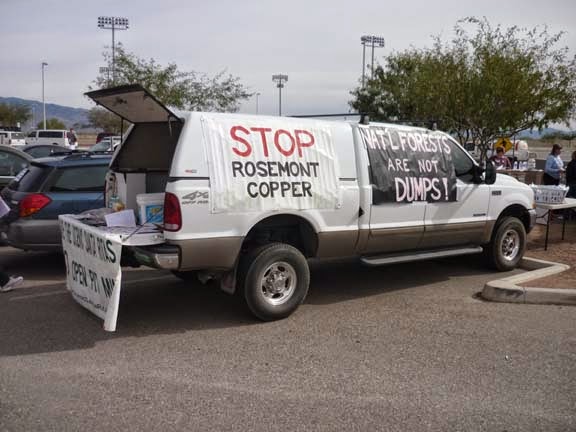
A truck owned by a member of Save The Scenic Santa Ritas protests the proposed Rosemont mine. (Photo © and courtesy Bruce Whitehouse)

"We had hearing with the U.S. Forest Service and they always had information and tried to educate the public," Bruce Whitehouse said. "The Rosemont people always said they would provide job, jobs jobs."

Bruce Whitehouse has a favorite bumper sticker that reads, "There will be no need for jobs on a dead planet."

This is a photo of the Rosemont ranch site where Hudbay Minerals hopes to dig a massive open-pit copper mine. (Photo © and courtesy Bruce Whitehouse)

 
Activist Bruce Whitehouse on top of Lopez Pass where the power lines and water lines are planned for the proposed Rosemont mine. "Huge 167KV towers and destruction of the landscape," Bruce says. "The tye-dyed t-shirt is custom designed by me. It says 'Ruck Fosemont' in olde English fonts. They hate it!" (Photo © and courtesy Bruce Whitehouse)

The group Save the Scenic Santa Ritas says the Rosemont project, if permitted, would have "disastrous AND permanent impacts to our water, air quality, wildlife and economy."*******

Oak Flat mine threatens rock-climbing tourism

Also participating in the protest camp at Oak Flat was rock climber Stephen Shaffer of Scottsdale, Ariz. He was helping prepare firewood for campers.

Stephen Shaffer of Scottsdale, Ariz., left, joins Roy Chavez, center, and Mike Gray of Smoke Hole, West Virginia, in chopping wood for campfires at the Oak Flat camp.

Shaffer said he was interested in joining Chavez's group, the Concerned Citizens and Retired Miners Coalition of Superior. Rock climbers like Shaffer are opposed to the mining project because it would prevent them from accessing their climbing routes that have been on public land until the recent land exchange.

According to a Dec. 21, 2014, article in Tucson.com, "Oak Flat -- which for 15 years was the site of an international bouldering competition -- contains thousands of bouldering and rock-climbing routes that will be inaccessible when mining begins."********

Chavez notes the rock-climbing and other outdoor activities add to a diversified economy, which the town leaders of Superior support -- and which a mining economy threatens.

A 2013 report, "Exaggerating the Net Economic Benefits of the Proposed Resolution Copper Mine, Superior, Arizona: A Critical Review of Resolution’s Economic Impact Analysis," by Thomas Power and Donovan Power of Power Consulting, for the San Carlos Apache Tribe, includes many of the points on the economic impacts of mining that Thomas Power, research professor and professor emeritus in the Economics Department at The University of Montana, made in his 2013 presentations in Houghton and in the report he did for FOLK (Friends of the Land of Keweenaw).

The loss of a diversified economy when mining dominates a community is an important point in both of Power's reports.

In his report for the San Carlos Tribe, Power states the following: "Mining tends to displace most other economic activities in the region around the mine. The spectacular environmental degradation combined with the instability associated with mining operations actually discourages individuals, families, and businesses from locating in mining towns. That is why mining communities tend to be so specialized in mining, lacking in the economic diversification that can stabilize communities in the face of commodity price fluctuations. People and businesses are not drawn to mining areas except for the job opportunities. When those job opportunities 'flicker' or disappear, residents and businesses disappear too. That is how 'ghost towns' are generated." ********

Concerned citizens in Arizona have not yet surrendered their sacred site, their environment or their towns to giant mining interests. 

Editor's Notes:


** See our slide show (Keweenaw Now, right-hand column) on the 2010 camp protesting Rio Tinto's use of Eagle Rock, a sacred Ojibwa site, for the Eagle Mine.

*** Visit the Arizona Mining Reform Coalition Web site for more info on their work.

**** Click here to read the San Carlos Apache Tribe Resolution opposing the land exchange.

***** Click here for the National Congress of American Indians (NCAI) resolution "To Protect Oak Flat and Apache Leap in Arizona from Mining."

****** Click here for the 2011 statement by Roy Chavez to the House Natural Resources Subcommittee on National Parks, Forests, and Public Lands.

******* Visit http://scenicsantaritas.org/ for more info on Rosemont.

******** See the Dec. 21, 2014, Tucson.com article here.
Click here for the report by Power Consulting for the San Carlos Apache Tribe. See also our article on Thomas Power's presentations in Houghton.

Thursday, April 09, 2015

Keweenaw Land Trust to host 3rd Annual Land Jam fundraiser at Orpheum Theater April 11

Poster for Keweenaw Land Trust 3rd Annual Land Jam at Orpheum Theater April 11. (Poster courtesy Keweenaw Land Trust)

HANCOCK -- The Keweenaw Land Trust (KLT) will host their 3rd Annual Land Jam from 8 p.m. to 11 p.m. on Saturday, April 11, at the Orpheum Theater in Hancock. Proceeds from the event will help KLT purchase new Keweenaw nature areas for the public to enjoy and will help pay off loans to expand KLT's Paavola Wetlands Nature Area, establish a water trail campsite at Princess Point, and protect rugged shoreline near the tip of the Abbaye Peninsula.

Cover at the door is $10/person. Local and regional beers will be on tap at the bar. KLT pint glasses will be on sale at the event. Stop by early to buy one before they're gone!

This year's show will feature The Old Hats, a band headed by Adam Kentala and Tony Laux, as well as Keweenaw Brewgrass. The Old Hats are scheduled to play from 8 p.m.- 9 p.m., with Keweenaw Brewgrass closing out the show. The $10 cover charge gets you the entire show, so bring a friend or two and help pack the house in support of public nature areas for the community.

Outdoor Gear Swap Apr. 11 at Houghton High School to benefit Ski Tigers

HOUGHTON -- The Copper Country Ski Tigers will hold a used Outdoor Gear Swap Saturday, April 11, at the Houghton High School Multi-Purpose room. Buy or sell outdoor gear -- bikes, kayaks, canoes, camping gear, skis, snowboards, soccer, hockey and outdoor clothing or any other item for the silent sport enthusiast.

Drop off items to be sold from 5:30 p.m. to 7:30 p.m. Friday, April 10, or from 9 a.m. - 9:45 a.m. Saturday, April 11.

The sale will be held from 10 a.m. - 12:30 p.m. Saturday. Unsold items or $$ earned are to be picked up from  12:45 p.m. - 1:30 p.m. A 15 percent commission, with a $50 maximum commission per item, will be charged on all items sold. The Ski Tigers will also summer wax cross country skis for $10 and snowboards for $15.

The outdoor gear swap is a huge fundraiser for the Copper Country Ski Tigers Race Team made up of middle and high school age Nordic skiers throughout the Copper Country.

For more information, Contact Amy at 487-6072.

Art installation by Lisa Johnson opens TODAY, April 9, at Community Arts Center

Ecotone (detail), by Lisa Johnson. Handmade milkweed, flax, and abaca papers 2012. (Photo courtesy Copper Country Community Arts Center)

HANCOCK -- The Copper Country Community Arts Center announces its new exhibition in the Kerredge Gallery, macho-maynitch... (more or less), an installation by Lisa Johnson, which opens with a reception from 6 p.m. to 8 p.m. TONIGHT, Thursday, April 9, and will be on view through April 30, 2015.

Lisa Johnson is a sculptor and collaborative artist living in Hancock. In her work she combines quilting techniques with fragile papers that she makes from plant species to create ethereal installations.

Sculptor and collaborative artist Lisa Johnson is Assistant Professor of Visual and Performing Arts at Michigan Tech. (Photo courtesy Lisa Johnson)*

She states, "My practice explores our relationships to landscape and to one another. I am particularly interested in the hidden narratives that make up our sense of personal and ecological place. My work often asks: What is the space between us? And: What does it take to cross it."

Lisa Johnson is Director of the Artist in Residence program at Iowa Lakeside Laboratory, a biological field station in Northwest Iowa -- where she links artists, scientists, and community members to address the varied ecological concerns of the region.* She received her MFA from The University of Iowa in 2012 and is an Assistant Professor of Visual and Performing Arts at Michigan Tech.

The Copper Country Community Arts Center is located at 126 Quincy Street in Hancock. Gallery hours are Tuesday through Friday 10 a.m. to 6 p.m. and Saturday 1 p.m. to 5 p.m. This exhibition is supported by a grant from the Michigan Council for Arts and Cultural Affairs with funding from the National Endowment for the Arts. For more information call (906) 482-2333 or visit the website: coppercountryarts.com.

* Editor's Note: Sculptor and scenic artist Lisa Johnson, assistant professor in the Visual and Performing Arts Department at Michigan Tech, involved her 2D and 3D Design classes in the art project "People's Climate March art: 30-city wheatpaste action," initiated by the Justseeds Artists' Cooperative. See our Oct. 28, 2014, article, "People's Climate March, Part 3: Home front action -- local art students create People's Climate March posters."

Tuesday, April 07, 2015

Tech Theatre to present new Mel Brooks musical, "The Producers," at Rozsa April 9-11

Poster for The Producers courtesy Rozsa Center.

HOUGHTON -- Michigan Tech University’s Tech Theatre presents The Producers, at 7:30 p.m. Thursday, Friday and Saturday, April 9 - 11, at the Rozsa Center for the Performing Arts. If you're a Mel Brooks fan, or just find his movies fun, you'll enjoy Tech Theatre’s musical version of The Producers.

The Producers is a perfect story for the stage, since the premise is a satire of the Broadway culture of the 1950s. The show is appealing on a couple of different levels. Many audience members will enjoy the way Mel Brooks pokes fun at the Golden Era of the Broadway musical, with many references to popular musicals like Fiddler on the Roof or The Ziegfeld Follies, as well as the stars that made these shows great, such as Zero Mostel and Ethel Merman. While the play is set in the 1950s, some of the jokes reference The Sound of Music and A Chorus Line.

The music is much more sophisticated than a Mel Brooks title might suggest. True to Brooks' style, the sophistication is paired with base characterizations of Broadway stereotypes and situations. In Brooks' story, the Broadway producer (Max Bialystock) leads a glamorous life in the public eye, but is actually a lecherous, greedy, and crass man. A picture emerges of "good" and "bad" characters, with the arrival of Leo Bloom, a naive and nerdy accountant and Broadway producer wanna be. Add the bombshell actress, Ulla, and the crazed Nazi playwright, Franz Liebkin, and we have a set of unlikely characters to embark on a Broadway show. 

In Mel Brooks fashion, no topic is safe from ridicule. He is a master of comedy, poking fun at every human frailty including, greed, lechery, pretentiousness, self-righteousness and false authority. Some may find Brooks' humor vulgar. The campfire/bean scene from Blazing Saddles comes to mind as an example of the type of humor most of us find crass, but undeniably funny. Brooks boldly satirizes normally taboo topics including religion, race, and sexual preference. He seems to have no fear of being offensive. The treatment of situations is done with such a lightness of touch that most viewers accept the gross exaggerations as necessary in arriving at a certain social justice. 

There is a happy ending. Those who misbehave are punished. Those who are inherently good are rewarded. Everyone is redeemed.

While the show may not be appropriate for young children (mature language and situations), audiences are in for a treat. Prepare yourselves for a hilarious chorus of tap-dancing old ladies, an unthinkable revue of dancing Nazi storm troopers, and the show-stopping musical number, "Keep It Gay"!

Tickets are $19 for adults, $6 for youth (17 and under), and free for Michigan Tech students with the Experience Tech fee. To purchase tickets, call (906) 487-2073, go online at rozsa.mtu.edu, or visit Ticketing Operations at Michigan Tech’s Student Development Complex (SDC), 600 MacInnes Drive, in Houghton. SDC box office hours are 8 a.m. - 9 p.m. Monday-Friday, 8 a.m. - 7 p.m. Saturday and noon - 8 p.m. on Sunday. Please note the Rozsa Box Office is closed during regular business hours and will only open two hours prior to show times.  

For more details, please contact Patricia Helsel, 906-487-3283 or helsel@mtu.edu.

Sunday, April 05, 2015

Public invited to Community Conversation on Minewater Geothermal in Calumet April 6

Old mine tunnels, like those under this hoist, are filled with water, which may be a valuable geothermal resource. (Photo © and courtesy Edward Louie) 

CALUMET -- A Community Conversation on Minewater Geothermal will be held from 7 p.m. to 9 p.m. on Monday, April 6, in the CLK School atrium in Calumet. The event is free and open to the public.

The water filling abandoned mine tunnels could be a major geothermal resource, both on the Keweenaw Peninsula and across the United States.

Student researchers at Michigan Technological University have put together the first comprehensive guidebook communities can use to explore the feasibility of utilizing mine water for geothermal energy to heat and cool buildings. While there is great potential for this resource, there are less than 30 active mine water geothermal systems in the world. One is at Michigan Tech’s Keweenaw Research Center just north of Houghton, Michigan.

The research team will present their work to the public at this event. Community members can interact with a tabletop model showing how mine water geothermal works, calculate the distance from their own home to the nearest mine shaft and make approximate cost calculations for installation and pay-back using a calculator tool. People of all ages are welcome.

Copies of "A Community Guide to Mine Water Heating and Cooling," inspired by the research team's work with the community of Calumet, will be available, along with information on existing mine water geothermal systems.

Refreshments from Cafe Rosetta will be provided.

Next week (April 11-13) the students will travel to Washington, D.C., to present their work at the Sustainable Design Expo, funded by the Environmental Protection Agency.

The research team worked with Michigan Tech's Keweenaw Research Center and community leaders in Calumet to understand the local potential. In fact, the idea for this project came from community members in Calumet, and especially Elmore Reese at Main Street Calumet.*

Michigan Tech graduate student Edward Louie spearheaded the project as part of his master’s degree work in energy policy. "With mine water, you can draw lots of heat from it without it cooling down," Louie says.

The mine water in the Keweenaw stays around 53 to 55 degrees Fahrenheit year-round, Louie explains. These temperatures can then be used to heat or cool buildings using simple technology: mostly pipes, heat exchangers and heat pumps.

Click here to read more about this project on the Michigan Tech News.

* See the March 25, 2014, guest article by Laura Smyth, "Minewater Geothermal on the Keweenaw Peninsula."

Saturday, April 04, 2015

Wolf supporters file suit challenging law intended to undermine will of Michigan voters

Logo courtesy Keep Michigan Wolves Protected.

LANSING -- Keep Michigan Wolves Protected has filed a lawsuit in Lansing in the Michigan Court of Claims to overturn the so-called Scientific Fish and Wildlife Conservation Act on the grounds that it violates the state’s constitution. The lawsuit challenges an underhanded legislative effort intended to overturn the result of two 2014 ballot measures through which Michigan voters soundly rejected sport hunting of wolves.

"The proponents of this misleading legislation combined several unrelated issues into the law such as funding for the control of Asian carp and free hunting licenses to members of the active military," said Jill Fritz, director of Keep Michigan Wolves Protected. "It was a cynical and veiled attempt to prevent Michigan voters from having a say on hunting of wolves and other animals."

In November 2014, Michigan voters overwhelmingly rejected two wolf hunting measures, including Proposal 2, which would have transferred authority to open new hunting seasons on protected species such as wolves to the unelected, politically-appointed Natural Resources Commission. Unlike laws enacted by the legislature, decisions of the Commission cannot be overturned by voters. Proposal 2 was rejected in 69 of Michigan’s 83 counties, and in all 15 congressional districts. It received more than 1.8 million "no" votes -- more votes than any statewide candidate who won election.

Title slide for the Oct. 21, 2014, presentation by Nancy Warren, Great Lakes regional director and executive director of the National Wolfwatcher Coalition, at the Finnish American Heritage Center in Hancock. (Keweenaw Now file photo by Allan Baker)*

Tucked in among the many provisions of the Scientific Fish and Wildlife Conservation Act was language reenacting Proposal 2 if rejected by voters, thereby transferring decision-making authority on important wildlife management issues to a panel of bureaucrats that is not accountable to the public. This purpose of the law was obscured by the law’s proponents in violation of the Michigan constitution.

Fritz said the lawsuit is necessary even though in December 2014, the U.S. District Court in Washington, D.C., reinstated protection of Great Lakes wolves under the Endangered Species Act, a decision resulting in a current ban on wolf hunting and trapping in Michigan, Wisconsin and Minnesota.

"Some members of Congress are attempting a forced delisting of wolves and renewed hunting and trapping. It’s important to prevent the Scientific Fish and Wildlife Conservation Act from taking effect so the decisions made by Michigan voters are honored once and for all, and that wolves remain protected. This unconstitutional law also gives the Natural Resources Commission unilateral authority over many protected species -- not just wolves," said Fritz.

The proponents of the misleadingly named Scientific Fish and Wildlife Conservation Act include the same politicians and state officials who exaggerated and even fabricated stories about wolf encounters with people in Michigan in order to justify opening a wolf hunting and trapping season. Nearly two-thirds of all wolf incidents in the U.P. occurred on a single farm, where the farmer baited wolves with cattle and deer carcasses.**

This goes much further than wolves -- it’s a power grab by politicians to eliminate public participation in decisions relating to wildlife management. As a result of overreaching and unconstitutional law, new hunting seasons on sandhill cranes and other vulnerable and protected species could be created -- and Michigan citizens would be powerless to reject such action.

FACTS:
  • In December 2012, the Michigan legislature passed a wolf-hunting law (Public Act 520 of 2012) that was approved during the 2012 lame duck session and was based on fabricated stories about wolf incidents in the U.P. 
  • In March 2013, Keep Michigan Wolves Protected submitted more than 255,000 signatures to place Public Act 520 on the November 2014 ballot. This halted implementation of the law pending voter approval or disapproval.
  • In May 2013, the Michigan legislature, ignoring the people, passed a second law (Public Act 21 of 2013) to give the political appointees on the Natural Resources Commission the power to designate game species and thereby effectively eliminate citizens’ right to vote on important wildlife management issues.
  • In March 2014, Keep Michigan Protected submitted more than 225,000 signatures to place Public Act 21 on the November 2014 ballot. This halted implementation of the law pending voter approval or disapproval.
  • In August 2014, the Michigan legislature approved the Scientific Fish and Wildlife Conservation Act to prospectively reenact Public Act 520 and Public Act 21 in the event that voters rejected these laws in the November 2014 election.
  • Public Act 520 and Public Act 21 were placed on the November 2014 ballot, as Proposal 1 and Proposal 2, respectively. Voters repealed Proposal 1 (moving the wolf to the game species list) with a 55 percent "no" vote, and they defeated Proposal 2 (giving the unaccountable NRC the authority to decide which species can be hunted), with a 64 percent "no" vote.
Keep Michigan Wolves Protected, The Humane Society of the United States, Detroit Zoo, Detroit Audubon Society, the Sault Sainte Marie Tribe of Chippewa Indians and others have petitioned the U.S. Fish and Wildlife Service to downlist the wolf from endangered to threatened status. This would retain protections for wolves, which Michigan voters said they want, but also allow more flexibility in dealing with the occasional problem wolf that threatens livestock.

Editor's Notes:

* See our Nov. 2, 2014, report on the presentation by Nancy Warren,Great Lakes regional director and executive director of the National Wolfwatcher Coalition, "Video report: Wolf hunt based on politics, not science -- why vote "NO" on Proposals 1 and 2."

** Click here to read about wolf incidents at this farm with poor animal husbandry practices.

Thursday, April 02, 2015

First Friday, April 3, in Calumet to offer art, music, poetry, more ...

Mask of amphibious cat, sculpture by Tom Rudd. Read the story behind the mask below! (Photo courtesy Galerie Bohème)

CALUMET -- First Friday in Calumet, April 3, 2015, will offer new exhibits, art activities, music, refreshments and more.

Galerie Bohème: "More Good Art" and story of cat sculpture

Galerie Bohème will exhibit "More Good Art," a presentation of new works by local artists. The opening reception for this April exhibit will be from 6:30 p.m. to 9 p.m. on First Friday, April 3.

Artist and Galerie Bohème host Tom Rudd recounts this story behind his cat sculpture, part of the new exhibit:

"On a perfectly calm summer day I had the good fortune to canoe Lake Superior, specifically the inside passage between Eagle Harbor and Esrey Park on the windward side of the Keweenaw Peninsula. I paddled and drifted between submerged rocks, dodged ancient basalt outcroppings and small islands.

"Just east of the largest small island I came upon something startling and exciting.

"For the past many decades I have searched for the true Lake Superior monster, and here stretched out on the rocks in front of me were the ghostly remains of the very beast.

Lake monster ghostly remains. (Photo courtesy Tom Rudd)

"Questioning the life of this critter I came to the conclusion that this had been a cat, an amphibious cat! I decided to render my impression of the amphibian creature in the form of a mask to at least give her a face. Perhaps later I will guess the remaining anatomy, the life style, feeding habits, etc., of the aquatic feline.

"So for now check out the mask that scared the bejeepers out of our cat."

Galerie Bohème is at 423 5th Street in Calumet. Call 906-369-4087 for more information.

Paige Wiard Gallery: "Poetry Takes Flight"

Poets have a long association with birds and bird song, and in appreciation of National Poetry Month Paige Wiard Gallery is hosting a special First Friday literary event. Local author, Laura Smyth, will be on hand from 6:30 p.m. to 9 p.m. to sign copies of her newly released poetry chapbook, Wandering In My Mind (Finishing Line Press, 2015).

Laura Smyth left years of urban existence behind for life on the Keweenaw Peninsula of Michigan. Her poetry is often inspired by the intersection of human nature and the natural world. She holds an MFA from Columbia University, has published in online and print journals and anthologies, and is a founding member of the Keweenaw Writers Workshop. She is also a book designer by profession and the owner of Smythtype Design.

Inset photo: Cover for Laura Smyth's poetry chapbook, Wandering In My Mind. Reprinted with permission.

The gallery will also feature a special show of paintings, photographs, sculpture and prints of all things birds by some of the gallery's best artists.

Woodpecker, by Ladislav Hanka. (Photo courtesy Paige Wiard Gallery)

The Paige Wiard Gallery is at 109 Fifth Street in Calumet. For additional information, please call 906-337-5970, or check out www.paigewiardgallery.com.

Calumet Art Center: "Sock Puppet Workshop"

If you are young at heart and enjoy a cool project, stop by the Calumet Art Center between 6 p.m. and 8 p.m. to join a "Sock Puppet Workshop" led by Anna Ehl. From socks to inspiration, all necessary ingredients will be provided, and donations are accepted but not required. While you’re at the Art Center, explore the ongoing projects and check out the upcoming class offerings. For more information, call 934-2228 or check out the website at http://calumetartcenter.com/.

The Calumet Art Center is at 57055 Fifth Street.

Copper Country Associated Artists: Flint Knapping Demonstration

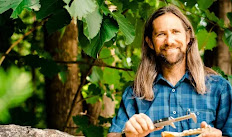
Artist Steve Hecht will demonstrate the ancient art of flint knapping from 6 p.m. to 8 p.m. on First Friday at the Copper Country Associated Artists (CCAA) gallery, 205 Fifth Street. Learn about selecting good stones and creating arrowheads using techniques that have been passed down through the centuries. Check out the new works by CCAA artists, and sign up for classes being offered this spring. For more information, call 337-1252 or check out the website at ccaartists.org.

Hahn Hammered Copper: Vintage Copper

Stop in at Hahn Hammered Copper this Good First Friday and see what’s "new" in old copper! Examine some very nice vintage Cobre copper pieces hand-crafted in Mexico and, as always, the Hahns' very own hand-hammered copper. See also their ever evolving assortment of odd and unusual items. Come in and nibble on a cookie and have a sip of tea at Hahn Hammered Copper.

Hahn Hammered Copper is at 203 Fifth Street.

Cross Country Sports: New for Spring

See what’s new for spring at Cross Country Sports, 507 Oak Street!  Photography by Jeremy Rowe and Eric Ollis; pottery by Jess Kane and Elaine Eikenberry; and jewelry by Heather Mroz, Jen Szubielak and Annele Sakari will be featured this First Friday.

Café Rosetta: Poetry and Art

In addition to the regular First Friday Open Mic Poetry reading from 6 p.m. to 7 p.m., Café Rosetta, 104 Fifth Street, will feature works by local artist Laura Cooley. Her work focuses mainly on single subjects in a contemporary style using acrylics.

Omphale Restaurant and Gallery: Food, Art and Live Music by the Backroom Boys

The Omphale Restaurant will feature a great mix of appetizers and entrées and live music by the Backroom Boys from 6 p.m. - 9 p.m. "Lake and Sky," a multimedia exhibition by K Carlton Johnson will be featured in the gallery.

The Omphale Restaurant and Gallery is at 431 Fifth Street in Calumet.

Tuesday, March 31, 2015

Save the Wild U.P. to host "Poets of the Wild U.P." April 2 in Marquette

"Poets of the Wild U.P." poetry reading poster courtesy Save the Wild U.P.

MARQUETTE -- Save the Wild U.P. (SWUP) invites the public to celebrate "Poets of the Wild U.P." with a poetry reading featuring Milton Bates, Janeen Pergrin Rastall, Kathleen M. Heideman and Russell Thorburn from 7 p.m. to 9 p.m. Thursday, April 2, at the Peter White Public Library’s Shiras Room. The event will lend a uniquely environmental emphasis to National Poetry Month. The reading is free and open to the public.

"Our goal in sponsoring this reading is to highlight the special connection between yoopers and the environment, through the work of four local authors who draw inspiration from Lake Superior, U.P. environmental issues, and the natural beauty of Upper Michigan’s wild places," said Alexandra Maxwell, SWUP’s interim director.

The U.P.’s environment figures differently in the work of each poet.

"There’s a strong spirit of place, an identification with wildness and struggle, at the heart of our stories," says Jon Saari, Northern Michigan University emeritus professor of history. Saari -- whose wife, Christine, is a poet and artist -- serves as Save the Wild U.P.’s vice president.

Milton Bates, the winner of Save the Wild U.P.’s "Putting the Wild into Words" 2014 poetry contest, taught English literature for thirty-five years at Williams College and Marquette University. During that time he was also a Guggenheim Fellow and a Fulbright lecturer in China and Spain. He has published half a dozen books on subjects such as the poet Wallace Stevens, the literature and film of the Vietnam War, and the natural and human history of the Bark River Valley in Wisconsin. On retirement he and his wife moved to the Upper Peninsula, which provides material for many of his poems.

Janeen Pergrin Rastall lives in Gordon, Mich, population 2. She is the author of the chapbook In The Yellowed House (dancing girl press, 2014). Her poetry has appeared in several publications, including The Midwest Quarterly, Midwestern Gothic, Border Crossing, The Michigan Poet, and Dunes Review. She has been nominated for two Pushcart Prizes.

Kathleen M. Heideman, SWUP's president, will receive the City of Marquette Arts and Culture Center’s 2015 Outstanding Writer Award. She has completed artist residencies with watersheds, forests, the National Science Foundation, and the National Park Service -- including Isle Royale and Sleeping Bear Dunes. Informed by landscape and environmental concerns, her work has garnered recognition from the Upper Peninsula Environmental Coalition, the Wurlitzer Foundation, and the Bush Foundation.

"For me, 'Saving the Wild U.P.' means naming, cherishing, and protecting what makes the Upper Peninsula of Michigan such an incredible place -- our creative culture, our clean water, and our wild lands," Heideman says. "When I consider the beautiful work of our local artists creating pottery, landscape painting, woodworking, etc., their material connection to place is obvious at a glance. Poets are really doing the same thing -- using woods, water and rocks to create our work."

Russell Thorburn served as the U.P. Poet Laureate from 2013-2015. He lives in Marquette with his son and wife. A manuscript consultant for poets, he takes orphan poems that don’t fit together and arranges the pieces in a way that not only makes sense, but makes beauty. He is a recipient of a National Endowment for the Arts Fellowship. Salt and Blood, an experimental noir, is forthcoming from Marick Press -- who also published his third book of poetry, Father, Tell Me I Have Not Aged.

National Poetry Month, founded by Academy of American Poets, is the world’s largest literary celebration, involving millions of readers, teachers, students, librarians and authors and celebrating the critical role of poetry in our lives each April.

The Peter White Public Library is at 217 N Front St. in Marquette.

Finlandia Gallery to host student art exhibit opening, fashion show April 2

HANCOCK -- A juried exhibit of artwork by students in the Finlandia University International School of Art and Design (ISAD) is featured at the Finlandia University Gallery, Hancock, from April 2 through April 22, 2015. A reception for the artists will take place from 7 p.m. to 8:30 p.m. on Thursday, April 2, at the gallery, located in the Finnish American Heritage Center, 435 Quincy St. A student and alumni fashion show will begin at 7:15 p.m., followed by a presentation of awards for student excellence. The reception is free and open to the public. Refreshments will be served.

The exhibition includes works by students working in media including drawing, painting, illustration, ceramic design, fiber arts and fashion design, sculpture, integrated design, graphic design, digital media, photography, and mixed media/installation.

"The annual student juried exhibit provides a venue to celebrate the talents of our students," notes Carrie Flaspohler, gallery director/curator of the Finlandia University Gallery. "For many students this is their first experience entering work into a juried exhibit. It is a great learning tool for their professional career."

Much of the student artwork featured in the juried exhibit will be available for purchase.

The awards include best of show, awards for freshman, 2-D and 3-D, a faculty award, and a purchase award. The jury included a faculty member, a graduating ISAD senior, and a community member.

For more information, contact the Finlandia University Gallery at 906-487-7500.

Wednesday, March 25, 2015

Concerned citizens plan 3 days of protest against Graymont proposal, more, March 27, 28, 29

This photo shows part of the Graymont limestone mining proposal area, which includes public lands supporting wildlife and land managed for timber -- contiguous forest lands considered some of the most productive forest land in the Eastern Upper Peninsula. These lands are also within the 1836 Treaty of Washington Ceded Territory, which guarantees Anishinaabe people the right to hunt, fish, gather and hold ceremonies. (Photo courtesy Save the Wild U.P.)

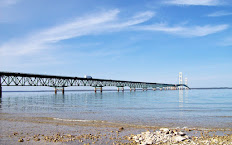
MARQUETTE -- Beginning at 9 a.m. on Friday, March 27, everyone who cares about the future ecological health of the Upper Peninsula is invited to join a protest against the proposed Graymont mine near Rexton, Mich., and to express other concerns -- like the Enbridge pipeline that is in disrepair under the Mackinac Bridge and the proposed Eagle Mine road (County Road 595) that would cut through a fragile ecosystem near Marquette.

Concerned citizens will meet at the rest stop on the UP side of the Mackinac Bridge at 9 a.m. each day for three consecutive days -- Friday, Saturday and Sunday, March 27, 28 and 29 -- to symbolize their deep concern about these issues.

Dr. Martin Reinhardt, a citizen of the Sault Ste. Marie Tribe of Chippewa Indians and an assistant professor of Native American Studies at Northern Michigan University, initiated this demonstration to cast a light on how the State of Michigan is violating the treaty rights of Michigan tribes and disenfranchising both tribal and non-tribal citizens from their right to clean air, water, and land.

"Governor Snyder and his band of misfit legislators and administrators are selling Michigan to the highest bidder," Reinhardt asserts. "It is high time that we the people remind them about our rights. We will be idle no more!"

Reinhardt says it is time for citizens to stand up and speak loudly about these serious issues that are impacting our communities now and in the future.

The Sault Ste. Marie Tribe of Chippewa Indians and other tribes in Michigan have called on the State of Michigan Department of Natural Resources (DNR) to reject Canadian mining company Graymont Inc.'s request to mine limestone on 10,000 acres of "state-owned" land in the Upper Peninsula near Rexton. This proposed activity would interfere with tribal rights to hunt, fish, gather, hold spiritual ceremonies, educate, and recreate in this area.* These rights are guaranteed by multiple treaties signed between the Anishinaabe Three Fires Confederacy of Chippewa, Ottawa, and Potawatomi and the United States of America. If it were not for these treaties, there would be no State of Michigan in the first place.

Reinhardt says he wants to be very clear that this is not a Native versus non-Native issue.

"Non-tribal citizens of the State are also exercising their treaty rights when they stand up to protect these lands," he notes. "Their leadership signed these treaties on their behalf and made solemn promises that they would protect these lands for the benefit of future generations."

The Sault Ste. Marie Tribe of Chippewa Indians points out that "this proposed Graymont mine would set a precedent where those who have enough money to influence elected officials can purchase vast tracts of land to further their corporate interests. The rights of Michigan citizens who use and enjoy this area shouldn't be traded for vague promises of economic prosperity."**

Reinhardt adds, "You simply cannot have a sustainable economy without a sustainable ecology."

Concerned citizens are encouraged to email the Michigan Department of Natural Resources with comments about the proposed Graymont mine and other related issues at: DNRGraymontProposalComments@michigan.gov.

"We hope that many people will join us as we pray, march, discuss issues, and sing in support of our Mother the Earth," Reinhardt says.

Dr. Martin Reinhardt can be reached at: martin@reinhardtassociates.net.

Inset photo: Dr. Martin Reinhardt. (File photo courtesy Dr. Martin Reinhardt)

* See our March 18, 2015, article, "Native American groups seek injunction against MDNR on Graymont land transfer proposal."

** See also our Feb. 22, 2015, article, "DNR Chief approves mineral rights exchange with Graymont but delays decision on 10,000-acre land transaction; residents, groups express opposition to Graymont project."

UPDATE: See the March 25 Press Release from Save the Wild U.P.: "U.P. Environmental Groups Criticize DNR’s Decision."

Friday, March 20, 2015

Michigan Tech's Center for Water and Society to host World Water Day events March 23-24

This Carrara Marble sculpture, "ladle 696," by Tom Rudd of Calumet, will be part of the "Texture of Water" Art Exhibit, opening in GLRC (Great Lakes Research Center) 201 on March 23 during the World Water Day celebration at Michigan Tech. Rudd says of his sculpture, "This piece was inspired by a small lake created by glacier runoff in the northern Rockies." (Photo courtesy Tom Rudd)

HOUGHTON -- Michigan Tech's Center for Water and Society (CWS) will celebrate World Water Day with several events next Monday and Tuesday, March 23-24, in the Great Lakes Research Center (GLRC). The 2015 World Water Day theme is Water and Sustainable Development.

Here is the schedule:

4 p.m. Monday, March 23, in GLRC (Great Lakes Research Center) 202: Dr. Peter Goodwin, director of the Center for Ecohydraulics Research, University of Idaho, will present a lecture on "River Restoration and Flood Management." (Inset photo of Dr. Peter Goodwin courtesy Michigan Tech University)

Monday and Tuesday, March 23-24: CWS World Water Day Poster Competition, GLRC 1st Floor. Monday, 2:30 p.m. to 4 p.m. -- Q and A with students.

3:30 p.m. Monday, March 23 in GLRC 201: Introduction to the "Texture of Water" Art Exhibit: Jamie Allen (painting), Tom Rudd (sculpture), Paul Rose (photography). The exhibit will run through the end of April.  

9 a.m. - 11:30 a.m. Tuesday, March 24, in GLRC 202: Panel Discussion: "What role will dams play in future water resource management?"
Panelists:
Peter Goodwin -- Director, Center for Ecohydraulics Research, University of Idaho William Leder -- President, Copper Country Trout Unlimited and Dept. of Civil and Environmental Engineering, Michigan Tech
David Rulison -- Otter Lake Property Owners Association
Jim Pawloski -- Michigan Department of Environmental Quality, Water Resources Division, Dam Safety (invited)

For more information, click here.

Thursday, March 19, 2015

Panel discussion to be held in honor of Environmental Justice Day March 19

HOUGHTON -- A panel discussion will be held in honor of Environmental Justice Day from 4:30 p.m. to 6:30 p.m. on Thursday, March 19, in Ballroom B of the MUB (Memorial Union Building) on the Michigan Tech campus.

The panel speakers will be Wilma Subra, a chemist helping communities find justice in toxic environment; Jessica Koski, Keweenaw Bay Indian Community mining technical  assistant; and Linda Rulison, Friends of the Land of Keweenaw (FOLK) president. They will discuss their experiences working with communities facing environmental justice issues and their own motivation for taking action.

Combining technical research and evaluation, Wilma Subra provides technical assistance to citizens concerned with their environment -- both across the United States and some foreign countries. This information is then presented to community members so that strategies may be developed to address their local struggles.

Subra has just completed a seven-year term as Vice-Chair of the Environmental Protection Agency National Advisory Council for Environmental Policy and Technology (NACEPT), a five-year term on the National Advisory Committee of the U.S. Representative to the Commission for Environmental Cooperation and a six-year term on the EPA National Environmental Justice Advisory Council (NEJAC) where she served as a member of the Cumulative Risk and Impacts Working Group of the NEJAC Council, and chaired the NEJAC Gulf Coast Hurricanes Work Group.

Jessica Koski is Ojibwe from the Keweenaw Bay Indian Community. Jessica is an alumna of Michigan Technological University where she received a Bachelor’s Degree in Social Sciences in 2009. After Michigan Tech, Jessica earned a Master's Degree in Environmental Management from the Yale School of Forestry and Environmental Studies. At Yale, Jessica’s focal area was Social Ecology and Environmental Policy, and her research examined indigenous environmental justice issues and activism in the western Great Lakes region.

Koski currently works for the Keweenaw Bay Indian Community's Natural Resources Department as mining technical assistant. In this role, she is working to build the capacity of her tribal community to address mining in the Lake Superior basin and Upper Peninsula. From 2011-2014, she also served on the National Environmental Justice Advisory Council’s Indigenous Peoples Working Group. In addition, Koski has been engaged as a community activist on mining issues for about eight years. This work has included organizing regional forums, assisting grassroots efforts, raising concerns at corporate shareholder meetings abroad, and elevating indigenous rights issues to the United Nations.

Linda Rulison, a retired middle/high school teacher of environmental and social studies, is interested in environmental justice on campus and in career paths. She became involved in local environmental issues with a group of citizens in 1989 and formalized the group as a 501(c)3 organization in 1990. She is currently the president of Friends of the Land of Keweenaw (FOLK).

This event is supported by the Parents' Fund of the Michigan Tech Fund, Michigan Tech's Students for Environmental Sustainability, the Center for Science and Environmental Outreach and the Michigan Tech Biology Department.

For more information contact Nicolette Slagle at nmslagle@mtu.edu.

Wednesday, March 18, 2015

Native American groups seek injunction against MDNR on Graymont land transfer proposal

By Michele Bourdieu

This wetland near Rexton, Mich. is within the area of the proposed Graymont limestone mining project -- an area that includes fragile wetlands and critical ecosystems. The proposed project is also within Native American ceded territory, which is under an 1836 Treaty that guarantees Native hunting, fishing and gathering rights. (Photo © and courtesy Steve Garske)

MARQUETTE, GRAND RAPIDS -- A group of American Indians from northern Michigan filed for an injunction today in federal court in Grand Rapids seeking to bar the Director of Michigan's Department of Natural Resources (MDNR), Keith Craegh, from approving a land transfer to Graymont Mining Company. If approved, the land transfer would be the largest transfer of land out of the public domain in Michigan's history -- over 11,000 acres would be affected.

According to the lead Plaintiff, Dr. Phil Bellfy, "The land subject to transfer is wholly within the 1836 Treaty of Washington Ceded Territory and subject to the conditions laid out in the 2007 Inland Consent Decree. It would be unconstitutional for the MDNR Director to transfer those lands as we -- American Indians -- have Treaty rights to "the usual privileges of occupancy" on those 11,000 acres. We are asking the Court to step in and preserve our Treaty rights and enjoin Mr. Craegh from transferring that land."

The phrase "the usual privileges of occupancy" is taken from Article XIII of the 1836 Treaty of Washington, and the extent of those "Article XIII Rights" was "conclusively resolved" by the 2007 Inland Consent Decree.

According to Idle No More, "Virtually all 'Land Cession' Treaties throughout the Upper Great Lakes region retain the right to hunt, fish, and gather on 'public lands.' The Courts have upheld these rights. Based on the language of the 1836 Treaty, for example, the 2007 Inland Consent Decree "is intended to resolve conclusively [Treaty Right] claims, and to provide for the protection of the resources in the 1836 Ceded Territory."*

Click here for the EX-PARTE MOTION FOR PRELIMINARY INJUNCTION WITH SUPPORTING BRIEF.

Concerned groups, citizens write to MDNR Chief

"A foreign mining company wants to buy 10,000 acres of our public land?" said Kathleen Heideman, SWUP president. "By my calculation, that’s ten thousand great reasons to reject the deal." (Image courtesy Save the Wild U.P.)

A February 27, 2015, a collective letter of opposition from concerned groups and citizens in the Upper Peninsula to MDNR Chief Craegh urges him to reject the Graymont proposal.

"The Michigan Department of Natural Resources must manage and conserve public lands for public benefit," the letter states. "The Graymont proposal includes lands currently open to the public for hunting and recreational trails, lands supporting wildlife, and land managed for timber -- contiguous forest lands considered some of the most productive forest land in the Eastern Upper Peninsula."

This sale of public land to benefit a foreign mining company would be a great loss for Michigan's forest and tourism economies, the letter adds. It would displace existing limestone quarrying jobs as well as long-term forestry and tourism jobs and would be "devastating" for the environment.

"The sale of these lands interferes with Indian tribes' rights by having an adverse impact on fishing, hunting and gathering activities of tribal members under the 1836 treaty, as well as a lack of cultural inventory, and no plan for inadvertent discovery," the collective letter of opposition continues.

Graymont, a Canadian mining company, first submitted an application to purchase over 10,000 acres of public land from the MDNR in November of 2013. Graymont intends to construct surface limestone quarries and, eventually, an extensive underground mine.

The area under consideration includes fragile wetlands and critical ecosystems. These public lands support unique hydrology and biodiversity, including "karst" habitat identified in Michigan’s Natural Features Inventory, limestone features (cliffs, pavement, sinkholes, caves) and special ecologies uniquely adapted to limestone: bats reliant on limestone caves, globally-rare "alvar" plant communities, and limestone wetlands critical to the endangered Hine's Emerald Dragonfly, termed "one of North America's rarest dragonflies" by the U.S. Fish and Wildlife Service.

The collective letter of opposition is signed by individual citizens as well as major groups, including the Michigan League of Conservation Voters, Upper Peninsula Environmental Coalition, Friends of the Land of Keweenaw’s Board of Directors, the Chippewa Ottawa Resource Authority, the Central U.P. Group of the Michigan Chapter of the Sierra Club, Yellow Dog Watershed Preserve, Concerned Citizens of Big Bay, Save the Wild U.P., the Sault Ste. Marie Tribe of Chippewa Indians, the Keweenaw Bay Indian Community, Students for Sustainability of Northern Michigan University, Northwoods Native Plant Society, Citizens for Alternatives to Chemical Contamination, Citizens Against the Rexton Project, Concerned Clergy of Marquette, the Marquette Unitarian Universalists Social Action Committee and multiple individual property owners in Trout Lake, Mich.**

"These are serious and unresolvable objections," said Alexandra Maxwell of Save the Wild U.P. (SWUP), who helped organize the collective letter of opposition. "Our message to Director Creagh is simple: don’t make this deal." According to Maxwell, Save the Wild U.P. has been following the developments of this project since Graymont submitted its application; SWUP and other groups have consistently attended public meetings and submitted commentary critical of this potential land sale. "Now a majority of environmental organizations and concerned citizens throughout the U.P. have reached a clear consensus -- the Graymont project must be stopped."

Aaron Payment, tribal chairperson of the Sault Ste. Marie Tribe of Chippewa Indians, said he was glad to sign the letter.

"I know that the DNR has received hundreds and hundreds of letters, emails and calls from my Tribal Citizens in opposition to this mine as it would devastate our treaty right to the land," Payment writes. "The proposed action is a harbinger of what's to come. The DNR has admitted in smaller group meetings they oppose the deal so you have to wonder why they are prostituting our land by continuing to consider this deal. Ask yourself, if the DNR has made clear they are in opposition, who is directing them to proceed despite DNR professional staff objections? What or who is driving this proposal? During the Chippewa County group of the League of Women Voters' public session at the Bayliss Library in the Sault, the DNR admitted the input they received was well over 90 percent in opposition. If the vast majority oppose, who is selling you out and for how much?"

Sierra Club, Michigan Chapter: Public needs more time to comment

A March 15 update from the Michigan Chapter of the Sierra Club states, "Sierra Club opposes the large-scale sale of public lands for private development. The decision on this application may come as soon as March 19. However, the application has gone through so many revisions, so quickly, that the public has not had an adequate opportunity to comment on the proposed action. Graymont has submitted nine versions of the application, with five coming since January 5, 2015. This means that by the time the public has seen and read an application, there has often already been a new one submitted.

"The most recent application was released to the public on March 10, less than 10 days before a proposed decision. Sierra Club believes that regardless of the merits of the proposal, the public deserves to have a reasonable period of time to review and comment on the final version of the application. We are asking DNR Director Keith Creagh to allow the public at least 30 days to review a final application before he makes a decision."

Graymont Proposal not on agenda for Citizens Advisory Councils

Horst Schmidt of FOLK (Friends of the Land of Keweenaw) said he attended a joint meeting of the MDNR's U.P. Citizens Advisory Council (Eastern and Western U.P. councils) in Marquette on March 16, but the Graymont proposal was not on the agenda.

"Considering the importance of the Graymont deal, it is significant that it was not on the agenda, even though I had asked our chair to place it on the agenda," Schmidt told Keweenaw Now. "One member from the eastern council said the access provisions after the deal would be implemented, as explained to him by the DNR, were enough to satisfy him that it was acceptable. The DNR did not communicate anything to the eastern and western councils in toto about the nature of the provisions or anything at all about the Graymont transaction."

Schmidt also questioned Graymont's proposed royalty payments.

"Over and over, Graymont appears to be generous," Schmidt noted. "First with the royalty increase from 18.75 to 30 cents/ton of usable dolomitic limestone. Second, it can indicate they are significantly underpaying the state. Third, by so doing, they are robbing people of the State of Michigan of revenue that would go into the DNR's land trust. Finally, by appearing generous, they apparently must think that it is still profitable for them. What kind of profit margin would they being making? Unlike regular mining operations, there is much less risk for Graymont with a known limestone deposit."

The Michigan Natural Resources Commission will hold its regular monthly meeting Thursday, March 19, at the Ralph A. MacMullan Conference Center, 104 Conservation Drive, in Roscommon. Following public comments, MDNR Director Creagh is scheduled to announce his decisions on several land transactions, including a revised land transaction application submitted by Graymont, Inc. For the agency's  background on Graymont’s proposals, visit the MDNR website at www.michigan.gov/graymontproposal.***

The MDNR is accepting written comment from the public concerning the newest revision of the Graymont proposal through Thursday, March 19.

"We strongly urge folks to review the facts," said SWUP's Maxwell, "and then write directly to Director Creagh, asking him to reject the Graymont land deal. Concerned citizens still have time to protect their public lands, in their own words."

Written commentary may be submitted to:
DNR-GraymontProposalComments@michigan.gov
 

Notes:

*Full texts of the Treaty and the Consent Decree can be found here: http://article32.org/

** Click here to read the Feb. 27 letter of opposition.

*** See also our Feb. 22, 2015, article, "DNR Chief approves mineral rights exchange with Graymont but delays decision on 10,000-acre land transaction; residents, groups express opposition to Graymont project."

Sunday, March 15, 2015

Carnegie Museum to host discussion on Keweenaw plants by Karena Schmidt March 17

Poster for the March 17 discussion on Keweenaw plants by Karena Schmidt, expert on natural plant communities and Michigan Tech's greenhouse manager. (Poster courtesy Carnegie Museum)

HOUGHTON -- Karena Schmidt, expert on natural plant communities and Michigan Tech's greenhouse manager, will lead a discussion on "Natural History and (un)natural future of plants in Keweenaw and Isle Royale" at 7 p.m. Tuesday, March 17, at the Carnegie Museum. An introduction and refreshments, from 6:30 p.m. to 7 p.m., will precede the lecture and discussion.

"Geologically, Isle Royale and the Keweenaw Peninsula reflect each other quite nicely," Schmidt explains. "Bedrock twins one could say. Botanically, too, the spare acidic soils maneuvered by glaciers are the substrate to a host of plants that manage to survive dynamic influences of Lake Superior. Historically humans, in their quest for cash, mined for copper and harvested magnificent old-growth forests; their actions radically altered the vegetative landscape, even more than a beaver or moose could ever dream. Isle Royale and the Keweenaw have recovered quite differently from these ventures for a variety of reasons we will explore. There is no end to the botanical delights that await discovery and understanding. Many plants here are western disjuncts, primarily having home base in the Pacific Northwest. Many arctic species reach their southern-most limit. Plants readily identified with more southerly climes reach their northern-most limit, putting down roots yet declaring thus far and no farther. Unique too are large and diverse populations of orchids, heathers and lichens all of which have evolved unique and admirable adaptations to abide in the spectacular Keweenaw terrain."

This event is part of the 2014-2015 Keweenaw Natural History Heritage seminar series at the Carnegie Museum.

Coming Tuesday, April 14: "Talking Rocks: Common Ground -- Geology in the Lake Superior Region and Native Americans." Come join the conversation as earth scientist Ron Morton and Native American elder Carl Gawboy -- wise men from two cultures -- explore the natural history of the Lake Superior region, examining both the science and the spirit of the land. For more information click here.

The Carnegie Museum of the Keweenaw is located at Huron and Montezuma in downtown Houghton. Seminars are held in the recently restored Community Room on the ground level of this historic building. Lectures are free, open to the public, and barrier free (wheelchair accessible). For each monthly lecture, the museum will open at 6:30 p.m. for refreshments; lectures and discussion from 7 p.m. to 8 p.m. For more information, please contact the Museum by telephone (906-482-7140) or Email (history@cityofhoughton.com); find them on Facebook, or go to the Seminar Web-site.

Thursday, March 12, 2015

Celebrate the UP! March 13-15 in Marquette

Poster courtesy Upper Peninsula Environmental Coalition (UPEC).

MARQUETTE -- The seventh annual Celebrate the UP! will be held Friday through Sunday, March 13-15, in Marquette. The public is invited to a wide range of presentations about the UP's environment, culture, and history on Friday evening and all day Saturday at the Landmark Inn, Peter White Public Library, the Federated Women’s Clubhouse, and the First United Methodist Church (the corners of Front and Ridge Streets). Sunday will be devoted to snowshoeing, socializing, and savoring this beautiful region. The events are free, although donations are appreciated.

John Davis, co-founder and Wildways advocate for Wildlands Network, will kick off the celebration at 7 p.m. on Friday at the Federated Women's Clubhouse with his vision for "Continental Wildways:  Reconnecting Natural Habitats for Wide-Ranging Species, Hikers, and Paddlers." Davis will challenge us to view the UP as an essential part of a larger east-west northern forest wildway characterized by a bio-diverse and healthy ecosystem.

Between 10 a.m. and 2:30 p.m. Saturday, 16 speakers will give a series of presentations on topics such as art, poetry, UP dialects, northern lights, loons, wilderness survival, and a birch basket weaving workshop. From 3 p.m. to 4:45 p.m., a panel discussion on "Predators and Ecosystems: The Connections" will take place in the sanctuary of the First United Methodist Church in Marquette. The panel will feature wildlife biologists, a forest ecologist, and predator advocates. A public reception will immediately follow at the Federated Women’s Clubhouse.

The Upper Peninsula Environmental Coalition (UPEC) sponsors Celebrate the UP!. This year the Upper Peninsula Land Conservancy (UPLC) has partnered with UPEC to include the "Over the River and Through the Woods" 5k Snowshoe Race/Trek. This event is Sunday afternoon at 2 p.m., followed by a supper at the Ore Dock for participants. For more information, visit upenvironment.org and uplandconservancy.org. For Sunday's events, please register at uplandconservancy.org.

Wednesday, March 11, 2015

Portage Library, Reading Council to host kids' Pollinators and Poetry workshops March 14, 21, 28

 
This worker bee is carrying pollen on her legs. Kids, do you know why? (Photo © and courtesy Gustavo Bourdieu)

HOUGHTON -- Calling all junketeers! Kids in grades 1- 6 are invited to use recyclable materials and just plain ol’ junk to build all kinds of pollinators including bees, birds, bats, beetles, ants, butterflies, flies, moths and more and have fun writing poems about them at the Portage Lake District Library.

Pollinator-making workshops will be held from 1 p.m. to 3 p.m. on Saturdays, March 14 and March 21, and from noon to 3 p.m. on March 28. Plenty of recyclable supplies and all manner of tape, glue, staplers, string, and dowels will be on hand for the construction. Kids are also encouraged to bring their own clean junk with them to the workshops.

On Saturday, March 14, Upward Bound students from Finlandia University will read stories about pollinators and show youtube videos about these important creatures. Upward Bound students will also read sample poems about pollinators to inspire kids as they begin to interact with and think about their own pollinator creations. Kids will have time during each session to write poems that describe the creatures they are creating.

Throughout this event, kids will learn why pollinators are important and what can be done to protect them. They may attend as many workshops as they choose in order to complete their creations and poems. On Saturday, April 4, from noon to 3 p.m., kids who participated in this workshop will give a performance at the library to introduce and describe their pollinators and read their poems. There will be a party afterwards to celebrate their accomplishments.

The pollinators and poems will be on display in the library during April in celebration of National Poetry Month.

This event is sponsored by the Copper Country Reading Council in partnership with Michigan River of Words and the Portage Lake District Library.

Library programs are free and everyone is invited. For more information, please call the library at 482-4570 and ask for Chris.

Flatlanders Art Galleries to host exhibit of new work by Margo McCafferty, Tom Rudd and Ken Thompson, opening March 14

Poster and photos courtesy Tom Rudd.

CALUMET -- Flatlanders Art Galleries will host "Tables, Chickens and Fish," an exhibit of new work by Calumet artists Margo McCafferty and Tom Rudd and Blissfield sculptor Ken Thompson with an opening reception from 2 p.m. to 4 p.m. on Saturday, March 14, in Blissfield, Mich. Flatlanders is at 11993 East US 223. The exhibit will continue through May 2, 2015.

Lake trout sculpture by Tom Rudd.

Visitors will see some superbly unique Tables by Ken Thompson, startling Chickens from Margo McCafferty, woodcuts and petite wooden dolls through the combined efforts of Tom and Margo and a few superior fish from Tom Rudd. Join Margo and Tom on a reasonably warm Saturday afternoon, check out the art and see and talk to friends that you haven't seen for a while.

Flatlands Galeries regular hours are Tuesday through Friday 10 a.m. to 5 p.m. and Saturday 10 a.m. to 1 p.m. For more information call 517-486-4591.

Calumet's Galerie Bohème March exhibit

"Blue Car," by Cynthia Coté, is one of the recent works on exhibit at Galerie Bohème in Calumet through March.

If you can't make it to Blissfield and you missed last week's First Friday openings in Calumet, Galerie Bohème is exhibiting new art by Margo McCafferty, Tom Rudd, Cynthia Coté and Kerri Corser through March.

"Traprock Pearls," by Kerri Corser, is also part of the March Galerie Bohème exhibit in Calumet.

Galerie Bohème is located at 423 Fifth St. in Calumet. For more information or a viewing appointment please call Tom Rudd at (906) 369-4087 or email galerieboheme@gmail.com.

Wednesday, March 04, 2015

MDNR seeks public comment on draft update of 2008 Michigan Wolf Management Plan

File photo of wolf courtesy wolfwatcher.org.

LANSING -- The Michigan Department of Natural Resources (MDNR) has completed a draft update of the 2008 Michigan Wolf Management Plan and is seeking public comment during a 30-day period beginning today, March 4. The 2008 Wolf Management Plan was created using extensive public input to identify important issues and assess public attitudes toward wolves and their management, as well as a review of the biological and social science on wolves.

The four principal goals within the plan are to:
  • Maintain a viable wolf population.
  • Facilitate wolf-related benefits.
  • Minimize wolf-related conflicts.
  • Conduct science-based and socially acceptable management of wolves.  
The plan and, more specifically, the four principal goals within the plan have guided wolf management in Michigan for the last six and a half years.

Beginning in November 2014, the DNR sought comments on the implementation of the 2008 plan.* During the comment period, the DNR received more than 3,000 responses to its online and hard-copy survey. Based on those responses and corresponding comments, and an internal review of the document, a draft updated plan recently was completed and is available for public review and comment.

The four principal goals in the 2008 plan remain the same in the updated plan. The 2015 draft also includes updated scientific literature and new information and facts regarding wolves in Michigan. A companion document, which summarizes DNR management accomplishments in addressing the action items from the 2008 plan, also is available for public review.

The draft updated plan and the 2008 Summary of Management Accomplishments document are available for download at Michigan.gov/wolves.

Send comments on the draft updated plan to:
DNR-Wildlife@michigan.gov or via U.S. mail to DNR Wildlife Division, P.O. Box 30444, Lansing MI 48909. Comments must be received no later than April 3.

* Editor's Note:

See our Nov. 14, 2014, article on the 2008 plan, including comments from Nancy Warren, Great Lakes regional director and executive director of the National Wolfwatcher Coalition (NWC), who has served on the Michigan Wolf Management Roundtable, whose members developed principles to guide management of Michigan wolves and wolf-related issues.