See our right-hand column for announcements and news briefs. Scroll down the right-hand column to access the Archives -- links to articles posted in the main column since 2007. See details about our site, including a way to comment, in the yellow text above the Archives.

Saturday, July 23, 2016

Local clean energy guru to work with Canadian cities

By Michele Bourdieu

Abhilash Kantamneni, or "Abhi" as he is known locally, founder of the Houghton Energy Efficiency Team (HEET), is pictured here in front of a Keweenaw map mural in Houghton, with the Heart and Hands of the Keweenaw Award, which he won for 2015. Abhi will be missed by many Copper Country residents as he departs from Houghton to continue his graduate studies in Guelph, Ontario.

HOUGHTON -- "Abhi" is a name that local residents associate with renewable energy. Why? Because Abhilash Kantamneni, known as "Abhi," in just the past few years while doing graduate work at Michigan Tech, has devoted much of his time to helping this community learn about sustainability through clean and more efficient energy. Local residents of all ages will miss Abhi as he sets off for Canada at the end of this month to continue his graduate studies in Guelph, Ontario.

In 2015, Abhi was declared winner of the Heart and Hands Award of the Keweenaw for his outstanding ability to educate the public and bring people from all walks of life together to promote energy conservation and a greener vision for local energy," according to Terry Kinzel, originator of the award.*

As the Founder/Program Director of the Houghton Energy Efficiency Team (HEET), Abhi helped the team qualify as semi-finalists in the Georgetown University Energy Prize, $5 million for the best achievement in energy efficiency. With his own personal energy, Abhi directed the design of HEET's Energy Plan for Houghton County -- the smallest, most rural and most economically disadvantaged of the 50 semifinalists in the two-year competition that began in January 2015 and continues to December 2016. The challenge in this second year of the competition is to implement the Houghton County Energy Plan in order to reduce utility-supplied energy consumption in a manner that is likely to yield continuing improvements within this community and replication in other communities.**

At the Sept. 17, 2014, Community Visioning Meeting for Saving Energy, held at the Finnish American Heritage Center in Hancock, HEET organizer Abhilash ("Abhi") Kantamneni points out that electric rates for the Upper Peninsula are among the highest in the U.S. (File photo by Allan Baker for Keweenaw Now)

In addition to his work with HEET, Abhi is responsible for tripling the solar capacity in Houghton County through his "Solarize Houghton" program. He also built a free-to-use solar calculator that is now used across Michigan, later building calculators for Wisconsin and Minnesota, Kinzel noted in the Heart and Hands Award announcement.

"Abhi has conducted numerous presentations to groups ranging from high school students to engineers, educating churches, schools, and community members about energy usage and the viability of solar power in cold, snowy climates," Kinzel added. "He also addressed an extremely important aspect of alternative energy: affordability. He’s helped churches and civic groups apply for grants and implement creative solutions to funding the purchase, installation and maintenance of solar energy systems. One of the qualities that members of the Heart and Hands Award particularly appreciated about Abhi is his unique knack of making complex history and political actions clear -- and technical details digestible."

Abhi to study comunity energy policy in Ontario

One reason Abhi is moving to Ontario is the fact that his wife, Paula Levesque, is living and working in Canada -- in Winnipeg, Manitoba, where her family lives. Another reason is that the province of Ontario encourages cities to come up with their own community energy plans, Abhi told Keweenaw Now in a recent interview.

"About two dozen cities in Ontario are in the process of creating their own community energy plans," he said. "It's very comprehensive there because the cities have direct control over their infrastructure. Here in Houghton our energy infrastructure (the grid) is owned and controlled by a private company and regulated by the State of Michigan."

In contrast with Houghton County, several Upper Peninsula communities do have control of their utilities, he added.

"Even in the U.P. there are cities, like Marquette, that own their own utility company -- so they have more flexibility," Abhi noted.

Abhi said he wants to go to a place where he would feel he's making a big impact.

"Here in Houghton I feel like I've done a lot, but you run into brick walls with the utility company and how they're regulated," he said. "We don't have a lot of agency and a voice to be able to make changes. Utility rates keep increasing, and I am yet to hear a solution from any of the people in charge."

Abhi noted also that he asked the Upper Peninsula Power Company (UPPCO) what they're going to do to reduce rates, which are among the highest in the U.S. -- but he never received an acceptable answer from them.

Abhi's love for the U.P.

Asked if his long-term goal is to stay in Canada or to return here, Abhi said that would be a difficult decision.

"It's really difficult to say. I love it here," he said. "I honestly think of this place as home."

Abhi and Paula were married last September in Houghton's Chutes and Ladders park.

"On September 04, 2015, I married the love of my life, Paula Levesque," Abhi said. "Due to certain organizational constraints, we missed our appointment with the county magistrate. We ended up with the quickest, funnest and happiest wedding possible":

Paula and Abhi get married in Houghton. (Video courtesy Abhilash Kantamneni. Published with permission.)

Richelle Winkler, Michigan Tech associate professor of sociology and demography, who has worked extensively with Abhi on HEET and the Houghton County Energy Plan, attests to Abhi's love for the Keweenaw and the U.P.

"Abhi is in love with Houghton, the broader Keweenaw region, and the whole UP," Winkler says. "It's the kind of love that energizes him and inspires him to give back. This love is much deeper than a love of Lake Superior or the forests or trails that so many of us feel. He loves the culture, the history, and the individual people and families who live here. It's this love that motivates him to work on our problems -- like the fact that so many people spend so much of their income on heating and power. Abhi loves us, and we love him back."

Winkler notes also Abhi's talents in community organizing.

"He is probably the best community organizer that I've ever met," Winkler adds. "It's because he genuinely loves us so much that he listens to all different types of people, he gives whatever it takes to get things done, he is funny and happy and inspiring, he is kind and compassionate, and he is smart. I've no doubt that Abhi will bring this same kind of energy to Guelph. It's time for him to do something for himself, his family, and his future career and go. I'll miss him. The whole community will miss him. The UP region will feel his absence. And even the hundreds of people downstate that he has inspired and worked with will miss him. But, I know that he's leaving us all in a better place."

During the Jan. 14, 2015, celebration at the Houghton County Courthouse marking Houghton County's status as one of 50 semifinalist communities in competition for the Georgetown University Energy Prize, Richelle Winkler introduces HEET organizer Abhi, who speaks about the prize and why Houghton County deserves it. (Video by Allan Baker for Keweenaw Now)***

Abhi, who was born in India and grew up in North Africa, is used to traveling, living and studying in many countries and adapting to different cultures. His undergraduate degree from India is in electrical engineering. While at Michigan Tech, he earned two masters degrees -- one in physics and one in computer science. Abhi intends to earn a doctoral degree in Guelph that will be related to his interest in energy policy. He believes the U.S. lacks a cohesive energy policy, and he hopes to learn more about a "bottom-up" energy policy.

"I don't pretend to have all the answers, so I'd like to learn how cities can be in charge of determining their own energy future and how they are transitioning to a clean energy future," Abhi explained.

His doctoral dissertation at the University of Guelph will be a study on how to help cities create their own community energy plans and how to build a general framework for cities to be able to do so. He plans to look at what cities are doing to transition to a clean energy policy -- to see what lessons can be learned from their efforts and to see how we can use those lessons to inform state and national energy policy.

"What we are learning is that, for individuals and communities, there are a lot of reasons to move towards a sustainable future," Abhi noted. "It's not just concerns about climate change. It's about freedom of choice -- about local decision-making, self-determination, opportunity."

Abhi said he considers himself a very optimistic person.

"I think the future is going to be great, and I want to be part of that," he said.

Technology and change

"We are on the threshold of huge changes in energy infrastructure," Abhi said. "Technology is getting better and cheaper. Just last year, for the first time in history, they installed more solar energy than natural gas in the U.S. grid."

Nevertheless, solar energy could be moving faster if better storage were available, he added. Storage could completely revolutionize the way we use the grid and would make it easier to integrate clean energy sources into the grid.

"Any electricity has to be consumed the moment it's generated because we don't have good storage technology yet," Abhi explained. "It's improving, but as of today we don't have adequate grid-size storage."

Abhi notes that while coal and nuclear energy have provided cheap "baseload" energy over a long time, both coal and nuclear plants are aging and building new ones is very cost-intensive.

Abhi designed this diagram to illustrate how clean and cheap energy can be integrated into the grid. While coal and nuclear are still needed for baseload energy, cleaner energy sources should be used when available. (Image © and courtesy Abhilash Kantamneni)

"As nuclear and coal plants come up for retirement, we're going to see them replaced by clean energy sources," he said.

Abhi noted that natural gas, in spite of concerns about fracking methods, is considered clean energy because it doesn't emit CO2. He considers it a transition energy source.

"I think natural gas is going to be a great transition fuel for the next three or four decades as we move away from coal and nuclear," he said. "It gives us more time to integrate more renewables into the grid."

As for wind energy, Abhi referred to a May 2016 article in Midwest Energy News about a potential 121-turbine, 150-megawatt wind energy project in Baraga and Marquette counties, which could be good news for the UP if it becomes a reality.****

Energy Justice

Abhi is also concerned about how energy justice plays into a community energy plan. What he calls "energy poverty" is the situation where people with low incomes are still charged high rates for energy and lack the agency to change their situation.

Asked about the work being done by the HEET group in promoting energy efficiency and helping local low-income residents insulate their homes, Abhi was optimistic about the group's future.

"I think they're doing important work -- helping the most vulnerable members of our community -- and, even though the Georgetown University Prize might only be a two-year effort, I can see the HEET group continuing to do the good work they've been doing," he said.

Abhi said he is a believer in the "American Dream" -- but not the image of the suburban house, car, picket fence, etc. For him the American Dream means you can aspire to greatness.

"It means hard work and tenacity are rewarded with opportunity regardless of the circumstances of your birth," Abhi said.

NOTES:

* The Heart and Hands Society provides recognition to a person who has given of her or his heart and hands in the service of peace, justice, or the environment who might otherwise not be recognized. The recipients are given the opportunity to designate a local non-profit organization to receive a cash donation. Abhilash Kantamneni, the most recent recipient of this award, chose the Barbara Kettle Gundlach Shelter to receive his donation. Click here to learn more about the Heart and Hands Society.

** Click here to read the Houghton County Energy Plan. Learn more about HEET's work on their Facebook page.

*** See our Jan. 21, 2015, article, "Houghton County, HEET celebrate semifinalist status for Georgetown University Energy Prize competition."

**** Click here to read the Midwest Energy News article on the potential wind energy project for Baraga and Marquette counties.

Thursday, July 21, 2016

Storm causes damage, power outages in western U.P. state parks; camping affected

Thunderstorms this morning, July 21, caused trees to fall on camper vehicles parked in Emily Lake State Forest Campground, which is located a few miles south of Twin Lakes State Park in Houghton County. So far no injuries have been reported, according to the Dept. of Natural Resources (DNR). (Photo courtesy Michigan DNR)

From Michigan Department of Natural Resources (DNR):*

MARQUETTE -- Michigan Department of Natural Resources (DNR) crews are continuing to assess and clear damage from a complex of thunderstorms that slashed through the western Upper Peninsula early today, felling countless trees and downing power lines.

Here in Hancock, power was off for about eight hours, restored at about 3:15 p.m.; but campers in State Parks suffered severe winds and damage.

Staff at the National Weather Service office in Negaunee Township said the storms pushed into the western U.P. from Minnesota, arriving at about 6 a.m. EDT and moving relatively swiftly east across the region.

"We’ve had damage reported at state parks from the Porcupine Mountains, east to Twin Lakes and especially at the Emily Lake State Forest Campground in Houghton County," said John Pepin, DNR deputy public information officer. "At this point, we have not had any injuries reported from the parks."

This map shows the location of Emily Lake State Forest Campground, which is now closed because of damage from today's thunderstorm. (Map courtesy Michigan DNR)

The Emily Lake State Forest Campground, which is located a few miles south of Twin Lakes State Park, will be closed until further notice. DNR officials have contracted J.M. Longyear LLC of Marquette to remove numerous trees downed at the campground.

Thunderstorms struck the campground shortly before 7 a.m. today, knocking trees down on top of vehicles and two travel campers, which were occupied at the time.

Damage to two travel campers was reported today from the Emily Lake State Forest Campground in Houghton County. The campground is closed temporarily until further notice while crews work to remove safety hazards. (Photo courtesy Michigan DNR)

"Basically, cleaved them in half," said Doug Rich, western U.P. district supervisor for the DNR’s Parks and Recreation Division. "Fortunately, nobody was hurt."

Trees were also downed at the Pike Lake boating access site, south of Emily Lake.

"The access site is not closed, but we are asking visitors to use caution in this area," Pepin said.

The National Weather Service said the storms packed strong winds, which were responsible for most of the damage, especially from Marquette and Iron counties west across the U.P.

This National Weather Service radar map shows the storm track at about 10 a.m. today, July 21. (Map courtesy Michigan DNR)

The strongest wind gust reported in the region today was 63 mph from Freda, located 15 miles west of Houghton. Kearsarge, also in Houghton County, reported 2.1 inches of rain. The storms had moved out of the area by noon EDT.

"The main damage reports in Houghton County came from Painesdale and areas to the southwest," Rich said.

Power has been restored at F.J. McLain State Park and half of the campground at Twin Lake State Park in Houghton County. Power remains out at Baraga, Fort Wilkins, Lake Gogebic and Porcupine Mountains Wilderness state parks (as of early evening today).

At the Porcupine Mountains, in Ontonagon County, the east end of the park sustained the most damage, with trees downed across roads and trails. A powerline down in the roadway blocked entry to the state park this afternoon.

Crews with chainsaws removed several dozen trees from county road 107 and the South Boundary Road at the park. A previous storm on July 11 damaged the west end of the park, forcing the closure of cabins, backcountry campsites, roads and trails.

Damage assessments from the prior weather event are still being compiled.

At the state parks without power, new reservations have been suspended over the next few days. Twin Lakes State Park, which had been closed this morning, has reopened.

Campers with reservations for Twin Lakes and Porcupine Mountains Wilderness State parks were being contacted today and provided options for reservations for scheduled arrivals through Saturday.

Those options include:
  • Keep reservations with nightly rates adjusted to the rustic rate of $13 as long as the park is without power.
  • Change reservation to another park with no modification fees.
  • Cancel reservation for a full refund.
At Fort Wilkins, Baraga and Lake Gogebic state parks, campers with reservations scheduled with arrivals for today and Friday, July 22, are being contacted.

Customer options for tonight at those parks are the same three listed above.

For arrivals Friday:
  • Campers are being made aware of the current situation and the possibility that power may not be restored Friday.
  • Change reservation to another park with no modification fees.
Late this afternoon, power was restored at Lake Gogebic State Park, but the DNR will continue to back the same offer to campers.

"We are also recommending campers contact the call center prior to heading to the park to check on the current power status," Pepin said. "We are also encouraging customers to be patient with any refunds."

Because of the power outages, number of parks, bookings, and prioritizing tasks, all refund adjustments for customers currently in the parks, and those choosing to leave early, will be processed early next week.

The call center number is 1-800-447-2757 or 1-800-44PARKS.

* Editor's Note: This report was received at 5:48 p.m. (EDT) Thursday, July 21, 2016.

Tuesday, July 19, 2016

Celebrate Lake Superior Day in Copper Harbor Sunday, July 24!

During Copper Harbor's Lake Superior Day celebration, Michigan Tech's Research Vessel Agassiz takes visitors around the harbor to learn how scientists use the boat to learn about the health of Lake Superior. (Keweenaw Now file photo)

COPPER HARBOR -- Celebrate the beauty and bounty of Lake Superior from 1 p.m. to 4 p.m. on Sunday, July 24, in Copper Harbor. Community volunteers, along with the Lake Superior Stewardship Initiative, are organizing the 4th annual Lake Superior Day Festival with lots of special activities at the 6th Street Dock along the Copper Harbor Boardwalk (near Isle Royale Queen boat dock). Here are some of the scheduled events:
  • Enjoy fish stew (kalamojakka), homemade pies, rieska (Finnish flatbread), and more at a community picnic ($5 donation suggested).
  • Canoe races and kayak demonstrations
  • Interactive art (paint the model freighter!)
  • Learn about the health of Lake Superior from a presentation by Great Lakes scientist Anika Kuczynski from Michigan Tech’s Department of Civil and Environmental Engineering.
  • Live music, talks, poetry, and more
On the Copper Harbor boardwalk, visitors cheer for the winners of the Lake Superior Day canoe race. (Keweenaw Now file photo)
From noon to 3 p.m., festival attendees will have an opportunity to find out how scientists study the Great Lakes by taking a 40-minute scientific excursion in the harbor aboard Michigan Tech’s Research Vessel Agassiz. These excursions are offered as part of the Ride the Waves Program funded by a grant from General Motors. On each scientific excursion, Anika Kuczynski a Michigan Tech Great Lakes scientist, will demonstrate the use of sampling equipment to collect data on water clarity, temperature, and turbidity that tells us about the health of the lake. Participants will explore the link between land uses and the health of the Great Lakes.

The Agassiz will depart every 45 minutes from the Isle Royale Queen dock beginning at 12 noon. Space is limited to 17 persons per excursion. Participants must be at least 7 years old, and children must be accompanied by an adult. All participants should wear closed-toe shoes. Interested participants may pre-register for a scientific excursion aboard the Agassiz by calling (906) 487-3341 or by emailing Lloyd Wescoat at lwescoat@mtu.edu. Space will be available for on-site participants.

For more information about the event, contact lead organizer, Don Kilpela, Captain of the Isle Royale Queen, at (906) 289-4735.

Lake Superior Day is celebrated on or close to the 3rd Sunday in July in many communities around Lake Superior. The event, now in its 13th year, highlights the special connections people have to this unique world treasure. All residents who live, work, play, and worship around the lake are invited to organize events in their communities or take action in their homes, at their places of employment or in community groups to help protect Lake Superior.

Click here to learn more about Lake Superior Day events around the lake. The Michigan Department of Environmental Quality (MDEQ) also provides information on Lake Superior and the other Great Lakes at www.michigan.gov/deqgreatlakes. To learn about Great Lakes environmental issues, visit the EPA (Environmental Protection Agency) Web site.

Monday, July 18, 2016

Deadline for comments on Rio Tinto mining project for Oak Flat, sacred Apache site, is TODAY, JULY 18

This photo shows Rio Tinto/BHP/Resolution Copper’s No. 9 and No. 10 shafts at their current mine workings on private land for their proposed mine at Oak Flat, east of Phoenix, Ariz. This was first built in the 1960s by then Magma Copper, which was purchased by BHP and then was merged into the Resolution Copper project now being proposed. (File photo by Keweenaw Now. Information from Roger Featherstone of Arizona Mining Reform Coalition.)

Today, Monday, July 18, 2016, is the deadline for scoping comments on Rio Tinto’s plan to destroy Oak Flat, a Native American sacred site, by building a dangerous mine. For the last day, the Forest Service is accepting scoping comments to help them prepare a draft Environmental Impact Statement. This is a chance for you to tell the Forest Service why this proposal is so bad, and why it is so important to protect Oak Flat. First, here is an excerpt from a letter by Horst Schmidt, Upper Peninsula Environmental Coalition president, about his visit earlier this year to Oak Flat and to a Native American celebration of their occupation of Oak Flat campground in opposition to the mine.*

By Horst Schmidt

My Visit to Oak Flat

Oak Flat is national forest land with a campground. The Apaches consider it sacred ground.  However, Resolution Mining Co., co-owned by two of the giant miners, Rio Tinto and BHP Billiton, want the mineral deposit 7,000 feet below Oak Flat. To achieve this goal, they plan to do block cave mining where they allow the rock above to subside into the cavity the company would create from removing the ore. It would be the same as removing your home's foundation. The structure above would collapse. So it would be with the rock above the mine.

When I drove into the rocky enclave at Oak Flat, I saw a pine forest intermittently covering the rocks of the mountain landscape. There is a low area where a pond is dammed, filled with trees. Although at first it seems like any other rocky area of the Superstition Mountains, a sense of serenity came over me -- almost a sense of isolation and beauty.

That sense of serenity was torn away when I arrived at the entrance to Magma Mining Road which leads to Oak Flat -- site of a cyclone-fenced-in area with materials and equipment of the company. As I went past the campground, I saw further signs of their occupation -- degradation caused by plastic water line snaking along the side of the road. At one point just before the end of the road, I saw a steep graveled two track going down vertically about 100 feet where several trucks were parked around a pool of water, presumably caused by drilling activities. A gate across the road and a guard trailer prevented public access. Above I could see a mine head frame and other structures and equipment.

Celebration in Tucson

On Feb. 12, 2016, I attended a celebration in Tucson, Arizona. The San Carlos Apaches and their supporters were in town to celebrate the first year of their occupation of Oak Flat campground in Tonto National Forest. This is the fight to keep Rio Tinto/BHP/ Resolution Copper and the US Forest Service from taking over their sacred land, aided and abetted by Arizona's two US senators.

It was a hopeful and joyous occasion. I came into the building which is home to a number of local community action groups. It's in one of Tucson's impoverished areas, a mix of houses and small businesses, some boarded up, some occupied, empty lots with natural, untended vegetation.

After the modest entrance it opened into a cavernous area with a stage at the back. Along with about 100 other hungry mouths, I enjoyed the potluck with rice and chicken, salads, and desserts. The organizers had their fund raising activity with t-shirts, buttons, posters. I put in my small contribution and got a couple of their neat posters and "Occupy Oak Flat" buttons.

Supporters of the San Carlos Apaches' opposition to the proposed Resolution Copper (Rio Tinto) mine at Oak Flat enjoy a potluck feast during a celebration in Tucson, Ariz. (Photo © and courtesy Horst Schmidt)

The entertainment started with a native guitar musician singing and acting as the master of ceremonies. All informal. A video of the Occupiers, Apache Stronghold, started with why they are fighting for their land again. U.S. Sen. John McCain (R-Ariz.) intervened on behalf of the mining company in a sneaky last minute maneuver by adding it to a defense bill which President Obama signed. This maneuver negated a 1955 land order, signed by President Dwight Eisenhower, in which the 760-acre Oak Flat Withdrawal Area was deemed off-limits to future mining.**

Participants in the Tucson celebration watch a video about Oak Flat. (Photo © and courtesy Horst Schmidt)

Many beautiful shots of Oak Flat were presented as part of the video. Then the serious work started. Occupation of the Oak Flat campground, marches, protests, rallies. Taking the campaign to the White House in D.C. and New York's Times Square as well as many other places around the country. Bringing young and old tribal members in traditional native costumes. Dancing, drumming. Inviting onlookers to participate. Many photos showed everyone holding their hands at chest level, parallel to the ground. The sheer volume of these group activities reinforces the tribe's willingness to continue the battle.

When the video was over, the heart and soul of the movement, Wendsler Nosie, San Carlos Apache tribal chairman, came up to talk. He is a committed, passionate leader, who had just returned from Washington, D.C., where he had been meeting politicians to negotiate a new deal for Oak Flat.

Wendsler Nosie, San Carlos Apache tribal chairman, speaks at the Celebration of the Oak Flat Occupation in Tucson, Ariz. (Photo © and courtesy Horst Schmidt)

Drawing on his experience, Nosie spoke in a fervent, almost evangelical way. Here are some paraphrases from the speech which all conveyed the essential message: HOPE.

-We are responsible for each other
-Education is a tough thing when our kids think their polluted environment is normal
-We have to put our spiritual life together
-We can't cut off our roots
-Once Oak Flat is destroyed there is no other place
-Our whole world is destroyed with this piecemeal loss of our land
-McCain, get rid of him by voting him out
-We have to continue our movement
-His mother told him: The greatest gift in the world is hard
-We Indians live in a post-war world: San Carlos people are suffering post-war syndrome (PWS).

What you can do:

The comment deadline is today, July 18, 2016. This is a chance for you to tell the Forest Service why this proposal is so bad, and why it is so important to protect Oak Flat.

The Forest Service needs to look at environmental, cultural, social, economic, transportation, and many other issues.

Rio Tinto’s proposal includes:
•   A mine that would destroy Oak Flat, a sacred site for Native Americans.
•   A process plant that would severely impact the town of Superior without adding any direct tax benefits.
•   A huge pile of toxic tailings on public land that would pollute the air and water and destroy recreational opportunities.

•   A loading facility that would ship copper concentrate oversees for processing.
•   A series of water wells that would further exacerbate water scarcity near Phoenix.

All of this needs to be analyzed in the permitting process. All of these problems need your comments.

Please click here to visit the Arizona Mining Reform Coalition action page to express your views to the Forest Service.


Notes:
*  See our April 10, 2015, article about Oak Flat, "Native, non-Native concerned citizens camp at Oak Flat, Ariz., opposing potential Rio Tinto/BHP/Resolution copper mine."

** Click here to read an earlier article about Oak Flat and the Resolution Mininc Co. project. 

Sunday, July 17, 2016

Learn potential impacts of Back 40 sulfide mine: Save the Menominee River Speaking Tour forum July 23; canoe/kayak excursion July 29

(Image courtesy Save the Wild U.P.)

From Save the Wild U.P.: 

MARQUETTE -- Grassroots opposition to Aquila’s Back Forty metallic sulfide mine next to the Menominee River will sponsor its fourth public forum on the cultural, environmental and economic impacts of the proposed mine at 10 a.m. on Saturday, July 23, in the Wausaukee, Wis., Town Hall (N 11856 Hwy 141). Save the Menominee River Speaking Tour sponsored previous forums in Marinette, Wis., and Menominee and Stephenson, Mich. The event is free and open to the public.

Speakers from groups including the Menominee Indian Tribe of Wisconsin, the River Alliance of Wisconsin, the Front 40 citizens group and the Wisconsin Resources Protection Council will present information about mining impacts, including the endangered sturgeon population in the Menominee River, and invite public comments about the proposed open pit mine.

Save the Wild U.P. to host activist trainings

Michigan’s Department of Environmental Quality is expected to hold a Public Hearing on the Back Forty proposal later this summer (TBA). Citizens can learn how to speak out at public hearings in "lunch and learn" activist trainings sponsored by Save the Wild U.P. (SWUP) from noon to 3 p.m. on Monday, July 18; Monday, July 25; and Monday, Aug. 1. followed by a social hour at the Ore Dock Brewing Company’s upstairs public space, 114 W. Spring St. in Marquette.*

Canoe/Kayak Excursion July 29

For those interested in a closer look at the proposed mine site, the River Alliance of Wisconsin is leading a canoe/kayak excursion on the Menominee River on Friday, July 29, to learn about the mine and appreciate the beauty of this river. Starting at the White Rapids dam, east of Amberg, Wis., and northwest of Stephenson, Mich., the excursion will visit significant native American archaeological sites and do a "paddle-by" of the proposed mine site. The River Alliance will be joined by officials from the Menominee Indian Tribe of Wisconsin and the Front 40 citizens group.  The Menominee River takes its name from the Menominee Indians of Wisconsin whose creation stories start at the mouth of the Menominee River. According to Guy Reiter, a Menominee tribal member, "the creator gave us responsibility for watching out for that water thousands of years ago." Click here for more details and registration.

For more information contact: Guy Reiter (715) 853-2776 anahkwet@hotmail.com or Ron Henriksen (906) 563-5766 menomineeriver.com.

* Editor's Note: See Save the Wild U.P.'s recent article, "Public Comments to MDEQ: 98 percent Opposed to Back Forty!"

Friday, July 15, 2016

Save Our Sky Blue Waters: Nix Twin Metals' leases, stop Polymet's land swap in Minnesota

Mineral exploration is taking place throughout this most critical and legendary area of northeast Minnesota -- the headwaters of the Rainy River watershed and the headwaters of Lake Superior, separated by the Laurentian Divide. (Photo © Sue Weber and courtesy Save Our Sky Blue Waters)

[Editor's Note: Save Our Sky Blue Waters is asking those who care about Lake Superior and the Boundary Waters Canoe Area Wilderness to write to Minnesota Gov. Mark Dayton and the U.S. Forest Service to request that mining lease renewals sought by Minnesota Twin Metals and a land swap proposed by Polymet for its proposed open-pit sulfide mine be denied. Both mining projects would be located on Superior National Forest public lands. A 30-day public input "listening session" for the Twin Metals leases is currently underway and runs through July 20, 2016. We are including, with permission, an excerpt from an article explaining the issue and a link to the article. Similar versions of the article have appeared in the Duluth Reader and in MINNPOST.]

By Elanne Palcich *

Consensus is building in Minnesota against sulfide mining and its potential disastrous impacts on Minnesota’s waters and environment. Metallic sulfide mining leaves behind significant and persistent pollution and environmental harm.  According to Governor Dayton, this type of mining discharges "highly toxic sulfide waste."

On June 13, 2016, the U.S. Forest Service announced a 30 day period for public input related to two proposed mining lease renewals, currently held by Twin Metals Minnesota (TMM). The Forest Service expressed a deep concern for the location of the leases within the watershed of the Boundary Waters Canoe Area Wilderness (BWCAW), and risks associated with potential copper-nickel sulfide mining. Potential impacts to water resources include changes in water quantity and quality, contamination from acid mine drainage and seepage of tailings water, tailings basin failures, and waste rock treatment locations. Based on these concerns, the Forest Service is considering withholding consent for lease renewal. (United States Dept. of Agriculture, Forest Service website)

On the coattails of political momentum expressing concern over metallic sulfide mining, the Forest Service is now considering the denial of the TMM leases. However, the pollution threats of sulfide mining are just as true for the proposed PolyMet copper-nickel mine as they are for Twin Metals. The only difference is that PolyMet, if permitted, will poison and degrade the Lake Superior watershed, with pollutants to seep into the Rainy River watershed (BWCAW) upon mine closure and thereafter....

Click here to read the rest of this article and see how you can submit public comments.

* Guest author Elanne Palcich, a retired elementary teacher, began following the proposed PolyMet sulfide mine starting in 2005, along with various environmental groups, working her way through thousands of pages of environmental review. "This project should never have been allowed to go forward and sulfide mining cannot be done in the environment of northeast Minnesota without polluting the waters, Palcich told Keweenaw Now. "The final EIS concedes that water treatment would be needed for a minimum of 500 years at the plant site." (Inset photo of Elanne Palcich courtesy Elanne Palcich)

Wednesday, July 13, 2016

"You'll Never Walk Alone," 10th Annual Omega House Summer Concert, is July 19

The 10th Annual Omega House Summer Concert will be held at 7 p.m. Tuesday, July 19, at Saints Peter and Paul Lutheran Church in Houghton. Local musical artists will again blend their talents through jazz, light opera, folk and popular music to support the Omega House hospice in Houghton. (Poster courtesy Omega House)

HOUGHTON -- Omega House continues its summer tradition with its 10th Annual Summer Concert, "You’ll Never Walk Alone." Local musicians and singers will combine their talents and volunteer their time to bring together what has become a favorite Omega House benefit. It will take place at 7 p.m. next Tuesday, July 19, at Saints Peter and Paul Lutheran Church in Houghton. A $10 donation is suggested.

This year’s concert will be headlined by Mark Oliver, singing "You’ll Never Walk Alone," the Rodgers and Hammerstein song written for Carousel. It carries a message that reminds us to live with hope and resilience.

Also, new to this year’s concert as concert mistress is Kiersten Birondo, who has agreed to take over, this year, for Lara Neves. Kiersten, a 6th generation Yooper, has performed in prior summer concerts. Omega House organizers are thrilled that she has agreed to take over this 10th Anniversary concert.

Saints Peter and Paul Lutheran Church is at 1010 Madeleine St. in Houghton. For more information email Carol Pfefferkorn at carolpf@omega-house.org.

Learn more about Omega House hospice care by visiting their Web site at www.omega-house.org.

(Inset photo: Kiersten Birondo performs at the 2015 Omega House Summer Concert. Photo by Keweenaw Now)

Tuesday, July 12, 2016

Carnegie Museum to host guided tours, beginning with Torch Lake tour July 13

Historic photo of Torch Lake. (Photo courtesy Michigan Tech Archives)

HOUGHTON -- The Carnegie Museum, 105 Huron St. in Houghton, will sponsor three upcoming guided tours highlighting the history of the Keweenaw.

The tours begin with a wine and cheese social at the museum at 5 p.m. Following the social, participants will board the Red Jacket Trolley Company's bus for a two-hour trip through time.

Seats are still available for the "Torch Lake Mining Waste" guided tour with geologists Dr. Bill Rose and Dr. Erika Vye from 5:30 p.m. to 7:30 p.m. TOMORROW, Wednesday, July 13. The tour guides will lead participants through the industrial corridor associated with milling of Quincy and Calumet mines along Torch Lake's western shore.

The western shore of Torch Lake is 35-50 percent filled with stamp sand waste and a variety of materials associated with milling and smelting activities. Parallel to the Keweenaw Fault, Torch Lake was formed in part from rivers flowing east, across the Fault into Jacobsville Sandstone areas that were eroded into deep plunge pools by rivers that were much larger than now, because of glacial melting 15-10,000 years ago. The tour takes a look at areas from Mason to Tamarack City, Hubbell and Lake Linden, viewing mill sites and stamp sand areas while discussing the modern implications and environmental mitigation efforts. This first tour is sponsored by Great Lakes Accounting, PC.

For all three Carnegie tours a $25 fee ($20 for Museum Members) includes the wine and cheese social at the Museum and the two-hour guided tour aboard the Red Jacket Trolley Company's plush tour bus. Reservations are recommended and your seat is not guaranteed until payment is made. Call the Museum at (906) 482-7140 for more information. The Museum is open until 5 p.m. today, Tuesday.

Upcoming tours in August and September

Upcoming tours will explore "Trials and Trails of Huron Creek," with Michigan Tech Professors Alex Mayer and Carol MacLennan on Wednesday Aug. 3, and "Hockey Arenas of the Copper Country," with Michigan Tech Professor Bill Sproule on Thursday, Sept. 8.

Visit the Carnegie Museum on Facebook for more info.

Monday, July 11, 2016

Vaudeville at the Calumet Theatre welcomes local talent; Unity the Band to offer rock to reggae July 11

Calumet High School Drama Club will present Vaudeville at the Calumet Theatre beginning this Thursday, July 14, and continuing each Thursday through Aug. 11, 2016. Auditions for local talent of all kinds, from singers and musicians to jugglers and more, will be held from 5 p.m. to 7 p.m. on Tuesdays, beginning July 12. (Poster courtesy Calumet Theatre)

CALUMET --  Calumet High School's Drama Club has auditions for Vaudeville acts of all types! If you can sing, dance, twirl a baton, perform magic, comedy, etc., be at the Theatre between 5 p.m. and 7 p.m. on any of the next five Tuesdays, beginning July 12, to try out. Vaudeville will run five weeks with auditions from 5 p.m. - 7 p.m. every Tuesday and shows at 7:30 p.m. every Thursday night.

This Thursday, July 14, the show will feature a variety of acts that are fashioned after the old-time Vaudeville shows that performed on the Theatre's stage back in the day. Tickets are $5 for adults and $3 for kids! Children 4 and under are FREE. Click here for more details.

Unity the Band to perform July 11

Unity the Band -- an award-winning Original Roots, Rock, Reggae and World Beat band from Wisconsin -- will perform at 7:30 p.m. TONIGHT, Monday, July 11, at the Calumet Theatre. General admission tickets are $16.

Kai "Pita" Katobalavu, the lead singer of Unity the Band, was born in the Fiji Islands. By listening to and singing native songs, Pita taught himself to play a wide range of instruments including a wooden drum called the lali and to perform the meke, which is a complex combination of voices and dance and is often used in times of war. At a very young age, he followed his uncle’s band, The Blue Ribbon, based out of Tailevu. In 1988 he formed a band called the Polynesian Connection that combined reggae, ska, and rock.

In 2002, Pita moved to Wisconsin where he could continue his music and share his original reggae with a new audience. He is joined by Timothy Perkins (music director, upright bass, electric basses, and vocals); Kelvin Ayres (singer, songwriter, producer and drums/percussion); Anthony Bessen  (acoustic & electric guitar, vocals); and Logan Dier (keys, vocals).

Tuesday, July 05, 2016

Citizens concerned about Line 5 pipeline meet Enbridge reps at Traverse City barbecue

By Diane Miller*

Outside Enbridge's recent "barbecue" in Traverse City, Mich., Greg Reisig and June Thaden hold signs showing their solidarity with the Oil and Water Don't Mix campaign to shut down Enbridge's Line 5 pipeline under the Mackinac Straits. (Photos by Diane Miller for Keweenaw Now)

TRAVERSE CITY -- Why would the Enbridge energy delivery company host six public barbecues in three days in Manistique, Mackinaw City, Petoskey, Charlevoix, Gaylord, and Traverse City?

As we know, Enbridge is the Canadian company that manages the now infamous Pipeline Number 5 -- two 62-year-old pipes, about 1000 feet apart and ranging from 100 to 270 feet deep in the Mackinac Straits. These pipes are transporting 540,000 barrels of crude oil and natural gas liquids through the bottom of the lake every single day. Most of the people who live near these pipes do not want them there. But barbecues?

On June 23 I took a trip to find out. While I was driving a couple of hours to Traverse City, to check out the sixth and final barbecue of the series, I was picturing a picnic; and since I really didn’t know my way to Hemming Hall, the advertised venue, I figured I’d just follow my nose to the barbecue grill. That didn’t quite happen, but as I was negotiating Traverse City’s summer bumper-to-bumper traffic I knew I was in the right place before I saw the hall. On the lake side of the highway, dressed in blue t-shirts, were a half dozen smiling people holding something that has now become familiar: Signs with blue letters that read "Shut Down Line 5 Pipeline."

Welcoming positive reactions to her sign from passing motorists in Traverse City is Denise Sica. "This issue is a no-brainer," Sica said. "It is so obvious that there is a potential disaster that we can prevent. Our society is constantly going around cleaning up messes after they’ve occurred, which is ridiculous when we have the ability to prevent something."

In a minute we’ll find out why Enbridge was hosting the barbecues. First, why were the people in the blue shirts smiling?
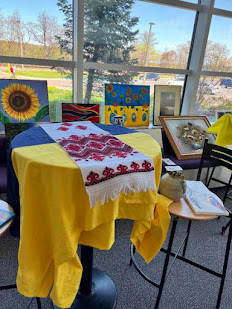
It might be partly because most of the cars crawling along in the bumper-to-bumper line were either smiling, honking, waving, or holding their "thumbs up" out of their vehicle windows toward the sign-holders, indicating solidarity, or at least approval for the "Shut Down Line 5" message.

Although the sign-holders indicated they weren’t interested in entering the building to eat Enbridge’s barbecue, June Thaden of Traverse City, who is a member of Northern Michigan Environmental Action Council (NMEAC) and has been working with the Oil and Water Don’t Mix campaign, was eager to share some good news. The big news on the sign-carrying line was that Mackinac Island’s mayor, Margaret Dowd, as well as Dan Musser, the owner of Mackinac Island’s Grand Hotel, are calling for the pipeline to be shut down -- and the Detroit Free Press that very day had published Musser’s Op Ed.**

They were also smiling because President Obama had just signed a bill to reauthorize pipeline safety measures and, inspired by concerns over Pipeline 5, to extend special safety provisions for pipelines in the Great Lakes.***

Miriam Owsley of the Groundwork Center for Resilient Communities (formerly Michigan Land Use Institute) displays her sign in Traverse City. "Instead of spending billions of dollars on cleanup, why not stop imposing giant risk on people who depend on the Great Lakes?" she asked.
But why would Enbridge hold a barbecue?

Becky Haase, Enbridge’s Senior Public Relations advisor, said that Enbridge brought in about 30 employees and subcontractors to staff the event, which was arranged like an expo -- equipment on display outside, a cafeteria-style serving line and booths lining the inside of Hemming Hall, a small community event venue.

Visitors meet with Enbridge representatives inside Hemming Hall in Traverse City.

The goal of the event was to clear up what Haase called false beliefs.

"There’s been a lot of misinformation circulating about Enbridge Line 5 and how we do business," she said. "We want to share our practices with the communities near the pipeline." 

Becky Haase, Enbridge’s Senior Public Relations advisor.

What kind of misinformation?

According to Haase, people are saying the 60-year-old pipeline needs to be replaced because of its age.

"Not true!" Haase said, adding that people believe "because we had a spill in Marshall, this pipeline is ready to burst!"

If she is in the business of correcting that kind of cause and effect error, then I am very glad she is doing her work. But I’ve been talking lately with a lot of concerned people lately, and I had not heard logic that simplistic. It might be more accurate to say this: Although the state of Michigan granted the easement for the pipeline in 1953, most people didn’t pay attention to it until July 2010 when Enbridge’s Pipeline 6B broke open; and, because of a combination of structural problems and human error, it spilled more than a million gallons of crude oil into the Kalamazoo River near the town of Marshall, Mich. This spill is known as the largest inland oil spill in U.S. history. People don’t want to see another one.

Sam Getsinger, who is running for commissioner of Leelanau County, said, "We’re all on the damn planet. We need a planet to support our children. When I say that we should shut down the damn pipeline, they say 'we get it.' We get it but are they going to do it? Hell no." Her sign says, "There are alternatives to oil and gas. There is no alternative to water."

Barry Lishawa of Traverse City put it this way: "The environmental risk is unacceptable here where we have 20 percent of the world’s fresh water. Line 6B was 15 years younger; they replaced it only after it burst. We need to be proactive, not reactive."

I also heard attendees refer to a variety of details that have held up, including specifics from the 1953 easement, the amount of insurance Enbridge has, the number of manufacturing defects in the thickness of pipeline 5, the structural wear and tear that has taken place according to published photographs of the National Wildlife Federation’s 2013 inspection, and the University of Michigan research that uses knowledge of currents and other lake attributes to predict the range of a potential spill.****

Attendees pushing for the pipe to be shut down also had figures -- which I verified through the Chicago Tribune and elsewhere -- about Enbridge spills in North America, a total of 44,475 barrels over a decade. The Tribune also cited property damage valued at $928 million.

Haase, however, wasn’t able to give me the kinds of numbers I asked for. Neither could any of the other Enbridge representatives or their subcontractors I met with at the event. But she did tell me this: All releases over five gallons need to be reported (releases under that amount do not), the pipeline safety record is similar to the commercial airline industry, the pipelines are as good as new, and Enbridge has made a huge investment in safety equipment -- in part to let anyone else who has a spill use it.

This is interesting -- that the equipment would be used by someone else. Does anyone other than Enbridge move oil in the area? She didn’t know.

Stephen Lloyd, Enbridge Emergency Response manager, said, "In the unlikely event of a spill we have the best technology possible to attack the oil."

Stephen Lloyd, Enbridge Emergency Response manager, left, chats with Barry and Linda Lishawa of Traverse City.

The company has just spent $7 million on equipment, which includes eight current busters. The first two arctic brushes in the world are going to be at the straits.

The Current Buster is one of the technologies Enbridge is investing in to scoop up spilled oil.

This polypropylene brush looks like the one I have in my garage. The brushes spin around and scoop up spilled oil.

"Leave it better than you found it," is the motto, Lloyd said.

Is that possible? What about possible wildlife deaths?

"That’s remediation, and that’s a different thing -- not what we do," he replied.

Better than you found it?

"We’ve been getting good feedback from people," Haase said. "They leave commenting, 'This is not necessarily what my neighbors are saying.'"

I think I can see why.

Some attendees represented NMEAC, the Groundwork Center for Resilient Communities (formerly Michigan Land Use Institute), the Michigan Environmental Council, and Occupy Traverse City. Others were there as citizens without a formal affiliation. They did not seem misinformed; rather, their perspective was different than Enbridge’s.

David Warren of Occupy Traverse City said his group, which meets every Saturday, takes on economic, environmental and social issues, including Line 5.

"I’m just a diehard activist for the long haul," Warren said.

David Warren, an activist member of Occupy Traverse City, attended the Enbridge barbecue.

Like many of the approximately 50 guests, Bill Hansen, a member of the Northern Michigan Environmental Action Council (NMEAC), said he was there to participate as someone who has researched the pipeline issue and knows what is going on.

Bill Hansen, a member of the Northern Michigan Environmental Action Council (NMEAC), brought his expertise on pipelines to the meeting.

"It is a democracy; it is our chance to be listened to," Hansen said.

Trent Wetmore, Enbridge director of operations, said he was happy to engage in conversations with people who understand how pipelines work.

"We can take it to the next level," he said. "They leave feeling positive and people provide different perspectives."

But might Enbridge use those perspectives in their planning, I asked. Wetmore looked confused.

I, too, was flabbergasted by my own reaction to the equipment investment -- so different from what was intended. Seeing this stuff makes an eventual spill seem more like a reality, even though the technology is designed to calm our fears. The Enbridge folks delivering these messages seemed like genuinely nice people who believed in what they were doing, but they frightened me with their lack of big picture understanding.

Mark Ploen, environmental division vice president for Qualitech, an environmental cleanup company, said he provided a gap analysis for Enbridge in September 2015.

"They were lacking in open water and ice responses," Ploen noted. "They didn’t have any offshore. They were operating legally, but needed to do better."

Mark Ploen, environmental division vice president for Qualitech, an environmental cleanup company, said he provided a gap analysis for Enbridge last September.

A day later I was still trying to understand the evening -- what seemed like a visit to an alternate universe. I called Oil and Water Don’t Mix and reached Bill Latka, who told me he was at the event for a few minutes.

In that short time he got it: "They’re just doing their jobs," he said. "They don’t want an oil spill either. But there is a difference between not wanting a spill and not having a spill. What they don’t understand is that a leak is not acceptable. And the only way to prevent a leak is to not have oil there. Their job as a corporation is to make money. Our job is to protect what is priceless."

Notes:

* Guest author Diane Miller is a former Keweenaw resident and former Finlandia University communication professor. She now teaches at a community college downstate.

** Click here to read Dan Musser's Op Ed.

*** See the June 22, 2016, Detroit Free Press article, "President Obama signs bill with Great Lakes pipeline protections." 

**** Click here to see a computer simulation that demonstrates what could happen if there were an oil spill at the Mackinac Straits.

Sunday, July 03, 2016

Letter: The Keweenaw as Shangri-la

Peaceful, scenic view of Lake Superior from Esrey Park, near Copper Harbor in Keweenaw County. (Keweenaw Now file photos unless otherwise indicated.)

While you’re out digging snow six months a year you may not feel how blessed you are to live on the Keweenaw Peninsula.

When you’re having trouble finding a job you may wonder why you live there. 

When you want to see great theater, visit art museums, eat in Indian or Thai restaurants --  take a trip. 

But who needs restaurants when those potluck dinners people have on the Keweenaw offer great food. Companionship. Fun! Do you realize nobody in the rest of the country gets together regularly anymore for potlucks?

As someone in Florida who’s lived many places both in the U.S. and Europe, followed by four recent years on the Keweenaw, I’m telling you: You are living in Shangri-la. (Shangri-la = A distant and secluded hideaway, usually of great beauty and peacefulness.) Great beauty and peacefulness, that’s it!

Reason Number One to be grateful you’re living there: The stars!

Just read a report that 80 percent of Americans cannot see the Milky Way. Light pollution from cities. Even on the Keweenaw in the places where there are lights you don’t see enough stars. On Route 26 in Lake Linden I didn’t see many.

But when I got to move up the hill to a woods in Calumet I went out in the back yard one clear September night and -- Voilà, the universe! My God!!!! The sky was so thick with stars it looked fake, like a stage set. I had to laugh out loud.

View of Northern Lights in the Keweenaw by photographer Steve Brimm. Click on photo for larger version. (Photo © and courtesy Steve Brimm)

"A miracle."  

That’s how people who looked up felt for thousands of years, before electric lights started preventing people from seeing beyond our planet.

I’m begging you who still get to live there: please, please protect the view of the stars you’ve got now. Please don’t install more lights. Don’t build many new buildings, lighted roads or parking lots.

Reason Number Two to be grateful: The silence.

If you don’t appreciate your lack of traffic and airplane noise in itself,  you might think about its rarity in the year 2016. I’ve read Finland is making money from "silence tourism," promoting silence and nature to urbanites from all over the world who are starving for it.

The main disturbers of your Keweenaw silence are snowmobiles and four wheelers or whatever they’re called. Could that noise be deadened somehow? To a silence lover it’s pretty jarring and horrendous.

Reason Number Three for gratitude: The Wildflowers.

Daisies grow wild in the Keweenaw.

When I first moved up the hill to Calumet -- actually already the summer before I moved -- I was so happy to again live in a house with a yard that I immediately began planting flowers. Red roses and purple pansies by the back door. Along the walkway between house and garage a long row of perennials. Delphinium. Lilies. Hydrangeas. 

Long line of gorgeous perennials I bought either at that wonderful nursery in Lake Linden or occasionally from that one in Houghton. I spent many, many hours digging, watering, thinking where to put what. Oh, to see my flowers this summer!

But! After doing all that gardening one day I changed my mind: "I wish I’d planted only wild flowers."

Forget-me-nots! My favorite flower in the world maybe -- growing everywhere. For freeeee!  Having paid six dollars for each small plant I had put in my yard in South Hadley, Massachusetts, I just could not believe your forget-me-nots.

Are you appreciating forget-me-nots? And lupines? Your wild pink roses along the roadsides. Daisies. Lilacs. (Okay, somebody planted the first lilacs. But they’re wild now.)

"Wild" lilacs.

If 80 percent of Americans don’t see the Milky Way, I’d bet 90 percent don’t see wildflowers.

In Massachusetts there are highways with wildflower swaths the state spends thousands of dollars each year to plant and maintain. But free, volunteer plants that spring up on their own? Doesn’t happen anymore.

I lived for 40 years in New England, which I thought the best place in this country until I met the Keweenaw. There are lovely winding roads around farms and villages in Massachusetts, Vermont, New Hampshire, Maine and Connecticut. But wildflowers in the profusion they grow on the Keweenaw? Nothing like.

Believe me, your views of stars, your silence and your wildflowers will be gone soon if you don’t make a conscious decision to keep the wildness as it is. With global warming more people will be coming and building houses. The Keweenaw will look the same as every place else.

Reason Number Four: So many trees!

Please, please stop taking them for granted.

Reason Number Five: The miles of free beaches along Lake Superior.

Beach at the Bete Grise Preserve, known for its "singing sand." 

Do you know what you’d have to pay to go to a beach on Cape Cod, Massachusetts, or here in Florida? You’d pay for parking at the very least, if you could even find a parking space -- big if. You’d pay in stress from driving on busy highways on your way there. You’d pay the price of loud music blasting all around you when you finally get to the beach covered with bodies.

Reason Number Six:  Free paths and walkways through nature.

Chances are there’s a path through the woods walking distance from where you live. Good Lord! Never existed any place I’ve ever lived in my life. Usually to get to a woodsy path in a state or national park in the U.S.A. first you drive on 8-lane highways.

Reason Number Seven: Music and dancing.

There are astoundingly many excellent musicians performing all around you every weekend. Anywhere else in this country you’d pay big bucks for high quality live music.

I know. This is a cultural thing, not wildness. But the culture of inexpensive or free music and dancing, along with the potlucks, is even rarer in this country than your stars, silence and wildflowers. 

Please take your children dancing! The fun they’ll have, the skills they’ll develop, the memories. They’ll do it all their lives and continue with their own children. Besides unconditional love and healthy food there’s nothing you could give your children more valuable than music and dancing.

Please join FOLK (Friends of the Land of Keweenaw), Save the Wild U.P., the Keweenaw Land Trust -- and be active in promoting preservation of the Shangri-la you get to live in.

If you don’t make every effort to preserve it now the Keweenaw will be lost to new mining, possibly even a radioactive waste dump, new military operations -- or simply to "development."

Please be so progressive as to be conservative. 

All the best, from someone who’s lost your paradise.


Mary Jane Williams
Winter Springs, Florida