See our right-hand column for announcements and news briefs. Scroll down the right-hand column to access the Archives -- links to articles posted in the main column since 2007. See details about our site, including a way to comment, in the yellow text above the Archives.

Monday, February 13, 2023

Sew Cranky's "Snowflake Challenge" for all ages continues through Feb. 14

By Michele Bourdieu

Mike Sabo of Sew Cranky offers Jethro Loosemore, 8, advice on using a hand-crank sewing machine to create a snowflake for the "Snowflake Challenge," a drop-in project for all ages at the Hancock shop, which has welcomed contestants since Dec. 1, 2022, to enter an original snowflake design. The event contines through Tuesday, Feb. 14. Also pictured, from right, are Maureen Loosemore, assisting son Jacob, and Kaitlyn Loosemore. Prizes will be announced on Monday, Feb. 20th. Click on photos for larger versions. (Photos by Keweenaw Now)

HANCOCK -- Ginger Alberti and her husband, Mike Sabo, of Hancock have been busy this winter helping visitors to their Hancock craft shop, Sew Cranky, with creative projects using their antique hand-crank sewing machines. Keweenaw Now visited the shop on Feb. 4 to capture these photos of the Loosemore family of Hancock participating in the current "Snowflake Challenge" -- their first experience using "cranky" sewing machines -- and Julie Beck  of Chassell, a regular customer at the shop, who was working on her own project.

Ginger Alberti helps the Loosemore family of Hancock get started on their snowflakes. Maureen Loosemore is a seamstress herself, accustomed to electric machines, but she welcomed the opportunity to try the hand-crank machines with her children.

Kaitlyn Loosemore, 10, works on her snowflake using one of the hand-crank sewing machines in the Sew Cranky shop.

Kaitlyn Loosemore worked steadily on her snowflake and made a second one with two different colors when not completely satisfied with her first effort.

"It was hard, but it was fun to do," Kaitlyn said. "An electric sewing machine does it for you, but with these antique ones you have control over where it's going. And I really liked cranking it!"

Kaitlyn Loosemore proudly displays her final snowflake creation. In the background, her Dad, John Loosemore, with Maureen, inspects some of the machines on display in the shop.

Maureen Loosemore helps five-year-old Jacob with his snowflake.

Maureen Loosemore, who uses an electric sewing machine at home, noted the hand-crank machines, although they are rather expensive antiques, would save on electricity. 

"I want one!" she said.

Jacob and Jethro display their completed snowflakes for the contest. Ginger irons each entry and puts the name of its creator on the back.

The "Snowflake Challenge" entries are displayed on a wall of the shop. Judging will be Monday, Feb. 20. Prizes will be awarded for most "intricate and realistic" and most "creative and original." All entries have a chance at two random prizes as well.

Today and tomorrow, Feb. 13 and 14, are the last days to work on a snowflake for the "Snowflake Challenge" -- between 1 p.m. and 6 p.m.

"We have 66 snowflakes so far," Ginger said. "No experience necessary!"

Ginger explained the word "Challenge" is used rather than "competition" because the project is a personal challenge to try something new.

At another table in the shop, Julie Beck of Chassell tests one of the machines with a piece of fabric, welcoming comments from Ginger.

Julie Beck of Chassell told Keweenaw Now she has been coming to the Sew Cranky shop for several years and has worked on several different projects.

"Shortly after Ginger opened, I came here to sew," Julie said. "I sew at home but I like learning here and Ginger is such an excellent teacher. She's very tolerant when you make mistakes. Her patience doesn't get any less."

Julie Beck pointed out some "fussy cut" placemats she made in the shop, displayed in the middle row on this wall.


Julie Beck is proud of her grandson, Logan, who recently finished making the colorful hobby horse he is displaying here.

Mike Sabo noted the Sew Cranky shop offers opportunities to create a variety of craft objects.

"We have other projects going on," Mike noted. "People can make fish, pin cushions, shopping bags and even a Victorian pocket."

Mike Sabo displays a Victorian pocket, a vintage item from the days when clothing did not include pockets and women attached one of these under their skirts.

Visitors who prefer not to sew can explore a wealth of interesting items in the shop, many that are handmade by Ginger for sale. The antique hand-crank sewing machines are also for sale.

Sew Cranky is at 322 Quincy Street in Hancock. Hours are 1 p.m. to 6 p.m. Monday through Saturday. Closed on Sunday. Visit Sew Cranky on Facebook for more info, photos and videos.

Friday, February 10, 2023

A Golden Ticket to First Place: Phi Kappa Tau’s Chocolate Factory Wins Snow Statue Contest

By Cyndi Perkins, Michigan Tech Marketing and Communications

For the fifth year in a row, Hancock-based Phi Kappa Tau wins first place in the Michigan Tech Winter Carnival overall monthlong statue competition with their snowy creation of "Charlie and the Chocolate Factory." (Photo courtesy Michigan Tech University)

The snozzberries taste like victory for Phi Kappa Tau. The Hancock-based Greek organization extended its winning streak in Michigan Tech’s Winter Carnival overall monthlong statue competition to five years in a row with the Willy Wonka-themed "Charlie and the Chocolate Factory."

The suspense was terrible -- but unlike Wonka’s sardonic wish in the classic movie, it didn’t last, as Blue Key National Honor Society announced the 2023 snow statue winners in the afternoon on Thursday, Feb. 9. Teams in monthlong and one-night categories created statues based on the overall Carnival theme "Tasty Foods for Wintry Moods." Within each category there are three divisions: co-ed, women’s and men’s. In both monthlong and one-night competition, the overall statue winner is determined by the top scores in each of the three divisions. ...

To read about the other winners see the rest of this article on Michigan Tech News.

Tuesday, February 07, 2023

UPDATED: Guest article: A Tale of two COPS: Indigenous Communities, Biodiversity and Climate Change

By Aritra Chakrabarty*

Members of Indigenous communities demonstrate in Montreal, Canada, during the December 2022 United Nations Convention on Biological Diversity (CBD) conference. Click on photos for larger versions. (Photo © and courtesy Rebecca Kemble**)

[Editor's Note: UPDATE: The following text has been edited slightly since publication to clarify some quoted comments.]

Any environmentalist or conservationist or any person of logic would agree that biodiversity is an integral part of climate change. Biodiversity loss, its mitigation and adaptation are linked to adaptation and mitigation strategies for climate change. We cannot tackle biodiversity loss without tackling climate change nor can we address climate change without addressing biodiversity loss. This is why COP 15, the United Nations Convention on Biological Diversity (CBD) conference, held last December in Montreal, is important relative to COP 27, the United Nations Framework Convention on Climate Change (UNFCCC) conference, held last November in Egypt.

Indigenous communities are at the forefront -- they face the impacts of climate change and biodiversity loss first and most. They are the frontline communities who are becoming the voice of protest against the misrecognition of their contribution and the discrediting of their knowledge as non-science. Indigenous groups were present and outspoken at both of these global conventions.

Indigenous peoples’ knowledge and their approach in safeguarding ecosystems is increasingly recognized at the international level, including COP 27 and the recently concluded COP 15. The voices of Indigenous people, with their wealth of local knowledge acquired and preserved over centuries, were present during COP 27 in the form of protest against neglect of Indigenous knowledge and in COP 15 as the main voice championing change. Their participation in policy, debate and a broader agenda setting has been recognized only in recent years. It was only as recent as in the 23rd UNFCCC COP (2018) that Local Communities and Indigenous peoples were operationalized as an entity that would engage with other stakeholders through their valuable knowledge in the fight against climate change and its impacts. 

Canadian President Justin Trudeau delivers remarks at the opening session of COP 15 on the global biodiversity crisis and the steps taken by Canada to meet its goal of conserving 30 percent of Canada’s land and water by 2030. (Photo Courtesy Flickr. Creative Commons attribution.)

It all started in 1988 when the United Nations Environment Program (UNEP) convened an Ad Hoc Working Group on Biological Diversity to explore the need for an international convention on biological diversity, resulting in the formation of the Ad Hoc Working Group of Technical and Legal experts in May 1989. The group was tasked with the preparation of an international legal instrument for the conservation and sustainable use of biological diversity (Scott 2014).

The Convention on Biological Diversity (CBD) came into force in 1992 during the Earth Summit at Rio de Janeiro, Brazil, and entered into force at the end of 1993. The recognition of Indigenous peoples and their contribution to biological diversity protection was recognized in 1998 when Article 8(j) was enshrined into the preamble of the CBD. In 2000, the COP adopted a programme of work to implement the commitments of Article 8(j) of the Convention in order to enhance the role and involvement of Indigenous peoples and local communities.

CBD is one of the many multilateral agreements/frameworks that have been constituted in the short history of environmentalism and climate change adaptation and mitigation. The need for such multilateral agreements has arisen for two reasons. First, the problem sets are unique and affect different geographies disproportionately. Second, and more importantly, the parties (a misnomer that includes nations and territories who often are in conflict with each other) cannot agree on a democratic set of rules and regulations despite being "parties." Given the amount of resources exhausted over years of such meetings across various cities, they should ideally be referred to as Herd of Detractors (HoD).

CBD was one of the three conventions adopted at the Rio Summit (1992) held in Brazil. The other two landmark conventions were the UN Framework Convention on Climate Change (UNFCC) and the Convention to Combat Desertification (UNCCD). COP 15 (2022) was important because the Parties were to review the Strategic Biodiversity Plan (2011-2020) including the Aichi targets that were set in the 10th meeting of COP to the CBD in Japan in 2010. The Aichi Biodiversity targets were meant to tackle biodiversity losses -- a goal which is very much linked to the Paris agreement target of limiting global temperature to 1.50C. However, there is a disconnect between the biodiversity targets and the climate change targets, both of which have been ratified by the same member Parties (with some exceptions). Nonetheless, given the failure to achieve the Aichi targets, this COP 15 was crucial to finalize and adopt the Global Biodiversity Framework (GBF), which aims to address biodiversity loss, restore ecosystems and protect Indigenous rights and which would subsume previous Strategic Plans. 

I spoke to Carley Dove-McFalls, a fierce climate justice activist and a McGill University alumna who participated in COP15 last December. Carley participated in a panel discussion along with representatives of the Bad River Band of Lake Superior Chippewa, the Anishinaabek Nation and other Great Lakes Indigenous water protectors on the issue of protecting the Great Lakes from the threat of Line 5, a 645-mile long oil pipeline that carries petroleum from western Canada to eastern Canada.

"I’m sceptical about the efficacy of both COP 15 and COP 27," Dove-McFalls said. "The bureaucracy and the scale of these meetings are simply not conducive to the changes that we need, as much proof has shown. It also seems quite ridiculous that there is such a stark division between the conferences on biodiversity and climate change as they cannot be dissociated. In general, these conferences simply reproduce the broken and violent (political, social, economic) systems that we operate in because the decision-makers are corrupt and generally prioritize lining their country’s pockets (on the short-term). These conferences are therefore not 'radical' enough to do anything."

Despite the efforts of Indigenous activists and water protectors at COP15, people in power only paid lip service to reconciling environmental injustice faced by Indigenous people with forward looking measures. The Indigenous community is incredibly frustrated because of the utter lack of clear and efficient changes needed.

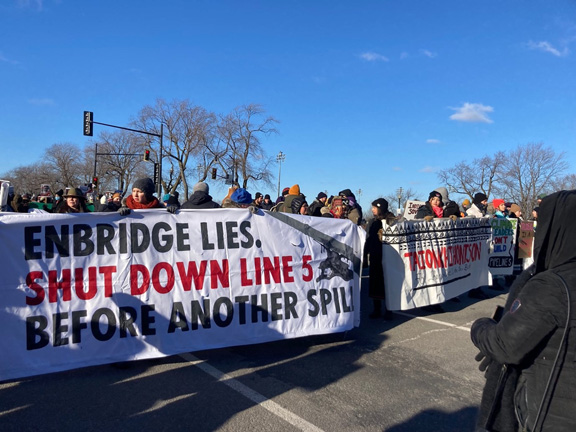
During COP 15 in Montreal, Indigenous communities protest against Enbridge, the company owning Line 5. (Photo © and courtesy Rebecca Kemble**)

Many Indigenous communities were present at COP 15 to protest against Enbridge and their complete neglect of wildlife and environmental regulations. Constructed in 1953, Line 5 carries 23 million gallons of oil daily underneath Lake Michigan and Lake Huron, which meet at the Straits of Mackinac. Since 1968 there have been at least 33 oil spills from the Line 5 pipelines that have severely damaged the flora and fauna around that area. According to research by the University of Michigan, any more oil spills now would threaten 700 miles of shoreline with contamination. This would affect the Great Lakes and the entire ecosystem supported by it. Just one example of a species whose habitat is threatened by a potential oil spill is the Piping plover -- an endangered species of shorebird found along the shorelines of the Great Lakes.

The experience of Indigenous communities who were present at COP 15 and at COP 27 brings out the disconnect between biodiversity targets and climate change targets. COP 27 and COP 15 do not speak to each other -- neither in terms of the output produced, nor through the spokespersons who represent the Parties at the two conferences.

Pipeline protest banner in Montreal. Indigenous water protectors have also been opposing Enbridge’s Line 3 for several years, and some have been arrested by law enforcement paid by Enbridge, including Honor the Earth leader Winona LaDuke. (Photo © and courtesy Rebecca Kemble**)

According to the Millennium Ecosystem Assessment, climate change will be the most significant driver of biodiversity loss by the end of the century. Climate change has already forced biodiversity to adapt either through shifting habitat, changing life cycles, or the development of new physical traits. Ecosystem based services that conserve natural terrestrial, freshwater and aquatic ecosystems are essential not only to meet the goals of the GBF, but also to meet the scientifically determined targets under UNFCCC. Understanding this phenomenon requires acknowledging Ecological Knowledge (EK), which includes Indigenous knowledge, as climate science -- and integrating that knowledge in policy making. However, little attention has been paid to the history of local knowledge present in Indigenous communities.

The use of EK has been slow and reductive in nature. The alternative pathway is to treat EK as a process, rather than as a source of information only. Accrediting the tribes and communities as environmental stewards and using their EK for climate change solutions is one important element  of integrating the knowledge of biodiversity and ecosystem services into an overall Climate Change Adaptation strategy in order to make that strategy cost-effective; capable of generating social, economic, and cultural co-benefits; and capable of contributing to the conservation of biodiversity.

Editor's Notes:

* Guest author Aritra Chakrabarty is a PhD Research Scholar in Environment and Energy Policy at Michigan Tech University.

** Thanks to Rebecca Kemble, journalist for the Wisconsin Citizens Media Cooperative (WCMC) for her photos of water protectors demonstrating at COP 15 in Montreal. CLICK HERE for her video, now on YouTube, with more photos. WCMC journalist and Keweenaw Now guest author Barbara With assisted with technical assembly of the video content.

Tuesday, January 31, 2023

Fighting to protect clean water from mining

By Kathleen Heideman*

Reprinted in part with permission from UP Environment, the Fall-Early Winter 2022 Newsletter of the Upper Peninsula Environmental Coalition (UPEC)

At the July 23, 2022, Water Celebration -- hosted by the Coalition to SAVE the Menominee River at Stephenson Island, Marinette, Wis. -- Kathleen Heideman of UPEC's Mining Action Group speaks about past struggles to stop sulfide mining and offers a challenge for the future. The following article is an excerpt from her talk at that event, adapted and published in UPEC's Fall-Early Winter 2022 Newsletter. (Photo © and courtesy Karen Slattery)**

Saving the Wild UP

I’d like us to reflect on the grassroots opposition to Eagle Mine, Michigan’s first metallic sulfide mine. Although we could not stop the project, environmental vigilance continues. Eagle Mine, targeting a nickel-copper orebody underneath the Salmon Trout River, was initially owned by Rio Tinto’s Kennecott Minerals, and later sold to Lundin Mining. Eagle Mine was fought for two decades, even as Michigan’s Sulfide Mining regulations were being written.

The formerly rustic Triple A road across the Yellow Dog Plains is now plowed to facilitate resource extraction, including year-round access to Eagle Mine, Eagle East, Eagle's ventilation infrastructure, trucks hauling sand and gravel for the mine's backfill (cementation), and exploration activities. (Photo © 2022 and courtesy Kathleen Heideman) 

A scrappy nonprofit called Save the Wild UP formed along the way, to educate the public about the dangers of sulfide mining; they later merged with the Upper Peninsula Environmental Coalition to form the Mining Action Group.
Community resistance has included public education, media outreach, peaceful demonstration, occupation of a sacred site at the proposed mine, and litigation by a diverse coalition of the Keweenaw Bay Indian Community, Yellow Dog Watershed Preserve, National Wildlife Federation, and the Huron Mountain Club landowners.

Eagle Mine's 'Main Vent Air Raise' (MVAR or vent stack) is the source of unfiltered air pollution. Eagle Mine’s air quality permit included the following emission limits: Particulate Matter (PM) at 232 pounds per day; Nickel at 0.21 pounds per day; Copper at 0.18 pounds per day. It is not possible to verify Eagle Mine's actual air pollution, as emissions are self-monitored. (Photo © 2022 and courtesy Kathleen Heideman)

Eagle Mine is being called a "successful nickel mine" by those who are promoting metallic sulfide mining, but in fact it is a cautionary tale:

  • Eagle Mine morphed from an eagle into a spider, blasting miles of underground tunnels to connect to a different orebody that lies beyond the boundary of the permitted mine facility, and 2,000 feet deeper than the original orebody.
  • Eagle Mine claimed their treated wastewater would be "cleaner than rainwater" and pose no threat to the aquifer -- but the mine’s septic system has leaked, and bottled drinking water is trucked to the mine site for their employees.
  • According to the State of Michigan, Eagle Mine’s wastewater treatment plant has accumulated more than 70 permit violations since operations began; the wastewater treatment plant at their mill has racked up more than 50 permit violations.
  • Eagle Mine is currently operating with a groundwater discharge permit that expired three years ago.
  • There is no filter on the mine’s vent stack (MVAR), which exhausts tons of particulate matter (including sulfides and heavy metals) into the air over the Yellow Dog Plains. In 2020 public comments to EGLE, the Mining Action Group stated, "The MVAR emissions release sulfides and numerous toxic metals to the surrounding environment, including headwaters of the Salmon Trout and Yellow Dog Rivers. Only one stack test was completed, in the fall of 2014 -- prior to the mine's full operation. While Eagle Mine self-monitors the opacity of these emissions, the MVAR remains unfiltered, and the real emissions (Particulate Matter and constituents) are unquantified. The operation's potential to emit has changed significantly since the PTI (Permit To Install) was issued in 2014, due to the addition of the Eagle East orebody, and extensive new underground development. Modeling is insufficient. We urgently request that a stack test be performed on the Eagle's MVAR, during a period of full operation in both orebodies, in order to accurately capture particulate matter as well as geochemical analysis of emissions."
  • Accidental "environmental releases" and worker injuries are increasing.
  • The Humboldt Mill’s tailings disposal "facility" -- merely a deep pit lake -- is rapidly filling with toxic mine waste.
This aerial photograph shows the Humboldt Mill Wastewater Treatment Plant (near Champion, Mich.) and the north end of the Humboldt Pit Lake, referred to as the "Humboldt Tailings Disposal Facility" (HTDF). (2017 Keweenaw Now file photo © and courtesy Jeremiah Eagle Eye)

  • Salts and dissolved solids have increased exponentially as deeper ore is mined, requiring expensive reverse-osmosis treatment.
  •  Permits were changed to allow Eagle Mine to lower water quality in the Middle Branch of the Escanaba River by pumping wastewater directly into the river.
  • Environmentalists are not impressed by Eagle Mine, and insist that Michigan’s first sulfide mine should also be Michigan’s last sulfide mine.

    Fighting to Protect the Menominee River

    Looking back, let us also applaud the work of our friends and trail-blazers, Ron and Carol Henriksen, who banded together with neighbors and concerned citizens to form the "FRONT FORTY" environmental group in 2003. From the beginning, their mission was to protect the Menominee River from the hazards of sulfide mining -- specifically the Back Forty Mine proposed by Aquila Resources, now owned by Gold Resource Corporation.

    Wherever you drive in this area, you’ll see signs, saying "Don’t Undermine the Menominee" and "Save Our Water -- Stop the Mine!"

    Signs near the Menominee River call attention to the threat from the Back 40 mining project. (Photo courtesy Coalition to SAVE the Menominee River)

    The Back Forty Mine aims to extract gold, zinc, silver, and copper (as well as lead) from an enormous open pit mine on the bank of the Menominee river. Members of the Front Forty worked tirelessly to educate the public about the dangers of sulfide mining pollution, and risks to the Menominee River. As I understand it, information was spread one fish-fry at a time! At the same time, the Menominee Indian Tribe of Wisconsin was working to identify and protect culturally important sites along the Menominee River in an area previously occupied by the Menominee people, with ancient garden beds and burial mounds. Grassroots resistance to the Back Forty project spilled over into Wisconsin, spreading along the Menominee River, and culminating in the formation of the Coalition to SAVE the Menominee River. Both the Menominee Tribe and the Coalition have pursued litigation, with success.

    Menominee Tribal member Wayne Swett photographed this early morning, peaceful scenic view of the Menominee River just before the Day 2 canoe launch (July 1, 2022) during the 4th Annual Menominee Canoe Trip to call attention to the threats of the Back 40 mine. (File photo © and courtesy Wayne Swett)

    Mining lobbyists claim "Our Western Civilization Depends on Mining." Aquila representatives, interviewed about the Back Forty Project, warned that we need mining in the UP or "we wouldn’t have cars -- we wouldn’t have anything."

    They claim mining in the UP is essential, ethical, that it is clean and safe and modern -- they claim that metallic sulfide mines can produce wastewater cleaner than river water! But contrary to these assurances, there is no safe sulfide mine, and no metallic sulfide mine has operated without polluting water. When tailings and waste rock are left on-site, as in the Back Forty mine proposal, acid mine drainage threatens to contaminate freshwater resources in perpetuity.

    Enough Is As Good As a Feast

    So how do we protect our water from mining? There is an external effort to educate ourselves, to participate and resist, but there is also a private, internal fight -- we must work to curb our own consumption.

    Everyone is familiar with the phrase "Less is More," which can be traced back to the 1850s. It echoes a far more ancient phrase, "Enough is as Good as a Feast." Not all-you-can eat, but enough. Enough to sustain life -- enough clean water, enough clean air, enough healthy food, enough wild, undeveloped land to support healthy ecosystems. "Less is more" has become popular as we seek to clear space in our cluttered minds and garages. "Less is more" becomes poignant if we try to picture our ancestors, or those who were living in the Upper Peninsula in the 1800s, making do with a kettle, a frying pan, a knife, an axe, a canoe, fishhooks, needles and thread. What would they think of us and our heaps of gadgets, our degraded lands and polluted rivers, our overflowing closets and basements and garages stuffed full of the surplus "stuff" we don’t really need but can’t seem to get rid of?

    It won’t be easy to change. We’ll need to think long and hard before buying more digital gadgets -- doorbell cameras, Alexas, garden lights, dusk-til-dawn lights, trail cams, web cams, go-pro cameras, video drones, gaming consoles, cell phones, laptops, flat-screen TVs, even hybrid and electric vehicles. Each high-tech device is full of promises, and metal; few of the metal components can be easily separated or fully recycled. Our magical, must-have modern conveniences contain copper, nickel, manganese, cobalt, platinum, palladium, zinc, lead, graphite, lithium, and rare earth elements. And since most of these metals can be found in the Upper Peninsula of Michigan, mining companies will continue to target our wild lands in search of new metallic deposits. Unless we change ourselves, and work to change the culture, environmental threats will radically increase in the coming years.

    No Green Nickel and No Simple Solutions

    In 2018, the Federal government published a long list of the "Critical and Strategic Minerals" deemed essential to our economy and national security. The list was expanded in 2022, and now includes both nickel and zinc. Michigan’s State Geologist is working with academic researchers, scouring historic mining documents and drill cores from the 1800s, looking for mine sites where these "critical metals" may have been overlooked by miners in past centuries. Changes urged by the mining industry, at the same time, include:
    • STREAMLINING the mine permitting process;
    • NATIONAL STOCKPILING of critical minerals;
    • IMPROVING the mining industry’s "environmental image"; and
    • HIGHLIGHTING "how mining contributes to a CLEAN ENERGY FUTURE."

    Hoarding stockpiles of critical metals, fast-tracking environmental permits and greenwashing the reputation of the mining industry? -- these are serious threats. And Michigan’s auto companies are already looking to create supply chain partnerships with individual mining companies, competing to secure a steady feed of "critical metals" as they ramp up production of electric vehicles. According to researcher Brian Roemmele, a typical electric vehicle (EV) battery contains:
    • 25 pounds of lithium
    • 60 pounds of nickel
    • 44 pounds of manganese
    • 30 pounds cobalt
    • 200 pounds of copper
    • 400 pounds of aluminum, steel, and plastic.

    The fabrication of a single EV battery requires extracting:
    • 25,000 pounds of brine to obtain lithium
    • 30,000 pounds of ore to obtain cobalt
    • 5,000 pounds of ore to obtain nickel
    • 25,000 pounds of ore to obtain copper.

    In sum, that means disturbing 500,000 pounds of the earth’s crust, including waste rock -- to produce a single EV battery!

    Obviously, there are no simple solutions, no single technology that can fix our old problems without creating new problems. We must scrutinize our own choices, and consciously resist the propaganda of the mining industry, which invents meaningless phrases like "Green Nickel" and "Sustainable Mining." Metallic mining is not sustainable. Metallic mining degrades our environment and contaminates water. There is no such thing as "green nickel" and all metals are non-renewable resources -- even when they are used to build "renewable energy" devices like electric vehicle batteries or wind turbines.

    Going forward, each of us must become a trail blazer, carrying on in the tradition of [those] who’ve guided us this far. For the sake of future generations -- of all species -- we must become stewards of Upper Michigan’s clean water and wild places, making difficult, cautious, well-informed decisions about non-renewable resources. This is the only way we can guarantee a future with more clean water, more Milky Way, more northern lights, more silence, more fish, more owls, more frogs, more wolves. Less mining -- and NO METALLIC SULFIDE MINING -- is the only way we can safeguard Lake Superior or the Menominee River, now and in the century to come.

    Editor's Notes:

    * Guest author Kathleen Heideman is a member of UPEC's Board of Directors and does research on mining impacts for the Mining Action Group (formerly Save the Wild UP and now part of UPEC).

    ** Click here to read this entire article, beginning on p. 5 in UP Environment, the Fall-Early Winter 2022 UPEC newsletter.

    See also our Sept. 8, 2022, article, "Coalition to SAVE the Menominee River holds Water Celebration featuring Native, non-Native speakers on Back 40 mining project," by Mark Doremus of Back 40 Film and Michele Bourdieu.

    Wednesday, January 25, 2023

    Heikinpäivä 2023: Enjoy Parade, Tori markets, Games, art, music, dance, more Saturday, Jan. 28

    The Heikinpäivä Parade will head down Quincy Street in Hancock at 11 a.m. on Saturday, Jan. 28, the final day of Heikinpäivä festivities. (Keweenaw Now file photo)

    Heikinpäivä 2023, the Finnish-American Mid-Winter Festival in Hancock, is underway. The main events, open to the public, will happen on Saturday, January 28, on Quincy Street in Hancock. The celebration’s themes are taken from a Finnish folk saying associated with the name day for Heikki (Henrik’s day, 19 January). See Saturday's schedule below:

    10 a.m. - 3 p.m. -- Tori markets, Finnish American Heritage Center and United Methodist Church.

    11 a.m. -- The Heikinpäivä Parade begins near La Cantina Mexican Restaurant on Quincy Street and heads toward the Finnish American Heritage Center. The Parade includes Finnish characters from the Kalevala (Finnish epic) along with St. Henrik and Heikki Lunta. Cash prizes will be awarded for entries.
    Karhunpeijäiset -- Join the costumed parade participants in a circle dance.

    Immediately following the Parade:  Outdoor Games (including vipukelkka (whip sled), kick sled races, Eukonkanto (Wife Carrying), etc. Quincy Green next to Finnish American Heritage Center.

    Kids enjoy riding the vipukelkka (whip sled) during Heikinpäivä. (Keweenaw Now file photo)

    Kids line up for kicksled races on Quincy Green. (Keweenaw Now file photo)

    Hannu and Lilli from Finland were winners in a previous Heikinpäivä Eukonkanto (Wife Carrying) contest. (Keweenaw Now file photo)

    Polar Bear Dive -- Has not been announced.

    1 p.m. -- Mark Munger, Duluth author: book talk and signing at North Wind Books, 601 Quincy Street.

    2 p.m. - 4 p.m. -- Animal Life: Art from the Kalevala -- Opening Reception. Traditional Finnish refreshments will be served. Copper Country Community Arts Center, 126 Quincy Street, Hancock. The Kalevala is a 19th century work of poetry compiled by Elias Lönnrot from Finnish and Karelian oral folklore and mythology. It is regarded as the national epic poem of Finland and is one of the significant works of Finnish literature. The annual open call exhibition asks artists to create artwork relating to the many animals that are part of the Finnish epic poem, as imagery and symbolism. The exhibition ends on Kalevala Day, Tuesday, February 28.

    7 p.m. - 10 p.m. --Iltamat (dance and buffet). Finnish American Heritage Center. $15. Music by Back Room Boys, featuring the accordion and Finnish vocals of Pasi Lautala. Family-friendly. Bring the kids, the old folks, and your dance slippers.

    Friday, January 20, 2023

    Yoopers for Ukraine welcome Ukrainian families, continue Walks for Ukraine on Sundays

    By Michele Bourdieu

    Yoopers for Ukraine welcome a new Ukrainian family to the Copper Country during the Jan. 8 Walk for Ukraine. Pictured here are Anna Polovets Hill (far left) of Chassell, who is hosting her nephew, Roman (center), his daughter Maria (second from left) and his partner, Larisa (third from left). Nadija Packauskas, Yoopers for Ukraine co-founder, and her Dad, Vytautas, are at right. (Photo courtesy Yoopers for Ukraine)

    HOUGHTON -- Undaunted by Copper Country snow and ice, Yoopers for Ukraine are continuing their weekly Walks for Ukraine across the Portage Lift Bridge on Sunday afternoons since Jan. 1, 2023. The Walks now begin on the Houghton side of the bridge at 3 p.m. on Sundays. Yoopers for Ukraine also welcome Ukrainian families to join their walks.

    The Jan. 15 Walk for Ukraine begins on the Houghton side of the Portage Lift Bridge. (Video by Keweenaw Now)

    Participants in the Jan. 15, Walk for Ukraine pause on the Hancock side of the Lift Bridge, displaying their flags and signs to oncoming traffic. (Photo courtesy Yoopers for Ukraine)

    One Ukrainian family, who have been here for six months, joined the Jan. 15 Walk: Angi Denesynko, her husband, Vitalii, and their two daughters, Riana and Alisa. They have participated in several events sponsored by Yoopers for Ukraine.

    The Denesynko family, from right -- Angi, her husband, Vitalii, and their daughters, Alisa and Riana -- display their signs and flags during the Jan. 15 Walk for Ukraine on the Portage Lift Bridge. (Photo © and courtesy Nadija Packauskas)

    Angi Denesynko spoke with Keweenaw Now about her concerns for her country and for her mother, who is still in Ukraine.

    During the Jan. 15, 2023, Walk for Ukraine from Houghton to Hancock, Angi Denesynko of Ukraine speaks about the war in her country one day after the tragic bombing of an apartment house in Dnipro, Ukraine, and her concern for her own family. (Video interview by Keweenaw Now)

    Yoopers for Ukraine to walk in Heikinpäivä Parade

    Following the Jan. 15 Walk, Nadija Packauskas announced that Finlandia has invited Yoopers for Ukraine to participate in the Heikinpäivä Parade on Saturday, Jan. 28. Supporters of Ukraine who wish to walk with them are invited to meet at 11 a.m. near La Cantina Restaurant, 101 E. Quincy Street, Hancock, where the parade begins.

    "We will have flags and signs!" Nadija said. "The public is welcome to help us in thanking Finlandia for their continued support! Finnish flags are welcome too!"

    January 8 Walk in sunshine

    On Jan. 8, 2023, sunshine warmed the walkers somewhat and Yoopers for Ukraine welcomed a new Ukrainian family, who recently arrived in Chassell, invited by Anna Polovets Hill (see photo above).

    Roman (center), nephew of Anna Polovets Hill of Chassell, is pictured here during the Jan. 8 Walk for Ukraine with his daughter Maria (left) and his partner, Larisa. (Photo © and courtesy Anna Polovets Hill)

    "We are happy to welcome the nephew of one of our members, Anna of Chassell," Nadija told Keweenaw Now. "Roman, his daughter Maria and his beloved girlfriend, Larisa, arrived in the Copper Country in December and are quite pleased with the kindness and beauty of the area. They hope to learn to ski soon! If anyone in the area wants to assist this family or any of our recently arrived familes feel free to email yoopersforukraine@gmail.com. One family is looking for an apartment or home to rent."

    January 6 visit with Ukrainian families in Marquette

    Nadija, her son, Robert, and her Dad, Vytautas, visited two Ukrainian families in Marquette for a Ukrainian Christmas celebration on January 6, 2023.

    "We had traditional Ukrainian treats and exchanged gifts for the kids," Nadija said.

    Yoopers for Ukraine co-founder Nadija Packauskas and her Dad, Vytautas, (center with flag) are pictured here with members of the Bilan and Liiamati Ukrainian families celebrating Ukrainian Christmas on Jan. 6, 2023. (Photo © and courtesy Karen Liiamati)

    Arkadii Bilan, 6, enjoys the snow in Marquette. He is proud to be Ukrainian. (Photo © and courtesy Yevhinia Bilan)

    Showing Nadija and her Dad a map of Ukraine that he brought with him from Ukraine, Arkadii tells them what is happening for the defense of Ukraine. (Photo © and courtesy Nadija Packauskas)

    January 1 Walk for Ukraine

    Yoopers for Ukraine began the New Year with a Sunday walk on Jan. 1.

    The wet, cold Jan. 1 weather did not discourage Yoopers for Ukraine from holding their Walk across the Portage Lift Bridge. (Photo courtesy Yoopers for Ukraine)

    Two visitors from Wausau, Wis. -- Margie, left, and Nancy -- joined the Jan. 1 Walk for Ukraine. (Photo courtesy Yoopers for Ukraine)

    Joey, a well known local resident, joins Nadija for the Jan. 1 Walk for Ukraine. (Photo courtesy Yoopers for Ukraine)

    How you can help

    As a spokesperson for Yoopers for Ukraine, Nadija Packauskas says there are several ways local residents can help Ukrainian refugees.

    "Every Ukrainian, whether in Ukraine or displaced around the world, only wants the same thing -- this war to end," Nadija told Keweenaw Now. "And the best way to help a refugee is to do all you can to help end it. Write, call, and talk to our legislators, your family and friends -- and support humanitarian efforts in Ukraine. This remains a stain on humanity and remains the most critical moment in our modern history. Wanna help refugees? Help Ukraine! Give them a home to go home to!"*

    * Editor's Note: To donate for aid to Ukraine, see the following:

    https://www.ukrainetrustchain.org/donate-yoopers

    https://sharedetroit.org/nonprofit/share-ukraine
    See their action for contacting Michigan elected officials:
    https://sharedetroit.org/events/help-ukraine-contacting-our-elected-officials

    https://ucareinc.org/  (Aid for Ukrainian children)

    Tuesday, January 17, 2023

    March Celebrating Reproductive Freedom to be Sunday, Jan. 22, in Houghton

    After a windy march across the Portage Lift Bridge and back, participants in the October 8, 2022, Women's March display their signs for women's rights and Proposal 3 on the Michigan ballot, which passed in the November mid-term election, restoring the rights of Michiganders to make their own private decisions about pregnancy and abortion. Next Sunday, Jan. 22, another March for Reproductive Freedom will be held in Houghton and across the U.S. (Keweenaw Now file photo)

    HOUGHTON -- Local residents are invited to join women and their friends in towns and cities around the country for a March Celebrating Reproductive Freedom on Sunday, January 22. In Houghton, participants will gather at 1 p.m. at Bridgeview Park and continue across the Lift Bridge to commemorate the 50th anniversary of Roe v. Wade. Supporters of Women's Reproductive Freedom wish to send a loud and clear message across the U.S. and in the local community that though the women’s wave delivered a blow to anti-freedom politicians in the 2022 midterms (protecting abortion access in Michigan, Kentucky, and Kansas), the work is not done.

    Women are still being told how to dress (Missouri Legislature), how not to talk to children ("Don’t say Gay"--Florida), or what should not be read (TX, FL, MI, …). We are ALL born free and equal in dignity and rights, irrespective of the state in which we live.

    The Women's March organizers and participants will harness the power of collective voices to let the Supreme Court and US Congress know that they have failed in their obligation to protect, respect, and uphold our human rights. The message of the march puts politicians at every level of government on notice: "If you come for our families, our freedoms, or our futures, we are coming for your seat. Our movement is strong. Our movement is growing. Our movement is Bigger than Roe," say organizers.

    Join marchers all across the US with your presence and signs to celebrate women's progress and fight to expand these rights. (Please no obscene signs.)

    For more information, contact Susan Burack at 906-482-3270 or ssburack@gmail.com, or Vicky Bergvall at v.bergvall.mt@gmail.com.

    Friday, January 13, 2023

    Michigan Tech to host MLK Celebration events Jan. 16

    Martin Luther King Jr. Day is Monday, Jan. 16. Michigan Tech will be hosting events to honor and celebrate MLK's life and legacy on campus and in local schools. (Banner courtesy Michigan Tech Center for Diversity and Inclusion)

     [Editor's Note: If you missed the livestream of the MLK Banquet, the video recording is still available on YouTube HERE. Keynote speaker Dr. Tayloria Adams is introduced for her presentation at about one hour and 16 minutes into the video recording.]

    HOUGHTON -- For more than three decades Michigan Tech has honored and celebrated the life and legacy of civil rights leader Martin Luther King Jr. This year Michigan Tech's Center for Diversity and Inclusion and the Van Pelt and Opie Library will feature several events to honor Dr. King.

    Van Pelt and Opie Library Exhibit

    Michigan Tech's Van Pelt and Opie Library is featuring, through Jan. 23, an MLK exhibit along the curved wall in the Opie Reading Room. This year, all students were invited to create a digital or physical art poster for display.

    The exhibit also features an interactive "I have a dream" poster, as well as a dedicated letter-writing service space for students. Any time during the exhibit, students can stop by and write letters to a local community organization or Letters of Love, a nonprofit organization that provides support for families who have been displaced by the turmoil in Ukraine.

    Student Service Project in local schools

    From 10 a.m. to Noon on Monday, Jan. 16, Michigan Tech students will read a book about MLK to students in local elementary schools.

    Interfaith Prayer Vigil and Peace March

    At Noon on Monday, Jan. 16, the Van Pelt and Opie Library will host a Prayer Vigil where religious communities on campus will read excerpts from Dr. King’s works. Following the event, the campus community is invited to meet at the Husky statue at 1 p.m. to gather for a peace march across campus. 

    MLK Banquet 

    The  34th Annual MLK Jr. Celebration Banquet will be held at 5 p.m. Monday, Jan. 16, in the Rozsa Lobby. The Center for Diversity and Inclusion thanks those who have registered for the banquet. Doors open at 5 p.m. Serving begins at 5:30 p.m. The attire is business casual.

    Dr. Tayloria Adams, assistant professor of Chemical and Biomolecular Engineering at the University of California, Irvine, will give the keynote address at the banquet. In 2014 Dr. Adams became the first African-American woman to obtain a PhD in Chemical Engineering at Michigan Technological University. (Inset photo: Dr. Tayloria Adams. Photo courtesy Michigan Tech University.)

    Please note that banquet spots are limited this year. When you arrive please give your name at the reception desk and you will be escorted to your table. Those who did not register may not have a seat available.

    If you were unable to reserve a seat, you are invited to watch a live stream of the event on social media to see keynote speaker and notable alum, Dr. Tayloria Adams, as well as the awarding of the Bayard Rustin Award by the National Society of Black Engineers. The link to the live stream will be available soon.

    For any questions or concerns, please email cdi@mtu.edu.

    Thursday, January 05, 2023

    Letter: Keeping the public informed

    The authors of this letter, Mary Hansen and Jeff Budish, Board Members of the Coalition to SAVE the Menominee River, are pictured here with signs used during their actions opposing the Back Forty Mine. (Photo courtesy Mary Hansen)

    An FYI from the Coalition to SAVE the Menominee River.

    By now you all should know something about the infamous Back Forty Mine. Many think because we defeated Aquila in court the threat of this mine is over. It is not. Aquila sold out their investors and transferred their remaining assets to Gold Resource Corp. (G.O.R.O.) on the New York Stock Exchange. They are determined to start the mine.

    They will need five permits before a shovel can be put in the ground. Each permit has numerous conditions that must be met before they can be issued. G.O.R.O. has submitted their first application. It is for their Air Quality Permit. They are requesting to submit all five of their permits together. If this happens We The People will be at a great disadvantage. Why? The pages in five applications can easily be over 40,000! A Public Hearing will then be scheduled where We The People will be allowed the usual time of three minutes to voice our concerns. In combining five permits no one can absorb all the information given to make an informed statement in that amount of time. Written statements are accepted but can never pack a punch like a public speaker can.

    Jeff Budish phoned Michigan EGLE (Environment, Great Lakes and Energy) representative Adam Wygant, who told him the Menominee Tribe and We the People were in favor of the combined permits. The Coalition Board sat with the Tribal Board at their meeting. They informed us that they had not even been contacted! As for We the People he referred to, they are NOT those we know!

    So, We the People, contact Adam Wygant at 517-897-4828 and tell him DO NOT COMBINE THE MINE PERMITS!

    Jeff Budish, Mary Hansen

    Friday, December 30, 2022

    Guest article: Michigan's latest 2022 Wolf Management Plan

    By Nancy Warren, Executive Director and Great Lakes Regional Director, National Wolfwatcher Coalition

    Western Upper Peninsula wolf. Note the collar and red ear tag in right ear indicating she was collared in Michigan. Click on photo for larger version.

    In order to understand the latest updated Wolf Management Plan for Michigan, you may wish to review these Fast Facts:

    • Federal protections, under the Endangered Species Act, were restored on February 10, 2022, for wolves in most of the US, including Michigan. Wolves in those states covered by the court order cannot be killed for any reason except defense of human life.

    • In 2011, wolves in Montana, Idaho, Washington, Oregon and Utah lost their federal protections when a rider was attached to a "must-pass" federal budget bill. However, due to the egregious hunting and trapping practices in the Northern Rockies, a formal petition was filed by many conservation groups, including the National Wolfwatcher Coalition, to restore protections. A decision by US Fish and Wildlife Services is expected soon.

    • The Michigan wolf population has remained stable for more than 12 years -- between 600 and 700 wolves. No wolves have been detected in the Lower Peninsula.

    • Michigan’s UP has about 1,000 working farms, with 50,000 head of cattle. In 2022, only three farms experienced a conflict with wolves and only one farm experienced more than one event. Six calves were killed.

    • Producers were reimbursed the fair market value for those animals killed as determined by the Michigan Department of Agriculture. Total amount paid was $3357.

    • The low number of conflicts is consistent with prior years with only a handful of farms experiencing a conflict.

    • Wolf-Dog conflicts are also low and consistently involve hunting dogs in pursuit of game such as bear, bobcat and hare.

    • Upon delisting, livestock producers and dog owners can use lethal control if a wolf is "in the act" of attacking their animals; livestock producers can also be issued permits to use licensed hunters to kill wolves at chronic farms.

    • Weather -- not wolves -- has the greatest impact on deer populations. Research shows that in the UP, nearly 70 percent of the wolf predations of adult does occurred in the late winter and spring months when body condition of deer was at its poorest. Further investigation into the body condition of adult does killed by wolves in the high snowfall zone found that nearly half (43 percent) were in extremely poor nutritional condition and likely would not have survived the winter even if they were not preyed upon.

    • Before a wolf hunting and trapping season can take place, wolves need to be federally delisted. Then, DNR must engage in tribal consultations and consider input from stakeholders, department biologists, and the general public. Ultimately, the Natural Resources Commission will decide whether a hunting/trapping season will occur.

    2022 Wolf Management Plan Update

    Having served on the council for developing the guiding principles for the 2008 and 2015 plan updates, I understand what must be considered in a wolf management plan. Do wolves even need to be managed? There are different interpretations of what it means to "manage" wolves. There are competing values. Some believe the only good wolf is a dead one; others believe no wolf should be killed for any reason.  Some question the ethics of collaring wolves. Fortunately, those extremes represent a very small minority.

    What role should politics, lawsuits and the media play?

    We learn more and more about wolves as evidenced by the more than 100 new scientific citations referenced in this updated plan. There is still so much more to learn. GPS collars and other technology have given us insight into pack dynamics, territory size, dispersal and mortality.

    There is a role playing exercise I do with high school students with each team studying the position of a different stakeholder -- including the farmer who lost livestock to wolves, the hunter, the biologist, the politician, the Native American, the "protectionist," etc. Then a stuffed wolf is placed on a ring with cords attached to it while each student holds a piece of cord.  They are tasked with lifting the wolf and walking with it and balancing the wolf and ring on a ball which moves. If one side pulls too hard, the wolf falls.

    In this role playing exercise students learn how stakeholders need to work together to balance wolf management. (Photo courtesy Nancy Warren)

    Wolf management is a balancing act. Michigan wolves do not live in isolation. They do not understand state boundaries. We all need to work together for the wolf to survive and thrive in Michigan and elsewhere.

    I believe the updated 2022 Michigan Wolf Management Plan, which was recently signed, accomplishes that goal.

    Consistent with the 2008 and 2015 plans, the update provides guiding principles for wolf management and utilizes the most current biological and social science complied in the White Paper  "Review of Social and Biological Science Relevant to Wolf Management in Michigan."

    The four goals remain the same as described in the earlier plans:
    •    Maintain a viable population
    •    Facilitate wolf-related benefits
    •    Minimize wolf-related conflicts
    •    Conduct science-based and socially responsible management.

    Also unchanged, the update does not identify a target population size, nor does it establish an upper limit for the number of wolves in Michigan.

    The plan also recognizes the cultural and religious values regarding wolves important to many Native Americans.

    In general, statewide, public attitudes towards wolves have improved since the 2006 Survey.

    The present Wolf Management Plan indicates the estimated percentage of people who desire a reduced wolf population is 24.0 percent while 49.9 percent desire an increase.

    Majority of respondents do not support killing wolves in the event of wolves killing a pet, hunting dog or livestock; only 35 percent support lethal control to address predation on livestock, even less for hunting dogs and pets.

    Statewide, less than half support a wolf hunting season (down from the 2015 survey).  70.2 percent of the general public strongly or moderately agreed that wolves are an important part of ecosystems. 80.2 percent strongly, moderately, or somewhat agree that wolves have an inherent right to exist. 49.9 percent desire an increase in the wolf population (24 percent prefer fewer). Support for compensation for livestock producers declined, only 48.5 percent indicated it was somewhat, moderately, or highly acceptable to use tax dollars for compensation (2015, 58 percent).

    49.2 percent of state residents support and 30.4 percent oppose a legal, recreational hunting season for wolves, if biologists and the DNR believed the wolf population could sustain it.

    2022 Plan Highlights

    The Plan places a strong emphasis on the need for education and stresses the importance of non-lethal measures to resolve wolf conflicts.

    It states, "To the extent non-lethal methods are effective at eliminating or minimizing depredation problems, lethal control of wolves will not be necessary. However, when such practices prove to be ineffective, are not expected to be effective, or are infeasible, lethal control may be necessary to prevent problems.
     
    "Lethal control will be a management option in situations where loss of livestock has been documented or where a wolf is in the act of depredating livestock; it will not be used as a preventative measure in areas where livestock depredation has not yet occurred."

    Western Upper Peninsula wolf.

    Some groups, lawmakers and even members of the Natural Resources Commission have often incorrectly interpreted the definition of a "viable" population of wolves, even though the prior plans clearly stated 200 wolves is not a target population size. Therefore, the updated plan further defines a viable population by explaining wolves are "an integral part of the natural resources of the State and are a component of naturally functioning Michigan ecosystems. In the context of the DNR’s mission and its implicit public trust responsibilities for the State’s wildlife, natural communities and ecosystems, the maintenance of a viable wolf population is an appropriate and necessary goal."

    The Plan does not oppose or support a wolf hunting season.  Rather, it addresses under what circumstances a hunt may take place for the purpose of reducing conflicts versus a recreational hunt.

    For addressing conflicts through the use of hunters and trappers, the plan states, "If it is determined that the number of conflicts are correlated to wolf abundance, or the spatial extent of the conflicts indicate it involves multiple pack territories, it may warrant the consideration of reducing wolf numbers in areas that span multiple pack territories to reduce the risk of future conflicts. Such consideration could be necessary if a high density of wolves in an area, rather than the behavior of individual wolves, is determined to be responsible for problems that could not otherwise be addressed through non-lethal or individually directed lethal method."  Further, it explains, "There is scientific uncertainty relative to the use of wolf harvest as a conflict management tool because most wildlife managers do not have experience with this approach for wolves."

    When considering a wolf hunting / trapping season for recreational purposes, the DNR is committed to evaluating the biological effects of a season and public attitudes. The plan states, "If biologically sustainable, legally feasible, and socially responsible, develop recommendations to the NRC to offer opportunities for the public to harvest wolves for recreational purposes."

    To address ecological, social, and regulatory shifts in a timely manner, the DNR will review and update this plan at 10-year intervals.

    The wolf management plan is 74 pages (plus appendices and cited references). I highlighted just a few of the most controversial aspects of wolf management. If you have any questions, do not hesitate to contact me at nancy@wolfwatcher.org

    Editor's Note: For more information and news from the National Wolfwatcher Coalition, visit their Web site: https://wolfwatcher.org/