See our right-hand column for announcements and news briefs. Scroll down the right-hand column to access the Archives -- links to articles posted in the main column since 2007. See details about our site, including a way to comment, in the yellow text above the Archives.

Saturday, January 17, 2026

Local residents brave snow, cold to hold ICE OFF vigil, HANDS OFF VENEZUELA rally in Houghton

By Michele Bourdieu

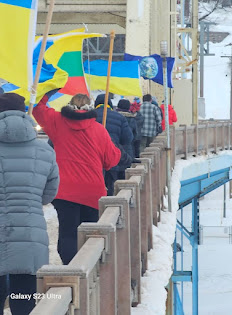
On a cold and snowy Saturday, January 10, participants in the ICE OFF vigil join those rallying against the administration's policies in Venezuela on Shelden Avenue in Houghton, MI. More than 120 local residents held a vigil against ICE on street corners and then rallied near the Lift Bridge during the two-hour event. Click on photos for larger versions. (Photo by John Peiffer for Keweenaw Now)
 
HOUGHTON -- Snow, wind and cold did not discourage more than 120 Keweenaw residents from joining together on street corners along Shelden Avenue in Houghton in a silent vigil, "ICE OFF," organized by Keweenaw Indivisible. Inspired by the recent fatal shooting of Renee Nicole Good by an ICE "officer" in Minneapolis, the vigil was against the illegal and inhumane actions of federal ICE personnel who have attacked and kidnapped innocent people in U.S. cities. Many of the vigil participants then joined a rally, organized by Keweenaw Socialists, against the administration's aggression against Venezuela.*
 
"For a small, rural community, mobilizing 124 people in under two days says a lot about what we value as an Indivisible chapter and as a community," said Heather Mroz of the Keweenaw Indivisible leadership team. This wasn’t just about honoring Renee Good and holding space for grief, but about showing solidarity and calling for accountability. When the [ICE] agent’s own cellphone video was released, it showed information that didn’t match the government’s initial description and raised real questions about what happened. As a public educator, I know that if I were involved in a crisis where someone was hurt, there would be a thorough investigation. If I acted outside my training or approved procedures, my employer could be held accountable, and if I acted intentionally outside those boundaries, I could be personally liable. That must be the standard any time one person hurts another -- transparency and accountability.
 
Rich Caneves of the Keweenaw Indivisible leadership team wears flowers in honor of Renee Nicole Good. Joining him during the vigil is Doneva Snyder of Hancock. (Photo by John Peiffer for Keweenaw Now)

Houghton resident Barry Fink also commented on her reason for attending the vigil.
 
"ICE agents are performing like fascist thugs, with no accountability for their actions," Fink said. "VP Hegseth thinks putting a man out on the street with a gun, who had a known history of trauma from a previous event with a vehicle thus making him 'trigger happy,' is okay.  He stated that agent is immune from legal consequences for his actions." 
 
Participants in the Jan. 10 vigil display their signs on street corners of Shelden Ave. in Houghton to convey the message, "Ice Off Our Streets." (Photo by John Peiffer for Keweenaw Now)

William Keith, chair of the Houghton County Democratic Party, noted the turnout at the event was an inspiration and a first step toward action.

"It was inspiring to see so many people turning out on a snowy day to demand justice," Keith told Keweenaw Now. "No one in Houghton knew Renee Good, but we all know someone like her: a mom in a minivan, getting her kids to school, worried about her neighbors. When someone like her isn't safe from armed half-trained cowards thinking they're above the law, no one is. Coming together as we did Saturday is the first step in doing the best thing we can do: demanding accountability from our leaders and cleaning house of those that enabled all of this."
 
During the Jan. 10 vigil on Shelden Avenue in Houghton, Donna Cole, left, of Twin Lakes and Emily Fiala of Hancock, display signs inspired by Renee Good and the behavior of ICE in Minneapolis. (Photo by Keweenaw Now) 

On another corner of Shelden Avenue in Houghton, a group of participants in the Jan, 10 vigil protest peacefully with their signs against ICE. (Video by John Peiffer for Keweenaw Now)
 
"It was affirmative to be gathered with kind and caring people in the Keweenaw," said Becky Darling of Chassell. "We can never give up. Say her name, she did not die in vain. Renee Nicole Hope Good. Saturday was healing and we have a long way toward recovery." 
 
Becky Darling of Chassell displays her sign during the vigil. (Photo by Keweenaw Now)

During the vigil, Beth Flynn of Hancock Township also commented on Renee Good's innocence.

"ICE agent Jonathan Ross’s video of his encounter with his victim, Renee Good, makes clear that she meant him no harm ( she says that), but his response, 'Bitch,' makes clear that he paid no attention to her words and expressed his anger by shooting her in the face," Flynn noted. "Ross is here to protect us? He is supposed to make us feel safer? He is obviously a menace to our communities and should be indicted for his crime." 

Standing on the corner with Beth Flynn was Valorie Troesch of Keweenaw Indivisible, organizers of the vigil.
 
"This is a sad and sober event to remember a tragedy that should not have happened and to mourn the death of a person who should not have been killed," Troesch said. "We have crossed the threshold into autocracy. The guardrails we always assumed would be there to backstop an authoritarian administration -- Congress, the Supreme Court, the mainstream media -- have failed us. As far as I can see, there are two bulwarks remaining: (1) our power to gather here, though not without fear, and protest the hellscape that Trump is unleashing and make our voices heard, and (2) an independent digital media that continues to report and to oppose this fascist regime, often at personal risk as well. Whether or not the third bulwark, free and fair elections, will hold remains to be seen. I am gratified by all those who came today. In the face of all that is going on, we must continue to show up and to speak up and to not give up."

Valorie Troesch, left, and Beth Flynn stand together in honor of ICE victim Renee Nicole Good during the Jan. 10 vigil in Houghton. (Photo by Keweenaw Now)

Carol Ekstrom of Houghton had a brief, but poignant, comment to add during the vigil.

"ICE under the present administration does not belong in this country. Melt it out," Carol said. 

Carol Ekstrom, accompanied by her husband, Peter Ekstrom, braves the cold and snow to participate in the vigil. (Photo by John Peiffer for Keweenaw Now)

Nadija Packauskas of Houghton distributes red roses to participants of the vigil in honor of Renee Good. Nadija said she was inspired by the following poem to remember Renee in this way. (Photo by John Peiffer for Keweenaw Now)

Poem courtesy Nadija Packauskas. 

Many of the vigil participants remained to join the rally in defense of Venezuela, organized by Keweenaw Socialists, at the end of Shelden Avenue near the Portage Lift Bridge.

On Saturday afternoon, Jan. 10, Local Keweenaw residents rally together peacefully in opposition to the administration's aggression against Venezuela. (Video by John Peiffer for Keweenaw Now)

Griffin, a member of Keweenaw Socialists, spoke at the rally, connecting the U.S. violence against Venezuela with the violent behavior of ICE toward innocent people.

"It's important to remember that the violence we have seen perpetrated against Venezuela by the United State military this past week and the violence we are continuing to see perpetrated by ICE against the American people are connected," Griffin commented to Keweenaw Now. "Fascism is imperialism turned inwards. The violence wielded against us here in the imperial core was crafted and honed repressing the imperial periphery. Both must be resisted and resistance to both is part of the same fight."

Joan Chadde, a local community member, also expressed her concerns about both the ICE issue and Venezuela.

"I am very concerned about what is happening," Chadde said. "Our country has attacked Venezuela without declaring war or getting congressional approval and killed more than 300 Venezuelans. The Administration has spent more than $800 million on actions against Venezuela in the past year, while cutting food assistance and healthcare funding for U.S. citizens, including treatment for those impacted by drugs. The killing of Renee Good in Minneapolis by ICE agents sent by our government is absolutely frightening! There are more than 125 people protesting today. That could've happened to one of us, if we were in Minneapolis." 

Joan Chadde exhibits her sign during the Jan. 10 vigil and rally in Houghton. (Photo by Keweenaw Now)

Alan Salmi of Hancock also participated in both the vigil and the rally.

"When over a hundred people gather silently in a rural community, it’s a sign that awareness is growing and that concern about ICE violence and U.S. actions in Venezuela reaches far beyond big cities," Salmi noted.

Participants in the Jan. 10 rally concerning Venezuela chant, "Hands off Venezuela!" (Video by Keweenaw Now) 

Some residents traveled a good distance from Keweenaw County to Houghton to participate in the Jan. 10 vigil and rally.

Sam Raymond of Copper Harbor displays a quote from George Orwell during the Jan. 10 vigil in Houghton. (Photo by John Peiffer for Keweenaw Now)

Jean Ellis of Eagle Harbor asked a question and found an answer to why she joined the vigil against ICE.

"What’s the point of standing ankle deep in snow, holding a sign while your fingers freeze?" Ellis asked. "Wouldn’t it be better to just keep your opinions to yourself rather than risk offending someone who doesn’t agree with you?  

"The answer to that comes loud and clear from German Pastor Martin Niemoller, regarding the Nazi rise to power:  

'First they came for the socialists, and I did not speak out -- 
     Because I was not a socialist.
Then they came for the trade unionists, and I did not speak out --
     Because I was not a trade unionist.
Then they came for the Jews, and I did not speak out --
     Because I was not a Jew.

Then they came for me -- and there was no one left to speak for me.'"

Ellis concludes, "Speaking out or, in the case of demonstrations, standing up is not always comfortable. But as each person stands up, another may be encouraged to do the same. When Constitutional rights are violated, people must stand up and speak out. And in the case of the demonstrations against ICE, ironically, there was the added challenge of having to do that in the cold and snow."
  

Jean Ellis drove from Eagle Harbor to join the vigil in Houghton. (Photo by Keweenaw Now)

Keweenaw resident Michael Gage posted on Facebook his reaction to the Jan. 10 vigil and rally.

"People, Hello we need to Wake up!! This is not American!" Gage wrote. "This is not making America great, at all. We don't need dictator Trump and his little army of federal law enforcement scaring and bullying people! We the people will not stand for this and other illegal things, like stealing oil from Venezuela."

*Editor's Note: 

Vigil organizer Keweenaw Indivisible (KI) organizes, mobilizes, and empowers the Copper Country to challenge corruption, defend democracy, and support those most harmed by regressive political agendas. Learn more about their work and how to join at linktr.ee/KeweenawIndivisible.

Keweenaw Socialists, organizers of the Hands Off Venezuela rally, are dedicated to promoting socialist ideas, engaging in mutual aid and disaster relief, and organizing community defense against the threats of fascism and white supremacy in the Keweenaw Peninsula community. They believe that a better world made by and for working people is both possible and necessary. To learn more about them and their positions on these recent events, visit https://keweenawsocialists.org/

Tuesday, January 06, 2026

Guest article: Reindeer in Iceland

By Nancy Langston*

"Reindeer and lichen in Iceland." (Original linocut print, © and courtesy Nancy Langston. 2024.)

In September 2023, while I was hiking under the cliffs that rise steeply above Stöðvarfjörður in east Iceland, a herd of animals drifted down the mountainside towards me. At first, I thought they were sheep, which outnumber people in Iceland two to one. But as they came closer, I saw their antlers. Reindeer! Stifling my yelp of joy, I dropped behind a rock outcropping and peered at the herd through my binoculars, scribbling notes on individual movements and snapping photographs. Eventually one female lifted her head from the lichen, snorted in my direction, then trotted back toward the protection of the cliffs. The rest of the herd took her cue, and soon they were scrambling back up the mountain, taking a route far too challenging for me to attempt.

This was my third research trip to Iceland, and I was thrilled that reindeer had finally graced me with their presence. Most visitors to east Iceland who glimpse reindeer assume they are completely wild creatures, an emblem of untouched wilderness free from human intervention. But the reindeer in Iceland are just the opposite: their histories are profoundly entangled with human settlement histories. Icelandic reindeer descend from those introduced from Europe in the 1770s by the country’s elite Danish rulers, the world’s first reindeer translocation. More than 250 years later, reindeer now roam freely, wintering along east Iceland’s fjords and migrating up into the highlands during summer, far from roads. No predators threaten their migrations, so wildlife managers carefully control permits for an annual hunt, trying to prevent overgrazing. Iceland’s reindeer speak to us not of untouched primordial wilderness, but instead of the complex historical relationships between humans and reindeer that still influence modern conservation.

Reindeer and caribou (Rangifer tarandus) are members of the same species, whose current ranges stretch across the circumpolar Arctic from North America to Eurasia. Members of the deer family, reindeer thrive in a variety of habitats. They are a migratory species, with some populations migrating vast distances across treeless Arctic tundra, making the longest annual migrations of any land mammal. Other populations have evolved shorter migrations in forests or on islands. These diverse migration strategies have been key to their resilience over thousands of years.

Reindeer are excellent swimmers and often migrate across water. (Linocut print, © and courtesy Nancy Langston)

But migration is harder than it used to be. Habitat loss, climate change, and infrastructure development have blocked many wildlife migration routes. Reindeer and caribou have retreated from roughly half their 19th century range, and their populations have dropped by 56 percent in the past decade (although some populations are expanding).

One reason to care about reindeer responses to climate change is that they may be crucial partners in the efforts to keep civilization from crossing key Arctic tipping points. Tipping points in climate models are critical thresholds that, if crossed, can lead to self-perpetuating, runaway warming in an ecosystem. Reindeer browsing can reduce the process of "shrubification" in the Arctic -- a positive feedback loop wherein heat-absorbing shrubs expand across the tundra as climates warm. As reindeer populations have declined in some sites, heat-absorbing shrubs have increased and heat-reflecting grasses decreased, leading to more warming. Ecologists fear that if this warming diminishes the reindeer’s ability to persist, it could unleash a domino effect of runaway warming. Translocation, however, may offer a way to help them persist.

Translocation of wildlife is nothing new. The first effort to move reindeer actually took place two and half centuries ago, when the ecological and social disruptions of the Little Ice Age led Danish rulers of Iceland to fear starvation among the island’s settlers. The Little Ice Age had hit Iceland hard, and settlers who had relied upon sheep herding struggled to survive. This problem was made worse by new sheep varieties imported from England that proved susceptible to scabies. The Danes tried to substitute reindeer as protein sources, calculating that if the reindeer could survive in the European tundra, surely they could survive in Iceland.

Snowy owls have protected reindeer migrations across the north, because wind project developments that might block reindeer migrations can be moved when they might harm snowy owl habitat. (Linocut print, © and courtesy Nancy Langston)

Initial efforts to move reindeer into Iceland in the 1770s failed; even without native Icelandic predators, the reindeer managed to fall off cliffs, stumble into boiling geysers, and get lost in lava fields. Finally, in 1787 a translocation of 35 reindeer from Finnmark met with more success (at least from the reindeer’s perspective). Descendants of those stragglers form the basis of Iceland’s current free-ranging herd. Rather than dying off like other introduced herds, they expanded rapidly in the latter half of the 20th century. Despite the genetic challenges associated with a tiny founding population estimated at 15 individuals, the population reached a size of about 6,000 to 7000 individuals. Because there are no native predators in Iceland, now regulated hunts and cars are the main sources of mortality. 

Northern gannets are now nesting in great numbers on Skrúður Island in eastern Iceland, thanks to successful conservation programs. (Linocut print, © and courtesy Nancy Langston)

What is the potential future for reindeer in Iceland? Climate change has brought dramatic changes to the region, as has hydropower development, which currently supplies 92 percent of Iceland’s energy production. Floods, landslides, and winter icing events have become more common. Winter ice can prevent reindeer from foraging lichen. But at least so far, Iceland’s reindeer appear to be surprisingly resilient and adaptable. When winter pastures ice over, some individuals starve, but others initiate new migrations, exploring new pastures and selecting new foods such as seaweed. Icelandic farmers long hated the reindeer, because they weren’t allowed to hunt them, but in recent decades, reindeer and locals have managed to co-exist in a rapidly warming Iceland.

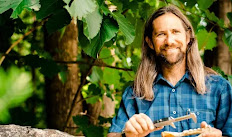
Nancy Langston demonstrates the process for creating a linocut print during the 49th Annual Poor Artists Sale at the CLK Gymnasium in Calumet on Dec. 6, 2025. (Photo by John Peiffer for Keweenaw Now)

*Editor's Note:

Nancy Langston, author of this article and linocut artist, is Board President of The Keweenaw Land Trust and Distinguished Professor Emerita of Environmental History, Michigan Technological University. Trained as an ornithologist, Nancy Langston's academic research in the past two decades has explored the ecological histories of wildlife in northern ecosystems. She is the author of six books on reindeer, Lake Superior, toxics, climate change, and old growth forests. To read more about Nancy and her linocut prints, visit her Web site, https://www.nancylangston.net/