
By Michele Bourdieu

Sarah Green, Michigan Tech professor emerita in chemistry and researcher known for her work on global climate change, has taken a group of students from Michigan Tech to the annual international climate Conference of the Parties (COP) every year since 2019 as observers. Green recently posted a report on COP 30, held in Belém, Brazil, in November 2025.
In her report, Green describes what happens at a COP, including the negotiations among countries on how they will cooperate to implement the goals of the Paris Agreement, whose chief goals are the following:
- Holding the increase in the global average temperature to well below 2 °C above pre-industrial levels and pursuing efforts to limit the temperature increase to 1.5 °C above pre-industrial levels, recognizing that this would significantly reduce the risks and impacts of climate change;
- Increasing the ability to adapt to the adverse impacts of climate change and foster climate resilience and low greenhouse gas emissions development, in a manner that does not threaten food production; and
- Making finance flows consistent with a pathway towards low greenhouse gas emissions and climate-resilient development.
She also notes the importance of information sharing among country and organizational representatives, negotiators and observers at the COP.
Green comments on the fact that the United States is the only party to have withdrawn from the Paris Agreement (twice).
"The United States had no official delegation at COP30, no negotiators, no seat at the table. But Americans were very present as observers," Green notes.

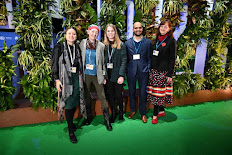
"I attend COP with students from Michigan Tech because the university has observer status," Green adds. "We work closely with other observer universities: Boston University, Vanderbilt University, Tennessee State, Colorado State, and others. Our students (and alumni) typically contribute to panel discussions during COPs."

One of Green's group of observers from Michigan Tech was Lexi Tater, a Michigan Tech PhD student in Environmental and Energy Policy, who is now on a leave of absence from the PhD program in order to work as an UP North Advocacy Community Organizer. Tater, who also attended COP 29 last year in Azerbaijan, was able, at a COP 30 panel, to speak about international climate governance and policy from a Justice lens.*
"We focused on carbon crediting mechanisms, and discussed their implications on marginalized communities and developing nations," Tater told Keweenaw Now.

Tater said these were her takeaways from the COP 30 experience:
"Real climate action and real climate justice starts with listening to communities who have been stewarding the earth forever. Recognizing and asserting sovereignty, Land Back movements, and decoupling from colonial/capitalist structures/growth are critical pieces to furthering true climate justice."
Over 50,000 delegates were registered to attend this conference, and COP 30 had the largest ever representation of Indigenous Peoples as delegates, Green reports.
Green also mentions the Peoples' Plenary, a COP tradition that gives an opportunity for observers, especially youth, to express their views. It brings a focus on justice and equity, with many delegates speaking about the impacts of wars.

In her report, Green summarizes several outcomes of COP 30, including the strong endorsement of the Paris Agreement and progress described in the document "Global Mutirão: Uniting humanity in a global mobilization against climate change."
Some of the progress Green mentions includes a Belém Gender Action Plan, more protection for forests and oceans, and the COP 30 Action Agenda -- a framework capable of mobilizing civil society, businesses, investors, cities, states, and countries.
This most recent COP took place in Belém, a city in the remote northeastern Para province of Brazil. In her report, Green offers her impressions of Belém and includes several photos.
CLICK HERE to read Sarah Green's report on COP 30, posted in her December 6, 2025, Citizens Rally for Accountable Government (CRAG) newsletter.
* If you missed Lexi Tater's report for Keweenaw Now on last year's COP 29, see "Guest article: COP 29 in Azerbaijan and international policy on climate change."











































No comments:
Post a Comment