By Michele Bourdieu
Scenic view from Oak Flat, a Native American sacred site, where Resolution Copper, a subsidiary of Rio Tinto and BHP - Billiton, plans to construct a large underground mine, now that a land exchange added to the Defense bill last December would privatize the area. Oak Flat is also a prime recreation area, especially for rock climbing and bouldering with more than 2,500 established climbing routes. Oak Flat is a rare desert riparian area. In Arizona, less than 10 percent of this type of habitat remains. (Photos by Keweenaw Now unless otherwise indicated. Information from Arizona Mining Reform Coalition.)
OAK FLAT, Ariz. -- Jerry Thomas is a Navajo (Dine) tribal member now living with his wife, Linda, on the San Carlos Apache reservation, nearly 50 miles from Oak Flat, a public campground near Superior, Arizona, in the Tonto National Forest, where he joined a camp of concerned citizen protesters.
Jerry Thomas, a Navajo tribal member, has been camping out at Oak Flat, a sacred site for the Apache and other tribes, to protest a federal land exchange that would allow a copper mining project that Native Americans, environmentalists and other concerned citizens have been opposing for 10 years.
At the Oak Flat Campground, Thomas and his wife joined Native Americans from other tribal groups and non-Native concerned citizens camping there in protest against the land exchange with Resolution Copper, a subsidiary of Rio Tinto and BHP - Billiton. Resolution Copper is proposing to mine a rich copper vein more than 7,000 feet deep just east of Superior, Ariz., and an hour east of Phoenix, Ariz.
The land exchange was recently approved by Congress when it was attached at the 11th hour last December to the National Defense Authorization Act of 2015, mostly because of the efforts of Sen. John McCain (R-Ariz.)*
Oak Flat is a sacred ceremonial and burial site for the Apache (Indeh) and other tribal groups, and Thomas says the mine would violate freedom of religion, not just for Native Americans but for others as well.
"That's the reason we're fighting," Thomas told
Keweenaw Now during our March 8, 2015, visit to the camp, where we were invited by Roger Featherstone, director of the Arizona Mining Reform Coalition.
Thomas expressed fears that "no trespassing" signs by the company will prevent people from praying at their sacred site.
"That's the issue with this bill," he said. "It's a defense bill against all religions."
Upper Peninsula residents -- Native and non-Native -- who opposed the Eagle Mine near Big Bay, Mich., are familiar with Rio Tinto's disregard for Native American sacred sites. Despite the Keweenaw Bay Indian Community's objections to Eagle Rock, a sacred site being used as the portal for the Eagle Mine, and despite KBIC's participation in a contested case against the Michigan Department of Environmental Quality for permitting the mine, the Eagle Mine, constructed by Rio Tinto, is now operating under the ownership of the Lundin Mining Company.
**
Gene Champagne of Big Bay, Mich., who has opposed the Eagle Mine, constructed by Rio Tinto and now owned by Lundin Mining Co., visited Oak Flat and the site of Rio Tinto/BHP/Resolution Copper's potential mining project in 2014. Here he inspects signs evidently posted by residents who support the project because of promises of jobs and oppose their town leaders' decision not to support it. (Photo © and courtesy Gene Champagne)
Thomas and his wife were camping at Oak Flat and attending meetings with both Native and non-Native concerned citizens, who are trying to educate themselves and others about the potential impacts of the proposed underground mine.
"It's a learning stage," Thomas said. "We're just now waking up."
Thomas noted the spiritual fight is combined with water issues and environmentalists are involved with water sampling.
"Water is our biggest concern," he said.
Thomas added the people are also concerned for their grandchildren and future generations.
The Pachero family, members of the Yaqui tribe, came from Tucson, Ariz., to the camp at Oak Flat.
The Pachero family, members of the Yaqui tribe from Tucson, joined other concerned citizens at the Oak Flat camp.
"We came to support the Apaches in their defense of freedom of religion, the land and the right to clean water for everybody," said Cati Carmen of the Pachero family.
Featherstone, who also lives in Tucson, was visiting the camp and meeting with representatives of several groups united in their opposition to the land exchange and the proposed mine.
Roger Featherstone, director of the Arizona Mining Reform Coalition, is pictured here at the Oak Flat Campground sign. The land exchange would mean the loss of this public campground to private ownership and potential destruction by subsidence caused by the proposed block cave mining method.
"The land is still ours until they complete environmental studies," Featherstone told
Keweenaw Now.
In the meantime there is a petition to repeal the bill, he noted.
"This encampment will stay here until we get it protected," Featherstone said.
Just recently the Arizona Mining Reform Coalition requested citizens sign a letter to the U.S. Forest Service commenting on Resolution Copper's proposal to conduct invasive hydrological and geotechnical testing for Rio Tinto’s preferred toxic tailings location for their proposed mine at Oak Flat.
According to the Coalition, Rio Tinto’s toxic tailings location is between the towns of Superior and Queen Valley and right in the middle of the Queen Creek watershed. The toxic tailings location would heavily affect Boyce Thompson Arboretum, a world-class botanical preserve.
The U.S. Forest Service (the permitting agency for the project) has written a Preliminary Environmental Assessment (EA) on Rio Tinto's plan of operations and would like to approve Rio Tinto's plan with very few (and minor) changes. The Coalition objects to the fact that the Forest Service did not examine Rio Tinto's full mining plan and insists that this action has no relationship to a larger mine.
The deadline for comments is April 12, 2015.***
Featherstone said the Coalition works to protect communities and the environment from inappropriate mines.
"And from the very first it was clear that what Rio Tinto wanted to do here was inappropriate," Featherstone noted.
He said he had also worked with the San Carlos Apache Tribe on other efforts to protect sacred sites.
Featherstone said an important point here is that Oak Flat is clearly sacred to San Carlos, but it's sacred to other tribes as well.
****
"Also because of what's happening here all the tribes of the United States, through the National Congress of American Indians (NCAI) and other national organizations -- all the tribes are together on this one," Featherstone explained.
The NCAI, which represents all the tribes in the U.S., has consistently passed resolutions unanimously against this Oak Flat mining project, which was first proposed in 2005.
*****
The bill that was passed under the Defense bill was the 13th bill for the land exchange, Featherstone said. The first 12 stand-alone bills did not pass, but when Sen. McCain, joined by fellow Arizona Republican Sen. Jeff Flake in an argument for jobs, attached it to the Defense bill, it passed.
Tina Kitcheyan, who was washing dishes at the camp, is a member of the San Carlos Apache Tribe and lives on the reservation, more than 40 miles from Oak Flat. She said she was coming to the camp every day because of her concern for the sacred site.
Tina Kitcheyan of the San Carlos Apache Tribe washes dishes at the Oak Flat camp. She came with her grandsons (not pictured) who were also helping out with various chores. Kitcheyan said she used to come to Oak Flat as a child to pick acorns used in Sunrise Dances.
"We used to come here when we were small to pick acorns and gather plants for traditional uses," Kitcheyan said.
The acorns are used in stew and also in the Sunrise Dances at the site, she explained.
Kitcheyan said she believes one reason the site is sacred is the historical memory of the Apache warriors who jumped off a cliff in the area when the U.S. cavalry was coming to kill them.
"My grandpa used to tell us a lot about it," she said.
She may have been referring to the story about "Apache Leap," which is often left out of history books about the area.
The Arizona Mining Reform Coalition notes on their Web site, "The land exchange would include Apache Leap, a cliff where more than 80 Apache warriors chose to leap to their deaths rather than surrender to the US cavalry."
Kitcheyan noted visitors from several different tribes, as well as non-Native birders and rock climbers, have come to the camp every weekend since it began as a protest and powwows and Sunrise Dances have been held there.
Two participants in the camp activities, Standing Fox (left), a San Carlos Apache, and Jake Toledo, a Dine (Navajo), were on their way to a meeting at the camp.
Former miner: New mining method could destroy Oak Flat area
Roy Chavez -- a former miner and former mayor of Superior, Ariz., who is now chair of the Concerned Citizens and Retired Miners Coalition of Superior -- says he has been fighting this proposed mine since 1998. His protest is in solidarity with that of the Native Americans at Oak Flat.
Chavez calls the land exchange under the Defense bill "a military action the U.S. Government is using as an attack on the San Carlos Apache Tribe."
Chavez cites his own experience in previous mines as one reason for his opposition to Resolution Copper's proposed mine.
This photo, taken from the town of Superior, Ariz., shows the original smelter from the Magma mine of the 1960s to 1980s.
"All these towns are here because of the mining industry," Chavez told
Keweenaw Now at the Oak Flat camp. "I support the mining industry but not this method of mining."
Chavez said he had worked in a mine at Superior that used a "cut and fill" method -- backfilling the empty spaces with tailings (mine waste) mixed with concrete; but the plan for this mine projects a "block cave" method, which could cause excessive subsidence and possibly leave a huge crater at Oak Flat.******
This photo shows Rio Tinto/BHP/Resolution Copper’s No. 9 and No. 10 shafts at their current mine workings on private land for their proposed mine at Oak Flat. This was first built in the 1960s by then Magma Copper, which was purchased by BHP and then was merged into the Resolution Copper project. (Photo by Keweenaw Now. Information from Roger Featherstone.)
In his 2011 statement as spokesperson for the Concerned Citizens and Retired Miners Coalition to the House Natural Resources Subcommittee on National Parks, Forests, and Public Lands, Chavez warns of the potential negative impacts of the block cave method:
"We are alarmed about the issue of subsidence by virtue of the mine's proposed block cave method and its effect on the Oak Flat campground, the Apache Leap escarpment, US Highway 60 through Queen Creek and the Town of Superior.
"The mine has finally admitted to 'minimal' subsidence at Oak Flat -- just how 'minimal?'
"They have admittedly chosen the block cave method to cut and fill because it is the least expensive and quickest method to approach this massive ore body. Experts have demonstrated that there will be irreparable destruction to the surface. Since the block cave method creates a huge volume of tailings which are toxic to both the water supply and the air we breathe, we are concerned regarding reclamation of these tailings upon mine closure."
******
In these video clips Chavez shows visitors to the camp a map of the proposed mining area and notes Resolution Copper's plans for the tailings:
At the Oak Flat camp on March 8, 2015, Roy Chavez, former miner and former mayor of Superior and chair of the Concerned Citizens and Retired Miners Coalition, explains a map of the proposed mining area to visitors Sandy and Bruce
Whitehouse of Corona de Tucson, who are opposing the projected Rosemont
mine near Tucson. (Video by Keweenaw Now)
Here Chavez talks about the changing price of copper and questions the value of putting a new mine at Oak Flat:
Discussing the changing price of copper with Sandy and Bruce Whitehouse, Roy Chavez points out that a copper mine in the area would not benefit the community but would ship the ore to China. (Video by Keweenaw Now)
Chavez discusses the impacts of tailings with Sandy and Bruce Whitehouse:
At the Oak Flat camp Roy Chavez describes tailings placement for the proposed Resolution Copper mine to Bruce and Sandy Whitehouse of Tucson, who express concerns about a proposed tailings pile from the Rosemont mine in their area. (Video by Keweenaw Now)
Tucson area visitors: Rosemont mine would be open-pit
Bruce and Sandy Whitehouse visited Oak Flat in solidarity with the protest since they have been fighting Hudbay Minerals' proposed massive Rosemont open-pit copper mine in the Santa Rita Mountains south of Tucson that threatens another scenic area and Arizona's diminishing resource -- water.
According to the Save the Scenic Santa Ritas Web site, "The U.S. Environmental Protection Agency has stated that the massive open-pit mine that would destroy more than 3,000 acres of Coronado National Forest would result in 'substantial and unacceptable impact' to water supplies of 'national importance' and that proposed mitigation measures are 'scientifically flawed' and 'grossly inadequate.'"*******
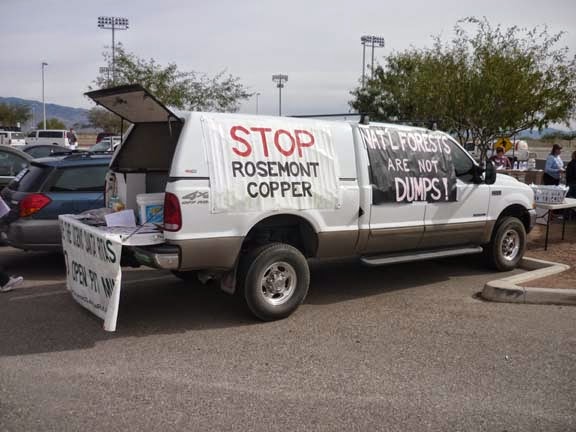
A truck owned by a member of Save The Scenic Santa Ritas protests the proposed Rosemont mine. (Photo © and courtesy Bruce Whitehouse)
"We had hearing with the U.S. Forest Service and they always had information and tried to educate the public," Bruce Whitehouse said. "The Rosemont people always said they would provide job, jobs jobs."
Bruce Whitehouse has a favorite bumper sticker that reads, "There will be no need for jobs on a dead planet."
This is a photo of the Rosemont ranch site where Hudbay Minerals hopes to dig a massive open-pit copper mine. (Photo © and courtesy Bruce Whitehouse)
Activist Bruce Whitehouse on top of Lopez Pass where the power lines and water lines are planned for the proposed Rosemont mine. "Huge 167KV towers and destruction of the landscape," Bruce says. "The tye-dyed t-shirt is custom designed by me. It says 'Ruck Fosemont' in olde English fonts. They hate it!" (Photo © and courtesy Bruce Whitehouse)
The group Save the Scenic Santa Ritas says the Rosemont project, if permitted, would have "disastrous AND permanent impacts to our water, air quality, wildlife and economy."*******
Oak Flat mine threatens rock-climbing tourism
Also participating in the protest camp at Oak Flat was rock climber Stephen Shaffer of Scottsdale, Ariz. He was helping prepare firewood for campers.
Stephen Shaffer of Scottsdale, Ariz., left, joins Roy Chavez, center, and Mike Gray of Smoke Hole, West Virginia, in chopping wood for campfires at the Oak Flat camp.
Shaffer said he was interested in joining Chavez's group, the Concerned Citizens and Retired Miners Coalition of Superior. Rock climbers like Shaffer are opposed to the mining project because it would prevent them from accessing their climbing routes that have been on public land until the recent land exchange.
According to a Dec. 21, 2014, article in Tucson.com, "Oak Flat -- which for 15 years was the site of an international bouldering competition -- contains thousands of bouldering and rock-climbing routes that will be inaccessible when mining begins."********
Chavez notes the rock-climbing and other outdoor activities add to a diversified economy, which the town leaders of Superior support -- and which a mining economy threatens.
A 2013 report, "Exaggerating the Net Economic Benefits of the Proposed Resolution Copper Mine, Superior, Arizona: A Critical Review of Resolution’s Economic Impact Analysis," by Thomas Power and Donovan Power of Power Consulting, for the San Carlos Apache Tribe, includes many of the points on the economic impacts of mining that Thomas Power, research professor and professor emeritus in the Economics Department at The University of Montana, made in his 2013 presentations in Houghton and in the report he did for FOLK (Friends of the Land of Keweenaw).
The loss of a diversified economy when mining dominates a community is an important point in both of Power's reports.
In his report for the San Carlos Tribe, Power states the following: "Mining tends to displace most other economic activities in the region around the mine. The spectacular environmental degradation combined with the instability associated with mining operations actually discourages individuals, families, and businesses from locating in mining towns. That is why mining communities tend to be so specialized in mining, lacking in the economic diversification that can stabilize communities in the face of commodity price fluctuations. People and businesses are not drawn to mining areas except for the job opportunities. When those job opportunities 'flicker' or disappear, residents and businesses disappear too. That is how 'ghost towns' are generated."
********
Concerned citizens in Arizona have not yet surrendered their sacred site, their environment or their towns to giant mining interests.
Editor's Notes:
** See our slide show (Keweenaw Now, right-hand column) on the 2010 camp protesting Rio Tinto's use of Eagle Rock, a sacred Ojibwa site, for the Eagle Mine.
**** Click here to read the San Carlos Apache Tribe Resolution opposing the land exchange.
****** Click here for the 2011 statement by Roy Chavez to the House Natural Resources Subcommittee on National Parks, Forests, and Public Lands.
******** See the Dec. 21, 2014, Tucson.com article
here.