TRAVERSE CITY, MICH. -- Hundreds of citizens concerned about the risks a 60-year-old oil pipeline beneath the Straits of Mackinac poses to the Great Lakes will rally at Bridge View State Park at the north end of the Mackinac Bridge from noon to 1:30 p.m. on Sunday, July 14. The "Oil and Water Don't Mix Rally" will call attention to the aging pipeline and urge state officials to take action to fully protect the Great Lakes from a potential oil spill that would cause great harm.
The event will feature a series of speakers, including climate activist and 350.org founder Bill McKibben and others, who will urge Gov. Rick Snyder to insist that federal authorities require Enbridge, Inc., of Calgary, Alberta -- the pipeline owner and operator -- to remove and replace the aging line with the safest, most protective pipe technology available. Local Traverse City chapter "TC 350" has joined with Michigan Land Use Institute and many other state and local groups to organize this rally.
Enbridge is responsible for the 2010 Kalamazoo River tar sands oil
pipeline spill, the largest inland oil spill in U.S. history. That
cleanup is still underway three years and nearly 1 billion dollars after
it began because submerged tar sands oil is proving to be far more
difficult to clean up than conventional oil.
Rally-goers will also call for a permanent ban on sending tar sands oil through the Mackinac pipeline, or any other lines near the Great Lakes or their tributaries.
"There is no such thing as a perfect, completely leak-free pipeline," according to Beth Wallace of the National Wildlife Federation, who co-authored several reports on Enbridge’s pipeline problems. "A major leak at the heart of the Great Lakes would be a terrible thing for the environmental and lakeshore landowners. This very old pipeline is a disaster waiting to happen."*
Also onstage will be Jerry Dennis, a noted author who writes extensively about Great Lakes history and ecosystems, and representatives from other communities that have been impacted by Enbridge’s pipelines, including Detroit Coalition Against Tar Sands and the Kalamazoo River Watershed Council.
Rally sponsors include the National Wildlife Federation, Michigan Environmental Council, Ann Arbor 350, Michigan Land Use Institute, FLOW, the Detroit and Michigan Coalitions Against Tar Sands, the Kalamazoo River Watershed Council, the Northern and West Michigan Environmental Action Councils, and Food and Water Watch.
Music will be provided by several northern Michigan artists, including Seth Bernard and May Erlewine, Rachael Davis and Dominic John Davis. Rally-goers are invited to bring a picnic lunch and spend the afternoon enjoying one of Michigan’s most scenic and environmentally fragile spots.
How to get there
Make the drive to the event in your own car, ride with friends, or sign up for a rideshare to give or get a ride. A number of buses from various cities in the Midwest are also being organized.
Click here for a map showing the location of Bridge View State Park.
* The Rally was inspired by an October 2012 National Wildlife Federation report, "Sunken Hazard: Aging oil pipelines beneath the Straits of Mackinac an ever-present threat to the Great Lakes."
Visit http://oilandwaterdontmix.com/ for more information.
Showing posts with label Bill McKibben. Show all posts
Showing posts with label Bill McKibben. Show all posts
Thursday, July 11, 2013


Tuesday, March 19, 2013
350.org: Call Senators today to oppose Keystone Pipeline; videos of Feb. 17 Climate Rally in D.C.
From 350.org, with videos of the Feb. 17, 2013, Forward on Climate Rally in Washington, D.C. (Videos by Allan Baker for Keweenaw Now)
OAKLAND, CALIF. -- Climate change activists around the country are rallying this week at Senate offices demanding that their senators vote against Keystone XL. This week the Senate is expected to vote on measures that would undermine President Obama’s authority to review the Keystone XL tar sands pipeline.
TODAY, Tuesday, March 19, is a national call-in day with groups like The Sierra Club, Moveon, Credo, NRDC, and others directing citizens to call their senators.*
Bill McKibben, 350.org founder, speaks to a crowd of more than 40,000 at the Feb. 17, 2013, Forward on Climate Rally in Washington, D.C. Supporters of the climate movement oppose the Keystone XL Pipeline that would carry oil from the Tar Sands in Alberta Canada through the U.S., endangering the environment. (Videos by Allan Baker for Keweenaw Now)
Large rallies are happening now in Virginia, Colorado, and Minnesota, with activists saying that the export pipeline is not in the national interest and that their senators cannot be climate champions while supporting KXL. Virginia activists in particular are furious at Sen. Mark Warner (D-VA), for voicing public support for the the project after voting against the pipeline last year.
During the Feb. 17 Forward on Climate Rally, just before the march from the National Mall to the White House, the Rev. Lennox Yearwood, Hip Hop Caucus President and CEO, introduces Van Jones, president of Rebuild the Dream. Jones addresses President Obama directly, asking him to deny permitting of the Keystone XL Pipeline (a vote on this is expected in the Senate this week).
"If you understand climate science, there’s no way you can support this pipeline," said Jason Kowalski, policy director for 350.org. "We know that this pipeline is a boondoggle -- it will spill, most of the oil is for export, and it will make climate change worse. Anyone who tells you the opposite isn’t being straight with you or doesn’t know the facts."
Indeed studies show that Keystone will dramatically increase the development of the tar sands, known to be among the largest pools of carbon on the planet. A recent study from Pembina Institute showed that if approved, Keystone XL alone would require tar sands production to increase by 36 percent.
More than 1,500 people have been arrested protesting the pipeline, and in February over 40,000 people gathered on the National Mall to tell President Obama to reject it. In 2011, over 800,000 people called into the Senate to reject a similar measure.
First Nations representatives from communities affected by the Tar Sands oil development and Native Americans opposed to the Keystone Pipeline dance, sing and drum at the head of the Forward on Climate march to the White House on Feb. 17, 2013. At the head of the march are also Bill McKibben, 350.org founder, and Van Jones, president of Rebuild the Dream.**
Activists are also rallying outside almost all of President Obama and Secretary Kerry’s public events. Last week scores of climate activists greeted the president at events in Washington and outside Chicago.
Editor's Notes:
* You can call Sen. Carl Levin's Washington, D.C. office at (202) 224-6221 and leave a message or speak with a representative about the Keystone XL Pipeline. Call Sen. Debbie Stabenow at (202) 224-4822.
** Click here to see a video (9 minutes) of speaker Crystal Lameman of Beaver Lake Cree First Nations in Canada to hear her report on the Tar Sands at the Forward on Climate Rally. The video also includes Native American leaders from Oklahoma and Louisiana.
Click here to see a video of Maria T. Cardona, Latinovations Founder and Dewey Square Group Principal, speaking on the effects of climate change on Latino populations.
Click here to see a video of Maria T. Cardona, Latinovations Founder and Dewey Square Group Principal, speaking on the effects of climate change on Latino populations.
Click here for Allan Baker's brief interview with Minnesota State Rep. Frank Hornstein, who was riding on the train to Washington for the Rally, with a group of concerned Minnesotans.
See also Keweenaw Now's Feb. 25, 2013, article, "Keystone Pipeline protest: over 40,000 people in freezing cold," by Shirley Galbraith, with photos by Allan Baker.
See also Keweenaw Now's Feb. 25, 2013, article, "Keystone Pipeline protest: over 40,000 people in freezing cold," by Shirley Galbraith, with photos by Allan Baker.
Sunday, November 18, 2012
Thousands to march at White House Nov. 18 for climate solutions, against Keystone XL Tar Sands Pipeline

WASHINGTON, DC -- In a recent news conference President Obama made several statements about his willingness to tackle the climate crisis. 350.org is helping to lead a
rally at the White House TODAY, Sunday, Nov. 18, over the Keystone XL pipeline. 350.org Executive Director May Boeve issued the following statement:
"The climate silence is broken, and now the President can show us he's serious with a decision already on his desk: rejecting the Keystone XL pipeline. The pipeline would unlock so much carbon that climate scientists say, if it were built, it would be 'game over' for the climate.
"The president can stop this dangerous pipeline with his pen; and, if he does, the American people will support him. This pipeline is not in the national interest."
IEA confirms Bill McKibben’s "Do The Math" numbers

OAKLAND, Calif. -- This week the International Energy Agency released its World Energy Outlook and confirmed estimates that the overwhelming majority of known fossil fuel reserves (75-80 percent) will have to be kept in the ground to avoid two degrees Celsius temperature rise. 350.org founder Bill McKibben, who is on a national tour discussing this math, issued the following statement:
"A week after we launched the nationwide 'Do The Math' tour, the planet's chief energy watchdogs put out a huge report that essentially confirms what we've been saying: most of the carbon in the fossil fuel industry's reserves has to stay below the ground if we're going to keep the planet from disastrously overheating.*
"For American leaders, keeping carbon in the ground means blocking the Keystone XL tar sands pipeline, stopping coal ports on the Pacific Coast, ending mountaintop removal, and cracking down on rampant fracking. Easy long-term gestures aren't enough any more; we've delayed so long that we have to stop exploiting new extreme energy.
"This is the basic, horrifying math of the planet we live on. Business as usual will bust it -- that's why we're on the road all month and why a divestment campaign is suddenly building out of nowhere."**

Shirley Galbraith of Houghton (in orange vest, to left of "No Tar Sands" sign) holds hands with Canadian journalist Naomi Klein during the Nov. 6, 2011, protest in front of the White House -- aimed at convincing President Obama to say "No" to the Keystone XL Pipeline. (Keweenaw Now file photo © Allan Baker)
Following 350.org’s "Do the Math" event at the Warner Theatre in Washington, DC, today, thousands will gather in Freedom Plaza and then march around the White House to
show President Obama that he has their support if he stands up to Big Oil and says no to the destructive Keystone XL tar sands pipeline. A rally will follow the march and will feature Bill McKibben, Sierra Club President Allison Chin, Oklahoma-based environmental leader Earl Hatley, and music from folk singer Nahko.
Notes:
* More information on the tour is at math.350.org.
** 350.org and partners are building a nation-wide campus divestment movement. Endowments at the country’s universities exceed $400 billion and they should not be invested in an industry that is cooking the planet. More information is at http://gofossilfree.org/.
Editor's Note: Click on the following links to read Keweenaw Now's coverage of the 2011 protests against the Keystone Pipeline in front of the White House by guest reporters Kate Flynn, Shirley Galbraith and Allan Baker.
"Protesters continue White House sit-in against pipeline for tar sands oil," by Kate Flynn (Aug. 31, 2011).
"Sit-in against Tar Sands XL Pipeline concludes peacefully Sept. 3; national campaign to follow," by Kate Flynn (Sept. 6, 2011).
"Houghton couple report on DC protest against Keystone XL Pipeline, Tar Sands oil," by Shirley Galbraith, with photos and video by Allan Baker (Nov. 11, 2011)
Tuesday, September 06, 2011
Sit-in against Tar Sands XL Pipeline concludes peacefully Sept. 3; national campaign to follow
Article and photos by Kate Flynn*
 In front of the White House, protesters against the Tar Sands XL Pipeline display signs on Saturday, Sept. 3, the final day of the peaceful two-week sit-in and civil disobedience. Their signs and banners were later taken away by the United States Park Police before the police began making arrests. Click on photos for larger versions. (Photos © 2011 and courtesy Kate Flynn)
WASHINGTON, D. C. -- A White House sit-in that has been called the largest environmental civil disobedience act in decades culminated in two days of protest on Friday, Sept. 2, and Saturday, Sept. 3. The 14-day sit-in was held in objection to the proposed Keystone XL pipeline project, which would transport crude oil over a distance of 1,980 miles from Canada to the U.S.
Organizers are pledging to escalate a nationwide campaign to push President Obama to deny the permit for the pipeline.
Climate activist Bill McKibben, who helped organize the protest, encouraged attendees not to view the fight against the pipeline as over.
 Bill McKibben, author and environmentalist, who was one of the first leaders arrested during the sit-in, addressed assembled protesters on Saturday., Sept. 3, the fourteenth and final day of protest outside the White House against the proposed Keystone XL pipeline. "This has turned into the biggest civil disobedience protest about anything this century," he stated.
"The next month or two are going to be absolutely crucial," he told those assembled before Saturday’s sit-in.
Hundreds of individuals took to the sidewalk in front of the White House on both days, risking arrest by the United States Park Police, while dozens more held signs, danced and sang across the street in Lafayette Square. The protest, which has been going on for the past fourteen days, has seen 1,252 arrests.
 Protesters in front of the White House on Saturday, Sept. 3, display signs objecting to the Keystone XL Pipeline. "Game Over" is what NASA climate scientist James Hansen, who was arrested during the protest last week, said about the tar sands exploitation and the pipeline. A petition with more than 600,000 signatures opposing the pipeline was delivered to the White House on Sept. 3.
"Third warning, they came out and got us," said Joey Firman of Arlington, Va., who was arrested on Thursday after being asked to leave the sidewalk area three times by police. Firman and other protesters were not jailed upon arrest, but rather brought to a processing center and required to pay a $100 fine before being released. “Even my SWAT-team guy who arrested me, he was like, 'Tell me about this pipeline,'" Firman said. "So I told him about it for like three minutes and he was like, 'Thank you.'"
The protest has been largely peaceful and has seen support from people all over North America, as well as the local D. C. area. A number of indigenous leaders, many of whose communities would be directly affected by the pipeline, made their voices heard on Friday.
 During the sit-in on Friday, Sept. 2, protesters hold a sign that says, "Respect Sovereignty / Honor Indigenous Rights." Several indigenous leaders addressed the crowd in front of the White House.
Chief Bill Erasmus -- of Yellowknife, Northwest Territories, Canada -- said his people are already being affected by the tar sands and pipeline.
 Chief Bill Erasmus of the Dene Nation in Yellowknife, Northwest Territories, Canada, speaks to assembled protesters on Friday, Sept. 2.
"We want people to know what our concerns are. We're saying that this pipeline is not needed," Chief Erasmus said. “Our people, in some areas, can no longer eat the fish. Our people can no longer drink the water. The oil is not for America; the oil is for the highest bidder."
Deborah Whitebloom of the Oklahoma Lakota Nation addressed the fact that the pipeline would cross the Ogallala Aquifer, one of the largest freshwater aquifers in the world.
 Deborah Lightbloom of the Oklahoma Lakota Nation speaks to assembled protesters on Friday, Sept. 2. She addressed the fact that the proposed Keystone XL pipeline would cross roughly 2,000 streams, lakes and creeks, as well as the Ogallala Aquifer, one of the world's largest aquifers.
"This is our territory," Whitebloom said. "We have to stand up and say no -- say no to the pipeline, say no to the corporations."
Candy Mosset spoke to assembled protesters on behalf of the Indigenous Environmental Network.
"It's going to affect all of us; it is, in fact, affecting all of us," she said, referring to the negative environmental impacts of the pipeline.
 During the Sept. 2 protest, Candy Mosset speaks on behalf of the Indigenous Environmental Network.
Maryland State Sen. Paul Pinsky also addressed the protesters on Friday, Sept. 2.
"We have to move in a forward direction," said Pinsky. "We need solar, we need wind. We have to speak truth to power."
Pinsky also said that he disputes the State Department’s final Environmental Impact Statement, released on August 26th, on the proposed pipeline. The report concludes that any environmental impact of the pipeline will be minimal. Pinsky was later one of the estimated 166 people arrested on Friday, Sept. 2.
 Maryland State Senator Paul Pinsky (D-Prince George's) makes a public statement before the Friday, Sept. 2, White House sit-in. He was later arrested.
Many see the pipeline issue as crucial to whether or not President Obama will receive voter support from environmentalists in the next election cycle.
 Members of the Ali-Latouche family, of Berwyn Heights, Md., line up on Fri., Sept. 2, to take part in the protest.
"This is a real chance for Obama to take a stand on something," said attendee Steve Paisley, of Ithaca, New York. "He is not going to get reelected by doing what he’s been doing, which is waffling and compromising and doing nothing. No one on the left is going to support that; even people in the middle are going to recognize someone who stands up for what they believe in, even if they don’t share that belief."
 The Reverend Lennox Yearwood, a D.C.-area minister and community activist, addresses assembled supporters and protesters after the sit-in on Saturday, Sept. 3.
The final State Department hearing on the Keystone XL pipeline will be held on Oct. 7, 2011. A final decision on the pipeline is expected from President Obama by the end of the year.
Editor's Notes:
*Guest reporter Kate Flynn is a graduate student in journalism at American University in Washington, D.C. She is a graduate of Hancock High School and Beloit College. Kate also worked as a journalism intern for both Keweenaw Now and the L'Anse Sentinel in 2010. This is her second article on the Keystone XL Pipeline protest. Click here to read her first article in this series, posted Aug. 31, 2011.
** See "The Indigenous Call: Take Back Our Future," a short video clip showing indigenous people at the protest, including some being arrested.
Tars Sands Action, organizers of the sit-in, will soon announce Phase 2 of the protest against the pipeline. Visit their Web site for updates.
 In front of the White House, protesters against the Tar Sands XL Pipeline display signs on Saturday, Sept. 3, the final day of the peaceful two-week sit-in and civil disobedience. Their signs and banners were later taken away by the United States Park Police before the police began making arrests. Click on photos for larger versions. (Photos © 2011 and courtesy Kate Flynn)
WASHINGTON, D. C. -- A White House sit-in that has been called the largest environmental civil disobedience act in decades culminated in two days of protest on Friday, Sept. 2, and Saturday, Sept. 3. The 14-day sit-in was held in objection to the proposed Keystone XL pipeline project, which would transport crude oil over a distance of 1,980 miles from Canada to the U.S.
Organizers are pledging to escalate a nationwide campaign to push President Obama to deny the permit for the pipeline.
Climate activist Bill McKibben, who helped organize the protest, encouraged attendees not to view the fight against the pipeline as over.
 Bill McKibben, author and environmentalist, who was one of the first leaders arrested during the sit-in, addressed assembled protesters on Saturday., Sept. 3, the fourteenth and final day of protest outside the White House against the proposed Keystone XL pipeline. "This has turned into the biggest civil disobedience protest about anything this century," he stated.
"The next month or two are going to be absolutely crucial," he told those assembled before Saturday’s sit-in.
Hundreds of individuals took to the sidewalk in front of the White House on both days, risking arrest by the United States Park Police, while dozens more held signs, danced and sang across the street in Lafayette Square. The protest, which has been going on for the past fourteen days, has seen 1,252 arrests.
 Protesters in front of the White House on Saturday, Sept. 3, display signs objecting to the Keystone XL Pipeline. "Game Over" is what NASA climate scientist James Hansen, who was arrested during the protest last week, said about the tar sands exploitation and the pipeline. A petition with more than 600,000 signatures opposing the pipeline was delivered to the White House on Sept. 3.
"Third warning, they came out and got us," said Joey Firman of Arlington, Va., who was arrested on Thursday after being asked to leave the sidewalk area three times by police. Firman and other protesters were not jailed upon arrest, but rather brought to a processing center and required to pay a $100 fine before being released. “Even my SWAT-team guy who arrested me, he was like, 'Tell me about this pipeline,'" Firman said. "So I told him about it for like three minutes and he was like, 'Thank you.'"
The protest has been largely peaceful and has seen support from people all over North America, as well as the local D. C. area. A number of indigenous leaders, many of whose communities would be directly affected by the pipeline, made their voices heard on Friday.
 During the sit-in on Friday, Sept. 2, protesters hold a sign that says, "Respect Sovereignty / Honor Indigenous Rights." Several indigenous leaders addressed the crowd in front of the White House.
Chief Bill Erasmus -- of Yellowknife, Northwest Territories, Canada -- said his people are already being affected by the tar sands and pipeline.
 Chief Bill Erasmus of the Dene Nation in Yellowknife, Northwest Territories, Canada, speaks to assembled protesters on Friday, Sept. 2.
"We want people to know what our concerns are. We're saying that this pipeline is not needed," Chief Erasmus said. “Our people, in some areas, can no longer eat the fish. Our people can no longer drink the water. The oil is not for America; the oil is for the highest bidder."
Deborah Whitebloom of the Oklahoma Lakota Nation addressed the fact that the pipeline would cross the Ogallala Aquifer, one of the largest freshwater aquifers in the world.
 Deborah Lightbloom of the Oklahoma Lakota Nation speaks to assembled protesters on Friday, Sept. 2. She addressed the fact that the proposed Keystone XL pipeline would cross roughly 2,000 streams, lakes and creeks, as well as the Ogallala Aquifer, one of the world's largest aquifers.
"This is our territory," Whitebloom said. "We have to stand up and say no -- say no to the pipeline, say no to the corporations."
Candy Mosset spoke to assembled protesters on behalf of the Indigenous Environmental Network.
"It's going to affect all of us; it is, in fact, affecting all of us," she said, referring to the negative environmental impacts of the pipeline.
 During the Sept. 2 protest, Candy Mosset speaks on behalf of the Indigenous Environmental Network.
Maryland State Sen. Paul Pinsky also addressed the protesters on Friday, Sept. 2.
"We have to move in a forward direction," said Pinsky. "We need solar, we need wind. We have to speak truth to power."
Pinsky also said that he disputes the State Department’s final Environmental Impact Statement, released on August 26th, on the proposed pipeline. The report concludes that any environmental impact of the pipeline will be minimal. Pinsky was later one of the estimated 166 people arrested on Friday, Sept. 2.
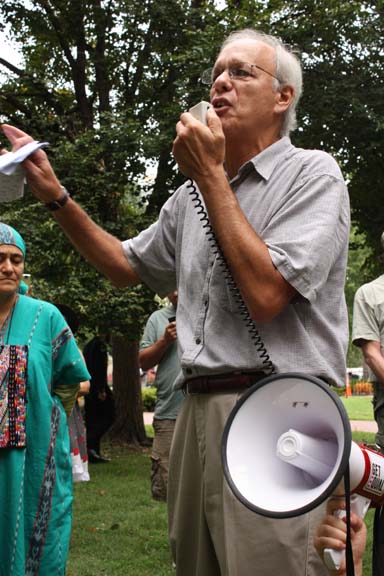 Maryland State Senator Paul Pinsky (D-Prince George's) makes a public statement before the Friday, Sept. 2, White House sit-in. He was later arrested.
Many see the pipeline issue as crucial to whether or not President Obama will receive voter support from environmentalists in the next election cycle.
 Members of the Ali-Latouche family, of Berwyn Heights, Md., line up on Fri., Sept. 2, to take part in the protest.
"This is a real chance for Obama to take a stand on something," said attendee Steve Paisley, of Ithaca, New York. "He is not going to get reelected by doing what he’s been doing, which is waffling and compromising and doing nothing. No one on the left is going to support that; even people in the middle are going to recognize someone who stands up for what they believe in, even if they don’t share that belief."
 The Reverend Lennox Yearwood, a D.C.-area minister and community activist, addresses assembled supporters and protesters after the sit-in on Saturday, Sept. 3.
The final State Department hearing on the Keystone XL pipeline will be held on Oct. 7, 2011. A final decision on the pipeline is expected from President Obama by the end of the year.
Editor's Notes:
*Guest reporter Kate Flynn is a graduate student in journalism at American University in Washington, D.C. She is a graduate of Hancock High School and Beloit College. Kate also worked as a journalism intern for both Keweenaw Now and the L'Anse Sentinel in 2010. This is her second article on the Keystone XL Pipeline protest. Click here to read her first article in this series, posted Aug. 31, 2011.
** See "The Indigenous Call: Take Back Our Future," a short video clip showing indigenous people at the protest, including some being arrested.
Tars Sands Action, organizers of the sit-in, will soon announce Phase 2 of the protest against the pipeline. Visit their Web site for updates.
Wednesday, August 31, 2011
Protesters continue White House sit-in against pipeline for tar sands oil
Article and photos by Kate Flynn*
 Actress Daryl Hannah addresses an assembled group of protesters near the White House on Tuesday, Aug. 30, the eleventh day of a sit-in against the Keystone XL pipeline, a proposed project that would funnel crude oil from the tar sands of Alberta, Canada, to terminals in the Gulf Coast. Hannah was reportedly one of those arrested during the sit-in. Click on photos for larger versions. (Photo © 2011 and courtesy Kate Flynn)
WASHINGTON, DC -- Dozens of activists gathered across the street from the White House Tuesday morning to prepare for the eleventh day of protest against the Keystone XL pipeline, a proposed project that would funnel tar sands crude oil from Alberta, Canada, to terminals in the Gulf Coast.
"We’re asking the president to do something that is entirely within his power," said Bill McKibben, an environmental author involved in organizing the effort, as he addressed assembled protesters. "All he has to do is not sign this permit and this pipeline can’t be built."
Police have made 706 arrests outside the White House since Aug. 20. Activists and others opposing the pipeline are concerned that carbon emissions from the process of extracting petroleum from the tar sands will contribute to global climate change. They are also concerned about an environmental threat in the form of a pipeline rupture.
"I think that it’s important that we show Obama the seriousness of clean energy and how much we want it now, for our future and for future generations," said Rebecca Ortiz, a student activist from Virginia. "The Keystone XL pipeline is a violation of our right to clean water."
 During the Aug. 30 sit-in against the Keystone XL pipeline, at the White House, young activists, from left, Rebecca Ortiz, Emma Peterson, and Nathaly Agosto Filion practice a protest song. (Photo © 2011 and courtesy Kate Flynn)
"We U.S. citizens need and want to be free from this hideously destructive fossil fuel dependence," stated actress Daryl Hannah as she addressed those assembled. "If President Obama rejects the lobbyists’ influences and does the right thing by the citizens, then we will be free so that the money and jobs can go towards safe, clean, regenerative, community-based U.S. energy and fuel."
Hannah is known for her roles in such films as Blade Runner, Splash and Kill Bill. CNN later reported Hannah was arrested during the sit-in.
Many activists saw the struggle as a personal one that would have a direct impact on their quality of life.
"My son," Suzie DeBrosse of Vermont replied when asked what her reason for protesting was. "To get a healthy and clean environment for the next generations."
 Suzie DeBrosse of Vermont holds a protest sign depicting her son. (Photo © 2011 and courtesy Kate Flynn)
Ben Gotschall, a spokesperson for Tar Sands Action, organizers of the sit-in, also spoke to the crowd at the protest on Aug. 30.
"Originally that was all it was about -- not in my backyard, not in my drinking water," Gotschall said. "But as I learned more about this…I realized this is something evil that we had to stop."
 Tar Sands Action spokesperson Ben Gotschall addresses an assembled group of protesters. (Photo © 2011 and courtesy Kate Flynn)
The protest has already seen solidarity from religious leaders and NASA’s Dr. James Hansen, a leading expert on climate change, who was arrested during the protest outside the White House on Monday, Aug. 29.
The New York Times reported that the pipeline is expected to open in 2013 unless delayed by lawsuits or other challenges.
Editor's Notes: Guest reporter Kate Flynn is a graduate student in journalism at American University in Washington, D.C. She is a graduate of Hancock High School and Beloit College. Kate also worked as a journalism intern for both Keweenaw Now and the L'Anse Sentinel in 2010.
Visit tarsandsaction.org for more updates on the protest.
Subscribe to:
Posts (Atom)