See our right-hand column for announcements and news briefs. Scroll down the right-hand column to access the Archives -- links to articles posted in the main column since 2007. See details about our site, including a way to comment, in the yellow text above the Archives.
Showing posts with label Green Burial. Show all posts

Saturday, January 13, 2024

Keweenaw Green Burial Alliance presents progress in local cemeteries' acceptance, development of green burial options

Signs in Chassell Township cemetery indicate an area reserved for green burial. (November 2023 photo by Keweenaw Now)

The Community Room at Portage Lake District Library was nearly standing room only on November 20, 2023, for a presentation by Keweenaw Green Burial Alliance (KGBA) President Stephen Jukuri on "A Tale of Two Cemeteries: Chassell Township Outperforms with Green Burial."

The event was KGBA's first "post-pandemic" community update on what this non-profit educational and advocacy organization has been learning in the past few years about both successes and failures of green burial in local Upper Peninsula cemeteries -- from Chassell to Nisula.

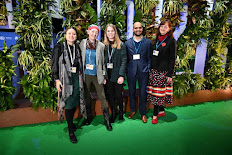
Jukuri prefaced his presentation by introducing some of the KGBA Board members who were present at the Nov. 20 event:

At the beginning of Keweenaw Green Burial Alliance President Stephen Jukuri's Nov. 20, 2023, community update on green burial, KGBA Board Members Jenn Donovan, Candy Peterson and Sue Ellen Kingsley speak briefly on their interest in green burial and how they became board members for this organization. Jukuri notes funeral director Jeff Dennis is also a KGBA board member. (Videos by Keweenaw Now)

Stephen Jukuri opened his presentation by explaining why the usual definition of green burial, i.e., burial 

  • with NO Conventional embalming fluids
  • with NO Vault
  • and With biodegradable materials
is true but no longer sufficient.

During his Nov. 20, 2023, presentation on green burial, Keweenaw Green Burial Alliance (KGBA) president Stephen Jukuri discusses why the original definition of green burial is insufficient. He notes various reasons why people prefer green burial.

Noting that, beginning in 2015, Joe Youngman of Chassell developed the areas in the Chassell Township cemetery for their aesthetic qualities -- for example, a natural, woodsy environment with many trees -- Jukuri gave several reasons for Chassell's success in providing green burial opportunities.

Stephen Jukuri cites the number of green burial plots that have been sold in the Chassell cemetery in just five years (76 of 102 plots were sold) as evidence of its success, noting the importance of aesthetics and a connection to the natural world.

A bridge leads to one of the green burial areas located along the side of the Chassell cemetery. (Photo by Keweenaw Now)

Next Jukuri compared the Chassell Township cemetery's achievements for green burial to Portage Township's less successful efforts to provide for green burial at Forest Hill cemetery. Both townships launched green burial in the fall of 2015.*

Stephen Jukuri explains why Forest Hill cemetery in Portage Township, has not been successful in providing green burial plots -- as opposed to Chassell cemetery, where 76 plots have been sold since 2015.

The Marquette cemetery's green burial area dates from 2019. Jukuri noted considerable progress in what they offer and a recent surge of interest in green burial as evidenced by 27 of 250 plots sold, including 12 just last summer, even though their plots are expensive.

 
Recounting his disappointment during a visit he made to the Marquette cemetery green burial section, Jukuri points out improvements made since then. At first their area for green burial lacked aesthetics, but local residents have removed invasive plants such as spotted knapweed and the new sexton is working to make positive changes.
 
Jukuri noted this progress in Marquette indicates "people are opting for green burial even if it's less than perfect."
 
Finally, Jukuri mentioned smaller cemeteries in the U.P. that are developing green burial areas, including Evergreen Cemetery in Eagle River, Jacobsville, Herman, Nisula and more.
 
Evergreen Cemetery, which is fully plotted (no room for additional plots) has designated certain rows for green burial. They have also eliminated the vault requirement for the cemetery.

Jacobsville Cemetery, Jukuri said, decided, just before COVID, that they would no longer require vaults.

"They allow green burial throughout the cemetery and have no residency requirement," Jukuri added.

Herman Cemetery in l'Anse Township, Baraga County, recently allowed green burial as of last summer (2023). They no longer require vaults and are planning to have some simple green burial rules. Since they are small, Jukuri said, they do restrict burial to people who have lived in Herman or who have close family who have lived there.

Jukuri also described development of green burial in some small cemeteries, including Nisula and Champion, and one large one -- Lake View Cemetery near Calumet.

Stephen Jukuri speaks about some local cemeteries that have recently begun to allow or plan for green burial areas and policies. 

Nisula has recently done surveys to determine how much land is available to include green burial. Champion has received a donation of an attractive piece of property that is designated for green burial. Lake View Cemetery is a private cemetery with shareholders and has indicated they are planning for green burial, but so far haven't announced details (as of the time of this presentation).

Arlene Ross of l'Anse, who attended the Nov. 20 presentation, said green burial is something she's been interested in for many years.

"Great!" Ross commented on Jukuri's presentation. "I think it's the wave of the future. Less land wasted and no carbon footprint. Traditional burial has a large waste of resources and land and contributes to pollution."

Roseann Terry of Houghton said she heard about the presentation from KGBA Board Member Candy Peterson.

"My husband died about a year and a half ago and he was cremated," Terry said, "but this sounds like something I would like to do. This was a great presentation! My whole thoughts on the future are changed now...and I wish more people would think this way." 

KGBA Board Member Jeff Dennis, manager of Pearce Funeral Home in Lake Linden, spoke with Keweenaw Now after this presentation on his support for green burial as a funeral director.

"I think that in general we're seeing a shift in people's attitudes -- being more environmentally conscious -- and that attitude is even trickling its way into the funeral industry," Jeff Dennis said. "People are getting more aware of the environmental impacts their choices make, and they want to be more environmentally friendly. I think there's a trend overall in all their choices, and even in their funeral choices, to be more environmentally friendly."

As a KGBA Board member, Jeff succeeds his father, Mark Dennis, manager of the O'Neill-Dennis Funeral Home in Hancock, who served on the KGBA Board for a three-year term.

One KGBA board seat is available to local funeral directors who have demonstrated strong support and commitment to green/natural burial practices. This seat is open to all such funeral directors on a rotational basis.

Learn about green burial, local cemeteries that support it, how it differs from conventional burial and cremation, and more on the KGBA Web site: https://kgba.weebly.com. 

One first step for anyone interested in green burial is to check out KGBA's Green Burial Planner. Planning ahead includes free consultation with a funeral director. Also, while it may be a little more common to purchase cemetery lots ahead of time, buying them is not necessary for planning ahead.

* Editor's Note: Chassell Township Cemetery is presently the only local cemetery that allows green burial in winter, with some caveats. For details, click here for their Green Burial Section Rules.

Tuesday, June 16, 2015

Green film June 18, Community Forum June 20 to focus on Natural/Green Burial

HANCOCK -- As any follower of crime drama knows, it is far from easy to dispose of a body. With the earth’s human population now over seven billion (and counting), awareness is also growing about how large a toll the disposition of all those bodies will take on our planet.

Human remains might seem to be an exception to the ecological principles of "reduce, reuse, recycle." However, a growing number of people have decided that returning to traditional ways of "recycling" our bodies back into the earth is also the best option for the planet itself. One such local group, the Keweenaw Green Burial Association (KGBA), is encouraging community members to participate in two upcoming free events focused on green burial practices -- some entirely new and some as old as humanity itself.

"This is about the environmental impact of a choice that we will all face some day: what to do with our bodies once we are no longer using them," said the aptly named Jay Green, KGBA president. "The burial practices that have become conventional in the past 100 years -- preservation of the body with embalming fluids and burial in metal caskets and concrete vaults -- are not environmentally sound -- due to their use of toxic chemicals, fossil fuels, and non-renewable materials."

In the first event, at 7 p.m. on Thursday, June 18, in G002 Hesterberg Hall, Michigan Tech Forestry Building, the Green Film Series will screen A Will for the Woods, a documentary about Clark Wang, a musician and psychiatrist who was determined that his last performance would be a gift back to the planet. Viewers will witness Wang preparing for his own green burial and, in so doing, creating that option for others in his community.

Two days later, from 10 a.m. to noon on Saturday, June 20, at Portage Lake District Library, the KGBA will host a community forum facilitated by Michigan resident Merilynne Rush, a Natural Death Care educator and board member of the Green Burial Council International. Rush will take the audience through an examination of conventional funeral and burial practices, their environmental and social implications, and what green burial is and is not.

Also included in the Community Forum will be discussion about the KGBA’s ongoing efforts to better inform the community and foster green burial practices on the Keweenaw Peninsula.

"What we are finding is that once people have more information, a better understanding, and an opportunity to discuss more natural, green burial options, they begin to get more interested in 'going out green,'" said Green of the KGBA. "For example, cremation is often perceived as having the least environmental impact among conventional burial practices and some people choose it because they believe it is the greenest option. However, even cremation has a significant carbon footprint, contributes to air pollution, and essentially wastes nutrients that can be recycled back into the earth.

"Then, once you multiply a burial practice by seven billion, even for a less problematic practice like cremation, we’re looking at a real problem."

Likewise, at the June 20 Community Forum, Rush will focus on common misconceptions and myths about death and burial, differences between law and common practices, "how to" advice for natural death care and burial, personal stories, and Q and A discussion. Rush will also discuss a closely related trend whereby people are once again practicing home funerals: family and friends caring for their deceased themselves, preparing the body for burial, and receiving visitors all in their own home instead of at a funeral home.

Yet another new natural/green trend, said Keren Tischler, KGBA secretary and Keweenaw Land Trust president, is toward establishing "conservation" cemeteries. "It has often been said that cemeteries are a 'waste of land,'" she said, "but in fact conservation cemeteries are the exact opposite. They serve the dual purpose of restoring and/or preserving lands, in perpetuity, while also serving as a burial ground. Prairies, forests, and other ecologically important ecosystems can be permanently set aside in honor of those who lie buried beneath them.

"It’s considered to be the ultimate gift back to the planet: instead of permanently expending financial and material resources, you use your burial as an opportunity to help set aside yet another piece of land for the health of the earth and future generations."

What’s driving these changes? While it may seem like "green" and "natural" practices would be most appealing to the upcoming future generations who are still quite far from death, a lot of interest appears to be coming from the Baby Boomer generation.

"When you think about it, it makes sense," said Carolyn Peterson, another member of the KGBA Board. "The Boomers have been burying their parents. They are facing the fact that they are next in line -- and, in their usual fashion, they are questioning the practices of previous generations and they want more and different choices for themselves. This really is not much different than any other social change they have been the driving force behind."

Prior registration is not required for either event, and both are open to the public free of charge (donations always welcome). Support and funding for the June 20 Community Forum also comes from the Portage Lake District Library and the Keweenaw Co-op’s Bring-a-Bag donation program. For more information, please contact the KGBA at KeweenawGreenBurial@gmail.com.