HOUGHTON -- A panel discussion will be held in honor of Environmental Justice Day from 4:30 p.m. to 6:30 p.m. on Thursday, March 19, in Ballroom B of the MUB (Memorial Union Building) on the Michigan Tech campus.
The panel speakers will be Wilma Subra, a chemist helping communities find justice in toxic environment; Jessica Koski, Keweenaw Bay Indian Community mining technical assistant; and Linda Rulison, Friends of the Land of Keweenaw (FOLK) president. They will discuss their experiences working with communities facing environmental justice issues and their own motivation for taking action.
Combining technical research and evaluation, Wilma Subra provides technical assistance to citizens concerned with their environment -- both across the United States and some foreign countries. This information is then presented to community members so that strategies may be developed to address their local struggles.
Subra has just completed a seven-year term as Vice-Chair of the Environmental Protection Agency National Advisory Council for Environmental Policy and Technology (NACEPT), a five-year term on the National Advisory Committee of the U.S. Representative to the Commission for Environmental Cooperation and a six-year term on the EPA National Environmental Justice Advisory Council (NEJAC) where she served as a member of the Cumulative Risk and Impacts Working Group of the NEJAC Council, and chaired the NEJAC Gulf Coast Hurricanes Work Group.
Jessica Koski is Ojibwe from the Keweenaw Bay Indian Community. Jessica is an alumna of Michigan Technological University where she received a Bachelor’s Degree in Social Sciences in 2009. After Michigan Tech, Jessica earned a Master's Degree in Environmental Management from the Yale School of Forestry and Environmental Studies. At Yale, Jessica’s focal area was Social Ecology and Environmental Policy, and her research examined indigenous environmental justice issues and activism in the western Great Lakes region.
Koski currently works for the Keweenaw Bay Indian Community's Natural Resources Department as mining technical assistant. In this role, she is working to build the capacity of her tribal community to address mining in the Lake Superior basin and Upper Peninsula. From 2011-2014, she also served on the National Environmental Justice Advisory Council’s Indigenous Peoples Working Group. In addition, Koski has been engaged as a community activist on mining issues for about eight years. This work has included organizing regional forums, assisting grassroots efforts, raising concerns at corporate shareholder meetings abroad, and elevating indigenous rights issues to the United Nations.
Linda Rulison, a retired middle/high school teacher of environmental and social studies, is interested in environmental justice on campus and in career paths. She became involved in local environmental issues with a group of citizens in 1989 and formalized the group as a 501(c)3 organization in 1990. She is currently the president of Friends of the Land of Keweenaw (FOLK).
This event is supported by the Parents' Fund of the Michigan Tech Fund, Michigan Tech's Students for Environmental Sustainability, the Center for Science and Environmental Outreach and the Michigan Tech Biology Department.
For more information contact Nicolette Slagle at nmslagle@mtu.edu.
Showing posts with label Jessica Koski. Show all posts
Showing posts with label Jessica Koski. Show all posts
Thursday, March 19, 2015


Tuesday, January 01, 2013
IDLE NO MORE: Returning To Our Sacred Places - Migizii wa sin
By Jessica Koski, from her blog*
Posted Dec. 30, 2012
Reprinted with permission

Atop Eagle Rock, Dec. 28, 2012. (Photo © and courtesy Kathleen Heideman. Reprinted with permission.)
"Idle No More calls on all people to join in a revolution which honors and fulfills Indigenous sovereignty and which protects the land and water. Colonization continues through attacks to Indigenous rights and damage to the land and water. We must repair these violations, live the spirit and intent of the treaty relationship, work towards justice in action, and protect Mother Earth." ~Idle No More**
BARAGA -- In solidarity with indigenous peoples seeking to protect and reclaim their sacred places around the world and the Idle No More movement, we gathered at Migizii wa sin, Eagle Rock, on December 28, 2012. We gathered in support of Chief Theresa Spence and our brothers and sisters in Canada, across Turtle Island, and down to South America.*** We prepared a fire and shared prayers, blessings, songs, and inspiration for our lands, waters, sacred places, Mother Earth, and the future.

On the way to Eagle Rock on Friday, Dec. 28, 2012, are, from left, Kathleen Heideman, Georgenia Earring, Jaimee Loonsfoot, Nancie Lamb, Margaret Boyer, Charlotte Loonsfoot and Dan MacNeil. (Photos © and courtesy Jessica Koski except where otherwise indicated. Reprinted with permission.)
Idle No More arose from grassroots and First Nations people across Canada in response to Bill C-45 which aims to gain access to natural resources on First Nation lands by removing environmental protections. Over the past two weeks, Flash Mobs and Round Dances have occurred throughout Canada, the U.S. -- from the Mall of America to Times Square, and even Europe, New Zealand and the Ukraine. Attawapiskat First Nation Chief Theresa Spence approaches week three of a fast/hunger strike protest. She is courageously willing to die for her people as she waits for Canadian Prime Minister Stephen Harper and a representative of Queen Elizabeth to accept her request to simply meet with her and other indigenous leaders to address the issues facing their communities.***
On December 28, the day of the full moon -- Manidoo-Giizisoons (Little Spirit Moon) -- indigenous peoples were asked to gather at their sacred places in solidarity. Eagle Rock, also known as the Home of the White Wolf and the High Place, has been a sacred place to the Anishinaabe and other peoples for centuries. It is located on 1842 Treaty territory in the presently occupied territory of the State of Michigan in the Upper Peninsula near the town of Big Bay. In 2010, Keweenaw Bay Anishinaabe Ogichidaag were arrested at our sacred site to make way for a sulfide mine, known as the "Eagle Mine."**** One of the world's largest mining companies, Rio Tinto, blasted a mine portal directly into Eagle Rock.

Eagle Rock, surrounded by Rio Tinto's fence, is to the left in this photo. The portal to their sulfide mine has been blasted into the rock.
Despite grassroots efforts and legal challenges, the company has constructed a mile long tunnel to a highly reactive sulfide copper/nickel ore body they plan to begin exploiting by 2014 beneath a river of Lake Superior. The effects would ripple to groundwater discharges to freshwater springs, a potential new 21-mile haul road through our pristine wetland and medicinal plant areas, processing and permanent disposal of 2.5 million tons of sulfide-bearing tailings at a lake at Humboldt in the Escanaba River Watershed of Lake Michigan, about 45,000+ acres of mineral rights claimed or leased by Rio Tinto, and a half dozen more sulfide mine target sites.

Sign placed at Eagle Rock on Friday, Dec. 28, 2012, in solidarity with the Idle No More movement.**
The Anishinaabe and their supporters who care for this land and do not wish to see the threshold of the world's fresh water poisoned, have continued to gather and pray at and near Eagle Rock -- amidst its strength and in the face of greed and destruction. We gathered again at Eagle Rock at this important time of solidarity with our brothers and sisters across Canada. We are inspired by the revitalization and strength of indigenous peoples, and we pray for the healing of our people and the protection of our lands and waters across Turtle Island.
Recently Rio Tinto sought to fund a program for tribal students. I issued this statement concerning the program: "My belief is that if Rio Tinto wants to begin respecting indigenous rights and leadership, it should halt its mining activities immediately at our sacred place and begin honest and meaningful consultation with our traditional and political leaders."

On Eagle Rock, participants in the Dec. 28, 2012, event display signs in solidarity with the Idle No More movement. Pictured here are, from left, Nancie Lamb, Kathleen Heideman, Georgenia Earring, and Margaret Boyer.
Editor's Notes:
* Keweenaw Now guest writer Jessica Koski, an Anishinaabe from the Otter Clan, is a member of the Keweenaw Bay Indian Community (KBIC) and is KBIC's Mining Technical Assistant. Most of this article appears on her blog: jessicakoski.blogspot.com. We have added a few of her additional statements.
** Learn more about the Idle No More movement by visiting their Web site.
*** Learn more about Chief Theresa Spence and her hunger strike by watching this You Tube video of a Dec. 18, 2012, interview with her. Click here for a Dec. 31, 2012, article about her invitation to Canadian Parliament members, despite her weakened state.
**** See our May 2010 slide show on Eagle Rock, those who marched in Marquette and those who camped on the Rock to protect it until some were arrested.
Tuesday, December 04, 2012
Public Meeting on Mining Issues to be Dec. 5-6 in Ashland, Odanah, Wis.
ASHLAND, Wis. -- A Public Meeting about Mining Issues will be held Wednesday and Thursday, Dec. 5-6 in Ashland and Odanah, Wis. It is sponsored by the Penokee Hills Education Project; Sigurd Olson Environmental Institute, Northland College; and the Bad River Band of Lake Superior Ojibwe.
The Penokee Hills Education Project is proud to present Bob Kincaid, 9th-Generation Appalachian, son of a coal miner, and human rights activist, who will be talking about his community's experience with modern mining on Dec. 5 and 6. Living in the heart of Appalachia, Kincaid has first-hand experience with the health crisis due to modern mining in the mountains above his home. Instead of bringing prosperity, mountaintop removal mining has brought cancer deaths and birth defects to the people he loves.
Bob Kincaid will be speaking at the Bad River Convention Center in Odanah, Wis., at 8 p.m. on Wednesday, Dec. 5. On Thursday, Dec. 6, Northland College will be hosting a panel discussion on Modern Mining at 7 p.m. in the Alvord Theater, featuring Bob Kincaid; Jessica Koski, Keweenaw Bay Indian Community Mining Specialist; and Bad River Chairman Mike Wiggins, Jr. These events are free of charge and open to the public and the media.
Click here to listen to a WOJB interview of Bob Kincaid on mountaintop removal effects on Penokee Hills in NW Wisconsin.
Click here to watch Bob Kincaid in Washington, DC, where he joined with Appalachian human rights activists who converged at EPA headquarters on June 8, 2011, to thank them for standing up to the coal industry and urge them to do more.
The Mining Impact Coalition of Wisconsin, Inc., is a 501(c)(3) non-profit educational organization whose mission is public education, networking, and grassroots organizing on the environmental, health, social, and economic issues of mining that disproportionately affect Native and rural populations.
The Penokee Hills Education Project is an education and outreach project of the Mining Impact Coalition and is focused on issues related to the proposed development of iron mining in northern Wisconsin.
Tuesday, May 08, 2012
From Stand for the Land: Mining activities on Anishinaabeg territories -- KBIC, Bad River submit statement to U.N.
Posted on Standfortheland.com on May 8, 2012
Reprinted with permission
BARAGA -- Keweenaw Bay Indian Community and the Bad River Band of Lake Superior Chippewa recently collaborated on a Statement of Information submitted to the United Nations Special Rapporteur on the Rights of Indigenous Peoples documenting concerns about the activities of multinational mining corporations in Anishinaabe territories.*
On May 2, 2012, members of the Bad River Band Council attended a consultation with the UN Special Rapporteur in Mission, South Dakota. Representatives from Keweenaw Bay Indian Community plan to attend another consultation with the UN Special Rapporteur later this month.
*Click here for the Statement of Information.
Editor's Note: Jessica Koski, KBIC tribal member, spoke on the Public Radio 90 news this morning, May 8. Click here for the May 7 article, "KBIC appeals to UN, saying sulfide mining infringes on Native rights."
Monday, January 09, 2012
2012 Mining Impacts on Native Lands Film Series begins Jan. 11
BARAGA -- The 2012 Mining Impacts on Native Lands Film Series will feature the January film, Under Rich Earth, which discusses human rights and mining companies in the Junin community of Ecuador, this Wednesday, Jan. 11, in Baraga.
Two screening times will take place: at 12:30 p.m. in the Ojibwa Seniors Center and at 6 p.m. in the Ojibwa Casino Chippewa Room.
Regional mining updates and time for questions follow each film in the series.
Learn more about this month's film and view a trailer online at http://underrichearth.ryecinema.com/
Coming films in the series, to be shown at these same times and locations, include the following:
Wednesday, Feb. 8: Locked Out
About Rio Tinto’s treatment of workers and communities in the U.S. and around the world
Wednesday, March 14: Four Corners: A National Sacrifice Area
Tells the stories of Native people impacted by strip-mining and uranium mining and milling
Wednesday, April 11: In the Light of Reverence
About Native American religious freedom rights in relation to mining and other developments throughout the U.S.
Wednesday, May 9: Tar Creek
About the largest Superfund site in America, near Native communities, left by a large lead and zinc mine in northeastern Oklahoma
Wednesday, June 13: Poison in the Rockies
Discusses threats to water quality and ecosystems in Colorado due to mining
Wednesday, July 11: American Outrage
About two elderly Western Shoshone sisters who received historic international recognition of their rights involving the confiscation of their land for gold mining interests in Nevada
This Film Series is hosted by the Keweenaw Bay Indian Community (KBIC) Natural Resources Department Mining Outreach and Education Program.
For more information contact Jessica Koski, Keweenaw Bay Indian Community Mining Technical Assistant, at 906-524-5757 ext. 25.
Monday, September 12, 2011
Updated: Protect the Earth 2011, Part 2: Jessica Koski speaks on mining exploration on KBIC reservation
By Michele Bourdieu
 Jessica Koski of the Keweenaw Bay Indian Community (KBIC) near L'Anse, Mich., addresses participants at the Aug. 6, 2011, Protect the Earth Great Lakes Community Gathering at Van Riper State Park near Champion, Mich. Koski spoke about exploration for copper, nickel and uranium on and near the KBIC reservation. (Photo by Keweenaw Now)
CHAMPION, Mich. -- "Coming Together: Uniting for Strength and Success" was the theme of the 2011 Protect the Earth Great Lakes Community Gathering on Aug. 6 in Van Riper State Park near Champion, Mich. The line-up of speakers -- from Michigan, Wisconsin and Minnesota -- was evidence of the need for sharing experiences and seeking mutual support.
The speakers described efforts of several grassroots groups around the Great Lakes to protect this great supply of fresh water from a number of mining projects that now threaten a large area rich in minerals.
One of the speakers -- Jessica Koski of the Keweenaw Bay Indian Community (KBIC) near L'Anse, Michigan -- spoke about exploration for copper, nickel and uranium on and near the KBIC reservation. She also spoke about treaty rights and land and water protection.
 Jessica Koski of KBIC speaks about treaty rights at a teaching event on Eagle Rock in May 2010 before Rio Tinto / Kennecott fenced off the rock for use as the portal to their projected Eagle Mine -- a sulfide mine for copper and nickel near Big Bay, Mich. (File photo by Keweenaw Now)*
Koski, who holds degrees from Keweenaw Bay Ojibwa Community College and Michigan Tech University, recently completed a masters degree in environmental management from the Yale School of Forestry and Environmental Studies. She currently serves as Mining Technical Assistant for the KBIC Natural Resources Department. Koski has been involved in efforts to protect Eagle Rock, a sacred Anishinaabe (Ojibwa) site where Rio-Tinto / Kennecott plans to blast a portal for their Eagle Mine project for copper and nickel, possibly this month.
 This photo shows recent construction of a portal to the prospective Eagle Mine by Rio Tinto / Kennecott at Eagle Rock, an Ojibwa sacred site. Note cylinder-shaped cover over incline behind construction in foreground. Click on photo for larger version. (Photo taken Sept. 11, 2011, © and courtesy standfortheland.com)
After greeting the audience in the Ojibwa language, Koski said KBIC staff had recently (on Aug. 5, 2011) visited a site of active exploration drilling by Kennecott on land Kennecott owns within the KBIC Reservation. The site is called BIC (Bovine Igneous Complex). Its geology is similar to that of the contested Eagle Mine on the Yellow Dog Plains. According to Koski, the BIC site's target minerals, or minerals they are considering trying to mine, are metallic sulfides containing copper, nickel and platinum group elements.
"There are global mining interests that are coming to the Great Lakes region and are interested in the rich geology and rich mineral resources that we have here," Koski said, "but this is also a very rich water region -- so it's something that we have to protect."
Here is a video excerpt of Koski's comments on mining exploration and treaty rights during the 2011 Protect the Earth:
During the Aug. 6, 2011, Protect the Earth Great Lakes Community Gathering near Champion, Mich., Jessica Koski, who now serves as Mining Technical Assistant for the KBIC Natural Resources Department, speaks about mining exploration on and near the KBIC reservation and about treaty rights. (Videos by Allan Baker for Keweenaw Now)
Actually Kennecott is exploring at more than one site within the reservation, Koski noted. The following map shows exploration sites in and around the reservation as well as lakes and rivers in the area.
 Click on this map for a larger version to see areas of mining exploration (small triangles) within and near the Keweenaw Bay Indian Community reservation. (Map courtesy Jessica Koski)
Koski told Keweenaw Now recently that KBIC did not sell land or mineral rights on the reservation to Kennecott.
"Land and mineral rights on our reservation are complicated due to history," Koski said. "While I don't know that my ancestors knew that the mineral rights would be severed from the surface and many elders and tribal members are still surprised to learn this to this day, that is how it is understood under Western law."
Koski noted the Dawes Allotment of 1887 divided up our reservation into individual allotments, and many of these allotments were unjustly taken by the state government.
"The purpose of this law was to assimilate Native Americans into American society," Koski explained. "Today, many non-Native people have settled on these allotments, and timber companies own some as well. A property ownership map of the reservation is quite complex -- consisting of KBIC land, federal trust land, BIA (Bureau of Indian Affairs) land, fee land, private ownership, etc."
The tribe does own land directly south of the BIC site, she added.
At least five additional companies are actively exploring for metallic sulfide and uranium mineral deposits in areas around the L’Anse and Ontonagon Reservations within KBIC Home Territory, Koski noted.
She also mentioned treaty rights -- legal documents that still exist today, although they have not been honored as they should be. According to legal scholars, Koski noted, Native American treaty rights -- such as the rights to hunting, fishing and gathering in the ceded territories -- could be a tool for protection of natural resources, including the Great Lakes.
Koski pointed out the recently adopted United Nations Declaration on the Rights of Indigenous Peoples -- endorsed by the United States -- could be another tool to assert as well, especially Free Prior and Informed Consent.
Koski mentioned two people who have inspired her. One was the late Walter Bressette, an Anishinaabe (Ojibwa) activist from the Red Cliff Band, who during his lifetime promoted a right to a healthy environment.
"And that's something that I really believe in," Koski said.
While the state permits give the mining companies the right to pollute, she added, we're not given the right to breathe clean air or drink clean water.
What Bressette did was look at the U.S. Constitution, the source and the preamble -- guaranteeing "the right to liberty and justice and well being to ourselves and our posterity, which means future generations," Koski said.
Koski read an excerpt by another person who influenced her -- First Nation (Canada) author Lorraine Rekmans, from This Is My Homeland: Stories of the effects of nuclear industries by people of the Serpent River First Nation and the north shore of Lake Huron, (edited by Lorraine Rekmans, Keith Lewis and Anabel Dwyer, published by the Serpent River First Nation, 2003.)
Rekmans wrote about her "bio-region" as her home -- the place where her ancestors walked -- a homeland she would defend.
"The mining companies may have a lot of mineral rights," Koski said, "but this is where we live. This is our bio-region, so we have a right to state our concerns about development."
Koski also spoke about jobs and the need for sustainable alternatives to mining, challenging the audience to come up with ideas for alternatives:
Jessica Koski speaks about jobs, challenging the Protect the Earth audience to come up with ideas for sustainable jobs for the Upper Peninsula.
During the question period following Koski's talk, Chuck Brumleve, geologist, who is working as KBIC's mining expert, answered a question on uranium exploration, noting Bitterroot Resources -- a Canadian Company whose mineral rights comprise approximately 461 square miles within Ontonagon, Houghton, Baraga and Iron Counties -- has explored for uranium west of the reservation in the Ottawa National Forest. They have three areas of exploration, Brumleve said -- the old Copper Range Mining Co. mineral rights to the north; copper, nickel, platinum exploration around Echo Lake; and uranium exploration further south near the Lac Vieux Desert reservation.
Some uranium has been found in people's wells, but Koski said she hadn't heard of a link between exploration and uranium in well water.
Brumleve pointed out the naturally occurring uranium in Jacobsville sandstone has occurred in some wells.
Another question concerned the status of the Humboldt Mill site, located about 23 miles from the L’Anse Reservation, south of US-41 in Humboldt Township, Marquette County, and within the 1842 ceded territories. The mill was originally an iron ore processing facility for the Humboldt Iron Mine and the nearby Republic Mine from 1954-1979. It consists of a large open-pit lake that naturally filled with groundwater and precipitation. Kennecott plans to use the site to process their ore from the projected Eagle Mine, thus adding 2.5 million tons of tailings to the site.
Brumleve explained the site right now is very polluted. Kennecott's own report indicated 26 contaminants that are migrating off the site.** He noted also that KBIC has requested that the U.S. Environmental Protection Agency (EPA) do a Superfund investigation of the site.
Following Jessica Koski's presentation at 2011 Protect the Earth, geologist Chuck Brumleve, who works as a mining expert for the Keweenaw Bay Indian Community, answers a question on the Humboldt Mill site, which Kennecott plans to use for processing ore from the projected Eagle Mine.
Koski also made available copies of a June 2011 map created by the Great Lakes Indian Fish and Wildlife Commission (GLIFWC), showing mines, mineral exploration and mineral leasing sites all around the Lake Superior watershed. The map was produced with funding from the Great Lakes Restoration Initiative (GLRI) and was compiled using data from various tribal, federal, state, and provincial sources. Click on this map for a larger version:
 This map of Mines, Mineral Exploration and Mineral Leasing in the Lake Superior Watershed was produced by GLIFWC (Great Lakes Indian Fish and Wildlife Commission) and is dated June 21, 2011. Click on map for larger version. (Map courtesy Esteban Chiriboga, GLIFWC Satellite Office, Madison, Wis.)
In a recent article Jessica Koski wrote for a KBIC newsletter, she states the following:
"Over time, tribes have developed the capacity to play a more prominent role in natural resource protection and mining related permit activities. There is also increasing recognition of the sovereign regulatory authority tribes possess, particularly through the federal Clean Air Act and Clean Water Act. Under the Montana v. United States (1981) case, it was recognized that tribes have a right to regulate the conduct of non-Indians within their reservations when that conduct threatens or has a direct effect on the political integrity, economic security or health and welfare of its members.
"Currently, the Mole Lake Sokaogon, Fond du Lac, Grand Portage, and Lac du Flambeau bands have their own Water Quality Standards; and the Bad River band recently submitted water quality standards for which federal approval is pending. KBIC is preparing to submit an application for TAS (treatment in the same manner as a state) which will then allow the community to establish and enforce its own Water Quality Standards as well."***
Updated: Koski has also been hosting a free monthly community film series, titled "Mining Impacts on Native Lands," in order to provide greater awareness to the social and environmental impacts mining can have on Native communities. The next film, Homeland, Four Portraits of Native Action, will be shown at 6 p.m. on Thursday, Oct. 6, at the Ojibwa Casino in Baraga. (Note new date and location.)
Editor's Notes:
* Read about the 2010 Treaty Rights Teaching event on Eagle Rock in our May 19, 2010, article.
** See our updated Aug. 29, 2011, article, "Protect the Earth 2011, Part 1: Walk to Humboldt mill, Rio Tinto-Kennecott projected ore processing site."
*** To read Jessica Koski's article in the September 2011 KBIC Newsletter, click here and scroll down to p. 11.
This is the second in a series of articles on Protect the Earth 2011.
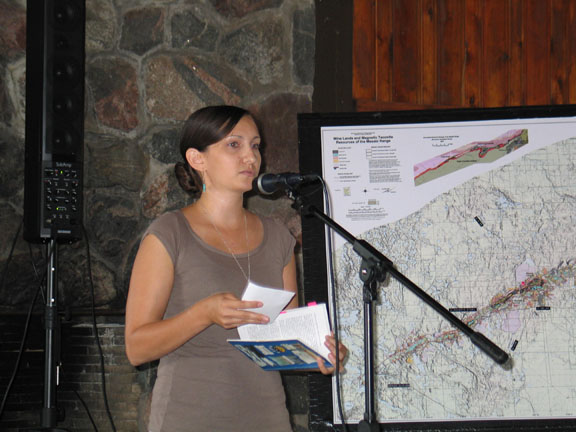 Jessica Koski of the Keweenaw Bay Indian Community (KBIC) near L'Anse, Mich., addresses participants at the Aug. 6, 2011, Protect the Earth Great Lakes Community Gathering at Van Riper State Park near Champion, Mich. Koski spoke about exploration for copper, nickel and uranium on and near the KBIC reservation. (Photo by Keweenaw Now)
CHAMPION, Mich. -- "Coming Together: Uniting for Strength and Success" was the theme of the 2011 Protect the Earth Great Lakes Community Gathering on Aug. 6 in Van Riper State Park near Champion, Mich. The line-up of speakers -- from Michigan, Wisconsin and Minnesota -- was evidence of the need for sharing experiences and seeking mutual support.
The speakers described efforts of several grassroots groups around the Great Lakes to protect this great supply of fresh water from a number of mining projects that now threaten a large area rich in minerals.
One of the speakers -- Jessica Koski of the Keweenaw Bay Indian Community (KBIC) near L'Anse, Michigan -- spoke about exploration for copper, nickel and uranium on and near the KBIC reservation. She also spoke about treaty rights and land and water protection.
 Jessica Koski of KBIC speaks about treaty rights at a teaching event on Eagle Rock in May 2010 before Rio Tinto / Kennecott fenced off the rock for use as the portal to their projected Eagle Mine -- a sulfide mine for copper and nickel near Big Bay, Mich. (File photo by Keweenaw Now)*
Koski, who holds degrees from Keweenaw Bay Ojibwa Community College and Michigan Tech University, recently completed a masters degree in environmental management from the Yale School of Forestry and Environmental Studies. She currently serves as Mining Technical Assistant for the KBIC Natural Resources Department. Koski has been involved in efforts to protect Eagle Rock, a sacred Anishinaabe (Ojibwa) site where Rio-Tinto / Kennecott plans to blast a portal for their Eagle Mine project for copper and nickel, possibly this month.
 This photo shows recent construction of a portal to the prospective Eagle Mine by Rio Tinto / Kennecott at Eagle Rock, an Ojibwa sacred site. Note cylinder-shaped cover over incline behind construction in foreground. Click on photo for larger version. (Photo taken Sept. 11, 2011, © and courtesy standfortheland.com)
After greeting the audience in the Ojibwa language, Koski said KBIC staff had recently (on Aug. 5, 2011) visited a site of active exploration drilling by Kennecott on land Kennecott owns within the KBIC Reservation. The site is called BIC (Bovine Igneous Complex). Its geology is similar to that of the contested Eagle Mine on the Yellow Dog Plains. According to Koski, the BIC site's target minerals, or minerals they are considering trying to mine, are metallic sulfides containing copper, nickel and platinum group elements.
"There are global mining interests that are coming to the Great Lakes region and are interested in the rich geology and rich mineral resources that we have here," Koski said, "but this is also a very rich water region -- so it's something that we have to protect."
Here is a video excerpt of Koski's comments on mining exploration and treaty rights during the 2011 Protect the Earth:
During the Aug. 6, 2011, Protect the Earth Great Lakes Community Gathering near Champion, Mich., Jessica Koski, who now serves as Mining Technical Assistant for the KBIC Natural Resources Department, speaks about mining exploration on and near the KBIC reservation and about treaty rights. (Videos by Allan Baker for Keweenaw Now)
Actually Kennecott is exploring at more than one site within the reservation, Koski noted. The following map shows exploration sites in and around the reservation as well as lakes and rivers in the area.
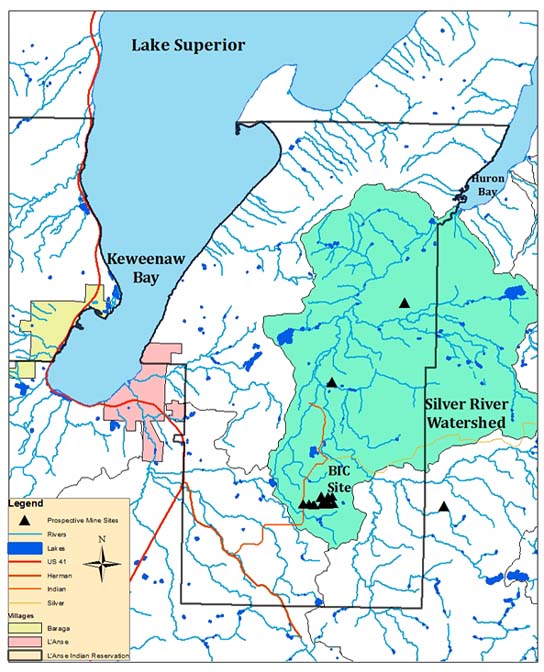 Click on this map for a larger version to see areas of mining exploration (small triangles) within and near the Keweenaw Bay Indian Community reservation. (Map courtesy Jessica Koski)
Koski told Keweenaw Now recently that KBIC did not sell land or mineral rights on the reservation to Kennecott.
"Land and mineral rights on our reservation are complicated due to history," Koski said. "While I don't know that my ancestors knew that the mineral rights would be severed from the surface and many elders and tribal members are still surprised to learn this to this day, that is how it is understood under Western law."
Koski noted the Dawes Allotment of 1887 divided up our reservation into individual allotments, and many of these allotments were unjustly taken by the state government.
"The purpose of this law was to assimilate Native Americans into American society," Koski explained. "Today, many non-Native people have settled on these allotments, and timber companies own some as well. A property ownership map of the reservation is quite complex -- consisting of KBIC land, federal trust land, BIA (Bureau of Indian Affairs) land, fee land, private ownership, etc."
The tribe does own land directly south of the BIC site, she added.
At least five additional companies are actively exploring for metallic sulfide and uranium mineral deposits in areas around the L’Anse and Ontonagon Reservations within KBIC Home Territory, Koski noted.
She also mentioned treaty rights -- legal documents that still exist today, although they have not been honored as they should be. According to legal scholars, Koski noted, Native American treaty rights -- such as the rights to hunting, fishing and gathering in the ceded territories -- could be a tool for protection of natural resources, including the Great Lakes.
Koski pointed out the recently adopted United Nations Declaration on the Rights of Indigenous Peoples -- endorsed by the United States -- could be another tool to assert as well, especially Free Prior and Informed Consent.
Koski mentioned two people who have inspired her. One was the late Walter Bressette, an Anishinaabe (Ojibwa) activist from the Red Cliff Band, who during his lifetime promoted a right to a healthy environment.
"And that's something that I really believe in," Koski said.
While the state permits give the mining companies the right to pollute, she added, we're not given the right to breathe clean air or drink clean water.
What Bressette did was look at the U.S. Constitution, the source and the preamble -- guaranteeing "the right to liberty and justice and well being to ourselves and our posterity, which means future generations," Koski said.
Koski read an excerpt by another person who influenced her -- First Nation (Canada) author Lorraine Rekmans, from This Is My Homeland: Stories of the effects of nuclear industries by people of the Serpent River First Nation and the north shore of Lake Huron, (edited by Lorraine Rekmans, Keith Lewis and Anabel Dwyer, published by the Serpent River First Nation, 2003.)
Rekmans wrote about her "bio-region" as her home -- the place where her ancestors walked -- a homeland she would defend.
"The mining companies may have a lot of mineral rights," Koski said, "but this is where we live. This is our bio-region, so we have a right to state our concerns about development."
Koski also spoke about jobs and the need for sustainable alternatives to mining, challenging the audience to come up with ideas for alternatives:
Jessica Koski speaks about jobs, challenging the Protect the Earth audience to come up with ideas for sustainable jobs for the Upper Peninsula.
During the question period following Koski's talk, Chuck Brumleve, geologist, who is working as KBIC's mining expert, answered a question on uranium exploration, noting Bitterroot Resources -- a Canadian Company whose mineral rights comprise approximately 461 square miles within Ontonagon, Houghton, Baraga and Iron Counties -- has explored for uranium west of the reservation in the Ottawa National Forest. They have three areas of exploration, Brumleve said -- the old Copper Range Mining Co. mineral rights to the north; copper, nickel, platinum exploration around Echo Lake; and uranium exploration further south near the Lac Vieux Desert reservation.
Some uranium has been found in people's wells, but Koski said she hadn't heard of a link between exploration and uranium in well water.
Brumleve pointed out the naturally occurring uranium in Jacobsville sandstone has occurred in some wells.
Another question concerned the status of the Humboldt Mill site, located about 23 miles from the L’Anse Reservation, south of US-41 in Humboldt Township, Marquette County, and within the 1842 ceded territories. The mill was originally an iron ore processing facility for the Humboldt Iron Mine and the nearby Republic Mine from 1954-1979. It consists of a large open-pit lake that naturally filled with groundwater and precipitation. Kennecott plans to use the site to process their ore from the projected Eagle Mine, thus adding 2.5 million tons of tailings to the site.
Brumleve explained the site right now is very polluted. Kennecott's own report indicated 26 contaminants that are migrating off the site.** He noted also that KBIC has requested that the U.S. Environmental Protection Agency (EPA) do a Superfund investigation of the site.
Following Jessica Koski's presentation at 2011 Protect the Earth, geologist Chuck Brumleve, who works as a mining expert for the Keweenaw Bay Indian Community, answers a question on the Humboldt Mill site, which Kennecott plans to use for processing ore from the projected Eagle Mine.
Koski also made available copies of a June 2011 map created by the Great Lakes Indian Fish and Wildlife Commission (GLIFWC), showing mines, mineral exploration and mineral leasing sites all around the Lake Superior watershed. The map was produced with funding from the Great Lakes Restoration Initiative (GLRI) and was compiled using data from various tribal, federal, state, and provincial sources. Click on this map for a larger version:
 This map of Mines, Mineral Exploration and Mineral Leasing in the Lake Superior Watershed was produced by GLIFWC (Great Lakes Indian Fish and Wildlife Commission) and is dated June 21, 2011. Click on map for larger version. (Map courtesy Esteban Chiriboga, GLIFWC Satellite Office, Madison, Wis.)
In a recent article Jessica Koski wrote for a KBIC newsletter, she states the following:
"Over time, tribes have developed the capacity to play a more prominent role in natural resource protection and mining related permit activities. There is also increasing recognition of the sovereign regulatory authority tribes possess, particularly through the federal Clean Air Act and Clean Water Act. Under the Montana v. United States (1981) case, it was recognized that tribes have a right to regulate the conduct of non-Indians within their reservations when that conduct threatens or has a direct effect on the political integrity, economic security or health and welfare of its members.
"Currently, the Mole Lake Sokaogon, Fond du Lac, Grand Portage, and Lac du Flambeau bands have their own Water Quality Standards; and the Bad River band recently submitted water quality standards for which federal approval is pending. KBIC is preparing to submit an application for TAS (treatment in the same manner as a state) which will then allow the community to establish and enforce its own Water Quality Standards as well."***
Updated: Koski has also been hosting a free monthly community film series, titled "Mining Impacts on Native Lands," in order to provide greater awareness to the social and environmental impacts mining can have on Native communities. The next film, Homeland, Four Portraits of Native Action, will be shown at 6 p.m. on Thursday, Oct. 6, at the Ojibwa Casino in Baraga. (Note new date and location.)
Editor's Notes:
* Read about the 2010 Treaty Rights Teaching event on Eagle Rock in our May 19, 2010, article.
** See our updated Aug. 29, 2011, article, "Protect the Earth 2011, Part 1: Walk to Humboldt mill, Rio Tinto-Kennecott projected ore processing site."
*** To read Jessica Koski's article in the September 2011 KBIC Newsletter, click here and scroll down to p. 11.
This is the second in a series of articles on Protect the Earth 2011.
Thursday, May 05, 2011
New Warriors for Earth launch new Web site
By Michele Bourdieu
BARAGA -- New Warriors for the Earth (Oshikinawe-Ogichidaag Akiing) recently launched their new Web site. New Warriors for the Earth, is an Anishinaabe-based non-profit organization dedicated to educating and empowering communities to take positive action to protect Aki, Mother Earth. Co-founders of the group are Jessica Koski and Cory Fountaine. Both are Anishinaabe and members of the Keweenaw Bay Indian Community (KBIC).
 During the 2010 Protect the Earth Gathering last July, at Keweenaw Bay Ojibwa Community College in Baraga, Jessica Koski and Cory Fountaine, co-founders of New Warriors for the Earth, present keynote speaker Winona LaDuke -- Native American activist, environmentalist and writer -- with the gift of a blue shawl. The Women's Movement for the Water is encouraging Native women to make and wear blue shawls to symbolize protecting the world's water for future generations. Fountaine, an art student, also designed the logo for the Protect the Earth banner. (Keweenaw Now 2010 file photo)
Fountaine, an artist and the proud father of two sons, is currently attending Ojibwa Community College in Baraga and Northern Michigan University in Marquette. This month Koski completed a master’s degree in environmental management from the Yale School of Forestry and Environmental Studies. She also holds an associate's degree from Ojibwa Community College and a bachelor's degree from Michigan Technological University. Koski recently accepted a full-time position as the Keweenaw Bay Indian Community’s Mining Technical Assistant.
"We are grounded and guided by our Anishinaabe heritage and culture," Koski says. "Our mission is to raise awareness about mining and environmental injustices facing the Western Great Lakes region and Aki. Our initial purpose is to protect our abundant freshwater resources and traditional homelands located in the Upper Peninsula of Michigan from intrusive multinational mining corporations and hazardous sulfide and uranium mining."
The new Web site offers a Community Education page that gives facts about sulfide mining and its impacts on the environment. It also offers a list of links to important documents of interest to anyone concerned with Native American treaties and environmental justice. The Culture page includes songs in the Ojibwa language and a video documentary on restoring the language.
In addition to news and events updates, New Warriors for the Earth has an attractive photo page of local interest. The video page offers inspiring video clips -- from Drew Nelson's illustrated song "Eagle Rock" to Winona LaDuke speaking on climate change and food sovereignty.
The About page gives profiles of Fountaine, Koski and other leaders of the group:
Editor's Note: See Jessica Koski's recent letter to the editor, "Gov. Snyder, halt Eagle Mine, consider long-term impacts," published in Keweenaw Now Apr. 14, 2011.
BARAGA -- New Warriors for the Earth (Oshikinawe-Ogichidaag Akiing) recently launched their new Web site. New Warriors for the Earth, is an Anishinaabe-based non-profit organization dedicated to educating and empowering communities to take positive action to protect Aki, Mother Earth. Co-founders of the group are Jessica Koski and Cory Fountaine. Both are Anishinaabe and members of the Keweenaw Bay Indian Community (KBIC).
 During the 2010 Protect the Earth Gathering last July, at Keweenaw Bay Ojibwa Community College in Baraga, Jessica Koski and Cory Fountaine, co-founders of New Warriors for the Earth, present keynote speaker Winona LaDuke -- Native American activist, environmentalist and writer -- with the gift of a blue shawl. The Women's Movement for the Water is encouraging Native women to make and wear blue shawls to symbolize protecting the world's water for future generations. Fountaine, an art student, also designed the logo for the Protect the Earth banner. (Keweenaw Now 2010 file photo)
Fountaine, an artist and the proud father of two sons, is currently attending Ojibwa Community College in Baraga and Northern Michigan University in Marquette. This month Koski completed a master’s degree in environmental management from the Yale School of Forestry and Environmental Studies. She also holds an associate's degree from Ojibwa Community College and a bachelor's degree from Michigan Technological University. Koski recently accepted a full-time position as the Keweenaw Bay Indian Community’s Mining Technical Assistant.
"We are grounded and guided by our Anishinaabe heritage and culture," Koski says. "Our mission is to raise awareness about mining and environmental injustices facing the Western Great Lakes region and Aki. Our initial purpose is to protect our abundant freshwater resources and traditional homelands located in the Upper Peninsula of Michigan from intrusive multinational mining corporations and hazardous sulfide and uranium mining."
The new Web site offers a Community Education page that gives facts about sulfide mining and its impacts on the environment. It also offers a list of links to important documents of interest to anyone concerned with Native American treaties and environmental justice. The Culture page includes songs in the Ojibwa language and a video documentary on restoring the language.
In addition to news and events updates, New Warriors for the Earth has an attractive photo page of local interest. The video page offers inspiring video clips -- from Drew Nelson's illustrated song "Eagle Rock" to Winona LaDuke speaking on climate change and food sovereignty.
The About page gives profiles of Fountaine, Koski and other leaders of the group:
- Charlotte Loonsfoot, KBIC member, who started the camp at Eagle Rock in April and May 2010 -- a mother of five children -- is committed to protecting the water for future generations. She has an associate's degree from Ojibwa Community College and plans to attend Michigan Tech for further study.
- Kalvin Hartwig, a member of the Sault Ste. Marie Tribe of Chippewa Indians, a Michigan Tech graduate who has been studying at Yale University, was a fire-keeper and camper at Eagle Rock. This summer he will be interning at the United Nations Secretariat of the Permanent Forum on Indigenous Issues.
- Casey Snyder, who grew up in rural central Michigan alongside many Anishinaabe people and has Metis ancestry, also participated in the 2010 occupation of Eagle Rock and played an important role in the start-up of New Warriors for the Earth.
Editor's Note: See Jessica Koski's recent letter to the editor, "Gov. Snyder, halt Eagle Mine, consider long-term impacts," published in Keweenaw Now Apr. 14, 2011.
Thursday, April 14, 2011
Letter from Jessica Koski: Gov. Snyder, halt Eagle Mine, consider long-term impacts
 To the editor:
I submitted a letter to Michigan Governer Rick Snyder on April 13 to urge him to use his authority to promptly issue an Executive Order calling for an immediate halt to activity at the Eagle Mine site, until the following points are considered. I wrote this letter in support of a recent citizen coalition "WAVE" letter to Snyder on March 24 (1).
1. Cumulative impacts of the Eagle Project. There should be a holistic impact study of the mine, mill and road, and six additional adjacent prospective projects that all add up (2). This includes impacts to fresh-water resources, wetlands habitat, social well-being, and culture (including federally entrusted treaty rights dependent upon uncontaminated fish, game, berries, and traditional medicines). A cumulative impact study should meaningfully involve the public and tribal nations throughout the process to help inform the community and decision-makers.
2. Short and long-term costs and benefits. The Eagle Project may offer much needed temporary employment, but what will be the long-term economic costs and impacts on jobs? What will be the impacts to the tourism, recreation, gaming and other industries that realistically cannot co-exist with large-scale extractive industry? Who will pay to clean up potential damage to natural resources beyond the company’s $17 million dollar assurance bond? (3) An independent study of the short- and long-term costs and benefits should be commissioned.
3. A state mining tax. Kennecott, a subsidiary of mining conglomerate Rio Tinto which is based in London, plans to profit $4.7 billion from the Eagle ore body. During our hard economic times, what does the state of Michigan expect to get in return with apparently no mining tax law? (4)
4. Mitigation of a religious Native American site Migi zii wa sin (Eagle Rock). Michigan State Administrative Law Judge Richard Patterson recommended that "provisions be made to avoid direct impacts to Eagle Rock that may interfere with religious practices theron." (5) The National Congress of American Indians has also called for Federal and State action to guarantee the protection and preservation of Eagle Rock from the consequences of mining operations by Kennecott Eagle Minerals. (6)
It’s possible to envision alternative sustainable development opportunities for Michigan’s Upper Peninsula. Traditional economic theorists, such as Adam Smith, believed economic growth to be dependent upon external capital and extraction of more resources. However, true economic progress is self-sustaining and driven from within, as leading economic scholar Paul Romer terms "endogenous growth theory" where people have an "incentive to go out and discover things like ideas, not to do things like dig up another cubic yard of iron ore." (7)
It is not too late to realize and overcome the socially divisive impacts already affecting the community by a multinational mining corporation. It doesn’t have to be a choice between jobs or a healthy environment, we have a right to demand both. We need leadership from all levels of government -- peoples lives, culture and future are at stake, not just jobs.
Sincerely,
Jessica L. Koski
Citizen, Baraga, Michigan
Member, Keweenaw Bay Indian Community
Master of Environmental Management Candidate ’11
Yale School of Forestry and Environmental Studies
Notes:
1. Click here for WAVE letter to Gov. Snyder.
2. See "Rio Tinto to enter nickel market with US$300 million Eagle Mine commitment" (Rio Tinto media release: Dec. 17, 2007).
3. See See Gabriel Caplett, "Michigan Rep. Bart Stupak Reiterates Concerns With Rio Tinto Mine" (Headwaters News: July 19, 2010).
4. See Charlotte Loonsfoot, "Counting the dollars" (Letter to Marquette Mining Journal: March 21, 2011).
5. Click here to read the State of Michigan State Office of Administrative Hearings and Rules document on the Petitions of the Keweenaw Bay Indian Community, Huron Mountain Club, National Wildlife Federation and Yellow Dog Watershed Environmental Preserve, Inc., on permits issued to the Kennecott Eagle Minerals Company.(See especially pp. 170-172 and Judge Patterson's statement on p. 177.)
6. Click here to read The National Congress of American Indians Resolution #ABQ-10-078: "Calling for Federal and State Action to Guarantee the Protection and Preservation of Eagle Rock from the Consequences of Mining Operations by Kennecott Eagle Minerals."
7. Paul Romer in "An Interview with Paul Romer on Economic Growth," by Russell Roberts (Library of Economics and Liberty: Nov. 5, 2007).
Editor's Note: Jessica Koski, author of this letter, spoke in defense of Eagle Rock and against the Rio Tinto/ Kennecott Eagle Mine at the 2010 Annual General Meeting (AGM) of Rio Tinto in London, England. Rio Tinto's 2011 AGM is being held today, April 14, 2011, in London.
Photo: Jessica Koski of the Keweenaw Bay Indian Community, author of this letter, speaks at the 2009 Protect the Earth event at Eagle Rock. (File photo by Keweenaw Now)
Subscribe to:
Posts (Atom)