HOUGHTON -- Keweenaw Unitarian Universalist Fellowship (KUUF) will host guest Jim Ludwig, speaking on "Recent Mine Reclamation in Wisconsin: The Jackson County Iron Mine and the Flambeau Mine," at its forum at 10:30 a.m. on Sunday, April 14, 2013.
Ludwig is an ecotoxicologist who planned and directed the well-known reclamation of (Rio Tinto) Kennecott's Flambeau Copper Mine in Ladysmith,Wis. This is the second in a series on Mining in the UP. The series will bring people with various perspectives to cultivate and inform our thinking and understanding about this form of land use.
KUUF programs and services are held in the community conference room at the BHK Center, Waterworks St. entrance, Houghton.
More information about the Keweenaw Unitarian Universalist Fellowship is available at 482-5586 and on the web at www.kuuf.net.
Showing posts with label Flambeau Mine. Show all posts
Showing posts with label Flambeau Mine. Show all posts
Thursday, April 11, 2013


Wednesday, July 25, 2012
Court: Flambeau Mining Company violated Clean Water Act
MADISON, Wis. -- A federal court ruled yesterday that the Flambeau Mining Company violated the Clean Water Act on multiple occasions by allowing pollution from its Flambeau Mine site -- near Ladysmith, Wis. -- to enter the Flambeau River and a nearby tributary. Eleven of these occasions occurred within the applicable statute of limitations, resulting in liability for 11 violations of the Act.
"The Clean Water Act requires that discharges of pollutants to public waters like the Flambeau River be regulated by a permit that sets clear limits on the amount of pollutants and protects the water quality of the stream," said James Saul, an attorney with McGillivray, Westerberg and Bender. "The Flambeau Mining Company never sought or obtained such a permit and therefore was found to be in violation of the Act."
The lawsuit resulting in yesterday’s ruling was filed early last year by the Wisconsin Resources Protection Council (WRPC), the Center for Biological Diversity and Laura Gauger against the Flambeau Mining Company, a subsidiary of Rio Tinto plc and formerly of Kennecott Minerals Company. The complaint charged that the mine site, which closed in 1997, discharges stormwater runoff containing toxic levels of metals from a detention basin known as the biofilter.*
Monitoring data from the mining company and the Wisconsin Department of Natural Resources show that copper levels in the discharge exceeded Wisconsin’s acute toxicity criterion of 8 µg/L -- set to protect fish and other aquatic species -- sometimes by several times.
Plaintiffs prevailed on most issues in the case on pre-trial motions. The sole issue left for the liability trial was whether Flambeau Mining Company’s discharges actually reached the Flambeau River or an adjacent tributary known as Stream C. During a five-day trial in May, Flambeau Mining Company claimed that the discharges never reached these waters.
In yesterday’s order, the judge rejected that claim, in part by citing multiple documents authored by Flambeau Mining Company itself stating that the discharge entered Stream C.
For example, the judge noted, "Anyone concluding that no biofilter discharge ever reached Stream C . . . would have to disregard the evidence of the plan that defendant designed for handling runoff from the industrial outlot -- a plan that the DNR approved."
"We’re glad to see the court recognized what concerned citizens have known for years: that even a relatively small-scale copper mine can still pollute our waters for years after it has closed," said WRPC Executive Secretary Al Gedicks.*
"We cannot allow mining companies to pollute our water," said plaintiff Laura Gauger. "They need to follow the same laws as you and I do."*
The court’s decision also undercuts the Flambeau Mine’s status as an environmentally successful "example mine." Wisconsin’s Mining Moratorium Law prohibits the mining of a sulfide ore body unless mine proponents can point to a mine that has been closed for at least 10 years without polluting the environment.
"There are a number of large copper-mine proposals pending in this region, and the continuing pollution at this much smaller and short-term mine does not bode well for the larger strip-mine projects," said Marc Fink, attorney with the Center for Biological Diversity.
The judge approvingly noted Flambeau Mining Company’s efforts to remediate the mine site. Many of these measures, including a recent series of infiltration basins, were undertaken after plaintiffs filed their suit.
The Wisconsin Resources Protection Council (WRPC) is a statewide, nonprofit membership organization concerned with the environmental impacts of metallic mining on the state’s precious water supplies, on the tourism and dairy industries, and upon the many Native American communities that are located near potential mine sites. WRPC educates the public about the consequences of allowing international mining corporations to develop a new mining district in the Lake Superior region.
The Center for Biological Diversity is a national, nonprofit conservation organization with more than 375,000 members and online activists dedicated to the protection of endangered species and wild places. See www.biologicaldiversity.org.
Ms. Laura Gauger is a member of WRPC and the Center of Biological Diversity. Ms. Gauger is formerly a resident of Spooner, Wis., and currently resides in Duluth, Minn.
The citizen groups and Ms. Gauger were represented in the case by attorneys James Saul, Pamela McGillivray, Christa Westerberg and David Bender (McGillivray, Westerberg and Bender; Madison, Wis.), Kevin Cassidy and Dan Mensher (Pacific Environmental Advocacy Center; Portland, Ore.) and Marc Fink (Center for Biological Diversity; Duluth, Minn.).
*Editor's Note: See our Aug. 5, 2009, article, "Protect the Earth 2009: Part 1," in which both Laura Gauger (formerly Furtman) and Al Gedicks spoke about pollution at the Flambeau Mine. See more background on this lawsuit in our Jan. 25, 2011, article, "Updated: Lawsuit filed against Kennecott subsidiary for water pollution at Flambeau Mine site."
"The Clean Water Act requires that discharges of pollutants to public waters like the Flambeau River be regulated by a permit that sets clear limits on the amount of pollutants and protects the water quality of the stream," said James Saul, an attorney with McGillivray, Westerberg and Bender. "The Flambeau Mining Company never sought or obtained such a permit and therefore was found to be in violation of the Act."
The lawsuit resulting in yesterday’s ruling was filed early last year by the Wisconsin Resources Protection Council (WRPC), the Center for Biological Diversity and Laura Gauger against the Flambeau Mining Company, a subsidiary of Rio Tinto plc and formerly of Kennecott Minerals Company. The complaint charged that the mine site, which closed in 1997, discharges stormwater runoff containing toxic levels of metals from a detention basin known as the biofilter.*
Monitoring data from the mining company and the Wisconsin Department of Natural Resources show that copper levels in the discharge exceeded Wisconsin’s acute toxicity criterion of 8 µg/L -- set to protect fish and other aquatic species -- sometimes by several times.
Plaintiffs prevailed on most issues in the case on pre-trial motions. The sole issue left for the liability trial was whether Flambeau Mining Company’s discharges actually reached the Flambeau River or an adjacent tributary known as Stream C. During a five-day trial in May, Flambeau Mining Company claimed that the discharges never reached these waters.
In yesterday’s order, the judge rejected that claim, in part by citing multiple documents authored by Flambeau Mining Company itself stating that the discharge entered Stream C.
For example, the judge noted, "Anyone concluding that no biofilter discharge ever reached Stream C . . . would have to disregard the evidence of the plan that defendant designed for handling runoff from the industrial outlot -- a plan that the DNR approved."
"We’re glad to see the court recognized what concerned citizens have known for years: that even a relatively small-scale copper mine can still pollute our waters for years after it has closed," said WRPC Executive Secretary Al Gedicks.*
"We cannot allow mining companies to pollute our water," said plaintiff Laura Gauger. "They need to follow the same laws as you and I do."*
The court’s decision also undercuts the Flambeau Mine’s status as an environmentally successful "example mine." Wisconsin’s Mining Moratorium Law prohibits the mining of a sulfide ore body unless mine proponents can point to a mine that has been closed for at least 10 years without polluting the environment.
"There are a number of large copper-mine proposals pending in this region, and the continuing pollution at this much smaller and short-term mine does not bode well for the larger strip-mine projects," said Marc Fink, attorney with the Center for Biological Diversity.
The judge approvingly noted Flambeau Mining Company’s efforts to remediate the mine site. Many of these measures, including a recent series of infiltration basins, were undertaken after plaintiffs filed their suit.
The Wisconsin Resources Protection Council (WRPC) is a statewide, nonprofit membership organization concerned with the environmental impacts of metallic mining on the state’s precious water supplies, on the tourism and dairy industries, and upon the many Native American communities that are located near potential mine sites. WRPC educates the public about the consequences of allowing international mining corporations to develop a new mining district in the Lake Superior region.
The Center for Biological Diversity is a national, nonprofit conservation organization with more than 375,000 members and online activists dedicated to the protection of endangered species and wild places. See www.biologicaldiversity.org.
Ms. Laura Gauger is a member of WRPC and the Center of Biological Diversity. Ms. Gauger is formerly a resident of Spooner, Wis., and currently resides in Duluth, Minn.
The citizen groups and Ms. Gauger were represented in the case by attorneys James Saul, Pamela McGillivray, Christa Westerberg and David Bender (McGillivray, Westerberg and Bender; Madison, Wis.), Kevin Cassidy and Dan Mensher (Pacific Environmental Advocacy Center; Portland, Ore.) and Marc Fink (Center for Biological Diversity; Duluth, Minn.).
*Editor's Note: See our Aug. 5, 2009, article, "Protect the Earth 2009: Part 1," in which both Laura Gauger (formerly Furtman) and Al Gedicks spoke about pollution at the Flambeau Mine. See more background on this lawsuit in our Jan. 25, 2011, article, "Updated: Lawsuit filed against Kennecott subsidiary for water pollution at Flambeau Mine site."
Saturday, May 19, 2012
Opinion: Wisconsin mine law needs public process, not "consensus"
By Al Gedicks and Eric Hansen*
If no mining company has been able to meet the standards of Wisconsin’s mining moratorium law, it does not mean the law is flawed and in need of revision. It means the mining industry’s claim of being able to mine safely lacks scientific merit.
Gogebic Taconite may have temporarily abandoned its proposed open pit iron mine at the pristine headwaters of the Bad River, but company spokesman Bob Seitz says the firm still wants Wisconsin’s mining law changed. Efforts are under way to develop a new "consensus" on legislation that failed to pass the Senate in the last session.
George Meyer, executive director of the Wisconsin Wildlife Federation (WWF), has met with Tim Sullivan, president of the Wisconsin Mining Association, to develop a compromise bill. According to Meyer, WWF and the mining association "agree on 90 percent" of the issues.**
Something is wrong with Meyer, Sullivan and other interested parties getting together to work out "consensus" legislation that would allow GTac and other proposed mines to go forward. That process would elevate an unrepresentative group over the broad, thorough civic discussion and scientific investigation that has served this state’s citizens, and its water, so well.
When Wisconsinites last saw this "consensus" approach to mining legislation, it resulted in regulations allowing groundwater contamination beneath and around mine sites. That ill-advised legislation was the result of a 1980s push by mining companies (Exxon, Kennecott and Inland Steel) and the Department of Natural Resources to overturn the previously existing policy of nondegradation of groundwater. Kennecott then obtained a permit for its Flambeau open pit copper and gold mine at Ladysmith in the early 1990s. Kennecott’s own monitoring wells now show the groundwater there is highly polluted with sulfates and various metals.
Wisconsinites thoroughly rejected the lax regulation that that "consensus" developed. In 1998 a broad-based alliance of conservation-minded citizens succeeded in passing Wisconsin’s common sense "show me it is safe first" mining moratorium law. A 29-3 bipartisan vote in the state Senate reflected the depth of support.***
This wise law reflects a high regard for due diligence and reasonable prudence -- but did not ban mining. It simply requires mining companies to prove their proposed mine would not pollute groundwater or surface water where sulfides are present in the ore body or the rock surrounding the ore body.
Sulfides exposed to air and water create acid mine drainage. Exxon could not meet the requirements of the law and withdrew from the controversial Crandon mine project, which threatened the Wolf River, in 1998.
GTac’s managing director, Matt Fifield, denies that the rock layers covering the iron ore deposit near the Bad River contain sulfides. Both the DNR and the U.S. Geological Survey disagree.
The iron mining bill that was proposed late last year, written by GTac, would have exempted the company from the requirements of the mining moratorium law. Any compromise legislation that allows GTac to mine where sulfides are present would threaten both Ashland’s drinking water and the Bad River Chippewa Tribe’s renowned wild rice beds.
One overwhelming message came out of public hearings on the bill written by GTac: The citizens and tribes of Wisconsin are not prepared to trade mining jobs for the long-term contamination of their water.
In addition, the secretive process that produced GTac’s mine bill reconfirmed a broad truth: An informed and assertive public is the watchdog that guarantees the public’s ability to question and block ill-advised industrial schemes.
Insist that your elected state representatives stand up for clean government, local control and an open public process for any mining bill procedure. Urge them to oppose an elite "consensus" decision-making group that includes GTac’s mining lobbyists but leaves the majority of Wisconsin citizens and tribal members out of the process.
* Al Gedicks is a professor of sociology at UW-La Crosse, executive secretary of the Wisconsin Resources Protection Council and author of Resource Rebels: Native Challenges to Mining and Oil Corporations. Eric Hansen is an award-winning outdoor writer, conservation essayist and public radio commentator. This article originally appeared in The CapTimes. It is reprinted here with the permission of the authors.
Editor's Notes:
** In a press release from the National Wildlife Federation (NWF), which recently released a legal analysis of weak laws and lax enforcement of mining laws in the Great Lakes Region (that showed mining laws and enforcement in Wisconsin as somewhat better than in Minnesota, Michigan or Ontario) George Meyer was cited as saying, "'While we may be faring better than our counterparts in Michigan and Minnesota, this study makes clear that Wisconsin has a long way to go before our residents can rest easy in regards to sulfide mining.'" Click here to read this May 10, 2012, NWF press release, "Great Lakes Remain Vulnerable to New Wave of Dangerous Mining, According to New Report."
When Keweenaw Now asked Meyer (during a recent NWF telephone press conference) about that moratorium in the light of sulfide mines now being proposed in Wisconsin, he said, "It is not a moratorium ... it is more of a standard that must be met by the agency before it issues a sulfide mining permit in Wisconsin." The standard, he explained requires that, before permitting a mine, a regulatory agency must find that -- anywhere in North America -- there has been a sulfide mine closed for 10 years without violating environmental laws as well as an existing sulfide mine that has been operating for 10 years without violating such laws. As far as the Flambeau Mine near Ladysmith, Wis., which Kennecott holds up as an example of a "successful" sulfide mine (now closed), Meyer said there is some contamination coming from it (as the authors of this article state above) but that, while some individuals find it significant, the regulating agency doesn't find it significant.
*** Click here to read the two-page Mining Moratorium Law, titled "1997 WISCONSIN ACT 171."
See also our Jan. 25, 2011, article, "Updated: Lawsuit filed against Kennecott subsidiary for water pollution at Flambeau Mine site."
Saturday, January 07, 2012
Letter: Urgent appeal concerning Flambeau Mine water pollution
The Wisconsin Resources Protection Council (WRPC) is asking you to voice your support for a proposal by the Wisconsin Department of Natural Resources (DNR) to list an unnamed stream at the Flambeau Mine site (known as "Stream C") as "impaired" due to copper and zinc toxicity. The Flambeau Mine, owned by London-based Rio Tinto, operated near Ladysmith, Wis., from 1993 to 1997. According to company reports, the mine produced 181,000 tons of copper, 3.3 million ounces of silver and 334,000 ounces of gold.
The DNR recently released its proposed 2012 list of "impaired waters" -- a list of lakes, rivers, and streams that are too polluted to meet state water quality standards intended to protect public health and aquatic life. On the list is Stream C, which flows over the southeast corner of the Flambeau Mine site, close to where the ore crusher was located and other mining-related activities took place in the mid-1990s. Toxic levels of copper were discovered in the stream shortly after the mine’s closure, and the pollution continues to this day. The part of the Flambeau Mine site where Stream C is located has not been released from state reclamation requirements.
Water quality data collected by both Flambeau Mining Company (FMC -- the Rio Tinto subsidiary that operated the Flambeau Mine) and the DNR since the early 2000s show that Stream C consistently has had levels of copper (and sometimes zinc) over the concentrations established by the DNR to protect surface waters from "acute toxicity."
Stream C flows in the vicinity of the mine’s former rail spur and across a portion of the mine site that, to date, has failed to be certified by the DNR as being successfully reclaimed by FMC. From there the stream meanders through a wooded area and eventually discharges into the nearby Flambeau River. Stream C is known to receive runoff from areas where mining wastes were stored in the past and where toxic discharges continue to this day. A DNR-designated "reference stream" does not show toxic levels of copper or zinc. Nor do two additional small streams being monitored in the area.
Earlier this year, the Wisconsin Resources Protection Council and Center for Biological Diversity filed a federal Clean Water Act lawsuit against Flambeau Mining Company for its toxic discharges of metals, including copper, iron, and zinc, into Stream C and the Flambeau River; the litigation is ongoing.
In addition, because of the consistently toxic levels of copper (and sometimes zinc) that have been documented in Stream C over the past decade, WRPC petitioned the DNR in late 2010 to consider classifying Stream C as "impaired." The inclusion of Stream C on the Department’s proposed 2012 list of "impaired waters" shows that the DNR listened to us. But it is not a done deal.
We expect Flambeau Mining Company to actively lobby the DNR to take this stream off the impaired waters list proposed by the Department (see press release from FMC -- link can be found below) -- there is a public comment period now underway.
WRPC is appealing to Wisconsin mining activists to submit written comments to the DNR in support of the Department’s proposal to list Stream C as impaired for copper and zinc and to ask that the DNR require Flambeau Mining Company to clean up its mess.
Public comments are due by February 20, 2012, and can be sent via email or regular mail to:
Email: dnrimpairedwaters@wisconsin.gov or AaronM.Larson@wisconsin.gov
Mail: Aaron Larson
Wisconsin DNR
Water Evaluation Section – WT/3
101 S. Webster St.
PO Box 7921
Madison, WI 53707-7921
For more information, please go to:
1. DNR’s impaired waters webpage: http://dnr.wi.gov/org/water/wm/wqs/303d/
When the page pops up, do the following:
-Click on Search 2012 Current, Proposed, and Restored Impaired Waters
-Next you will be asked to "Enter Water Name or WBIC." Enter the following: "Stream C, trib to Flambeau River" and click "Search"
2. Another listing on DNR’s impaired waters webpage:
http://dnr.wi.gov/org/water/condition/impaired/comment.htm
When the page pops up, do either or both of the following:
-Click on 2012 Impaired Waters List (Stream C is listed as "Unnamed" on the Excel spreadsheet)
-Or click on View a summary of the data submitted to see detailed information on Stream C
3. Flambeau Mining Company’s press release from 12/11/2011:
http://www.thewheelerreport.com/releases/December11/1220/1220flambeau.pdf
4. Milwaukee Journal-Sentinel article about the proposed impaired waters list, including a paragraph about Flambeau and Stream C: http://www.jsonline.com/blogs/news/135968848.html
5. Milwaukee Journal Sentinel front-page article from November 2011 about Flambeau Mine pollution:
http://www.jsonline.com/news/wisconsin/tests-find-toxins-at-flambeau-mine-133051073.html
6. WRPC website: www.wrpc.net
-For information on our lawsuit, click on the "Flambeau Mine Lawsuit" tab at the top of the home page. To specifically access the "Notice Letter" filed by WRPC in federal court (which includes data for the polluted discharge to Stream C), click on the third document listed under "Official Correspondence."
Thank You!
Al Gedicks and Laura Gauger
Editor's Note: Keweenaw Now first learned about the Kennecott / Flambeau Mining Company's pollution of Stream C from Laura (Furtman) Gauger's presentation at Protect the Earth 2009. See our Aug. 5, 2009, article, "Protect the Earth 2009: Part 1."
The DNR recently released its proposed 2012 list of "impaired waters" -- a list of lakes, rivers, and streams that are too polluted to meet state water quality standards intended to protect public health and aquatic life. On the list is Stream C, which flows over the southeast corner of the Flambeau Mine site, close to where the ore crusher was located and other mining-related activities took place in the mid-1990s. Toxic levels of copper were discovered in the stream shortly after the mine’s closure, and the pollution continues to this day. The part of the Flambeau Mine site where Stream C is located has not been released from state reclamation requirements.
Water quality data collected by both Flambeau Mining Company (FMC -- the Rio Tinto subsidiary that operated the Flambeau Mine) and the DNR since the early 2000s show that Stream C consistently has had levels of copper (and sometimes zinc) over the concentrations established by the DNR to protect surface waters from "acute toxicity."
Stream C flows in the vicinity of the mine’s former rail spur and across a portion of the mine site that, to date, has failed to be certified by the DNR as being successfully reclaimed by FMC. From there the stream meanders through a wooded area and eventually discharges into the nearby Flambeau River. Stream C is known to receive runoff from areas where mining wastes were stored in the past and where toxic discharges continue to this day. A DNR-designated "reference stream" does not show toxic levels of copper or zinc. Nor do two additional small streams being monitored in the area.
Earlier this year, the Wisconsin Resources Protection Council and Center for Biological Diversity filed a federal Clean Water Act lawsuit against Flambeau Mining Company for its toxic discharges of metals, including copper, iron, and zinc, into Stream C and the Flambeau River; the litigation is ongoing.
In addition, because of the consistently toxic levels of copper (and sometimes zinc) that have been documented in Stream C over the past decade, WRPC petitioned the DNR in late 2010 to consider classifying Stream C as "impaired." The inclusion of Stream C on the Department’s proposed 2012 list of "impaired waters" shows that the DNR listened to us. But it is not a done deal.
We expect Flambeau Mining Company to actively lobby the DNR to take this stream off the impaired waters list proposed by the Department (see press release from FMC -- link can be found below) -- there is a public comment period now underway.
WRPC is appealing to Wisconsin mining activists to submit written comments to the DNR in support of the Department’s proposal to list Stream C as impaired for copper and zinc and to ask that the DNR require Flambeau Mining Company to clean up its mess.
Public comments are due by February 20, 2012, and can be sent via email or regular mail to:
Email: dnrimpairedwaters@wisconsin.gov or AaronM.Larson@wisconsin.gov
Mail: Aaron Larson
Wisconsin DNR
Water Evaluation Section – WT/3
101 S. Webster St.
PO Box 7921
Madison, WI 53707-7921
For more information, please go to:
1. DNR’s impaired waters webpage: http://dnr.wi.gov/org/water/wm/wqs/303d/
When the page pops up, do the following:
-Click on Search 2012 Current, Proposed, and Restored Impaired Waters
-Next you will be asked to "Enter Water Name or WBIC." Enter the following: "Stream C, trib to Flambeau River" and click "Search"
2. Another listing on DNR’s impaired waters webpage:
http://dnr.wi.gov/org/water/condition/impaired/comment.htm
When the page pops up, do either or both of the following:
-Click on 2012 Impaired Waters List (Stream C is listed as "Unnamed" on the Excel spreadsheet)
-Or click on View a summary of the data submitted to see detailed information on Stream C
3. Flambeau Mining Company’s press release from 12/11/2011:
http://www.thewheelerreport.com/releases/December11/1220/1220flambeau.pdf
4. Milwaukee Journal-Sentinel article about the proposed impaired waters list, including a paragraph about Flambeau and Stream C: http://www.jsonline.com/blogs/news/135968848.html
5. Milwaukee Journal Sentinel front-page article from November 2011 about Flambeau Mine pollution:
http://www.jsonline.com/news/wisconsin/tests-find-toxins-at-flambeau-mine-133051073.html
6. WRPC website: www.wrpc.net
-For information on our lawsuit, click on the "Flambeau Mine Lawsuit" tab at the top of the home page. To specifically access the "Notice Letter" filed by WRPC in federal court (which includes data for the polluted discharge to Stream C), click on the third document listed under "Official Correspondence."
Thank You!
Al Gedicks and Laura Gauger
Editor's Note: Keweenaw Now first learned about the Kennecott / Flambeau Mining Company's pollution of Stream C from Laura (Furtman) Gauger's presentation at Protect the Earth 2009. See our Aug. 5, 2009, article, "Protect the Earth 2009: Part 1."
Saturday, November 19, 2011
Updated: Penokee iron mining proposal threatens Bad River watershed
By Michele Bourdieu
 View of the Penokee Hills in northern Wisconsin, where Gogebic Taconite (GTAC) plans to put a huge open pit iron mine. Click on photos for larger versions. (Photo © Pete Rasmussen, Moving Water Photography, and courtesy Penokee Hills Education Project.* Reprinted with permission.)
LA CROSSE, WISCONSIN -- Al Gedicks, professor of sociology at the University of Wisconsin - La Crosse and author of Resource Rebels: Native Challenges to Mining and Oil Corporations, recently published an article on the projected Gogebic Taconite (GTAC) open-pit mine for taconite iron deposits of the Penokee Range in northern Wisconsin. The article, titled "Resisting Resource Colonialism in the Lake Superior Region," was published by Z Magazine in September 2011.**
At the beginning of the article, Gedicks notes his main concern about the potential impact of such a mine: its effect on the water.
"The water that flows off the iron-rich Penokee Hills feeds the Penokee aquifer and the Bad River watershed, which flows into Lake Superior and provides drinking water for the city of Ashland and nearby towns. The water also feeds the wild rice beds of the Bad River Ojibwe Tribe. Wild rice is a sacred plant for the Ojibwe and an important food source. The tribe’s wild rice beds are the largest in the state," Gedicks writes.
 For the Bad River Ojibwe Tribe, clean water is essential for their fisheries and wild rice crop. This photo shows a brook trout from Spring Brook in the Penokees. (Photo © Pete Rasmussen, Moving Water Photography, and courtesy Penokee Hills Education Project.* Reprinted with permission.)
This is not the first time Gedicks has been involved in a mining project that threatened water quality and Native American rights. He was actively involved in the struggle against the Crandon Mine, which he wrote about in two well documented books: The New Resource Wars: Native and Environmental Struggles Against Multinational Corporations (1993) and Resource Rebels: Native Challenges to Mining and Oil Corporations (2001). That struggle eventually led to Wisconsin's moratorium on sulfide mining. Gedicks summarized this for an audience at the 2011 Protect the Earth Gathering at Van Riper State Park near Champion, Mich., last summer. Here is an excerpt from his talk:
During the 2011 Protect the Earth Gathering at Van Riper State Park near Champion, Mich., Al Gedicks, professor of sociology at the University of Wisconsin - La Crosse, speaks about the importance of the struggle against the Crandon Mine, which led to Wisconsin's moratorium on sulfide mining. (Video by Allan Baker for Keweenaw Now)
What the proponents of this iron mine seem to be seeking is legislation that will distinguish between ferrous and non-ferrous mining so that the permitting process for iron mining will be speeded up.
Unlike Rio Tinto-Kennecott's Eagle Mine for nickel and copper near Big Bay, Mich., the Penokee iron ore project is not considered a sulfide mine. GTAC, which has leases for the mineral rights on 22,000 acres of the Penokee-Gogebic Range, covering 22 miles in Wisconsin's Ashland and Iron Counties, stresses the difference between ferrous and non-ferrous mining in their public relations, trying to convince the public that this "iron" mine is safer than a "sulfide" mine that has a high potential to produce acid mine drainage (AMD) -- since iron mining, as they describe it, does not use chemicals.***
As Gedicks points out in his article, GTAC goes beyond just public relations trying to prove their claims that taconite mining can be done safely without harming the environment. They are heavily involved in "crafting legislation that would prevent the public and the state’s Indian Nations from challenging any of these claims by excluding them from participation in the mine permitting process."
In fact, he notes, GTAC "contributed more than $40,000 in 2010 campaign contributions to Republican candidates involved with the mining issue, including Wisconsin Gov. Scott Walker and Rep. Mark Honadel (R-South Milwaukee)."
Penokee project discussed at Oct. 27 meeting on legislation, Hurley, Wis.
Gogebic Taconite's projected open-pit mine for taconite iron deposits of the Penokee Range in northern Wisconsin was an important part of the discussion at an informational hearing in Hurley, Wis., on Oct. 27, 2011. The meeting was called by the Wisconsin Assembly Committee on Jobs, Economy and Small Business. The subject of the meeting was "Creation of Iron Mining Statutes in Wisconsin: Economic and Environmental Considerations."
Its purpose was stated in the meeting announcement as follows: "In the near future and following the Informational Hearing, the Committee will be tasked with considering legislation to update Wisconsin's metallic mining laws to reflect the differences between ferrous and nonferrous mining. The legislation will have two primary goals: ensuring that ferrous mining in this state is economical, and providing for reasonable environmental protections. The purpose of the Informational Hearing is to gather relevant information related to this task." Invited speakers and the public were asked to comment.
Wisconsin Public Radio interview
At 7 a.m. on Oct. 27, just a few hours before this meeting, Wisconsin Public Radio's Ideas Network broadcast an interview presenting two opposing views on the subject. The interviewer, Joy Cardin, first spoke by telephone with one of the invited speakers -- Tim Sullivan, chair of the Wisconsin Mining Association and former president and CEO of Bucyrus International, Inc. Sullivan was on his way to the meeting. Cardin also interviewed Al Gedicks. The listening audience was invited to call in their questions.
Sullivan mentioned the Crandon Mine, admitting it was a complicated issue and many of the objections to it were "probably appropriate," especially since it was an underground mine and located at the headwaters of the Wolf River.
"It was a copper mine, which is a sulfide mine," Sullivan said.
He added that the processing of copper requires chemicals, while an iron mine, such as the projected open-pit Gogebic Taconite mine, uses large magnets -- not chemicals -- to extract the iron.
Sullivan expressed concern that the iron mining company should not get caught in laws that were made in response to the Crandon Mine.
"No one wants to unduly speed the process, but we want to make it so it's at least reasonable," Sullivan told Cardin.
Sullivan noted the purpose of proposed legislation would be to differentiate between ferrous and non-ferrous mining so that ferrous (iron) mining does not come under laws for a sulfide mine. He said the mine proponents want to align processing time (for permits) with those of "sister states" Minnesota and Michigan, which, he said, are "more reasonable."
After Sullivan presented his views, radio host Cardin welcomed questions from listeners.
One caller asked why the company shouldn't have to pay a severance tax on the tonnage extracted and a pollution tax since there is no non-polluting way to mine this ore.
"We are giving away something that belongs to all of us," he said.
Sullivan said under current Wisconsin statutes all the tax money (millions of dollars) goes back to the two counties.
A caller who has property in Republic, Mich., and is familiar with the closing of Cleveland Cliffs iron mine, asked about the impact of tailings on water sources.
 This aerial photo shows Cleveland Cliffs Tilden and Empire Mines, including tailing ponds, tailing piles, mining and milling facilities. Click on photo for larger version. (Photo © Jeremiah Eagle Eye. Reprinted with permission.)
Sullivan replied that laws and regulations on tailings -- restrictions by the EPA -- have to be upheld.
On the other hand, Sullivan echoed the boasting from Kennecott when he said, "The Flambeau Mine (near Ladysmith, Wis.) had no issues. It was very successful."
Not only is the water pollution at the Flambeau Mine the subject of a lawsuit initiated by Laura Gauger, co-author with the late Roscoe Churchill of The Buzzards Have Landed: The real story of the Flambeau Mine, and by the Wisconsin Resources Protection Council, of which Al Gedicks is the executive secretary -- but recent tests have confirmed that copper and zinc levels at the Flambeau mine have exceeded state toxicity standards for surface waters, potentially threatening fish and other aquatic life.****
 "Just grass over a grave" is what the late Roscoe Churchill -- pictured here at the "reclaimed" Flambeau Mine site near Ladysmith, Wis. -- called the reclamation by the Flambeau Mining Co., a Rio Tinto / Kennecott subsidiary, that now faces a Clean Water Act citizen lawsuit because of pollution of the Flambeau River and one of its tributaries. (Keweenaw Now file photo © Linda Runstrom, Winona, Minn. Reprinted with permission.)
Cardin then interviewed Gedicks, who said the State of Wisconsin should not be in a rush to change the rules about mining.
Gedicks said -- both in the interview and in his September article -- that his primary concern is the impact of the Penokee mine releasing toxic materials, including mercury, into the watershed that is used by nearby communities and the Bad River Ojibwe Tribe, whose wild rice beds could be destroyed by the potential Acid Mine Drainage pollution -- as well as the impact of the discharge of pollutants into Lake Superior.
His second concern, Gedicks added, is "the erosion of democratic access to the the decision-making process about mining."
Gedicks mentioned the citizens' alliance (sports fishermen, environmentalists, and Native Americans) whose struggle against the Crandon Mine led to the moratorium on sulfide mining. (See video above.) He sees this rush to introduce new mining legislation as an effort to overturn that moratorium.
Gedicks pointed out that this ferrous mine could have impacts similar to those of a sulfide mine. He called Sullivan's distinction between ferrous and non-ferrous mining "a fundamental misrepresentation of what is at stake in the Penokee Gogebic Taconite project."
According to Gedicks, the Penokee iron ore body is in an area that contains sulfide minerals.
"The quantity of material that would have to be excavated in order to get at the iron ore penetrates through 1500 feet of rock material, which includes sulfide mineralization," Gedicks said.
This overburden, containing heavy metals and sulfides, would be blasted, crushed and piled at the headwaters of the watershed and would be released into the environment, Gedicks explained.
 Aerial view of the Penokee Hills, where Gogebic Taconite plans to put an open-pit iron mine -- a $1.5 billion investment -- to extract taconite by removing about 650 feet of overburden (waste rock) and creating a narrow pit four miles long, one-third mile wide and at least 900 feet deep. This photo shows the south and east side of the proposed Penokee mine site: Looking northeast, where Mud Creek meets Mead Creak and the Tyler Forks. (Photo © Pete Rasmussen, Moving Water Photography, and courtesy Penokee Hills Education Project.* Reprinted with permission.)
Even without pollution this mine would take from 10 to 15 billion gallons of water a year from the watershed in order to extract the ore, seriously impacting the water supply, he added.
Cardin then asked him about Sullivan's statement that Wisconsin mining laws should be more like those of Minnesota and Michigan.
Gedicks replied that taconite mining in Minnesota has released pollution, and -- instead of enforcing laws designed to prevent pollution -- the Minnesota Pollution Control Agency is granting waivers and variances that allow ongoing taconite operations to continue polluting water sources.
In Michigan, he added, Kennecott -- the same company that has polluted water at the Flambeau mine -- is being allowed to proceed with the Eagle project.
 Rio Tinto-Kennecott's Eagle Mine near Big Bay, Mich. Photo taken as the company was preparing to blast under Eagle Rock, an Ojibwe sacred site, the portal to the mine which is intended to access an ore body of nickel and copper under the Salmon Trout River. (Photo courtesy Stand for the Land)
"They are being allowed to proceed with a mining project which their own experts have told the Michigan Department of Environmental Quality is likely to collapse," Gedicks noted. "If it does collapse into the Salmon Trout River, all the pollution from that mine would go into Lake Superior, which is about 10 miles downstream from the proposed mine. This is a model of environmental irresponsibility -- which the Wisconsin Mining Association is trying to get Wisconsin to adopt -- that will, in fact, prevent the State of Wisconsin from enforcing the already adequate and quite comprehensive and protective legislation which now protects ground water and surface water from this type of mining."
Al Gedicks: "What is more valuable -- iron ore or water?"
Gedicks said this issue includes the potential destruction of entire ecosystems which are unique in the Great Lakes region -- including people, wildlife and wild rice -- a violation of the sovereign rights of an Ojibwe Nation that is the direct recipient of the pollution.
"We're talking about a violation of international treaties with Canada to protect the Great Lakes," he added.
Gedicks said the question is this: "Do we sacrifice the interests of the vast majority of the citizens and the tribes of Wisconsin -- and the environment -- for a private development of a mining company which has, first of all, no record of mining in a taconite ore body -- and the record it does have, mining coal in Illinois, is full of complaints from nearby communities."
The company's underground coal mining in Illinois has destroyed farmland and the economies of these communities, he explained.
In his article on the Penokee project, Gedicks gives the background of the Gogebic Taconite (GTAC) company and its relation to coal mining: "GTAC is a limited liability company registered on the Toronto Stock Exchange and owned by the privately held Cline Group, a coal mining company based in Florida. Christopher Cline is a billionaire who owns large coal reserves in Illinois and Northern Appalachia. He has been called the "New King Coal" by Bloomberg Markets Magazine. Coal industry publications describe his leadership style as confrontational. In 1999 he closed down a West Virginia mine when workers voted to join the union. He then reopened the mine without union workers. As popular opposition to the practice of mountaintop removal coal mining spread in Appalachia, Cline shifted his new investments to Illinois coal. The company's coal mines in Illinois use longwall mining to remove the entire coal seam. Once the coal has been removed the ground sinks, sometimes to a depth of more than four feet as the earth above the excavated coal fills the void. Environmental groups have protested that longwall mining has disrupted stream flows, polluted aquifers and permanently damaged historic buildings."
Answering a question from a listener on whether the Penokee project is a strip mine or a surface mine, Gedicks said the notion that it is a surface mine is a misrepresentation because of the location of the ore body -- 1500 feet down into the bedrock.
"This is a version of mountaintop removal mining," Gedicks said, comparing it to coal mining in Appalachia.
While the Gogebic Range is not as high as mountains in Appalachia, the mining has the same end result: you knock off the top and store waste material at the headwaters of a pristine watershed that affects the economy of people, their access to water, and their relationship with the environment, Gedicks said.
Cardin asked Gedicks if there would be a challenge to the Gogebic Taconite project from Native Americans.
Gedicks said the Bad River tribe met with Governor Walker's office. Although they were heard, the Governor's office has done nothing about it. The tribe has, however, received authority from the EPA to set up their own water quality standards -- for water that affects their wild rice -- in order to prohibit any discharges of polluted water that would threaten their existence as a tribal entity.
 This map shows the location of the Penokee ore body in relation to the Bad River watershed and the Reservation of the Bad River Ojibwe Tribe. Click on map for larger version. (Map created June 8, 2011, by the Bad River Natural Resources Dept. and courtesy Dick Thiede, Iron County, Wisconsin, resident.)
A July 6, 2011, document listing the Bad River Tribe's water quality standards states this in its introduction:
"The Bad River Tribe (Tribe) has a primary interest in the protection, control, conservation and utilization of the water resources of the Bad River Reservation, as exemplified in the original treaty and the Bad River Constitution and ultimately recognized by the U.S. Environmental Protection Agency (EPA) on June 26, 2009, when it affirmed the tribe's application for program authority. The program authority granted by the EPA is in addition to the Tribe's historic hunting, fishing, gathering, and usufructuary rights, and is in addition to the Tribe's treaty rights."
A listener called in to ask what other toxins besides sulfur and acid could affect the water and how much impact they would have on the lake. Gedicks said not only does AMD destroy wild rice, the acid also releases 26 other heavy metals, including mercury, into the environment. Some of these heavy metals would go into Lake Superior.
Toward the end of the radio interview, Joy Cardin noted an email question from a listener in Hurley, who asked about jobs, noting mining has been successful in other states so why not have it in Wisconsin.
Sullivan had said that the construction process for the Penokee project would include 2000 - 3000 jobs. The mine itself would offer 700 jobs. According to Sullivan, most of the jobs would be semi-skilled, not requiring advanced training. In addition to these new jobs, the project would help sustain mining-related jobs in other parts of Wisconsin, such as machinery to be manufactured in Milwaukee.
Gedicks questioned the listener's word "successful," pointing out that schools are closed in many former taconite mining locations in Minnesota. He calls this the "resource curse" -- communities that are the richest in resources turn out to be the most impoverished because the mining companies take out the minerals but fail to invest in the community. The people don't receive the economic benefits they've been promised.
Whether or not a job as a taconite miner is a "benefit" is questionable as well if one considers human health impacts of taconite mining.
In his September 2011 article, Gedicks comments on health effects of taconite mining on Minnesota miners: "The Minnesota Health Department has confirmed 58 taconite miners have died of mesothelioma, a rare form of cancer, since 2003. Researchers concluded that commercial asbestos was the likely cause of the mesothelioma though it didn't rule out taconite dust as a factor. Some scientists have suspected that exposure to asbestos might be from inhaling asbestos-like fibers in the taconite production plants or from contaminated taconite rocks."
Gedicks said the reason the mining proponents want this legislation is so they can prevent a full and public disclosure of all the potential social, economic and environmental impacts of this Penokee project.
"If people actually understood how vast this project was -- that it's the largest mining project ever contemplated in the State of Wisconsin -- they would have serious second thoughts about this project," Gedicks said.
Dick Thiede, a resident of Iron County, Wis., who attended the Oct. 27, 2011, public meeting in Hurley, said he tries to maintain a good relationship with people on both sides of the mining issue.
"I guess I’d have to say that I was most impressed with the statements by Chairman Wiggins of the Bad River Band," Thiede told Keweenaw Now. "I think he came into a relatively hostile environment and gave an honest evaluation of the situation and of his people’s concerns which seemed to soften some of the hostility aimed at the tribe. Other than that, I had heard most of the other testimony before. Some of it was factual, some not."
Conflicting views of the Oct. 27 public meeting in Hurley were published by Ashland media following the meeting.
See "Varied Voices At Mining-Related Hearings" in the Oct. 27, 2011, Ashland Current. It includes comments posted by readers. One person claimed to have stayed at the meeting nearly nine hours.
See also "Marathon meeting runs into a mining-friendly crowd" and "Bad River tribe, others want no part of mine," in the Oct. 28, 2011, Ashland Daily Press.
The second Daily Press article cites Mike Wiggins, Jr., the Bad River Tribal Council chair, as expressing the tribe's opposition to the mining proposal and their right to set water quality standards. A video clip of Wiggins stating the position of the tribe (posted about a week before this meeting) is available on YouTube.
Editor's Notes: Click here to listen to this radio interview in the Wisconsin Public Radio archives.
Update: The Great Lakes Indian Fish and Wildlife Commission (GLIFWC), in the Winter 2011-2012 issue of its publication MAZINA'IGAN, has two articles on Great Lakes mining issues involving the Bad River Tribe. One article, "Changes to WI mining laws subject of hearing," reports on testimonies by GLIFWC staff at the Oct. 27, 2011, public meeting in Hurley, Wis. Click here to read these two articles on line.
* Click here to visit the Web site of the Penokee Hills Education Project. Keweenaw Now wishes to thank Frank Koehn, guest speaker at the recent annual meeting of FOLK (Friends of the Land of Keweenaw) for information about this group and their work. Thanks also to Dick Thiede for sharing documents with Keweenaw Now.
** Click here to read this article by Al Gedicks: "Resisting Resource Colonialism in the Lake Superior Region."
*** Visit the Gogebic Taconite Web page to read what they say about this project.
**** See the Nov. 1, 2011, Milwaukee Journal Sentinel article, "Tests find toxins at Flambeau mine."
 View of the Penokee Hills in northern Wisconsin, where Gogebic Taconite (GTAC) plans to put a huge open pit iron mine. Click on photos for larger versions. (Photo © Pete Rasmussen, Moving Water Photography, and courtesy Penokee Hills Education Project.* Reprinted with permission.)
LA CROSSE, WISCONSIN -- Al Gedicks, professor of sociology at the University of Wisconsin - La Crosse and author of Resource Rebels: Native Challenges to Mining and Oil Corporations, recently published an article on the projected Gogebic Taconite (GTAC) open-pit mine for taconite iron deposits of the Penokee Range in northern Wisconsin. The article, titled "Resisting Resource Colonialism in the Lake Superior Region," was published by Z Magazine in September 2011.**
At the beginning of the article, Gedicks notes his main concern about the potential impact of such a mine: its effect on the water.
"The water that flows off the iron-rich Penokee Hills feeds the Penokee aquifer and the Bad River watershed, which flows into Lake Superior and provides drinking water for the city of Ashland and nearby towns. The water also feeds the wild rice beds of the Bad River Ojibwe Tribe. Wild rice is a sacred plant for the Ojibwe and an important food source. The tribe’s wild rice beds are the largest in the state," Gedicks writes.
 For the Bad River Ojibwe Tribe, clean water is essential for their fisheries and wild rice crop. This photo shows a brook trout from Spring Brook in the Penokees. (Photo © Pete Rasmussen, Moving Water Photography, and courtesy Penokee Hills Education Project.* Reprinted with permission.)
This is not the first time Gedicks has been involved in a mining project that threatened water quality and Native American rights. He was actively involved in the struggle against the Crandon Mine, which he wrote about in two well documented books: The New Resource Wars: Native and Environmental Struggles Against Multinational Corporations (1993) and Resource Rebels: Native Challenges to Mining and Oil Corporations (2001). That struggle eventually led to Wisconsin's moratorium on sulfide mining. Gedicks summarized this for an audience at the 2011 Protect the Earth Gathering at Van Riper State Park near Champion, Mich., last summer. Here is an excerpt from his talk:
During the 2011 Protect the Earth Gathering at Van Riper State Park near Champion, Mich., Al Gedicks, professor of sociology at the University of Wisconsin - La Crosse, speaks about the importance of the struggle against the Crandon Mine, which led to Wisconsin's moratorium on sulfide mining. (Video by Allan Baker for Keweenaw Now)
What the proponents of this iron mine seem to be seeking is legislation that will distinguish between ferrous and non-ferrous mining so that the permitting process for iron mining will be speeded up.
Unlike Rio Tinto-Kennecott's Eagle Mine for nickel and copper near Big Bay, Mich., the Penokee iron ore project is not considered a sulfide mine. GTAC, which has leases for the mineral rights on 22,000 acres of the Penokee-Gogebic Range, covering 22 miles in Wisconsin's Ashland and Iron Counties, stresses the difference between ferrous and non-ferrous mining in their public relations, trying to convince the public that this "iron" mine is safer than a "sulfide" mine that has a high potential to produce acid mine drainage (AMD) -- since iron mining, as they describe it, does not use chemicals.***
As Gedicks points out in his article, GTAC goes beyond just public relations trying to prove their claims that taconite mining can be done safely without harming the environment. They are heavily involved in "crafting legislation that would prevent the public and the state’s Indian Nations from challenging any of these claims by excluding them from participation in the mine permitting process."
In fact, he notes, GTAC "contributed more than $40,000 in 2010 campaign contributions to Republican candidates involved with the mining issue, including Wisconsin Gov. Scott Walker and Rep. Mark Honadel (R-South Milwaukee)."
Penokee project discussed at Oct. 27 meeting on legislation, Hurley, Wis.
Gogebic Taconite's projected open-pit mine for taconite iron deposits of the Penokee Range in northern Wisconsin was an important part of the discussion at an informational hearing in Hurley, Wis., on Oct. 27, 2011. The meeting was called by the Wisconsin Assembly Committee on Jobs, Economy and Small Business. The subject of the meeting was "Creation of Iron Mining Statutes in Wisconsin: Economic and Environmental Considerations."
Its purpose was stated in the meeting announcement as follows: "In the near future and following the Informational Hearing, the Committee will be tasked with considering legislation to update Wisconsin's metallic mining laws to reflect the differences between ferrous and nonferrous mining. The legislation will have two primary goals: ensuring that ferrous mining in this state is economical, and providing for reasonable environmental protections. The purpose of the Informational Hearing is to gather relevant information related to this task." Invited speakers and the public were asked to comment.
Wisconsin Public Radio interview
At 7 a.m. on Oct. 27, just a few hours before this meeting, Wisconsin Public Radio's Ideas Network broadcast an interview presenting two opposing views on the subject. The interviewer, Joy Cardin, first spoke by telephone with one of the invited speakers -- Tim Sullivan, chair of the Wisconsin Mining Association and former president and CEO of Bucyrus International, Inc. Sullivan was on his way to the meeting. Cardin also interviewed Al Gedicks. The listening audience was invited to call in their questions.
Sullivan mentioned the Crandon Mine, admitting it was a complicated issue and many of the objections to it were "probably appropriate," especially since it was an underground mine and located at the headwaters of the Wolf River.
"It was a copper mine, which is a sulfide mine," Sullivan said.
He added that the processing of copper requires chemicals, while an iron mine, such as the projected open-pit Gogebic Taconite mine, uses large magnets -- not chemicals -- to extract the iron.
Sullivan expressed concern that the iron mining company should not get caught in laws that were made in response to the Crandon Mine.
"No one wants to unduly speed the process, but we want to make it so it's at least reasonable," Sullivan told Cardin.
Sullivan noted the purpose of proposed legislation would be to differentiate between ferrous and non-ferrous mining so that ferrous (iron) mining does not come under laws for a sulfide mine. He said the mine proponents want to align processing time (for permits) with those of "sister states" Minnesota and Michigan, which, he said, are "more reasonable."
After Sullivan presented his views, radio host Cardin welcomed questions from listeners.
One caller asked why the company shouldn't have to pay a severance tax on the tonnage extracted and a pollution tax since there is no non-polluting way to mine this ore.
"We are giving away something that belongs to all of us," he said.
Sullivan said under current Wisconsin statutes all the tax money (millions of dollars) goes back to the two counties.
A caller who has property in Republic, Mich., and is familiar with the closing of Cleveland Cliffs iron mine, asked about the impact of tailings on water sources.
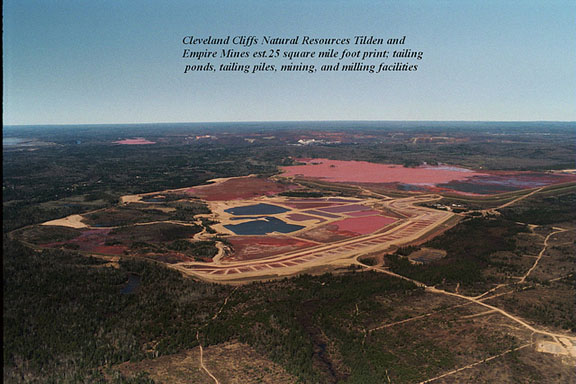 This aerial photo shows Cleveland Cliffs Tilden and Empire Mines, including tailing ponds, tailing piles, mining and milling facilities. Click on photo for larger version. (Photo © Jeremiah Eagle Eye. Reprinted with permission.)
Sullivan replied that laws and regulations on tailings -- restrictions by the EPA -- have to be upheld.
On the other hand, Sullivan echoed the boasting from Kennecott when he said, "The Flambeau Mine (near Ladysmith, Wis.) had no issues. It was very successful."
Not only is the water pollution at the Flambeau Mine the subject of a lawsuit initiated by Laura Gauger, co-author with the late Roscoe Churchill of The Buzzards Have Landed: The real story of the Flambeau Mine, and by the Wisconsin Resources Protection Council, of which Al Gedicks is the executive secretary -- but recent tests have confirmed that copper and zinc levels at the Flambeau mine have exceeded state toxicity standards for surface waters, potentially threatening fish and other aquatic life.****
 "Just grass over a grave" is what the late Roscoe Churchill -- pictured here at the "reclaimed" Flambeau Mine site near Ladysmith, Wis. -- called the reclamation by the Flambeau Mining Co., a Rio Tinto / Kennecott subsidiary, that now faces a Clean Water Act citizen lawsuit because of pollution of the Flambeau River and one of its tributaries. (Keweenaw Now file photo © Linda Runstrom, Winona, Minn. Reprinted with permission.)
Cardin then interviewed Gedicks, who said the State of Wisconsin should not be in a rush to change the rules about mining.
Gedicks said -- both in the interview and in his September article -- that his primary concern is the impact of the Penokee mine releasing toxic materials, including mercury, into the watershed that is used by nearby communities and the Bad River Ojibwe Tribe, whose wild rice beds could be destroyed by the potential Acid Mine Drainage pollution -- as well as the impact of the discharge of pollutants into Lake Superior.
His second concern, Gedicks added, is "the erosion of democratic access to the the decision-making process about mining."
Gedicks mentioned the citizens' alliance (sports fishermen, environmentalists, and Native Americans) whose struggle against the Crandon Mine led to the moratorium on sulfide mining. (See video above.) He sees this rush to introduce new mining legislation as an effort to overturn that moratorium.
Gedicks pointed out that this ferrous mine could have impacts similar to those of a sulfide mine. He called Sullivan's distinction between ferrous and non-ferrous mining "a fundamental misrepresentation of what is at stake in the Penokee Gogebic Taconite project."
According to Gedicks, the Penokee iron ore body is in an area that contains sulfide minerals.
"The quantity of material that would have to be excavated in order to get at the iron ore penetrates through 1500 feet of rock material, which includes sulfide mineralization," Gedicks said.
This overburden, containing heavy metals and sulfides, would be blasted, crushed and piled at the headwaters of the watershed and would be released into the environment, Gedicks explained.
 Aerial view of the Penokee Hills, where Gogebic Taconite plans to put an open-pit iron mine -- a $1.5 billion investment -- to extract taconite by removing about 650 feet of overburden (waste rock) and creating a narrow pit four miles long, one-third mile wide and at least 900 feet deep. This photo shows the south and east side of the proposed Penokee mine site: Looking northeast, where Mud Creek meets Mead Creak and the Tyler Forks. (Photo © Pete Rasmussen, Moving Water Photography, and courtesy Penokee Hills Education Project.* Reprinted with permission.)
Even without pollution this mine would take from 10 to 15 billion gallons of water a year from the watershed in order to extract the ore, seriously impacting the water supply, he added.
Cardin then asked him about Sullivan's statement that Wisconsin mining laws should be more like those of Minnesota and Michigan.
Gedicks replied that taconite mining in Minnesota has released pollution, and -- instead of enforcing laws designed to prevent pollution -- the Minnesota Pollution Control Agency is granting waivers and variances that allow ongoing taconite operations to continue polluting water sources.
In Michigan, he added, Kennecott -- the same company that has polluted water at the Flambeau mine -- is being allowed to proceed with the Eagle project.
 Rio Tinto-Kennecott's Eagle Mine near Big Bay, Mich. Photo taken as the company was preparing to blast under Eagle Rock, an Ojibwe sacred site, the portal to the mine which is intended to access an ore body of nickel and copper under the Salmon Trout River. (Photo courtesy Stand for the Land)
"They are being allowed to proceed with a mining project which their own experts have told the Michigan Department of Environmental Quality is likely to collapse," Gedicks noted. "If it does collapse into the Salmon Trout River, all the pollution from that mine would go into Lake Superior, which is about 10 miles downstream from the proposed mine. This is a model of environmental irresponsibility -- which the Wisconsin Mining Association is trying to get Wisconsin to adopt -- that will, in fact, prevent the State of Wisconsin from enforcing the already adequate and quite comprehensive and protective legislation which now protects ground water and surface water from this type of mining."
Al Gedicks: "What is more valuable -- iron ore or water?"
Gedicks said this issue includes the potential destruction of entire ecosystems which are unique in the Great Lakes region -- including people, wildlife and wild rice -- a violation of the sovereign rights of an Ojibwe Nation that is the direct recipient of the pollution.
"We're talking about a violation of international treaties with Canada to protect the Great Lakes," he added.
Gedicks said the question is this: "Do we sacrifice the interests of the vast majority of the citizens and the tribes of Wisconsin -- and the environment -- for a private development of a mining company which has, first of all, no record of mining in a taconite ore body -- and the record it does have, mining coal in Illinois, is full of complaints from nearby communities."
The company's underground coal mining in Illinois has destroyed farmland and the economies of these communities, he explained.
In his article on the Penokee project, Gedicks gives the background of the Gogebic Taconite (GTAC) company and its relation to coal mining: "GTAC is a limited liability company registered on the Toronto Stock Exchange and owned by the privately held Cline Group, a coal mining company based in Florida. Christopher Cline is a billionaire who owns large coal reserves in Illinois and Northern Appalachia. He has been called the "New King Coal" by Bloomberg Markets Magazine. Coal industry publications describe his leadership style as confrontational. In 1999 he closed down a West Virginia mine when workers voted to join the union. He then reopened the mine without union workers. As popular opposition to the practice of mountaintop removal coal mining spread in Appalachia, Cline shifted his new investments to Illinois coal. The company's coal mines in Illinois use longwall mining to remove the entire coal seam. Once the coal has been removed the ground sinks, sometimes to a depth of more than four feet as the earth above the excavated coal fills the void. Environmental groups have protested that longwall mining has disrupted stream flows, polluted aquifers and permanently damaged historic buildings."
Answering a question from a listener on whether the Penokee project is a strip mine or a surface mine, Gedicks said the notion that it is a surface mine is a misrepresentation because of the location of the ore body -- 1500 feet down into the bedrock.
"This is a version of mountaintop removal mining," Gedicks said, comparing it to coal mining in Appalachia.
While the Gogebic Range is not as high as mountains in Appalachia, the mining has the same end result: you knock off the top and store waste material at the headwaters of a pristine watershed that affects the economy of people, their access to water, and their relationship with the environment, Gedicks said.
Cardin asked Gedicks if there would be a challenge to the Gogebic Taconite project from Native Americans.
Gedicks said the Bad River tribe met with Governor Walker's office. Although they were heard, the Governor's office has done nothing about it. The tribe has, however, received authority from the EPA to set up their own water quality standards -- for water that affects their wild rice -- in order to prohibit any discharges of polluted water that would threaten their existence as a tribal entity.
 This map shows the location of the Penokee ore body in relation to the Bad River watershed and the Reservation of the Bad River Ojibwe Tribe. Click on map for larger version. (Map created June 8, 2011, by the Bad River Natural Resources Dept. and courtesy Dick Thiede, Iron County, Wisconsin, resident.)
A July 6, 2011, document listing the Bad River Tribe's water quality standards states this in its introduction:
"The Bad River Tribe (Tribe) has a primary interest in the protection, control, conservation and utilization of the water resources of the Bad River Reservation, as exemplified in the original treaty and the Bad River Constitution and ultimately recognized by the U.S. Environmental Protection Agency (EPA) on June 26, 2009, when it affirmed the tribe's application for program authority. The program authority granted by the EPA is in addition to the Tribe's historic hunting, fishing, gathering, and usufructuary rights, and is in addition to the Tribe's treaty rights."
A listener called in to ask what other toxins besides sulfur and acid could affect the water and how much impact they would have on the lake. Gedicks said not only does AMD destroy wild rice, the acid also releases 26 other heavy metals, including mercury, into the environment. Some of these heavy metals would go into Lake Superior.
Toward the end of the radio interview, Joy Cardin noted an email question from a listener in Hurley, who asked about jobs, noting mining has been successful in other states so why not have it in Wisconsin.
Sullivan had said that the construction process for the Penokee project would include 2000 - 3000 jobs. The mine itself would offer 700 jobs. According to Sullivan, most of the jobs would be semi-skilled, not requiring advanced training. In addition to these new jobs, the project would help sustain mining-related jobs in other parts of Wisconsin, such as machinery to be manufactured in Milwaukee.
Gedicks questioned the listener's word "successful," pointing out that schools are closed in many former taconite mining locations in Minnesota. He calls this the "resource curse" -- communities that are the richest in resources turn out to be the most impoverished because the mining companies take out the minerals but fail to invest in the community. The people don't receive the economic benefits they've been promised.
Whether or not a job as a taconite miner is a "benefit" is questionable as well if one considers human health impacts of taconite mining.
In his September 2011 article, Gedicks comments on health effects of taconite mining on Minnesota miners: "The Minnesota Health Department has confirmed 58 taconite miners have died of mesothelioma, a rare form of cancer, since 2003. Researchers concluded that commercial asbestos was the likely cause of the mesothelioma though it didn't rule out taconite dust as a factor. Some scientists have suspected that exposure to asbestos might be from inhaling asbestos-like fibers in the taconite production plants or from contaminated taconite rocks."
Gedicks said the reason the mining proponents want this legislation is so they can prevent a full and public disclosure of all the potential social, economic and environmental impacts of this Penokee project.
"If people actually understood how vast this project was -- that it's the largest mining project ever contemplated in the State of Wisconsin -- they would have serious second thoughts about this project," Gedicks said.
Dick Thiede, a resident of Iron County, Wis., who attended the Oct. 27, 2011, public meeting in Hurley, said he tries to maintain a good relationship with people on both sides of the mining issue.
"I guess I’d have to say that I was most impressed with the statements by Chairman Wiggins of the Bad River Band," Thiede told Keweenaw Now. "I think he came into a relatively hostile environment and gave an honest evaluation of the situation and of his people’s concerns which seemed to soften some of the hostility aimed at the tribe. Other than that, I had heard most of the other testimony before. Some of it was factual, some not."
Conflicting views of the Oct. 27 public meeting in Hurley were published by Ashland media following the meeting.
See "Varied Voices At Mining-Related Hearings" in the Oct. 27, 2011, Ashland Current. It includes comments posted by readers. One person claimed to have stayed at the meeting nearly nine hours.
See also "Marathon meeting runs into a mining-friendly crowd" and "Bad River tribe, others want no part of mine," in the Oct. 28, 2011, Ashland Daily Press.
The second Daily Press article cites Mike Wiggins, Jr., the Bad River Tribal Council chair, as expressing the tribe's opposition to the mining proposal and their right to set water quality standards. A video clip of Wiggins stating the position of the tribe (posted about a week before this meeting) is available on YouTube.
Editor's Notes: Click here to listen to this radio interview in the Wisconsin Public Radio archives.
Update: The Great Lakes Indian Fish and Wildlife Commission (GLIFWC), in the Winter 2011-2012 issue of its publication MAZINA'IGAN, has two articles on Great Lakes mining issues involving the Bad River Tribe. One article, "Changes to WI mining laws subject of hearing," reports on testimonies by GLIFWC staff at the Oct. 27, 2011, public meeting in Hurley, Wis. Click here to read these two articles on line.
* Click here to visit the Web site of the Penokee Hills Education Project. Keweenaw Now wishes to thank Frank Koehn, guest speaker at the recent annual meeting of FOLK (Friends of the Land of Keweenaw) for information about this group and their work. Thanks also to Dick Thiede for sharing documents with Keweenaw Now.
** Click here to read this article by Al Gedicks: "Resisting Resource Colonialism in the Lake Superior Region."
*** Visit the Gogebic Taconite Web page to read what they say about this project.
**** See the Nov. 1, 2011, Milwaukee Journal Sentinel article, "Tests find toxins at Flambeau mine."
Wednesday, November 16, 2011
From Stand for the Land: Kennecott Eagle Minerals announces aerial survey program
Posted on Stand for the Land on Nov. 13, 2011
Nov. 9, 2011, Press Release from Kennecott Eagle Minerals
ISHPEMING -- Kennecott Eagle Minerals recently announced a series of geophysical surveys to commence over Western and Central Upper Michigan.
The survey program is expected to start this month and continue for approximately three months. These surveys are part of the continuing exploration commitment by Kennecott in the Upper Peninsula.
The surveys will be completed using helicopters with geophysical equipment tethered behind the aircraft. The altitude of the helicopters will be low-level and will comply with Federal Transit Administration guidelines.
Residents will notice the helicopters flying over several U.P. counties. There are no materials being released into the environment.
Kennecott welcomes your questions and comments at kennecotteagleminerals.com/contact or on their Community Hotline at (906) 486-6970.
Editor's Note:
See more mining-related articles and links on standfortheland.com:
"U.P.’s Empire and Tilden mines: jobs and a scarred environment"
"Milwaukee Journal-Sentinel: Tests find toxins at Flambeau mine"
"Poll says public doesn’t support rollback on mining regulations"
"Bad River tribe pursues air quality standards"
Nov. 9, 2011, Press Release from Kennecott Eagle Minerals
ISHPEMING -- Kennecott Eagle Minerals recently announced a series of geophysical surveys to commence over Western and Central Upper Michigan.
The survey program is expected to start this month and continue for approximately three months. These surveys are part of the continuing exploration commitment by Kennecott in the Upper Peninsula.
The surveys will be completed using helicopters with geophysical equipment tethered behind the aircraft. The altitude of the helicopters will be low-level and will comply with Federal Transit Administration guidelines.
Residents will notice the helicopters flying over several U.P. counties. There are no materials being released into the environment.
Kennecott welcomes your questions and comments at kennecotteagleminerals.com/contact or on their Community Hotline at (906) 486-6970.
Editor's Note:
See more mining-related articles and links on standfortheland.com:
"U.P.’s Empire and Tilden mines: jobs and a scarred environment"
"Milwaukee Journal-Sentinel: Tests find toxins at Flambeau mine"
"Poll says public doesn’t support rollback on mining regulations"
"Bad River tribe pursues air quality standards"
Friday, July 29, 2011
Updated: Flambeau Mine Update: A new proposal from Kennecott, but still "Just Grass Over a Grave"
(Editor's Update: The hearing mentioned below has been canceled. According to the Wisconsin DNR, it will be rescheduled.)
By Laura Gauger*
LADYSMITH, WIS. -- Kennecott / Flambeau Mining Company (FMC) is proposing to convert an existing 0.9-acre, lined "detention basin" (pond) at the partially reclaimed Flambeau Mine site to an "infiltration basin" and construct two new infiltration basins at the site to handle contaminated runoff. A public hearing has been scheduled on the proposal for 5 p.m. Wednesday, August 3, 2011, at the Wisconsin Department of Natural Resources (WDNR) Service Center, N4103 State Highway 27, in Ladysmith, Wisconsin.**
Here are a few details: The existing man-made detention basin (also referred to as a biofilter) at the Flambeau Mine site was designed to collect and passively treat contaminated runoff. Since 1998, Kennecott’s own data consistently has shown elevated levels of copper in the pond. And the levels are not just a little high. Copper levels in the runoff draining into the pond have varied widely over the years, ranging from 15 ppb (Oct. 09) to 2000 ppb (Aug. 05) -- latest reported reading was 22 ppb (Sep. 10). Copper levels in the water draining out of the pond, into a tributary of the Flambeau River known as Stream C, have ranged from 4 ppb (Aug. 07) to 91 ppb (Nov. 00) -- latest reported reading was 5 ppb (Sep. 10). Wisconsin's chronic toxicity standard for copper, set to protect fish and other aquatic species, is 2.7 ppb, so the reported levels are truly significant. Elevated zinc and iron in the discharge have also been reported by Kennecott.
The present discharge of this contaminated water into Stream C is the subject of a lawsuit filed in federal court this past January (U.S. District Court for the Western District of Wisconsin; Case No. 11-cv-45). I am one of the plaintiffs in the case, as is the Wisconsin Resources Protection Council and the Center for Biological Diversity. We are alleging violations of the Clean Water Act, since Kennecott does not have, nor has it ever had, a Wisconsin Pollutant Discharge Elimination System (WPDES) permit authorizing the discharge of contaminants to Stream C.***
Now Kennecott is proposing that, instead of routing the contaminated water from the (lined) detention basin into Stream C (where levels of contaminants can be measured easily and standards enforced), the liner be removed, the detention basin be converted to an infiltration basin (so the contaminated water can seep down into the earth), and two additional infiltration basins be created at the site.
Instead of CLEANING UP the source of the contamination, Kennecott is COVERING UP the problem. The proposed "infiltration basins" will allow the contaminants to move down into the groundwater, hiding the problem from view and making it more difficult to hold the company accountable for the pollution. Like Roscoe said: "Just Grass Over a Grave."
See the link below for a "Notice of Complete Application for and Public Informational Hearing for Proposed Grading and Stream Realignment" regarding Kennecott/FMC's proposal to create the infiltration basins.****
As I mentioned above, the hearing is set for 5 p.m. Wednesday, Aug. 3, 2011, in Ladysmith, Wis. If anyone cares to attend the public hearing but needs more information, please contact me at kettu2010@callta.com and I will do my best to help.
Please note that this action proposed by Kennecott is separate from our lawsuit.
Laura Gauger
Duluth, MN 55805
* Laura (Furtman) Gauger is the co-author, with the late Roscoe Churchill, of The Buzzards Have Landed: The Real Story of the Flambeau Mine.
** Click here for Notice of the Public Hearing.
*** Click here for a "Fact Sheet" with details of the lawsuit (and background information on the detention basin).
**** Click here for a "Notice of Complete Application for and Public Informational Hearing for Proposed Grading and Stream Realignment" regarding Kennecott/FMC's proposal to create the infiltration basins.
By Laura Gauger*
LADYSMITH, WIS. -- Kennecott / Flambeau Mining Company (FMC) is proposing to convert an existing 0.9-acre, lined "detention basin" (pond) at the partially reclaimed Flambeau Mine site to an "infiltration basin" and construct two new infiltration basins at the site to handle contaminated runoff. A public hearing has been scheduled on the proposal for 5 p.m. Wednesday, August 3, 2011, at the Wisconsin Department of Natural Resources (WDNR) Service Center, N4103 State Highway 27, in Ladysmith, Wisconsin.**
Here are a few details: The existing man-made detention basin (also referred to as a biofilter) at the Flambeau Mine site was designed to collect and passively treat contaminated runoff. Since 1998, Kennecott’s own data consistently has shown elevated levels of copper in the pond. And the levels are not just a little high. Copper levels in the runoff draining into the pond have varied widely over the years, ranging from 15 ppb (Oct. 09) to 2000 ppb (Aug. 05) -- latest reported reading was 22 ppb (Sep. 10). Copper levels in the water draining out of the pond, into a tributary of the Flambeau River known as Stream C, have ranged from 4 ppb (Aug. 07) to 91 ppb (Nov. 00) -- latest reported reading was 5 ppb (Sep. 10). Wisconsin's chronic toxicity standard for copper, set to protect fish and other aquatic species, is 2.7 ppb, so the reported levels are truly significant. Elevated zinc and iron in the discharge have also been reported by Kennecott.
The present discharge of this contaminated water into Stream C is the subject of a lawsuit filed in federal court this past January (U.S. District Court for the Western District of Wisconsin; Case No. 11-cv-45). I am one of the plaintiffs in the case, as is the Wisconsin Resources Protection Council and the Center for Biological Diversity. We are alleging violations of the Clean Water Act, since Kennecott does not have, nor has it ever had, a Wisconsin Pollutant Discharge Elimination System (WPDES) permit authorizing the discharge of contaminants to Stream C.***
Now Kennecott is proposing that, instead of routing the contaminated water from the (lined) detention basin into Stream C (where levels of contaminants can be measured easily and standards enforced), the liner be removed, the detention basin be converted to an infiltration basin (so the contaminated water can seep down into the earth), and two additional infiltration basins be created at the site.
Instead of CLEANING UP the source of the contamination, Kennecott is COVERING UP the problem. The proposed "infiltration basins" will allow the contaminants to move down into the groundwater, hiding the problem from view and making it more difficult to hold the company accountable for the pollution. Like Roscoe said: "Just Grass Over a Grave."
See the link below for a "Notice of Complete Application for and Public Informational Hearing for Proposed Grading and Stream Realignment" regarding Kennecott/FMC's proposal to create the infiltration basins.****
As I mentioned above, the hearing is set for 5 p.m. Wednesday, Aug. 3, 2011, in Ladysmith, Wis. If anyone cares to attend the public hearing but needs more information, please contact me at kettu2010@callta.com and I will do my best to help.
Please note that this action proposed by Kennecott is separate from our lawsuit.
Laura Gauger
Duluth, MN 55805
* Laura (Furtman) Gauger is the co-author, with the late Roscoe Churchill, of The Buzzards Have Landed: The Real Story of the Flambeau Mine.
** Click here for Notice of the Public Hearing.
*** Click here for a "Fact Sheet" with details of the lawsuit (and background information on the detention basin).
**** Click here for a "Notice of Complete Application for and Public Informational Hearing for Proposed Grading and Stream Realignment" regarding Kennecott/FMC's proposal to create the infiltration basins.
Subscribe to:
Posts (Atom)