Dear Editor,
County Road 595 is being built because of the mine at Eagle Rock. If there were no mine, there would be no road. It is a road for the mine -- a haul road. Kennecott needs to step up to the plate and do what is right, and it is the DEQ’s job to make them follow the law. This is a mine road and the mining company needs to take responsibility for it. They need to amend their permit to include this road. They need to increase their financial assurance to include the road, do an Environmental Impact Assessment, provide contingency plans, and address possible reclamation. These are the responsibility of Kennecott -- not the citizens of Marquette County.
If this road is built, County Roads 550, 510, and AAA will continue to be used for the next two years or until 595 is completed. After that, those roads will still be used for supplies and employees. Who is going to take care of those roads? Who will be paying for the upkeep and repairs? We have been told for years that money for road repairs and maintenance is scarce. Now the DEQ/Kennecott are asking us to support and take care of a new road whose main purpose is to help a huge international extraction corporation move its ore from the mine to the mill.
I understand why people do not want all this mining traffic coming through their town, on the roads they travel every day. I don’t want them in my backyard either, but they are there and will continue to be there into the future. And again the DEQ has not made the mining company responsible.
This issue should have been properly addressed in the original permit. From the beginning, the DEQ has allowed Kennecott to "make up their plans as they go." This is not what the law says should be done.
It is a haul road and the DEQ needs to treat it as such.
Carla Champagne
Big Bay, Michigan
Showing posts with label Kennecott Eagle Mine. Show all posts
Showing posts with label Kennecott Eagle Mine. Show all posts
Tuesday, February 14, 2012


Saturday, November 19, 2011
Updated: Penokee iron mining proposal threatens Bad River watershed
By Michele Bourdieu
 View of the Penokee Hills in northern Wisconsin, where Gogebic Taconite (GTAC) plans to put a huge open pit iron mine. Click on photos for larger versions. (Photo © Pete Rasmussen, Moving Water Photography, and courtesy Penokee Hills Education Project.* Reprinted with permission.)
LA CROSSE, WISCONSIN -- Al Gedicks, professor of sociology at the University of Wisconsin - La Crosse and author of Resource Rebels: Native Challenges to Mining and Oil Corporations, recently published an article on the projected Gogebic Taconite (GTAC) open-pit mine for taconite iron deposits of the Penokee Range in northern Wisconsin. The article, titled "Resisting Resource Colonialism in the Lake Superior Region," was published by Z Magazine in September 2011.**
At the beginning of the article, Gedicks notes his main concern about the potential impact of such a mine: its effect on the water.
"The water that flows off the iron-rich Penokee Hills feeds the Penokee aquifer and the Bad River watershed, which flows into Lake Superior and provides drinking water for the city of Ashland and nearby towns. The water also feeds the wild rice beds of the Bad River Ojibwe Tribe. Wild rice is a sacred plant for the Ojibwe and an important food source. The tribe’s wild rice beds are the largest in the state," Gedicks writes.
 For the Bad River Ojibwe Tribe, clean water is essential for their fisheries and wild rice crop. This photo shows a brook trout from Spring Brook in the Penokees. (Photo © Pete Rasmussen, Moving Water Photography, and courtesy Penokee Hills Education Project.* Reprinted with permission.)
This is not the first time Gedicks has been involved in a mining project that threatened water quality and Native American rights. He was actively involved in the struggle against the Crandon Mine, which he wrote about in two well documented books: The New Resource Wars: Native and Environmental Struggles Against Multinational Corporations (1993) and Resource Rebels: Native Challenges to Mining and Oil Corporations (2001). That struggle eventually led to Wisconsin's moratorium on sulfide mining. Gedicks summarized this for an audience at the 2011 Protect the Earth Gathering at Van Riper State Park near Champion, Mich., last summer. Here is an excerpt from his talk:
During the 2011 Protect the Earth Gathering at Van Riper State Park near Champion, Mich., Al Gedicks, professor of sociology at the University of Wisconsin - La Crosse, speaks about the importance of the struggle against the Crandon Mine, which led to Wisconsin's moratorium on sulfide mining. (Video by Allan Baker for Keweenaw Now)
What the proponents of this iron mine seem to be seeking is legislation that will distinguish between ferrous and non-ferrous mining so that the permitting process for iron mining will be speeded up.
Unlike Rio Tinto-Kennecott's Eagle Mine for nickel and copper near Big Bay, Mich., the Penokee iron ore project is not considered a sulfide mine. GTAC, which has leases for the mineral rights on 22,000 acres of the Penokee-Gogebic Range, covering 22 miles in Wisconsin's Ashland and Iron Counties, stresses the difference between ferrous and non-ferrous mining in their public relations, trying to convince the public that this "iron" mine is safer than a "sulfide" mine that has a high potential to produce acid mine drainage (AMD) -- since iron mining, as they describe it, does not use chemicals.***
As Gedicks points out in his article, GTAC goes beyond just public relations trying to prove their claims that taconite mining can be done safely without harming the environment. They are heavily involved in "crafting legislation that would prevent the public and the state’s Indian Nations from challenging any of these claims by excluding them from participation in the mine permitting process."
In fact, he notes, GTAC "contributed more than $40,000 in 2010 campaign contributions to Republican candidates involved with the mining issue, including Wisconsin Gov. Scott Walker and Rep. Mark Honadel (R-South Milwaukee)."
Penokee project discussed at Oct. 27 meeting on legislation, Hurley, Wis.
Gogebic Taconite's projected open-pit mine for taconite iron deposits of the Penokee Range in northern Wisconsin was an important part of the discussion at an informational hearing in Hurley, Wis., on Oct. 27, 2011. The meeting was called by the Wisconsin Assembly Committee on Jobs, Economy and Small Business. The subject of the meeting was "Creation of Iron Mining Statutes in Wisconsin: Economic and Environmental Considerations."
Its purpose was stated in the meeting announcement as follows: "In the near future and following the Informational Hearing, the Committee will be tasked with considering legislation to update Wisconsin's metallic mining laws to reflect the differences between ferrous and nonferrous mining. The legislation will have two primary goals: ensuring that ferrous mining in this state is economical, and providing for reasonable environmental protections. The purpose of the Informational Hearing is to gather relevant information related to this task." Invited speakers and the public were asked to comment.
Wisconsin Public Radio interview
At 7 a.m. on Oct. 27, just a few hours before this meeting, Wisconsin Public Radio's Ideas Network broadcast an interview presenting two opposing views on the subject. The interviewer, Joy Cardin, first spoke by telephone with one of the invited speakers -- Tim Sullivan, chair of the Wisconsin Mining Association and former president and CEO of Bucyrus International, Inc. Sullivan was on his way to the meeting. Cardin also interviewed Al Gedicks. The listening audience was invited to call in their questions.
Sullivan mentioned the Crandon Mine, admitting it was a complicated issue and many of the objections to it were "probably appropriate," especially since it was an underground mine and located at the headwaters of the Wolf River.
"It was a copper mine, which is a sulfide mine," Sullivan said.
He added that the processing of copper requires chemicals, while an iron mine, such as the projected open-pit Gogebic Taconite mine, uses large magnets -- not chemicals -- to extract the iron.
Sullivan expressed concern that the iron mining company should not get caught in laws that were made in response to the Crandon Mine.
"No one wants to unduly speed the process, but we want to make it so it's at least reasonable," Sullivan told Cardin.
Sullivan noted the purpose of proposed legislation would be to differentiate between ferrous and non-ferrous mining so that ferrous (iron) mining does not come under laws for a sulfide mine. He said the mine proponents want to align processing time (for permits) with those of "sister states" Minnesota and Michigan, which, he said, are "more reasonable."
After Sullivan presented his views, radio host Cardin welcomed questions from listeners.
One caller asked why the company shouldn't have to pay a severance tax on the tonnage extracted and a pollution tax since there is no non-polluting way to mine this ore.
"We are giving away something that belongs to all of us," he said.
Sullivan said under current Wisconsin statutes all the tax money (millions of dollars) goes back to the two counties.
A caller who has property in Republic, Mich., and is familiar with the closing of Cleveland Cliffs iron mine, asked about the impact of tailings on water sources.
 This aerial photo shows Cleveland Cliffs Tilden and Empire Mines, including tailing ponds, tailing piles, mining and milling facilities. Click on photo for larger version. (Photo © Jeremiah Eagle Eye. Reprinted with permission.)
Sullivan replied that laws and regulations on tailings -- restrictions by the EPA -- have to be upheld.
On the other hand, Sullivan echoed the boasting from Kennecott when he said, "The Flambeau Mine (near Ladysmith, Wis.) had no issues. It was very successful."
Not only is the water pollution at the Flambeau Mine the subject of a lawsuit initiated by Laura Gauger, co-author with the late Roscoe Churchill of The Buzzards Have Landed: The real story of the Flambeau Mine, and by the Wisconsin Resources Protection Council, of which Al Gedicks is the executive secretary -- but recent tests have confirmed that copper and zinc levels at the Flambeau mine have exceeded state toxicity standards for surface waters, potentially threatening fish and other aquatic life.****
 "Just grass over a grave" is what the late Roscoe Churchill -- pictured here at the "reclaimed" Flambeau Mine site near Ladysmith, Wis. -- called the reclamation by the Flambeau Mining Co., a Rio Tinto / Kennecott subsidiary, that now faces a Clean Water Act citizen lawsuit because of pollution of the Flambeau River and one of its tributaries. (Keweenaw Now file photo © Linda Runstrom, Winona, Minn. Reprinted with permission.)
Cardin then interviewed Gedicks, who said the State of Wisconsin should not be in a rush to change the rules about mining.
Gedicks said -- both in the interview and in his September article -- that his primary concern is the impact of the Penokee mine releasing toxic materials, including mercury, into the watershed that is used by nearby communities and the Bad River Ojibwe Tribe, whose wild rice beds could be destroyed by the potential Acid Mine Drainage pollution -- as well as the impact of the discharge of pollutants into Lake Superior.
His second concern, Gedicks added, is "the erosion of democratic access to the the decision-making process about mining."
Gedicks mentioned the citizens' alliance (sports fishermen, environmentalists, and Native Americans) whose struggle against the Crandon Mine led to the moratorium on sulfide mining. (See video above.) He sees this rush to introduce new mining legislation as an effort to overturn that moratorium.
Gedicks pointed out that this ferrous mine could have impacts similar to those of a sulfide mine. He called Sullivan's distinction between ferrous and non-ferrous mining "a fundamental misrepresentation of what is at stake in the Penokee Gogebic Taconite project."
According to Gedicks, the Penokee iron ore body is in an area that contains sulfide minerals.
"The quantity of material that would have to be excavated in order to get at the iron ore penetrates through 1500 feet of rock material, which includes sulfide mineralization," Gedicks said.
This overburden, containing heavy metals and sulfides, would be blasted, crushed and piled at the headwaters of the watershed and would be released into the environment, Gedicks explained.
 Aerial view of the Penokee Hills, where Gogebic Taconite plans to put an open-pit iron mine -- a $1.5 billion investment -- to extract taconite by removing about 650 feet of overburden (waste rock) and creating a narrow pit four miles long, one-third mile wide and at least 900 feet deep. This photo shows the south and east side of the proposed Penokee mine site: Looking northeast, where Mud Creek meets Mead Creak and the Tyler Forks. (Photo © Pete Rasmussen, Moving Water Photography, and courtesy Penokee Hills Education Project.* Reprinted with permission.)
Even without pollution this mine would take from 10 to 15 billion gallons of water a year from the watershed in order to extract the ore, seriously impacting the water supply, he added.
Cardin then asked him about Sullivan's statement that Wisconsin mining laws should be more like those of Minnesota and Michigan.
Gedicks replied that taconite mining in Minnesota has released pollution, and -- instead of enforcing laws designed to prevent pollution -- the Minnesota Pollution Control Agency is granting waivers and variances that allow ongoing taconite operations to continue polluting water sources.
In Michigan, he added, Kennecott -- the same company that has polluted water at the Flambeau mine -- is being allowed to proceed with the Eagle project.
 Rio Tinto-Kennecott's Eagle Mine near Big Bay, Mich. Photo taken as the company was preparing to blast under Eagle Rock, an Ojibwe sacred site, the portal to the mine which is intended to access an ore body of nickel and copper under the Salmon Trout River. (Photo courtesy Stand for the Land)
"They are being allowed to proceed with a mining project which their own experts have told the Michigan Department of Environmental Quality is likely to collapse," Gedicks noted. "If it does collapse into the Salmon Trout River, all the pollution from that mine would go into Lake Superior, which is about 10 miles downstream from the proposed mine. This is a model of environmental irresponsibility -- which the Wisconsin Mining Association is trying to get Wisconsin to adopt -- that will, in fact, prevent the State of Wisconsin from enforcing the already adequate and quite comprehensive and protective legislation which now protects ground water and surface water from this type of mining."
Al Gedicks: "What is more valuable -- iron ore or water?"
Gedicks said this issue includes the potential destruction of entire ecosystems which are unique in the Great Lakes region -- including people, wildlife and wild rice -- a violation of the sovereign rights of an Ojibwe Nation that is the direct recipient of the pollution.
"We're talking about a violation of international treaties with Canada to protect the Great Lakes," he added.
Gedicks said the question is this: "Do we sacrifice the interests of the vast majority of the citizens and the tribes of Wisconsin -- and the environment -- for a private development of a mining company which has, first of all, no record of mining in a taconite ore body -- and the record it does have, mining coal in Illinois, is full of complaints from nearby communities."
The company's underground coal mining in Illinois has destroyed farmland and the economies of these communities, he explained.
In his article on the Penokee project, Gedicks gives the background of the Gogebic Taconite (GTAC) company and its relation to coal mining: "GTAC is a limited liability company registered on the Toronto Stock Exchange and owned by the privately held Cline Group, a coal mining company based in Florida. Christopher Cline is a billionaire who owns large coal reserves in Illinois and Northern Appalachia. He has been called the "New King Coal" by Bloomberg Markets Magazine. Coal industry publications describe his leadership style as confrontational. In 1999 he closed down a West Virginia mine when workers voted to join the union. He then reopened the mine without union workers. As popular opposition to the practice of mountaintop removal coal mining spread in Appalachia, Cline shifted his new investments to Illinois coal. The company's coal mines in Illinois use longwall mining to remove the entire coal seam. Once the coal has been removed the ground sinks, sometimes to a depth of more than four feet as the earth above the excavated coal fills the void. Environmental groups have protested that longwall mining has disrupted stream flows, polluted aquifers and permanently damaged historic buildings."
Answering a question from a listener on whether the Penokee project is a strip mine or a surface mine, Gedicks said the notion that it is a surface mine is a misrepresentation because of the location of the ore body -- 1500 feet down into the bedrock.
"This is a version of mountaintop removal mining," Gedicks said, comparing it to coal mining in Appalachia.
While the Gogebic Range is not as high as mountains in Appalachia, the mining has the same end result: you knock off the top and store waste material at the headwaters of a pristine watershed that affects the economy of people, their access to water, and their relationship with the environment, Gedicks said.
Cardin asked Gedicks if there would be a challenge to the Gogebic Taconite project from Native Americans.
Gedicks said the Bad River tribe met with Governor Walker's office. Although they were heard, the Governor's office has done nothing about it. The tribe has, however, received authority from the EPA to set up their own water quality standards -- for water that affects their wild rice -- in order to prohibit any discharges of polluted water that would threaten their existence as a tribal entity.
 This map shows the location of the Penokee ore body in relation to the Bad River watershed and the Reservation of the Bad River Ojibwe Tribe. Click on map for larger version. (Map created June 8, 2011, by the Bad River Natural Resources Dept. and courtesy Dick Thiede, Iron County, Wisconsin, resident.)
A July 6, 2011, document listing the Bad River Tribe's water quality standards states this in its introduction:
"The Bad River Tribe (Tribe) has a primary interest in the protection, control, conservation and utilization of the water resources of the Bad River Reservation, as exemplified in the original treaty and the Bad River Constitution and ultimately recognized by the U.S. Environmental Protection Agency (EPA) on June 26, 2009, when it affirmed the tribe's application for program authority. The program authority granted by the EPA is in addition to the Tribe's historic hunting, fishing, gathering, and usufructuary rights, and is in addition to the Tribe's treaty rights."
A listener called in to ask what other toxins besides sulfur and acid could affect the water and how much impact they would have on the lake. Gedicks said not only does AMD destroy wild rice, the acid also releases 26 other heavy metals, including mercury, into the environment. Some of these heavy metals would go into Lake Superior.
Toward the end of the radio interview, Joy Cardin noted an email question from a listener in Hurley, who asked about jobs, noting mining has been successful in other states so why not have it in Wisconsin.
Sullivan had said that the construction process for the Penokee project would include 2000 - 3000 jobs. The mine itself would offer 700 jobs. According to Sullivan, most of the jobs would be semi-skilled, not requiring advanced training. In addition to these new jobs, the project would help sustain mining-related jobs in other parts of Wisconsin, such as machinery to be manufactured in Milwaukee.
Gedicks questioned the listener's word "successful," pointing out that schools are closed in many former taconite mining locations in Minnesota. He calls this the "resource curse" -- communities that are the richest in resources turn out to be the most impoverished because the mining companies take out the minerals but fail to invest in the community. The people don't receive the economic benefits they've been promised.
Whether or not a job as a taconite miner is a "benefit" is questionable as well if one considers human health impacts of taconite mining.
In his September 2011 article, Gedicks comments on health effects of taconite mining on Minnesota miners: "The Minnesota Health Department has confirmed 58 taconite miners have died of mesothelioma, a rare form of cancer, since 2003. Researchers concluded that commercial asbestos was the likely cause of the mesothelioma though it didn't rule out taconite dust as a factor. Some scientists have suspected that exposure to asbestos might be from inhaling asbestos-like fibers in the taconite production plants or from contaminated taconite rocks."
Gedicks said the reason the mining proponents want this legislation is so they can prevent a full and public disclosure of all the potential social, economic and environmental impacts of this Penokee project.
"If people actually understood how vast this project was -- that it's the largest mining project ever contemplated in the State of Wisconsin -- they would have serious second thoughts about this project," Gedicks said.
Dick Thiede, a resident of Iron County, Wis., who attended the Oct. 27, 2011, public meeting in Hurley, said he tries to maintain a good relationship with people on both sides of the mining issue.
"I guess I’d have to say that I was most impressed with the statements by Chairman Wiggins of the Bad River Band," Thiede told Keweenaw Now. "I think he came into a relatively hostile environment and gave an honest evaluation of the situation and of his people’s concerns which seemed to soften some of the hostility aimed at the tribe. Other than that, I had heard most of the other testimony before. Some of it was factual, some not."
Conflicting views of the Oct. 27 public meeting in Hurley were published by Ashland media following the meeting.
See "Varied Voices At Mining-Related Hearings" in the Oct. 27, 2011, Ashland Current. It includes comments posted by readers. One person claimed to have stayed at the meeting nearly nine hours.
See also "Marathon meeting runs into a mining-friendly crowd" and "Bad River tribe, others want no part of mine," in the Oct. 28, 2011, Ashland Daily Press.
The second Daily Press article cites Mike Wiggins, Jr., the Bad River Tribal Council chair, as expressing the tribe's opposition to the mining proposal and their right to set water quality standards. A video clip of Wiggins stating the position of the tribe (posted about a week before this meeting) is available on YouTube.
Editor's Notes: Click here to listen to this radio interview in the Wisconsin Public Radio archives.
Update: The Great Lakes Indian Fish and Wildlife Commission (GLIFWC), in the Winter 2011-2012 issue of its publication MAZINA'IGAN, has two articles on Great Lakes mining issues involving the Bad River Tribe. One article, "Changes to WI mining laws subject of hearing," reports on testimonies by GLIFWC staff at the Oct. 27, 2011, public meeting in Hurley, Wis. Click here to read these two articles on line.
* Click here to visit the Web site of the Penokee Hills Education Project. Keweenaw Now wishes to thank Frank Koehn, guest speaker at the recent annual meeting of FOLK (Friends of the Land of Keweenaw) for information about this group and their work. Thanks also to Dick Thiede for sharing documents with Keweenaw Now.
** Click here to read this article by Al Gedicks: "Resisting Resource Colonialism in the Lake Superior Region."
*** Visit the Gogebic Taconite Web page to read what they say about this project.
**** See the Nov. 1, 2011, Milwaukee Journal Sentinel article, "Tests find toxins at Flambeau mine."
 View of the Penokee Hills in northern Wisconsin, where Gogebic Taconite (GTAC) plans to put a huge open pit iron mine. Click on photos for larger versions. (Photo © Pete Rasmussen, Moving Water Photography, and courtesy Penokee Hills Education Project.* Reprinted with permission.)
LA CROSSE, WISCONSIN -- Al Gedicks, professor of sociology at the University of Wisconsin - La Crosse and author of Resource Rebels: Native Challenges to Mining and Oil Corporations, recently published an article on the projected Gogebic Taconite (GTAC) open-pit mine for taconite iron deposits of the Penokee Range in northern Wisconsin. The article, titled "Resisting Resource Colonialism in the Lake Superior Region," was published by Z Magazine in September 2011.**
At the beginning of the article, Gedicks notes his main concern about the potential impact of such a mine: its effect on the water.
"The water that flows off the iron-rich Penokee Hills feeds the Penokee aquifer and the Bad River watershed, which flows into Lake Superior and provides drinking water for the city of Ashland and nearby towns. The water also feeds the wild rice beds of the Bad River Ojibwe Tribe. Wild rice is a sacred plant for the Ojibwe and an important food source. The tribe’s wild rice beds are the largest in the state," Gedicks writes.
 For the Bad River Ojibwe Tribe, clean water is essential for their fisheries and wild rice crop. This photo shows a brook trout from Spring Brook in the Penokees. (Photo © Pete Rasmussen, Moving Water Photography, and courtesy Penokee Hills Education Project.* Reprinted with permission.)
This is not the first time Gedicks has been involved in a mining project that threatened water quality and Native American rights. He was actively involved in the struggle against the Crandon Mine, which he wrote about in two well documented books: The New Resource Wars: Native and Environmental Struggles Against Multinational Corporations (1993) and Resource Rebels: Native Challenges to Mining and Oil Corporations (2001). That struggle eventually led to Wisconsin's moratorium on sulfide mining. Gedicks summarized this for an audience at the 2011 Protect the Earth Gathering at Van Riper State Park near Champion, Mich., last summer. Here is an excerpt from his talk:
During the 2011 Protect the Earth Gathering at Van Riper State Park near Champion, Mich., Al Gedicks, professor of sociology at the University of Wisconsin - La Crosse, speaks about the importance of the struggle against the Crandon Mine, which led to Wisconsin's moratorium on sulfide mining. (Video by Allan Baker for Keweenaw Now)
What the proponents of this iron mine seem to be seeking is legislation that will distinguish between ferrous and non-ferrous mining so that the permitting process for iron mining will be speeded up.
Unlike Rio Tinto-Kennecott's Eagle Mine for nickel and copper near Big Bay, Mich., the Penokee iron ore project is not considered a sulfide mine. GTAC, which has leases for the mineral rights on 22,000 acres of the Penokee-Gogebic Range, covering 22 miles in Wisconsin's Ashland and Iron Counties, stresses the difference between ferrous and non-ferrous mining in their public relations, trying to convince the public that this "iron" mine is safer than a "sulfide" mine that has a high potential to produce acid mine drainage (AMD) -- since iron mining, as they describe it, does not use chemicals.***
As Gedicks points out in his article, GTAC goes beyond just public relations trying to prove their claims that taconite mining can be done safely without harming the environment. They are heavily involved in "crafting legislation that would prevent the public and the state’s Indian Nations from challenging any of these claims by excluding them from participation in the mine permitting process."
In fact, he notes, GTAC "contributed more than $40,000 in 2010 campaign contributions to Republican candidates involved with the mining issue, including Wisconsin Gov. Scott Walker and Rep. Mark Honadel (R-South Milwaukee)."
Penokee project discussed at Oct. 27 meeting on legislation, Hurley, Wis.
Gogebic Taconite's projected open-pit mine for taconite iron deposits of the Penokee Range in northern Wisconsin was an important part of the discussion at an informational hearing in Hurley, Wis., on Oct. 27, 2011. The meeting was called by the Wisconsin Assembly Committee on Jobs, Economy and Small Business. The subject of the meeting was "Creation of Iron Mining Statutes in Wisconsin: Economic and Environmental Considerations."
Its purpose was stated in the meeting announcement as follows: "In the near future and following the Informational Hearing, the Committee will be tasked with considering legislation to update Wisconsin's metallic mining laws to reflect the differences between ferrous and nonferrous mining. The legislation will have two primary goals: ensuring that ferrous mining in this state is economical, and providing for reasonable environmental protections. The purpose of the Informational Hearing is to gather relevant information related to this task." Invited speakers and the public were asked to comment.
Wisconsin Public Radio interview
At 7 a.m. on Oct. 27, just a few hours before this meeting, Wisconsin Public Radio's Ideas Network broadcast an interview presenting two opposing views on the subject. The interviewer, Joy Cardin, first spoke by telephone with one of the invited speakers -- Tim Sullivan, chair of the Wisconsin Mining Association and former president and CEO of Bucyrus International, Inc. Sullivan was on his way to the meeting. Cardin also interviewed Al Gedicks. The listening audience was invited to call in their questions.
Sullivan mentioned the Crandon Mine, admitting it was a complicated issue and many of the objections to it were "probably appropriate," especially since it was an underground mine and located at the headwaters of the Wolf River.
"It was a copper mine, which is a sulfide mine," Sullivan said.
He added that the processing of copper requires chemicals, while an iron mine, such as the projected open-pit Gogebic Taconite mine, uses large magnets -- not chemicals -- to extract the iron.
Sullivan expressed concern that the iron mining company should not get caught in laws that were made in response to the Crandon Mine.
"No one wants to unduly speed the process, but we want to make it so it's at least reasonable," Sullivan told Cardin.
Sullivan noted the purpose of proposed legislation would be to differentiate between ferrous and non-ferrous mining so that ferrous (iron) mining does not come under laws for a sulfide mine. He said the mine proponents want to align processing time (for permits) with those of "sister states" Minnesota and Michigan, which, he said, are "more reasonable."
After Sullivan presented his views, radio host Cardin welcomed questions from listeners.
One caller asked why the company shouldn't have to pay a severance tax on the tonnage extracted and a pollution tax since there is no non-polluting way to mine this ore.
"We are giving away something that belongs to all of us," he said.
Sullivan said under current Wisconsin statutes all the tax money (millions of dollars) goes back to the two counties.
A caller who has property in Republic, Mich., and is familiar with the closing of Cleveland Cliffs iron mine, asked about the impact of tailings on water sources.
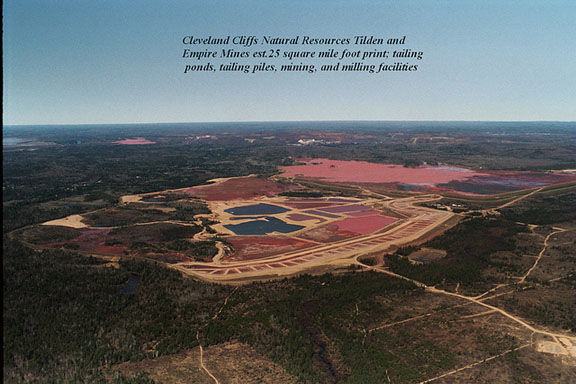 This aerial photo shows Cleveland Cliffs Tilden and Empire Mines, including tailing ponds, tailing piles, mining and milling facilities. Click on photo for larger version. (Photo © Jeremiah Eagle Eye. Reprinted with permission.)
Sullivan replied that laws and regulations on tailings -- restrictions by the EPA -- have to be upheld.
On the other hand, Sullivan echoed the boasting from Kennecott when he said, "The Flambeau Mine (near Ladysmith, Wis.) had no issues. It was very successful."
Not only is the water pollution at the Flambeau Mine the subject of a lawsuit initiated by Laura Gauger, co-author with the late Roscoe Churchill of The Buzzards Have Landed: The real story of the Flambeau Mine, and by the Wisconsin Resources Protection Council, of which Al Gedicks is the executive secretary -- but recent tests have confirmed that copper and zinc levels at the Flambeau mine have exceeded state toxicity standards for surface waters, potentially threatening fish and other aquatic life.****
 "Just grass over a grave" is what the late Roscoe Churchill -- pictured here at the "reclaimed" Flambeau Mine site near Ladysmith, Wis. -- called the reclamation by the Flambeau Mining Co., a Rio Tinto / Kennecott subsidiary, that now faces a Clean Water Act citizen lawsuit because of pollution of the Flambeau River and one of its tributaries. (Keweenaw Now file photo © Linda Runstrom, Winona, Minn. Reprinted with permission.)
Cardin then interviewed Gedicks, who said the State of Wisconsin should not be in a rush to change the rules about mining.
Gedicks said -- both in the interview and in his September article -- that his primary concern is the impact of the Penokee mine releasing toxic materials, including mercury, into the watershed that is used by nearby communities and the Bad River Ojibwe Tribe, whose wild rice beds could be destroyed by the potential Acid Mine Drainage pollution -- as well as the impact of the discharge of pollutants into Lake Superior.
His second concern, Gedicks added, is "the erosion of democratic access to the the decision-making process about mining."
Gedicks mentioned the citizens' alliance (sports fishermen, environmentalists, and Native Americans) whose struggle against the Crandon Mine led to the moratorium on sulfide mining. (See video above.) He sees this rush to introduce new mining legislation as an effort to overturn that moratorium.
Gedicks pointed out that this ferrous mine could have impacts similar to those of a sulfide mine. He called Sullivan's distinction between ferrous and non-ferrous mining "a fundamental misrepresentation of what is at stake in the Penokee Gogebic Taconite project."
According to Gedicks, the Penokee iron ore body is in an area that contains sulfide minerals.
"The quantity of material that would have to be excavated in order to get at the iron ore penetrates through 1500 feet of rock material, which includes sulfide mineralization," Gedicks said.
This overburden, containing heavy metals and sulfides, would be blasted, crushed and piled at the headwaters of the watershed and would be released into the environment, Gedicks explained.
 Aerial view of the Penokee Hills, where Gogebic Taconite plans to put an open-pit iron mine -- a $1.5 billion investment -- to extract taconite by removing about 650 feet of overburden (waste rock) and creating a narrow pit four miles long, one-third mile wide and at least 900 feet deep. This photo shows the south and east side of the proposed Penokee mine site: Looking northeast, where Mud Creek meets Mead Creak and the Tyler Forks. (Photo © Pete Rasmussen, Moving Water Photography, and courtesy Penokee Hills Education Project.* Reprinted with permission.)
Even without pollution this mine would take from 10 to 15 billion gallons of water a year from the watershed in order to extract the ore, seriously impacting the water supply, he added.
Cardin then asked him about Sullivan's statement that Wisconsin mining laws should be more like those of Minnesota and Michigan.
Gedicks replied that taconite mining in Minnesota has released pollution, and -- instead of enforcing laws designed to prevent pollution -- the Minnesota Pollution Control Agency is granting waivers and variances that allow ongoing taconite operations to continue polluting water sources.
In Michigan, he added, Kennecott -- the same company that has polluted water at the Flambeau mine -- is being allowed to proceed with the Eagle project.
 Rio Tinto-Kennecott's Eagle Mine near Big Bay, Mich. Photo taken as the company was preparing to blast under Eagle Rock, an Ojibwe sacred site, the portal to the mine which is intended to access an ore body of nickel and copper under the Salmon Trout River. (Photo courtesy Stand for the Land)
"They are being allowed to proceed with a mining project which their own experts have told the Michigan Department of Environmental Quality is likely to collapse," Gedicks noted. "If it does collapse into the Salmon Trout River, all the pollution from that mine would go into Lake Superior, which is about 10 miles downstream from the proposed mine. This is a model of environmental irresponsibility -- which the Wisconsin Mining Association is trying to get Wisconsin to adopt -- that will, in fact, prevent the State of Wisconsin from enforcing the already adequate and quite comprehensive and protective legislation which now protects ground water and surface water from this type of mining."
Al Gedicks: "What is more valuable -- iron ore or water?"
Gedicks said this issue includes the potential destruction of entire ecosystems which are unique in the Great Lakes region -- including people, wildlife and wild rice -- a violation of the sovereign rights of an Ojibwe Nation that is the direct recipient of the pollution.
"We're talking about a violation of international treaties with Canada to protect the Great Lakes," he added.
Gedicks said the question is this: "Do we sacrifice the interests of the vast majority of the citizens and the tribes of Wisconsin -- and the environment -- for a private development of a mining company which has, first of all, no record of mining in a taconite ore body -- and the record it does have, mining coal in Illinois, is full of complaints from nearby communities."
The company's underground coal mining in Illinois has destroyed farmland and the economies of these communities, he explained.
In his article on the Penokee project, Gedicks gives the background of the Gogebic Taconite (GTAC) company and its relation to coal mining: "GTAC is a limited liability company registered on the Toronto Stock Exchange and owned by the privately held Cline Group, a coal mining company based in Florida. Christopher Cline is a billionaire who owns large coal reserves in Illinois and Northern Appalachia. He has been called the "New King Coal" by Bloomberg Markets Magazine. Coal industry publications describe his leadership style as confrontational. In 1999 he closed down a West Virginia mine when workers voted to join the union. He then reopened the mine without union workers. As popular opposition to the practice of mountaintop removal coal mining spread in Appalachia, Cline shifted his new investments to Illinois coal. The company's coal mines in Illinois use longwall mining to remove the entire coal seam. Once the coal has been removed the ground sinks, sometimes to a depth of more than four feet as the earth above the excavated coal fills the void. Environmental groups have protested that longwall mining has disrupted stream flows, polluted aquifers and permanently damaged historic buildings."
Answering a question from a listener on whether the Penokee project is a strip mine or a surface mine, Gedicks said the notion that it is a surface mine is a misrepresentation because of the location of the ore body -- 1500 feet down into the bedrock.
"This is a version of mountaintop removal mining," Gedicks said, comparing it to coal mining in Appalachia.
While the Gogebic Range is not as high as mountains in Appalachia, the mining has the same end result: you knock off the top and store waste material at the headwaters of a pristine watershed that affects the economy of people, their access to water, and their relationship with the environment, Gedicks said.
Cardin asked Gedicks if there would be a challenge to the Gogebic Taconite project from Native Americans.
Gedicks said the Bad River tribe met with Governor Walker's office. Although they were heard, the Governor's office has done nothing about it. The tribe has, however, received authority from the EPA to set up their own water quality standards -- for water that affects their wild rice -- in order to prohibit any discharges of polluted water that would threaten their existence as a tribal entity.
 This map shows the location of the Penokee ore body in relation to the Bad River watershed and the Reservation of the Bad River Ojibwe Tribe. Click on map for larger version. (Map created June 8, 2011, by the Bad River Natural Resources Dept. and courtesy Dick Thiede, Iron County, Wisconsin, resident.)
A July 6, 2011, document listing the Bad River Tribe's water quality standards states this in its introduction:
"The Bad River Tribe (Tribe) has a primary interest in the protection, control, conservation and utilization of the water resources of the Bad River Reservation, as exemplified in the original treaty and the Bad River Constitution and ultimately recognized by the U.S. Environmental Protection Agency (EPA) on June 26, 2009, when it affirmed the tribe's application for program authority. The program authority granted by the EPA is in addition to the Tribe's historic hunting, fishing, gathering, and usufructuary rights, and is in addition to the Tribe's treaty rights."
A listener called in to ask what other toxins besides sulfur and acid could affect the water and how much impact they would have on the lake. Gedicks said not only does AMD destroy wild rice, the acid also releases 26 other heavy metals, including mercury, into the environment. Some of these heavy metals would go into Lake Superior.
Toward the end of the radio interview, Joy Cardin noted an email question from a listener in Hurley, who asked about jobs, noting mining has been successful in other states so why not have it in Wisconsin.
Sullivan had said that the construction process for the Penokee project would include 2000 - 3000 jobs. The mine itself would offer 700 jobs. According to Sullivan, most of the jobs would be semi-skilled, not requiring advanced training. In addition to these new jobs, the project would help sustain mining-related jobs in other parts of Wisconsin, such as machinery to be manufactured in Milwaukee.
Gedicks questioned the listener's word "successful," pointing out that schools are closed in many former taconite mining locations in Minnesota. He calls this the "resource curse" -- communities that are the richest in resources turn out to be the most impoverished because the mining companies take out the minerals but fail to invest in the community. The people don't receive the economic benefits they've been promised.
Whether or not a job as a taconite miner is a "benefit" is questionable as well if one considers human health impacts of taconite mining.
In his September 2011 article, Gedicks comments on health effects of taconite mining on Minnesota miners: "The Minnesota Health Department has confirmed 58 taconite miners have died of mesothelioma, a rare form of cancer, since 2003. Researchers concluded that commercial asbestos was the likely cause of the mesothelioma though it didn't rule out taconite dust as a factor. Some scientists have suspected that exposure to asbestos might be from inhaling asbestos-like fibers in the taconite production plants or from contaminated taconite rocks."
Gedicks said the reason the mining proponents want this legislation is so they can prevent a full and public disclosure of all the potential social, economic and environmental impacts of this Penokee project.
"If people actually understood how vast this project was -- that it's the largest mining project ever contemplated in the State of Wisconsin -- they would have serious second thoughts about this project," Gedicks said.
Dick Thiede, a resident of Iron County, Wis., who attended the Oct. 27, 2011, public meeting in Hurley, said he tries to maintain a good relationship with people on both sides of the mining issue.
"I guess I’d have to say that I was most impressed with the statements by Chairman Wiggins of the Bad River Band," Thiede told Keweenaw Now. "I think he came into a relatively hostile environment and gave an honest evaluation of the situation and of his people’s concerns which seemed to soften some of the hostility aimed at the tribe. Other than that, I had heard most of the other testimony before. Some of it was factual, some not."
Conflicting views of the Oct. 27 public meeting in Hurley were published by Ashland media following the meeting.
See "Varied Voices At Mining-Related Hearings" in the Oct. 27, 2011, Ashland Current. It includes comments posted by readers. One person claimed to have stayed at the meeting nearly nine hours.
See also "Marathon meeting runs into a mining-friendly crowd" and "Bad River tribe, others want no part of mine," in the Oct. 28, 2011, Ashland Daily Press.
The second Daily Press article cites Mike Wiggins, Jr., the Bad River Tribal Council chair, as expressing the tribe's opposition to the mining proposal and their right to set water quality standards. A video clip of Wiggins stating the position of the tribe (posted about a week before this meeting) is available on YouTube.
Editor's Notes: Click here to listen to this radio interview in the Wisconsin Public Radio archives.
Update: The Great Lakes Indian Fish and Wildlife Commission (GLIFWC), in the Winter 2011-2012 issue of its publication MAZINA'IGAN, has two articles on Great Lakes mining issues involving the Bad River Tribe. One article, "Changes to WI mining laws subject of hearing," reports on testimonies by GLIFWC staff at the Oct. 27, 2011, public meeting in Hurley, Wis. Click here to read these two articles on line.
* Click here to visit the Web site of the Penokee Hills Education Project. Keweenaw Now wishes to thank Frank Koehn, guest speaker at the recent annual meeting of FOLK (Friends of the Land of Keweenaw) for information about this group and their work. Thanks also to Dick Thiede for sharing documents with Keweenaw Now.
** Click here to read this article by Al Gedicks: "Resisting Resource Colonialism in the Lake Superior Region."
*** Visit the Gogebic Taconite Web page to read what they say about this project.
**** See the Nov. 1, 2011, Milwaukee Journal Sentinel article, "Tests find toxins at Flambeau mine."
Wednesday, September 21, 2011
Letter: Judge Manderfield's edict on sacred site was incorrect
By Jack Parker*
1. Judge Patterson originally ruled that the portal at Eagle Rock should be moved from the proposed location at the base of the western face of Eagle Rock, far enough to allow activities of worship to take place. That was obviously NOT a casual comment but a decision.
 Rio Tinto - Kennecott Eagle Minerals project at Eagle Rock on the Yellow Dog Plains: portal construction, east view. Click on photo for larger version. (Sept. 15, 2011, photo © Jeremiah Eagle Eye and courtesy Stand for the Land. Reprinted with permission.)
2. KEMC (Kennecott Eagle Minerals Co.) attorneys made another of their arrogant and presumptuous "determinations" and declared that the site was not a place of worship because there were no man-made buildings or structures on it. The DEQ went along with the KEMC determination and allowed the portal to stay where it was.
Both KEMC and DEQ had misinterpreted the definitions, deliberately. They had presented false statements into the permitting process. Check your dictionaries. Then check Part 632, page 14 (4).**
"Sacred" may refer to a religious context (with the word "religious" itself being open for discussion), but it can also refer to objects or subjects which are revered.
That definition can be applied to the Rock unquestionably. The requirement that there be a man-made structure or building on it may apply in some places; but a lot of people have "gone to the mountain" to communicate with a god, or gods, thus making it a place of worship, without question. Worship may well be defined as a practice which expresses to a person or an object or a deity adoration, reverence and love -- essentially great worth, i.e., worthship.
Surely I am conscious of that as I watch the sun go down over the Yellow Dog Plains. The great big world keeps turning. I witness it. Yet another day is done. I am so small …
Here I must interject a bit of geology: A few thousand years ago, when man first came to the Plains, Eagle Rock was an island rising some 50 ft above a proglacial lake (bordered in part by glacial ice). At that time there were no trees, so the view from the Rock, itself higher than Mount Bohemia, would include most of the Keweenaw Peninsula and great distances to the north, south and east, too. The travel agent might label it "Magnificent!" The ancients would be awe-struck -- a mixed emotion of respect, reverence, dread and wonder. Undoubtedly it was a very special place.
I submit that the Rock has always been a place of "worship."
Kennecott displays a condition of being unaware, uneducated, uninformed.
No doubt there were made-made shelters there then, initially made of snow and ice, later made of saplings covered with skins and bark and thatch, and, more recently -- tents. Nobody specified concrete blocks and tin roofs.
I once asked a Native American lady to tell me about her religion but she demurred, very gently, saying that they do not like to talk about it with the white folks, because we make fun of such things. So we changed the subject. Would that KEMC could respect their feelings.
3. A cyclone fence has been erected around the outcrop, close to the base of the west face, where the portal is planned to be. It defines a "Do not disturb" area. We appreciate that.
Suppose that we accept the fenceline as a token of acceptance by Kennecott that the Rock is a special place. Leaning on definitions, as Kennecott is wont to do, the word "Rock" refers not only to the outcrop but also to that volume defined by planes extending vertically downward from the limits of the outcrop to the center of the earth -- just as mineral rights are assumed to do. That would be halfway to Australia -- which means that the declined tunnel must not pass beneath the Rock at any depth.
4. "Do not disturb." Turning again to our trusty dictionary (mine is American Heritage, 4th Edition).
With pleasure I accept the #1 definition: "To disturb is to destroy or break up the tranquility." Again there can be no doubt that any mining-related activity will destroy the tranquility -- be it drilling, blasting, loading, trucking or any traffic. Activities making noises, dusts and odors would likewise be allowed only at a distance of several hundred feet from the Rock.
Judge Patterson’s ruling was correct -- the portal must be moved far from the Rock.
My opinion is that the Rock is not the best place from which to access and ventilate the ore body. Kennecott made a costly mistake and must pay for it.
Judge Manderfield was misled by their arrogant and overconfident propaganda and must now rescind her edict and issue the injunction specified in Part 632 for cases of doubt.
Thank you,
Jack Parker, Mining Engineer, Toivola, MI 49965
* Mining expert Jack Parker, semi-retired mining engineer/geologist, is well respected for his practical experience in more than 500 mines around the world. Parker -- who has degrees in mining engineering, geological engineering and geology from Michigan Technological University -- specializes in practical rock mechanics.
** Click here for Part 632, Michigan Nonferrous Metallic Mineral Mining Law.
Sunday, September 18, 2011
Updated: Marquette Road Commission to answer public comments on CR 595 at Sept. 19 meeting
By Michele Bourdieu
MARQUETTE -- At their Board Meeting tomorrow, Monday, Sept. 19, the Marquette County Road Commission will be answering written comments submitted to them during and after the Open Houses they held on the proposed County Road 595 Aug. 30 and 31.
 Marquette County Road Engineer Jim Iwanicki speaks to citizens attending the County Road Commission Open House on CR 595 on Aug. 30, 2011, at Lakeview Arena in Marquette. Seated at right is Charles Wolverton, an environmental consultant for Kennecott Eagle Minerals Co., who spoke about avoiding environmental impacts in building this road. On the table is a recent, lengthy document with information on analysis and project assessment for the road, to which Wolverton contributed his expertise. (Photos by Keweenaw Now)
The meeting will be held at 6 p.m. at the Ishpeming Township Hall, 1575 US 41 West. While written comments on CR 595 were due on Sept. 6, 2011, the Commission will again take public comments and will vote on the pursuance of CR 595, Rio Tinto-Kennecott's haul road from the Eagle Mine site to Humboldt, a brownfield site to be used for processing the ore for copper and nickel.
"Anything that we get in writing we will answer at our Sept. 19th, 2011, Board Meeting," said Jim Iwanicki, Marquette County road engineer, at the Aug. 30 Open House in Marquette.
Iwanicki read aloud the purpose of road as stated in a recent document with information on analysis and project assessment for the road: "The Road Commission purpose for County Road 595 is to construct a primary north-south road that (1) connects and improves emergency access and recreational access to a somewhat isolated but key industrial, commercial and recreational area in northwest Marquette County to U.S. 41 and (2) reduces truck travel from this area to the county's populations."
Iwanicki gave the length of the road as approximately 22.7 miles, noting 22.5 miles of that, or 99% of the 2.7 miles, are within 500 ft. of an existing road, two-track or trail. The road, if built, would provide an alternative to hauling the ore from the Eagle Mine site on existing roads, including CR 550 in Marquette, to Humboldt -- a distance of about 60 miles.
 This map of the proposed CR 595 (vertical red line ending at Humboldt) was among the documents displayed at the Road Commission's Open House. Click on map for larger version.
"One of the factors in deciding where to place CR 595 is the fact that the new road is not being built and developed in a pristine wilderness. It's being built in a commercial forest area that has lots of roads and trails that crisscross the land. The timber in this area has also been harvested over the years," Iwanicki said.
As of now 23.35 acres of wetland would be impacted by the proposed road alignment, so 43.9 acres of wetland are proposed as mitigation, he explained. The plans include 23 river and stream crossings regulated by Part 301. Only six of these are new -- clear-span bridges -- while 17 existing ones will be improved and upgraded with concrete box culverts. One of the stream mitigation projects will be a clear-span bridge across the East Branch Salmon Trout River where it crosses the Triple A Road.
Iwanicki noted a realignment of the Triple A Road is proposed for this location so that the road is not right next to the existing stream.
Ideally, Iwanicki said, the Road Commission would like to have a 40 ft.-wide road (two 12-ft. lanes with an 8-ft. shoulder on each side) designed for 55 mph for the entire length of the road. However, because of environmental impacts, the Commission has decided on 32-ft wide road -- two 12-ft. lanes with a 4-ft. shoulder on each side. Some places would have a 35 mph design speed (on curves and up and down hills) to reduce environmental impacts.
 This diagram, displayed at the Road Commission's Aug. 30 Open House, shows the proposed width of the road. One foot of the shoulder on each side would be paved and the remaining three feet of shoulder would be aggregate. Click on photo for larger version.
"Socially (this road) will improve the health, safety and welfare of the motoring public and also improves the health, safety and welfare of others that interact with or live adjacent to both the existing roadways and the proposed roadway," Iwanicki said. "CR 595 will also economically help three of our key local industries -- logging, mining and tourism."
He noted the proposed road has the support of all local governments including the county board and of several state and federal agencies -- MDOT (Michigan Department of Transportation), Michigan State Police and the Federal Highway Administration.
[Editor's Update: Keweenaw Now reader Jeffery Loman, a Keweeenaw Bay Indian Community (KBIC) member, who works in Alaska as deputy director of the Bureau of Ocean Energy Management Regulation and Enforcement, sent this comment on Sept. 18, 2011, on the above statement by Mr. Iwanicki: "If the Federal Highway Administration supports this road when did they prepare an Environmental Impact Statement (EIS) or an Environmental Assessment (EA) pursuant to the National Environmental Policy Act (NEPA) and sign a Finding of No Significant Impact (FONSI)? Are Federal funds being used for this project? If they are the Federal agency that's providing these funds is taking a Major Federal Action and must comply with NEPA."]
"We have already determined at the Road Commission that this road is needed," Iwanicki stated.
Iwanicki said this road is similar to the previously proposed Woodland Road except about four miles of the road that have been adjusted.
Charles Wolverton, an environmental consultant from the Traverse City area, who is working for Kennecott, pointed out some of the differences between the Woodland Road and CR 595 -- mostly efforts to reduce environmental impacts.
George Lindquist, who works with Michigan Conservation Clubs, said natural stream crossings are important for wildlife. He asked whether the new road design would accommodate the wildlife in this wilderness area.
Wolverton replied that the new, large box culverts intended for CR 595 would have natural stream bed material put inside -- very different from what was done previously.
Wolverton also pointed out on the map about four miles that differ from the Woodland Road.*
"It's generally the same (as the Woodland Road), but there's been a lot of changes in the design to minimize impacts and there's been areas of reroute like this that really got rid of a new stream crossing and allow us to rebuild an existing one that's in dire need of being rebuilt," Wolverton explained.
 During the Aug. 30 Road Commission Open House, Charles Wolverton, environmental consultant for Kennecott, points out some differences between the proposed CR 595 and the previously proposed Woodland Road -- mainly in four miles of the proposed 22.7-mile CR 595, north of U.S. 41.
Iwanicki said the Road Commission was working on a document showing the differences in the designs of the two roads, but it was not ready at the time of the Open House.
Rosa Musket, a member of WAVE (Water Action Vital Earth), asked about the cost of winter maintenance for this road.
Iwanicki gave a rough comparison with Ewing Township, where 20-some miles of local road cost $50,000 for winter maintenance. He said at this time no one has stepped up to pay for that. The Road Commission is funded by the State of Michigan transportation budget (from a percentage of fuel purchases and the cost of license plates -- not taxes), he explained. It receives about $2000 a mile for a primary road in a rural area.
"Does the Road Commission always do stuff in its best interest? Absolutely, positively no," Iwanicki said. "We do things that make sense from a community level."
In other words, he added, the local government support gives the Commission some of its marching orders.
To a question on whether Kennecott is helping fund this, Iwanicki said the Road Commission has no commitment -- no signed document or contract -- saying Kennecott is going to fund CR 595.
"We have a letter that says they're interested in talking about funding," he noted. "They have helped us with the engineering. They have helped pay for the documents here. We have a commitment from them to help us with the permitting process (under certain conditions)."**
Lindquist pointed out this area has the highest snowfall in northern Michigan.
"I just can't see how the county can take this on without full funding for everything, essentially -- whether they direct you to or not," Lindquist said.
Gail Griffith of Save the Wild UP asked how much this project has cost the Road Commission so far.
Iwanicki replied that $15,000 was spent for an environmental consultant for quality control -- to look at what Kennecott consultants produced and make necessary changes. He noted staff time has been minimal with the exception of his own additional time, especially for meetings.
 Jim Iwanicki, Marquette County road engineer, fields questions from residents at the Aug. 30 Open House on the proposed CR 595.
Some residents who live on or near CR 550 said they would prefer this new road to having Kennecott use existing Marquette roads.
"We live on 550, and right now it is non-stop (truck traffic) so we would be glad (for the 595)," said one such resident (unidentified). You don't feel safe walking down the road, but I don't think it's fair for the county to be left (after this mine is completed). What are you going to do with this beautiful big road? Are you going to maintain that plus the Triple A?"
Iwanicki replied, "If it's an all-season road that's what we are required to do. There's a process for putting it back into a seasonal road standard."
He noted that would be a possibility if there were no more development in that area; however, he added he believed future development would occur to the west.
"I think ultimately you're going to see an east-west road being developed betweeen Marquette County and Baraga County," Iwanicki said. "There is no public road connection north of US 41 to Baraga County."
Gabriel Caplett of Headwaters News made a comment referring to the difficulty Kennecott had with permitting the Woodland Road because three federal agencies questioned its environmental impacts.*
"I don't understand how you're going to convince the EPA that this isn't a Kennecott haul road (from the mine to the mill)," Caplett said.
"That is a valid point. I cannot control what EPA (or DEQ) will do," Iwanicki said. "My board has determined that it's in the public's best interest."
Mike Springer of the Marquette Township Planning Commission said his township would be greatly impacted if truck traffic from the Eagle Mine comes down 550.
As for township residents' opinions on the Eagle Mine, Springer said they were looking at both sides.
"People have concerns about the environmental impacts (of the Eagle Mine)," Springer said. "They (also) certainly look at it as helping the economy."
At the end of the Open House, Gene Champagne, a resident of Big Bay, told Keweenaw Now he believed the road should have been included in the original Department of Environmental Quality (DEQ) permit application for the mine.
"We shouldn't even have to be here. The DEQ did not follow the law. These permits are illegal. That's why they're being contested in court," Champagne said. "They should have addressed all this in the original permit application. The impacts of transportation were not addressed in the original permit. They only did an EIS (Environmental Impact Statement) on the fenced area. The law requires that they do an EIS on all impacted areas of the mine. The Humboldt mill, this road and the electricity -- all should have been in the original permit. They piecemealed their permit to get around the law, and the DEQ let them get away with it."
Champagne has acted as a spokesperson for Concerned Citizens of Big Bay in a lawsuit contesting Kennecott's electrical permit. Kennecott lawyers and Michigan's Assistant Attorney General accused him of practicing law illegally, he said.
"I wasn't claiming to be a lawyer. I was just conveying the group consensus," Champagne explained. "The Kennecott lawyers and the Assistant Attorney General were afraid of me kicking their ass in court."
Champagne noted the Concerned Citizens of Big Bay want Kennecott to do the electric permits over with a full EIS and everything else the law prescribes.
"They didn't ask for the permits until the wires were a stone's throw from their gate," Champagne said. "There's never been electricity on the Yellow Dog Plains. They (Kennecott) paid for the whole thing and then asked for a permit afterwards."***
Champagne said he objected to the way Kennecott has divided the community with their Eagle project.
Barbara Bradley of Skandia, who also attended the Open House, sent this comment to Keweenaw Now: "I think twenty, thirty years from now, if this road goes through -- along with the Eagle Project -- many of our county leaders will regret what they have left for their grandchildren and the U.P."
Editor's Notes:
* Kennecott's proposal for the Woodland Road was rejected by the EPA, the U.S. Fish and Wildlife Service and the Army Corps of Engineers. Click here to read Catherine Parker's article in Headwaters News, including the objections of these three agencies.
** Click here to read the March 31, 2011, press statement from Rio Tinto-Kennecott concerning their agreement with the Marquette Road Commission.
*** Click here to read Gene Champagne's article on Kennecott's electric permit.
Thursday, June 30, 2011
Updated: Michigan Attorney General asked to investigate state permitting of Eagle Mine
From Stand for the Land *
LANSING -- On June 15, 2011, a small group of people, including mining expert Jack Parker and conservationist Laura Gauger, sent a request to Michigan Attorney General Bill Schuette, asking him to investigate allegations of criminal activity at the Michigan Department of Environmental Quality (MDEQ). The subject of the requested investigation is the department’s approval of Kennecott Minerals’ mine permit application for the Eagle Mine Project in Michigan’s Upper Peninsula.
Read the revised press release on Stand for the Land ...
*Editor's Note: You can read about Jack Parker's reports on the potential instability of the Eagle Mine in our Dec. 6, 2010, article, "Mining expert Jack Parker says Eagle Mine likely to collapse," and about Laura Gauger's book, The Buzzards Have Landed, and her experience with Kennecott's Flambeau Mine in Wisconsin in our Jan. 25, 2011, article, "Updated: Lawsuit filed against Kennecott subsidiary for water pollution at Flambeau Mine site."
Monday, April 25, 2011
At Houghton Town Hall meeting local elected officials attack federal regulation of gas drilling, mining
By Michele Bourdieu
 State Sen. Tom Casperson (left, standing) and State Rep. Matt Huuki address a mostly supportive crowd at the April 23 Town Hall meeting held in Michigan Tech’s Isle Royale Ballroom in the Memorial Union. (Photo by Keweenaw Now)
HOUGHTON -- The Town Hall meeting with State Senator Tom Casperson (R-Escanaba) and State Representative Matt Huuki (R-Atlantic Mine) on Saturday, April 23, at Michigan Tech began with a discussion on budget cuts, the need for jobs and tax base, and proposed development of natural resources -- which led to criticism of federal regulation to protect those resources.
Casperson appeared to be sympathetic in his answer to a question by a special education teacher on Medicaid cuts affecting wheel chairs for severely impaired students and people in nursing homes, saying he would be willing to bring a wheel chair up north himself if the issue weren't complicated by the need for it to be fitted to the user.
"I'm going to go to the appropriations chair in the Senate, and I'm going to bring that up with them," he said.
 State Sen. Tom Casperson, left, answers a question from the audience at the April 23 Town Hall meeting at Michigan Tech. Casperson and Rep. Matt Huuki, right, took turns answering questions. (Photo © 2011 and courtesy Allan Baker)
Huuki said this problem was an example of "the magnitude of the issues we're facing right now" --a $ 1.4 billion deficit. "Surface" arguments over whose piece of the pie gets cut will not solve the problem, he added.
Huuki expressed his concern about the budget cuts, especially to schools.
"We're dealing with major issues with our schools," Huuki said. "Trust me. I've got stomach aches about our schools and what we're facing there."
Huuki noted he had introduced legislation to help Upper Peninsula schools by allowing smaller schools to save money from administration and put it into classroom use.
"We've got to get to the root of our issues, and the root of our issues is the lack of jobs. That is what I've been focusing on," Huuki said. "How are we going to get employment back here to get the tax base back to enable us to have the services that we need here in Michigan?"
A comment from the audience on "all that natural gas under Lake Michigan" was met with some applause from the audience -- and followed by a negative comment about the "green movement."
State Rep. Matt Huuki tells a Houghton audience "the root of the problem" of the state's budget deficit is "jobs." He points out the possibility of drilling for natural gas under the Great Lakes as Canada has done. (Video clip © 2011 and courtesy Allan Baker)
Huuki noted Canada is doing well because they've accessed their natural resources (and possibly ours) by drilling under the Great Lakes. He said we could do this "responsibly" ourselves instead of buying the gas from them. Huuki said we need to "unshackle ourselves" -- apparently a reference to easing environmental regulation -- so that we can access these natural resources.
Casperson noted, aside from the Great Lakes sources, natural gas deposits on state land below the bridge, north of the Gaylord area, could possibly earn the state $100,000,000 a year for the Natural Resources Trust Fund.
"It's our money. It's the people's money," Casperson said.
Neither Casperson nor Huuki nor anyone in the audience brought up the current concern about the hydraulic fracturing or "fracking" method of obtaining natural gas and the dangers it poses to drinking water.
An April 19, 2011, article in the Michigan Messenger notes a recent congressional report that "the nation's 14 leading natural gas drilling service companies used hydraulic fracturing fluids containing 29 different chemicals regulated under the Safe Drinking Water Act (SDWA) as potential human carcinogens." The article adds that Michigan auctioned off 120,000 acres of state land for hydrofracking and plans to auction off half a million more acres soon. In addition thousands of acres of private land have been leased to gas companies for this process.*
Neither elected official mentioned specifically how accessing natural gas below the Mackinac Bridge would provide jobs for people above the bridge. Neither one mentioned sustainable jobs or non-fossil-fuel alternative energy potential.
To a question on whether the federal government was preventing natural gas development, Casperson said he didn't know as far as natural gas was concerned, but the EPA (Environmental Protection Agency) had limited industry's access to other resources.
State Sen. Tom Casperson answers a question on government regulation by attacking efforts by the Environmental Protection Agency (EPA) to protect wetlands that would be destroyed by the proposed haul road for the Kennecott mine. Casperson did not mention "Kennecott" but his mention of County Road 595 alluded to the mine. (Video clip © 2011 and courtesy Allan Baker)
Casperson referred -- without naming it -- to Rio Tinto-Kennecott's Eagle Mine for nickel and copper when he said the EPA had halted the construction of County Road 595 intended as a haul road for the mine.
"It was EPA who literally stepped in and has halted the project," Casperson said.
He didn't explain to this audience -- or perhaps he meant to oversimplify the issue -- that the EPA and two other federal agencies -- the Army Corps of Engineers and the U.S. Fish and Wildlife Commission -- had objected to the original Woodland Road (a private Kennecott road) proposed last year. Local Marquette officials then came up with County Road 595, which would be a public road, but intended for Kennecott's haul trucks. Since then, Kennecott is proposing two haul road plans.**
Casperson said the proposed road affected 22 acres of wetlands over a 22-mile stretch of road.
"I personally don't see where that can't be overcome," Casperson said.
He went on to explain that he and Huuki had sent a letter from "the entire Michigan delegation" to U.S. Senator Carl Levin and the U.S. Congressional delegation urging them to tell the EPA not to regulate this (Kennecott) project.
"Senator Levin has been working in his office pretty hard to try and help this project along," Casperson said.
Editor's Notes:
* See the Michigan Messenger Apr. 19, 2011, article, "Congressional probe finds 29 human carcinogens in hydraulic fracturing fluids."
** See Catherine Parker's Feb. 7, 2011, Letter to the Editor, "Road to somewhere" on County Road 595, and accompanying links.
See also the Marquette Mining Journal Feb. 12, 2011, article, "Two-fold approach," on Kennecott's haul road plans.
This is the first in a series of articles with video clips on the topics covered at the Apr. 23 Town Hall meeting.
Update: See the second article in this series, posted May 12, 2011: "EFMs, schools concern residents at April Town Hall with Casperson, Huuki."
 State Sen. Tom Casperson (left, standing) and State Rep. Matt Huuki address a mostly supportive crowd at the April 23 Town Hall meeting held in Michigan Tech’s Isle Royale Ballroom in the Memorial Union. (Photo by Keweenaw Now)
HOUGHTON -- The Town Hall meeting with State Senator Tom Casperson (R-Escanaba) and State Representative Matt Huuki (R-Atlantic Mine) on Saturday, April 23, at Michigan Tech began with a discussion on budget cuts, the need for jobs and tax base, and proposed development of natural resources -- which led to criticism of federal regulation to protect those resources.
Casperson appeared to be sympathetic in his answer to a question by a special education teacher on Medicaid cuts affecting wheel chairs for severely impaired students and people in nursing homes, saying he would be willing to bring a wheel chair up north himself if the issue weren't complicated by the need for it to be fitted to the user.
"I'm going to go to the appropriations chair in the Senate, and I'm going to bring that up with them," he said.
 State Sen. Tom Casperson, left, answers a question from the audience at the April 23 Town Hall meeting at Michigan Tech. Casperson and Rep. Matt Huuki, right, took turns answering questions. (Photo © 2011 and courtesy Allan Baker)
Huuki said this problem was an example of "the magnitude of the issues we're facing right now" --a $ 1.4 billion deficit. "Surface" arguments over whose piece of the pie gets cut will not solve the problem, he added.
Huuki expressed his concern about the budget cuts, especially to schools.
"We're dealing with major issues with our schools," Huuki said. "Trust me. I've got stomach aches about our schools and what we're facing there."
Huuki noted he had introduced legislation to help Upper Peninsula schools by allowing smaller schools to save money from administration and put it into classroom use.
"We've got to get to the root of our issues, and the root of our issues is the lack of jobs. That is what I've been focusing on," Huuki said. "How are we going to get employment back here to get the tax base back to enable us to have the services that we need here in Michigan?"
A comment from the audience on "all that natural gas under Lake Michigan" was met with some applause from the audience -- and followed by a negative comment about the "green movement."
State Rep. Matt Huuki tells a Houghton audience "the root of the problem" of the state's budget deficit is "jobs." He points out the possibility of drilling for natural gas under the Great Lakes as Canada has done. (Video clip © 2011 and courtesy Allan Baker)
Huuki noted Canada is doing well because they've accessed their natural resources (and possibly ours) by drilling under the Great Lakes. He said we could do this "responsibly" ourselves instead of buying the gas from them. Huuki said we need to "unshackle ourselves" -- apparently a reference to easing environmental regulation -- so that we can access these natural resources.
Casperson noted, aside from the Great Lakes sources, natural gas deposits on state land below the bridge, north of the Gaylord area, could possibly earn the state $100,000,000 a year for the Natural Resources Trust Fund.
"It's our money. It's the people's money," Casperson said.
Neither Casperson nor Huuki nor anyone in the audience brought up the current concern about the hydraulic fracturing or "fracking" method of obtaining natural gas and the dangers it poses to drinking water.
An April 19, 2011, article in the Michigan Messenger notes a recent congressional report that "the nation's 14 leading natural gas drilling service companies used hydraulic fracturing fluids containing 29 different chemicals regulated under the Safe Drinking Water Act (SDWA) as potential human carcinogens." The article adds that Michigan auctioned off 120,000 acres of state land for hydrofracking and plans to auction off half a million more acres soon. In addition thousands of acres of private land have been leased to gas companies for this process.*
Neither elected official mentioned specifically how accessing natural gas below the Mackinac Bridge would provide jobs for people above the bridge. Neither one mentioned sustainable jobs or non-fossil-fuel alternative energy potential.
To a question on whether the federal government was preventing natural gas development, Casperson said he didn't know as far as natural gas was concerned, but the EPA (Environmental Protection Agency) had limited industry's access to other resources.
State Sen. Tom Casperson answers a question on government regulation by attacking efforts by the Environmental Protection Agency (EPA) to protect wetlands that would be destroyed by the proposed haul road for the Kennecott mine. Casperson did not mention "Kennecott" but his mention of County Road 595 alluded to the mine. (Video clip © 2011 and courtesy Allan Baker)
"It was EPA who literally stepped in and has halted the project," Casperson said.
He didn't explain to this audience -- or perhaps he meant to oversimplify the issue -- that the EPA and two other federal agencies -- the Army Corps of Engineers and the U.S. Fish and Wildlife Commission -- had objected to the original Woodland Road (a private Kennecott road) proposed last year. Local Marquette officials then came up with County Road 595, which would be a public road, but intended for Kennecott's haul trucks. Since then, Kennecott is proposing two haul road plans.**
Casperson said the proposed road affected 22 acres of wetlands over a 22-mile stretch of road.
"I personally don't see where that can't be overcome," Casperson said.
He went on to explain that he and Huuki had sent a letter from "the entire Michigan delegation" to U.S. Senator Carl Levin and the U.S. Congressional delegation urging them to tell the EPA not to regulate this (Kennecott) project.
"Senator Levin has been working in his office pretty hard to try and help this project along," Casperson said.
Editor's Notes:
* See the Michigan Messenger Apr. 19, 2011, article, "Congressional probe finds 29 human carcinogens in hydraulic fracturing fluids."
** See Catherine Parker's Feb. 7, 2011, Letter to the Editor, "Road to somewhere" on County Road 595, and accompanying links.
See also the Marquette Mining Journal Feb. 12, 2011, article, "Two-fold approach," on Kennecott's haul road plans.
This is the first in a series of articles with video clips on the topics covered at the Apr. 23 Town Hall meeting.
Update: See the second article in this series, posted May 12, 2011: "EFMs, schools concern residents at April Town Hall with Casperson, Huuki."
Subscribe to:
Posts (Atom)