See our right-hand column for announcements and news briefs. Scroll down the right-hand column to access the Archives -- links to articles posted in the main column since 2007. See details about our site, including a way to comment, in the yellow text above the Archives.
Showing posts with label Torch Lake Area of Concern. Show all posts

Tuesday, November 15, 2016

New DEQ Web site offers info, updates on Torch Lake Abandoned Mining Wastes project; scientists meet with public at Open House

By Michele Bourdieu

This is one of 59 similar drums pulled out of a drum disposal mound created during the late 1970s or early 1980s on the former Coal Dock property between Hubbell and Lake Linden in September and October 2016 as part of the ongoing Torch Lake Abandoned Mining Wastes Project led by the Michigan Department of Environmental Quality (DEQ) Remediation and Redevelopment Division. More removal of buried drums is planned for summer 2017. (Photo from Amy Keranen's Fall 2016 Newsletter courtesy Michigan DEQ)

LAKE LINDEN -- In her Fall 2016 Newsletter, Amy Keranen, Michigan DEQ project manager for the Abandoned Mining Wastes (AMW) project at Torch Lake, published several photos of the work completed between June and October of this year, including removal of asbestos- and PCB-containing wastes between Lake Linden and Tamarack City in Houghton County. Keranen also announced the recent posting of a new DEQ Web site where the public can access the relevant studies, data and findings of past work done at Torch Lake, as well as the data from the current AMW project.*

This map shows the areas of the DEQ's Abandoned Mining Wastes project, prioritized in the following order: Calumet and Hecla Lake Linden Operations Area (CHLL), C and H Tamarack City Operations Area (CHTC), Quincy Mining Company Mason Operations Area (QMCM), Centennial Mine, Michigan Smelter and Freda/Redridge. (Image courtesy Michigan DEQ)

The following is the AMW Project Statement published on the new Web site:

Environmental impairments within Torch Lake and industrial areas along the shoreline resulting from historical mining-associated industrial operations:
  • Present potential human health and ecological concerns;
  • Limit the recovery of the Torch Lake ecosystem;
  • Create uncertainty over safe and beneficial reuse of the land; and,
  • The on-going presence of Polychlorinated biphenyls (PCBs) and other contaminants, in part, prevent Torch Lake from being delisted as an Area of Concern (AOC) under the Great Lakes Water Quality Agreement due to Beneficial Use Impairments (BUIs) related to restrictions on fish and wildlife consumption and degradation of benthos.
This photo from Amy Keranen's recent Fall 2016 Newsletter shows pieces of PCB-containing wire coatings discarded on the ground surface during the reclamation processes conducted at the C and H properties in Hubbell. These wastes were removed and disposed in September 2016. (Photo courtesy Michigan DEQ)

The purpose of the AMW project, underway since 2014, is to identify and evaluate environmental impairments that were not effectively addressed under the US EPA's Superfund program, which included the upper six inches of stamp sand and slag in certain areas of Houghton County and any soil cap and vegetative cover applied to such areas, but which did not attempt any action on groundwater, surface water and sediment.

The present DEQ project also intends to provide findings to governmental stakeholders responsible for implementing and monitoring US EPA’s remedy for the Torch Lake Superfund Site so they can determine if any remedy modifications are necessary in Torch Lake or the terrestrial areas previously addressed by US EPA. The AMW project plans to support a comprehensive management approach that will guide DEQ’s decision making process in addressing potential human health and ecological concerns and to address the most significant risks to public health and safety, or to the environment, posed by terrestrial abandoned mining wastes.

AMW Project work completed in 2016

Here are some before and after photos of work completed in 2016, from Amy Keranen's Fall 2016 Newsletter:

BEFORE: This photo shows an area of the former Coal Dock and Mineral Building properties between Hubbell and Lake Linden -- where numerous abandoned mining era wastes, including PCB-contaminated materials, are located. (Photo courtesy Michigan DEQ)

AFTER: In late June 2016 Keranen's team installed a gate, repaired the damaged fence and replaced decades-old fading signs. Securing these properties is meant to reduce the public's potential exposure to the wastes until the cleanup work can be done in 2017. (Photo courtesy Michigan DEQ)

BEFORE: This photo shows asbestos-containing roofing material on the ground surface around the Mineral Building near Hubbell. (Photo courtesy Michigan DEQ)

AFTER: This photo shows the asbestos being removed during late June and early July 2016. (Photo courtesy Michigan DEQ)

BEFORE: Contaminated area near Torch Lake. (Photo courtesy Michigan DEQ)

AFTER: In August 2016 the team completed certain sections of drainage ditches on the former Coal Dock and Mineral Building properties in order to return flow to its historic locations, routing it away from the most contaminated areas in an effort to reduce potential contaminant flow into Torch Lake. (Photo courtesy Michigan DEQ)

Plans for Fall and Winter 2016/2017 include continuing to develop plans for Emergency Response Actions to remove drums (see photo above) beneath the Superfund cap along the shoreline at the former Hubbell Smelter and the seep areas at the Tamarack Sands (contingent on receiving the Federal permit); compiling information and reports on evaluation and Emergency Response Actions completed; obtaining access to  to properties in the next phase of the AMW project -- the Quincy Mining Company - Mason Area (QMCM) and becoming familiar with the area; and developing engineering estimates and designs for the Hubbell Processing Area (the former Coal Dock and Mineral Building properties), pertaining to PCB contamination and the demolition debris piles on site. Until conditions at the site can be improved, the public should continue to avoid accessing this private property without taking appropriate precautions.**

DEQ holds 2016 Open House on AMW project

The Michigan Department of Environmental Quality Remediation and Redevelopment Division Upper Peninsula District Office has held Open House events in Lake Linden in 2015 and 2016 to share information with the public and provide an opportunity for the public to ask questions and meet the project staff.***

During the DEQ Open House held at the Lake Linden-Hubbell High School on May 17, 2016, Clif Clark, right, DEQ Remediation and Redevelopment Field Operations supervisor for the U.P. District, chats with Jeff Pincumbe, geologist for the DEQ Remediation and Redevelopment Division. Pincumbe shows Clark how his electromagnetic survey instrument is used to find metal objects in the ground using ground penetrating radar. (Photos of Open House by Keweenaw Now)

Geologist Jeff Pincombe is pictured here with a display about the ground penetrating radar he uses to pinpoint where an object is. "You get a better idea how deep it is, and sometimes you can get a good idea what it is," he said of the technology.

Clif Clark, DEQ Remediation and Redevelopment Field Operations supervisor for the U.P. District, has welcomed the public to both of these events and is now also attending meetings of the Torch Lake Area of Concern Public Action Council (PAC), a group of community stakeholders with the federal and state agencies working at the Torch Lake Area of Concern (AOC) and Superfund site.****

During the Open House last May, Clark told Keweenaw Now he is very happy with the work Amy Keranen has done on the AMW project.

"I'm really proud of what Amy has done," Clark said. "It's a big project. It's big, it's complicated, it's important."

Clark said he estimates the entire project could take another six years to complete.

"How long it takes depends on what we find, on whether material needs to be moved or managed, what kind of funding sources we have, and what kind of cooperation we can get from people we might partner with," he explained.

Clark noted, for example, that the project data is shared with the Torch Lake PAC and the State Department of Health and Human Services.

"There's a lot of work to do and a limited number of people to do it and we're doing the work in a smart way," he added. "We're prioritizing it, and we're doing the most important stuff first."

During the May 2016 Open House, AMW Project Manager Amy Keranen, right, DEQ Remediation and Redevelopment Division, talks about educating the public about the project with visitors from Friends of the Land of Keweenaw (FOLK), from left, Catherine Andrews and Linda Rulison, FOLK president.

Keranen writes her newsletters and arranges the Open House events in order share information on the project and communicate with the public.

"As part of the project, I feel it is important to continue to expand the audience who receives direct information regarding the work at Abandoned Mining Wastes - Torch Lake project," she said.

The new Web site now makes her newsletters and reports accessible on line.

Catherine Andrews and Linda Rulison of FOLK (Friends of the Land of Keweenaw), who attended the Open House, both expressed interest in the AMW project.

Andrews said she was concerned about the fish advisories for Torch Lake.

Said Rulison, "It's nice having educational open houses to help inform the public so they'll know why it's important to support the Abandoned Mining Wastes project."

During the Open House scientists working on Torch Lake issues were available to speak with the public and other scientists about their work.

Kevin Brown, environmental scientist for the Mannik and Smith Group, consultants to DEQ, shows  Judith Perlinger, Michigan Tech professor of environmental engineering, a Google Earth file showing locations of DEQ's ROV (Remotely Operated Vehicle) camera. Perlinger is now working on an integrated assessment of historical industrial activities and the pollution in and near Torch Lake.

Kevin Brown, environmental scientist and GIS specialist for the Mannik and Smith Group, has contributed a useful data base to the AMW project.

"I've created a data base of the chemical analytical results from analyses of samples taken by DEQ, EPA and others," Brown said.

Jed Christensen, left, environmental engineer for the Mannik and Smith Group, talks with Mike Dziobak of Houghton about pollution from mercury and PCBs. Dziobak said he studied air pollution in Michigan Tech's Department of Civil and Environmental Engineering. 

Jed Christensen, environmental engineer for the Mannik and Smith Group, consultants for DEQ, said his main work on this AMW project is cleaning up PCBs, metals and asbestos.

"The two primary options are to excavate them and properly dispose of them -- or we could manage in place and cap them with clean soil and vegetation so they're not accessible to the public and not eroding into the lake," Christensen explained.

The asbestos has to be double-bagged and taken to a land fill that accepts it, he added.

Jeff Binkley, project manager for the Mannik and Smith Group, points to a groundwater sampling point in the Hubbell Processing Area on the map.

Jeff Binkley, project manager for the Mannik and Smith Group, described the company's role in the AMW project.

"We support Amy Keranen by doing a lot of the background research and developing a plan for investigation and remediation," Binkley said.

Amy Keranen chats with Mike Lahti of Hancock about the AMW project.

Keranen said in her recent newsletter that she plans to hold another Open House on the project in May 2017.

Notes:

* Click here to access the new Web site on the AMW project. For detailed study of the reports and other documents on the new AMW Web site see the User Guide.

** Click here to read Amy Keranen's Fall 2016 Newsletter, with more photos. See links to previous newsletters on the AMW project here.

*** See our Feb. 16, 2016, article on Torch Lake, which includes the DEQ's 2015 Open House, research findings on PCBs at Torch Lake, and a historical presentation on Torch Lake areas of contamination from mining by Carol MacLennan, Michigan Tech professor of anthropology.

**** Watch for a future article on recent meetings of the Torch Lake PAC.

Thursday, May 12, 2016

DEQ Abandoned Mining Wastes team to hold Open House May 17 in Lake Linden

From DEQ Spring 2016 Newsletter by Amy Keranen

This photo shows the run-off from contaminated property in the Hubbell Processing Area into Torch Lake. The Department of Environmental Quality (DEQ) Abandoned Mining Wastes (AMW) - Torch Lake project team is studying contamination in this area in order to plan remediation. (Photo courtesy Amy Keranen, Michigan DEQ Remediation and Redevelopment Division)

LAKE LINDEN -- The Department of Environmental Quality (DEQ) Abandoned Mining Wastes (AMW) - Torch Lake project team will host another project Open House from 4 p.m. to 8 p.m. Tuesday, May 17, at the Lake Linden-Hubbell High School Auditorium.

The AMW project team involved in the planning, field work, and reporting for the project will be on hand to share their findings with the community. The DEQ sampling crew who conducted on-land and in-lake investigative activities will be there with some of their equipment and pictures and videos of their findings. Maps and other photos will be on display to illustrate where the team conducted their work and what they found.

This photo shows an example of near shore and buried drums along the Torch Lake shoreline in the Hubbell Processing Area. (Photo courtesy Amy Keranen, Michigan DEQ Remediation and Redevelopment Division)

The last Open House on the AMW project was held in May 2015.*

"We received good feed back from the attendees that the opportunity to come meet with us and to talk about the project was appreciated," said Amy Keranen, DEQ project manager for the AMW - Torch Lake project.

Amy Keranen, DEQ project manager for the AMW - Torch Lake project, speaks with visitors during the May 2015 Open House on the Abandoned Mining Wastes Project. (Keweenaw Now file photo)

It will again be an informal open house, providing visitors with the opportunity to drop in to meet the project team and to get their questions answered.

2016 Field Work Plan

In her Spring 2016 Newsletter, Keranen lists the AMW team's plans for 2016 field work, beginning this month, as follows:
  • Preparing a Limited Feasibility Study and conducting pre-design studies to support remediation of the CHLL (C and H Lake Linden) Hubbell Processing Area (the former Coal Dock and Mineral Building properties) pertaining to PCB-containing materials, asbestos-containing building materials (ACBM), waste piles, drums and soil erosion prevention. Until conditions at the site can be improved, the public should avoid accessing this private property without taking appropriate precautions.
This map shows Torch Lake and several sites of abandoned mine waste in the Lake Linden and Hubbell areas. The Hubbell Processing Area (just below the Lake Linden Processing Area on the map) is a highly contaminated site now being studied by the DEQ's AMW team. (Map courtesy Weston Solutions of Michigan, Inc.)
  • Conducting geophysical investigations of suspected buried waste in the CHTC (C and H Tamarack City) area (to determine the extent of waste buried in the stampsands).
  • Developing plans to address an old dump area with ACBM n the CHTC area.
  • Conducting additional underwater camera work in the CHLL Hubbell Processing Area; and, 
  • Conducting in-lake side-scan sonar investigations in the "Quincy-Mason" area of the AMW project, in advance of the team's on-land investigation anticipated in 2017.
This photo shows evidence of the erosion path entering Torch Lake at the Hubbell Processing Area. (Photo courtesy Amy Keranen, Michigan DEQ Remediation and Redevelopment Division)
The EPA Emergency Response Branch is working on asbestos issues at the former Calumet Stampmill.

Reports on AMW Project

The reports of our the AMW team's work in the Lake Linden and Tamarack City Operations Areas of the Abandoned Mining Wastes project have been finalized and are available in a set of 2 CDs at the Lake Linden Public Library (in the basement of the Lake Linden High School). Copies have also been distributed to the Torch Lake Area of Concern Public Action Council (PAC) -- a group representing local stakeholders with the federal and state agencies working at the Torch Lake Area of Concern (AOC) and Superfund site. According to Keranen, the DEQ is in the process of making a website for the project where these reports will be posted.

Eat Safe Fish Workshop June 1

An "Eat Safe Fish Workshop" will be held from 5 p.m. to 8:30 p.m. on Wednesday, June 1, in the Lake Linden High School Auditorium. Staff from various State agencies will be providing information to the public about how to "Eat Safe Fish" from Torch Lake. They will be sharing what the current recommendations are and what is causing the fish consumption advisory in Torch Lake. Information about local interest in creating a watershed management plan will also be discussed. Staff will be available to meet with the public starting at 5 p.m., with a presentation of information from 6:30 p.m. until 8:30 p.m.

The workshop is sponsored by Fisheries Division of the Department of Natural Resources (DNR), the Department of Health and Human Services (DHHS), the DEQ Office of the Great Lakes, and the DEQ Water Resource Division.

* Read about the 2015 Open House in Keweenaw Now's Feb. 9, 2016, article, "Torch Lake Watershed Project Public Meeting to be Feb. 10; DEQ, Michigan Tech researchers present findings on PCBs, more ..."

Wednesday, March 16, 2016

Conservation District to hold Public Meeting on Torch Lake Watershed MARCH 23 in Lake Linden

This map shows the extent of the Torch Lake Watershed. (Image courtesy Houghton Keweenaw Conservation District)

UPDATE: Because of inclement weather, the Torch Lake Watershed Project meeting has been POSTPONED to Wednesday, March 23. It will be held from 5 p.m. to 7 p.m. at the Lake Linden-Hubbell School auditorium.*

LAKE LINDEN -- The Houghton Keweenaw Conservation District (HKCD) will host a public informational meeting on the Torch Lake Watershed Project from 5 p.m. to 7 p.m. on Wednesday, MARCH 23, at the Lake Linden-Hubbell School auditorium.

Carol MacLennan, Michigan Tech professor of anthropology, presents a history of pollution problems in the Torch Lake Watershed at the Feb. 10 Torch Lake Watershed Project meeting in Lake Linden. (Photo by Keweenaw Now)

This meeting will provide information on previous restoration work along Torch Lake and additional water quality information. Guest speakers will review the history of Superfund work, current sediment mercury levels, fish consumption recommendations, an update on the state and regional Area of Concern meeting and next steps to take to continue remediation of Torch Lake.

This meeting is open to all interested individuals. RSVP is appreciated but not required. Please call (906)482-0214 or email meral.jackson@macd.org to notify Meral Jackson of HKCD that you will attend.

Funding is provided by the Areas of Concern Program, Office of the Great Lakes (OGL), Michigan Department of Environmental Quality.

*Editor's Note: We originally announced the date of this meeting as March 16. We have updated it to March 23, as requested by Houghton Keweenaw Conservation District.

Tuesday, February 09, 2016

Torch Lake Watershed Project Public Meeting to be Feb. 10; DEQ, Michigan Tech researchers present findings on PCBs, more ...

By Michele Bourdieu

This sign was designed and posted by the Torch Lake Township board to advise visitors of the hazards at Hubbell Beach near the old town dump. These wastes can be seen in the shallow water near the swimming area. (Photo courtesy Amy Keranen, Michigan Department of Environmental Quality Remediation and Redevelopment Division)

LAKE LINDEN -- What do you know about the Torch Lake Watershed, the Torch Lake Superfund and stamp sand, the Torch Lake Area of Concern, PCBs and fish advisories, ongoing research and remediation of contaminated sites in the area? The Torch Lake Watershed Project public meeting is one way to learn about these issues and to become involved in a community effort to plan the future of this area.

The Houghton Keweenaw Conservation District (HKCD) will host a Torch Lake Watershed Project Public Meeting from 6 p.m. to 8 p.m. on Wednesday, Feb. 10, 2016, in the Lake Linden-Hubbell School Auditorium, 601 Calumet St., Lake Linden. This meeting is free and open to the public and all interested people are invited to attend.

This community meeting continues the informational sessions started in 2015 and will provide the community with background on the environmental issues of Torch Lake and its watershed including PCBs and their historic origins.

This map shows areas tested for PCBs in and around Torch Lake. Green circles indicate sediment locations; purple triangles are soil locations; and blue square indicates groundwater detection. Michigan Tech Professor Carol MacLennan discussed this cluster of PCBs in her Jan. 19, 2016, presentation at Carnegie Museum. See video below. (Photo by Keweenaw Now)

No preregistration is required; however, RSVP is appreciated. To RSVP or to obtain more information, contact Meral Jackson at HKCD at (906) 482-0214, or email  meral.jackson@macd.org.

Guest speakers will be Michigan Tech Professors Noel Urban (Civil and Environmental Engineering) and Carol MacLennan (Social Sciences). They will provide information on what some of the current environmental concerns are at Torch Lake -- where they are and how they got there -- and will discuss the development of a Torch Lake Watershed Management Plan. The second Torch Lake Watershed Project Public meeting in 2016 will be held from 5 p.m. to 7 p.m. on Wednesday, March 16, at the same location.

May 2015 Torch Lake Watershed informational meeting: videos, photos

Map of the Torch Lake Watershed, presented at the May 26, 2015, informational meeting. (Photo by Keweenaw Now)

Last May HKCD held a Torch Lake Watershed informational meeting at Michigan Tech's Great Lakes Research Center with presentations by HKCD President Gina Nicholas, Michigan Tech Emeritus Professor of Geological Engineering and Geology Bill Rose and Michigan Tech Professor of Anthropology Carol MacLennan. Here is an excerpt from Gina Nicholas' introduction to the concept of the Torch Lake Watershed at that meeting:

Gina Nicholas, Houghton Keweenaw Conservation District president, presents the concept of the Torch Lake Watershed Project during an informational meeting May 26, 2015, at Michigan Tech's Great Lakes Research Center. Click on YouTube icon for larger screen. (Video by Keweenaw Now)

Nicholas then introduced Bill Rose, who spoke about the geology of the Torch Lake Watershed -- how the lake and rivers that empty into it were formed and more.

During the May 26 Torch Lake Watershed informational meeting, Bill Rose, Michigan Tech emeritus professor of geological engineering and geology, speaks about the geology of the Torch Lake Watershed, including the Keweenaw Fault. (Photo by Keweenaw Now) *

Following Rose's geology presentation at the May 26, 2015, meeting, Carol MacLennan gave a detailed presentation on the history of the industrial mining on Torch Lake and the problems that have resulted from the mining waste.

Key points in Carol MacLennan's presentation on the history of the Torch Lake industrial site and problems of pollution that still remain from mining-related activities. (Photo by Keweenaw Now)

Community members asked questions about several issues, including the problem of building on remediated stamp sand:


Following her presentation on the history of Torch Lake industrial sites at the May 26, 2015, Torch Lake Watershed informational meeting, Michigan Tech Professor Carol MacLennan fields an audience question concerning requirements for building on remediated stamp sand. (Video by Keweenaw Now)

MacLennan also spoke about local legacy mining issues and moderated a group discussion at the Oct. 8, 2015, annual meeting of Friends of the Land of Keweenaw (FOLK).

Carol MacLennan gives an overview of the Torch Lake mining waste issues during the Oct. 8, 2015, annual meeting of Friends of the Land of Keweenaw (FOLK). (Photo by Keweenaw Now)

Linda Rulison, president of FOLK, told Keweenaw Now why the local environmental group is participating in the Torch Lake Watershed project.

"We were interested in getting a watershed project going because we believe the Torch Lake area has been neglected too long and that the watershed development is a good way of addressing the environmental problems by looking beyond the lake -- at what is going on in the watershed that feeds Torch Lake," Rulison said.

Bill Rose leads geoheritage tour of Keweenaw stamp sand sites

On July 30, 2015, Bill Rose led a Keweenaw geoheritage tour, "Copper Mining Waste of Lake Superior Today," that included Torch Lake. Here is how he explained how stamp sand became a man-made delta in Torch Lake:

During his July 30, 2015, geoheritage tour of stamp sand in the Keweenaw, Bill Rose, Michigan Tech emeritus professor of geological studies, explains how stamp sand in Torch Lake forms man-made deltas. The tour group gathers near Torch Lake in Lake Linden, Michigan. Michigan Tech Professors Carol Mac Lennan and Charles Kerfoot accompany the tour and add their expertise. (Video by Keweenaw Now)

Rose, along with Michigan Tech Professor of Biology Charles Kerfoot and Professor of Anthropology Carol MacLennan, took the tour group to see the remains of the last stamp mill that operated in the Keweenaw near what is now Tamarack City. Here they discuss the closing of the nearby Hubbell Beach and other areas where PCBs have been found through the Michigan Department of Environmental Quality (DEQ) ongoing Abandoned Mining Wastes project, directed by Amy Keranen, DEQ Remediation and Redevelopment Division senior environmental quality analyst:

Bill Rose, Michigan Tech emeritus professor of geological engineering and sciences, leads his July 30, 2015, geoheritage tour to a historic stamp mill site near Tamarack City on Torch Lake. He is joined by Michigan Tech professors Charles Kerfoot (biology) and Carol MacLennan (anthropology), who talk about PCB pollution in the area. (Video by Keweenaw Now)

The tour group then walked out on a windy peninsula of the Superfund site of remediated stamp sands and discussed the EPA's efforts to cover the stamp sand. Later they rode on Michigan Tech's Research Vessel Agassiz to explore areas of Torch Lake and to view the Gay stamp sands from Lake Superior.

During his July 30, 2015, geology tour, "Copper Mining Waste of Lake Superior Today," Bill Rose, Michigan Tech professor emeritus of geological engineering and sciences, joined by Professors Kerfoot and MacLennan, speaks about the stamp sand in Torch Lake and the EPA Superfund project to remediate it. (Video by Keweenaw Now)

Carol MacLennan speaks on "Mine Polluted Waters" at Carnegie Museum

More recently Carol MacLennan presented "Mine Polluted Waters: What are our Options?" on Jan. 19, 2016, as part of the Carnegie Museum's Keweenaw Natural History Lecture Series. She gave an updated historical presentation on Torch Lake areas of contamination and the present efforts of the Michigan Department of Environmental Quality to locate and remediate some of these sites. She also described community action by a New Mexico group of citizens that has made progress in remediating mine pollution.

Here are some video excerpts from her presentation:

During her Jan. 19, 2016, presentation "Mine Polluted Waters: What are our Options?" at the Carnegie Museum, Carol MacLennan, Michigan Tech University professor of anthropology, points out areas of PCB contamination left from copper mining activities near Torch Lake. (Videos by Keweenaw Now)

Carol MacLennan talks about clusters of PCBs detected near Torch Lake and ongoing Michigan DEQ studies into the sources of PCB contamination in the area. 

Here MacLennan speaks about the 800 barrels left in Torch Lake from mining activities. Joining the discussion is Charles Kerfoot, Michigan Tech professor of biology, who has studied mining waste contamination in Torch Lake.

Citing an example of a community in New Mexico that has actively participated in solving problems of mining waste, MacLennan notes the importance of community organization and long-term involvement.

During the question period following her presentation, MacLennan discusses concerns about health issues related to Torch Lake pollution from mining wastes.

"Notes from the desk of Amy Keranen"

In her talks, MacLennan mentioned the work of Amy Keranen, senior environmental quality analyst for the Michigan DEQ Remediation and Redevelopment Division, in locating areas of PCBs along the Torch Lake shoreline through soil and sediment analysis.

Last year Keranen told Keweenaw Now that MacLennan's historical research has been helpful for her DEQ Abandoned Mining Wastes (AMW) project.

"We used Carol's research to confirm where our samples should be -- targeting areas of waste streams and disposal areas," Keranen said.

On Feb.1, 2016, Keranen published a newsletter, "Notes from the desk of Amy Keranen,"  reporting on her AMW project team's progress in the past year.

Keranen begins with comments on the DEQ Open House she held at the Lake Linden School in May 2015.

During her May 13, 2015, Open House in Lake Linden, Amy Keranen, right, chats with Lake Linden (and Washington, DC) resident James Gekas, who grew up in Lake Linden. Gekas asked about the safety of local beaches for his grandchildren. Also pictured is Kathy Shirey, DEQ Remediation and Redevelopment Division Field Operations Section chief for western Michigan. (Open House photos by Keweenaw Now)

"We were able to show the tools we use to conduct our investigations and share the findings of our 2014 on-land and in-lake work," Keranen writes. "We received a lot of feedback from attendees who said they appreciated the opportunity to talk one-on-one with project team members to get their questions answered and receive information directly. Others preferred to just listen in or to look around and take in the information for themselves."

Clifton Clark, DEQ Remediation and Redevelopment Field Operations supervisor for the U.P. District, is pictured here with an underwater camera he purchased for the state. "I'm really impressed with the quality of the team that's been put together (for this project) -- Amy, Weston and our own Geological Services Unit in Lansing," Clark said.

Jeremy Brown of the DEQ Geological Services Unit in Lansing is pictured here near the Lake Linden School during the Open House with the geoprobe he operated for collecting soil samples last spring.

Sharon Baker, right, of DEQ Office of the Great Lakes, who has been working on Torch Lake Area of Concern issues, chats with Linda Rulison, president of FOLK, and a visitor during the Open House.

Keranen estimates between 60 and 100 visitors attended the Open House last May.

"That is a large turnout for an event like this, considering public meetings regarding Torch Lake in the recent past have drawn only 10-15 attendees," Keranen notes. "Given this response and interest, we plan to hold another open house in the spring of 2016."

Keranen's current project goes beyond the Superfund project of covering the stamp sands.

"The continued presence of PCBs in Torch Lake is preventing the recovery of the Torch Lake ecosystem and keeps it from being delisted as an Area of Concern under the Great Lakes Water Quality Agreement," Keranen explains. "In addition, other potential environmental and human health risks are present which require further evaluation and possible clean-up."

Horst Schmidt, right, of FOLK, and visitor Jim Conroy of Omaha, who is working with the Keweenaw National Historical Park, study one of the maps of Torch Lake on display at the Open House.

Last summer Keranen's team sampled the former Calumet Stampmill properties, most of which are located on the Houghton County Historical Society's museum property.

"Our investigations found that asbestos is widespread on the foundation of the former stampmill, which is located inside of the railroad tracks used by the historic society to give train rides throughout the summer and fall," Keranen reports. "Due to the extent of the asbestos and the costs associated with clean up, we have requested that the EPA Emergency Response Branch manage this asbestos project. The museum operators have indicated that access to this area of the property will be prohibited until the asbestos is cleaned up."

This map shows the Calumet and Hecla Lake Linden project area. The key issues here are with asbestos at the former Calumet Stampmill; PCBs, asbestos and metals in the former Hubbell Smelter area; a small area of asbestos in a dump in Tamarack City; and, PCBs in sediments in the lake at Lake Linden and Hubbell. (Map courtesy Michigan DEQ Remediation and Redevelopment Division and Weston Solutions. Reprinted with permission.)

According to the newsletter, in the Lake Linden Recreation Area, the team's 2014 sediment PCB detections were found in water 14’ - 24’ deep, not within the swimming or wading area. In response to July 2015 concerns from Lake Linden Village residents about swimming at their beach, Keranen reports the Michigan Department of Health and Human Services (MDHHS) review of new data did not identify any new concerns.

"Based on the location and depth of PCBs in the Lake Linden Recreation Area, the risk posed by PCBs is to aquatic organisms - not to a typical beach user," she explains.

The project focus in 2015 was in the Calumet and Hecla Tamarack City Operations Area, where PCBs are less of a problem than in the Lake Linden area, Keranen notes, though the team continues to find asbestos.

Tamarack City Trail asbestos: This photo shows an area where asbestos from an old steam pipe was left behind after the pipe was removed and the mines shut down. As part of addressing the asbestos, the DEQ capped the former railroad grade and brought in soil and grass seed. (Photo courtesy Amy Keranen, Michigan DEQ Remediation and Redevelopment Division)

The newsletter reports key findings related to PCBs within and adjacent to Torch Lake include the following:
  •  In the Hubbell Processing Area, PCB contamination is present in debris, charred waste materials, waste piles, soil, surface water and groundwater.
  • These materials are subject to migration into Torch Lake via erosion channels on the ground surface that lead to holes in the former coal dock bulkhead.
  •  Off-shore sediment sampling confirmed that PCBs are present in Torch Lake sediment in front of the former Hubbell smelter and coal dock as well as off-shore of the former leach plant in Lake Linden.
Keranen's team plans the following investigation and clean up work for 2016:
  • Developing engineering estimates and designs for the Hubbell Processing Area (the former Coal Dock and Mineral Building properties), pertaining to PCB-containing materials, asbestos and drums. Until conditions at the site can be improved, the public should avoid accessing this private property without taking appropriate precautions.
  • Conducting geophysical investigations of suspected buried waste in the Tamarack City area (to determine the extent of waste buried in the stampsands).
  • Developing plans to address an old dump area containing asbestos in the Calumet and Hecla Tamarack City area.
  • Conducting additional underwater camera work in the Hubbell area; and,
  • Conducting in-lake side-scan sonar investigations in the "Quincy-Mason" area of the AMW project, in advance of the on-land investigation anticipated in 2017.
  • The EPA Emergency Response Branch is working on asbestos issues at the former Calumet Stampmill.**
 Notes:
 
*  Click here for our video clip from Bill Rose's presentation on the Keweenaw Fault.

** The above information is reprinted with permission from Amy Keranen's Fall-Winter, 2015-2016, Newsletter.

Monday, January 18, 2016

Michigan Tech Prof. Carol MacLennan to speak on "Mine Polluted Waters" at Carnegie Museum Jan. 19

Michigan Tech Professor Carol MacLennan will discuss "Mine Polluted Waters: What are our Options?" Tuesday, Jan. 19, at the Carnegie Museum. Click on image for larger version. (Poster courtesy Carnegie Museum)

HOUGHTON -- The Keweenaw Natural History Lecture Series at the Carnegie Museum will present "Mine Polluted Waters: What are our Options?" a lecture by Carol MacLennan, Michigan Tech professor of anthropology and Dept. of Social Sciences graduate director, on Tuesday, Jan. 19. Refreshments and introductions begin at 6:30 p.m., and the lecture and discussion will be from 7 p.m. to 8 p.m. in the Community Room downstairs.

Professor Carol MacLennan speaks about Torch Lake issues during the July 30, 2015, Keweenaw Geotour, "Copper Mining Waste of Lake Superior Today," on Michigan Tech's Research Vessel Agassiz. Bill Rose, Michigan Tech professor emeritus in geology, led the series of educational tours for the public last summer. Highlights of this tour included visits to the Gay and Torch Lake stamp sands. (Photo by Keweenaw Now)

The Keweenaw's experience with the Torch Lake Superfund Site and Area of Concern raises questions as to how we can better understand the mechanisms and government programs we have at our disposal to clean up our watered environment and prevent future pollution. What strategies have worked in other communities? How can we navigate complicated programs and technical issues in order to protect human health and restore the environment. This seminar and discussion will examine our history of pollution, untangle the various efforts to clean it up, and introduce some new ideas for addressing the issues.

Monday, May 11, 2015

MDEQ to hold Open House on Torch Lake Abandoned Mining Wastes project May 13

By Michele Bourdieu

This partially sunken dredge is a reminder of the copper reclamation industry that left stamp sand and PCB pollution in the Torch Lake Area of Concern. (2012 Photo © Todd Marsee and courtesy Michigan Sea Grant Research Project)

LAKE LINDEN -- The Michigan Department of Environmental Quality (MDEQ) and a team of Michigan Tech University researchers have been working to locate and study environmental hazards left by 100 years of copper mining industries in the Torch Lake Area of Concern so they can be cleaned up where possible. Contaminants that cause an immediate threat to human health, such as PCBs (Polychlorinated Biphenyls) and mercury in fish tissues, are an important subject of two recent projects.

MDEQ Emergency Response and Removal: Abandoned Mining Wastes project

On Wednesday, May 13, Amy Keranen, Department of Environmental Quality (MDEQ) Remediation and Redevelopment Division project manager for the Abandoned Mining Wastes (including PCBs) project at Torch Lake, will host an Open House, free and open to the public, from 4 p.m. to 8 p.m. at Lake Linden-Hubbell High School Auditorium. Staff from WESTON Solutions of Michigan will also be on hand to speak with the public and answer questions.

Last summer, the MDEQ began an investigation to identify and characterize mining wastes remaining along the shores of Torch Lake near Lake Linden-Hubbell. The MDEQ sampling crew who conducted on-land and in-lake investigative activities will display some of their equipment, pictures, maps and videos of their findings. The informal Open House will offer citizens the opportunity to drop in to meet the project team and to get their questions answered.

Keranen notes this work is separate from the projects conducted by the U.S. Environmental Protection Agency (EPA) under the Superfund program, which involved capping the exposed stamp sands/tailings and was to require property/resource use restrictions to prevent certain activities in select areas.* Keranen's present project has included evaluating the industrial processes that generated the wastes and various hazardous substances that remain in the area.

Powder-like stamp sands spread through Torch Lake after the original stamp sand was put through a regrinding process to remove more copper and then dumped back into the lake. Electrification used for this process led to the present pollution from PCBs. (See video clips below.) (2012 Photo © Todd Marsee and courtesy Michigan Sea Grant Research Project)

"This work is needed to address two concerns remaining after the completion of the EPA’s Superfund project," Keranen says. "The continued presence of PCBs in Torch Lake is preventing the recovery of the Torch Lake ecosystem and keeps it from being delisted as an Area of Concern under the Great Lakes Water Quality Agreement. In addition, other potential environmental and human health risks are present which require further evaluation and possible clean-up."

PCBs have been found in the basement of the Calumet and Hecla (C and H) Powerhouse, near the Calumet Stamp Mill site, C and H Smelter, and the coal dock area in Hubbell. PCBs are also in the water, fish and sediment of Torch Lake.

In addition to the presence of organic and inorganic contamination, found through the MDEQ's investigation of the C and H Lake Linden Operations Area, physical hazards such as metal and porcelain-like debris can be seen here at the Hubbell Beach near the old town dump. These wastes can be seen in the shallow water near the swimming area. (Photo courtesy Amy Keranen)

"In the Hubbell Processing Area, PCB contamination is present in debris, charred waste materials, waste piles, soil, and groundwater," Keranen reports. "These materials are subject to migration to Torch Lake via erosion channels on the ground surface that lead to holes in the former coal dock bulkhead. PCBs were also detected in groundwater suggesting the potential for movement of PCBs through the groundwater to the lake. Offshore sediment sampling confirmed that PCBs are present in Torch Lake sediment in front of the former smelter and coal dock."

This map shows Torch Lake and several sites of abandoned mine waste in the Lake Linden and Hubbell areas. (Map courtesy Weston Solutions of Michigan, Inc.)

Keranen adds the investigation is moving down the shoreline to include the C and H Tamarack City Operations Area. Her team has completed historic archival research, compiled and evaluated the previous studies and reports for the Tamarack City area, and conducted underwater mapping (via side-scan sonar) to develop a soil sampling plan beginning this week.

"Studies in the lake will start in late May," Keranen says. "The work will continue in a phased manner, allowing us time to look at preliminary data and get back out to fill in any data gaps later in the summer."

Carol MacLennan, Michigan Tech professor in Social Sciences, has worked with MDEQ on the Abandoned Mining Wastes Project, Keranen said.

"She conducted historic research regarding the industries in the Lake Linden-Hubbell, the Tamarack City and the Mason areas," Keranen noted. "We used Carol's research to confirm where our samples should be -- targeting areas of waste streams and disposal areas."

On September 25, 2014, MacLennan gave a presentation on "Creating the Torch Lake Industrial District and Its Environment" for the Fourth Thursday in History Series, sponsored by Keweenaw National Historical Park.

1947 photo of the Torch Lake Industrial District. (Photo courtesy Michigan Tech Archives and Carol MacLennan)

Using historic photos, MacLennan pointed out how the Torch Lake shoreline between Lake Linden and Mason was once the largest industrial site in the Keweenaw copper district. An enormous powerhouse, eight stamp mills, a smelter, and three reclamation plants lined the Torch Lake shoreline, and the lake bustled with ships delivering coal and taking copper to market. She demonstrated how processing mined rock, reclaiming copper-rich stamp sands from the lake and from scrap metals, and experimenting with new copper oxide products consumed the attention of the Calumet and Hecla and Quincy mining companies in their later years.

Historic photo of Calumet and Hecla stamp mills in Lake Linden. (Photo courtesy Michigan Tech University)

"History is a critical tool for figuring out mine waste pollution," MacLennan said. "Without our investigation into Torch Lake, we would not be able to untangle the PCB problem there."

MacLennan's research has helped to identify sites of hazardous mining waste, including PCBs. Here are some video clips from her presentation:

Carol MacLennan, Michigan Tech University professor of anthropology, speaks about her historical research for the Michigan Sea Grant Torch Lake Integrated Assessment project on Sept. 25, 2014, at Lake Linden-Hubbell High School. The presentation was hosted by Keweenaw National Historical Park. (Videos by Keweenaw Now)

Here Carol MacLennan shows photos of some of the buildings and equipment used in reclamation of copper from the stamp sands as well as the facilities for regrinding, leaching and refining it -- processes that left pollutants in the environment.

Carol MacLennan speaks here about the electrification that led to PCB contamination in and around Torch Lake.

This chart from Carol MacLennan's presentation shows the waste products and contaminants left from several industrial facilities near Torch Lake.**

Potential health hazards from exposure to PCBs include cancer, neurological disorders, skin lesions and liver problems. Additionally, PCBs can be passed from mothers to children during pregnancy and
through breast feeding. Children are more vulnerable to the effects of PCBs than adults.**

During the question-answer period following her presentation, Mac Lennan pointed out that the Torch Lake Area of Concern is larger than just Torch Lake.***

"We still have a long way to go with delisting it as an Area of Concern," she said.

MacLennan has also done historical research on the Torch Lake Area of Concern through the Michigan Sea Grant project titled Torch Lake Integrated Assessment. On this project she worked with two other Michigan Tech professors and student researchers, again helping identify the sources of contaminants through her study of industrial sites in the area.

Michigan Sea Grant Project: Torch Lake Integrated Assessment

In 2012 MacLennan, along with Noel Urban and Judith Perlinger, Michigan Tech professors in Civil and Environmental Engineering, received funding from the Michigan Sea Grant (federal funding through the State of Michigan) to study the environmental and historical effects of the intensive copper mining that took place on the Keweenaw Peninsula from 1845 to 1968. Their project is titled the Torch Lake Integrated Assessment.

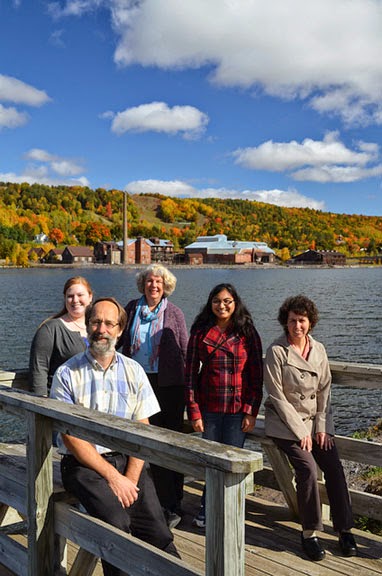
Michigan Tech professors leading the Torch Lake Integrated Assessment -- Noel Urban (foreground), Judith Perlinger (right) and Carol MacLennan (third from right) -- are pictured here opposite the Quincy Smelter, along with student research assistants Emma Schwaiger (far left) and Ankita Mandelia. (2012 Photo © Todd Marsee and courtesy Michigan Sea Grant Research Project)

"The purpose of this project is to assemble all the existing information regarding problems in Torch Lake," Urban explains. "The most important part was the information on PCBs. As a result of our findings we convinced the DEQ, the EPA and the PAC (Torch Lake Public Advisory Council) that there is ongoing contamination from PCBs."

Urban and Perlinger found data indicating that concentrations of PCBs in Torch Lake sediments, water and fish were much higher than those in nearby waterways. The highest concentrations -- hot spots -- are near the western shore of Torch Lake, where industrial activity was intense.

While swimming and boating in Torch Lake are considered safe, humans can be exposed to harmful effects of PCBs from eating fish with high levels of PCBs in their fatty tissues and from contact with contaminated soils. The local municipal drinking water, which comes from groundwater wells, is not contaminated with PCBs.

On July 4, 2014, Professor Noel Urban took groups of visitors on a boat ride aboard Michigan Tech's research vessel, the Agassiz, and explained various aspects of the pollution in the sediments and the fish of Torch Lake. Passengers were invited to ask questions during the sessions. Here are some video clips from one of his presentations:

On Michigan Tech's research vessel Agassiz, Noel Urban, Michigan Tech professor of environmental engineering, speaks about the stamp sands in Torch Lake during a community education event in Lake Linden, Mich., on July 4, 2014. (Videos by Keweenaw Now)

Urban estimates it will take 800 years for the sediments at the bottom of Torch Lake to recover naturally:

Michigan Tech Professor Noel Urban explains why nothing can grow on the bottom of Torch Lake, where sediments are still contaminated with stamp sand from industrial reclamation of copper in the area. He is speaking on July 4, 2014, during an educational boat ride on Michigan Tech's Agassiz research boat.

Aboard the Agassiz research boat on July 4, 2014, Michigan Tech Professor Noel Urban explains how electrical transformers contained PCBs that contaminated the soil and how fish in Torch Lake are contaminated with both PCBs and mercury. He points out that Amy Keranen of MDEQ is working to locate the PCBs so they can be cleaned up.

Michigan Tech Professor Noel Urban answers questions about contamination of Torch Lake from copper mining and reclamation. Here he discusses contaminants in the sediment and the fish. Agassiz Captain Steve Roblee asks about the safety of well water. 

As Noel Urban noted in his presentation, fish consumption advisories prohibit eating certain fish from Torch Lake because of mercury and PCBs that bioaccumulate in fish tissues.

The Michigan Department of Community Health (now known as the Michigan Department of Health and Human Services) is working on the problem of Torch Lake's contaminated fish and has issued fish consumption advisories for Walley, Northern Pike and Smallmouth Bass. Michigan's Health Department toxicologists are also working on evaluations of risk from toxic contaminants around Torch Lake.**** 

Notes:

* The EPA has defined the Superfund Site as the upper six inches of stamp sand and slag in certain areas of Houghton County and any soil cap and vegetative cover applied to these areas. It has also included a "no-action" remedy for lake sediments. The Superfund program continues to monitor this remedy.

** Click here to learn more about the PCBs in and around Torch Lake and potential health hazards they pose to humans. Click here for more details on toxic metals in and around Torch Lake. Learn which government agencies and community groups are working on Torch Lake issues in the Michigan Sea Grant publication, "Who Is Doing What at Torch Lake?"

*** Click here for a map of the Torch Lake Area of Concern.

**** Click here to see fish consumption advisories for your area of Michigan.  Click here for Michigan Health Department reports on the Torch Lake Superfund site and surrounding areas.

Editor's Note: This is the fourth in a series of articles including Michigan Tech's Research Vessel Agassiz used for community education programs during 2014. See also our July 22, 2014, article, "Adults and kids learn about Great Lakes research, fish food web, marine robotics, more ..."; our Aug. 4, 2014, article, "Photos: Copper Harbor celebrates Lake Superior Day 2014 with R/V Agassiz excursions, ROVs, canoe races, picnic, more .."; and our Nov. 17, 2014, article, "Geology expert notes concerns about arsenic in Gay stamp sands as DEQ accepts comments on stamp sand removal proposal."