See our right-hand column for announcements and news briefs. Scroll down the right-hand column to access the Archives -- links to articles posted in the main column since 2007. See details about our site, including a way to comment, in the yellow text above the Archives.
Showing posts with label renewable energy. Show all posts

Friday, January 14, 2022

Guest article: COP26 -- An Indigenous Experience

By Kathleen Brosemer*

Guest author Kathleen Brosemer, Environmental Director for the Sault Ste. Marie Tribe of Chippewa Indians and Michigan Tech Ph.D. student in Energy and Environmental Policy, is pictured here at a display on ancestors along a walkway at COP26, the UN Climate Change Conference in Glasgow (November 2021). "This quote about the ancestors meant a lot to me," Brosemer writes. "WE are the ancestors to the people who will be struggling to survive. We should be better ancestors than we have been." Click on photos for larger versions. (Photos courtesy Kathleen Brosemer)

What’s COP26? It’s the 26th annual Conference of the Parties to the UN Framework Convention on Climate Change (UNFCCC). The United Nations has been brokering a climate change agreement among the nations of the world for over 26 years. It’s not controversial -- it’s settled science that humans are altering the climate of the only planet we know of that can support human life. It’s not a smart thing to do; but so far it’s been profitable, so it’s tough to get it stopped.

This mural, painted on the wall in the entrance hall going into the Conference Center, depicts most aspects of public concerns and involvement in COP26.

At COP21 in Paris in 2015, the big news was the agreement of the parties to this convention, to work to limit human-caused global warming to 1.5 degrees Celsius. That was a big deal, because there's good science that predicts if we let the warming exceed 1.5 degrees across the entire surface of the earth, not only would that be catastrophic regarding hurricanes, wildfires, and coastal inundation, but it might not be possible to prevent a runaway warming of the surface that would wipe out all life.  So the Paris Agreement was cause for celebration. But as with everything at an international level, the devil is in the details.  How would we make this come about? COP26 was significant because the parties agree to review all the details and make new commitments every five years.

The intervening six years have seen little progress. Although some nations have made great strides in reducing emissions, the global emissions keep going up. Even during the pandemic, when planes stopped flying and people stayed home, emissions kept going up. The pandemic meant the postponement of COP26 from November 2020 to 2021, which was a good thing, because in November 2020 the US representatives would have been from an administration hostile to progress in this area. The former administration had in fact withdrawn from the Paris Agreement, which the incoming administration in January 2021 immediately rectified. So there was at least a chance at some progress.

I was attending COP26 in two roles: as an observer because I'm a PhD student in Energy and Environmental Policy at Michigan Tech, and as a presenter -- to give a talk about energy justice for the Anishinaabeg, in my role as Environmental Director for the Sault Ste. Marie Tribe of Chippewa Indians.

A display of red dresses along the fence leading to the entrance to the conference center in Glasgow commemorates the lives of the Missing and Murdered Indigenous Women and Girls.

At the COP, I spent most of my time with the Indigenous Peoples’ Caucus, helping draft language for inclusion in Article 6 of the Paris Rulebook, which provides the details for implementing the 2015 Paris Agreement. Article 6 contains rules about market and non-market measures and international cooperation. What worries Indigenous peoples around the world is the possibility that states could put rules on how people are living within healthy forests, turning them into "protected areas" that exclude the people who have lived there since time immemorial. So-called "forest offsets" are false solutions for mitigating climate change -- they’re just calculators that let states pretend they’re taking action while they continue to subsidize fossil fuels.

Kathleen took this photo while working with the Indigenous Peoples' Caucus to draft suggested language for inclusion in Article 6.
  
We were able to get some good language inserted into Article 6, as well as into the final COP26 decision, recognizing Indigenous peoples’ rights and providing for a grievance mechanism when states take actions that harm Indigenous peoples. However, a grave disappointment was the failure of the parties to promise to phase out coal. Instead they used the more wishy-washy "phasing down" in the final consensus document. They also only committed to "cut back" on state subsidies to non-sustainable energy production, not to eliminate those subsidies.

At Paris in 2015, our Anishinaabeg knowledge keeper Frank Ettawageshik was there for the exciting moment when the governments of the world promised to limit warming to 1.5 degrees Celsius. The former chairman of the Little Traverse Bay Bands of Odawa Indians has been active worldwide in protecting Aki (Mother Earth) through work on the Great Lakes Commission and many other collaborative efforts.

Since 2015, he has turned his voice toward climate change.  Ettawageshik understands the drastic and terrible consequences that all of humanity faces, but that will come first and worst to Indigenous peoples if we let this get away from us. If we are to keep our Paris commitment, we must reduce emissions by 45 percent (below 2010 levels) by 2030. This is the best science we have and has been accepted by the signatories to the UNFCCC.

That’s only eight years away.

There is frankly no way to do this while governments still subsidize fossil fuels, using our tax dollars at cross purposes.

We are at a turning point.

Kathleen is pictured here at the booth for Action for the Climate Emergency, wearing her ribbon skirt and her red moccasins.

What can you do to reduce carbon emissions? There is a long list of things to try. Some of it will save you money. Other things won’t work in your life or require too much of an investment you can’t afford right now, but no matter your circumstances there is something you can do. After Glasgow, it looks as though it’s going to be up to us.

Checklist of things you might incorporate into your life to reduce carbon emissions:
- Grow some of your own food in your garden. Food from far away increases vehicle emissions.
- Hunt, fish, and gather locally.
- Buy food from local farmers.
- If you buy any new appliances, look for the EnergyStar logo.
- Switch from natural gas or propane to electric appliances.
- Start and use a backyard composter for kitchen and garden waste.
- Recycle as much as you can. Landfills emit methane, which is a potent greenhouse gas. The less we throw in, the less methane.
- Buy less stuff. Buy used items if they’ll do the job, or share with others. Manufacturing and transporting new goods emits carbon.
- Air seal your home. Clear caulk is cheap, and it will reduce drafts and save money.
- Add insulation to your home, especially the top (attic) and bottom (basement). Insulating and air sealing the top and bottom means stopping the chimney stack effect that steals your heat.
- If you do any renovations (even for just one wall or one room), plan for energy efficiency at the same time. Any extra costs will pay for themselves in energy savings.
- If a furnace upgrade is in your future, plan for ground source heat pump** and/or wood or pellet stove heat.
- When it’s time to replace a car, look into a hybrid or all electric vehicle. Prices are coming down!
- Use the car less. Combine trips, carpool, and walk or bike if that’s possible for you for some trips.
- If travelling, see if you can avoid a car rental and use public transit.
- Look into solar net metering for your home.

Next year’s COP will be in Egypt. I hope I am able to attend and be part of the Indigenous Peoples' demands for change once again. It’s incredibly important if we are to have a future on this planet.***

Editor's Notes:

* Guest author Kathleen Brosemer has been the Environmental Director for the Sault Ste. Marie Tribe of Chippewa Indians for 11 years and is presently a Michigan Tech Ph.D. student in Energy and Environmental Policy. She is a member of the Echota Cherokee, from her father, who grew up in Alabama. She is also known as Azhede-kwe (White Pelican Woman), a name given to her by an elder after Brosemer's return from Standing Rock.

** According to a recent Michigan Tech News article, "Solar-powered Heat Pumps Warm Upper Peninsula Homes for Less," heat pumps are defined thus: "A heat pump is an air conditioner running in reverse. Working at temperatures as low as minus 5 degrees Fahrenheit, the pump takes cold air from outside and produces warm air inside. It runs on electricity but is three times more efficient than the space heater under your desk. That efficiency is vital for dealing with the U.P.’s high electricity prices -- but the real savings come from using solar PV (photovoltaic). MTU studies have previously shown that solar PV is cheaper than grid electricity. The latest studies explore whether enough solar energy can be generated and used by the heat pump to keep an average U.P. home warm -- and what it will cost."

*** This is the second in Keweenaw Now's series of articles by guest authors who attended COP26 in Glasgow, Scotland, in November 2021. See also: "Guest article: COP26 Reflection," by Alexis Pascaris, posted Jan. 1, 2022.

Monday, November 07, 2016

Congressional Candidate Lon Johnson holds Town Hall in Keweenaw County

By Michele Bourdieu

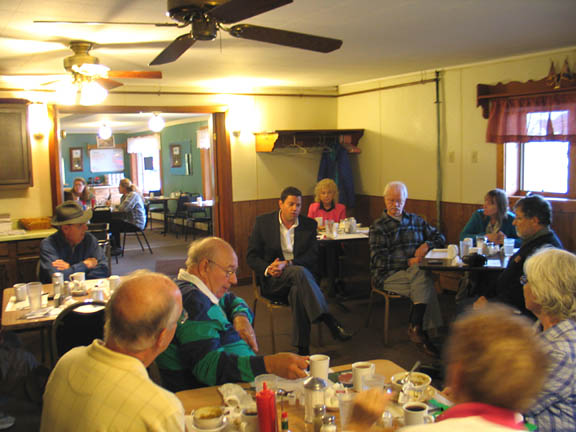
First District Democratic Congressional Candidate Lon Johnson (center in dark jacket) holds an informal Town Hall discussion at Slim's Café in Mohawk on Oct. 5. Jacqueline Jaaskelainen (in background behind Johnson), Keweenaw County Democratic Party chair, arranged the venue when Johnson expressed his wish to meet with Keweenaw County residents. (Photo by Keweenaw Now)
 
MOHAWK -- In the final weeks of the election campaign, First District Democratic Congressional Candidate Lon Johnson traveled all over the 32 counties in the district holding Town Halls and participating in candidate forums. He made a special trip to the northernmost county -- Keweenaw -- with a Town Hall visit to Slim's Café in Mohawk on Wednesday, Oct. 5. Thanks to the organizing efforts of Keweenaw County Chair Jacqueline Jaaskelainen, Slim's offered their dining room that day to fit the candidate's busy schedule -- following his participation in the Ontonagon Candidate Forum on Tuesday, Oct. 4, and a Wednesday morning Town Hall at Carmelita's in Calumet -- and preceding a Town Hall he held at the Downtowner in Houghton that Wednesday evening.

On Nov. 2, 2016, Lon Johnson posted on his Facebook page this map of his tour of the First District, showing his extensive participation in candidate forums and town hall meetings. (Map courtesy Lon Johnson for Congress)

In an email reply to Keweenaw Now, Brian Spangle, Johnson's campaign manager, confirmed Lon has visited with voters in all 32 counties of the 1st Congressional District.

"On a comparison of the mileage from his home in Kalkaska, it seems that Ironwood / Gogebic County was the furthest he traveled, with Mohawk and Keweenaw being a very close second," Spangle notes. "The great news is we covered everywhere in between Gogebic and Chippewa counties, and from coast to coast (Mason County to Alcona County) in the Lower Peninsula, and left no county unvisited."

The Mohawk event was very informal, allowing participants to ask questions and discuss issues such as fresh water, Social Security, education, renewable energy, tourism and gridlock in Congress.

Johnson began by stating some of his priorities: a better government (not divided, angry and partisan as it is now), a tax code that doesn't continually favor the wealthy, trade deals that work for us, a strong economy along with environmental protection. He noted we should be thinking 10, 20, 30 years into the future.

Lon Johnson and his wife, Julianna Smoot, are pictured here with the 1985 Coachmen RV in which they have traveled all over Michigan's large First Congressional District to attend candidate forums, debates and Town Hall meetings. (Photo courtesy Lon Johnson for Congress)

"We've got to make money here, but we also have to protect our environment," Johnson said. "That means continued sustainable logging and sustainable mining practices, but it also means a renewed effort to protect our Great Lakes. Fresh water is who we are."

Fresh water, Line 5, climate change

Johnson noted the First District has more fresh water than any district in the United States.

Ruth Mohr of Eagle Harbor congratulated Johnson for being concerned about the pipelines under the Straits of Mackinac.

"I'm not opposed to pipelines," Johnson said. "Pipelines are the safest way to move oil. We don't want oil moved on a truck or by train or, heaven forbid, on a boat."

Johnson noted there are smart places to put pipelines but putting pipelines in the Great Lakes is not smart.

"This current pipeline that we're talking about -- Line 5 -- this is a 63-year-old oil pipeline pushing a half a billion barrels a day through the Straits of Mackinac, and it hasn't been independently inspected," Johnson said. It's dangerous. And when you operate in our Great Lakes -- or anywhere on land -- you must be 100 percent transparent. If you're not willing to be transparent you forfeit the right to use our resources."

This pipeline could be shut down at the Straits and propane could still be delivered via Line 5 to the U.P., Johnson added.

Here's a video ad showing Johnson's fight to shut down Line 5 and protect the Great Lakes:

This video shows Lon Johnson speaking about Line 5 at a Town Hall in St. Ignace, near the Straits of Mackinac. (Video courtesy www.lonjohnson.com) 

Mary Byers of Eagle Harbor said she was glad to hear Johnson is looking years ahead with his concerns, because some local residents are too shortsighted in thinking Lake Superior is here forever.

"With climate change California, Arizona, the whole southwest is coveting our water," Byers noted. "They want it. And if we get the wrong people in Congress we could lose our water."

Johnson said our water is his concern because those Western states have more members of Congress than the Great Lakes states do. Besides working right now on our legal protections, we have a moral responsibility to show the world how to use and protect fresh water, he said.

"We need to create and make the U.P. and northern Michigan the hub for the use and protection of fresh water," Johnson noted.

This means, for example, showing manufacturers, farmers, the military and the energy industry how to use less water and build a better economy.

Byers noted she has met many Republicans who don't believe in climate change and don't see the problem.

"The climate's changing," Johnson said. "The question is can we do something about it, and I believe that we should."

Johnson noted his Republican opponent Jack Bergman, when asked about Line 5 on television, called it a "business decision."

"Protecting our Great Lakes is not a business decision," Johnson said.

Invest in people, not corporations

Johnson also said he wants the U.P. and northern Michigan to be a place where families can stay and succeed.

"Number one we've got to protect what you've already earned -- your Social Security, your Medicare, your V.A. benefits," Johnson said. "There is a real effort in Washington, D.C., to move those benefits of yours -- that you worked a lifetime for -- to private corporations -- to privatize them. I'm opposed to that."

Johnson said thinking years ahead means bringing high speed Internet and mobile telephone service into the whole district, investing in our infrastructure and renewable energy, funding a new Soo Lock and restoring passenger rail service to the area to promote tourism. It means making college affordable and investing in local school districts and making sure they're not privatized.

Johnson said the biggest difference between himself and his opponent Jack Bergman is that he, Johnson, believes in investing in people, our land and the Great Lakes.

"Jack Bergman wants to take basically our tax dollars and send them off to Wall Street in the hopes that it will trickle down and support us. That doesn't work. When you give these massive tax breaks to these corporations -- number one, it doesn't come back to us, and number two, they take the revenue and hide it overseas."

Jacqueline Jaaskelainen, a former teacher, said she was glad to hear Johnson supports public schools, because we have to be committed to investing in public schools to be sure children are being educated. While home schooling can be done correctly, she said, sometimes there are loopholes and the children do not receive the education they need

Gridlock in Congress

Ernest Mooney of Eagle Harbor said he believes the biggest problem in this country -- that stands in the way of education, immigration reform, building infrastructure and more -- is gridlock in Congress -- the inability to compromise.

"In the Congress nobody gets along," Mooney said. "I think what made this country great, at least up to the Civil War, was the ability to compromise and find common ground between people."

During the Oct. 5 Town Hall in Mohawk, Ernest Mooney of Eagle Harbor, left, asks Lon Johnson about gridlock in Congress and what he would do about it. Also pictured are Thomas Renier, second from left, and Gordon Jaaskelainen. (Photo by Keweenaw Now)

Mooney asked Johnson how he would combat gridlock if elected to Congress.

Johnson said it begins with example and common courtesy, civility, not questioning others' motives.

"When you're an elected officer you have an obligation to serve everyone regardless of what their party is," he said. "We also need to start looking at institutional changes to our political process."

Johnson said the way congressional lines are drawn (according to parties) elected officials have no institutional incentive to compromise -- for fear of losing re-election in a primary.

"We also have to get these billions of dollars of corporate money out of politics," Johnson said.

He noted his admiration for former First District Congressman Bart Stupak, who has endorsed him. Stupak is a good example of compromise, being able to work across party lines, Johnson noted.

Renewable energy

Ruth Mohr told Johnson there seems to be a lot of interest in solar energy locally. She mentioned the Keweenaw Research Center's finding that solar energy is feasible in this area, but the example of some electric companies that have reduced the rewards for net metering on residential solar makes her wonder what the future holds for such efforts to introduce renewable energy sources.

Johnson said people shouldn't be punished for investing in renewable energy. Policies shouldn't go backwards. Renewable energy can create jobs and lessen our dependence on foreign carbon-based energy.

"We need to start investing in renewable energy -- be that bio, geothermal, solar or wind," Johnson said. "Our nation gives an enormous amount of tax breaks to the oil and gas industry. We need to start incentivizing the same for renewable energy."

Mooney commented that the Republicans, as opposed to the Democrats, are pushing for the use of coal, and the coal and oil and gas industries have lots of money. To fight Republicans you have to fight the money they spend on legislatures, he said.

"I think we have to demonstrate to people the advantages of solar and wind," Johnson replied, "and at the same time we've got to start to move resources away from the oil and gas industry and over to solar. We're starting to see more -- as individual consumer demand goes up for it -- private industry will follow."

To a question on wind energy, Johnson said he's in favor of renewable energy, but decisions on what kind of energy and where to put it should be made by the local communities.

After Johnson left to go to his next Town Hall in Houghton, Paul Taipale of Eagle Harbor told Keweenaw Now he was very impressed with the candidate.

"He was at our level, listening carefully and answering the questions directly," Taipale said.

Mary Byers of Eagle Harbor also had a positive reaction.

"He seemed sincere,"  Byers said. "He doesn't talk just to hear himself talk. He was very open to our questions and comments, and he did seem knowledgeable about the issues that voters are concerned about."

To learn more about Lon Johnson's positions on important issues, click here.

Wednesday, August 19, 2015

Rep. Dianda to host three Energy Town Halls -- Aug. 22, 24, 25

Poster announcing Energy Town Hall Meetings this month with State Rep. Scott Dianda. (Poster courtesy Rep. Scott Dianda) 

CALUMET – State Representative Scott Dianda (D- Calumet) will hold three town halls to discuss energy generation and the Upper Peninsula’s energy independence. The town halls will be held in Hancock, Ishpeming and Ironwood and will include a presentation on energy generation followed by a question-and-answer period with Rep. Dianda and guests. These events are free and open to the public.  

The town halls will be held as follows:

Hancock Energy Town Hall: 11 a.m. to 1 p.m. (ET) Saturday, Aug. 22, at Franklin Township Hall, 49850 U.S. Highway 41, Hancock.

Ishpeming Township Energy Town Hall: 6 p.m. to 8 p.m. (ET) Monday, Aug. 24, at Ishpeming Township Hall, 1575 U.S. Highway 41W, Ishpeming.

Ironwood Energy Town Hall: 6 p.m. to 8 p.m. (CT) Tuesday, Aug. 25, at Memorial Building Auditorium, 213 S. Marquette St., Ironwood.

Monday, July 27, 2015

UP Supporters for Bernie Sanders to hold organizing event July 29 at Orpheum Theater

U.S. Senator Bernie Sanders speaks about the need for renewable energy during the Sept. 20, 2014, panel discussion held in New York City in conjunction with the Climate March the following day. Sanders will speak to supporters in a live online national broadcast on Wednesday, July 29. UP Supporters for Bernie Sanders will host an event including the broadcast at the Orpheum Theater in Hancock. (Photo by Allan Baker for Keweenaw Now)

HANCOCK --UP Supporters for Bernie Sanders will hold an organizing meeting from 6 p.m. to 9 p.m. on Wednesday, July 29, 2015, at The Orpheum/Studio Pizza, 426 Quincy Street in Hancock, for those interested in supporting Sen. Bernie Sanders' campaign for President.

The meeting will include two parts. From 6 p.m. to 7 p.m. Bernie supporters will have an opportunity to meet one another and share their stories about why they support Bernie. Beginning at 7 p.m. (EDT) a live online broadcast will feature Bernie and campaign staff discussing concrete steps supporters can all take together to build the movement.

Allan Baker, who videotaped a panel discussion including Bernie on Sept. 20, 2014, the evening before the New York City Climate March, helped organize this event at the Orpheum along with hostess Anne Newcombe.

Here is Baker's video clip in  which Bernie expresses his views on what could be done in the U.S. to reduce greenhouse gases and the dependence on fossil fuels:

During a panel discussion held Sept. 20, 2014, at All Souls Unitarian Church in New York's upper east side in conjunction with the New York City Climate March, U.S. Sen. Bernie Sanders expresses his views on the need for renewable energy to fight climate change. (Video by Allan Baker for Keweenaw Now)

"When Bernie spoke he talked about what could be done about climate change as well as forces slowing down the movement," Baker said. "He is not a candidate that has trouble staying on message, for he just tells the straight truth. Others who spoke that night were Chris Hedges, Naomi Klein, Bill McKibben and Kshama Sawant -- but it was Bernie who was the more inspiring that night because what he said, he is still saying it and now on the national stage! No matter that the coal, gas and oil companies have control of Congress, his country can and should move quickly toward wind, geothermal and solar electric generation."

Come join your fellow Yoopers, enjoy some food and drink, and hear the man who has been breaking venue records. The meeting will start with some basic organizing principles, will broadcast Bernie addressing the nation at 7 p.m. Eastern Daylight Time, and will follow up with next steps. Please bring your friends, family and co-workers.

Friday, May 29, 2015

KBIC to host Environmental Forum, "Weaving a Sustainable Future," June 2 in Baraga

Poster for Keweenaw Bay Indian Community Environmental Forum June 2, 2015, at Niiwin Akea Center/Ojibwa Community College. (Poster courtesy Jessica Koski)

BARAGA -- The Keweenaw Bay Indian Community (KBIC) Natural Resources Department is hosting an Environmental Forum, "Weaving a Sustainable Future," from 2 p.m. to 8 p.m. next Tuesday, June 2, at the Niiwin Akea Center/Ojibwa Community College located at 111 Beartown Road in Baraga. The event is free and open to the public.

Families, fishermen, elected tribal leaders, tribal members, elders, non-native community members and the general public are welcome to attend this event.

At 6 p.m. there will be a Breakout Session on Fisheries and Treaty Rights. KBIC commercial and subsistence fishermen are strongly encouraged to attend this session in order to exchange information and ideas regarding the status of Lake Superior fishery management as well as regional fishery resources.

Also at 6 p.m. a concurrent breakout session on Healthy Homes will be held. Green cleaning products and ideas will be provided, as well as information about illnesses that could be related to indoor air quality. Learn how to improve your home’s air quality for you and your family.

What will be happening at the Forum?

Starting at 2 p.m. Information Booths will provide educational materials from KBIC’s Natural Resources Department and from environmental partners including the Great Lakes Indian Fish and Wildlife Commission (GLIFWC), Superior Watershed Partnership, Save the Wild UP, and Friends of the Land of Keweenaw. There will also be a booth featuring Eco-Friendly Diapers.

From 2:30 p.m. to 4:30 p.m. and 6 p.m. to 8 p.m. Breakout Sessions will offer the opportunity to hear from KBIC environmental staff on what the tribe is doing to increase its authority to regulate and protect the reservation environment. Topics will also include climate change, wildlife and species of concern, waste management and recycling, treaty rights, mining, fisheries, healthy homes, and more.

At 4:30 p.m. enjoy a free dinner with pizza, sandwiches, fruit and veggies.

At 5 p.m. the highlight of the Environmental Forum will take place in the Gym with a Plenary Session on "Strategizing for Tribal Renewable Energy." The special guest speaker will be Kathleen Brosemer, Environmental Program manager for the Sault Tribe, who have recently received White House recognition for a Tribal Energy Strategy. In addition, KBIC’s Committee for Alternative and Renewable Energy will report on steps taken thus far to pursue a renewable energy future.

Kids' Activities

Kids' activities will start at 5 p.m. for ages 1-4 and at 6 p.m. for ages 5 and up. Kids' activities include Ojibwe Storytelling, Recycled Crafts, and Creating a Butterfly Garden where youth will learn the importance of pollinators and participate in a live release of monarch butterflies. This is a family friendly event where all ages of our community can learn about the importance of protecting our environment. Please register kids by calling 524-5757 ext. 25.

Why is this an important event?

This Environmental Forum is a unique opportunity to learn about the many great programs and projects being led by KBIC’s Natural Resources Department. Come meet and get to know KBIC’s environmental staff, increase your awareness of your local environment and environmental issues, and discover ways you can play a more active role in creating a sustainable future for the community.

This event is made possible with support from the Great Lakes Restoration Initiative, Indigenous Environmental Network, KBIC Family Spirit Program, KBIC Pre-Primary Education Program, KBIC Cultural Committee, Keweenaw Bay Ojibwa Community College and more.

Click here for an agenda. Jessica Koski of KBIC's Natural Resources Department speaks about the forum in an interview on Eagle Radio's Weekly Native American Radio Program (Eagle Country 105.7). Click here to listen to the interview.

Tuesday, April 21, 2015

Public is invited to Lake Superior Celebration of Energy, Sustainability Apr. 23 at Great Lakes Research Center

Michigan Tech's Great Lakes Research Center will be the scene of a Lake Superior Celebration of Energy and Sustainability on Thursday, April 23. The event is free and open to the public. (Keweenaw Now file photo)

HOUGHTON -- A Lake Superior Celebration of Energy and Sustainability will take place from 6 p.m. to 8 p.m. Thursday, Apr. 23, at Michigan Tech's Great Lakes Research Center (GLRC) in Houghton.

The public is invited to tour the GLRC, participate in hands-on activities, explore local resources and celebrate the achievements of student and community groups now working on renewable energy projects.

Hands-On Activities
  • Great Lakes Research Center tours: green roof  and other sustainable features
  • Energy efficient homes, wind turbines, draft dodger activities for youth
  • MTU Sustainable Vehicle Lab (invited)
Local Resources
  • Renewable energy experts
  • Energy efficient builders
  • Home energy audits
  • Green burial initiative
  • Local food and greenhouses
  • Houghton County recycling plan!
Celebrate!
  • Solarize Houghton County! Abhilash "Abhi" Kantamneni
  • Mine Water Geothermal? MTU Alternative Energy Enterprise students
  • Lake Superior Stewardship Initiative (LSSI) Student Presentations and School Team Displays
  • Enjoy cake and lemonade!
The event is sponsored by Lake Superior Stewardship Initiative; Michigan Technological University; Western U.P. Center for Science, Mathematics and Environmental Education; and Houghton Energy Efficiency Team (HEET).

Funded in part with a grant from the Great Lakes Stewardship Initiative.

Monday, November 03, 2014

Congressman Gary Peters, candidate for U.S. Senate, visits Houghton

By Michele Bourdieu

Congressman Gary Peters, Democratic candidate for the U.S. Senate seat held for 36 years by Sen. Carl Levin (D-Michigan), chats with Houghton County Democrats during an informal "meet and greet" event on Oct. 18, 2014, at the Super 8 Motel in Houghton. (Photos by Keweenaw Now)

HANCOCK -- U.S. Rep. Gary Peters, now a candidate for the Senate seat held by retiring Sen. Carl Levin (D-Michigan), fielded questions on the Affordable Health Care Act, climate change, Upper Peninsula electrical power issues, U.S. involvement in the Middle East, military spending and more during an informal "meet and greet" visit to Houghton County Democrats on Oct. 18, 2014.

Scott Dianda, Michigan 110th District state representative, welcomed Peters and introduced him as a colleague, a friend and a person who cares about Michigan:

U.S. Rep. Gary Peters, candidate for the U.S. Senate seat now held by retiring Sen. Carl Levin (D-Michigan), speaks to a group of Houghton County Democrats about his visits to the Upper Peninsula and his campaign. He is introduced by State Rep. Scott Dianda, at right. (Videos by Allan Baker for Keweenaw Now)

After talking briefly about his positive experiences visiting the U.P., in both winter and summer, Peters talked about his campaign, plans to honor Sen. Levin for his 36-years of service in the Senate and his present lead over Republican opponent Terri Lynn Land, former Michigan Secretary of State.

Describing "meet and greet" as "sort of a laid-back discussion with friends," Peters welcomed questions from the audience.

Gary Peters, Michigan Democratic candidate for the U.S. Senate, fields questions from the audience during the Oct. 18 "meet and greet" event with Houghton County Democrats.

He expressed his agreement with the opinion that the Affordable Care Act needs to be presented in a more positive light and facts about it contrasted with negative ads.

"I did vote for the Affordable Care Act, and I'm proud of it," Peters said. "It's my basic core belief ... that everybody in this country -- no matter who you are, no matter where you live -- should have access to affordable health care."

Peters noted 270,000 families signed up for the insurance exchange in Michigan. Adding that to the Medicaid expansion in Michigan, a total of 600,000 families, formerly without insurance, now have health insurance, even though, he acknowledged, it's not a perfect law. Peters said he is also working on legislation to help small business owners provide health care for themselves and their employees.

Brian Hoduski, Houghton County Democratic Party co-chair, brought up the subject of the minimum wage. He noted he read recently that raising the minimum wage to $10.10 would actually save the federal government $7.7 billion in aid given to people in need.

"I'm a strong supporter -- we have to raise the minimum wage in my mind to $10.10," Peters agreed. "If someone is working hard, playing by the rules, you should at least be able to make money to at least pay your basic bills."

Peters said he would continue to keep pushing for that increase, noting his opponent does not seem to realize how important it is.

Keweenaw Now's Allan Baker asked a question on climate change:

During the Oct. 18 informal discussion with Houghton County Democrats, U.S. Rep. Gary Peters, candidate for U.S. Senate, answers a question on climate change, noting the importance of renewable energy in Michigan.

Peters said he believes what is good for the environment is also good for the economy. He gave examples of the growth of solar energy in Michigan. He also commented on Michigan's agricultural assets and great water supply -- both of which are at risk if we do nothing about climate change.

In a brief interview with Keweenaw Now, Peters said he was aware of the Enbridge pipelines near the Mackinac Bridge and the devastation caused by that company's Kalamazoo oil spill.

"We have to be very concerned about the pipelines," Peters said. "The particular danger of Canadian tar sands oil is that, unlike regular oil that floats on the top of the surface of water, it's so heavy that it actually sinks -- so it is particularly problematic to clean up if you have an oil break or a break of the pipeline."
 
Peters added, "We need to be sure that we are aggressively working with the company to make sure that pipeline (under the Straits of Mackinac) is as safe as it can possibly be."

Peters noted that Mark Schauer, the Democratic candidate for governor opposing Michigan Gov. Rick Snyder in this election, is very engaged in that issue.

Asked about the recent mining projects in the U.P., Peters said he was not aware of those issues since he presently does not represent the U.P., but when he is elected Senator he will be coming up here to meet with residents and environmental groups "to be sure as those projects go forward that they're done in a way that doesn't endanger the environment."

Two Great Lakes issues that have concerned him are the Asian Carp issue and the Great Lakes Restoration funding.

Janet (Niemi) Burkholder of Bootjack asked Peters about his views on fracking and federal clean air and water laws:

Gary Peters answers a question on environmental regulation of new industries like fracking, noting legislation he is working on to include fracking in the Clean Water Act and the Clean Drinking Water Act.

After a question from Barry Solomon, Michigan Tech professor of geography and environmental policy, on the failing Presque Isle power plant in Marquette, State Rep. Scott Dianda joined in the discussion on renewable energy, noting his work on the power issue and his interest in biofuels and recycling. Peters said he was following the issue and will be actively engaged, along with Michigan Sen. Debbie Stabenow, in finding a solution.

Vietnam veteran Phil Faucher asked Peters about his views on our military involvement in the Middle East:

Gary Peters comments on U.S. involvement in the Middle East, support of veterans and limits on military spending.

Frequent applause in response to Peters' statements of his views seemed to indicate most of the Democrats present were supportive of the candidate.

Rick Kasprzak, Houghton County Democratic Party (HCDP) co-chair and candidate for Houghton County Commissioner, said he thought Peters was well spoken and seemed informed on the issues.

"His ideas were well thought out," Kasprzak said. "I think he actually showed his position on the Middle East. It just showed how very complicated that issue is. Because of past actions we are now in a position where we don't have any good options. We're deciding between the lesser of two evil options. From what I heard tonight he's the kind of guy that can steer the ship through the rough waters."

Tammy Hoduski of Houghton, a teacher at Houghton Middle School, was impressed by Peters.

"I think he's great," she said. "He's honest. I felt like I could trust him to represent us in a fair way. I liked that he talked about raising the minimum wage. I think that's smart."

Janet Gregorich, Houghton County Democratic Party vice chair, said she liked the fact that Peters voted for the Affordable Care Act.

"I think it's very needed in our country so that people are insured," she said.

Brian Hoduski, HCDP co-chair, commented to Keweenaw Now, "Nobody can replace Senator Levin, but Gary can make a good crack at it."

John Slivon, Hancock city councilman, was a bit skeptical on at least two issues discussed at the meeting.

"I don't think he's well enough informed about the negative aspects of fracking to be able to make an informed decision about it," Slivon said. "I don't agree that we should be bombing in the Middle East. Period."

To learn more about Gary Peters, visit his Web site.

You can also compare Peters' answers to questions from the Michigan League of Women Voters with those of other candidates by consulting the League of Women Voters 2014 Nonpartisan Voter Guide.

Tuesday, March 13, 2012

Transit workers' union backs Michigan renewable energy ballot proposal

LANSING -- The Amalgamated Transit Union (ATU), a statewide organization representing Michigan public transit workers, has endorsed a Michigan ballot initiative that would raise the use of renewable energy to 25 percent by 2025.

The Michigan Energy, Michigan Jobs initiative is collecting petition signatures to put the 25 percent renewable energy standard before voters in November.

A resolution adopted by the ATU states, "Investing in more renewable energy will also help diversify Michigan’s economy, especially Michigan’s manufacturing sector, attracting new investments and opening the door for companies and workers to innovate and diversify so they can truly compete in the 21st Century energy economy."

The ballot proposal also includes strong consumer protections by limiting rate increases to no more than 1 percent in any year. That equates to no more than $1.25 per month for families and businesses to get more of their power from clean, renewable sources.

"We know using public transit helps reduce air pollutants, but we should also be powering our homes and businesses with cleaner, more renewable sources of energy, which is why we support the ballot initiative," said Katie Kelley, president of the ATU Michigan Legislative Conference Board. "Michigan shouldn’t be left in the wake of other states that already have stronger renewable energy standards."*

Mark Fisk, spokesman for Michigan Energy, Michigan Jobs, commended ATU members for endorsing the ballot initiative.

"We are thankful for the support of ATU members," Fisk said. "Workers understand this proposal will create more jobs in Michigan that can’t be outsourced."

More information on the ballot initiative can be found at www.MienergyMIjobs.com.

* Editor's Note: See how Michigan compares with other states on renewable energy goals in this week's Michigan League of Conservation Voters Political Week in Review (PWIR). See especially the article, "Gov. Chris Christie Approves 22.5% by 2021 for New Jersey."

Friday, February 17, 2012

Michigan LCV: Renewable energy could mean 21,000 Michigan jobs

By Ryan Werder, Michigan League of Conservation Voters
Posted Feb. 13, 2012
Reprinted with permission

On Feb. 8, 2012, the Energy Innovation Business Council (EIBC) released a fascinating report on renewable energy jobs in Michigan. We'll summarize it in a sentence: Renewable energy manufacturing in Michigan could become a $4.9 billion industry supporting 21,000 jobs by 2015.*

At this point we're talking about big numbers, so please take a moment to pause and reflect on the thousands of families whose lives would improve if they were just one of those 21,000 new jobs. Exciting, right? It is sometimes too easy to get lost in the statistics of asthma rates from coal, jobs from new clean energy projects, billions of dollars in the budget, etc. If we don't remember the faces behind the statistics from time to time, we risk forgetting why we spend so much time researching them in the first place.

Anyway, back to the question of what to do with these crucial numbers in this report. As we've discussed previously, Michigan citizens have the unique opportunity to decide if they want to reach for a future that includes these new clean energy jobs. We firmly believe that an increased Renewable Energy Standard (RES) that is proposed for this November’s ballot would guarantee that future by ensuring that Michigan achieves 25 percent of our energy from renewable sources by 2025.**

Renewable energy manufacturing, installation, and maintenance jobs will go where the demand is. Just because MSU beat Ohio State at basketball this weekend doesn't mean we're beating the state of Ohio in the fight for more jobs; they have a renewable energy standard of their own that is out-rebounding us for jobs. We can begin to box them out with this ballot initiative.

For more on the success stories already in Michigan based on clean energy, check out my live-tweeting from the EIBC's launch in the State Capitol.***

So you don't miss it in the future, you can follow us in the future by clicking here.

* Click here for the LCV's Feb. 12 post, "New Advanced Energy Business Coalition Strengthens Renewables' Political Voice."

** See Michigan Energy Michigan Jobs on this ballot initiative.

*** Click here for more Twitter updates.

Visit the Michigan League of Conservation Voters Web site for more articles and political news related to environmental topics.

Michigan LCV Action alert: Protect Natural Resources Trust Fund

In 1976, the Michigan Natural Resources Trust Fund was created to acquire and develop outdoor recreation property with the proceeds of royalties from oil and gas wells drilled on public land.

In 1984, the citizens of Michigan voted the Trust Fund into the Constitution to protect it from politically-motivated legislators.

Now, in 2012, some legislators want it back.

The Natural Resources Trust Fund Board recently approved 41 projects in 25 counties that will provide outdoor recreation opportunities and create jobs in dozens of local townships.

Two-thirds of the funding will go directly to local projects, and the rest will protect new state recreation land.

State legislators, however, are threatening to deny some of these projects. In 2010, the Trust Fund received a record infusion of money from gas and oil leases, and some legislators have other ideas for the money than outdoor recreation.

Please tell Representatives Jon Bumstead (R - Newago) and Stephen Lindberg (D - Marquette) -- House Appropriations Natural Resources Sub-Committee Chair and Vice Chair -- to reject any attempt to interfere with the Trust Fund and to immediately pass HB 5364 to fund these projects.

Click here to take action.

Thursday, January 19, 2012

New exciting opportunity for clean energy jobs in Michigan

From the Michigan League of Conservation Voters*
Posted Jan. 12, 2012

Michigan has the chance to seize a remarkable opportunity in 2012 that will create thousands of new jobs and dramatically improve public health across the state. A proposed ballot initiative that would increase the state's renewable energy standard to 25 percent by 2025 is being put forth for the 2012 November elections. What does that mean? A quick breakdown:
  • If the proposal gathers enough signatures, it will then be considered for placement on the November ballot. It will require that 25 percent of Michigan’s energy come from clean, renewable sources such as wind, solar and biomass by 2025.

  • Right now, Michigan imports the vast majority of its energy from other states and countries, sending billions of dollars out of Michigan each year. Instead of producing our own energy -- and creating our own jobs -- we are importing dirty coal from other states and oil from the Middle East. This proposal will help us build a clean energy industry right here in Michigan.

  • This initiative will help expand Michigan’s clean energy production, without significantly increasing energy prices. In fact, studies by independent economists predict that it would cost the average Michigander, at most, $15 per year, or only $1.25 per month.

  • Unfortunately, we're lagging behind other states who have already realized the importance and value of more renewable energy. Twenty other states, including Illinois, Minnesota and Iowa, have already adopted measures similar to this initiative without significant increases in utility costs for consumers.

  • Beyond creating Michigan jobs and expanding Michigan's economy, using more wind and solar energy will reduce pollution and give Michigan families cleaner and healthier air and water, protect the Great Lakes from more mercury pollution, and reduce asthma and lung disease.
* Editor's Note: This article is reprinted with permission from the Michigan League of Conservation Voters. Check out their Web site at www.michiganlcv.org.
You can follow them on Twitter at @michiganlcv or on Facebook for quick updates.