See our right-hand column for announcements and news briefs. Scroll down the right-hand column to access the Archives -- links to articles posted in the main column since 2007. See details about our site, including a way to comment, in the yellow text above the Archives.
Showing posts with label Lundin Mining Co.. Show all posts

Tuesday, January 02, 2018

Environmental groups, Keweenaw Bay Indian Community question Lundin Mining's permit amendment request for Humboldt Mill tailings disposal

By Michele Bourdieu
 
This aerial photograph shows the Humboldt Mill Wastewater Treatment Plant and the north end of the Humboldt Pit Lake, referred to by the permit amendment request as the "Humboldt Tailings Disposal Facility" (HTDF). (2017 Photo © and courtesy Jeremiah Eagle Eye)

MARQUETTE --Environmentalists in the Mining Action Group -- part of the Upper Peninsula Environmental Coalition (UPEC) -- along with the Concerned Citizens of Big Bay and the Keweenaw Bay Indian Community, have sent comments to the Michigan Department of Environmental Quality (DEQ) expressing strong concerns about Lundin Mining's permit amendment request for Eagle Mine's Humboldt Mill.

The mining company has asked approval to place tailings to a higher elevation in the Humboldt Tailings Disposal Facility (aka HTDF or the Humboldt Pit) than currently permitted by the Eagle Mine's 2010 mining permit. The public comment period, which followed a public meeting on Nov. 27, officially ended on Dec. 26, 2017, despite requests from concerned citizens that DEQ officials extend the comment period and provide more information. Here are some excerpts from the public comments:

Comments (summary) to DEQ from Mining Action Group: "Don’t Fill Humboldt Pit Lake with Toxic Mine Waste"
Posted Dec. 26, 2017 on their Web site*


The Public Comment period on Lundin Mining’s proposed "Humboldt Mill permit amendment request" came to a close at 5 p.m. today, Dec. 26, 2017. Members of the Mining Action Group participated in the Public Meeting held on Nov. 27. We thank everyone who attended the DEQ meeting and all of the environmental stakeholders who have voiced their concerns about this flawed permit amendment request.

Our Conclusion:

We are concerned that Michigan law (especially Part 301, with regards to the filling of Humboldt Pit Lake with toxic mine tailings) and the Clean Water Act are being applied inconsistently, and that regulations are improperly interpreted. The Humboldt Pit Lake is treated, simultaneously, as an "Inland Lake" according to Michigan’s Part 301 Inland Lakes and Streams Program, but not regarded as "waters of the state" under Part 31.

During the DEQ's Nov. 27, 2017, public meeting on Lundin Mining's request to amend the Humboldt Mill mining permit because of an anticipated increase in tailings to be added to the Humboldt pit, Kathleen Heideman of the Mining Action Group asks questions of DEQ officials concerning the mining regulations, in particular the interpretation of statutes to determine whether the Humboldt Pit qualifies for protection as an inland lake. Joe Maki, geology specialist of DEQ Oil, Gas, and Minerals Division, UP District, and Steve Casey, DEQ Water Resources Division Upper Peninsula District supervisor, reply to her questions. Also representing DEQ is Melanie Humphrey, geological technician, Oil, Gas, and Minerals Division, UP District. (Video by Keweenaw Now)

The DEQ’s stewardship of Michigan’s freshwater natural resources is the shared interest and responsibility of all stakeholders. Concerned citizens, the Keweenaw Bay Indian Community, the Community Environmental Monitoring Program, the Mining Action Group and other UPESG (Upper Peninsula Environmental Stakeholders Group) stakeholders have all expressed our concerns regarding Lundin’s use of the Humboldt Pit Lake as a "waste disposal facility" which appears to violate common sense, as well as the law. We ask the DEQ to regulate this body of water in full accordance with the Clean Water Act and NREPA, keeping in mind that Michigan citizens and the Escanaba River Watershed will bear the burden of these polluting activities long after Lundin’s mining and milling operations have ceased.

We believe the Humboldt Mill amendment request does not fulfill the requirements of Part 632. The applicant failed to provide an updated EIA (Environmental Impact Assessment), failed to update the reclamation plan, dismissed the contingency plan, failed to provide a list of all additional necessary permits, and did not increase the financial assurity to offset the significant, permanent environmental hazards posed by additional tailings storage and reduced water cover at the Humboldt Pit Lake.

The Applicant has Not Met the Standard for Review

Furthermore, the DEQ has a statutory requirement under Section 324.63207 (6)(c) of Part 632 to "submit the request for amendment to the same review process as provided for a new permit application" and consolidate multiple permits into a single review process, to facilitate public participation.

The DEQ has Not Met this Statutory Requirement

The permit amendment request is fundamentally incomplete, as it falsely and narrowly limits discussion to a single permit condition; because Condition F.4 is being considered apart from other connected permits and deprecated permit conditions, steamrolling the permit process without offering an opportunity for public input; and because the applicant provides no supporting material, with no updated analysis of the cumulative Environmental Impacts.

"DEQ shall deny a permit if it determines that the mining operation will 'pollute, impair, or destroy, air, water or other natural resources or the public trust in those resources, in accordance with part 17' (Michigan Environmental Protection Act)."

This permit amendment request is obviously unsubstantiated and incomplete. Environmental stakeholders are unable to consider the implications of such a significant change, in the absence of monitoring data, modeling, and the lack of a revised EIA. Confident predictions made by Lundin’s experts in public presentations do not change our conclusion. Please deny the Humboldt Mill MP-012010 permit amendment request, on the grounds that it fails to meet the standard for review as required under Part 632.

Here is another aerial view of the Humboldt Mill Wastewater Treatment Plant and the north end of the Humboldt Pit Lake, referred to by the permit amendment request as the "Humboldt Tailings Disposal Facility" (HTDF). (2017 Photo © Jeremiah Eagle Eye)

* To read the Mining Action Group’s full public comments on the Humboldt Mill permit amendment request, click here and and follow the link at the end to access their pdf file with the complete comments.

Excerpts from comments to DEQ from Keweenaw Bay Indian Community (KBIC), dated Dec. 21, 2017

In the cover letter to their comments, KBIC President Warren C. Swartz, JR, states the basic reason for the tribe's concerns about the Humboldt Mill permit: "Under the 1842 Treaty of LaPointe, KBIC reserved rights to hunt, fish, trap, and gather on traditional lands ceded to the United States. Today KBIC continues to harvest berries, medicinal plants, water from springs, fish from streams, and wildlife within the Escanaba River watershed for subsistence and cultural lifeways. The Humboldt Mill, and its water treatment outfalls, are in the Escanaba River watershed and within the 1842 Ceded Territory."

During the Nov. 27 DEQ public meeting on Lundin Mining's request to amend the Humboldt Mill mining permit, KBIC tribal member Jeffery Loman reminded the DEQ of the tribe's concern for migratory birds and other natural resources that could be impacted by the Humboldt pit/artificial lake. He suggested the DEQ seek the participation of the U.S. Fish and Wildlife Service in regulating the lake.

Jeffery Loman, Keweenaw Bay Indian Community member, addresses Michigan Dept. of Environmental Quality officials during the Nov. 27, 2017, public meeting on Lundin Mining's request to amend the permit for the Humboldt Mill because of anticipated added tailings in the Humboldt pit. (Video by Keweenaw Now)

In their comments, KBIC also questions Lundin's original EIA, which claims that Eagle Mine activities are not expected to harm threatened, endangered or special concern species: "What is being done to keep Threatened or Endangered and Special Concern species out of the HTDF? Especially if the lake strata turn over. If bald eagles or other birds fly into and land on the HTDF lake, what is being done to keep them off? There could be the potential for animal poisoning." 

At the beginning of their comment document, KBIC states, "Lundin Mining Company, Eagle Humboldt Mill is not prepared to request an amendment to their Mining Permit, MP 012010, Condition F4. This is due to the state of understanding of the pit lake now in 2017, the modeling performed to date and the unavailability of relevant data."

The document notes that before considering Lundin's request for a higher elevation of the tailings, the DEQ, the tribe and the public need to know and understand "the complex geochemistry and fluid dynamics of the current pit lake tailings discharge." KBIC also notes concern about very high salts from the Humboldt Mill that potentially threaten the top layer of cleaner water. They also question the modeling being done -- but not yet completed -- by Lundin, specifically modeling wind speed at which lake turnover and mixing would occur.

During the Nov. 27, 2017, public meeting on Lundin Mining's request for an amendment to the mining permit for Humboldt Mill, Chuck Brumleve, Keweenaw Bay Indian Community (KBIC) environmental mining specialist, asks Michigan DEQ officials several questions related to the regulatory limits for tailings in the Humboldt pit. Seated with him (second from left) is Timothy Dombrowski, KBIC Great Lakes resource specialist. DEQ's Joe Maki comments on the geochemistry of the Humboldt pit. (Video by Keweenaw Now)

KBIC also expresses several concerns about the shallow pit lake -- impacts that could result from raising the elevation of the tailings -- in the following comments:

"Without a satisfactory water depth over the tailings, as is requested by the Humboldt Mill's Amendment to Condition F.4, the lower anoxic layers will not develop and the sulfide reducing bacteria will not develop. The thin remaining top layer will stay mixed and oxygenated due to wind-driven upwelling and other natural processes. Metals will remain dissolved and water treatment will be required before discharge well into the future after the mill closes. The elimination of an anoxic layer and sulfide reducing bacteria significantly increases the risk of perpetual or at least long term pit lake treatment."

They add that the irregular pit bottom caused by the cone-shaped mounds of tailings under the water would prohibit the planting of wetland plants, which is a sulfide mining remediation technique that has been used in other pit lakes to produce anoxic conditions.

KBIC adds, "While Lundin goes to great lengths in the Request for Amendment to Condition F.4 to calm questions about a shallow water cover with no anoxic layer for managing the dissolved metals, we fear this removes another safety measure and increases the risk of this tailings disposal site to be a long term environmental problem for the Middle Branch of the Escanaba River, Tribes and people of Michigan."

KBIC's conclusions indicate their concerns for future generations and their unwillingness to take risks based on DEQ's acceptance of Lundin's questionable modeling:

"Lundin Mining Company will be in and out of here in a matter of less than ten years. The logic presented in the amendment request is short term when considering the centuries that the Ojibwa people have been in the area in the past and intend to remain into the future. While laboratory experiments are good starting points for input to modeling, we all know that the modeling of geologic systems over decades in the short term and centuries in the long term is an inexact science if for no other reason than models have not been around for these time periods -- it is a relatively new tool. To gamble the environmental health and sustainability of the Middle Branch of the Escanaba River on model predictions is a risk the mining company and the DEQ expects the tribes to take for little or no reward for the additional risk."

Concerned Citizens of Big Bay: Public needs more information

During the Nov. 27 public meeting, Gene Champagne of the Concerned Citizens of Big Bay asked the DEQ to extend their comment period because of the lack of information available to the public:

During the Nov. 27, 2017, public meeting on Lundin Mining's request for an amendment to the Humboldt Mill mining permit, Gene Champagne of Concerned Citizens of Big Bay asks DEQ officials to extend the public comment period because of missing information needed by the public. He also asks DEQ to consider the impacts of the project as a whole rather than treating it in a piecemeal fashion. (Video by Keweenaw Now)

At one point during the Nov. 27 meeting, Joe Maki, geology specialist of DEQ Oil, Gas, and Minerals Division, UP District, stated that DEQ officials are willing to consider public comments that arrive after the deadline. Champagne took Maki at his word in sending the following comments on Dec. 28, 2017:

"Regarding 'Humboldt Mill MP-012010 Permit Amendment Request':

"I apologize for being late in sending my comments concerning this permit amendment request. The Dec. 26th deadline made it difficult to send my comments on time, as I have been traveling for the Holidays. I was also waiting until the last minute for information that was requested, and agreed upon with DEQ personnel at the public hearing November 27 at Westwood High School, that the information regarding geochemistry was necessary to make both good comment and good judgment on the requested permit amendment. I do appreciate that Joe Maki informed attendees at the November 27th public comment meeting that the DEQ does accept and take into account comments that are received after the deadline date.

"Two of the main points brought up in public comment on November 27th were the lack of geochemistry data and the lack of an anoxic layer being utilized in the 'pit lake.' Without these two pieces of critical information, along with several others, the permit is lacking in data to comment sufficiently on it, thus making it incomplete. At this point the DEQ has a due diligence to either deny the permit, or request further information and begin a new comment period of at least 90 days for the public to be able to dissect and understand, and comment on any new and needed information when it becomes available."

Maki also announced during the Nov. 27 meeting that the 28-day DEQ review of the permit amendment request, should DEQ come to a proposed decision on the permit, would be followed by a public hearing and another comment period on the proposed decision.

Several members of the public have indicated their dissatisfaction with the DEQ timeline, since they find it more difficult to persuade DEQ of their concerns once a "proposed decision" has been made; thus the need for the public to be fully informed at the time of the first comment period.

During the Nov. 27 meeting Carla Champagne of Concerned Citizens of Big Bay also questioned the meaning of "significant" as used by DEQ to determine that changes in the mining company's plans or actions are important enough for new permitting and public input.

Maki admitted that DEQ does not have a formal definition for "significant."

Editor's Note: For links to DEQ documents concerning Lundin's Humboldt Mill Permit Amendment Request, click here.

Monday, November 20, 2017

MDEQ to hold public meeting on Humboldt Mill permit amendment request Nov. 27

Outflow from Humboldt Mill basin. (Photo © Jeremiah Eagle Eye and courtesy Yellow Dog Watershed Preserve)

MARQUETTE -- The Michigan Department of Environmental Quality (MDEQ), Oil, Gas, and Minerals Division, will hold a public meeting from 6 p.m. to 9 p.m. on Monday, Nov. 27, 2017, at the Westwood High School auditorium, 300 Westwood Drive, Ishpeming, Michigan 49849, regarding Lundin Mining’s request to amend their Humboldt Mill Mining Permit MP 01 2010, issued under Part 632, Nonferrous Metallic Mineral Mining, of the Natural Resources and Environmental Protection Act, 1994 PA 451, as amended. The public comment period will follow the meeting through 5 p.m., Dec. 26, 2017.

Lundin is requesting approval to place tailings to a higher elevation in the Humboldt Tailings Disposal Facility than currently permitted. The MDEQ has determined that the request constitutes a significant change from the conditions of the approved mine permit, and as such the review of the request will proceed as for a new permit application.
 
The purpose of the meeting is for MDEQ to (1) notify the public that an amendment request is under review and how to access relevant documents (2) provide information regarding the review process and how to submit comments, and (3) receive questions and comments from the public for the MDEQ to consider prior to making a proposed decision.

Written comments will be accepted at the meeting, and until 5 p.m. Dec. 26, 2017. Mail comments to DEQ Humboldt Mill Amendment Request, Oil, Gas, and Minerals Division, 1504 West Washington Street, Marquette, MI 49855, or E-mail comments to the designated MDEQ mailbox at DEQ: Mining-Comments@michigan.gov, including "Humboldt Mill Amendment Request" as the subject.

The Humboldt Mill Amendment Request document is located on the following DEQ web page:
http://www.michigan.gov/documents/deq/deq-ogmd-mining-Eagle_Mine_Humboldt_Mill_Part_632_Amendment_Request_-_Condition_F4_595910_7.pdf 

Documents related to the Humboldt Mill Mining Permit are located on the following web pages: 

Mining Permit MP 01 2010: 
http://www.michigan.gov/documents/deq/Kennecott_Humboldt_Mining_Permit_387350_7.pdf

Environmental Impact Assessment:
http://www.michigan.gov/documents/deq/DEQ_FTP_372266_7.pdf 

Nonferrous Metallic Mining Website: 
http://www.michigan.gov/deq/0,4561,7-135-3311_18442-359902--,00.html


Individuals needing accommodations for effective participation at the hearing should contact Tina Coluccio, 906-228-4524 one week in advance of the hearing date to request mobility, visual, hearing, or other assistance.

Tuesday, July 28, 2015

Guest article: The Political Project of MCRC v. EPA, Part 1: No labels

By Louis V. Galdieri
Posted on Louis V. Galdieri's blog on July 22, 2015
Reprinted here with permission

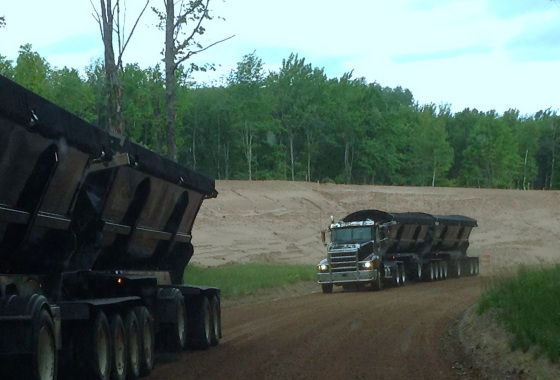
Ore trucks from Lundin Mining’s Eagle Mine make their way down the Triple A road. (Photo © and courtesy Save the Wild U.P.)

[Editor's Note: Guest author Louis Galdieri is a filmmaker based in New York City. He and fellow filmmaker Ken Ross visited Houghton, Mich., in October 2013 and screened their documentary 1913 Massacre, about the Italian Hall tragedy. Since then he has posted several articles on his blog about present-day mining issues in the Upper Peninsula. This is the first in a series of articles Galdieri is writing on the Marquette County Road Commission (MCRC) lawsuit against the Environmental Protection Agency (EPA) concerning County Road 595.]

I’ve just gotten around to reading the complaint filed on July 8th in the U.S. District Court for the Western District of Michigan, Northern Division, by the Marquette County Road Commission (MCRC) against the EPA.* The complaint alleges that the EPA’s repeated objections to County Road 595 -- that the road will threaten and destroy wetlands, streams and protected wildlife in its way -- are "arbitrary and capricious" and in violation of Section 404(J) of the Clean Water Act.** The Road Commission asks the court to set aside the EPA’s Final Decision against the building of County Road 595, restore Michigan Department of Environmental Quality’s authority to permit the road, and bar the EPA from further interference in the matter.

While it may take the court some time to decide whether MCRC v. EPA has any legal merit, the complaint is written to serve other ends as well: political objectives. The complaint is aligned with efforts in Michigan, Wisconsin and elsewhere, to ease regulations, subvert the legal authority of the EPA and whip up anger against the federal government; and the plaintiffs appear to be connected, through their attorneys, to one of the most powerful Republican party fundraisers and a network of ultra-wealthy political donors.

The MCRC complaint directs ire against a familiar cadre of enemies -- environmental "activists," overreaching federal bureaucrats and the area’s indigenous community; and it pretends to discover a dark conspiracy, in which these groups meet "surreptitiously," write "sarcastically" about mining interests, and collude to block economic development. In fact, it’s often hard to decide whether the arguments and evidence assembled in this complaint are meant to serve as legal fodder or support political posturing. So I thought I would try to sort through them in a short series of posts on the CR 595 lawsuit.

There is the tiresome pretense throughout the complaint that CR 595 would serve as something other than a haul route from the Eagle Mine to the Humboldt Mill, and that the road will benefit the public as much as the mining company. While the mining company says it is committed to making do with current infrastructure, the public clearly deserves some relief: trucks hauling ore on a makeshift route from Eagle have already been involved in a few scary accidents, and it remains a question whether cars can safely share the same road, especially an icy winter road, with ore trucks trying to beat the clock.*** People are understandably concerned, too, about big trucks loaded with sulfide ore barreling through the city of Marquette.

During the May 19, 2015, community meeting held by Eagle Mine in Big Bay, Mich., local residents ask questions about road visibility and safety, especially in winter, with large mining trucks using local public roads. (Video by Keweenaw Now. This video clip is included here with permission of our guest author.)

The public has another cause for grievance, and it makes for some angry foot stomping in the complaint: the MCRC spent millions to prepare for EPA reviews of the CR 595 application and failed repeatedly to win approval. Both time and money were wasted, the complaint says, not due to incompetence, stubbornness or denial, but because the EPA was never going to give the Road Commission a fair hearing. It’s in this connection that the complaint tries to lay out an "anti-mining" conspiracy between the EPA and environmental activists and the indigenous community in the Great Lakes Basin, and where the arguments become specious and contorted.

In subsequent posts I’ll address some of the ways MCRC v. EPA constructs this anti-mining strawman in order to mount a political offensive; and throughout this series, I’m going to be asking whether the "anti-mining" label correctly characterizes the evidence brought by the MCRC. I think it’s fair to say from the outset that it does not accurately represent the priorities and commitments of people and groups concerned about the construction of CR 595. It’s reductive, and turns road skeptics into industry opponents. To be against this particular haul road -- or hold its planners to the letter of the law -- is not necessarily to pit yourself against the entire mining industry.

The anti-mining label deliberately confuses haul-road opposition with opposition to the mining industry in order to coerce people into going along with the haul road or risk losing their livelihood, or at least the jobs and economic prosperity promised when mining projects are pitched. The MCRC complaint goes even further: it conflates mining with economic development -- or reduces all economic development in the region to mining -- and so runs roughshod over the thoughtful arguments of people like Thomas M. Power, who has studied the ways mining can restrict and quash sustainable economic development.****

The anti-mining label fences ordinary people in, distorts and exaggerates their legitimate concerns, and does not recognize that people might come to the CR 595 discussion from all different places. Most don’t arrive as members of some anti-industry coalition; they are fishermen, residents, property owners, teachers, hunters, parents, hikers, snowmobilers, birdwatchers, loggers, parishioners, kayakers, merchants, and so on. Some are many of these things all at once.

The label is fundamentally disrespectful: it refuses to meet people on their own terms and fails to ask what any of the people who oppose CR 595 actually stand for. What do they want for the area? What do they value and love? What do they envision for the future? Where do they have shared interests? Where do they have real differences? How can we work together? The anti-mining label forecloses all those questions. Instead, people are divided. The label demands that everybody take one side or the other (and, as I learned in the course of my work on 1913 Massacre, in the Upper Peninsula that demand has deep historical roots in the labor conflicts of the early twentieth century; but, no worries, in this series of posts I’ll try to stay focused on the present).*****

I have always had trouble with the idea that "anti-" and "pro-" mining positions should govern the way we talk about the environmental regulation of mining. I myself can easily slip into this way of talking. But as I tried to explain in an exchange on this blog with Dan Blondeau of Eagle Mine, that way of thinking impedes and short-circuits important conversations about the ethics of mining.****** Playing the anti-mining card reduces the questions of whether and how mining can be done responsibly -- in this place, by that company, at this time -- to mere pro and contra. It’s a dangerous ruse: instead of identifying risks and addressing responsibilities, it generates social conflict.

Author's Links:

* Click here for the Marquette County Road Commission July 8, 2015, complaint against the EPA.


** Click here for Section 404 of the Clean Water Act.

*** Click here for the UPMatters.com article "Stand U.P." for Co. Rd. 595. Click here for Louis Galdieri's post "A Boom Starts with a Rush," concerning an overturned Eagle ore truck.

**** See the Nov. 6, 2013, Daily Mining Gazette article "Economist presents results of copper mining study."  See a report by Thomas Power here. [Editor's Note: See Keweenaw Now's article on Thomas Power's visits in Houghton here.]

***** See http://1913massacre.com/

****** Click here for these comments on Louis Galdieri's post "A Mining Renaissance?"

UPDATE: Part 2 of this series, "The Political Project of MCRC v. EPA, 2," is now posted on Louis Galdieri's blog.

Wednesday, June 24, 2015

Eagle Mine exploration of "Eagle East" site raises environmental concerns

From Save the Wild U.P.*

Eagle Mine's environmental impacts continue to expand. This aerial photograph taken on June 19, 2015, shows the following: 1. Salmon Trout River, Eagle orebody and Main Vent Air Raise, 2. Eagle Rock and mining portal tunnel, 3. Eagle Mine surface facility, and 4. new drilling rigs, logging and mineral exploration in what Lundin Mining is calling the "Eagle East" area. Click on photo for larger version. (Photo courtesy Save the Wild U.P.)

MARQUETTE -- Lundin Mining, parent company of Eagle Mine, recently announced exploration results for the potential orebody known as "Eagle East," which is located outside the current footprint of the mine and said to contain "high grade massive and semi-massive copper-nickel sulfide mineralization."

With the current Eagle orebody located just below the Salmon Trout River and Eagle East exploration approaching the Yellow Dog River, environmental groups are speaking out about renewed concerns regarding ground and surface water contamination, the creeping industrialization of the Yellow Dog Plains, undisclosed exploratory drilling, trash left by exploration contractors, and the threat posed by acid mine drainage (AMD).

The Yellow Dog River, part of which is designated a National Wild and Scenic River, is threatened by the proximity of the Eagle Mine and Eagle's continued mineral exploration. (Keweenaw Now file photo)

AMD is a dangerous byproduct of sulfide mining. Sought-after minerals such as copper, nickel, lead, cobalt, silver and zinc are embedded in sulfides; the process of extraction brings the sulfide-rich rock into contact with air and water, resulting in sulfuric acid. AMD could devastate watersheds like the Salmon Trout or the Yellow Dog, as it has historically devastated watersheds in coal mining regions, and in hardrock mining districts throughout the Rocky Mountains.

In Michigan, mineral exploration is regulated under Part 625, which establishes the protocol for adherence to environmental protections during the exploration phase. According to the state’s "Typical Metallic Mining Exploration Flowchart," much of the mineral exploration process occurs before any permits are required, allowing industry to perform much of the exploration process without regulatory or public scrutiny.

PVC pipe left behind by unregulated mineral exploration on the Yellow Dog Plains. (Photo courtesy Save the Wild U.P. (Photo courtesy Save the Wild U.P.)

Companies currently conducting exploratory drilling on the Yellow Dog Plains do so with impunity. According to the Michigan Department of Environmental Quality’s (MDEQ) website, "(E)xploration companies are extremely secretive about their projects. All information regarding exploration drilling is considered proprietary under Part 625." According to the MDEQ, "Most metallic mineral exploration occurs in an area exempt from acquiring a Part 625 permit."

The lack of oversight has real consequences. Following a phase of surface and seismic mineral exploration in 2014, performed by Lundin Mining contractors who pulled miles of geophysical survey cables through the landscape, piles of PVC pipes were left abandoned in forests, ravines, and swamps, a plague of plastic ribbons fluttered from trees, and ATV tracks cut through wetlands.. Members of the public -- including adjacent landowners and watershed groups -- learn of exploration drilling sites only when the drill rigs appear, bringing 24-hour drilling noise, or leaving behind pools of drilling fluid.

Drilling oil from mining exploration in the Yellow Dog Watershed. (Photo © and courtesy Shawn Malone)

"Given the new Wild West mining camp vibe, who is monitoring the work of Lundin's numerous contractors?" asked Alexandra Maxwell, Save the Wild U.P. (SWUP) interim director. "What enforcement tools are in place to guarantee adherence to environmental safeguards, as specified under Part 625? Is anyone really checking the situation on the ground? It appears that Lundin’s contractors don’t even pick up their trash when they finish a project."

The circle on this photo shows trash left by Eagle Mine exploration contractors. (Photo courtesy Save the Wild U.P.)

While Lundin is quick to promote the potential "Eagle East" discovery to its investors, the company insists that it is too soon to consider any environmental concerns.

Eagle Mine’s spokesman Dan Blondeau has stated, "We're very early in the exploration stage for this area. It's too early to tell if this will materialize into anything significant. It's too early to talk mining or permitting.”

According to the MDEQ’s mineral exploration flowchart, however, drilling is actually one of the final stages of exploration.

Kathleen Heideman, SWUP president, says, "Lundin's new orebody appears to be comprised of copper-nickel-platinum-palladium, all wrapped in a matrix of massive hype. Investors, beware! No word on how much uranium-vanadium-arsenic this orebody will contain -- but the Yellow Dog River will be directly threatened. This is nothing to celebrate."

Michael Loukinen, SWUP advisory board member, filmmaker, and retired professor of Sociology at Northern Michigan University, has also expressed concern that the Yellow Dog River could be contaminated by expansion of mining in this area.

"Rio Tinto (former owner of Eagle Mine) had made a big public relations effort to assure citizens that their mining was going to leave a small footprint and would NOT contaminate the Yellow Dog River watershed -- just the Salmon Trout River. Now by 'discovering' a so-called new deposit they are incrementally expanding their footprint and clearly violating their promises," Loukinen noted. "I fear that this will not be the first discovery of new deposits but the beginning of a pattern of new environmental losses."

Cynthia Pryor,Yellow Dog Watershed Preserve (YDWP) board member, says a hydrologic assessment of the Yellow Dog Plains is needed.

"In 2004, the Yellow Dog Watershed Preserve (YDWP), Concerned Citizens of Big Bay, all but one of the townships of Marquette County, and the Marquette County Commission petitioned the State of Michigan to require that a full Hydrologic Assessment of the Yellow Dog Plains be done, by the United States Geological Survey (USGS) -- 'before' any mining activities took place on the Plains. That did not happen," Pryor noted. "Now, more than ever, there needs to be a third party hydrologic assessment of the Plains; and the only party qualified to do an unbiased assessment is the USGS. They are already involved in surface water monitoring on the Plains, so let them do their job and give us, the people of the State of Michigan, the straight story about the cumulative impact of these sulfide metallic mines on the Yellow Dog Plains."

Jeffery Loman, former federal oil regulator, expresses concern that Eagle Mine is in violation of the Clean Water Act.

"The mine’s industrial wastewater discharges at Eagle mine are presenting to the surface," Loman said. "Soon there will be undisputed evidence that Lundin is violating the Clean Water Act. When people across the U.P. finally realize our water is at risk, Eagle East will go South."

* Founded in 2004, Save the Wild U.P. is a grassroots environmental organization dedicated to preserving the Upper Peninsula of Michigan's unique cultural and environmental resources. For more information visit savethewildup.org.

Monday, November 24, 2014

Guest article: Lundin mineral lease application -- Here we go again

This photo from the north demonstrates the proximity of Lundin Mining's proposed 40-acre mineral lease to the Yellow Dog River and recreational access. The actual corner of the parcel with trees removed north of the bridge (red X) is less than 400 feet from the river and less than that from the flood plain. Click on photo for larger version. (Photo and caption © and courtesy Jeremiah Eagle Eye)

By Gene Champagne*

Eagle Mine LCC, a subsidiary of Lundin Mining of Toronto and Sweden, has recently applied for a mineral lease on 40 acres of state owned property (in other words OUR property) that lie a short distance southeast of the current Eagle Mine site. The parcel also lies within a few hundred yards of the Yellow Dog River -- close enough to be in the river’s 100-year floodplain. Public comment is currently being accepted by the Michigan Dept. of Natural Resources (MDNR) until December 1, 2014. Citizens should not only comment on this proposed mineral lease, but also request that a public hearing be held on the permit application either in Marquette or Big Bay. Marquette is a regional hub that would enable more people to comment. Big Bay is the community most affected by the creeping industrialization of the decreasingly pristine Yellow Dog Plains.

Residents of Big Bay are literally the "canary in the coal mine" for this segment of the mining industry that is mapping out a new mining region around Lake Superior. Big Bay residents are just beginning to experience some of the negative side effects of this industrialization. Our quality of life is being seriously diminished by noise, super highways, and other precursor effects. Other potential effects to our water and air may not be felt for years to come. By the time any negative impacts to our water are realized, it will be too late; the horse will be out of the barn with no turning back. You cannot reverse the process of acid mine drainage. We need to give pause before proceeding with any new mineral leases of state land in this area.

First of all, Eagle Mine has just commenced production, which is not even up to full speed yet. This segment of the mining industry is relatively new to the region. The history and science of hard rock mining has left a legacy of watershed devastation worldwide and in the western US, where it is DRY. Michigan and the Great Lakes region may have too much water for this type of mining. Water is becoming the oil of the 21st century.

Eagle Mine permit challenged

Many consider the current permit very inadequate at the least. There is enough evidence to render it fraudulent and illegal. If Eagle Mine is to operate we should wait a few years with Eagle at full capacity before jumping down some sink hole we may never recover from. The minerals are going nowhere. If our water is ruined, it is ruined forever. No one is making any more.

Of most concern is the process of mineral leasing and mine permitting itself. The state leases minerals for exploration that may, or may not, turn out to be profitable. If determined to be profitable, the company submits a permit application to mine. The State of Michigan, through the Dept. of Environment Quality (MDEQ) feels obligated to grant a permit. You cannot lease minerals without the expectation of a permit application to follow. The area may be an inappropriate place to mine due to the sensitivity of the environment (read water table/watershed/rare fauna/flora). The permit may be totally inadequate to protect such an area, but will be granted regardless.

Michigan needs siting criteria for mining

Those who speak of our toughest in the nation mining laws (politicians and mine advocates/officials) are blowing smoke. For example, South Dakota, a traditional mining state, has siting criteria, which determine areas that are too sensitive for mining activity. Michigan needs such siting criteria. The writers of the current rules and regulations refused to include a siting provision when Kennecott Minerals opposed it. Some of these same mine advocates, with the backing of local media, portend the need to balance the environment with development, but there is no balance when development always wins out. All we get is an inadequate and illegally compromised permit. The "winners" of late are international conglomerates beholden to stockholders, while we are tossed "trinkets and beads." Trinkets and beads buy us nothing when our lands are gone.

Dan Blondeau, senior advisor, Communications and Media Relations for Eagle Mine, has stated that Eagle Mine LLC has no interest in mining this parcel, but hopes it will help them understand the geology of the area better.

Dan states, "Contrary to speculation there is no mine plan for the proposed lease area, nor is there an immediate plan for exploration."

I can relate to that. I lease parking spaces all the time and let them sit idle. I just want to better understand the nature of parking lots. I do the same with apartments and cars. When Lundin acquired Eagle Mine from Rio Tinto, the package came with over 5,000 acres of owned/leased mineral rights in the vicinity of Eagle Mine. What is this 40-acre parcel going to tell them that they don’t already know? And so we begin the slide down the slippery slope.

Why lease this public land?

To grease the skids down this slippery slope, the MDNR Fisheries Division quietly changed the property’s designation to "development -- with restrictions," which could include a mine, when Eagle Mine made their intention for a mineral lease application known to the MDNR. The property was originally designated as "non-development" in 2003. What changed on this land other than a mining company’s interest in it? This land is OUR land. This 40-acre parcel of OUR land sits adjacent to an additional 481 acres of OUR land. Sound familiar? It should.

Many area residents, as well as tourists, use this area for camping, fishing, hunting, hiking, gathering, snowmobiling, skiing, and quiet reflection. This is OUR quality of life. It is the main reason many have chosen to live here. Private land adjacent to this state- controlled 40 is used by many people for some of these same purposes. There was a recent gathering here in October for religious and spiritually inclined individuals to mourn the loss of our solitude and quality of life. The gathering bemoaned the destruction of our immediate environment and, reflecting upon nature’s gifts, resolved to stand against further loss. The gathering was well attended.

Public comments due Dec. 1, 2014

Do we, as residents of the central Upper Peninsula, wish to maintain our quality of life or would we rather sell out to foreign internationals for a temporary infusion of "trinkets and beads"? Your opinion matters. Comments may be mailed by Monday, Dec. 1, 2014, to
Karen Maidlow, Property Analyst
Minerals Management Office, Department of Natural Resources
P.O. Box 30452
Lansing, Michigan 48909-7952

or email Karen Maidlow at maidlowk@michigan.gov.

* Editor's Notes:
Guest author Gene Champagne is a member of Concerned Citizens of Big Bay. Excerpts from this opinion article appeared recently in the Marquette Mining Journal.

Thursday, November 20, 2014

Letter to DNR: Deny Eagle Mine's request for new mineral lease on public land

Lundin Mining Co. has applied to the Michigan Department of Natural Resources (DNR) for a 40-acre mineral lease (right side of photo) for exploration on State land near the Yellow Dog River, not far from the Eagle Mine. Both the Yellow Dog Watershed Preserve and Save the Wild U.P. have expressed strong concerns about the potential impacts to the river, nearby wetlands and endangered and threatened species in the area -- and are calling for a public hearing on the proposed lease. Click on photo for larger version. (Photo © and courtesy Jeremiah Eagle Eye. Reprinted with permission.)*

[Editor's Note: This letter to the Department of Natural Resources from June Rydholm, who owns property near the Eagle Mine, is reprinted here with permission.)

Karen Maidlow, Property Analyst, Minerals Management
Michigan Department of Natural Resources (DNR)
P.O. Box 30452
Lansing, MI 48909

Dear Karen Maidlow,

This letter is with regard to land owned by the State of Michigan on the Yellow Dog Plains and next to the Yellow Dog River in Michigamme Township, Marquette County (40 acres, NE1/4 SE1/4, Sec.13, T50N, R29W).

I am a property owner on the west side of Eagle Mine and also on the east side. We have owned our property since 1949, and built a seasonal home there. The Eagle Mine mine has taken away the wilderness we have previously enjoyed.

I feel the DNR is mandated to care for the resources on Michigan-owned land for all citizens of Michigan, both living and future generations. Michigan is known throughout the country for our valuable natural resources.

You recently stated in an interview, "All we're doing is saying that if there's activity on state-owned land, we need to be paid for it. That's what the lease does."  You must understand, however, that this public land is more valuable because its minerals have not been leased, because natural resources on the surface are not undermined or threatened by mine activity. What value does the DNR assign to silence, to the tranquility of being in a wilderness area, to the experience of seeing wild animals and sleeping to the sound of wolves howling at night? What value does the DNR assign to the health of the Yellow Dog River, spring-fed lakes, or a drink of pure, cold spring-water? How do you put a price-tag on the experience of a family picking a full pail of wild blueberries, kneeling in soft reindeer lichen, enjoying pine-fresh air unpolluted by industry?

Clearly, Eagle Mine has removed value from public land. They have taken away the resources I describe above, along with their ore. Their profits go to stockholders in other states and countries with precious little benefit for the citizens of Michigan. Future generations will not have the pleasure of  breathing clean air and enjoying pure water. The mine has drawn up so much water from the aquifer that we cannot hand-pump our needs for the cabin. Animals we used to enjoy seeing are dislocated from their places of feeding and nesting: the mine already occupies so much acreage with noise, pollution and vehicle activity that our wildlife are forced from their native habitats. By allowing more mineral exploration, the DNR is not caring for Michigan's natural resources. The DNR will be leaving our children with holes filled with waste rock and tailings to replace the minerals extracted from below. Will our water ever be the same again?

Test-drilling for minerals on state-owned land must cease! The DNR must recognize that protecting all of our state’s natural resources is more than seeking glad-handing and backslapping from corporate executives. The constitution and laws of the State of Michigan are intended to serve the public, not the whims of Eagle Mine or Lundin Mining!

The DNR is not obligated to lease additional mineral rights simply because a mine requests them.  Eagle Mine will be gone when they obtain what they came for, leaving a barren landscape in their wake. Michigan’s citizens deserve better. Our regulatory agencies must stop serving profit-minded shareholders and begin to preserve and protect the experience of wilderness as it was before the mine -- for all to enjoy.

I am asking you to deny Eagle Mine’s request for a new mineral lease on the Yellow Dog Plains (NE1/4 SE1/4, Sec.13, T50N, R29W). Please hold a public hearing concerning this lease request.

Sincerely,

June E. Rydholm
November 8, 2014


*Editor's Note: For background on this mineral lease proposal see our Oct. 31, 2014, article "Eagle Mine seeks new mineral lease near Yellow Dog River, continues exploration."
The deadline for comments on this proposed lease was originally Nov. 20, but has been extended to Dec. 1, 2014. Concerned citizens can sign an online petition to the DNR to request that they deny this lease. Click here to read more and sign the petition.

Monday, October 27, 2014

Eagle Mine to host Community Forum Series beginning Oct. 27

Lundin Mining Co. is now mining nickel and copper at Eagle Mine and milling at the Humboldt Mill. (Photo courtesy Eagle Mine)

CHAMPION -- Eagle Mine will host a series of community forums this week and next week in order to keep the public informed about activities at Eagle Mine. Since the last round of forums Eagle Mine has begun operations. They are now mining, milling, and shipping nickel and copper concentrates to their customers.

During the forums Eagle representatives will present an inside look at their operations and introduce some of their team members. In addition, they will ask you to participate in the Eagle Mine Community Scorecard. The Scorecard is an opportunity for residents to rate Eagle Mine's performance over the past six months in the areas of safety, environmental protection, local hire, communication, and community development.

Most importantly, the series is designed for a two-way dialog between Eagle and the community. The public is encouraged to come and ask questions about operations and activities.

All forums will be held from 6 p.m. to 8 p.m.

Here is the schedule of dates and locations:

Monday, Oct. 27 -- Michigamme Township Hall
Wednesday, Oct. 29 -- Humboldt Township Hall
Monday, Nov. 3 -- Powell Township Hall
Wednesday, Nov. 5 -- Marquette Township Hall

Enter to win a tour

Attendees at the forums will have an opportunity to enter a drawing for a chance to take an underground mine tour or a mill tour. One person from each forum will be selected to take up to two guests with them on their tour of choice.*

*Persons must be present at the time of the drawing and 18 years of age or older. For more information, please call (906) 273-1550 or email info-eagle@lundinmining.com.

Tuesday, October 07, 2014

Guest article: A Postscript on Weird Timing and Pending Collapse

By Louis Galdieri*
Posted on Louis Galdieri's blog Oct. 2, 2014
Reprinted here with permission

Since I wrote my last post on Eagle Mine, I’ve been thinking about the thing I most wanted to say and never managed to say. I’d hoped in that post to call attention to the weird timing of Conibear’s announcement, but I couldn’t quite figure out how to do that. The company announced the start of mining operations in the Yellow Dog Plains right in the wake of the People’s Climate March, and during a week when world leaders were gathered at the UN to discuss the global climate crisis and acknowledge the fragile condition of the biosphere.

The Eagle announcement never takes any of that into account. It makes some predictable noises about environmental responsibility. You don’t have to listen very hard to hear the dissonance.

Hands up during the 12:58 moment of silence at the People's Climate March. Just before this, a group led a chant that went something like: "Keep the tar sands in the ground / Close the mines and shut them down." Other than that I didn't hear too much talk about mining at the march. (Photo and caption © and courtesy Louis Galdieri. Reprinted with permission.)

That this mining operation poses an immediate threat to the Yellow Dog watershed hardly needs saying. As I mentioned in my last post, Lundin Mining cannot point to a nickel and copper mining operation in the U.S. or Canada that has not polluted groundwater or surrounding waters, and there is no reason to believe that Eagle will be the magical exception -- despite the company’s claims that the water they are discharging is drinkable.** No one who makes that statement should be taken seriously, let alone believed, unless he follows it with a nice big glass of minewater, and fetches one for the kids while he’s at it.

Eagle is just the start. The bigger mining, leasing and exploration boom all around Lake Superior only magnifies the threat. One of the busiest mining operations in the world is about to be staged around one of the largest freshwater lakes in the world. The timing couldn’t be worse. Freshwater ecosystems are under greater pressure than ever before. Just this week, the Living Planet Index reported a 76 percent decline in freshwater species since 1970. That alarming statistic is one very clear indication of pending environmental collapse, and reason enough to protect Lake Superior from any further encroachments by risky mining operations.

It’s disconcerting, too, that the new mining around Lake Superior was spurred, in no small part, by Chinese growth and urbanization, which put a new premium on copper and nickel; and of course urbanization in China -- which starts with pouring cement and raising stainless steel -- will only aggravate emissions, further compromise China’s freshwater resources, and hasten environmental collapse. It is hard to see how this can end well, and it’s difficult for me to understand why anyone would pretend it is sustainable.

The weirdest twist in all this may be that this new mining operation goes into production just as China appears to be slowing down, after two decades of heady growth. As a result, "money managers are bearish on copper," reports Bloomberg’s Luzi Ann Javier in a review of commodity ETFs; and "global inventories of nickel tracked by the London Metal Exchange are at an all-time high." There is a glut. The warehouses are full. Right now, at least, it looks as if the rush is over.

Editor's Notes:

* Guest author Louis Galdieri is a filmmaker based in New York City. He and fellow filmmaker Ken Ross visited Houghton, Mich., in October 2013 and screened their documentary 1913 Massacre, about the Italian Hall tragedy, at Michigan Tech University's Writing Across the Peninsula Conference, where Keweenaw Now interviewed them. (Inset: October 2013 Keweenaw Now photo of Louis Galdieri, speaking during interview at Michigan Tech.)

** See Louis Galdieri's Sept. 28, 2014, post, "Does Eagle Mine Have Social License to Operate?"

Sunday, June 22, 2014

Eagle Mine tours still open to public

Eagle Mine near Big Bay, Michigan. Aerial photo showing surface facilities. (Photo courtesy Eagle Mine)

MARQUETTE -- Once again Eagle Mine near Big Bay, Mich., is offering tours to the public so people may see the surface facilities that support this modern day nickel-copper mine scheduled to begin production at the end of 2014.

Tours continue on Fridays from now through mid-October. The duration of the tour is 4.5 to 5 hours.

Itinerary: The tour will depart promptly at 12:30 p.m. from the Eagle Mine Information Center, 153A West Washington Street, Marquette.

Tours will return to the Information Center between 5 p.m. and 5:30 p.m. depending on travel time.

Note: Reservation confirmation is required. The minimum age for the tour is 16 years old. Anyone under 18 must be accompanied by a legal guardian. Participants will be walking approximately one half mile during the tour.

To register for a tour of the Eagle Mine please call (906) 273-1550 or visit the Information Center located at 153A West Washington Street in downtown Marquette. All tours will depart from and return to the Information Center.

Click here for details and a full list of dates.

Sunday, June 08, 2014

Michigan Court of Appeals Lansing hearing on Eagle Mine state permits draws 500 KBIC members

By Michele Bourdieu (with information from Keweenaw Bay Indian Community and Eagle Mine)

Members of the Keweenaw Bay Indian Community (KBIC) drum in front of the Michigan Hall of Justice in Lansing on June 3, 2014, the occasion of a long-awaited hearing by the Michigan Court of Appeals on a contested case brought against the State of Michigan for issuing permits to Kennecott/Rio Tinto (now Lundin Mining) for the Eagle Mine Project near Big Bay, Michigan. KBIC leaders pictured here include Ogimaa (Chief) Shalifoe, left in red on the drum, and KBIC Councilman Eddy Edwards to his right in orange also on the drum. (Photo © and courtesy Jessica Koski)

BARAGA -- About 500 members of the Keweenaw Bay Indian Community (KBIC) stood united around the importance of keeping their waters clean from contamination associated with sulfide mining on June 3, 2014, at the Michigan Court of Appeals in Lansing. Oral arguments were heard involving the Eagle Mine, Michigan’s first permitted sulfide mine in the Upper Peninsula.

"This is the first time in our generation that the community as a whole came together to fight for true sovereignty and engage in spontaneous government participation. The goal of the new moving-forward Tribal Council is to bring transparency and involvement to the Anishinaabeg (the people)," said Donald Shalifoe, Sr., KBIC’s Ogimaa (Chief).

Keweenaw Bay Indian Community (KBIC) tribal members gather in front of the Michigan Hall of Justice for the June 3, 2014, contested case hearing on the Eagle Mine, in which KBIC and three other groups petition against what they consider illegal permitting of a sulfide mine by the State of Michigan. (Photo © and courtesy Jessica Koski)

Many tribal members carpooled and traveled about eight hours to line up for the 10 a.m. Lansing hearing. KBIC’s remarkable presence overwhelmed the Michigan Hall of Justice, whose staff reported it was their largest turnout ever for a court hearing.

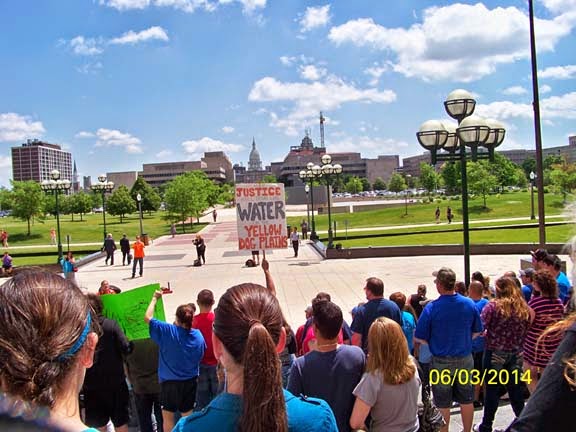
Some of those in the crowd in front of the Hall of Justice carry signs asking for protection of the water on the Yellow Dog Plains. (Photo © and courtesy Gene Champagne)

Tribal leaders and elders observed the hearing from within the court room, while hundreds watched and listened to the proceedings in an overflow video conferencing room.  Traditional drumming and singing resounded outside the building following the hearing.

KBIC’s Vice President Carole LaPointe remarked, "It was a very educational experience for our membership and youth."

One of the youngest KBIC members, Skyler Sandman-Shelifoe, has a special seat -- a tikinaagan, meaning cradle board -- for this peaceful family gathering of all ages in Lansing. (Photo © and courtesy Jessica Koski, Skyler's Mom)

The Anishinaabeg band has opposed the Eagle Mine development, located on Treaty of 1842 ceded homeland, since it was first permitted by the Michigan Department of Environmental Quality (MDEQ) in 2006.

Unsettled concerns involve the mining regulatory process, improper permitting and inadequate assessment of impacts to the area environment, cultural resources and water quality, including groundwater contamination and the potential for perpetual acid mine drainage upstream from Lake Superior.

Donald Shalifoe, Sr., KBIC’s Ogimaa (Chief), foreground in red, addresses Keweenaw Bay Indian Community members gathered in front of the Michigan Hall of Justice in Lansing for the June 3, 2014, contested case hearing before the Michigan Court of Appeals. (Photo courtesy Keweenaw Bay Indian Community)

KBIC -- along with the Yellow Dog Watershed Preserve, National Wildlife Federation, and Huron Mountain Club -- originally brought the case forward in 2008, asserting that the Michigan Department of Environmental Quality (MDEQ) issued permits for Eagle Mine without assuring the permittee followed the criteria set in Michigan’s non-ferrous mining law, Part 632. Initially, the case was heard by an administrative judge. The case then went to Circuit Court in Ingham County, where Judge Paula Manderfield concluded that the MDEQ rightfully granted the permits. The petitioners filed an appeal, which has been in limbo, waiting for a date for the Court of Appeals to hear the case.

Tribal member Jeffery Loman said on June 3, "The hearing today is another testimony to the fact that inadequate regulation and collusion between industry and government results in endless litigation."

A sign in the crowd points out the contradiction between "Pure Michigan" (a state slogan to attract tourism) and the potential dangers to water quality posed by sulfide mining. (Photo © and courtesy Gene Champagne)

Preceding the hearing, Yellow Dog Watershed Preserve Executive Director Mindy Otto was quoted on their Web site as saying, "There are many points that prove the MDEQ should not have issued the permits. They should have taken certain things into consideration, such as the fact that under Part 632, it is required to assess the impacts to the 'affected area.' The company stated that the only affected area was everything inside the fence line at Eagle Mine. It is clear this is not true, with a plethora of impacts that have happened and continue to happen today."

One aspect of the evolving case questions what qualifies as a "place of worship" under Michigan’s sulfide mining statute. An initial ruling by Michigan Administrative Law Judge Richard Patterson recommended mitigation of impacts to an Anishinaabeg sacred place, Migi zii wa sin (Eagle Rock), but the MDEQ made a final permit decision asserting only built structures are places of worship. Since then the portal to the Eagle Mine has been constructed under Eagle Rock.

This 2012 photo shows the decline tunnel that has been constructed under Eagle Rock (tree-covered outcrop at left behind fence) to serve as the portal to the Eagle Mine. The decline tunnel is 18 feet in diameter and descends under Eagle Rock at a 13 percent grade (Every 100 feet it drops 13 feet). (Keweenaw Now file photo)

Discriminatory enforcement of Michigan law has led to substantial degradation to KBIC’s sacred site.  This includes obtrusive mine facilities and a decline access ramp into the base of Eagle Rock, non-stop noise and activity, and hindered traditional access and use.  Spiritually significant high places like Eagle Rock are used in solitude by the Anishinaabeg for multi-day fasting, vision quest and ceremony.

Despite the passage of the American Indian Religious Freedom Act of 1978, Native people still struggle to protect their remaining sacred places in the face of extractive development agendas.

"It is a shame that the United States of America, proudly founded upon values of religious freedom, has trouble guaranteeing this right to all of its nation’s first people," said tribal member Jessica Koski.

Gene and Carla Champagne of Concerned Citizens of Big Bay were also present in the Hall of Justice during part of the hearing.

"We were able to squeeze into a standing-room-only TV room to watch the proceedings," Gene Champagne said. "The courtroom itself was full. The appeals panel had already heard arguments about the desecration of a sacred site and were finishing up discussion on the water treatment plant."

Gene noted he was impressed by the solidarity in the gathering outside and the cautious optimism of those who had witnessed the entire hearing.

"I was moved that so many people had traveled so far to defend a fundamental constitutional, tribal, and universal right -- the freedom of religion and the right to worship and practice as we believe," he added. "It is too bad the MDEQ does not regard the constitution as relevant. Hopefully the Appeals Court will."

KBIC anticipates a decision from the Michigan Court of Appeals within six months. The Eagle Mine’s time frame for production start-up is the end of 2014.

"While the court deliberates, it is important to remember that regardless of the outcome, we are in the right for standing up for the Yellow Dog Plains," said Emily Whittaker of Big Bay, Mich., who joined KBIC members and other locally affected residents during the hearing in Lansing. "We hope the court understands their decision will have long lasting implications for this place, as well as other areas that are slated for mining."

According to KBIC, several environmental groups and many concerned citizens, the Michigan Court of Appeals ruling will be an important precedent for additional sulfide mining proposals threatening Michigan’s Upper Peninsula and waters of the Great Lakes.

Eagle Mine issues statement on Court of Appeals hearing

A recent aerial view of Eagle Mine near Big Bay, Michigan. Eagle Rock, the Anishinaabeg sacred site, is the green outcrop in the lower right quarter of the photo. (Photo courtesy Eagle Mine. Reprinted with permission.)

On June 3, Eagle Mine issued a statement noting they are confident in their own position and optimistic about the pending Appeals Court decision.

Commenting on the arguments made before the Michigan Court of Appeals on June 3, Eagle Mine General Manager Mike Welch said, "Eagle Mine appreciates the opportunity to argue the merits of the case in support of the permits granted by MDEQ and the agency's extensive review process that has withstood previous challenges over the past eight years.

"This is a testament to our team's expertise, experience and professionalism in terms of its environmental protectiveness, safety culture and commitment to the community in which we operate. We are confident the project complies with all state and federal laws and regulations for safeguarding the environment. Even more, we are extremely proud of the nearly 800 men and women that have built Eagle."

Eagle Mine's statement notes the small, high-grade deposit will produce 360 million pounds of nickel, 295 million pounds of copper and small amounts of other metals over an estimated eight-year mine life. They expect to begin operations in late 2014.