See our right-hand column for announcements and news briefs. Scroll down the right-hand column to access the Archives -- links to articles posted in the main column since 2007. See details about our site, including a way to comment, in the yellow text above the Archives.
Showing posts with label Louis Galdieri's blog. Show all posts

Saturday, March 31, 2018

County Road 595 Appeal concludes

This wetland in the proposed CR 595 corridor is one of many sensitive areas that would be impacted if the proposed road were built. (Keweenaw Now file photo © and courtesy Jessica Koski)

By Yellow Dog Watershed Preserve
Posted on their Web site March 23, 2018*
Reprinted here with permission.


MARQUETTE -- The battle between the U.S. Environmental Protection Agency and the Marquette County Road Commission concluded on March 20th in the U.S. 6th Circuit Court over County Road 595, the proposed road leading from Eagle Mine to Humboldt Mill. For those who need a refresher, the permit for CR 595 was submitted to the MDEQ (Michigan Department of Environmental Quality) in 2012 and as part of the review process, the U.S. EPA issued objections to the project based on the Clean Water Act. Long story short, the MDEQ did not issue the permit and the process then transferred to the U.S. Army Corps of Engineers.

The Road Commission then decided to file suit against the U.S. EPA with the crux of the lawsuit over the their perception that the EPA’s objections were "arbitrary and capricious" and that they "exceeded their authority" in the process. After review in District court, it was determined that the court cannot even decide on the case because, according to the Administrative Procedures Act, you cannot bring suit against a decision unless it is considered a "final agency decision." The case was dismissed.

The Road Commission then teamed up with a lobbying group called Pacific Legal Fund, who paint themselves as the champions of the little guy against the Goliath of government. They decided to appeal the decision. Oral argument transpired in Circuit court, from which you can read transcripts thanks to journalist Louis Galdieri.** Ultimately Circuit court agreed and affirmed the District court’s decision. The EPA’s objections were not final agency decisions and therefore not reviewable because the permitting process could have continued, but it was abandoned by the Road Commission.

It remains to be seen what the next step is for the Road Commission. In an interview, Road Commission manager Jim Iwanicki said that they have options including asking the court to look at specific things again, proceeding with the case to the U.S. Supreme Court, or dropping the case. It is also a possibility that the permitting process could continue under the authority of the U.S. Army Corps of Engineers. While the road isn’t going to be built anytime soon, the future is still unclear. The Yellow Dog Watershed Preserve still strongly opposes building a mine road through this remote and wild area. Enough damage has already occurred from mining related activities and we don’t need anymore!

* Click here for this and other articles by the Yellow Dog Watershed Preserve.

** Click here to read Louis Galdieri's series of articles on the CR 595 controversy.

Sunday, June 26, 2016

The Political Project of MCRC v. EPA, Revisited

By Louis V. Galdieri*
Posted June 18, 2016, on Louis V. Galdieri's blog
Reprinted in part with permission

Judge Robert Holmes Bell dismissed the Marquette County Road Commission’s case against the EPA back in May, and last week the Road Commission’s attorneys at Clark Hill PLC filed a motion to alter and amend that judgment. They complain that the Court’s dismissal for failure to state a claim is not only mistaken on points of law but, more dramatically, it allows the "EPA and the Corps to wage a war of attrition on local governments seeking to protect the health and welfare of their people."

I was struck by this inflammatory piece of political rhetoric about federal overreach for a couple of reasons. First, because it’s just the sort of hyperbolical language Michigan State Senator Tom Casperson and StandUP, the 501c4 dark-money organization funding the Road Commission lawsuit, have used to frame the case for County Road 595 and advance what, in a series of posts (1, 2, 3, 4) last summer, I called the political project of MCRC v. EPA. Second, because the motion here tacitly admits that mining activity on the Yellow Dog Plains has put "the health and welfare" of people in Marquette County at risk. Rio Tinto and then Lundin Mining proceeded with their plans to mine copper and nickel at Eagle Mine and truck it to Humboldt Mill without a clear haul route. They not only went ahead; they were permitted by the state to do so. The risk was transferred to the public....
Click here to read the rest of this article on Louis V. Galdieri's blog.

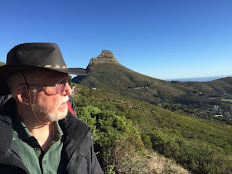
* Guest author Louis V. Galdieri is a writer, filmmaker and co-director of the acclaimed 1913 Massacre, a documentary film about the Italian Hall tragedy in Calumet. (Inset photo of Louis V. Galdieri courtesy Save the Wild U.P.)

 Editor's Note: See also Keweenaw Now's June 17, 2016, article from Save the Wild U.P.: "Environmentalists applaud dismissal of Road Commission's CR595 lawsuit."

Tuesday, July 28, 2015

Guest article: The Political Project of MCRC v. EPA, Part 1: No labels

By Louis V. Galdieri
Posted on Louis V. Galdieri's blog on July 22, 2015
Reprinted here with permission

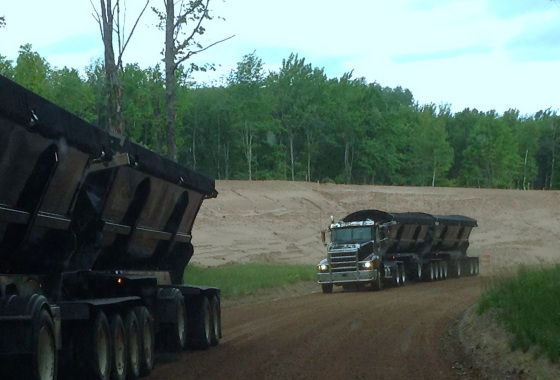
Ore trucks from Lundin Mining’s Eagle Mine make their way down the Triple A road. (Photo © and courtesy Save the Wild U.P.)

[Editor's Note: Guest author Louis Galdieri is a filmmaker based in New York City. He and fellow filmmaker Ken Ross visited Houghton, Mich., in October 2013 and screened their documentary 1913 Massacre, about the Italian Hall tragedy. Since then he has posted several articles on his blog about present-day mining issues in the Upper Peninsula. This is the first in a series of articles Galdieri is writing on the Marquette County Road Commission (MCRC) lawsuit against the Environmental Protection Agency (EPA) concerning County Road 595.]

I’ve just gotten around to reading the complaint filed on July 8th in the U.S. District Court for the Western District of Michigan, Northern Division, by the Marquette County Road Commission (MCRC) against the EPA.* The complaint alleges that the EPA’s repeated objections to County Road 595 -- that the road will threaten and destroy wetlands, streams and protected wildlife in its way -- are "arbitrary and capricious" and in violation of Section 404(J) of the Clean Water Act.** The Road Commission asks the court to set aside the EPA’s Final Decision against the building of County Road 595, restore Michigan Department of Environmental Quality’s authority to permit the road, and bar the EPA from further interference in the matter.

While it may take the court some time to decide whether MCRC v. EPA has any legal merit, the complaint is written to serve other ends as well: political objectives. The complaint is aligned with efforts in Michigan, Wisconsin and elsewhere, to ease regulations, subvert the legal authority of the EPA and whip up anger against the federal government; and the plaintiffs appear to be connected, through their attorneys, to one of the most powerful Republican party fundraisers and a network of ultra-wealthy political donors.

The MCRC complaint directs ire against a familiar cadre of enemies -- environmental "activists," overreaching federal bureaucrats and the area’s indigenous community; and it pretends to discover a dark conspiracy, in which these groups meet "surreptitiously," write "sarcastically" about mining interests, and collude to block economic development. In fact, it’s often hard to decide whether the arguments and evidence assembled in this complaint are meant to serve as legal fodder or support political posturing. So I thought I would try to sort through them in a short series of posts on the CR 595 lawsuit.

There is the tiresome pretense throughout the complaint that CR 595 would serve as something other than a haul route from the Eagle Mine to the Humboldt Mill, and that the road will benefit the public as much as the mining company. While the mining company says it is committed to making do with current infrastructure, the public clearly deserves some relief: trucks hauling ore on a makeshift route from Eagle have already been involved in a few scary accidents, and it remains a question whether cars can safely share the same road, especially an icy winter road, with ore trucks trying to beat the clock.*** People are understandably concerned, too, about big trucks loaded with sulfide ore barreling through the city of Marquette.

During the May 19, 2015, community meeting held by Eagle Mine in Big Bay, Mich., local residents ask questions about road visibility and safety, especially in winter, with large mining trucks using local public roads. (Video by Keweenaw Now. This video clip is included here with permission of our guest author.)

The public has another cause for grievance, and it makes for some angry foot stomping in the complaint: the MCRC spent millions to prepare for EPA reviews of the CR 595 application and failed repeatedly to win approval. Both time and money were wasted, the complaint says, not due to incompetence, stubbornness or denial, but because the EPA was never going to give the Road Commission a fair hearing. It’s in this connection that the complaint tries to lay out an "anti-mining" conspiracy between the EPA and environmental activists and the indigenous community in the Great Lakes Basin, and where the arguments become specious and contorted.

In subsequent posts I’ll address some of the ways MCRC v. EPA constructs this anti-mining strawman in order to mount a political offensive; and throughout this series, I’m going to be asking whether the "anti-mining" label correctly characterizes the evidence brought by the MCRC. I think it’s fair to say from the outset that it does not accurately represent the priorities and commitments of people and groups concerned about the construction of CR 595. It’s reductive, and turns road skeptics into industry opponents. To be against this particular haul road -- or hold its planners to the letter of the law -- is not necessarily to pit yourself against the entire mining industry.

The anti-mining label deliberately confuses haul-road opposition with opposition to the mining industry in order to coerce people into going along with the haul road or risk losing their livelihood, or at least the jobs and economic prosperity promised when mining projects are pitched. The MCRC complaint goes even further: it conflates mining with economic development -- or reduces all economic development in the region to mining -- and so runs roughshod over the thoughtful arguments of people like Thomas M. Power, who has studied the ways mining can restrict and quash sustainable economic development.****

The anti-mining label fences ordinary people in, distorts and exaggerates their legitimate concerns, and does not recognize that people might come to the CR 595 discussion from all different places. Most don’t arrive as members of some anti-industry coalition; they are fishermen, residents, property owners, teachers, hunters, parents, hikers, snowmobilers, birdwatchers, loggers, parishioners, kayakers, merchants, and so on. Some are many of these things all at once.

The label is fundamentally disrespectful: it refuses to meet people on their own terms and fails to ask what any of the people who oppose CR 595 actually stand for. What do they want for the area? What do they value and love? What do they envision for the future? Where do they have shared interests? Where do they have real differences? How can we work together? The anti-mining label forecloses all those questions. Instead, people are divided. The label demands that everybody take one side or the other (and, as I learned in the course of my work on 1913 Massacre, in the Upper Peninsula that demand has deep historical roots in the labor conflicts of the early twentieth century; but, no worries, in this series of posts I’ll try to stay focused on the present).*****

I have always had trouble with the idea that "anti-" and "pro-" mining positions should govern the way we talk about the environmental regulation of mining. I myself can easily slip into this way of talking. But as I tried to explain in an exchange on this blog with Dan Blondeau of Eagle Mine, that way of thinking impedes and short-circuits important conversations about the ethics of mining.****** Playing the anti-mining card reduces the questions of whether and how mining can be done responsibly -- in this place, by that company, at this time -- to mere pro and contra. It’s a dangerous ruse: instead of identifying risks and addressing responsibilities, it generates social conflict.

Author's Links:

* Click here for the Marquette County Road Commission July 8, 2015, complaint against the EPA.


** Click here for Section 404 of the Clean Water Act.

*** Click here for the UPMatters.com article "Stand U.P." for Co. Rd. 595. Click here for Louis Galdieri's post "A Boom Starts with a Rush," concerning an overturned Eagle ore truck.

**** See the Nov. 6, 2013, Daily Mining Gazette article "Economist presents results of copper mining study."  See a report by Thomas Power here. [Editor's Note: See Keweenaw Now's article on Thomas Power's visits in Houghton here.]

***** See http://1913massacre.com/

****** Click here for these comments on Louis Galdieri's post "A Mining Renaissance?"

UPDATE: Part 2 of this series, "The Political Project of MCRC v. EPA, 2," is now posted on Louis Galdieri's blog.

Tuesday, October 07, 2014

Guest article: A Postscript on Weird Timing and Pending Collapse

By Louis Galdieri*
Posted on Louis Galdieri's blog Oct. 2, 2014
Reprinted here with permission

Since I wrote my last post on Eagle Mine, I’ve been thinking about the thing I most wanted to say and never managed to say. I’d hoped in that post to call attention to the weird timing of Conibear’s announcement, but I couldn’t quite figure out how to do that. The company announced the start of mining operations in the Yellow Dog Plains right in the wake of the People’s Climate March, and during a week when world leaders were gathered at the UN to discuss the global climate crisis and acknowledge the fragile condition of the biosphere.

The Eagle announcement never takes any of that into account. It makes some predictable noises about environmental responsibility. You don’t have to listen very hard to hear the dissonance.

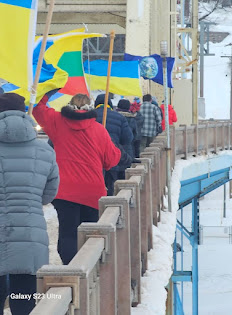
Hands up during the 12:58 moment of silence at the People's Climate March. Just before this, a group led a chant that went something like: "Keep the tar sands in the ground / Close the mines and shut them down." Other than that I didn't hear too much talk about mining at the march. (Photo and caption © and courtesy Louis Galdieri. Reprinted with permission.)

That this mining operation poses an immediate threat to the Yellow Dog watershed hardly needs saying. As I mentioned in my last post, Lundin Mining cannot point to a nickel and copper mining operation in the U.S. or Canada that has not polluted groundwater or surrounding waters, and there is no reason to believe that Eagle will be the magical exception -- despite the company’s claims that the water they are discharging is drinkable.** No one who makes that statement should be taken seriously, let alone believed, unless he follows it with a nice big glass of minewater, and fetches one for the kids while he’s at it.

Eagle is just the start. The bigger mining, leasing and exploration boom all around Lake Superior only magnifies the threat. One of the busiest mining operations in the world is about to be staged around one of the largest freshwater lakes in the world. The timing couldn’t be worse. Freshwater ecosystems are under greater pressure than ever before. Just this week, the Living Planet Index reported a 76 percent decline in freshwater species since 1970. That alarming statistic is one very clear indication of pending environmental collapse, and reason enough to protect Lake Superior from any further encroachments by risky mining operations.

It’s disconcerting, too, that the new mining around Lake Superior was spurred, in no small part, by Chinese growth and urbanization, which put a new premium on copper and nickel; and of course urbanization in China -- which starts with pouring cement and raising stainless steel -- will only aggravate emissions, further compromise China’s freshwater resources, and hasten environmental collapse. It is hard to see how this can end well, and it’s difficult for me to understand why anyone would pretend it is sustainable.

The weirdest twist in all this may be that this new mining operation goes into production just as China appears to be slowing down, after two decades of heady growth. As a result, "money managers are bearish on copper," reports Bloomberg’s Luzi Ann Javier in a review of commodity ETFs; and "global inventories of nickel tracked by the London Metal Exchange are at an all-time high." There is a glut. The warehouses are full. Right now, at least, it looks as if the rush is over.

Editor's Notes:

* Guest author Louis Galdieri is a filmmaker based in New York City. He and fellow filmmaker Ken Ross visited Houghton, Mich., in October 2013 and screened their documentary 1913 Massacre, about the Italian Hall tragedy, at Michigan Tech University's Writing Across the Peninsula Conference, where Keweenaw Now interviewed them. (Inset: October 2013 Keweenaw Now photo of Louis Galdieri, speaking during interview at Michigan Tech.)

** See Louis Galdieri's Sept. 28, 2014, post, "Does Eagle Mine Have Social License to Operate?"