See our right-hand column for announcements and news briefs. Scroll down the right-hand column to access the Archives -- links to articles posted in the main column since 2007. See details about our site, including a way to comment, in the yellow text above the Archives.
Showing posts with label People's Climate March in New York City. Show all posts

Tuesday, December 09, 2014

People's Climate March, Part 4: Videos, photos of the People's Climate March -- 400,000 strong

By Michele Bourdieu 

[Editor's Note: This is the fourth in our series of articles about the People's Climate March in New York City and related events.*]

Lined up on Central Park West, indigenous groups -- among the "Frontline" marchers at the head of the People's Climate March -- wait for the march to begin on Sunday, Sept. 21, 2014. (Photo by Keweenaw Now)

NEW YORK, NY -- It was an amazing display of diversity: A multitude of people of all ages and of many different cultures, races, religions and languages -- 400,000 strong and united in their message to the world -- offered that message peacefully on signs, sculptures and banners and in chants, song and dance: Climate change is real and we all need to do something about it NOW!

Large crowds converge in an orderly, peaceful demonstration at Columbus Circle, where the march begins. (Photo by Allan Baker for Keweenaw Now)

The People's Climate March on Sunday, Sept. 21, began at Columbus Circle, near Central Park in New York City, and Keweenaw Now's two video cameras caught much of the action during the four hours of the march. Allan Baker (right inset) and his wife, Shirley Galbraith (at left, below, joining a group of Unitarian participants), captured the crowds that convened at Columbus Circle.

Meanwhile Keweenaw Now's editor found a spot along Central Park West, in view of the giant video screen where marchers cheered as they watched themselves on camera or caught a glimpse of climate marches in other parts of the world -- from Kathmandu to Rio de Janeiro -- all concerned about climate justice and the survival of Mother Earth and humanity's future generations.
The People's Climate March on Sept. 21, 2014, begins at Columbus Circle, near Central Park, in New York City. Eventually the participants will number about 400,000 -- much more than anticipated. A giant "Madre Tierra" (Mother Earth) heads down Central Park West toward Columbus Circle, followed by a peace and justice group chanting in Spanish, "El pueblo, unido, jamás será vencido!" (The people, united, shall never be defeated!) (Video by Allan Baker and Keweenaw Now)

Heading toward Columbus Circle from Central Park West, indigenous groups in colorful regalia are among the leaders of the People's Climate March, followed by a giant sculpture representing "Madre Tierra" (Mother Earth). Representatives of the Climate Justice Alliance follow, chanting for clean air and clean water. (Video by Keweenaw Now)

During the march, Keweenaw Now asked some enthusiastic visitors why they were attending the march. A couple from the United Kingdom, who wished to remain anonymous, said they just happened to come upon the march on their way to visit Central Park. Two students from Michigan -- Charlie Thatch of Traverse City, a Washtenaw Community College student of business and music production, and Matt Blain of Troy, a University of Michigan graduate student in urban planning and public policy, offered brief comments:

A visitor from the UK and two students from Michigan tell why they're at the People's Climate March. (Video by Keweenaw Now)

Another presence from Michigan spotted in the crowd: Marchers carry signs against fracking. (Photo by Keweenaw Now)

Marchers' signs, banners and chants call attention to climate justice -- from Peru to New York City neighborhoods affected by Super Storm Sandy. A cheer goes up from the crowd when they see themselves on the large video screen facing Central Park West. (Video by Allan Baker and Keweenaw Now)

At Columbus Circle, a lively New Orleans-style jazz band adds to the excited atmosphere of the People's Climate March and hundreds of union representatives with their signs speak out for action on climate change. (Video by Allan Baker for Keweenaw Now)

Photos of people marching in other cities around the world are projected on a large screen so the marchers can be aware of international solidarity about climate change. (Video by Keweenaw Now)

Phil Aroneanu of 350.org, one of the organizers of the People's Climate March, addressed Keweenaw Now readers in our brief interview. Standing near him, leading the marchers in chants, was Clara Vondrich, originally from McLean, Va., and now a New York resident working for Fenton, a social change communication firm. Both were excited about the tremendous turnout:

Phil Aroneanu of 350.org, one of the organizers of the People's Climate March, comments on the turnout and the importance of the event. Clara Vondrich, originally from Virginia and now living in New York City, explains her reasons for supporting the march. (Video by Keweenaw Now)

From "We Shall Overcome" to lively klezmer, various musical rhythms and chants set the pace of the marchers. (Video by Keweenaw Now and Allan Baker)

Groups of young people call for change to fight the climate crisis. Students ask their universities to divest from fossil fuels. (Video by Keweenaw Now and Allan Baker)

While thousands of young people marched for their future at this event, senior citizens also joined them -- concerned about their children's and their grandchildren's future.

At Columbus Circle, senior citizens march together with signs and banners announcing their concern for future generations. (Photo by Allan Baker)

One of those seniors, Elsbeth Reimann, 80, a New Yorker originally from Switzerland, struck up a conversation -- in French and in English -- with Keweenaw Now's editor.
Reimann said she had recently returned from Washington, D.C., where she was lobbying for food banks in New York City and also in the rest of the country.

Elsbeth Reimann, watching the march from a bench near Central Park, commented on her concerns about food and hunger. (Photo by Keweenaw Now)

"Regardless of age or where we live, hunger is increasing," she said. "I'm very concerned for the future -- for the young people. It's so important that people wake up."

Reimann, who came to the U.S. in 1967, said she likes living in New York because it's made up of people from all over the world.

"People need to speak with each other and not at each other, so you keep learning," she noted. "It's fascinating!"

Like Elsbeth Reimann, these marchers expressed concerns about food justice -- and the importance of growing local, natural food. (Photo by Allan Baker)

Hector and Gladys Rubio, a retired couple from Guayaquil, Ecuador, were on their way to visit the Natural History Museum in New York during a visit with their daughter, who lives in New Jersey, and were happy to discover the People's Climate March.

"Thumbs up!" Visitors Hector and Gladys Rubio of Guayaquil, Ecuador, said they thought the People's Climate March was a great event. (Photo by Keweenaw Now)

At one point during the march, young and old stopped their chants and paused for a moment of silence and unity -- announced on the large video screen:

Marchers pause for a moment of silence to honor victims and survivors of climate change. (Photo by Keweenaw Now)

After the silence, roars and cheers of unity spread through the crowd:

After a moment of silence, the People's Climate marchers let out a giant roar of enthusiasm -- heard around the world. (Video by Allan Baker) 

At Columbus Circle, following a float resembling Noah's Ark, thousands of marchers from a variety of religious groups chant and display their signs and banners. (Video by Allan Baker)

Participants from Canada join others in protesting tar sands and their effect on climate change. (Video by Keweenaw Now)

Among the Canadian marchers was this Greenpeace group from Victoria, B.C., who paused for a photo. (Photo by Keweenaw Now)

Editor's Notes: Watch for more of our photos of the People's Climate March, coming soon in a new slide show.

* See our three previous articles related to this event:

"People's Climate March, Part 1, Letter: Houghton couple travel to New York to march for planet's future"

"People's Climate March, Part 2: Video Report: Riding People's Climate Train to New York"

"People's Climate March, Part 3: Home front action -- local art students create People's Climate March posters"

Tuesday, October 28, 2014

People's Climate March, Part 3: Home front action -- local art students create People's Climate March posters

By Michele Bourdieu

Along the Michigan Tech Trails, these People's Climate March posters, created by students in Michigan Tech Prof. Lisa Johnson's 3D Design class, who added their own touches to basic designs sent by the Justseeds Artists' Cooperative and turned them into sculptures, call attention to the march and climate issues. (Photo courtesy Michigan Tech University)

HOUGHTON/HANCOCK -- When they signed up for certain art and design classes at Michigan Tech and Finlandia universities this fall, students were unaware they would become involved in a historic event -- the People's Climate March of Sept. 21, 2014. The event attracted 400,000 participants to New York City -- and thousands to other cities participating around the world -- to call for action on climate change.

Through their art classes at Michigan Tech and Finlandia, the students participated in the Justseeds Artists' Cooperative's "People's Climate March art: 30-city wheatpaste action" intended to get the word out about the march and climate crisis issues.*

Houghton/Hancock was one of the 30 cities that participated in the project through these students. Several artists in the Justseeds Cooperative created a series of large posters about the march, and the students were invited to use their creative instincts to turn the posters into art projects to be displayed on campus and in the community in order to call attention to the march and climate change.

Students in Lisa Johnson's 2D Design class add their own creative touches to posters sent to them by the Justseeds Cooperative. (Photo courtesy Michigan Tech University)

Lisa Johnson, assistant professor in the Visual and Performing Arts Department at Michigan Tech, said she chose the project for both her 2D Design and 3D Design classes, both of which have been developed within the framework, "Design for Ecological Reflection" -- an idea that ties in to research in which artists, writers, and scientists are coming together as partners, working towards a greater understanding of ecology.

Sculptor and scenic artist Lisa Johnson, assistant professor in the Visual and Performing Arts Department at Michigan Tech, involved her 2D and 3D Design classes in the art project "People's Climate March art: 30-city wheatpaste action," initiated by the Justseeds Artists' Cooperative.* (Photo courtesy Lisa Johnson)

"I knew about the project because I'm friends with Rachel Shragis (she is one of the main organizers in New York, and I met her when we were both artists in residence at the Vermont Studio Center)," Johnson explained. "The project was a happy accident and a great fit. My design classes are taught with an eye towards ecological response and reflection, and I was hoping for a project that would help the class spring into making things, being environmentally conscious, and jump start their ability to talk about design and its connection to communities."

Johnson noted the connection with the march came at the right time for her classes.

"We were able to research issues, artists, and other activist events; brainstorm display ideas; get out into the community; work with great images that we could then look at and discuss ("why is this a strong graphic?" what works here?). But the thing I'm most happy about is the connectivity between different communities -- across the U.S. and the world -- and that the students were able to see that connectivity and find links between themselves, here in Houghton, and others around the country."

Dakota Lowrance of Buchanan, Mich., a third-year student in mechanical engineering at Michigan Tech, said he was "pretty fluent" in climate change issues through social media, his main source for news, so he was excited to participate in the Climate March project through Johnson's 2D Design class.

Dakota Lowrance, left, a student in Lisa Johnson's 2D Design class, is pictured here with two students from the 3D Design class, who also participated in the project: Zhen Wang of Chang-Zhou, China (center), and Greg Roberts of Holland, Mich. -- both seniors in mechanical engineering. After the completion of their project, the students met with Keweenaw Now for an interview in Michigan Tech's J. R. Van Pelt and Opie Library café. (Photo by Keweenaw Now)**

"I was really happy and excited to collaborate with the issues through the class," Lowrance said. "The product was a non-violent approach to climate change issues."

The 3D class mounted images from the poster designs on stands, creating climate change sculptures, which they set up along the Michigan Tech Trails.

Climate change sculpture on the Michigan Tech Trails. Students in Lisa Johnson's 3D Design class created these and set them up along the trails to call attention to the People's Climate March and climate change issues. (Photo courtesy Michigan Tech University)

"You design art with an overall purpose in mind," Lowrance noted. "You incorporate principles of art -- for example, movement, emphasis, proportion and balance -- into the final design."

Kier MacArtney of Grand Rapids, Mich., a senior studying live entertainment production and stage electrics, said he thought the Climate March project was an interesting and surprising take on what he expected from the 3D class, since the students became involved in a current issue.

"It was interesting taking a two-dimensional poster and coming up with an idea to make it three-dimensional -- since billboards are boring," MacArtney noted.

Kier MacArtney of Grand Rapids (center) and other students in Lisa Johnson's 3D Design class, carry their Climate March posters to set them up along the Michigan Tech Trails. (Photo courtesy Michigan Tech University)

He said it was fun despite the type of glue they were asked to use, which he thought resembled cream of wheat.

"The glue was gross, but environmentally safe," MacArtney added.

Students in the 3D Design class paste climate change images to their sculptures.  (Photo courtesy Michigan Tech University)**

Students in Johnson's 2D Design class used the poster designs to create large-format, interactive puzzles for the People’s Climate March.

After cutting the images and pasting them on wooden tiles that could be moved around with either hands or feet, the students first placed them in the Michigan Tech's J. R. Van Pelt and Opie Library. Later they moved them to the Forestry Building on campus.

Students in the 2D Design class arrange the pieces of their interactive puzzle on the floor of Michigan Tech's J. R. Van Pelt and Opie Library. The purpose was to involve others in making their own designs with hands or feet (suggesting the march) by re-arranging the wooden tiles. (Photo courtesy Michigan Tech University)

Kristen Doering of Wausau, Wis., a senior in medical lab science at Michigan Tech, also worked on the posters in the 2D class. Doering said she did not know about the march before the class project, but was already interested in climate change and its relationship to medical fields.

"I did research on the Kyoto Protocol a few years ago," Doering said. "Health issues can arise from climate issues."

Doering noted some of her friends (who were not in the design class) got interested in her project and the march when she told them about it.

"They went to the library and snap-chatted me a picture to show they were there," Doering said.

The interactive puzzle created by Lisa Johnson's 2D Design class invites participation and calls attention to the Climate March. On the table in the foreground the students displayed informational brochures about the climate movement. (Photo courtesy Michigan Tech University)

Doering said she went to the library and noticed people had moved the puzzle pieces.

"I found it really exciting that the artist (from the Justseeds Cooperative who created the original poster) was impressed with our design -- because it was interactive," Doering added.

Christine Shonnard, a senior at Houghton High School, takes the 2D Design class at Michigan Tech through the dual enrollment program.

"I wanted to take an art class because I am thinking of art as a possible career," Shonnard explained.

Like several of the other students, Shonnard learned about the Climate March through the 2D Design class.

Joining Dakota Lowrance, left, and Zhen Wang, third from left, for Keweenaw Now's interview in the library café are, from right, Christine Shonnard of Houghton, Kristen Doering of Wausaw, Wis. -- both students in the 2D Design class -- and Kier MacArtney of Grand Rapids, a student in the 3D class. (Photo by Keweenaw Now)

"I thought it was pretty cool," Shonnard said about the class project and the march. "I think if I had more time and independence it would have been cool to attend the march."

Christine also noted Lauri Davis, her biology teacher at Houghton High School, who also teaches ecology, has included climate change issues in her classes. As an example, she had her class do research on how to design an energy-efficient building.

"She's a really great teacher," Shonnard said about Davis. "I learned about having the building partially underground and walls built into a hill (for insulation)."

Davis also had her class do research on factory farms -- issues pertaining to industrial agriculture, Shonnard added.

While the students from these classes were unable to attend the march, one student from the 2D Design class, Jacob Braykovich of Walled Lake, Mich., a 5th-year student in materials science and engineering, went to New York City the week following the Climate March. He said he noticed, while walking around New York, that some of the climate posters were still displayed.

Jacob Braykovich trims a design for the Climate March interactive puzzle during the 2D Design class. (Photo courtesy Michigan Tech University)

"Its powerful that thousands of people from all over the country came together to stand up for such a controversial topic," Braykovich said.

He commented on the dual importance of the class -- both artistic and ecological.

"My appreciation for the way we capture the viewer's eye was transformed through this project. Using balance we were able to draw together many aspects of design while effectively conveying the importance of climate change," Braykovich explained.

Finlandia faculty, art students participate in Climate March poster project

People's Climate March poster from Justseeds Cooperative displayed in the Ryan Street Garden, part of Finlandia University's participation in the art project. (Photo by Keweenaw Now)

In Hancock, at Finlandia University's International School of Art and Design, two faculty members participated in the People's Climate March art project: Phillip Faulkner, assistant professor of intermedia, and Phyllis Fredendall, professor of fiber and fashion design.

Faulkner said the goal of the project was "to present promotion materials throughout the two towns in the form of large scale visual art posters to raise awareness of the People's Climate March cause," while involving students in the presentation and creation.

Finlandia International School of Art and Design faculty members, Phillip Faulkner, left, and Phyllis Fredendall, second from left, are pictured here with students who worked on the climate posters -- from left, Deidre Yseult (aka Taylor Ruotsala) of Atlantic Mine, Angie Kilpela of Houghton and Olivia Leukuma of Chassell. (Photo by Keweenaw Now)

After learning about the project from Lisa Johnson, Faulkner contacted several local businesses, seeking community partners for the project, and set up three different large posters from Justseeds artists at these locations: Keweenaw Co-op in Hancock, Fifth and Elm Coffee House in Houghton and the Ryan Street Community Garden in Hancock.

People's Climate March poster at the Keweenaw Co-op in Hancock. (Photo courtesy Phillip Faulkner, Finlandia University)

This People's Climate March poster set up outside the Fifth and Elm Coffee House in Houghton was part of Finlandia's participation in the art project. (Photo courtesy Phillip Faulkner, Finlandia University)

Meanwhile, Fredendall incorporated the project into her Color and Composition class, which is held in the Jutila Center in Hancock. Her students made posters about the People's Climate March and set them up in the Jutila Center and outside on the main Finlandia campus.

One large collage poster created by students in Phyllis Fredendall's class is still displayed in the Jutila Center in Hancock. Pictured here with Prof. Phyllis Fredendall are students in her Color and Composition class -- from left, Victoria Wallace, Angie Kilpela, Brandon Hylton (seated on floor), Deidre Yseult (aka Taylor Ruotsala), Joy Petaja and Olivia Leukuma. (Photo by Keweenaw Now)

Art students Angie Kilpela of Houghton and Olivia Leukuma of Chassell worked together on one of the larger posters, a collage that is still displayed on the second floor of the Jutila Center. In their collage, they incorporated three of the original posters sent from Justseeds Cooperative to Michigan Tech's Lisa Johnson, who shared them with Finlandia.

"Getting the word out about climate change is important," Kilpela said. "It was fun. I had never heard of (the march) until we worked on the project."

Olivia Leukuma, left, and Angie Kilpela with the collage they designed using three different posters sent by the Justseeds Cooperative. (Photo by Phyllis Fredendall for Keweenaw Now)

Leukuma said she didn't know about the march before the project but learned how to "take what we're given and make something out of it -- expand it and get more creative and get across the purpose of the Climate March and where it is."

Both Leukuma and Kilpela said they noticed the posters on the main Finlandia campus attracted the attention of other students.

After adding their personal collage designs to the posters from Justseeds Cooperative, Finlandia art students displayed them on the main Finlandia campus to call attention to the People's Climate March. (Photo courtesy Phillip Faulkner, Finlandia University)

"I heard people ask what they were," Leukuma said.

"They were very catchy," added Kilpela. "I think that's important."

Victoria Wallace of Houghton said she learned from the Climate March project that many people in many places have all come together to change the way the earth is treated and to try to make it a better place with different types of energy and practices.

"Working to make the posters for the world to see was an amazing way to put my own print on the ideas of change," Wallace added.

One student in Fredendall's class, Deidre Yseult (aka Taylor Ruotsala) of Atlantic Mine, said she had heard of the Climate March before the class project but learned more about it in class.

"I'm very eco-friendly and I try to keep up with those issues," Ruotsala said. "I was really happy to see that people of the United States are still working towards a greener future."

Deidre Yseult (aka Taylor Ruotsala) of Atlantic Mine displays a poster announcing an upcoming fundraiser (Oct. 30, 31) for the Young Women's Art Caucus, a Finlandia group planning a February 2015 trip to New York City. A member of the Caucus, Ruotsala says she hopes to see post-Climate March changes in New York if she's able to travel there with the group.

Ruotsala said she worked with student Sarah Williams of Houghton on one of the posters hung on the main campus, across from Finlandia Hall.

"We took a bit longer than the other groups because we wanted to focus on several different problems, such as polar icecaps melting, deforestation, genetic mutation and dramatic climate changes (such as a polar vortex in Hawaii)," Ruotsala noted.

A first-year student at Finlandia, Ruotsala added that she has been active in environmental issues since middle school. At Finlandia she is a member of the Young Women's Caucus and hopes to visit New York City with that group in February 2015. She said she hopes to see "a difference in New York after the march."

* To learn more about the Justseeds Cooperative People's Climate March art project, visit their Web site.

** Update: In an earlier posting, we made a few errors in identifying the classes of the students pictured here. These have been corrected. Thanks to Lisa Johnson for calling our attention to the details.

Editor's Note: This is the third in our series of articles on the People's Climate March and related events.

See also: People's Climate March, Part 1, Letter: Houghton couple travel to New York to march for planet's future  and People's Climate March, Part 2: Video Report: Riding People's Climate Train to New York.

Watch for our photos and videos of the Sept. 21, 2014, People's Climate March -- coming soon ...

Wednesday, October 15, 2014

People's Climate March, Part 2: Video Report: Riding People's Climate Train to New York

By Michele Bourdieu

On Sept. 19, 2014, Amtrak passengers riding a People's Climate Train assemble for a group photo at a train stop in Buffalo, NY, on the way to New York City for a weekend of workshops, meetings, lectures by climate activist leaders and the Sunday, Sept. 21,  People's Climate March. Some stayed in New York on Monday, Sept. 22, for a Flood Wall Street march as well. Pictured with the group are Houghton residents Allan Baker, Keweenaw Now videographer, and his wife, Shirley Galbraith, Keweenaw Now guest author (second row, seated right).* (Photo by Gustavo Bourdieu for Keweenaw Now)

HANCOCK -- The Amtrak train for New York City, dubbed the "People's Climate Train" by passengers who boarded it in San Francisco, picked up more passengers bound for the Sept. 21 People's Climate March along the way. Amtrak arranged for the group to be seated together in two cars, which facilitated a day of presentations, workshops and discussions on various climate change issues -- and networking among both young and old. A spirit of camaraderie and solidarity prevailed.

Susan Riederer, co-chair of the Boulder, Colo., Citizens' Climate Lobby (CCL) chapter, was one of the organizers of talks and discussions on the People's Climate Train.

Keweenaw Now staff boarded the train in Chicago at 9:30 p.m. on Thursday, Sept. 18. Friday was a long day, especially since a health emergency on the train caused a delay of several hours; yet the nearly 24-hour ride from Chicago to New York City was nothing to those people we met who had been riding the train since California and other points west.

One of these, Diana Cabcabin of San Francisco, gave a presentation about Typhoon Haiyan, which had affected her family directly since it struck their town in the Philippines:

During workshops on the People's Climate Train on the way to New York City on Sept. 19, 2014, Diana Cabcabin of San Francisco talks about Typhoon Haiyan, which struck her family's home town in the Philippines. In a later presentation, Cabcabin speaks about mining companies that exploit poor communities in the Philippines. (Video by Allan Baker for Keweenaw Now)

Cabcabin is a member of Women for Genuine Security, a group that advocates for justice and educates the public about historical inequities. She questioned the value of trade agreements in the Asia Pacific region that favor large corporations rather than people in poor communities vulnerable to impacts of climate change.

A California journalist and author, Christopher Cook, spoke about the relationship between climate change and industrial agriculture with large-scale food production:

San Francisco journalist and author Christopher Cook notes that industrial, concentrated agriculture around the world produces great amounts of toxic pollution and carbon emissions while making it difficult for subsistence and small-scale farmers to survive. (Video by Allan Baker for Keweenaw Now)

Cook, who is the author of Diet for a Dead Planet, also published an article on riding the train from San Francisco. He actually filed the article when the train stopped in Chicago, and it was posted on Sept. 19.**

Activist James Blakely of Boise, Idaho, said he also boarded the train in San Francisco. He spoke about his recent experience in Alberta, Canada -- participating in the 4th Annual Tar Sands Healing Walk with First Nations people who are most immediately impacted by this industry:

James Blakely of Boise, Idaho, recounts his participation in the 4th Annual Tar Sands Healing Walk in Alberta, Canada. led by First Nations tribes of the area. (Video by Allan Baker for Keweenaw Now)***

Blakely pointed out that the boreal forests, once rich in biodiversity, are destroyed to enable the industry to mine the tar sands. The process puts so many toxins into the environment that the First Nations people can no longer hunt and fish as they used to do for subsistence.

"The only real jobs up there are for the oil companies, so they're now almost forced to work for the oil companies or leave their land," he said.

According to Lemmon McMillan of Evanston, Ill., talking about climate issues must include the intersectionality of poverty, racism and gender inequality. These social justice issues, along with government corruption and U.S. foreign policy, are all connected, he says.

Lemmon McMillan of Evanston, Ill., joins in the discussion of climate change and insists it must be discussed in connection with social justice issues, especially poverty and racism. (Photo by Allan Baker for Keweenaw Now)

McMillan, whose own heritage includes Native American and African American roots, is working on a series of videos intended to discuss these issues and how they are all related.

McMillan said he spoke with teenagers from an African American community on the south side of Chicago and one asked him why he should be concerned about climate change that might kill him in 20 or 30 years when he's facing situations (police or gang members) that could kill him now.

"The climate movement needs to answer that question," McMillan said. "We all have to support each other and understand that all our issues are related."

Two other Illinois residents -- Jill Paulus of Wheaton, Ill., and Joyce Good of Chicago -- spoke about an environmental issue that is now impacting people of many different socio-economic groups -- fracking:

Jill Paulus of Wheaton, Illinois, and Joyce Good of Chicago speak about fracking in Illinois and legislation to regulate it. (Video by Allan Baker for Keweenaw Now)

Paulus and Good spoke about citizens' grassroots efforts to learn about legislative "rules" for fracking and the importance of participation in public hearings on the issue.

The climate movement, led by 350.org and other groups, more recently has been encouraging students on college campuses to influence their colleges and universities to divest from fossil fuel companies. This divestment takes as a model the divestment from South Africa which helped to end the unjust apartheid system.

On the People's Climate Train, Becky Romatoski, a graduate student at MIT (Massachusetts Institute of Technology), spoke optimistically about increasing numbers of colleges, students and faculty now beginning to divest from companies that produce fossil fuels:

Rebecca ("Becky") Romatoski, a doctoral candidate in nuclear science and engineering at MIT (Massachusetts Institute of Technology), talks about students, faculty and colleges that are divesting from fossil fuel companies. (Video by Keweenaw Now)

"The biggest issue is not hurting these people (fossil fuel companies) financially, but hurting them on a moral level," Romatoski said.

Romatoski is a member of the student group Fossil Free MIT. After the Sept. 21 People's Climate March, she wrote to Keweenaw Now saying the march was a great way to recruit more MIT students for that group, which is active in raising awareness of climate change on campus.****

"Our group right now has succeeded in getting MIT to have a committee on climate change which will propose actions for MIT, and our group has secured divestment as one key aspect the committee will consider," Romatoski writes.

 As for the People's Climate Train, she notes it was a great and unique experience.

"I will never forget it and the empowerment and excitement from the experience!" Romatoski adds.

Amanda Gabryszak boarded the train in Salt Lake City and, once she realized it was a People's Climate Train, joined in the discussions and workshops, played her guitar in the lounge and regretted that she had to get off in Buffalo, NY, and was unable to attend the Climate March.

Amanda Gabryszak took this photo on the People's Climate Train and wrote a blog article on her experience, noting she even led a workshop on conservation biology. Keweenaw Now's videographer, Allan Baker, is pictured here in the aisle. While people often had to stand in the aisle to hear the speakers, they were very considerate about making room for other passengers passing through the cars. (Photo © and courtesy Amanda Gabryszak. Reprinted with permission.)*****

Susan Riederer, co-chair of the Boulder, Colo., chapter of Citizens Climate Lobby, also commented about the positive experience of the People's Climate Train, the Climate March and the Flood Wall Street action, in which she also participated.

"I am still on a high from our time together (on the train), the march and then my time with the Flood Wall Street direct action," she wrote in an email to Keweenaw Now last week.

Here Riederer speaks about the Citizens' Climate Lobby:

During the workshops held on the People's Climate Train Susan Riederer of Boulder, Colo., describes her experience working with the Citizens' Climate Lobby. (Video by Keweenaw Now)******

Another speaker who rode the train from San Francisco -- Pete Gang, an architect from Petaluma, Calif. -- explained the connection between green building and climate change:

Architect Pete Gang of Petaluma, Calif., speaks about green building and climate change. (Video by Keweenaw Now)

Gang pointed out that at least 40 percent of all energy is used in the making and operation of buildings. In addition, 50 percent of the energy used in commercial buildings is used for heating and cooling space and water.

"Green building is a very simple idea -- just trying to make buildings that are more energy efficient, resource efficient and people friendly," Gang explained, "because actually a lot of buildings that we build, especially commercial buildings, are full of chemicals that are known to be toxic to humans."

Gang said he has designed green residential buildings with a range of alternative techniques, including straw-bale, which is an agricultural waste product that could be put to better use as wall insulation. His guidelines for building an energy efficient house follow this order: 1) reduce the demand by designing the building so it needs minimal energy for heating or cooling (with insulation, windows, size, etc.); 2) use energy-efficient appliances; 3) use renewables like solar and wind to provide energy.

Three activists planning to participate in the Sept. 22 Flood Wall Street action spoke about action and civil disobedience, encouraging listeners to take training that would be provided in New York before committing to a civil disobedience action. They also explained that supporters would also be needed for those who may get arrested.

Aaron "iLLLy" Murphy described his own efforts to find active solutions to the climate problem:


Aaron "iLLLy" Murphy suggests possible solutions to the climate problem, including his own experience living in an intentional community, Dancing Rabbit Eco-Village in Missouri. (Video by Allan Baker for Keweenaw Now)

Illinois resident Hillary Colby described her experience with civil disobedience in Chicago:

Illinois resident Hillary Colby speaks about her experience as one of the original Chicago 22 who risked arrest in front of the federal building in Chicago during a protest against the Keystone XL Pipeline in June 2012. (Video by Allan Baker for Keweenaw Now)

Bobby Wengronowitz, a graduate student at Boston College and one of the organizers of the workshops and talks on the People's Climate Train, shared his views on why "putting your bodies on the street" in the Climate March is a good beginning and why the Flood Wall Street action is even more important:


Activist Bobby Wengronowitz emphasizes the importance of the Flood Wall Street action planned for Sept. 22, 2014, in New York City (a day after the People's Climate March). (Video by Allan Baker for Keweenaw Now)

Regina Birchem of Minneapolis, a member of the Women's International League for Peace and Freedom, said she chose to ride the People's Climate Train to New York rather than taking a bus from Minneapolis because of a train experience she had in 1995 -- traveling from Helsinki to Beijing for the 4th World Conference of Women:


Regina Birchem of Minneapolis explains how a 1995 train ride with the Women's International League for Peace and Freedom -- from Helsinki to Beijing for the 4th World Conference of Women -- inspired her to take the People's Climate Train to the 2014 People's Climate March in New York. (Video by Keweenaw Now)

Finally, as the train approached Penn Station late Friday evening, Jorge Arauz of Ecuador, who now lives in Madison, Wis., told Keweenaw Now why he was heading for the People's Climate March.

Jorge Arauz of Madison, Wis., displays the sign he made to take to the People's Climate March. (Photo by Keweenaw Now)

"It's just painful to live every day seeing what's happened," Arauz said. "It's outrageous to see the inaction of our leaders."

Soon Arauz was leading the group in a song titled "Sing for the Climate":


As the People's Climate Train approaches New York City on Friday, Sept. 19, 2014, travelers keep up their spirits and motivation as they join in singing.

Notes:
* This is the second in a series of articles about the People's Climate March and related events Sept. 19-22, 2014, in New York City. Shirley Galbraith is the author of "People's Climate March, Part 1, Letter: Houghton couple travel to New York to march for planet's future," posted on Keweenaw Now Sept. 30, 2014.

** See Christopher Cook's article, "All Aboard the People’s Climate Train," posted Sept. 19, 2014, on Earth Island Journal.

*** Click here to read more about the Tar Sands Healing Walk.

**** Read about Fossil Free MIT on their Web site.

***** Click here to read Amanda Gabryszak's blog entry on the People's Climate Train.

****** Click here to learn about the Citizens' Climate Lobby.

Tuesday, October 07, 2014

Guest article: A Postscript on Weird Timing and Pending Collapse

By Louis Galdieri*
Posted on Louis Galdieri's blog Oct. 2, 2014
Reprinted here with permission

Since I wrote my last post on Eagle Mine, I’ve been thinking about the thing I most wanted to say and never managed to say. I’d hoped in that post to call attention to the weird timing of Conibear’s announcement, but I couldn’t quite figure out how to do that. The company announced the start of mining operations in the Yellow Dog Plains right in the wake of the People’s Climate March, and during a week when world leaders were gathered at the UN to discuss the global climate crisis and acknowledge the fragile condition of the biosphere.

The Eagle announcement never takes any of that into account. It makes some predictable noises about environmental responsibility. You don’t have to listen very hard to hear the dissonance.

Hands up during the 12:58 moment of silence at the People's Climate March. Just before this, a group led a chant that went something like: "Keep the tar sands in the ground / Close the mines and shut them down." Other than that I didn't hear too much talk about mining at the march. (Photo and caption © and courtesy Louis Galdieri. Reprinted with permission.)

That this mining operation poses an immediate threat to the Yellow Dog watershed hardly needs saying. As I mentioned in my last post, Lundin Mining cannot point to a nickel and copper mining operation in the U.S. or Canada that has not polluted groundwater or surrounding waters, and there is no reason to believe that Eagle will be the magical exception -- despite the company’s claims that the water they are discharging is drinkable.** No one who makes that statement should be taken seriously, let alone believed, unless he follows it with a nice big glass of minewater, and fetches one for the kids while he’s at it.

Eagle is just the start. The bigger mining, leasing and exploration boom all around Lake Superior only magnifies the threat. One of the busiest mining operations in the world is about to be staged around one of the largest freshwater lakes in the world. The timing couldn’t be worse. Freshwater ecosystems are under greater pressure than ever before. Just this week, the Living Planet Index reported a 76 percent decline in freshwater species since 1970. That alarming statistic is one very clear indication of pending environmental collapse, and reason enough to protect Lake Superior from any further encroachments by risky mining operations.

It’s disconcerting, too, that the new mining around Lake Superior was spurred, in no small part, by Chinese growth and urbanization, which put a new premium on copper and nickel; and of course urbanization in China -- which starts with pouring cement and raising stainless steel -- will only aggravate emissions, further compromise China’s freshwater resources, and hasten environmental collapse. It is hard to see how this can end well, and it’s difficult for me to understand why anyone would pretend it is sustainable.

The weirdest twist in all this may be that this new mining operation goes into production just as China appears to be slowing down, after two decades of heady growth. As a result, "money managers are bearish on copper," reports Bloomberg’s Luzi Ann Javier in a review of commodity ETFs; and "global inventories of nickel tracked by the London Metal Exchange are at an all-time high." There is a glut. The warehouses are full. Right now, at least, it looks as if the rush is over.

Editor's Notes:

* Guest author Louis Galdieri is a filmmaker based in New York City. He and fellow filmmaker Ken Ross visited Houghton, Mich., in October 2013 and screened their documentary 1913 Massacre, about the Italian Hall tragedy, at Michigan Tech University's Writing Across the Peninsula Conference, where Keweenaw Now interviewed them. (Inset: October 2013 Keweenaw Now photo of Louis Galdieri, speaking during interview at Michigan Tech.)

** See Louis Galdieri's Sept. 28, 2014, post, "Does Eagle Mine Have Social License to Operate?"

Tuesday, September 30, 2014

People's Climate March, Part 1, Letter: Houghton couple travel to New York to march for planet's future

By Shirley Galbraith*

Shirley Galbraith of Houghton participates in the Sept. 21 People's Climate March in New York City. (Photos by Allan Baker for Keweenaw Now)

In September, 2014, a historic summit on climate change was about to take place. Not only were Heads of States from all over the world planning on being there, but also the global media. With our future on the line, concerned citizens and social activists decided to take a weekend before the anticipated summit, and use it to bend the course of history.

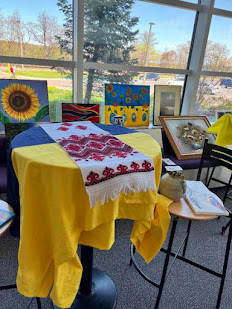
In New York City alone there was an unprecedented climate mobilization -- in size, beauty, and impact. It was estimated that there were between 3 and 4 hundred thousand who met at Columbus Circle and walked. Allan and I had decided to join the march though it meant a total of about 36 hours of travel time one way. Why? Because the older we get the more we worry about the future of our planet for our children and grandchildren.

Young and old march together -- many parents carrying kids on their shoulders -- during the Sept. 21 Climate March in New York City.

People chatted as we marched along. One woman commented that it was nice to be with like-minded people; another remarked that if the establishment keeps their heads in the sand much longer, our world is doomed. A little girl, about 8 years old,  passed me at one point proudly displaying a sign that she and her Dad had made which said, "Children need clean air." I asked her why she was marching, and she said something to the effect that we need to let God know that our earth needs help and maybe he’s watching all these worried people and will tell the president to take care of the earth. She wasn’t exactly super coherent, but it was obvious that she was aware of why she and her Dad were in this march. Her brother, slightly younger, piped in something about puppies whereupon the girl explained that they have a cute puppy named Sam and they wanted to make sure that the animals would be safe too.

There was a lively group of seniors and "Grannies," some in wheel chairs or using canes.

Carrying a banner asking, "What will be our legacy?" elders march for the future of their children and grandchildren.

A large number of LGBTs walked hand in hand along with Christian, Jewish, Buddhist, Pagan, Unitarian, atheist and various other groups. I had situated myself with the faith groups though I could have joined any number of other categories.

According to Rabbi Arthur Waskow of Philadelphia's Shalom Center (in red, waving at front of ark), more than 10,000 members of Communities of Faith and Spirit joined the New York City Climate March. "We were led by an extraordinary Noah’s Ark, built by students of the Auburn Theological Seminary under the leadership of Isaac Luria," Waskow writes. "I was able to join the thirty people who actually rode aboard the Ark. From that vantage point I was able to see the ocean of humanity that was pouring out to heal the oceans, the rivers, the clouds and mountains, the air and earth, the many many species, that make up the interwoven ecosystems of our planet."**

The signs were creative, poignant, sad, funny, imaginative. There were some floats and people dressed in costumes, dresses, jeans and you name it. Everybody helped each other in a spirit of friendship and commonalities despite differences in beliefs. Allan took lots of pictures for our Keweenaw Now site.

So, here I am, doing my part!
Love,

Shirley

Editor's Notes:

* Guest author Shirley Galbraith is a resident of Houghton and a member of the Keweenaw Unitarian Universalist Fellowship. Shirley wrote this letter to her children and friends and shares it with Keweenaw Now. With her husband, Allan Baker, videographer and photographer for Keweenaw Now, she has also reported on climate marches against the Keystone Pipeline in Washington, D.C. Click here to see her story on the Feb. 13, 2013, Keystone protest.

** Rabbi Arthur Waskow has included Keweenaw Now in his emails since we published his article on the late Pete Seeger last January. He kept us posted on plans for the September Climate March. His comments here are taken from his Sept. 22, 2014, report on the March, "The Ocean of Humanity: 300,000+ call for Climate Action Now!" on theshalomcenter.org.

This is the first in a series of articles on the recent People's Climate March and related events. Watch for photos and videos, coming soon!