See our right-hand column for announcements and news briefs. Scroll down the right-hand column to access the Archives -- links to articles posted in the main column since 2007. See details about our site, including a way to comment, in the yellow text above the Archives.

Saturday, May 16, 2015

Dianda appointed to new Roads, Economic Development Committee


LANSING -- State Representative Scott Dianda (D-Calumet) said this week that he is pleased to be one of the Democratic members of the newly created House Special Committee on Roads and Economic Development. On May 14, Speaker of the House Kevin Cotter (R-Mt. Pleasant) announced the new committee with five Republican members and two Democratic members.

"The voters spoke on May 5 and said they want the Legislature to get to work and come up with a plan to fix the roads. I am honored to be representing the people of the Upper Peninsula in this important endeavor," said Dianda. "I am ready to work in good faith with my colleagues from across the state to craft a solution that repairs our state’s infrastructure, grows our economy and is based on sound budgetary principles."

Several plans were offered and discussed last year, with Proposal 1 the plan that won enough legislative support to go before the voters. After its defeat at the polls, legislators are now considering ways to generate about $1 billion a year to fix and maintain Michigan’s roads.

"As a former Michigan Department of Transportation employee, I know the department can do more with the dollars it currently receives," said Dianda. "I am ready to come to the table with suggestions that would reduce the department’s administrative costs, increase oversight and accountability, and make sure every dollar MDOT can spare is directed towards repairing road surfaces. That is my first priority in this discussion, and the thing we need to solve before we can move on to other issues."

Thursday, May 14, 2015

Lake Linden-Hubbell biology students invite public to join them in stewardship project May 15

LAKE LINDEN -- The Lake Superior Stewardship Initiative is sponsoring a Community Event from 1 p.m. to 3 p.m. Friday, May 15, at the Lake Linden Sands.

 Photo from event flyer courtesy Nick Squires.

The public is invited to join 10th grade biology students from Lake Linden-Hubbell High School as they plant Red-osier dogwoods and Dark-green bulrush, write poetry while enjoying disc golf and install birdhouses and bird watch.

Meet the group with their teacher, Mr. Nick Squires, at the beach parking lot near the start of the disc golf course and become a part of this Lake Superior Stewardship Initiative Project.

Click here for directions from Houghton. For more information email nsquires@lakelinden.k12.mi.us.

Monday, May 11, 2015

MDEQ to hold Open House on Torch Lake Abandoned Mining Wastes project May 13

By Michele Bourdieu

This partially sunken dredge is a reminder of the copper reclamation industry that left stamp sand and PCB pollution in the Torch Lake Area of Concern. (2012 Photo © Todd Marsee and courtesy Michigan Sea Grant Research Project)

LAKE LINDEN -- The Michigan Department of Environmental Quality (MDEQ) and a team of Michigan Tech University researchers have been working to locate and study environmental hazards left by 100 years of copper mining industries in the Torch Lake Area of Concern so they can be cleaned up where possible. Contaminants that cause an immediate threat to human health, such as PCBs (Polychlorinated Biphenyls) and mercury in fish tissues, are an important subject of two recent projects.

MDEQ Emergency Response and Removal: Abandoned Mining Wastes project

On Wednesday, May 13, Amy Keranen, Department of Environmental Quality (MDEQ) Remediation and Redevelopment Division project manager for the Abandoned Mining Wastes (including PCBs) project at Torch Lake, will host an Open House, free and open to the public, from 4 p.m. to 8 p.m. at Lake Linden-Hubbell High School Auditorium. Staff from WESTON Solutions of Michigan will also be on hand to speak with the public and answer questions.

Last summer, the MDEQ began an investigation to identify and characterize mining wastes remaining along the shores of Torch Lake near Lake Linden-Hubbell. The MDEQ sampling crew who conducted on-land and in-lake investigative activities will display some of their equipment, pictures, maps and videos of their findings. The informal Open House will offer citizens the opportunity to drop in to meet the project team and to get their questions answered.

Keranen notes this work is separate from the projects conducted by the U.S. Environmental Protection Agency (EPA) under the Superfund program, which involved capping the exposed stamp sands/tailings and was to require property/resource use restrictions to prevent certain activities in select areas.* Keranen's present project has included evaluating the industrial processes that generated the wastes and various hazardous substances that remain in the area.

Powder-like stamp sands spread through Torch Lake after the original stamp sand was put through a regrinding process to remove more copper and then dumped back into the lake. Electrification used for this process led to the present pollution from PCBs. (See video clips below.) (2012 Photo © Todd Marsee and courtesy Michigan Sea Grant Research Project)

"This work is needed to address two concerns remaining after the completion of the EPA’s Superfund project," Keranen says. "The continued presence of PCBs in Torch Lake is preventing the recovery of the Torch Lake ecosystem and keeps it from being delisted as an Area of Concern under the Great Lakes Water Quality Agreement. In addition, other potential environmental and human health risks are present which require further evaluation and possible clean-up."

PCBs have been found in the basement of the Calumet and Hecla (C and H) Powerhouse, near the Calumet Stamp Mill site, C and H Smelter, and the coal dock area in Hubbell. PCBs are also in the water, fish and sediment of Torch Lake.

In addition to the presence of organic and inorganic contamination, found through the MDEQ's investigation of the C and H Lake Linden Operations Area, physical hazards such as metal and porcelain-like debris can be seen here at the Hubbell Beach near the old town dump. These wastes can be seen in the shallow water near the swimming area. (Photo courtesy Amy Keranen)

"In the Hubbell Processing Area, PCB contamination is present in debris, charred waste materials, waste piles, soil, and groundwater," Keranen reports. "These materials are subject to migration to Torch Lake via erosion channels on the ground surface that lead to holes in the former coal dock bulkhead. PCBs were also detected in groundwater suggesting the potential for movement of PCBs through the groundwater to the lake. Offshore sediment sampling confirmed that PCBs are present in Torch Lake sediment in front of the former smelter and coal dock."

This map shows Torch Lake and several sites of abandoned mine waste in the Lake Linden and Hubbell areas. (Map courtesy Weston Solutions of Michigan, Inc.)

Keranen adds the investigation is moving down the shoreline to include the C and H Tamarack City Operations Area. Her team has completed historic archival research, compiled and evaluated the previous studies and reports for the Tamarack City area, and conducted underwater mapping (via side-scan sonar) to develop a soil sampling plan beginning this week.

"Studies in the lake will start in late May," Keranen says. "The work will continue in a phased manner, allowing us time to look at preliminary data and get back out to fill in any data gaps later in the summer."

Carol MacLennan, Michigan Tech professor in Social Sciences, has worked with MDEQ on the Abandoned Mining Wastes Project, Keranen said.

"She conducted historic research regarding the industries in the Lake Linden-Hubbell, the Tamarack City and the Mason areas," Keranen noted. "We used Carol's research to confirm where our samples should be -- targeting areas of waste streams and disposal areas."

On September 25, 2014, MacLennan gave a presentation on "Creating the Torch Lake Industrial District and Its Environment" for the Fourth Thursday in History Series, sponsored by Keweenaw National Historical Park.

1947 photo of the Torch Lake Industrial District. (Photo courtesy Michigan Tech Archives and Carol MacLennan)

Using historic photos, MacLennan pointed out how the Torch Lake shoreline between Lake Linden and Mason was once the largest industrial site in the Keweenaw copper district. An enormous powerhouse, eight stamp mills, a smelter, and three reclamation plants lined the Torch Lake shoreline, and the lake bustled with ships delivering coal and taking copper to market. She demonstrated how processing mined rock, reclaiming copper-rich stamp sands from the lake and from scrap metals, and experimenting with new copper oxide products consumed the attention of the Calumet and Hecla and Quincy mining companies in their later years.

Historic photo of Calumet and Hecla stamp mills in Lake Linden. (Photo courtesy Michigan Tech University)

"History is a critical tool for figuring out mine waste pollution," MacLennan said. "Without our investigation into Torch Lake, we would not be able to untangle the PCB problem there."

MacLennan's research has helped to identify sites of hazardous mining waste, including PCBs. Here are some video clips from her presentation:

Carol MacLennan, Michigan Tech University professor of anthropology, speaks about her historical research for the Michigan Sea Grant Torch Lake Integrated Assessment project on Sept. 25, 2014, at Lake Linden-Hubbell High School. The presentation was hosted by Keweenaw National Historical Park. (Videos by Keweenaw Now)

Here Carol MacLennan shows photos of some of the buildings and equipment used in reclamation of copper from the stamp sands as well as the facilities for regrinding, leaching and refining it -- processes that left pollutants in the environment.

Carol MacLennan speaks here about the electrification that led to PCB contamination in and around Torch Lake.

This chart from Carol MacLennan's presentation shows the waste products and contaminants left from several industrial facilities near Torch Lake.**

Potential health hazards from exposure to PCBs include cancer, neurological disorders, skin lesions and liver problems. Additionally, PCBs can be passed from mothers to children during pregnancy and
through breast feeding. Children are more vulnerable to the effects of PCBs than adults.**

During the question-answer period following her presentation, Mac Lennan pointed out that the Torch Lake Area of Concern is larger than just Torch Lake.***

"We still have a long way to go with delisting it as an Area of Concern," she said.

MacLennan has also done historical research on the Torch Lake Area of Concern through the Michigan Sea Grant project titled Torch Lake Integrated Assessment. On this project she worked with two other Michigan Tech professors and student researchers, again helping identify the sources of contaminants through her study of industrial sites in the area.

Michigan Sea Grant Project: Torch Lake Integrated Assessment

In 2012 MacLennan, along with Noel Urban and Judith Perlinger, Michigan Tech professors in Civil and Environmental Engineering, received funding from the Michigan Sea Grant (federal funding through the State of Michigan) to study the environmental and historical effects of the intensive copper mining that took place on the Keweenaw Peninsula from 1845 to 1968. Their project is titled the Torch Lake Integrated Assessment.

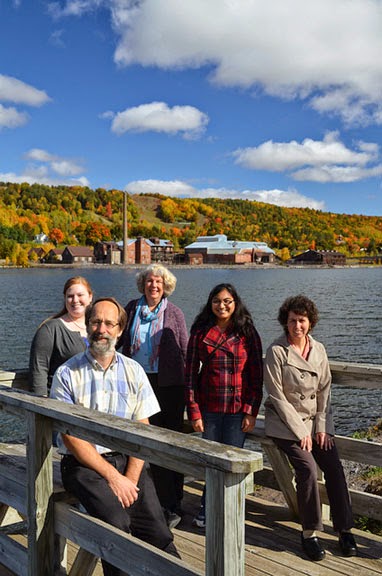
Michigan Tech professors leading the Torch Lake Integrated Assessment -- Noel Urban (foreground), Judith Perlinger (right) and Carol MacLennan (third from right) -- are pictured here opposite the Quincy Smelter, along with student research assistants Emma Schwaiger (far left) and Ankita Mandelia. (2012 Photo © Todd Marsee and courtesy Michigan Sea Grant Research Project)

"The purpose of this project is to assemble all the existing information regarding problems in Torch Lake," Urban explains. "The most important part was the information on PCBs. As a result of our findings we convinced the DEQ, the EPA and the PAC (Torch Lake Public Advisory Council) that there is ongoing contamination from PCBs."

Urban and Perlinger found data indicating that concentrations of PCBs in Torch Lake sediments, water and fish were much higher than those in nearby waterways. The highest concentrations -- hot spots -- are near the western shore of Torch Lake, where industrial activity was intense.

While swimming and boating in Torch Lake are considered safe, humans can be exposed to harmful effects of PCBs from eating fish with high levels of PCBs in their fatty tissues and from contact with contaminated soils. The local municipal drinking water, which comes from groundwater wells, is not contaminated with PCBs.

On July 4, 2014, Professor Noel Urban took groups of visitors on a boat ride aboard Michigan Tech's research vessel, the Agassiz, and explained various aspects of the pollution in the sediments and the fish of Torch Lake. Passengers were invited to ask questions during the sessions. Here are some video clips from one of his presentations:

On Michigan Tech's research vessel Agassiz, Noel Urban, Michigan Tech professor of environmental engineering, speaks about the stamp sands in Torch Lake during a community education event in Lake Linden, Mich., on July 4, 2014. (Videos by Keweenaw Now)

Urban estimates it will take 800 years for the sediments at the bottom of Torch Lake to recover naturally:

Michigan Tech Professor Noel Urban explains why nothing can grow on the bottom of Torch Lake, where sediments are still contaminated with stamp sand from industrial reclamation of copper in the area. He is speaking on July 4, 2014, during an educational boat ride on Michigan Tech's Agassiz research boat.

Aboard the Agassiz research boat on July 4, 2014, Michigan Tech Professor Noel Urban explains how electrical transformers contained PCBs that contaminated the soil and how fish in Torch Lake are contaminated with both PCBs and mercury. He points out that Amy Keranen of MDEQ is working to locate the PCBs so they can be cleaned up.

Michigan Tech Professor Noel Urban answers questions about contamination of Torch Lake from copper mining and reclamation. Here he discusses contaminants in the sediment and the fish. Agassiz Captain Steve Roblee asks about the safety of well water. 

As Noel Urban noted in his presentation, fish consumption advisories prohibit eating certain fish from Torch Lake because of mercury and PCBs that bioaccumulate in fish tissues.

The Michigan Department of Community Health (now known as the Michigan Department of Health and Human Services) is working on the problem of Torch Lake's contaminated fish and has issued fish consumption advisories for Walley, Northern Pike and Smallmouth Bass. Michigan's Health Department toxicologists are also working on evaluations of risk from toxic contaminants around Torch Lake.**** 

Notes:

* The EPA has defined the Superfund Site as the upper six inches of stamp sand and slag in certain areas of Houghton County and any soil cap and vegetative cover applied to these areas. It has also included a "no-action" remedy for lake sediments. The Superfund program continues to monitor this remedy.

** Click here to learn more about the PCBs in and around Torch Lake and potential health hazards they pose to humans. Click here for more details on toxic metals in and around Torch Lake. Learn which government agencies and community groups are working on Torch Lake issues in the Michigan Sea Grant publication, "Who Is Doing What at Torch Lake?"

*** Click here for a map of the Torch Lake Area of Concern.

**** Click here to see fish consumption advisories for your area of Michigan.  Click here for Michigan Health Department reports on the Torch Lake Superfund site and surrounding areas.

Editor's Note: This is the fourth in a series of articles including Michigan Tech's Research Vessel Agassiz used for community education programs during 2014. See also our July 22, 2014, article, "Adults and kids learn about Great Lakes research, fish food web, marine robotics, more ..."; our Aug. 4, 2014, article, "Photos: Copper Harbor celebrates Lake Superior Day 2014 with R/V Agassiz excursions, ROVs, canoe races, picnic, more .."; and our Nov. 17, 2014, article, "Geology expert notes concerns about arsenic in Gay stamp sands as DEQ accepts comments on stamp sand removal proposal."

Thursday, May 07, 2015

PUBLIC NOTICES: Hancock 2015 Spring Cleanup

HANCOCK -- For City of Hancock Residents ONLY: Two Public Notices by the City of Hancock announce upcoming Spring Cleanup events:

General Debris

General Debris, such as old furniture, lumber, small metal items, etc. can be brought to the Public Works Garage (DPW), 1601 Tomasi Dr., Hancock between 7 a.m. and 7 p.m. on Friday, May 8, and Saturday, May 9. Proof of residency, such as a driver's license, will be required at the DPW Facility.

General Debris Terms and Conditions: The DPW storage site will have restricted access and the site will be closed for debris drop off except for the above published times. Any debris left at the gate area will be treated as a littering offense by the City. The City is limiting the amount of material to four cubic yards per household or facility. Only two box springs or mattresses will be accepted per household or facility. Debris is limited to debris generated in the City.

WHITE GOODS WILL BE ACCEPTED BY THE CITY including refrigerators, freezers, washers, dryers and microwaves.
Scrap Metal -- Steel, iron, copper, brass and aluminum will be accepted -- including bicycles, lawn mowers, and snow blowers.
PAINTS, OILS, TIRES AND BATTERIES WILL NOT BE ACCEPTED!

Curbside Leaf and Branch Pickup

The City of Hancock will be picking up curbside leaves, grass clippings and small branches on Monday, May 11, and Monday May 18. Leaves and branches should be placed at curbside prior to 7 a.m. The City will only pickup leaves and grass clippings if they are placed in the clear (green) biodegradable bags purchased from the City of Hancock. The city will not pickup leaves along city curbs or streets.

The City sells the bags at City Hall, 10 bags for $5 or 25 bags for $12. Biodegradable bags with leaves or grass can be brought to the City DPW (1601 Tomasi Dr) during regular business hours throughout the summer or fall.

Small branches less than 4" in diameter, can be put on the curb for the City to pickup during the above listed dates. Small branches should be bundled with string for easy handling by City workers.
Residency is required for participation 


Click here for the City of Hancock Event Calendar for May 2015.

"Portraits" exhibition opens at Community Arts Center May 7

HANCOCK -- "Portraits," the new exhibition in the Copper Country Community Arts Center’s Kerredge Gallery, includes portraits of people and animals in photography, color pencil, watercolor, pen and ink, marker, charcoal, acrylic, oil, watermedia, fabric collage, and pastel.

An opening reception will be held from 6 p.m. to 8 p.m. TONIGHT, Thursday, May 7, in the Community Arts Center. The exhibition continues through May 30.

Artists participating in the exhibition are Madhura Mehendale, Kanak Nanavati, Abigail Tembreull, Clyde Mikkola, Sandra Norris Palmore, Miriam Pickens, Bob Dawson, Marianne Brokaw, Ray Sharp, Cynthia Coté, Paula  Jacobs, Kris Raisanan Schourek, and Joyce Koskenmaki.

The Copper Country Community Arts Center is located at 126 Quincy Street in Hancock. Gallery hours are Tuesday through Friday 10 a.m. - 6 p.m. and Saturday 1 p.m. - 5 p.m. Exhibitions are supported in part by a grant from the Michigan Council for Arts and Cultural Affiars with funding from the National Endowment for the Arts. For more information call 482-2333 or visit the website: coppercountryarts.com.

Conservation District to hold annual Tree Sale May 9

Sue Haralson, former Houghton Keweenaw Conservation District administrator and now volunteer, prepares plants and trees for sale at HKCD's ONE-DAYTREE SALE to be held Saturday, May 9. (Photos by Keweenaw Now)

HOUGHTON -- The Houghton Keweenaw Conservation District (HKCD) will hold a ONE-DAY TREE SALE: First Come, First Served from 8:30 a.m. to Noon on Saturday, May 9, at the Houghton Keweenaw Conservation District Office, 711 W. Lakeshore Drive, Houghton.

New varieties have been added this year. Also, you can help Monarch butterflies by purchasing and planting milkweed ($3 per plant, 4 for $10). See Meral Jackson's article, "The Mighty Monarch: How can we help them survive?" and check out the trees and plants for sale in the HKCD 2015 Tree Sale catalogue on their Web site.

A wide variety of trees, plants, berries and more will be available at the May 9 Tree Sale. First Come, First Served.

If you wish to help with the tree sale, HKCD will appreciate any time you can spare from now through Saturday, May 9. For more information on work session times and dates call HKCD at (906) 482-0214 or (906) 370-7248.

Tuesday, May 05, 2015

Michigan Tech News: Listening Under the Ice

By Allison Mills, Michigan Tech Science and Technology Writer
Posted April 28 and updated Apr. 30, 2015, on Michigan Tech News
Reprinted in part with permission.

Andrew Barnard, assistant professor in mechanical engineering studying acoustics at Michigan Tech, helped install this passive hydrophone system off the dock at the Great Lakes Research Center. "Passive acoustics is just listening to whatever is out there," he said. (Photo © Andrew Barnard and courtesy Michigan Tech University)

HOUGHTON -- Spring is finally here in Michigan's Upper Peninsula -- and the thaw marks the first season of under-ice acoustics studies completed at the Great Lakes Research Center by Michigan Technological University researchers.

The watery world under winter’s ice is a mystery. It’s also a world full of sound. Now, as the days lengthen and the ice is retreating, researchers at Michigan Technological University are wrapping up their first winter season of underwater acoustic studies.

Learning more about acoustic properties underwater -- and specifically under the ice -- is important for designing acoustic communication networks and quiet underwater vehicles. These networks and vehicles have a range of applications. Environment monitoring is an example, encompassing everything from ice movement to the habits of aquatic critters to keeping tabs on chemical conditions.

Michigan Tech researchers work with a hydrophone network on L'Anse Bay. Zhaohui Wang, assistant professor of electrical and computer engineering at Michigan Tech, studies underwater wireless communication networks. (Photo © Zhaohui Wang and courtesy Michigan Tech University)

Although the applications are broad, studying acoustics all comes back to sound: Beeps and chirps for network signals, the glassy crinkle of floating ice and even the underwater reverb of a snowmobile passing by. Each sound tells a story; each narrative helps researchers understand the icy-cold depths we can’t normally see. ...

Click here to read the rest of this article and to LISTEN to sounds under the ice recorded by Michigan Tech Professors Andrew Barnard and Zhaohui Wang.

Monday, May 04, 2015

Portage Library to host program on Michigan Bats and Invasive Insect Species May 6

HOUGHTON -- The Portage Lake District Library will host a two-part discussion and slide show about the effects of White-Nose Syndrome on Michigan bats and about invasive insect species that affect trees at 7 p.m. on Wednesday, May 6. Jennifer Kimball will give this presentation as part of her Capstone Research Project with the University of Wisconsin.

The first part of her presentation will focus on Michigan bats and how they are faring in the fight against White Nose Syndrome. Her discussion will include the history, spread, and prognosis for the disease. White Nose Syndrome has been decimating hibernating bats since 2006 with local mortality near 100 percent in two years for some species. She will also share findings on possible treatments for the disease, including creating artificial bat caves.

The second part of her presentation will take a look at the Asian Longhorned Beetle, Emerald Ash Borer, and Oak Wilt. Kimball will give a history of the invasive insects, discuss the kinds of trees they affect and describe preventative measures that are being tried to prevent the spread of disease among trees.

This program is geared towards high school students and adults, but children who are interested in learning about bats and invasive insects are encouraged to attend.

Library programs are free and everyone is welcome. For more information, please call the library at 482-4570 or visit www.pldl.org.

Friday, May 01, 2015

Michigan Tech students hold fundraising dinner for Nepal earthquake relief; fundraiser continues online

By Michele Bourdieu

Students enjoy a fundraising dinner at the Canterbury House in Houghton on Apr. 29, 2015. The event raised about $1,800 for victims of the recent earthquake in Nepal. With a goal of $10,000, Michigan Tech's Nepalese Student Organization continues the fundraiser online. So far they have collected more than $8,000. Serving food, at left, is Ezequiel Medici, who, along with Evan Post and other Canterbury House students, helped organizer Sara Alian with the food preparation. (Photos © and courtesy Allan Baker)

HOUGHTON -- Michigan Tech's Nepalese Student Organization and friends raised about $1,800 Wednesday night, Apr. 29, during a fundraising dinner at the Canterbury House for victims of the recent devastating earthquake in Nepal. Since then, the students' fundraising for Nepal has continued online HERE.

Sara Alian, center, one of the organizers of the dinner for Nepal earthquake relief, chats with friends in the Canterbury House during the event. Alian noted food was provided by Canterbury House.

So far the online fundraiser has collected more than $8,000 toward a goal of $10,000. The Nepalese Student Organization members hope to send the money to help in the best way possible. As of Thursday, April 29, they were still considering where to send the money.

"We have not yet decided to whom to give the money as we have not reached our target, but it seems we will meet our target pretty soon," said Dolendra Karki, president of the Nepalese Student Organization and graduate student in the Department of Physics. "However, we are thinking of providing part of it to the local groups working for relief efforts in Sindhupalchok District and Gorkha District."

These districts are in one of the remote areas most devastated by the earthquake, he explained.

Students provided food with an international flavor, including vegetarian dishes, for the Apr. 29 fundraising dinner.

Karki said the students were taking time to select the relief group to be sure it is trustworthy. They want to be sure the money will be spent on the people in need and not be misused. Another possibility under consideration is to give the funds to the Red Cross, which is helping people in those areas.

Ashma Vaidya, a member of the Nepalese Student Organization, sent an email out to students to let them know how donations can be made online.

"It is very discomfiting for us, members of the Nepalese Student Organization at MTU, that we are unable to be with our loved ones back home at this hour of such huge tragedy," Vaidya writes. "While there is so little we can do about it, we are determined to do all that we can to help provide relief to the affected people in Nepal."

Visit the Michigan Tech Nepalese Student Organization Facebook page to learn more.

Thursday, April 30, 2015

Enjoy First Friday Art Walk through Calumet's Art District May 1

CALUMET -- The Calumet Art District will offer poetry, art exhibits, music and activities this First Friday, May 1. Here are some treats the galleries have in store for visitors Friday evening:

Café Rosetta: Poetry Open Mic

Photo courtesy Café Rosetta.

Start your First Friday tour of the art galleries in Calumet with the Poetry Open Mic from 6 p.m. to 7 p.m. Friday, May 1, at Cafe Rosetta, 104 Fifth Street. Share your latest poem or a poem from your favorite poet. Don’t have a poem? Share a tiny story. Don’t want to share? Grab a hot beverage and listen.

Paige Wiard Gallery: Art and Paper

Paper art by John Hubbard. (Photo courtesy Paige Wiard Gallery)

Artists have been integrating paper into their work for years. Because of the endless possibilities paper adds to art, artists have been creating amazing and unique works. Visit the Paige Wiard Gallery, 109 Fifth Street, on May 1, 2015, to view the ways artists have integrated paper into their artwork. An opening reception will be held from 6:30 p.m. to 9 p.m. For more information please email paigewiardgallery@gmail.com or call 906-337-5970.

Galerie Bohème: New works by three artists

Art by Cynthia Coté. (Photo courtesy Galerie Bohème)

Galerie Bohème will feature new works by Cynthia Coté, Tom Rudd and Margo McCafferty this month. Meet the artists, enjoy the snacks and conversation on First Friday, May 1. The Galerie will be open on First Friday from 6:30 p.m. to 9 p.m. Call 906-369-4087 for more information. Galerie Bohème is at 423 Fifth Street in Calumet.

Calumet Art Center: Explore work from classes

Visit the Calumet Art Center on First Friday between 6:30 p.m. and 8:30 p.m. on First Friday and see what students have created in the latest art classes. To learn about the Center and their work see a new video with Ed Gray, artist and executive director, on their Web site (Click on "A Welcome"). The Calumet Art Center is at 57055 Fifth Street. For more information call 906-934-2228.

Hahn Hammered Copper: Copper icicle ornaments

This First Friday evening see what's new at Hahn Hammered Copper -- their own hand-hammered copper icicle ornaments and also a large collection of near-mint Jewel Tea Autumn Harvest dinnerware. Hahn Hammered Copper is at 203 Fifth Street.

Copper Country Associated Artists: Art of Tin Cans workshop

Learn about the Art of Tin Cans at Copper Country Associated Artists (CCAA) Gallery from 6 p.m. to 8 p.m. this First Friday. All you need to bring is your imagination and a hammer. You will learn the techniques and inspirations needed to transform a fruit or vegetable can into a beautiful silhouette candleholder with just a nail and hammer. Then you'll combine color alcohol inks to finish off your creation.

Please bring a hammer if attending this event. All other supplies will be provided. For safety reasons all participants must be over 12 years of age. CCAA is at 205 Fifth Street.

Cross Country Sports: "Art of Biking"

Cross Country Sports welcomes the biking season with a show titled "The Art of Biking" for the month of May. Artists participating with a variety of media include Joyce Koskenmaki, Cynthia Coté, jd slack, Shelly Hahn, Christa Walck, Elaine Eikenberry, Heather Ann Mroz and Jen Szubielak. Enjoy an open house and refreshments from 6 p.m. to 9 p.m. May 1 at 507 Oak Street. For more information call 337-4520 or check the Cross Country Sports Facebook page.

Omphale Restaurant and Gallery: Music, Art of Jeremy Rowe

The Omphale Restaurant and Gallery, 431 Fifth Street, will host the Music and Art of Jeremy Rowe from 6 p.m. to 9 p.m. First Friday, May 1 -- ONE NIGHT ONLY! Enjoy Dinner and Music every Friday. Visit the Omphale Facebook page for details.

Monday, April 27, 2015

Students to hold fundraising dinner to help Michigan Tech Nepalese students' families Apr. 29

Poster for Help Nepal Fundraiser courtesy Sara Alian.

HOUGHTON -- A group of Michigan Tech students and friends will be holding a dinner-style fundraiser for Nepal to support Nepalese Students at Michigan Tech and their families back home who are suffering from the recent severe earthquake and its terrible aftereffects.

The dinner will be held from 6 p.m. to 8 p.m. Wednesday, April 29, at the Canterbury House, 1405 E. Houghton Avenue in Houghton. Donations of any amount will be accepted. Students will provide the food.

If you cannot attend the dinner and would like to send a check, please make the check out to Sara Alian and mail it to her at The Canterbury House, 1405 E. Houghton Avenue, Houghton, MI 49931. Indicate that it is for the Nepal fundraiser.

Friday, April 24, 2015

Concerned Native, non-Native citizens protest Graymont land deal, Enbridge pipeline, more, near Mackinac Bridge

By Michele Bourdieu

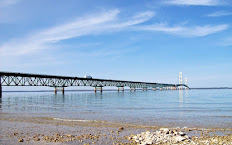
Just north of the Mackinac Bridge on March 28, 2015, Native and non-Native protesters carry signs expressing concerns about Michigan environmental issues -- including the state's approval of a land and mineral rights exchange and sale involving more than 10,000 acres of public land for the Graymont limestone mining project, the proposed CR 595 wilderness road near Marquette, the aging Enbridge pipeline threatening the Straits of Mackinac, and fracking. The three-day protest attracted a total of about 100 participants from both sides of the bridge. (Photos by Keweenaw Now unless otherwise indicated)

ST. IGNACE -- Bundled up against single-digit temperatures, Miguel and Anita Levy of Chassell joined protesters near the Mackinac Bridge on Saturday, March 28, 2015. The group of Native and non-Native protesters carried signs to express several concerns -- including the recent land deal approved by the Michigan Department of Natural Resources (DNR) involving more than 10,000 acres of Michigan public land to benefit Graymont, Inc., a Canadian company planning to construct a huge limestone mining operation in the eastern U.P.*

Miguel and Anita Levy of Chassell display a sign they carried during the March 28 protest near the Mackinac Bridge.

"It's exciting to be doing this -- to be speaking against the selling of Michigan's land," said Anita Levy, a retired elementary school teacher.

Martin Reinhardt, a citizen of the Sault Ste. Marie Tribe of Chippewa Indians and assistant professor and chair of Native American Studies at Northern Michigan University, initiated this three-day demonstration March 27, 28 and 29 to cast a light on how the State of Michigan is violating the treaty rights of Michigan tribes and disenfranchising both tribal and non-tribal citizens from their right to clean air, water, and land. A total of about 100 people participated in the protest during the three days despite inclement weather. Fortunately, the group had permission to use the Michigan Welcome Center near the bridge to warm up for short periods during the event.

Miguel Levy, Michigan Tech professor in physics and materials science and engineering, who is interested in indigenous rights, invited Reinhardt to speak at Michigan Tech Feb. 27 on "Anishinaabe Treaty Rights and Education in Michigan." Levy has also joined colleagues and community members in organizing an Indigenous Issues Discussion Group, which co-sponsored Reinhardt's talk along with Michigan Tech Center for Diversity and Inclusion and the Michigan Tech departments of Social Sciences and Humanities.

In addition to the Graymont issue, protesters held signs concerning the aging Enbridge pipeline under the Straits of Mackinac; the proposed wilderness road, County Road 595 near Marquette; and fracking.

Reinhardt said these are issues that concern the Anishinaabe (Ojibwe) people in the Great Lakes region because these projects infringe on treaty rights and have sparked their concern.

Preceding the walk toward the Mackinac Bridge, Native participants drum and sing traditional Anishinaabe songs. Seated, second from right, and drumming is Martin Reinhardt, citizen of the Sault Ste. Marie Tribe of Chippewa Indians and assistant professor and chair of Native American Studies at Northern Michigan University. Reinhardt initiated the protest out of concern for Anishinaabe treaty rights and the environment. Standing, at right, are Kathy and Al English of Trout Lake, Mich., who have actively spoken out against the project, which would be very close to their home.*

Reinhardt mentioned Graymont's mining proposal -- taking public lands for activities that will injure the ecology; the Enbridge pipeline that is in disrepair and should be shut down and taken care of; CR 595 that would destroy wetlands and devastate that area; and fracking that will bring devastation to the water quality, possibly causing earthquakes.

On Saturday, March 28, 2015, braving the bitter cold, protesters walk from the Michigan Welcome Center to the edge of the highway just above the Mackinac Bridge, displaying signs that express their concerns for Michigan's environment and treaty rights. This was one of three days of protest. (Video by Keweenaw Now)

"Every time that they mess around with the public lands -- whether that's timbering or mining concerns -- they're dealing with a set of issues that impact our rights as Anishinaabe people to hunt, to fish, to gather, to have our spiritual ceremonies, to go out and enjoy nature, to educate, recreate," Reinhardt told Keweenaw Now. "We have the right to occupy these territories -- our traditional homelands."

Reinhardt noted also the Anishinaabe teaching of concern for future generations -- of thinking seven generations into the future.

"We as a people have to stand up and we have to say 'no more.' We can be idle no more. If our 'government' is getting in bed with the corporations, well, then we need to take that power away from them and remind them that WE are the government -- the people -- they answer to us," Reinhardt said. "This gathering here, this protest, this rally is really about reminding people that we have the power -- if we only choose to use it."

Reinhardt said he chose the Mackinac Bridge as the place for the gathering because it symbolizes the center of the Great Lakes region and the joining of Michigan -- a place to remind people, as they drive by, about these issues -- or make them aware of issues they possibly haven't thought about before.

Martin Reinhardt carries the Anishinaabe eagle staff during the March 28 protest. Next to him, holding the Idle No More sign, is Phil Bellfy of Sault Ste. Marie, Mich., a citizen of the White Earth Nation (of Minnesota), who is the lead plaintiff in a lawsuit against DNR Chief Keith Creagh over the Graymont issue. Gene and Carla Champagne of Big Bay are at left.

"This is not a Native vs. non-Native," Reinhardt pointed out. "This is a reminder to both that we all have rights. When our ancestors signed those treaties, it wasn't just one side signing the treaties. It was both sides. The very fact that people are here in Michigan and they get to enjoy Michigan is because their ancestors signed those treaties as well. Both sides have to be responsible for what our ancestors foresaw as the future of this area. We've got to protect it for future generations."

Phil Bellfy of Sault Ste. Marie, Mich., a citizen of the White Earth Nation (of Minnesota), who recently joined Reinhardt in filing a suit against DNR Chief Keith Creagh to ask for an injunction against the Graymont project, also participated in the Mackinac Bridge protest.

Native plaintiffs file suit against DNR Chief Keith Creagh 

"We had been trying to get the tribes involved as tribal entities in our Graymont suit, but they decided to take a different approach to it (such as passing resolutions opposing Graymont)," Bellfy told Keweenaw Now. "We, as Native individuals, have more rights than the tribes themselves. So we filed a suit against Mr. Creagh."

Bellfy noted the 2007 Inland Consent Decree essentially federalized the land included in the Graymont land deal, stating that the federal government has jurisdiction over the land as far as treaty rights are concerned.**

"So that's the approach that we're taking," he said. "We're going to go to court based on our treaty rights."

Bellfy said the state of Michigan signed that Consent Decree but doesn't respect it.

"So we decided that Mr. Creagh, the head of the DNR -- he's just a state-level political appointee -- he has no authority to abrogate our treaty rights," Bellfy explained. "They're our rights as human beings to access the resources of that land. And the way the agreements are written up between Graymont and the State of Michigan, we would be considered trespassers on that land. They say it's open to the public, but it doesn't say it's open to the public for the exercise of your treaty rights. You can go and recreate there -- you can hunt there, you can fish there -- but it says all others are trespassers. So we don't accept that."

Bellfy and fellow plaintiffs filed on March 17, 2015, a motion for a temporary restraining order (which was denied) and a motion for an injunction. The DNR had 21 days to respond to the injunction lawsuit. The plaintiffs filed a second, almost identical, motion for a temporary restraining order on April 13. The DNR did respond to that, and Judge Paul Maloney denied the second request for a temporary restraining order on April 16. He also set a date for a hearing on the motion for an injunction, set for 3 p.m. Wednesday, April 29, 2015, 174 Federal Building, 410 W. Michigan Ave., Kalamazoo, MI 49007. ***

This week, on April 21, Bellfy filed a Motion for Default Judgment, noting the DNR did not respond to the injunction lawsuit within the 21-day limit. Bellfy and fellow plaintiffs request that the Court "immediately preliminarily enjoin Defendant (Keith Creagh), or other State of Michigan officers, employees, agencies, subdivisions, successors, or assigns, from approving the land transactions involved in the Graymont-Rexton Project."

The plaintiffs add that the Court should also enjoin the same entities "from approving any land transactions that adversely affect the usufructuary, occupancy, or any other rights of American Indians throughout the 1836 Ceded Territory, throughout the extent of that Territory as it is detailed in the 2007 Inland Consent Decree."****

On Apr. 23, Bellfy posted an update on his Idle No More page on article32.org, stating both Graymont and the State of Michigan have filed actions opposing the plaintiffs' suit.

"What is at stake in this argument is the requirement that the Court grant our 'relief' --  the imposition of a temporary injunction," Bellfy writes. "As I read the law, the state can certainly argue against the injunction, but only after it’s imposed as a result of their failure to respond to our original motion, as was claimed in the other of today’s filings.

"One of the motions I filed today contained a 'request for relief' that the temporary injunction required under the Default statute be 'upgraded' to permanent." *****

Bellfy also noted he and fellow plaintiffs are pursuing these motions against the DNR without the aid of an attorney. He said 55,000 Native people are being affected by the Graymont project.

In an email reply to Keweenaw Now on April 20, 2015, Reinhardt stated, "We are still working on the case and will be seeking assistance from the federal government. It comes down to the fact that the State of Michigan had no authority to deal with Graymont without the tribes' approval. As tribes and tribal citizens, we have rights to the land that cannot be ignored."

Citizens from both sides of bridge participate in protest

Gene and Carla Champagne of Big Bay, who have been active in opposing the state's permits given to the Eagle Mine, and who now oppose the Marquette County Road Commission's renewed plans to construct the wilderness road CR 595, were also at the protest.

Gene Champagne of Concerned Citizens of Big Bay displays his "Yooper" sign during the March 28 protest. A longtime activist questioning the Eagle Mine permits, he has been active recently in opposing renewed efforts to construct County Road 595, a wilderness road (originally intended as a haul road for the Eagle Mine). So far it has not been built because of the Environmental Protection Agency's concerns for wetlands. His wife, Carla Champagne, who attended Rio Tinto's 2012 Annual General Meeting in London, England, to protest the Eagle Mine, also participated in the Mackinac Bridge protest.

An anti-fracking sign caught the attention of Rachell Alley of Traverse City, who stopped after crossing the bridge to check out the protest with her daughter, Sarabeth, and her friend Cindy Gerhard, also of Traverse City.

With Martin Reinhardt and holding a sign that questions the "Pure Michigan" tourism campaign are Rachell Alley (center) of Traverse City; her daughter, Sarabeth; and her friend Cindy Gerhard, also of Traverse City.

"We were just passing through," Alley said, "then I saw the sign that said 'No Fracking.'"

She didn't know about the land exchange in the U.P., Alley added, but was interested because she's been involved in similar issues nationally.

Julianna Richards of Cross Village, Michigan, 30 miles south of the bridge, said she came to the protest because she had met Martin Reinhardt at an event several years ago.

Julianna Richards of Cross Village, Michigan, displays a sign opposing the Graymont land sale.

"I took a group of teenagers to learn, from Marty, about the decolonization diet (what food was like in the past)," Richards said.

She noted she learned from Reinhardt that Native American views on natural food were not very different from her own German-Celtic heritage.

Protesters display signs near the highway just above the Mackinac Bridge on March 28. (Photo © and courtesy Valerie Jean of Detroit.)

During the protest on Saturday, participants were invited to form a circle of unity and speak about their own concerns. Photographer Valerie Jean, one of the organizers of DCATS (Detroit Coalition Against Tar Sands) came all the way from Detroit with other DCATS members to show solidarity with the protest.

Green Party supporters Linda Cree and her daughter, Aimée Cree Dunn, were also at the protest.

Linda Cree posted this comment on Facebook: "It was COLD Saturday, but -- politicians and policy-makers take note -- there was overwhelming support from people passing by on the highway and reading our signs!" 

Martin Reinhardt speaks and invites others to speak about their concerns or why they came to the protest. At far right is photographer Valerie Jean of Detroit, who spoke about DCATS and their work against tar sands oil and petcoke, a tar sands oil waste product that pollutes Detroit neighborhoods. Also pictured are, from right, Green Party supporters Linda Cree, her daughter Aimée Cree Dunn and Aimée's son, Forest. Aimée is on the faculty of the Center for Native American Studies at Northern Michigan University.

Enisha Hill, a Six Nations Mohawk member, of Hannahville, Mich., came with friends to the protest.

Enisha Hill, a Six Nations Mohawk member, of Hannahville, Mich. (near Escanaba), is pictured here at right with her friend Kristy Phillips and Kristy's daughter, Adeline McKinny -- Potawatomi members from Shawnee, Oklahoma.

Asked why she came to the protest, Hill replied, "We're tired of a country run on corporate greed and money and not by the people."

Paul Yarnell, a Korean War veteran and Métis member from Turtle Mountain, North Dakota, was proud to carry the eagle staff as the group set out from the Welcome Center for another walk to the protest point near the bridge.

When Martin Reinhardt asked for a veteran in the group to carry the eagle staff, Paul Yarnell, a Korean War veteran, offered to carry it. Yarnell is a Métis member from Turtle Mountain, North Dakota. Walking with him is Scott Wyzlic of Mackinaw City, a citizen of the Grand River Bands of Ottawa Indians.

Chauncey and Nancy Moran and their son, Jeremiah, of Big Bay, active members of the Yellow Dog Watershed Preserve, also joined the protest. Nancy noted the Eagle Mine has completely changed their wilderness life style and threatens the water quality in the area.

Jeremiah Moran, son of Chauncey and Nancy Moran of Big Bay, who has spoken out at public meetings concerning the Eagle Mine since a very young age, is pictured here during the protest. The Mackinac Bridge can be seen in the background. Some passers-by on the highway tooted their horns in support of the protesters.

After the protest on Saturday, Reinhardt took a tour of the Graymont site with Al and Kathy English of Trout Lake, Mich., who have opposed the project and spoken out against it at public meetings.*

Kathy English participated in the protest all three days. She said she was happy to meet people she had been corresponding with on email and Facebook concerning the issue.

"We are encouraged by the support we received as evidenced by all the horns blowing and the thumbs up while we were there," she told Keweenaw Now.

On Sunday, the third day of protest, despite severely cold weather, about 20 people showed up for the event until they were forced to end it early because of the blowing rain and snow.

On Sunday, despite the cold, protesters drum and sing before beginning their walk toward the Mackinac Bridge. (Photo © and courtesy Kathy English)

Reinhardt posted this comment on Facebook on March 29, 2015: "I am very proud of all those who sacrificed their weekend to come stand out in the freezing cold to take a stand for our Mother the Earth. I was able to take a tour of the area where the proposed mine would be established (miigwech to Al and Kathy English). It is obvious that most of the locals are opposed to the mine and the ones who are not have been bought off by Graymont, or hope to be soon. It is shameful that Graymont has used its megawealth to buy the vote of people in local government, the local school system, and some local organizations and business owners. It is not too late to give their money back and do what it is right. Don't sell your community's soul to Graymont!"

Reinhardt is already planning a second protest at the Mackinac Bridge for Sunday, Sept. 6, 2015, the day before the Labor Day Bridge Walk. Stay tuned ...

Notes:

* UPDATE: According to a March 20, 2015, DNR press release, the details of the transaction include the direct sale of approximately 1,781 acres of state-owned land and 7,026 acres of mineral rights to Graymont; a land exchange whereby Graymont will acquire approximately 830 acres of state-owned land; and a 10-year option secured by Graymont to acquire an easement over a maximum of 55 acres of state-owned land within an identified area of 535 acres.

See our  Feb. 22, 2015, article, "DNR Chief approves mineral rights exchange with Graymont but delays decision on 10,000-acre land transaction; residents, groups express opposition to Graymont project."

** Click here for the 2007 Inland Consent Decree. See also our March 18, 2015, article, "Native American groups seek injunction against MDNR on Graymont land transfer proposal."

*** Click here for the judge's denial and order for the Apr. 29 hearing.

**** Click here for the Affidavit In Support Of Motion For Default Judgment.

***** See the Idle No More page on More Graymont Filings for more details and comments. See also Citizens Against the Rexton Project Facebook page.

Click here to visit the Department of Natural Resources (DNR) page with links to documents concerning the Graymont land transaction.

See Graymont's project map here.

Portage Library to host talk on Biomass Apr. 28

Poster for Apr. 28 talk on biomass claims courtesy Diane Miller.

HOUGHTON -- The Portage Lake District Library will host a presentation that takes a closer look at woody biomass energy production.

Diane Miller and Catherine Andrews will present "Power from Trees? An Investigation into the Issues Behind Biomass Claims" from 6:30 p.m. - 7:30 p.m. on Tuesday, Apr. 28, at the library.

Woody  biomass is one option being considered for the Upper Peninsula as energy producers and others who are concerned about increasing energy needs look for new sources of power. Miller and Andrews will discuss their investigation of claims made about using biomass and share their findings. There will be time for questions and answers following their presentation.

"We will be addressing five claims that are commonly falsely made by proponents of woody biomass burning," Miller says. "Biomass proponents claim that (1) burning biomass is carbon neutral -- which it is clearly not; that it (2) is renewable -- which it is not in any meaningful time frame; that it (3) is 'just waste wood' -- even though plants burn tires, creosote railroad ties, garbage, and whole trees; that it (4) is 'environmentally friendly' when it harms human health and destroys ecosystems; and that (5) we have plenty of biomass fuel -- which we do not."

Miller and Andrews approach the issue of large scale biomass power generation from the informed citizen perspective. As landowners, they are responsible for wooded Upper Peninsula acreage. As grandmothers, they hold special concern for future generations.

Andrews is a L'Anse resident who serves on the L'Anse Township Planning Commission and is a member of a citizen advisory committee for the Warden biomass plant in L'Anse.

Miller has lived "off the grid" for the past ten years and is a professor of communication with a special interest in using communication responsibly for the good of the entire community.

Library presentations are free and everyone is welcome. For more information, please call the library at 482-4570 or visit www.pldl.org.

Thursday, April 23, 2015

Public seminar on Engineering a Solar Panel Array to be Apr. 25 at Michigan Tech

This photo shows the solar panel array installed at 1104 Datolite Street in Houghton, an apartment complex owned by Allan Baker, who took the photo during snowfall in early April in order to show that snow does not accumulate on the panels. (Photo © and courtesy Allan Baker)

HOUGHTON -- The seminar "An Engineering Approach to Solar PV Installation" will be presented at 2 p.m. Saturday, Apr. 25, in Room G002, Hesterberg Hall, in the U. J. Noblet Forestry Building at Michigan Tech University. The seminar is free and open to the public.

James B. Malosh, a professional engineer with a PhD in mechanical engineering, will discuss the design and construction of an unconventional solar panel array at 1104 Datolite Street in Houghton. The panels are mounted on the walls of the apartment complex, which is owned by Allan Baker.

Since the panels became operational in January, Baker has seen a dramatic change in his electric bill. In March 2014 he was charged $176; and, a year later, the solar panels generated more electricity than he used: he received a credit of $45.

"It’s too early to tell for sure, but right now I think my annual savings will be between $1,400 and $1,700," Baker said.

Malosh is a registered professional mechanical engineer, a founding fellow of the Institute of Diagnostic Engineers and the holder of five patents.

Keweenaw Symphony Orchestra to conclude 5-city tour of "Suites" Apr. 25 at Rozsa

Poster for "Suites" courtesy Rozsa Center for the Performing Arts.

HOUGHTON -- The Keweenaw Symphony Orchestra will conclude its five-city tour with a concert titled "Suites!" at 7:30 p.m. on Saturday, Apr. 25, at the Rozsa Center.

According to KSO Conductor Joel Neves, "The Keweenaw Symphony Orchestra concludes its 44th season with a performance comprised entirely of concert suites: Short multi-movement orchestral works that tell a story. 'The Golden Cockerel' is based on a Russian fairy tale; 'L'Arlésienne' is the incidental music to Daudet's The Girl from Arles; 'Water Music' is music written for King George I."

The KSO has been performing this repertoire in April during its inaugural five-city concert tour to Crystal Falls, Algoma, Oshkosh, Chicago and now finally Houghton.

Also available the night of the performance is a "VPA Livestream" of the music, at http://vpa-live.mtu.edu, for those who are not able to be present for the event. (Please note, this link will not be active until the time of the event.)

Tickets for adults are $19, youth tickets (17 and under) are $6, and Michigan Tech student tickets are free with the Experience Tech Fee. For tickets, go online, call Ticketing Operations at Michigan Tech’s Student Development Complex (SDC), (906) 487-2073, or visit in person at 600 MacInnes Drive, in Houghton. SDC box office hours are 8 a.m. - 9 p.m. Monday-Friday, 8 a.m. - 7 p.m. Saturday, and noon - 8 p.m. Sunday. Please note the Rozsa Box Office is closed during regular business hours and will only open two hours prior to show times.

For more details, please contact Dr. Joel Neves, DMA, Music Director, Keweenaw Symphony Orchestra, at jbneves@mtu.edu or call (906) 487-2859.

Wednesday, April 22, 2015

Superior Wind Symphony to present "In the Throes of Radios" concert Apr. 24

HOUGHTON -- At 7:30 p.m. this Friday, April 24, in the McArdle Theatre, Michigan Tech’s Superior Wind Symphony, under the direction of Mike Christianson, will present their final concert of the 2014-15 Season, titled "In the Throes of Radios."

The audience will experience music that owes a debt to the invention of radio. This world-premier event features music by Michigan Tech's resident composer, Elizabeth Meyer, as well as music by George Gershwin, Ottorino Respighi, Morton Gould, and John Philip Sousa.

Also available, the night of the performance is a "VPA Livestream" of the music, at http://vpa-live.mtu.edu, for those who are not able to be present for the event. (Please note: this link will not be active until the time of the event.)

Tickets are $13 for adults, $5 for youth (17 and under), and free for Michigan Tech Students. To purchase tickets, call (906) 487-2073, go online at rozsa.mtu.edu, or visit Ticketing Operations at Michigan Tech’s Student Development Complex (SDC), 600 MacInnes Drive, in Houghton. SDC box office hours are 8 a.m. - 9 p.m. Monday-Friday, 8 a.m. - 7 p.m. Saturday and noon - 8 p.m. Sunday. Please note the Rozsa Box Office is closed during regular business hours and will only open two hours prior to show times.

Tuesday, April 21, 2015

Public is invited to Lake Superior Celebration of Energy, Sustainability Apr. 23 at Great Lakes Research Center

Michigan Tech's Great Lakes Research Center will be the scene of a Lake Superior Celebration of Energy and Sustainability on Thursday, April 23. The event is free and open to the public. (Keweenaw Now file photo)

HOUGHTON -- A Lake Superior Celebration of Energy and Sustainability will take place from 6 p.m. to 8 p.m. Thursday, Apr. 23, at Michigan Tech's Great Lakes Research Center (GLRC) in Houghton.

The public is invited to tour the GLRC, participate in hands-on activities, explore local resources and celebrate the achievements of student and community groups now working on renewable energy projects.

Hands-On Activities
  • Great Lakes Research Center tours: green roof  and other sustainable features
  • Energy efficient homes, wind turbines, draft dodger activities for youth
  • MTU Sustainable Vehicle Lab (invited)
Local Resources
  • Renewable energy experts
  • Energy efficient builders
  • Home energy audits
  • Green burial initiative
  • Local food and greenhouses
  • Houghton County recycling plan!
Celebrate!
  • Solarize Houghton County! Abhilash "Abhi" Kantamneni
  • Mine Water Geothermal? MTU Alternative Energy Enterprise students
  • Lake Superior Stewardship Initiative (LSSI) Student Presentations and School Team Displays
  • Enjoy cake and lemonade!
The event is sponsored by Lake Superior Stewardship Initiative; Michigan Technological University; Western U.P. Center for Science, Mathematics and Environmental Education; and Houghton Energy Efficiency Team (HEET).

Funded in part with a grant from the Great Lakes Stewardship Initiative.

Monday, April 20, 2015

Portage Library hosts National Parks Series with Ranger Valerie Martin

HOUGHTON -- The Portage Lake District Library is hosting "Junior Ranger Underwater Explorer Family Programs," a series of family programs presented by Isle Royale National Park Ranger Valerie Martin.

Children and their families will discover their National Parks and kids will earn their Junior Ranger Underwater Explorer badge. These programs offer adventures and activities that are suitable for families and kids age five to twelve. Programs include a short presentation followed by hands-on activities. Two more programs will be held this month:

Shipwreck Sleuths -- 6:30 p.m. Thursday, April 23. Kids will submerge themselves into the chilly waters of Isle Royale National Park to investigate a shipwreck. They will become an underwater archaeologist as they investigate a shipwreck site and examine artifacts. They will also find out if invasive species could affect this piece of history.

During a 2012 family presentation on Isle Royale at Portage Library, Ranger Valerie Martin introduces the concept of invasive species with an entertaining father-son game in which Dad is an invasive zebra mussel. (File video by Keweenaw Now)

Join the Kelp Crew -- 6:30 p.m. Thursday, April 30. Kids will descend into the cool waters of California's Channel Islands National Park and discover a forest under the waves. They will become a marine ecologist as they survey the species and determine if the kelp forest is healthy or not.

Valerie Martin has been a National Park Service Ranger and educator for over twenty years. She has spent fifteen summers sharing the wonders of Isle Royale with others.

Library presentations are free and everyone is welcome. For more information, please call the library at 482-4570 or visit www.pldl.org.