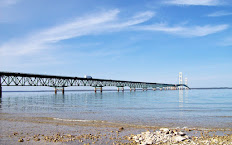
See our right-hand column for announcements and news briefs. Scroll down the right-hand column to access the Archives -- links to articles posted in the main column since 2007. See details about our site, including a way to comment, in the yellow text above the Archives.

Saturday, July 18, 2020

DNR Director Eichinger asks Enbridge parent company to assume Line 5 financial obligation

LANSING -- On Friday, July 17, Michigan Department of Natural Resources (DNR) Director Dan Eichinger sent a letter to Enbridge Inc., requesting that the corporation enter into a written agreement with the State of Michigan to provide financial assurances to cover all damages and losses caused to property or individuals due to operation of the Line 5 dual pipelines through the Straits of Mackinac. Eichinger requested that Enbridge Inc. enter into a written agreement with the State of Michigan to provide sufficient financial assurances to cover any loss, including a catastrophic release from the dual pipelines.

"As recent events have reminded us, we must get these pipelines that transport crude oil out of the Great Lakes as soon as possible," said Eichinger. "In the meantime, Enbridge must provide full financial assurance to the people of Michigan that the company will meet its obligations in the event there is a spill or some other disastrous damage to the Great Lakes."

The 1953 Easement allowing placement of the Line 5 dual pipelines in the Straits of Mackinac requires Enbridge Energy Company Inc., the corporate successor to Lakehead Pipe Line Company, to compensate the State of Michigan for all damages and losses caused by the operation of the pipelines, and to provide insurance, bond or surety liability coverage.

Under former Gov. Rick Snyder, Enbridge signed an agreement to fulfill that requirement, but only signed as a subsidiary of Enbridge Inc. The subsidiary does not have sufficient resources to cover the costs of a spill. Additionally, in an expert report titled "An Analysis of The Enbridge Financial Assurances Offered to the State of Michigan On Matters Related To The Operation of the Enbridge Line 5 Pipeline At the Straits of Mackinac (Oct. 29, 2019)," American Risk Management Resources Network (ARMRN) concluded that Enbridge Inc. is not subject to the indemnity language under the 1953 Easement. To address this deficiency, in his letter to Enbridge, Eichinger requested an agreement that includes the following:
  • Enbridge Inc., the parent company, agrees to assume the indemnity obligations of Enbridge Energy Company, Inc. (successor to Lakehead Pipe Line Company).
  • Enbridge Inc. agrees to a minimum of $900 million in liability insurance.
  • Enbridge Inc. names the State of Michigan as an additional insured party on the identified policies so that Michigan’s right of recovery is not derivative.
  • Enbridge Inc. will directly pledge its own assets for the remainder of the financial assurance requirements (to meet or exceed $1.878 billion, annually adjusted for inflation).
On June 25, 2020, Ingham County Circuit Court Judge James S. Jamo granted Attorney General Dana Nessel’s motion for a temporary restraining order requiring Enbridge Energy to cease all transport operations of its Line 5 twin pipelines.*

Click here to see the July 17, 2020, letter from DNR Director Eichinger to Enbridge Inc.

*Editor's Note: See our June 25, 2020 article, "UPDATED: Judge orders Enbridge to cease Line 5 operations following recent damage."

Governor Whitmer lowers flags to honor Congressman John Lewis

LANSING -- Gov. Gretchen Whitmer has ordered U.S. and Michigan flags within the State Capitol Complex and upon all public buildings and grounds across the state of Michigan to be lowered to half-staff on Saturday, July 18, 2020, to honor the life and service of Congressman John Lewis.

"Congressman John Lewis was a civil rights legend who stood firmly on the front lines of our nation’s history," said Governor Whitmer. "Congressman Lewis dedicated his life to building a more just, equitable nation for Black Americans everywhere, and his unwavering commitment to public service has set an example for leaders across the country. His work with leaders like Dr. Martin Luther King transformed our nation. John Lewis was an icon, and I know that people everywhere will feel the impact of his passing. May we honor his legacy by continuing the work to fix the systemic racism Black Americans face every day and build a country where everyone, no matter the color of their skin, can find opportunity. My heart goes out to the congressman’s family and loved ones during this time."

Michigan Lieutenant Governor Garlin Gilchrist also recognized the late Congressman John Lewis as a great civil rights leader and role model.

"America lost one of its greatest warriors in the fight for civil rights at a time when his leadership was needed the most," said Lieutenant Governor Gilchrist. "As our congressional and collective consciousness for two generations, John Lewis paved the way for so many people to make history by laying the foundation upon which I and so many others stand. This loss hits deep in the soul of every American, but we find solace in knowing that he inspired a legion of champions for change to carry forward this mission of justice, so that the next generation can be, believe, and become their greatest selves. We must recommit to righting the wrongs that John Lewis fought today and every day. To the man who caused good trouble: rest in power."

The State of Michigan recognizes the duty, honor and selfless service of Congressman John Lewis by lowering flags to half-staff. Michigan residents, businesses, and other organizations also are encouraged to display the flag at half-staff. To lower flags to half-staff, flags should be hoisted first to the peak for an instant and then lowered to the half-staff position. The process is reversed before the flag is lowered for the day. 

Flags should be returned to full-staff on Sunday, July 19, 2020.

Tuesday, July 14, 2020

UPDATED: Learn about Federal, State candidates for Aug. 4 Michigan Primary; absentee ballots available for all voters

HOUGHTON -- The Michigan Primary for State and Federal elections is Aug. 4, 2020 -- only three weeks away! All Michigan registered voters have the right to vote by mail. You should have received your application to vote absentee. If not, contact your local clerk for an application or go online to Michigan.gov/vote to download the form to mail in.

If you have already mailed in your application, you should have your absentee voter ballot. If not, use Michigan.gov/vote to check on its status.  If not found, contact your local clerk to find out where it is.

IMPORTANT TO NOTE ABOUT AUGUST 4 PRIMARY BALLOT!

Democrat and Republican candidates are on the same ballot. Vote for only ONE party. Voting for both will invalidate the ballot and it will not be counted. Candidates in uncontested primary races will also be invited to provide background information and respond to general questions on Vote411.org later in July. There are also countywide and local proposals.

To assist in your voting decisions, here are some links to various voter guides and debates:

See FEDERAL Level from American Association of University Women (AAUW) of Michigan’s Voter Guide for U.S. Senate and Congress HERE.

FEDERAL and STATE Level from the League of Women Voters (LWV): Go to Vote411.org/ballot to see their voter guide responses from these candidates. Note also links to interviews and debates:

U.S Senate -- Gary Peters (Dem) and John James (Rep)
U.S. House, District 1 -- Dana Ferguson (Dem), Linda O’Dell (Dem) and Jack Bergman (Rep)

The Democratic race for U.S. House District 1 is contested; here is a link to their debate in Alpena: https://www.youtube.com/watch?v=LggEbxojBqw

Michigan House District 110 -- Lawrence Dale (Dem), Janet Metsa (Dem), Casey VerBerkmoes (Dem) and Gregory Markkanen (Rep)

[Editor's update: We have now added passwords needed to access the interviews below. Originally we believed the links would work without passwords, but apparently not. Please follow directions below.]

The Democratic race is contested; here are links to zoom interviews with the LWV of the Copper Country. For each candidate copy the given password. Click on candidate's name to go to the interview. Then paste the given password for each when requested.

Lawrence Dale interview. Password: 5h=1b53U

Janet Metsa interview. Password: 6y#^P=n!

Casey VerBerkmoes interview. Password: 1n?I%rdz

LOCAL LEVEL:
Houghton County Sheriff Primary Candidate Interviews:

Steve Laux interview. Password: 2q+K#v5g

Brian McLean interview. Password: 5D+%#78B

If you have any questions, please contact LWV of the Copper Country cclwvmi@gmail.com or 906-483-2291.

Wednesday, July 08, 2020

UPDATED: US Army Corps of Engineers seeks public comment on Enbridge permit application for proposed tunnel under Mackinac Straits; deadline extended to July 14

By Michele Bourdieu

This map, included in the US Army Corps of Engineers Public Notice on Enbridge Energy's permit application for their proposed tunnel under the Straits of Mackinac, shows the location of the existing Line 5 dual pipelines -- dotted lines to the west of the Mackinac Bridge (at right, in red) between St. Ignace and Mackinaw City, Michigan. Enbridge hopes to replace the 67-year-old Line 5 with a pipeline inside a tunnel under the lakebed of the Straits. (Image courtesy US Army Corps of Engineers)

LANSING -- Since May 15, 2020, the US Army Corps of Engineers has been soliciting comments from the public; Federal, State, and local agencies and officials; Indian Tribes; and other interested parties in order to consider and evaluate the impacts of Enbridge Energy's proposed pipeline tunnel, intended to replace Line 5, under the Straits of Mackinac between Mackinaw City and Saint Ignace, Michigan.

Enbridge has applied for a Department of the Army permit under Section 10 of the Rivers and Harbors Act of 1899 and Section 404 of the Clean Water Act. State Authority is also required since Section 401 of the Clean Water Act requires that all discharges of dredged or fill material must be certified by the State as complying with applicable effluent limitations and water quality standards. Coastal Zone Management Certification (or waiver thereof) is required from the State of Michigan if this proposed activity would occur within the designated coastal zone.

The Army Corps public notice on these permit applications includes several diagrams to illustrate Enbridge's plans.

This slide showing wetland impacts is one of several diagrams included in the US Army Corps of Engineers Public Notice on Enbridge's tunnel application. (See larger image on p. 13 of the June 4, 2020, Public Notice pdf document.)

After the Army Corps issued a Public Notice on May 15 with a public comment deadline of June 4, many public comments requesting an extension of the comment period resulted in a 40-day extension, indicated in the revised June 4 Public Notice. The deadline for comments on Enbridge's application for permits for the tunnel is now July 14, 2020.

The following are some excerpts from the June 4 Public Notice:

Enbridge proposes to construct an 18- to 21-foot-diameter tunnel approximately 3.6 miles long, underneath the lakebed of the Straits of Mackinac at depths at least 10 feet below the top of rock or 60 feet below the mud line, whichever is shallower. Approximately 364,000 cubic yards of material would be removed from underneath the lakebed to construct the tunnel. The material would be disposed of in an upland location. Upon tunnel completion, the applicant proposes to install a new 30-inch diameter pipeline within the tunnel, for light crude oil and natural gas liquids, to replace the existing Line 5 dual pipelines crossing the Straits of Mackinac. The tunnel would be constructed using a tunnel boring machine (TBM). Pre-cast concrete segmental lining would be installed as the tunnel is constructed, and the annular space outside the tunnel’s concrete lining would be filled with low-permeability grout. 

Enbridge has stated that impacts to the waters of the United States have been minimized by: 1) locating the tunnel at the shortest distance between the upper and lower peninsulas, 2) siting tunnel entrance, exit, and construction facilities away from existing residential, commercial, recreational areas, 3) maximizing use of uplands, 4) using or improving existing roads for construction access, and 5) minimizing the area that would be disturbed by construction. The Corps has not verified the adequacy of the applicant’s avoidance and minimization statement at this time.

Enbridge has stated that compensatory mitigation is not necessary or appropriate for the proposed work because:  "Total wetland impacts are 0.11 acres [revised to 0.10 acre of permanent impact and 0.03 acre of temporary impact] and Enbridge is seeking that wetland mitigation requirements be waived." The Corps has not verified the adequacy of this mitigation proposal at this time.

This activity involves the discharge of dredged or fill material into waters of the United States. Therefore, the U.S. Army Corps of Engineers' evaluation of the impact of the activity on the public interest will include application of the guidelines promulgated by the Administrator of the Federal Environmental Protection Agency, under the authority of Section 404(b)(1) of the Clean Water Act.

Upper Peninsula Environmental Coalition hosts speakers on tunnel, Line 5

On May 12, 2020, the Upper Peninsula Environmental Coalition hosted a Zoom livestream presentation on the controversy over re-permitting Enbridge’s Line 5 oil pipeline. Jeff Towner, U.S. Army Corps of Engineers retired wildlife biologist and UPEC Board member, and Mike Ripley of the Chippewa Ottawa Resource Authority (CORA) were the guests. Towner explained the regulatory path Enbridge has to go through for the Line 5 tunnel approval. Ripley discussed tribal efforts to shut down Line 5 because of the dangers a spill would pose to their fisheries, which they operate under rights recognized by the Treaty of 1836.

Speaking during UPEC's May 12 presentation via Zoom are Jeff Towner, UPEC Board member (lower left) and Mike Ripley of CORA (upper row, second from left). The program can now be viewed on YouTube here.

Towner, who has extensive experience working with the U.S. Army Corps of Engineers, explained the regulatory path Enbridge has to go through for the Line 5 tunnel approval under the Clean Water Act (Section 404, delegated to the State of Michigan) and Section 10 of the Rivers and Harbors Act of 1899. Section 404 requires a permit for placement of dredged or fill material into the waters of the United States, including wetlands. Section 10 of the Rivers and Harbors Act of 1899 is summarized in this slide from Towner's presentation:

Note that this law applies to any "structure or work [that] affects the course, condition, location, or capacity of the water body" and applies to a "tunnel." (Slide courtesy Jeff Towner)*

"To me, in this case, the word 'condition' is really what applies more than anything," Towner said of the wording of this 1899 Act.

Towner also pointed out that an Environmental Impact Statement (EIS) is required under NEPA (the National Environmental Protection Act) for "major federal actions significantly affecting the quality of the human environment."
One purpose of the EIS is "to engage the public in the agency deliberative process."

Towner, who also has worked with U.S. Fish and Wildlife Service, pointed out that Section 7 of the Endangered Species Act requires federal agencies, in this case the Army Corps, to consult with U.S. Fish and Wildlife Service for any action they determine "may affect" threatened or endangered species or their critical habitat. He added that listed species in the UP include: Canada Lynx, Gray Wolf, Northern Big-Eared Bat and Piping Plover. Other species, and not necessarily all, may be affected.**

Towner also noted that despite protections under the Migratory Bird Treaty Act, it would no longer hold Enbridge liable for harm to birds from an oil leak because the Trump Administration removed those provisions. However, a permit is required for unavoidable harm to bald or golden eagles.

Towner said the Fish and Wildlife Coordination Act requires the Army Corps to seek the views of the Fish and Wildlife Service and the Michigan Department of Natural Resources (MDNR).

Under Cultural Resources, Towner mentioned the Native American Graves Protection and Repatriation Act, which requires return of grave and cultural items found on reservations, federal land, and project areas receiving federal funding or permits.

Towner, who was one of many concerned citizens to ask the Army Corps to extend the original comment period, more recently sent this comment to the Army Corps on Enbridge's tunnel permit application: "Among other things, the Corps should carefully analyze the potential effects to threatened and endangered species in the area, and obtain concurrence from the U.S. Fish and Wildlife Service. In addition, the potential impacts of this project, to include a risk analysis of the potential for a major pipeline rupture and petroleum leak into the Straits should be conducted, and a full environmental impact statement should be prepared, in accordance with the National Environmental Policy Act."

Mike Ripley, a member of the Sault Ste. Marie Tribe of Chippewa Indians and a representative of the Chippewa Ottawa Resource Authority (CORA), a coalition of five 1836 Treaty fishing tribes in Michigan -- Bay Mills Indian Community, Grand Traverse Band of Ottawa and Chippewa Indians, Little River Band of Ottawa Indians, Little Traverse Bay Bands of Odawa Indians, and Sault Ste. Marie Tribe of Chippewa Indians -- spoke during the same May 12 UPEC zoom meeting on "Addressing the Threat to Treaty Fisheries."

This map shows the ceded areas of Michigan and 3 Great Lakes under the 1836 Treaty, which guaranteed fishing and hunting rights to the tribes. (Map courtesy Mike Ripley)

Beginning with the wake-up call of the 2010 Kalamazoo oil spill from Enbridge Line B, Ripley gave a historical overview of tribal efforts to protect their fisheries from potential oil spills, particularly in the area that would be affected by a Line 5 spill in the Straits of Mackinac -- the "worst possible place for an oil spill," according to David Schwab, University of Michigan Water Center."

Mike Ripley used this slide to illustrate how the 2012 National Wildlife Federation report and videos called attention to Line 5 in the Straits and how the CORA tribes soon began taking steps to oppose it. (Slide courtesy Mike Ripley)

In 2014 CORA joined the Oil and Water Don't Mix coalition of groups, tribes, businesses and individuals opposed to Line 5. Oil and Water Don't Mix also opposes the proposed tunnel.

Eventually former Michigan Gov. Rick Snyder made a "backroom deal" with Enbridge for a tunnel as an alternative to Line 5, Ripley explained.

Following meetings of the Pipeline Safety Advisory Board, at which CORA members testified against Line 5, one Alternatives Analysis Report (during the Snyder administration) suggested a tunnel under the Straits as an alternative to Line 5, as this slide shows. (Slide courtesy Mike Ripley)

In 2017, CORA issued a "Resolution in Opposition to Placing an  Oil Pipeline in Trenches or Tunnel Beneath the Straits of Mackinac," stating, in part, that "both trenching and tunneling beneath the Straits of Mackinac will  have significant adverse effects to the Treaty Fishery in that  area including significant disruptive effects on  the bottomlands, water quality, fish spawning shoals and will require disruption of tribal commercial and subsistence fisheries" and "construction of new pipelines in the Straits of Mackinac, be they in trenches or tunnels, will not eliminate the risks of an oil spill in the 1836 Treaty ceded lands and waters."***

In that same Resolution CORA called for the shutdown of Line 5.

"Cora is very much opposed to a tunnel," Ripley said.

This slide reviews Enbridge's efforts to obtain approval for a tunnel and CORA's opposition and mentions the Michigan Public Service Commission (MPSC) public comment period. (Slide courtesy Mike Ripley)****

Several weeks after this UPEC presentation, MPSC, on June 30, denied Enbridge's request for approval of its tunnel plans and has scheduled a contested case public hearing on Enbridge's application for August 24, 2020.*****

Earth Justice supports Bay Mills Indian Community

Attorneys from Earth Justice have been representing the Bay Mills Indian Community in the tribe's Petition to Intervene in the MPSC contested  case hearing.

"If our petition to intervene is granted, Earth Justice will represent Bay Mills in a contested case to protect the important treaty rights that the tribe has in this area," Christopher Clark of Earth Justice told Keweenaw Now recently.

Clark said Bay Mills will also be submitting comments on the Enbridge permit application to the Army Corps.

"We're very concerned about the environmental impact that the tunnel would have on the tribe's fishing rights in the Straits," Clark said.

Bryan Newland, Bay Mills Indian Community president, is cited in Bay Mills' Petition to Intervene as follows: "At present, the Tribe is deeply concerned that environmental stressors such as climate change, invasive species, chemical pollutants and habitat destruction will combine to have a significant and perhaps permanent adverse impact on the fishery. The operation of current Line 5, and the prospect of the siting and construction of a tunnel in the Straits of Mackinac for the transport of petroleum products, is the most obvious and most preventable risk to the fishery resources throughout northern Lakes Michigan and Huron."

The petition also states, "Bay Mills and its members have further concerns that the project may risk harm to the environment during construction and that it may not eliminate risk after construction. Bay Mills and its members are also concerned about the length of time in which the project may be under development and the continued operation of the pipes in the water in the meantime."

FLOW applauds MPSC for June 30 decision on tunnel

Liz Kirkwood, environmental attorney and executive director of FLOW (For Love of Water), a Great Lakes law and policy center based in Traverse City, said this about MPSC's June 30 decision:

"The Michigan Public Service Commission’s decision today is a big win for all Michigan residents that upholds their public trust rights in the Great Lakes. The MPSC flatly rejected the untenable claim by Enbridge that it had somehow already received approval in 1953, when Line 5 was built in the Straits of Mackinac, for an oil tunnel it is proposing 67 years later in 2020. The 3-0 vote by the MPSC means Enbridge will not be allowed to dodge a full review of their proposed oil pipeline tunnel, including an August 24 public hearing, which is desperately needed in light of the potential impact on the Great Lakes and its regional economy.

"We applaud the MPSC for rejecting Enbridge’s declaratory ruling request, and instead, requiring that Enbridge’s application be reviewed as a contested case with a public hearing under Michigan’s Act 16. Enbridge now has the burden to show a public need for this proposed oil pipeline under the Great Lakes, ensure no harm or pollution to our public trust waters and lands, and fully consider feasible and prudent alternatives to this project. With society’s urgent need to tackle climate change head on and ensure freshwater security, Enbridge cannot show that its proposed fossil fuel infrastructure is a credible solution for Michigan’s 21st century just and equitable future."

Oil and Water Don't Mix sends public comments to Army Corps

Oil and Water Don't Mix states on their Web site: "Enbridge has applied for a permit to construct a tunnel for its Line 5 oil pipeline through the Great Lakes to the U.S. Army Corps of Engineers (USACE). It appears the USACE is not intending on subjecting the permit to the rigorous environmental review and public process that this project demands. It's up to us to ensure this permit is subject to the highest scrutiny." Oil and Water Don't Mix facilitates public comments to the USACE with a form for sending an email from their site here.

They also note in the sample email, which calls for an EIS and a public hearing, "The project Enbridge is pursuing is an issue of significant public interest involving large-scale impacts in areas potentially impacting Great Lakes waters where multiple federally protected threatened species reside. As proposed, construction of a 3.58-mile tunnel under the lakebed of the Straits of Mackinac will involve extensive blasting, tunnel excavation, and the discharge of up to five million gallons a day of wastewater into Lake Michigan."

In her comments to the Army Corps on the tunnel permits, Lisa Patrell of Ann Arbor, who has done geological research on karsts and sinkholes, says, "The Army Corps of Engineers is in the position to require a thorough geology study of the Straits of Mackinac, in order to confirm the stability of the land in two regards. One, guarantee that disturbing the North American Intracontinental Rift will not undermine the structural integrity of the Mackinac Bridge. Two, guarantee that tunneling through the karst formation will not trigger sinkholes during or after the proposed tunnel’s completion. Enbridge’s 25 borings samples are not sufficient nor equivalent to third party scientific study."

Patrell explains that Michigan's underlying geology in the region is a karst -- a system of large, porous openings that are prone to collapsing. Sinkholes are such collapses that happen on dry land.

Comments to Army Corps of Engineers due by July 14, 2020

According to the Army Corps' June 4 Public Notice, comments on the project should be e-mailed but may also be submitted in writing and postmarked or delivered by July 14, 2020. Comments of a positive or negative nature may be submitted. All responses must refer to file number LRE-2010-00463-56-A19. The Corps will interpret a lack of response as meaning that there is no objection to the permit application. Comments should be filed with:

Kerrie E. Kuhne
Chief, Permit Evaluation Western Branch
Regulatory Office
Corps of Engineers, Detroit District
477 Michigan Avenue
Detroit, Michigan 48226-2550

Comments may be e-mailed to: Katie.L.Otanez@usace.army.mil but must include a name and mailing address.

Any person may request, in writing, within the comment period specified in this notice, that a public hearing be held to consider this application. Requests for public hearings shall state, with particularity, the reasons for holding a public hearing.

The Public Notice states the following under Evaluation:

"The decision whether to issue the Department of the Army permit will be based on evaluation of the probable impacts of the proposed activity on the public interest. That decision will reflect the national concerns for both protection and utilization of important resources. The benefit which reasonably may be expected to accrue from the proposal must be balanced against its reasonably foreseeable detriments. All factors which may be relevant to the proposal will be considered including the cumulative effects thereof; among those are conservation, economics, aesthetics, general environmental concerns, wetlands, historic properties, fish and wildlife values, flood hazards, floodplain values, land use, navigation, shoreline erosion and accretion, recreation, water supply and conservation, water quality, energy needs, safety, food and fiber production, mineral needs, considerations of property ownership, and, in general, the needs and welfare of the people."

UPDATE: The Michigan Department of Environment, Great Lakes, and Energy (EGLE) together with the Michigan Public Service Commission (MPSC) and Michigan Department of Transportation’s (MDOT) Mackinac Straits Corridor Authority (MSCA) has announced the launch of the Line 5 in Michigan website, Michigan.gov/Line 5 -- designed to keep the public informed about Enbridge Energy’s proposal to relocate the current section of the Line 5 oil and natural gas liquids pipeline that crosses the Straits of Mackinac with a new section of pipeline to be housed in a tunnel beneath the lakebed.

Editor's Notes:

* Additional slides from Jeff Towner's presentation are available here.

** See the Army Corps Public Notice on impacts on Endangered Species.

*** Click here to read the 2017 CORA Resolution against the proposed tunnel project.

**** For more of Mike Ripley's slides click here.

***** See "MPSC denies Enbridge Energy's request for relief on Line 5 pipeline project, sets Aug. 24 full hearing process for proposal."

See also our May 8, 2020, article, "Michigan Public Service Commission seeks public comment on Enbridge Line 5 - tunnel request by May 13," which includes several public comments.

Nine award-winning community gardens increase food access in Western UP

The Ryan Street Garden in Hancock is one of nine recipients of a Community Gardens award from Portage Health Foundation. (Photo © and courtesy Michael H. Babcock at Portage Health Foundation)

HANCOCK -- Portage Health Foundation (PHF) is proud to announce $37,400 has been awarded for nine projects who responded to the foundation’s Community Gardens request for proposals that was released in January.

"Overall, we are very pleased with this group of grantees," said Dr. Michelle Seguin, Director of Community Health at PHF. "The projects funded will serve a wide cross-section of the community in a variety of different settings including traditional community gardens, schools, and residential housing complexes. It’s especially exciting to see the collaborations involved including school-community-based partnerships and opportunities for intergenerational learning. When we learn, grow and eat together, we all win."

The nine project awardees:

Chassell Township Schools - Chassell School Garden -- $5,000. Chassell Public Schools is creating a shared greenspace, including a community garden. This new school garden fits into the district’s goal of creating a nature trail through a partnership with the Lake Superior Stewardship Initiative.

City of Hancock - Herb and "Three Sisters" Garden -- $1,900. In an effort to continue the beautification of Hancock and provide an opportunity for food education and security, Portage Health Foundation, with the assistance of a private donor, has funded garden projects at Porvoo Park, site of the new Hancock Outdoor Farmers Market, on the waterfront in the City of Hancock. The new raised garden bed and the previous overgrown circular bed are now full of edible herbs for public use.

Dollar Bay-Tamarack City Schools - DB-TC Tower Gardening Project -- $2,500. The school district will be measuring lettuce consumption rates before, during and after learning about the hydro garden, which will use a tower gardening system -- known to grow more in less time with few resources.

Finlandia University - Ryan Street Community Garden -- $5,000. One of the longest-running community gardens in Michigan’s Copper Country, the Ryan Street Community Garden was founded in 2010 on the Finlandia University campus. Since then it has provided a rich and fruitful experience for a stable membership group that has now created more demand than capacity. With the $5,000 grant, the all-volunteer organization will install two new raised beds, install and plant a new perennial garden, offer workshops, add a picnic table and benches, and host field trips.

Gogebic-Ontonagon Intermediate School District - School Community Garden -- $5,000. In an effort to increase the consumption of healthy produce for students and community members, increase opportunities for health education, and create a space to foster social connection among community members Gogebic-Ontonagon Intermediate School District in partnership with Ontonagon Area Schools is going to create a community garden on the school district's campus.

Hancock Public Schools - Barkell Elementary School Garden -- $5,000. A 20’ x 30’ school garden will be created behind Barkell Elementary School in Hancock -- in close proximity to the location of their previous garden, which was ruined in 2019 because of a roof collapse. The new garden will support six beds, including an elevated raised bed that will be used by three Copper Country ISD special education classes.

Ontonagon Village Housing Commission - Pedestal and Raised Bed Gardens -- $3,000. This grant allowed the construction of raised bed gardens that are accessible to individuals with mobility issues and help create a community environment within Ontonagon Village Housing, a 60-unit residential housing complex. The grant funded materials to construct the gardens, including wood, dirt, fencing and mulch.

Osceola Township - Dollar Bay Community Garden -- $5,000. A community garden in Dollar Bay (Osceola Township) will provide local residents access to fresh, seasonal vegetables as well as serve as an educational resource for the community. The new garden will be located within walking distance of the school, creating the potential to host on-site learning tied to grade-level curriculum. See the Dollar Bay Community Garden on Facebook.

Village of South Range - South Range Community Garden -- $5,000. The creation of a community garden in the Village of South Range should provide a space for many programs to be successful, help the village promote more community involvement and spark a strong sense of community pride. The Adams Township School District hopes to involve students in the trades and culinary programs at Jeffers High School and younger students at South Range Elementary School to use this space as a tool for learning about plants and ecosystems.

Follow Portage Health Foundation on Facebook, Instagram and Twitter for updates on each project throughout the summer, and visit phfgive.org for more information on these grants and on the health-focused foundation.

Monday, July 06, 2020

Health Department reports potential COVID-19 site exposures for Houghton County

HANCOCK -- The Western Upper Peninsula Health Department (WUPHD) has identified sites visited by individuals who later tested positive for COVID-19. Local residents visiting these sites may be at a higher risk for exposure if larger crowds were present and masking and social distancing guidelines were not consistently followed. These sites are the following:
  • Keweenaw Brewing Company, 408 Shelden Ave, Houghton, MI, on June 26th through June 29th.
  • Downtowner Lounge, 100 Shelden Ave, Houghton, on June 27th.
  • Mosquito Inn, 39959 M-26, Toivola, MI, on June 27th.
  • Agate Beach Campground, M-26, Toivola, MI, on June 27th.
  • Twin Lakes State Park, M-26, Toivola, MI, on June 27th through June 29th.
  • Applebees, 980 Razorback Drive, Houghton, on June 28th, from 3:30 p.m. to 4:30 p.m.
  • Portage Golf Course, 46789 US-41, Houghton, on June 28th and June 29th.
The health department is advising people that exposure could have occurred at the sites listed above or several days later with close contact to someone who visited one of the sites. Depending on the length of exposure, you may be at higher risk for contacting COVID-19. Symptoms will typically appear within 2 to 14 days of the exposure

WUPHD asks that if you visited any of these sites, or have had close contact with someone who visited those sites, and have or develop symptoms such as cough, fever, or shortness of breath that you call your healthcare provider and inform them of any potential exposure. For general information, call the WUPHD COVID-19 call center at (906) 487-5545, Monday through Friday, from 8 a.m. to 4 p.m.

If your symptoms worsen to the point of needing emergency care, please call 911 and notify the dispatcher of your symptoms or any potential exposure.

Editor's Note: See Keweenaw Now's right column for updates on positive cases and recoveries.

Sunday, July 05, 2020

Judge continues restrictions for Line 5 operations, orders Enbridge to provide State with information

From Office of Michigan Attorney General Dana Nessel

Attorneys for the Michigan Attorney General and for Enbridge present arguments concerning Line 5 in the Straits of Mackinac to Judge James S. Jamo (top right photo) during a  virtual hearing on June 30 in Ingham County Circuit Court. (Photo courtesy Oil and Water Don't Mix)

LANSING – After a lengthy hearing on Tuesday, June 30, on Attorney General Dana Nessel’s motion for a preliminary injunction related to the recently discovered damage to Line 5 at the Straits of Mackinac, Ingham County Circuit Court ordered continued restrictions on the operation of Line 5 and required Enbridge Energy to promptly and fully disclose all relevant information and data to the State.

"Today’s Court decision allows the State to receive the vital information surrounding this incident that we need to complete an informed analysis of the damage and evaluate the threat this pipeline poses to our environment if left to operate in its current state," Nessel said on July 1. "A breach of the Line 5 pipeline or a similar incident would result in devastating consequences for a wide range of industries and countless Michiganders. The long-term risk this pipeline poses to not only Michigan, but the Great Lakes region, cannot be taken lightly."

Judge James S. Jamo’s July 1 order amends the temporary restraining order (TRO) sought by the Attorney General’s office and issued by the Court on June 25. The new TRO temporarily prohibits Enbridge from operating the east leg of twin pipelines that comprise Line 5 until the federal Pipeline and Hazardous Materials and Safety Administration (PHMSA) completes its investigation of the matter, and until Enbridge provides the state and PHMSA necessary information, completes any needed repairs and until further order by the court.

Damage to the east leg of Line 5 was reported to State officials June 18, which caused Enbridge to shut down both lines, but it then unilaterally reactivated the west leg on June 20 without alerting the State.

This is one of the photos of damage to an anchor support on the east leg of the Line 5 pipelines, sent by Enbridge to EGLE and DNR. (Photo courtesy Enbridge Energy)

The July 1 court order also allows Enbridge to restart the west leg for the purpose of conducting an In Line Inspection (ILI) of that pipeline, and requires Enbridge to provide the results on the area of interest to the State and the Court within seven days of restarting operations of that line. The order also requires Enbridge to provide all other information requested by the State.

The order sets a deadline for receipt of documents, stating, "Parties must prepare a stipulated list of documents and other materials to be produced, with expected timeframes for production, and a list of documents or other materials requested by the State of Michigan but production of which is objected to by Defendants and the basis for objection, and file it with the Court on or before July 7, 2020, at 1:00 p.m."*

The Court based its decision on the grounds argued by the Attorney General -- the requirements of the 1953 easement mandating that Enbridge at all times exercise the "due care" of a reasonably prudent person for the safety and welfare of all persons and of all public and private property. 

The Court stated that this order would remain in effect until it issues a full opinion and order on the Attorney General’s motion for preliminary injunction, which seeks continued suspension of the pipeline operations until certain conditions are met.

* Click here
to view a copy of the Court’s order.

Friday, July 03, 2020

Second annual Menominee canoe trip against Back 40 mine begins; water protectors overcome challenges on Menominee River

By Michele Bourdieu
With photos and videos by Tina Lesperance

Water protectors launch their canoes on July 2, 2020, for the second annual four-day, 48-mile canoe trip down the Menominee River to call attention to the environmenmtal and cultural threats of the Back 40 mining project. (Photo © and courtesy Tina Lesperance)

STEPHENSON, Mich. -- Water protectors from the Menominee Indian Tribe of Wisconsin and supporters set out from the location of sacred Menominee ancestral burial mounds on the Michigan side of the Menominee River for the second annual  four-day canoe trip to the mouth of the river, where a statue of the Great Bear marks the tribe's place of origin. Despite the challenges of a heavy rain storm and an unfriendly Wisconsin "official," the group safely completed the first all-day leg of their journey.

This ancestral burial mound is one of the Menominee sacred archaeological sites located very near the Menominee River and near the proposed site for the Back 40 mine on the Michigan side of the river. (Keweenaw Now file photo)

"Today is the 1st day of the second annual Menominees on the Menominee!" said Tina Lesperance, a member of the Coalition to Save the Menominee River, on Thursday, July 2, 2020. "This is a 48-mile journey, by canoe, by members of the Menominee Nation to honor the Menominee River and bring awareness to the dangers of a metallic sulfide mining project proposed by Aquila Resources. If constructed the mine would be less than 50 yards from the Menominee River."

Lesperance, known on Facebook as Luna Luiz, has been sharing her videos and photos of the trip with Keweenaw Now. Along with other supporters, she follows the group of canoers and records the trip from the shore as well as bringing them food and other necessities at each overnight stop.

A scenic view of the Menominee River, not far from the proposed Back 40 mine site. (Photo © and courtesy Tina Lesperance)

Mary Hansen, activist member of the Coalition to Save the Menominee River and a friend of the Menominee Tribe, fighting with them to save their River, told Keweenaw Now she will be meeting the group of canoers at their destination, the mouth of the river, where the Great Bear stands proudly.

"They are following the ripples on their river that were left for them by their ancestors," Hansen said. "I'm just so blessed to call them friend."

Setting out from sacred sites: Water Ceremony, canoe launch

Water protectors pause for a photo following their water ceremony in the Menominee River held at dawn on July 2 near the Menominee Tribe's sacred sites, now threatened by the proposed Back 40 sulfide mine -- projected to be an open-pit mine for gold, zinc and other metals. (Photo © and courtesy Tina Lesperance)

Canoe trip participants carry their canoes down to the Menominee River for the first day's launch on July 2. (Photo © and courtesy Tina Lesperance)

"Wolf" is ready for the challenge of an all-day canoe trip on this beautiful river. (Photo © and courtesy Tina Lesperance)

Menominee tribal member Wayne Swett, who was one of three who did the first canoe trip in July 2019 -- the others were Menominee tribal members Dawn Wilber and Jwin Zillier -- prepares to unload his canoe from his vehicle for the first day's launch. Swett, a co-organizer of the event, is also sharing his photos with Keweenaw Now again this year. (Photo © and courtesy Tina Lesperance)

Videographer Tony Corey of Stephenson, Mich., assists Wayne Swett in getting their canoe ready for the launch. Keweenaw Now looks forward to some videos from Corey again this year. (Photo © and courtesy Tina Lesperance)

Co-organizer and Menominee tribal member Dawn Wilber, who also completed the 2019 Menominee canoe trip, proudly displays the flag of the Menominee Tribe, which she will carry on her canoe. (Photo © and courtesy Tina Lesperance)

Menominee leaders speak to fellow water protectors just before they head down the Menominee River to call attention to environmental and cultural treasures threatened by the proposed Back 40 sulfide mine. (Video © and courtesy Tina Lesperance)

Participants set out on the morning of July 2, 2020, for a full day of canoeing on the river. (Video © and courtesy Tina Lesperance)

Two challenges face canoers on Day 1 ...

After making through a heavy, windy rainstorm Thursday afternoon, the canoers stopped at their camping destination at a public boat launch near Bear Point -- on the Wisconsin side of the river. Even though the first group had camped there in 2019 and this year's group had stickers for the county park, an unfriendly, rude county employee woke them up late at night and made them leave. By the time they reached a camp site on the Michigan side they were exhausted.

Tina Lesperance recounts the incident in her video here:

Exhausted canoers finally set up camp late Thursday night at Koss Bridge on the Michigan side of the river. (Video © and courtesy Tina Lesperance)

Keweenaw Now attempted to contact the Marinette (Wis.) County Parks Office several times today but received no reply to our questions.

Editor's Note: Watch for Part 2 of the Menominee canoe trip, coming soon ...

Wednesday, July 01, 2020

MPSC denies Enbridge Energy's request for relief on Line 5 pipeline project, sets Aug. 24 full hearing process for proposal

LANSING -- The Michigan Public Service Commission, on June 30, denied the relief Enbridge Energy LP sought in its request for a declaratory ruling and also rejected the company’s request for ex parte* approval of plans to relocate the Line 5 pipeline to a tunnel beneath the Straits of Mackinac. The Commission established a full hearing process for the proposal.

Enbridge in April filed an application (Case No. U-20763) requesting siting approval under Act 16 of 1929 to replace and relocate the Line 5 section in the Straits of Mackinac into a new tunnel it would build beneath the lakebed. In the alternative, Enbridge sought a declaratory ruling from the MPSC that the company already has authority from the Commission to build the replacement segment based on the MPSC’s 1953 order that first granted permission for Line 5. The 645-mile interstate pipeline spans both Michigan peninsulas to transport light crude oil and natural gas liquids, including propane used for home heating in Michigan.

In their June 30, 2020, order, the Commission found that, based on Enbridge’s application and comments received from stakeholders, the Line 5 project differs substantially from the pipeline approved in 1953, and therefore the company does not have authority for the project under the 1953 order. Whereas the Commission approved in 1953 dual 20-inch pipelines constructed on the lakebed, Enbridge proposes replacing them with a single 30-inch pipeline housed in a concrete-lined tunnel 60-250 feet beneath the lakebed, involving a new easement and a 99-year lease of public trust property.

The order states that Enbridge is required to file an Act 16 application, pursuant to Rule 447(1)(c) and Commission precedent, to obtain Commission approval to construct the Line 5 project through a contested case. The Commission found that the Line 5 project involves important factual, policy and legal issues best resolved through a proceeding that includes discovery, comprehensive testimony and evidence to provide a robust record. The Commission observed that this proposal is a matter of significant public interest best addressed through a contested case.

The Commission in April put Enbridge’s application on hold while it considered the issue of a declaratory ruling and established a public comment period during which it sought public input specifically on any legal analysis of issues pertaining to Enbridge’s request for a declaratory ruling. A number of stakeholders filed comments opposing Enbridge’s request, including the Office of Attorney General Dana Nessel, more than a dozen Indian Tribes, a number of Michigan-based and national environmental organizations, and State Sen. Jeff Irwin. The Commission also received thousands of  comments from Michigan residents, both in support of and in opposition to the tunnel project, many discussing the merits of Line 5 rather than focusing on the legal issues surrounding Enbridge’s request for a declaratory ruling.**

Following the June 30 order, a notice of hearing will be issued with information on the scheduling of a prehearing conference and deadline for parties seeking to intervene in the formal contested case proceeding.   

Opportunities to monitor and participate in MPSC’s Line 5 proceedings  

The MPSC is scheduling a public hearing on Aug. 24 to provide an overview of the MPSC process and Enbridge’s application and for commissioners to hear directly from the public. The hearing will be held remotely with telephone and web access options. Additional details will be provided in the coming weeks. 

The MPSC launched a dedicated webpage, www.michigan.gov/MPSCLine5, to enable the public to monitor Enbridge’s siting application and related requests. Background resources on the MPSC’s siting authority under Act 16 and opportunities for the public to participate are available.  Individuals can sign up for e-mail updates on MPSC meeting notices, orders, press releases, public meetings, or other developments specifically related to the Line 5 proceeding before the Commission.  Instructions are also available for individuals seeking to sign up to be notified of all formal case filings through the MPSC’s e-dockets system. Additional information will be posted on the website as it becomes available.

To watch recordings of the MPSC’s meetings, including the June 30, 2020 meeting, click here.

To view the MPSC's June 30 order, click here.

For information about the MPSC, visit www.Michigan.gov/MPSC, sign up for one of its listservs, or follow the Commission on Twitter.

Editor's Notes:

* ex parte = from or on one side only of a dispute, as a divorce suit; without notice to or the presence of the other party. (From dictionary.com)

** See our May 8, 2020, article, "Michigan Public Service Commission seeks public comment on Enbridge Line 5 - tunnel request by May 13."

Public Health Advisory: Potentially toxic algal bloom in Portage Lake, Portage Canal and Torch Lake -- Houghton County; beach monitoring for E. coli continues

HANCOCK -- The Western Upper Peninsula Health Department (WUPHD), working in conjunction with the Michigan Department of Health and Human Services (MDHHS), and the Department of Environment, Great Lakes, and Energy (EGLE), is issuing a Cyanobacteria harmful algal bloom (HAB) recreational public health advisory for Portage Lake, Portage Canal, and Torch Lake in Houghton County. People and pets should avoid direct body contact and avoid swallowing water in areas where these HABs are present.

HABs look like spilled paint, pea soup, floating scum, mats, green sheens, clumps, or streaks. Swimming, wading and water activities that create spray are not recommended in the areas where this is visible present. Do not let dogs drink affected water. Monitor children and pets closely to ensure they do not eat or play with algae on the shoreline. If people and dogs enter the affected water, rinse them off and monitor for illness.

The algal bloom will be tested for Anatoxin-a; this is one of the algal toxins that HABs can produce. These toxins can make people and animals sick when swallowed or breathed in, or may cause skin irritations such rashes and hives. Dogs are especially at risk of developing health effects. This toxin has been associated with dog deaths in other lakes. The testing results will not be available until after the Fourth of July weekend.

If people may have had contact with or swallowed affected water and feel sick, they should consult with their doctor or Poison Control at 800-222-1222. If symptoms are severe, people should get emergency medical attention. If animals become sick after contact with lake water, contact your veterinarian immediately.

Click here for details on symptoms.

More information on harmful algal blooms can be found at www.michigan.gov/habs.

Local beach monitoring by WUPHD, KBIC

The Western Upper Peninsula Health Department (WUPHD) and the Keweenaw Bay Indian Community (KBIC) are conducting a bathing beach monitoring program of public beaches. This swimming season will be the 14th consecutive year WUPHD will be monitoring selected public beaches.

"KBIC is excited to continue working alongside Western UP Health Department in protecting our waters. This will be our third year monitoring the local beaches, and feel that it’s important to continue providing this service to the public," stated Stephanie Cree, Water Resources Specialist with the Keweenaw Bay Indian Community Natural Resources Department.

Monitoring consists of weekly water sampling and testing for E. coli, posting results on the State’s BeachGuard website, and posting closings or advisories at beaches with elevated E. coli results. Testing beaches during the swimming season is important to make sure the public is informed of high E. coli levels that pose a greater risk of illness.

Surface waters contaminated with elevated levels of E. coli bacteria can result in illness symptoms including nausea, vomiting, stomachache, diarrhea, headache and fever. Other illnesses associated with swimming in contaminated waters include ear, eye, nose and throat infections, and skin rashes and skin infections.

"Beaches that are open to the public for swimming but not part of a monitoring program are being asked by the health department to either implement a water sampling program that meets the State standards or post notices at the beaches to inform the public whether or not the water has been tested for E. coli bacteria," stated Tanya Rule, Environmental Health Director of the Western Upper Peninsula Health Department.

Public beaches which are not being monitored for E. coli are required to post a sign stating they are not being monitored.

The COVID-19 pandemic has added another concern while at the beach this summer. Stay home if you are feel ill or experiencing any of the following symptoms: cough, shortness of breath, fever, sore throat, headache, or muscle aches. Protect yourself and family by practicing social distancing; keeping at least 6 feet away from people not in your household. Wear a face covering while indoors at public spaces. Use hand sanitizer after contact with high-touch surfaces.

Weekly beach inspections and water quality monitoring is being conducted by the Health Department and Keweenaw Bay Indian Community Natural Resource Department at the following Western U.P. public beaches and the test results may be viewed on the state beach website:
Baraga County: The Alligator, First Sand’s Beach, Head of the Bay, L’Anse Waterfront Park, Ojibwa Campground Beach, Sandpoint Beach North, Sandpoint Beach South, Zeba Boat Launch
Gogebic County: Gogebic County Beach on Lake Gogebic, Lake Gogebic State Park, Sunday Lake Campground and Beach
Houghton County: Agate Beach, Calumet Waterworks Beach, Chassell Beach, Dollar Bay Beach, Hancock City Park Beach, Houghton City Beach, McLain State Park, Twin Lakes State Park
Keweenaw County: Eagle Harbor Beach, Eagle River Beach, Lake Fanny Hooe Campground
Ontonagon County: Bergland Township Beach on Lake Gogebic , Bond Falls Beach, Ontonagon County Park on Lake Gogebic, Ontonagon Township Park, Porcupine Mountain State Park.

Click here for more details on beach monitoring.

Saturday, June 27, 2020

Democrat Janet Metsa announces campaign for 110th District State Representative; fundraiser to be June 29 in Calumet

Pictured here at work, play and community involvement, Janet Metsa seeks election as a Democratic candidate for Michigan's 110th State House District. (Photos courtesy friendsofjanetmetsa.com)

HOUGHTON COUNTY -- Local businesswoman and longtime Houghton County resident Janet Metsa recently announced her campaign for State Representative for the 110th State House District covering Keweenaw, Baraga, Houghton, Iron, Ontonagon, and Gogebic counties, plus Ishpeming and Powell townships in Marquette County.

Studying the 110th District on a map of Michigan, Janet Metsa and her aide Elo Wittig of Chassell work on developing a campaign plan. (Photo courtesy Friends of Janet Metsa)

"The Western UP is a unique place, far from Lansing," Metsa says. "I have deep family roots in the UP and understand the values we prize most. Our next state representative needs to understand our issues, and to be able to effectively communicate our needs to the state legislature. I believe my background and experience qualifies me to do that and to be a strong representative for the 110th District."

Janet Metsa is pictured here receiving the Andrew H. Wisti Award for leadership in the Houghton County Democratic Party from Ruth Wisti, active Democrat and Andrew's widow. (Photo courtesy Friends of Janet Metsa)

Metsa was born and raised in Houghton County with her 4 sisters and 1 brother on the farm her grandparents established during the Finnish migration in the early 1900s. Her parents operated a dairy farm in Chassell Township on the properties from both sets of grandparents for over 50 years. She graduated from Chassell Township Schools and then attended the Massachusetts Institute of Technology (MIT) where she received a B.S and M.S. in Chemical Engineering in 1980.

She was employed at Eastman Kodak as a Development Engineer for 3 years and then at EPA’s Office of Air Quality Planning and Standards (OAQPS) as an Environmental Engineer in Durham NC until 1988. She returned to the Copper Country when her husband, Michael Mullins, accepted a faculty position at Michigan Technological University.

Janet Metsa is pictured here with her buddy Alphonzo (Alfie) in front of the barn her grandfather built. Photo © and courtesy Elo Wittig.

"Growing up on a Chassell dairy farm, and as a current landowner, I understand the need for wise management of our land and water resources," Metsa notes. "Forest products, minerals, and farm products have long been the financial base for the UP, and their sustainable use is essential for our economic future. Wise use of our natural resources should be balanced with maintaining the natural beauty and ecology of the western UP which attracts large numbers of visitors seeking an incomparable outdoors experience. We should ensure that our children and grandchildren can enjoy this same legacy."

This photo captures Janet Metsa describing how she and her husband planted blight-resistant chestnut trees on a property they own in Chassell Township. (Photo © and courtesy Elo Wittig)

Metsa is running as a Democrat focused on bringing new jobs and businesses to the area.

"As a business entrepreneur and former KEDA (Keweenaw Economic Development Alliance) Board member, Janet has been an important force in building the Western UP economy," said Philip Musser, former KEDA Executive Director and Smartzone Chairperson. "Janet not only started her own business but was also a key person on the KEDA board in designing and carrying out an aggressive economic development strategy for the Western UP at a time when businesses had closed and jobs had been lost. This is again a critical time when the Western UP needs to continue to reinvent its economy to create family sustaining jobs as it emerges from the pandemic. The Western UP region needs economic savvy leaders like Janet."

Once settled in the Copper Country, Metsa established a private consulting practice specializing in air and water environmental issues. Her clients include the EPA, the American Institute of Chemical Engineers (AIChE), the American Chemical Council, private clients, and Argonne National Laboratories. Much of her consulting work focuses on database and model development combined with software development and review. These tools are used in assessing process sustainability and environmental impacts. She has had consulting collaborations with researchers from several universities and private industry.

In her campaign announcement, Metsa said, "Initiatives I would bring to Lansing include economic development, renewed infrastructure, ensuring public health, lower energy prices, and more autonomy for the UP on strategic issues of local importance. However, I believe the next two years will be consumed with economic recovery from the Covid-19 pandemic. Services such as education, public health, revenue sharing, pensions, and law enforcement will be under extreme budgetary pressures; and this district needs someone to make sure the UP gets their fair share of diminished state resources."

In 2005, Metsa established Vesitech, Inc. to explore the development and commercialization of water treatment technologies. She has been the recipient of several Phase I and Phase II Small Business Innovative Research (SBIR) grants.  Vesitech, Inc completed SBIR grants for Army Corps of Engineers (which resulted in a US Patent), the US Marine Corps (2), and NASA. For commercialization of the technologies developed, she collaborated with Cascade Designs, Inc. of Seattle, WA, a major supplier of outdoor gear for campers and the military.

Metsa's community service includes time as Treasurer of the Houghton County Democratic Party, Chair of the Houghton County Democratic Party, Portage Township Zoning Board of Appeals, Keweenaw Economic Development Alliance (KEDA) Board member and Chair, Good Shepherd Lutheran Church Council and Lutheran Campus Ministry Board and Chair. She is a 2002 alumni of the MSU/ISSPR Michigan Political Leadership program.

Fundraiser for Janet Metsa Monday, June 29, at Carmelita's

Friends of Janet Metsa will hold a fundraiser event for her campaign from 4 p.m. to 6 p.m. Monday, June 29, at Carmelita's Outdoor Patio, 618 Oak Street, Calumet. The fundraiser is being held outside as a precaution during this time of Social Distancing. Masks are recommended.

Tickets are $25, Sponsor $50 and Host $100. Tickets may be purchased through ActBlue or at the event.  No Cash. No Corporate Checks. Personal checks accepted. Please RSVP to info@friendsofjanetmetsa.com. Limited cash bar available.

Learn more about Janet Metsa and her campaign for the 110th District at friendsofjanetmetsa.com or on the Friends of Janet Metsa Facebook page.

Thursday, June 25, 2020

UPDATED: Judge orders Enbridge to cease Line 5 operations following recent damage

By Michele Bourdieu
This figure from the Executive Summary of the 2018 "Independent Risk Analysis for the Straits Pipelines - Final Report," by researchers from Michigan Technological University and several other universities, shows their evaluation of risks to natural resources in and surrounding Mackinac Straits in the event of a 10-day worst-case spill from a Line 5 pipeline rupture. At the time of their research, they estimated that 201 - 552 miles of shoreline in Lake Michigan and 269 - 668 miles of shoreline in Lake Huron are at risk of oiling following such a spill from Line 5. Nearly all this reach of shoreline would require cleanup and remediation. Click on image for larger version. (Image courtesy Michigan Technological University)

[Editor's Note: See UPDATE  below on Enbridge reports to the State. We received notice of this after our first posting of this article.]

LANSING -- Ingham County Circuit Court Judge James S. Jamo today, June 25, granted Attorney General Dana Nessel’s motion for a temporary restraining order requiring Enbridge Energy to cease all transport operations of its Line 5, twin pipelines which carry crude oil and liquid natural gas in the Straits of Mackinac, and disclose information in its possession related to the recent damage caused to the pipeline’s eastern segment.

The Michigan Department of Attorney General filed motions for a temporary restraining order and preliminary injunction Monday after Enbridge’s disclosure late last week of significant damage to an anchor support on the east leg of the Line 5 pipelines. The motions were filed in the parties’ ongoing case, Nessel v. Enbridge Energy LP, et al., Case No. 19-474, currently pending in Ingham County Circuit Court.*

In a six-page order, the Court granted the Attorney General’s request and ordered that the east line of the pipeline remain shut down and that the west line, which is currently operating, be shut down as soon as possible, but no later than 24 hours of receipt of the Court’s order. Both lines are to remain closed until the hearing on the Attorney General’s motion for preliminary injunction is held at 1:30 p.m. on Tuesday, June 30.

"Enbridge has failed to provide the State with information about the cause of this significant development involving Line 5, and so I’m very grateful for the Court’s decision today," Nessel said. "While the fact that Enbridge reactivated one of the lines before consulting with the State is concerning, the fact that the company has failed to disclose the cause of this damage is equally alarming, considering the impact a breach in the pipeline could have to our state residents and economy. With the continued operation of this pipeline, the risk of severe and lasting environmental damage to Michigan’s most important natural resource continues to grow every day. However, this ruling, while significant, is only a short-term fix. If the lines are put back into operation, one mismanaged incident or accident would result in a historic catastrophe for our state. Work must continue toward complete removal of Line 5 from our waters."

In granting the temporary restraining order, the Court noted that the 1953 Easement Agreement between the State of Michigan and Enbridge required Enbridge to exercise due care and operate the pipelines as a reasonably prudent person would.

Environmental coalition: Gov. Whitmer needs to revoke 1953 Enbridge easement

Oil and Water Don't Mix, a coalition of groups, tribes and concerned citizens opposed to Line 5, said today that this temporary restraining order requires an urgent response from Gov. Whitmer.

"Today’s decision by Ingham Circuit Court Judge James Jamo giving Enbridge 24 hours to halt transporting oil through Enbridge’s damaged Line 5 pipelines is a clear victory for the Great Lakes and should be followed by Gov. Gretchen Whitmer taking action to revoke Enbridge’s 1953 easement agreement with the state," stated Sean McBrearty, Oil and Water Don’t Mix campaign coordinator.

"Revoking the easement has always been the right move to protect the Great Lakes from the urgent and immediate threat from Line 5, but the judge’s order specifically cites violations of the 1953 easement and agreements they made with the state in his decision," Mc Brearty added. "Jamo cites potential 'irreparable harm' to the Great Lakes from Line 5. Clearly, there is urgency for Gov. Whitmer to take appropriate steps to revoke the easement and decommission Line 5. The judge’s conclusions on the facts and the law are a testament to Attorney General Nessel’s concerns that Enbridge is failing to exercise due care in its operation of the 67-year-old pipeline. Gov. Whitmer must act to ensure that the threat of Line 5 to the Great Lakes and Michigan’s economy ends and ends now."**

Additionally, the Court noted that a 2018 agreement between the State of Michigan and Enbridge required Enbridge to share the information related to the recent damage to the pipelines, which Gov. Gretchen Whitmer had requested.

Today, Governor Whitmer’s office released the following statement from Press Secretary Tiffany Brown on Judge Jamo's decision to grant Attorney General Dana Nessel’s motion for a temporary restraining order requiring Enbridge Energy to cease all transport operations of its Line 5: "Governor Whitmer applauds the court’s decision to issue a temporary restraining order to shut down Line 5 immediately, following severe damage to an anchor support. Enbridge’s decision to continue pumping crude oil through the Straits of Mackinac with so many unanswered questions was reckless and unacceptable. Enbridge owes a duty to the people of Michigan and must answer to the state for how it treats our Great Lakes. The governor will continue working to keep our water safe."

In issuing the temporary restraining order, the Court noted that Enbridge’s "failure to provide sufficient documentation to the State of Michigan related to the nature, extent, and cause(s) of the newly-discovered damage to Line 5 and its supporting infrastructure has resulted in the State’s inability to review or assess any risk of harm arising from the identified damage."

The Court further noted that "the risk of harm to the Great Lakes and various communities and business that rely on the Great Lakes would not only be substantial but also in some respects irreparable."

2018 report led by Michigan Technological University analyzes "worst-case" scenario of a potential Line 5 rupture

The 2018 "Independent Risk Analysis for the Straits Pipelines - final report" by researchers from Michigan Technological University and other universities discussed what would happen if there was a catastrophic pipeline failure: where the oils would go, what would happen to them, and what the ultimate costs to the environment and the taxpayer would be.

"As a result of that, we understand the hydrodynamics and fate and transport issues throughout the Straits region," said Guy Meadows, director of the Michigan Technological University Marine Engineering Laboratory and Robbins Professor of Sustainable Marine Engineering. "We're continuing to work to make the Straits as safe as possible while the public debate goes on about the pipeline."***

Michigan Tech currently operates one buoy in the Straits, and is in the process of adding a second buoy, which could help provide more complete and reliable wave and current measurements. Both the current and future buoy are funded by Enbridge.

"Additionally, we're working on setting up operational high-frequency radar in the Straits that will provide 24/7/365 observations of the Straits once an hour throughout the year. The radar is funded by NOAA through GLOS. All of these efforts are combined to make the Straits as safe as possible," Meadows said.****

Enbridge fails to report cause of pipeline damage

Enbridge reported the pipeline damage to State officials on Thursday, June 18, and shut down both east and west legs of Line 5 to inspect the damage. The company failed to immediately provide the State with information surrounding the incident -- including the cause of the damage -- as requested by Gov. Whitmer in a letter sent Friday, June 19.

Enbridge then unilaterally reactivated the west leg of the pipeline Saturday, June 20, without first providing the State with an opportunity to discuss it.

Gov. Whitmer then sent another letter to Enbridge requesting that the pipeline be shut down immediately until the incident could be investigated and preventive measures put in place.

The company provided a brief summary of the damage to the State Monday, but left several critical questions unanswered -- including the cause of the damage.

Inset photos: Michigan Attorney General Dana Nessel and Governor Gretchen Whitmer. (Photos courtesy michigan.gov)

UPDATE: DNR, EGLE release Enbridge documents on recent damage to Line 5

This is one of the photos of damage to an anchor support on the east leg of the Line 5 pipelines, sent by Enbridge to EGLE and DNR. (Photo courtesy Enbridge Energy)

On June 25, directors Dan Eichinger of the Michigan Department of Natural Resources (DNR) and Liesl Clark of the Michigan Department of Environment, Great Lakes, and Energy (EGLE) released engineering reports and photographs received from Enbridge Inc. regarding the recently discovered damage to the Line 5 pipeline in the Straits of Mackinac.

The reports, which are available online, were requested of Enbridge by Gov. Gretchen Whitmer. Also requested but not yet received from Enbridge: Information about the potential causes of the damage and steps Enbridge may undertake to protect the pipeline from potential future damage. 

Click here for the reports and photos depicting damage to anchor support EP-17-1 on the east leg of the Line 5 pipeline within the Straits of Mackinac.

Editor's Notes:

* See: "AG Nessel files motions after Enbridge discloses damage to Line 5 pipeline." 

** Click here to join Oil and Water Don't Mix in emailing Gov. Whitmer to call for a shutdown now, and start a process to revoke the Line 5 easement.

*** Click here for links to the "Independent Risk Analysis for the Straits Pipelines - Final Report," as well as its Executive Summary and Appendices.

Click here for the August 13, 2018, presentation on the report.

See the 2018 Michigan Tech article, "Navigating Risk," by Stefanie Sidortsova, for background on this report.

**** See also the Michigan Tech News article "Deploying High-frequency Radar in the Straits of Mackinac," by Kelley Christensen, and her recent article in Michigan Tech's 2020 Research Magazine, "Radar and Risk in the Straits of Mackinac."