See our right-hand column for announcements and news briefs. Scroll down the right-hand column to access the Archives -- links to articles posted in the main column since 2007. See details about our site, including a way to comment, in the yellow text above the Archives.
Showing posts with label John Vucetich. Show all posts

Tuesday, April 16, 2013

Letter from John Vucetich, wildlife ecologist: Reasons to oppose SB288

Photo of wolf courtesy Wolfwatcher.org. Reprinted with permission.

By John Vucetich

HANCOCK -- John Vucetich, Michigan Tech associate professor of wildlife ecology and co-director of the Isle Royale Wolf-Moose Study, has submitted a written testimony to be included in legislative hearings related to Senate Bill 288, which was recently passed by the Michigan Senate Committee on Natural Resources and is expected to pass the Michigan Senate, possibly this week. Vucetich, who has authored more than 75 scholarly publications on a range of topics -- including wolf-prey ecology, extinction risk, and the human dimensions of natural resource management, says he expresses his views in the letter as a citizen of Michigan with that expertise and the views are not necessarily those of his employer.

Walking on the ice of Washington Harbor, Isle Royale, are, from left, Don E. Glaser, winter study pilot, Rolf Peterson and John Vucetich, wolf biologists. Peterson and Vucetich are co-directors of the Isle Royale Wolf-Moose Study. (Keweenaw Now file photo © 2008 George Desort. Reprinted with permission.)

Keweenaw Now received permission to publish excerpts from this letter, in which Vucetich says SB288 should be opposed for five main reasons, which we summarize here:

SB288: less science, less democracy in wildlife management

1. The best-available scholarship provides an exceedingly clear explanation that good wildlife management is a judicious balance between best-available science and democratic principles. SB288 would make wildlife management less democratic and less scientific. (author's emphasis) In particular, SB288 gives new management authority to Michigan’s Natural Resources Commission (NRC). While the NRC has a valuable role in natural resource management, it is not especially well-versed in the science of wildlife management; and NRC decisions are considerably more insulated from the will of citizens.

Also, wildlife and other natural resources are a public trust, which means that every citizen has an interest and voice in the management of natural resources. By contrast, the NRC has a strong tendency to represent hunters’ interests at the expense of representing the interests of most Michiganders who are not hunters. Hunting is an honorable tradition, and the voice of hunters is valuable. However, expanding the authority to the NRC with the ability to name which species of animals can be hunted is a betrayal of the public trust doctrine.

2) A ballot initiative process to determine what citizens of Michigan think about Public Act 520, which lists the wolf as a game species, has been underway for the past few months. That process has already gained many more signatures than required to result in a referendum vote that would occur in November 2014. Michiganders have democratically earned the right to this kind of referendum. The primary purpose of SB288 is to abort this process. However, the bill does not acknowledge that purpose or even attempt to offer reasons to think that wolf hunting is more important than basic principles of democracy.  For these reasons, SB288 is deceptive to a degree that is fundamentally antithetical to democracy. (author's emphasis)

3) The North American Model of Wildlife Management is essentially a set of seven principles held in high esteem by many hunting organizations and wildlife professionals including, as I understand it, many members of the NRC and Michigan Department of Natural Resources (MDNR). The reasons given above suggest that SB288 would work against three of those seven principles: Principle 1, whereby wildlife is to be held in the public trust; Principle 3, whereby management is to be determined through basic democratic principles; and Principle 7, whereby management is to be faithful to the best-available science.*

In November 2010 at the Portage Lake District Library, Dr. John Vucetich, Michigan Tech University professor of wildlife ecology, participated in an environmental ethics discussion led by Michael Nelson, resident philosopher of the Isle Royale Wolf/Moose project. Here Vucetich reads from his contribution to Nelson's book of essays, MORAL GROUND: Ethical Action for a Planet in Peril. (File photo by Keweenaw Now)
 
Management principle 5: Adequate reason needed for hunting wildlife

4) Controversy over SB288 is also troubling because it distracts from a much deeper problem: a tendency for advocates of SB288 to advocate wolf hunting, and for detractors of SB288 to oppose wolf hunting. Many advocates for wolf hunting believe that opposition is just one element of a much larger social force to abolish all forms of hunting. In support of their concern, these citizens remind us of the 2006 referendum that precludes sport hunting of mourning doves in Michigan. On the other side of the issue, some opponents of wolf hunting believe that SB288 and wolf hunting represent a path to allowing many cruel and thoughtless forms of hunting. 

Citizens on both sides of this issue accuse those on the other side of relying on human and financial resources from outside the state of Michigan in support of their cause. Both sides are correct on this point. However, concerns about big money interfering with politics distract from a serious problem; that is, as a society, we have lost the ability to understand the true value of hunting. Principle #5 of the North American Model states that wildlife should not be killed for "frivolous use." Stated more straightforwardly, we should not kill a living creature without an adequate reason.

Judging what does and does not count as an adequate reason is a responsibility that good hunters take quite seriously. There is legitimate concern that advocates of wolf hunting have failed to offer adequate reasons for hunting wolves. This testimony is not the place to review all the reasons that have been offered. It is sufficient to observe that (i) nearly a quarter million citizens of Michigan, in signing a petition to take Public Act 520 to referendum vote, believe that adequate reasons have not been offered, and (ii) sociological research indicates that non-hunting citizens tend to support hunting when the purpose of a hunt is adequately justified.

Isle Royale wolves in winter. Wolves first came to Isle Royale in about the year 1950 by walking on an ice bridge from Canada. (Keweenaw Now file photo © and courtesy John Vucetich. Reprinted with permission.)

The referendum of November 2014 is a critically important opportunity for advocates to provide adequate reasoning for wolf hunting. Plenty of time exists between now and next November to make the best possible case. SB 288 should be opposed because it seems to work against principle #5 of the North American Model and thus fails to honor the good reputation of hunting.

Questions on MDNR goals of wolf harvest

5) Good wildlife management demands good answers to these three questions: What is the goal of any proposed wildlife management action? How will that goal be accomplished? Why is the goal appropriate?  My concern is that advocates for wolf hunting have not provided adequate answers to those questions.

This concern is illustrated by the memo submitted by the MDNR to the NRC (April 2, 2013), which explains the details of a proposed wolf harvest. The memo states that a purpose of the proposed wolf harvest is to protect human safety. Threats to human safety, when they occur, had better be dealt with swiftly, precisely, thoroughly and immediately. Protecting human safety cannot wait until the upcoming hunting season, with the subsequent hope that some hunter has the good fortune to kill the offending wolf. If genuine human safety concerns are dealt with appropriately then offending and potentially offending wolves would either be dead or living with plenty of fear of humans by the time the next hunting season rolls around. I do not quite see how a harvest is an appropriate way to promote human safety in any appreciable manner.

The memo also implies that the goal of the harvest is to reduce the number of complaints (of nuisance wolves) received by the MDNR. It should not be taken for granted that the number of complaints is an adequate indicator of threats to human safety.

Other key aspects of the memo can be criticized in a similar manner. If wolf hunting is to be good wildlife management, there is a need to evaluate more rigorously whether adequate answers exist for this constellation of questions -- What? How? and Why? And, that evaluation needs to occur in a manner that is accountable to the citizens of Michigan. SB288 seems to work against these interests.

* This particular numbering of the principles is presented at www.rmef.org/Conservation/HuntingIsConservation/NorthAmericanWildlifeConservationModel.aspx.

The original version of this letter was submitted respectfully to Joy Brewer, Michigan House Committee clerk, on 16 Apr 2013 by John Vucetich.

Tuesday, April 09, 2013

Petition against Michigan wolf hunt submitted; Natural Resources Commission to consider DNR wolf hunt proposal

By Michele Bourdieu, with information from a Mar. 27, 2013, Keep Michigan Wolves Protected press release and from the Michigan Department of Natural Resources

Upper Peninsula coordinator for Keep Michigan Wolves Protected Adam Robarge gives instructions as Northern Michigan University students and others line up at NMU on Feb. 27, 2013, to help protect Michigan wolves by forcing a referendum in the fall of 2014 that could at least temporarily halt a proposed Michigan wolf hunt. (File photo © and courtesy Greg Peterson)

LANSING -- Keep Michigan Wolves Protected submitted 253,705 signatures to the Secretary of State’s office, that, when certified, will place any plans for a wolf hunting season on hold until Michigan voters decide the issue at the ballot box in November 2014. During a short 67-day period, the coalition far surpassed the 161,305 valid signatures needed to qualify for the ballot.

"The public response over the past few months has been tremendous, and it demonstrates that Michigan voters in every corner of the state oppose the pointless trophy hunting of wolves," said Jill Fritz, director of Keep Michigan Wolves Protected. "Mounting a petition drive in the dead of winter and collecting a quarter of a million signatures in 67 days has been a monumental feat. We look forward to giving Michigan voters -- not the politicians -- the opportunity to decide whether to keep wolves protected or to allow sport hunting and trapping of these rare creatures just beginning to recover from the brink of extinction."

Across the entire state, hundreds of thousands of Michiganders have spoken with their pens to tell legislators that they were wrong in approving a wolf hunting bill (Public Act 520, the wolf hunting law) last December.*

Natural Resources Commission to consider wolf hunt issue at Apr. 11, 2013, meeting

Meanwhile the agenda for the Michigan Natural Resources Commission meeting this Thursday, April 11, in Lansing includes presentations from two external experts on wolf management: Chris Smith, western representative of the Wildlife Management Institute and former policy advisor to the governor of Montana on wolf and grizzly bear management; and Jim Hammill, a member of the board of directors of Safari Club International and former member of the International Wolf Center board.

State law authorizes that the Natural Resource Commission to determine the method and manner of take for all game species in Michigan. A Department of Natural Resources (DNR) proposal for a public harvest of wolves will be presented to the committee. The proposal is for discussion only and will not be acted upon at the April meeting.**

Adam Robarge, Upper Peninsula coordinator for Keep Michigan Wolves Protected, says his organization will be represented at the NRC meeting. Robarge organized several UP petition signings, including those in Marquette and Houghton reported on Keweenaw Now.***

Nancy Warren, Great Lakes Regional director of the National Wolfwatcher Coalition, who spoke about the wolf hunt issue in Houghton on Feb. 9, 2013, has already testified before the Natural Resources Commission. For this April 11 NRC meeting, she submitted a letter to the commission on Apr. 8, 2013, listing serious concerns with Wildlife Conservation Order Amendment 6 of 2013, Wolf Regulations.****

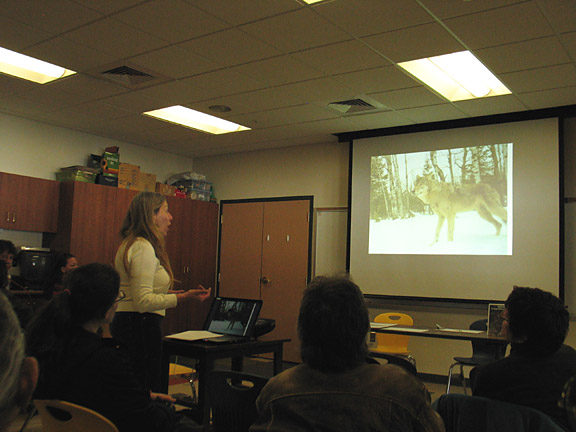
Nancy Warren, Volunteer Speakers Bureau coordinator for the Timber Wolf Alliance (TWA) and National Wolfwatcher Coalition Great Lakes Regional director, presents "Co-Existing with Wolves" at the Portage Lake District Library on Feb. 9, 2013. She is projecting here a photo of a wolf taken near her driveway at her home near Ewen, Mich. (File photo by Keweenaw Now)

"At the March 14th NRC meeting it was decided to step up the timeline regarding a public wolf hunting season," Warren writes in her letter. "The National Wolfwatcher Coalition serves on the Wolf Management Advisory Council (WMAC) and although we have met three times since June 2012, we never had the opportunity to discuss or even review this proposal, leaving the WMAC out of the process.

"Questions raised during the March public meetings were to be answered and posted to the DNR website along with the most current depredation and conflict information. As of this writing, this has not been done. A survey was conducted at each of the meetings; however survey results have not yet been tabulated or shared with the public."

Warren notes her disappointment that the NRC has ignored scientific evidence that questions the need for a wolf hunt in Michigan.

"It is disappointing that the April NRC agenda did not include two leading Michigan wolf researchers, Rolf Peterson and John Vucetich," Warren adds. "It seems apparent that the NRC is only interested in input from those who support a hunting season."*****

During the Feb. 9, 2013, presentation on wolves and petition signing event at Portage Lake District Library in Houghton, wildlife biologist Leah Vucetich reads a message from her husband, John Vucetich, Michigan Tech professor and co-director of the Isle Royale Wolf-Moose Study, in which he gives reasons why a general wolf hunt does not target an offending animal and is not based on scientific knowledge about wolves. (Photo by Keweenaw Now)

In her letter to NRC, Warren cites scientific studies in Michigan, Wisconsin and Minnesota -- refuting claims that wolves have caused a decline in deer populations.

"Data compiled by Mississippi State University, over a three year period, in Menominee County [Michigan] shows the coyote as the leading predator of deer, including fawns and adult females, followed by the bobcat," Warren notes as one example.

Warren also notes that Michigan's Wolf Management Plan states wolf-related conflicts should be handled on an individual basis.

She writes, "The recommending guidelines approved by the Michigan wolf roundtable states, 'In recent years, Michigan wolves have been killed on a case-by-case basis by government personnel for the purpose of addressing wolf-related conflicts. All reason suggests wolves will continue to be killed for this purpose. The DNR can use hunters for this [emphasis added] management need. Satisfying, in part, the interest to recreationally hunt would be an outcome of killing wolves to address wolf-related conflicts.'  This was the only use of hunters that was agreed upon by the Roundtable."

Warren adds that the proposed regulations conflict with the Wolf Management Plan because they expand the use of hunters and trappers as a management tool.

She gives the following summary of points she wishes the NRC will consider:
  • "The proposed wolf regulations have been submitted  without the input of the WMAC
  • The Wolf Management Units are too large and must be reduced to target the few packs that may be responsible for depredation
  • This proposal essentially creates a recreational hunting/trapping season because it includes wolf packs not directly responsible for livestock depredation
  • We do not support baiting, trapping or night hunting
  • DNR has not provided the data to support this proposal and has not established that a hunting /trapping season will reduce conflicts."
At their Apr. 11 meeting, immediately following a conservation award presentation, the NRC will hear comments from the public. Those wishing to make public comments before the NRC should contact Deb Whipple, executive assistant to the NRC, at 517-373-2352 or whippled1@michigan.gov to register. If unable to attend the meeting, the public may also submit written comments to Deb Whipple via email or to Natural Resources Commission, P.O. Box 30028, Lansing, MI 48909.**

Petition could suspend implementation of wolf hunting law

More than 2,000 Michigan residents volunteered for Keep Michigan Wolves Protected, a coalition of animal welfare groups, conservationists, veterinarians, Native American tribes and faith leaders -- to gather signatures during sub-freezing temperatures. The volunteers participated in more than 700 events statewide, most of them outdoors.

By the time Keep Michigan Wolves Protected received approval for the wording by the Board of State Canvassers and printed petitions, the 90-day petition period prescribed by law had dwindled down to only 67 days to complete the task. The most common response heard by signature gatherers -- whether they were in Houghton, Marquette, Detroit, Kalamazoo, Petoskey or Lansing -- was "Thank you for being here and speaking up for our wolves."

Once submitted, the Board of State Canvassers has 60 days, with an option of 15 additional days, to determine if the petitions contain enough valid signatures. If so, implementation of Public Act 520, the wolf hunting law, will be suspended pending the outcome of the November 2014 vote.

Wolves have been protected in Michigan for almost 50 years after being hunted to the brink of extinction. After more than four decades of protection, there are fewer than 700 wolves in Michigan. Despite the wolf population's fragile status, the Michigan legislature rushed a bill through last year’s session authorizing a sport hunting season for wolves -- opening the door to the same practices that virtually eradicated their population in the first place.

It’s already legal in Michigan to kill wolves in order to protect livestock or dogs, making a sport hunting and trapping season unnecessary. People don’t eat wolves, and it’s just pointless trophy hunting for no good purpose. Wolf hunting may involve especially cruel and unfair practices, such as painful steel-jawed leghold traps, hunting over bait, and even using packs of dogs to chase down and kill wolves.

Michigan residents interested in volunteering, donating or learning more about the issue can visit KeepWolvesProtected.com.

* Click here for PA 520, the wolf hunt bill, introduced by Michigan Sen. Tom Casperson (R-Escanaba).

** Click here for the Natural Resources Commission agenda for their Apr. 11, 2013, meeting.

*** See our Feb. 15, 2013, article, "Video report: Presentation on wolves offers facts, petition signing opportunity" and the March 10, 2013, article, "Petition signing to protect wolves continues in Marquette," by Greg Peterson. See also our Jan. 29, 2013, article, "KBIC Elder speaks against wolf hunt at DNR Citizens' Advisory Council meeting."

**** Click here for the DNR Memorandum to the Natural Resources Commission, proposing a public harvest of wolves, to be presented to the NRC at their Apr. 11 meeting.

***** Click here to read a statement by John Vucetich, "Some Reasons to Oppose Wolf Hunting in Michigan."

Thursday, June 14, 2012

Michigan Tech News: A Mystery Solved: 3 Wolves Drowned in Old Mine Shaft at Isle Royale National Park

By Jennifer Donovan, Michigan Tech Director of Public Relations
Posted on Michigan Tech News, June 14, 2012

HOUGHTON -- During their 2012 Winter Study, Michigan Technological University population biologist John Vucetich and wildlife ecologist Rolf Peterson started wondering where the wolves of Isle Royale National Park had gone. They only found nine wolves; and, as far as they could tell, only one was a female. They expressed serious concern that the wolves of Isle Royale might be well on their way to extinction.

Now they know what happened to at least three of those wolves, one of them a young female who likely would have contributed to the population’s viability in the future.

In late May, National Park Service biologist Ted Gostomsk reported one or more animal carcasses floating in water in a deep, 19th-century mine shaft at Isle Royale. With the aid of the Park Service, Peterson and his wife, Carolyn, went in to investigate. They recovered and examined what was left of the animals and then collected the bones.

"We found there had been a real catastrophe in early winter, before we arrived on the island in January," said Vucetich. "There were three dead wolves from the Chippewa Harbor Pack in the shaft: a collared male that we had been unable to locate this winter, an older male -- maybe the alpha male -- and a female born in 2011.

"We now understand a major reason for the decline in pack size of the Chippewa Harbor Pack in 2012, and perhaps why we saw such a desultory pattern of travel and low kill rate in this pack," Vucetich said.

The pack seemed to have no "game plan" following the large loss of so many individuals, he explained....

Click here for the full story on the Michigan Tech News.