See our right-hand column for announcements and news briefs. Scroll down the right-hand column to access the Archives -- links to articles posted in the main column since 2007. See details about our site, including a way to comment, in the yellow text above the Archives.
Showing posts with label Michigan petition against wolf hunt. Show all posts

Tuesday, September 10, 2013

Letter: Support petition drive for referendum on PA 21 and wolf hunt

Photo of wolf courtesy wolfwatcher.org. Reprinted with permission.

Please support the petition drive to help repeal Public Act 21.

It’s not just about the wolves. Passage of PA 21 means that Michigan voters can no longer appeal the naming of any animal as a game species, a right we’d held since 1908. How did we get to this point?

In December 2012, the Michigan legislature enacted PA 520 designating the wolf as a game animal and authorized the Natural Resources Commission (NRC) to establish a wolf hunt. More than 255,000 signatures were collected from citizens opposed to the hunt and were submitted in March of this year, earning PA 520 a place on the November 2014 ballot. This also meant there could be no wolf hunt before the votes were in.

Senator Tom Casperson introduced SB 288 in April, crafting a bill that would allow the Natural Resources Commission, in addition to the legislature, to add animals to the list of game species. As a politically appointed, regulatory body, NRC’s decisions cannot be subjected to a referendum. Governor Snyder signed SB 288, now known as PA 21, into law on May 8, enabling the NRC to reinstate the hunt, which they have done.

The citizens of Michigan have a constitutional right to challenge any recently passed legislation, with the exception of instances where the attached appropriations are vital to the functioning of our state government. The escalating use of appropriations to subvert the ability of citizens to utilize this important system of checks and balances, with notable examples being the Emergency Financial Manager and Right-to-Work laws, is a huge concern.

With the introduction of SB288/PA 21, Casperson found yet another way to undermine democracy. He said he did it to protect Michigan citizens from special interest groups like the Humane Society and to ensure that the people of the Upper Peninsula are heard. He neglected to mention that groups like Safari International lobbied for a wolf hunt, and that he has effectively silenced the voices of the more than 255,000 Michigan residents who signed the petition to subject PA 520 to referendum.

Our choices now are to lie down and take it, or dust ourselves off and fight for our right to vote on wildlife management issues. Repealing PA 21 and PA 520 will restore that right.  What we cannot do is repeal the current wolf hunt so speedily established by the NRC.  There will be wolves killed in Michigan this fall. Whether or not you think wolves should be "harvested," this is an outrage. And with their new found authority, we can expect the NRC to add the sandhill crane and possibly lynx to the list of game species to be hunted.

During First Friday events in Calumet on Sept. 6, 2013, Diane Miller, left, collects signatures on the petition for a referendum on PA 21 -- the second petition drive to allow Michigan voters to decide whether a wolf should be a game species. Signing the petition on Fifth Street in Calumet are, from left, Nancy Sprague, Bill Sewell and Oren Tikkanen. See below to learn how you can sign the petition. (Photo by Keweenaw Now)

The repeal of PA 520 will be on the November 2014 ballot and the petition drive to repeal PA 21 is underway. To learn more about the current campaign, go to http://keepwolvesprotected.com/. If you wish to help by gathering signatures, click on  Gather Signatures so you can obtain petition sheets. It is not necessary to write a letter of endorsement. If you are in the Marquette area and wish to sign the petition, please email me at brinkleycourt@yahoo.com. You just need to be a Michigan voter to sign it.

Catherine Parker
Marquette, Michigan

Editor's Notes:

Several people in the local area are collecting signatures for the petition on PA 21. You may contact Diane Miller in the Houghton / Hancock area by calling her at 906-370-1069 and she will arrange to help you sign the petition. She will also be at the Parade of Nations on Sept. 14 collecting signatures from Michigan voters.

UPDATE: In addition, Keep Michigan Wolves Protected will have a table during the Parade of Nations events at the Dee Stadium from 11 a.m. to 3 p.m. on Saturday, Sept. 14, for Michigan voters who wish to sign the petition there.

Chris Alquist, who works in the Portage Lake District Library in Houghton, also has petition sheets you  may request to sign in the library.

In the Marquette area, Jackie Winkowski of Gwinn, Great Lakes advisor for Wolfwatcher, is also collecting signatures. You may email her at jwsnowyplains@yahoo.com.

Other petition gathering events are listed on the Keep Michigan Wolves Protected Web site. Click here to find an event near you.

UPDATE: Anyone interested in signing a petition personally can request a petition form via U.S. mail by emailing katie@keepwolvesprotected.com, or call KMWP at 517-993-5201.

UPDATE: Charlotte Loonsfoot of KBIC is now collecting petition signatures in Baraga. You can call her at 906-235-4220 and she will arrange for you to sign it.

Jackie Winkowski has written a letter to the editor on this issue, published in the September 2013 Marquette Monthly. She gives more details on the reasons for the petition drive. Click here and scroll down to read her letter under City Notes.

See also our Aug. 25, 2013, article, "Wolf advocates kick off second petition drive, seek referendum on Michigan wolf hunt law."

Visit wolfwatcher.org for more information and articles on wolf protection.

Sunday, August 25, 2013

Wolf advocates kick off second petition drive, seek referendum on Michigan wolf hunt law

By Michele Bourdieu

Photo of wolf courtesy wolfwatcher.org. Reprinted with permission.

HOUGHTON -- Keep Michigan Wolves Protected -- the organization that sponsored a successful petition drive (collecting more than 255,000 signatures) for a referendum on Michigan PA 520 of December 2012 -- a law that allowed the legislature to designate wolves as a game species and authorized the Michigan Natural Resources Commission (NRC) to establish a wolf hunting season -- has now launched a second petition drive to put on the November 2014 ballot a referendum on PA 21, passed in May 2013 to circumvent the first petition.

PA 21 extends to the NRC the authority to designate any species (except mourning doves) as game. The NRC, with their new found authority, quickly designated the wolf as game and authorized a public hunt for Nov. 15 to Dec. 31, 2013, with a quota of 43 wolves to be killed in three designated Wolf Management Units (WMUs), or areas -- labeled A, B and C -- of the Upper Peninsula.

Nancy Warren, National Wolfwatcher Coalition Great Lakes Regional director, says this law is not just about the wolf.

"They (NRC) can designate anything (except mourning doves) as game -- the lynx, sand hill cranes etc," Warren says. "Their decisions cannot be challenged through the referendum, but PA 21 can since it is a new law. Therefore the second petition drive. If successful -- and based on the outpouring of support I am confident we will get the signatures -- two measures will be on the ballot: the repeal of PA 520 and the repeal of PA 21." (Inset: Photo of Nancy Warren by Allan Baker for Keweenaw Now)

On July 24, 2013, Warren and representatives from Keep Michigan Wolves Protected came to Houghton to rally concerned citizens wishing to help collect these signatures.

Warren, who had just flown in from Arizona, where she was doing work to help the Mexican gray wolf, kicked off that meeting with a presentation on how recent legislation has overruled Michigan's Wolf Management Plan and how the NRC, a politically appointed, unelected body -- only one of whom has a natural resources background -- has the authority to designate a game species and establish a hunt that is not based on science. Here is an excerpt from the first part of her presentation:


During  a July 24, 2013 kick-off meeting in Houghton, Mich., for the second petition drive calling for a Michigan referendum against recent wolf hunt legislation, Nancy Warren, National Wolfwatcher Coalition Great Lakes Regional director, speaks about Michigan legislation involving wolf management and the current PA 21, a law allowing the Michigan Natural Resources Commission decision to designate a wolf hunt in the fall of 2013. (Videos by Allan Baker for Keweenaw Now unless otherwise indicated.)

In the same presentation, Warren introduced some new information on wolf depredation she recently received from the Michigan Department of Natural Resources (DNR) -- information she has been requesting under the Freedom of Information Act to determine the actual number of depredations in each Upper Peninsula unit designated for a wolf hunt. Here is a video clip in which Warren speaks about that information and what it reveals about the disconnect between depredations and the authorized wolf hunt:


At the July 24 meeting for the petition drive on PA 21, Nancy Warren continues her presentation on Michigan's wolf legislation, noting some recent DNR information on wolf depredations in the Upper Peninsula. She points out that federal funding is now available for farmers who lose livestock, and she explains how wolf management without a hunt has allowed both non-lethal and lethal means of dealing with problem wolves.

During the public comment period of the July 15, 2013, meeting of the Western Upper Peninsula Citizens Advisory Council in Ewen, Warren spoke to DNR officials about how her FOIA requests had been refused.

During the July 15, 2013, meeting of the DNR Western Upper Peninsula Citizens Advisory Council in Ewen, Nancy Warren (standing, center) speaks about her difficulties in obtaining information about wolf depredations through the Freedom of Information Act (FOIA) and the fees she was asked to pay for what she believed should be public information. Later, through an appeal, she received the information requested, as indicated in the interview above. Present at the meeting also is 110th District State Rep. Scott Dianda, second from left, who voted for the bill that became PA 21. (Photo by Keweenaw Now)*

At that July 15 meeting, Terry Minzey, DNR Wildlife Division, brought Citizens Advisory Council members up to date on the wolf legislation, the petitions for referenda and the authorized hunt for fall 2013. He noted that trapping will not be allowed except on a case-by-case basis under certain circumstances. He also attempted to answer some of Warren's questions on why her FOIA requests were refused.

At the July 15, 2013, (Michigan) Dept. of Natural Resources Western Upper Peninsula Citizens Advisory Council meeting in Ewen, Mich., Terry Minzey, DNR Wildlife Division, summarizes the legislation and the actions of the Natural Resources Commission (NRC) that resulted in the approval of a public wolf hunt for certain areas of Michigan's Upper Peninsula -- scheduled for the fall of 2013. J. R. Richardson, NRC chair, of Ontonagon, is present at this meeting (Minzey refers to him as "J.R.") A council member asks a question on trapping. (Video by Keweenaw Now)

Here Minzey attempts to answer Nancy Warren's questions:

During the July 15, 2013, meeting of the DNR Citizens Advisory Council in Ewen, Terry Minzey of the DNR Wildlife Division attempts to answer questions posed by Nancy Warren, National Wolfwatcher Coalition Great Lakes Regional director, concerning FOIA requests she made for statistics on wolf depredation events in areas of the Upper Peninsula now designated for a public wolf hunt. (Video by Keweenaw Now)

Following the July 15 DNR Citizens Advisory Council meeting, Warren sent the DNR her appeal on the FOIA refusals. In the appeal, dated July 16, 2013, she writes as follows:

"The Wildlife Conservation Order does not provide a breakout of the depredations for each of the years, only the totals.

"I requested a breakout for the number of livestock depredations (calves/adult cows) for each of the years 2010-2013 for each of the units; the amount of payments made in each of the years; the most paid to any one producer for each of the years. Since the DNR tabulated the final figures for the Order (example 80 for WMU B) and stated the problems continue, the figures for each individual year should be readily available. The breakout for the years is critical, since (in) 2010 and 2011, lethal control was not allowed, but in 2012 and 2013, lethal control was allowed."

At the July 24 meeting on the second petition, Keweenaw Now's Allan Baker interviewed Nancy Warren about the new information she recently received from the DNR on wolf depredations in the U.P. Warren explained how her FOIA requests were at first refused, but finally answered when she appealed the DNR decision not to release information.

In an interview during the July 24 a kick-off meeting in Houghton for the petition drive for a referendum on PA 21, Nancy Warren speaks about her efforts to FOIA information about wolf depredation from the Michigan DNR. She also gives more details on how, since wolves in Michigan were removed from the Endangered Species List in 2012, lethal control has been used to manage problem wolves. 

Warren has since been analyzing the information she received on wolf depredations in the three units designated for a wolf hunt. She is especially concerned that 73 percent of ALL livestock depredations in Unit B for the period 2010-2013 occurred at one farm with a history of poor animal husbandry practices.**

"This producer was provided non-lethal tools, yet failed to utilized them. Wildlife Services have killed wolves at this property and this producer was given permits to kill wolves," Warren says. "For the years 2006, 2007, 2008, 2009 the Koski farm had 18 of the 22 verified depredations in Ontonagon County. The 2009 data shows he had the only 4 depredations in the county and in 2008 the only other depredations were some rabbits and another farm with ducks/geese."

A February 2013 DNR report on the Koski farm, whose owner had failed to dispose properly of dead animals, which can attract wolves and other predators, indicated to Warren that the justification for a wolf hunt used by the DNR and NRC (to reduce conflicts) is misleading.**

"It resonates well with the public if they are led to believe a wolf hunt will make wolves more wary and that will reduce conflicts. The true intent of the hunt has nothing to do with livestock conflicts and is purely to satisfy a vocal minority who just want a trophy hunt," Warren says. "It is interesting to note that since delisting (January 2012), lethal control of wolves responsible for depredation was implemented; and, so far, there have not been any depredations within any of the Units where the wolf hunt is planned. So the combination of lethal and non-lethal measures do work."

At a June 7, 2013, town hall meeting in Calumet, State Sen. Tom Casperson (R-Escanaba), who sponsored the bills that eventually became PA 520 and PA 21, told an audience made up mostly of his supporters that PA 21 passed the legislature thanks to votes from House Democrats who added their support to the wolf hunt legislation and the Republican majority -- including 110th District Rep. Scott Dianda (D-Calumet) and 109th District Rep. John Kivela (D-Marquette).***

State Senator Tom Casperson, sponsor of both bills that led to legislation for a wolf hunt in Michigan, speaks about that legislation during a town hall meeting on June 7, 2013, at Calumet High School. (Photo by Allan Baker for Keweenaw Now)

"I was in a position that if I got it done a lot of my people would appreciate that. They would respect that," Casperson said. "I think we did a pretty good job of working together and not playing the party line, bickering or anything like that."

Volunteers collect signatures statewide for second petition

Also speaking at the July 24 meeting on the petition was Jill Fritz, Michigan director of the Humane Society of the United States (HSUS), who summarized the legislature's approval of both PA 520, passed in December 2012, and PA 21, passed in May 2013. She described the successful petition effort that put PA 520 on hold, only to be followed by the NRC's decision, under authority given to them by PA 21, to hold a wolf hunt in the fall of 2013 -- thus the need for this second petition drive.

At the July 24 meeting for volunteer petition signature gatherers, Jill Fritz, Michigan director of the Humane Society of the United States (HSUS), describes how 255,000 signatures succeeded in putting a referendum on the Dec. 2012 wolf hunt legislation on the November 2014 ballot in Michigan. She also explains why a second referendum is needed. (Video by Allan Baker for Keweenaw Now)

Local resident Diane Miller attended the July 24 meeting and is now collecting signatures for a referendum on PA 21. Miller says she believes she has to work to end the wolf hunting season since none of the reasons given for it is sound.

"Rather," Miller notes, "the hunting season seems to be based on hate and misinformation, as well as a desire to shoot for sport. That is, farmers already have the right to shoot problem wolves and access to alternate methods of protecting livestock and dogs from wolves, whose territory is constantly shrinking. I hope that by gathering signatures I can participate in a process that reminds people that while there are many documented cases of domestic dogs biting humans every year, the number of Michigan wolves harming humans EVER is zero. As a citizen, it's important for me to participate in the act of creating a meaningful referendum question -- a democratic process that Public Act 21 blatantly seeks to block."

Miller adds she has found that some citizens who care least about wolves are livid about that democratic process being constrained in such an underhanded way.

 "Over the past several weeks as I have been gathering signatures at public places across the state, I've been heartened by the support our residents are showing for this effort," Miller says. "Even people who are not necessarily fond of wolves or are frank about NOT liking them see that the hunt is not a good idea, and they are especially angry about Public Act 21."

Miller said local residents who wish to sign the petition can call her at 906-370-1069 and she will arrange to get their signatures.

"It occurs to me that people might be especially interested in knowing that, in a way, they represent their county in an additional way when they sign the petition," Miller added. "KMWP (Keep Michigan Wolves Protected) is keeping track of the top signature gatherers in the state, and I am number four. I'm rather proud of this, since the top three are in Kalamazoo, where there is a much higher population." 

Ellie Hayes, campaign manager for Keep Michigan Wolves Protected, spoke at the July24 meeting and explained the procedures for collecting signatures on the petition.

Ellie Hayes, campaign manager for Keep Michigan Wolves Protected, explains to volunteers at the July 24 petition meeting the correct procedures for collecting signatures. (Photo by Allan Baker for Keweenaw Now)

More recently, Hayes reports, "We just concluded our 15-stop kick-off tour through Michigan. We traveled to Detroit, Houghton, Sault Ste. Marie, St. Joseph, Kalamazoo, Flint, Harbor Springs, Grand Rapids, Marquette, Traverse City, and many more cities to meet volunteers eager to keep Michigan's wolves protected and put a stop to the legislature's egregious power grab from the voters."

Michigan resident Kristi Lloyd, who collected signatures for the first petition, is enthusiastic about collecting them again to support this effort for a referendum on PA 21. In fact, she finds people are even more willing to sign this petition because of the way the legislature went about disregarding, nullifying, and silencing the 255,000 Michigan voters who signed the first petition.

"I'm collecting signatures for the petition because the wolf hunt in Michigan, as in other wolf-hunting states, has nothing to do with the wolves," Lloyd says. "The 'hunts' are all about politics from federal and state levels. In Michigan we are fortunate to have the right to referendum our state government to change laws with which we disagree. The non-hunting, non-consumptive users of our wildlife in MI have the same right to contribute to the preservation of our wildlife and do have a say in how it is 'managed,' but we have no way to financially support the preservation of our wildlife -- unlike hunters or trappers or anglers who pay to take our wildlife via licenses, tags, taxes on guns and ammunition. Gov. Rick Snyder and MI's GOP-led legislature took only the well-financed, high-powered organizations into consideration in proposing and signing SB 288 into law (PA 21)."

Lloyd, who also has experience with wolf issues in Yellowstone National Park and other areas of the West, says she has found that hunting wolves does not necessarily reduce their numbers in a certain area.

"Wolves need room to roam and where there is space, they (or other animals) will move in," Lloyd notes. "Shooting or killing wolves teaches them nothing. And wolves ARE still afraid of humans -- otherwise we would have many, many reported attacks on people and that just is not happening. Even hunters and trappers that go IN to the woods where wolves live have never been attacked. And neither have researchers, biologists, hikers, fishermen/women. "

Keweenaw Bay Indian Community (KBIC) member Charlotte Loonsfoot, who also collected signatures for the first petition, plans to collect them again in Baraga for this petition against PA 21.

"Wolves are not for hunting and stripping them of their hides," Loonsfoot says. "If you Don't Eat it, Don't Kill it! Our little rodents and small game will overflow in the forests if this hunt happens, and we will definitely be infested when those rodents come into our towns."

Loonsfoot sees both the wolf hunt and excess logging of the forest as facilitating access for mining companies now doing drill testing in many areas of the Upper Peninsula.

"They (the mining companies) will have easier road access for extracting the minerals from the ground," Loonsfoot notes. "The map of mining companies buying up mineral rights in the western UP is outrageous, and I bet they are cutting (forests) close to these mineral right properties or right on top them."

In Houghton, Chris Alquist, Community Program director at Portage Lake District Library, is also volunteering to collect signatures for this petition. Stop in at the library or call the library at 482-4570 and ask for Chris. She'll provide a petition form for you to sign. Petitions must be signed in person.

Petition signing events are posted on the Keep Michigan Wolves Protected Web site under Events. Click here to find an event near you.

Tomorrow, Aug. 26, Keep Michigan Wolves Protected will host a petition signing event beginning at 11 a.m. and at 1 p.m. in the Academic Mall at Northern Michigan University, 1401 Presque Isle Ave. in Marquette.

If you would like to help collect signatures for this petition drive click here for the Keep Michigan Wolves Protected online form to volunteer as a signature gatherer.

You can also email info@keepwolvesprotected.com if you have any questions about how you can help volunteer or just questions about the campaign in general.

Nancy Warren is traveling at present, but you can email her at nancy@wolfwatcher.org if you need more information about upcoming petition signing events.

Notes:
* See our May 8, 2013, article, "Michigan legislators offer views on hunting bills, signed into law today; NRC may establish wolf hunting season despite public opposition."

** See the June 27, 2013, article by Nancy Warren, "Opinion: Nearly half of wolf depredations attributed to one farm with poor animal husbandry practices."

*** State Sen. Tom Casperson participated in a "Media Meet" broadcast, "Wolf Hunt in the U.P," on Public Radio 90, WNMU-FM, Aug. 11 and 12, 2013. The panel also included wildlife advocate Adam Robarge and Michigan Department of Natural Resources wildlife biologist Brian Roelle. Click here for the podcast.

Friday, April 26, 2013

Guest Editorial: There and Back, Again

By Adam Robarge

MARQUETTE -- For the second time in less than a month, I found myself this past Tuesday (April 23) making my way around the Capitol Square in Lansing. I had spoken at a press conference on March 27th to announce the submitting of over a quarter million signatures that hoped to protect Michigan’s gray wolf from being hunted. I had declared that as Michigan citizens, "we endeavored to become a model in wildlife conservation --  and a point of organization to forward thinking individuals across our entire nation." Two weeks later with the introduction of Senate Bill 288 and its House chamber companion, House Bill 4552, my words and the thoughts they invoke found themselves at risk of being silenced. So I returned to Lansing on Tuesday with every intent of defending them.

Adam Robarge, author of this article, is now the director of Wild Land Guardians, a Marquette-based grass-roots group advocating for wildlife and wildlife habitat. In January, February and March, he worked with Keep Michigan Wolves Protected on the petition drive for a referendum on Michigan's PA 520, legislation designating the wolf as a game animal. Here he is speaking about the petition during a presentation at the Portage Lake District Library on Feb. 9, 2013. Keep Michigan Wolves Protected collected more than a quarter of a million signatures for the petition, far more than the necessary minimum of 161,000 signatures. (Photo by Keweenaw Now)*

As I sat in the offices of our Senators and Representatives, I soon discovered that it wasn’t only my voice that was being silenced or ignored. It was truth.

The day began with a rally on the Capitol steps in opposition to SB 288 and HB 4552. As the winds picked up, a collection of activists and concerned citizens huddled in close before the podium. It was a sea of determination speckled with red, as we all wore hats silhouetted by a gray wolf, with the question "Will of the people, endangered too?" I had given nearly everything to this campaign over the course of a cold and snowy UP winter.

At times I questioned my actions, my beliefs. I always returned to the endorsement of Dr. John Vucetich. Here was a wolf biologist, co-director of the Isle Royale Wolf-Moose Study and a lead researcher of the annual Isle Royale Winter Study. Who could argue with that? I stood there that morning as did many others, needing no further validation for what we had accomplished.

In front of the Capitol building in Lansing, Dr. John Vucetich, Michigan Tech professor of wildlife ecology and co-director of the Isle Royale Wolf-Moose Study, speaks during the April 23, 2013, rally opposing SB 288 and HB 4552 -- both of which would allow the Natural Resources Commission to decide on a public harvest of wolves. (Photo © and courtesy Adam Robarge)

Instead, we listened intently for words to rally around, words to keep us moving forward. Listening so intently, people often forgot to cheer at opportune moments, rather remaining focused upon what would be said next.

Dr. Vucetich spoke of science, and in truths. The recent DNR population survey does not actually suggest that the wolf population in the Upper Peninsula is declining. The correct interpretation is that the population is leveling off, naturally. So the DNR suggests that the proposed hunt is to protect human safety, rather than population control.  

Dr. John Vucetich addresses the crowd at the April 23, 2013, Rally against wolf hunt legislation, saying, "Hunting is not a tool for dealing with human safety (issues). If there is a threat in April, you can't wait until the next hunting season six months from now, with the hope that some hunter will have the good fortune of taking the offending wolf. It just doesn't work that way." **

However, Dr. Vucetich appealed, "Threats to human safety, when they occur, had better be dealt with swiftly, precisely, thoroughly and immediately. Protecting human safety cannot wait until the upcoming hunting season."

Discussing the decline in hunting and the increase in negative attitudes toward its practitioners, he told us, "Studies show that the public will overwhelmingly support hunting methods when given good reason to do so."

Dr. Vucetich added that hunting the wolf will result in a further mistrust of this act steeped in our cultural heritage. There exists no good reason to randomly hunt members of the gray wolf population. It may be as simple as this. Hunting without reason is killing.

We then sat by his side in the offices of legislators while he attempted to educate them. For we are told that these bills -- now named the "Scientific Wildlife Management Package" -- are meant to encourage just that -- science. But they weren't listening. This was an expert, a scientist from our own state of Michigan sitting in front of them. Our legislators remained fixed on the idea of outside interests and their information. They remained fixed on representing a portion of inside residents, and their phobias. Certainly, nuisance behavior is found to exist within the gray wolf population -- within any population, for that matter. And losing livestock or a pet, or feeling threatened by wolves, is not something to ignore. But a random hunt is not the answer. Data exists that suggests this may actually increase unwanted behaviors. And that is an outcome none of us are looking for.

A sign at the April 23 rally expresses the view that SB 288 and HB 4552 are not based on scientific data. (Photo © and courtesy Adam Robarge)

It's hard to know how or where to keep fighting when our legislators won't see science or listen to truths. Senate Bill 288 passed the floor with a vote along party lines on Thursday, April 25. It now moves to the House Committee on Natural Resources. We must implore our Representatives -- Dianda, Kivela, McBroom, and Foster. Implore them to hear their other constituents, to provide us answers based on science and truth. Implore them to hear you. We are running out of time. I returned home believing the only option for us is to keep fighting, despite the defeats. The truth will shine through, for it is all that truly exists.

It is my feeling now to demand that they at least represent us as equally as possible, no matter what their final vote says. I want to see that science has truly been brought to the table, whether it is merely to be debated or actually seen as an amendment to the bill. If the gray wolf is to be hunted, I want it transparent to everyone that all measures were rightfully considered and that a framework to be followed when making such designations be put in place. Only then should this bill be voted upon.

Editor's Notes:
* See our Feb. 15, 2013, article, "Video report: Presentation on wolves offers facts, petition signing opportunity" on this presentation at Portage Lake District Library in Houghton.
See also this March 10, 2013, article by Greg Peterson, "Petition signing to protect wolves continues in Marquette."

** See "Letter from John Vucetich, wildlife ecologist: Reasons to oppose SB288," posted on Keweenaw Now April 16, 2013

Click here for the present version of SB 288 as passed by the Michigan Senate on April 25, 2013.

Click here for the present version of HB 4552, which has been referred to the House Committee on Natural Resources.

Tuesday, April 09, 2013

Petition against Michigan wolf hunt submitted; Natural Resources Commission to consider DNR wolf hunt proposal

By Michele Bourdieu, with information from a Mar. 27, 2013, Keep Michigan Wolves Protected press release and from the Michigan Department of Natural Resources

Upper Peninsula coordinator for Keep Michigan Wolves Protected Adam Robarge gives instructions as Northern Michigan University students and others line up at NMU on Feb. 27, 2013, to help protect Michigan wolves by forcing a referendum in the fall of 2014 that could at least temporarily halt a proposed Michigan wolf hunt. (File photo © and courtesy Greg Peterson)

LANSING -- Keep Michigan Wolves Protected submitted 253,705 signatures to the Secretary of State’s office, that, when certified, will place any plans for a wolf hunting season on hold until Michigan voters decide the issue at the ballot box in November 2014. During a short 67-day period, the coalition far surpassed the 161,305 valid signatures needed to qualify for the ballot.

"The public response over the past few months has been tremendous, and it demonstrates that Michigan voters in every corner of the state oppose the pointless trophy hunting of wolves," said Jill Fritz, director of Keep Michigan Wolves Protected. "Mounting a petition drive in the dead of winter and collecting a quarter of a million signatures in 67 days has been a monumental feat. We look forward to giving Michigan voters -- not the politicians -- the opportunity to decide whether to keep wolves protected or to allow sport hunting and trapping of these rare creatures just beginning to recover from the brink of extinction."

Across the entire state, hundreds of thousands of Michiganders have spoken with their pens to tell legislators that they were wrong in approving a wolf hunting bill (Public Act 520, the wolf hunting law) last December.*

Natural Resources Commission to consider wolf hunt issue at Apr. 11, 2013, meeting

Meanwhile the agenda for the Michigan Natural Resources Commission meeting this Thursday, April 11, in Lansing includes presentations from two external experts on wolf management: Chris Smith, western representative of the Wildlife Management Institute and former policy advisor to the governor of Montana on wolf and grizzly bear management; and Jim Hammill, a member of the board of directors of Safari Club International and former member of the International Wolf Center board.

State law authorizes that the Natural Resource Commission to determine the method and manner of take for all game species in Michigan. A Department of Natural Resources (DNR) proposal for a public harvest of wolves will be presented to the committee. The proposal is for discussion only and will not be acted upon at the April meeting.**

Adam Robarge, Upper Peninsula coordinator for Keep Michigan Wolves Protected, says his organization will be represented at the NRC meeting. Robarge organized several UP petition signings, including those in Marquette and Houghton reported on Keweenaw Now.***

Nancy Warren, Great Lakes Regional director of the National Wolfwatcher Coalition, who spoke about the wolf hunt issue in Houghton on Feb. 9, 2013, has already testified before the Natural Resources Commission. For this April 11 NRC meeting, she submitted a letter to the commission on Apr. 8, 2013, listing serious concerns with Wildlife Conservation Order Amendment 6 of 2013, Wolf Regulations.****

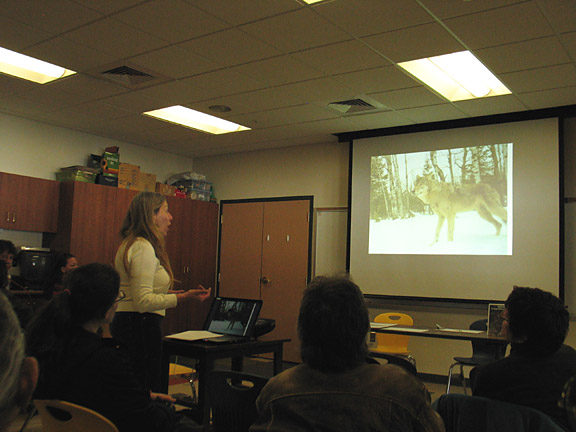
Nancy Warren, Volunteer Speakers Bureau coordinator for the Timber Wolf Alliance (TWA) and National Wolfwatcher Coalition Great Lakes Regional director, presents "Co-Existing with Wolves" at the Portage Lake District Library on Feb. 9, 2013. She is projecting here a photo of a wolf taken near her driveway at her home near Ewen, Mich. (File photo by Keweenaw Now)

"At the March 14th NRC meeting it was decided to step up the timeline regarding a public wolf hunting season," Warren writes in her letter. "The National Wolfwatcher Coalition serves on the Wolf Management Advisory Council (WMAC) and although we have met three times since June 2012, we never had the opportunity to discuss or even review this proposal, leaving the WMAC out of the process.

"Questions raised during the March public meetings were to be answered and posted to the DNR website along with the most current depredation and conflict information. As of this writing, this has not been done. A survey was conducted at each of the meetings; however survey results have not yet been tabulated or shared with the public."

Warren notes her disappointment that the NRC has ignored scientific evidence that questions the need for a wolf hunt in Michigan.

"It is disappointing that the April NRC agenda did not include two leading Michigan wolf researchers, Rolf Peterson and John Vucetich," Warren adds. "It seems apparent that the NRC is only interested in input from those who support a hunting season."*****

During the Feb. 9, 2013, presentation on wolves and petition signing event at Portage Lake District Library in Houghton, wildlife biologist Leah Vucetich reads a message from her husband, John Vucetich, Michigan Tech professor and co-director of the Isle Royale Wolf-Moose Study, in which he gives reasons why a general wolf hunt does not target an offending animal and is not based on scientific knowledge about wolves. (Photo by Keweenaw Now)

In her letter to NRC, Warren cites scientific studies in Michigan, Wisconsin and Minnesota -- refuting claims that wolves have caused a decline in deer populations.

"Data compiled by Mississippi State University, over a three year period, in Menominee County [Michigan] shows the coyote as the leading predator of deer, including fawns and adult females, followed by the bobcat," Warren notes as one example.

Warren also notes that Michigan's Wolf Management Plan states wolf-related conflicts should be handled on an individual basis.

She writes, "The recommending guidelines approved by the Michigan wolf roundtable states, 'In recent years, Michigan wolves have been killed on a case-by-case basis by government personnel for the purpose of addressing wolf-related conflicts. All reason suggests wolves will continue to be killed for this purpose. The DNR can use hunters for this [emphasis added] management need. Satisfying, in part, the interest to recreationally hunt would be an outcome of killing wolves to address wolf-related conflicts.'  This was the only use of hunters that was agreed upon by the Roundtable."

Warren adds that the proposed regulations conflict with the Wolf Management Plan because they expand the use of hunters and trappers as a management tool.

She gives the following summary of points she wishes the NRC will consider:
  • "The proposed wolf regulations have been submitted  without the input of the WMAC
  • The Wolf Management Units are too large and must be reduced to target the few packs that may be responsible for depredation
  • This proposal essentially creates a recreational hunting/trapping season because it includes wolf packs not directly responsible for livestock depredation
  • We do not support baiting, trapping or night hunting
  • DNR has not provided the data to support this proposal and has not established that a hunting /trapping season will reduce conflicts."
At their Apr. 11 meeting, immediately following a conservation award presentation, the NRC will hear comments from the public. Those wishing to make public comments before the NRC should contact Deb Whipple, executive assistant to the NRC, at 517-373-2352 or whippled1@michigan.gov to register. If unable to attend the meeting, the public may also submit written comments to Deb Whipple via email or to Natural Resources Commission, P.O. Box 30028, Lansing, MI 48909.**

Petition could suspend implementation of wolf hunting law

More than 2,000 Michigan residents volunteered for Keep Michigan Wolves Protected, a coalition of animal welfare groups, conservationists, veterinarians, Native American tribes and faith leaders -- to gather signatures during sub-freezing temperatures. The volunteers participated in more than 700 events statewide, most of them outdoors.

By the time Keep Michigan Wolves Protected received approval for the wording by the Board of State Canvassers and printed petitions, the 90-day petition period prescribed by law had dwindled down to only 67 days to complete the task. The most common response heard by signature gatherers -- whether they were in Houghton, Marquette, Detroit, Kalamazoo, Petoskey or Lansing -- was "Thank you for being here and speaking up for our wolves."

Once submitted, the Board of State Canvassers has 60 days, with an option of 15 additional days, to determine if the petitions contain enough valid signatures. If so, implementation of Public Act 520, the wolf hunting law, will be suspended pending the outcome of the November 2014 vote.

Wolves have been protected in Michigan for almost 50 years after being hunted to the brink of extinction. After more than four decades of protection, there are fewer than 700 wolves in Michigan. Despite the wolf population's fragile status, the Michigan legislature rushed a bill through last year’s session authorizing a sport hunting season for wolves -- opening the door to the same practices that virtually eradicated their population in the first place.

It’s already legal in Michigan to kill wolves in order to protect livestock or dogs, making a sport hunting and trapping season unnecessary. People don’t eat wolves, and it’s just pointless trophy hunting for no good purpose. Wolf hunting may involve especially cruel and unfair practices, such as painful steel-jawed leghold traps, hunting over bait, and even using packs of dogs to chase down and kill wolves.

Michigan residents interested in volunteering, donating or learning more about the issue can visit KeepWolvesProtected.com.

* Click here for PA 520, the wolf hunt bill, introduced by Michigan Sen. Tom Casperson (R-Escanaba).

** Click here for the Natural Resources Commission agenda for their Apr. 11, 2013, meeting.

*** See our Feb. 15, 2013, article, "Video report: Presentation on wolves offers facts, petition signing opportunity" and the March 10, 2013, article, "Petition signing to protect wolves continues in Marquette," by Greg Peterson. See also our Jan. 29, 2013, article, "KBIC Elder speaks against wolf hunt at DNR Citizens' Advisory Council meeting."

**** Click here for the DNR Memorandum to the Natural Resources Commission, proposing a public harvest of wolves, to be presented to the NRC at their Apr. 11 meeting.

***** Click here to read a statement by John Vucetich, "Some Reasons to Oppose Wolf Hunting in Michigan."