See our right-hand column for announcements and news briefs. Scroll down the right-hand column to access the Archives -- links to articles posted in the main column since 2007. See details about our site, including a way to comment, in the yellow text above the Archives.
Showing posts with label National Wolfwatcher Coalition. Show all posts

Thursday, November 25, 2021

UP Wolf advocacy group calls for resignation of Natural Resources Commissioner over false statement

Michigan wolves are again in danger of being hunted since they were removed from the federal endangered species list last year and state officials ignore science and ethics. (Photo courtesy National Wolfwatcher Coalition. Reprinted with permission.)

EWEN, Michigan -- In a letter to Michigan Natural Resources Commission Chairwoman Carol Rose and DNR Director Dan Eichinger, Nancy Warren -- a U.P. resident, wolf advocate and  National Wolfwatcher Coalition director -- asked that Commissioner JR Richardson release a public apology and resign from the Commission because of his history of deceptive actions about wolves in Michigan.

During the program "Ask the DNR," which aired on November 4, 2021, on WNMU-TV, Commissioner Richardson told an unsubstantiated story of a wolf attack on a dog chained to a porch. During the same segment, Commissioner Richardson encouraged listeners to contact him, which Warren did in an attempt to get more details. When Richardson failed to respond, Warren submitted a formal Freedom of Information Act (FOIA) request to the Michigan DNR, asking for documentation of the incident any time within the past ten years, as alleged by Richardson. The DNR responded that no such record exists.

"Commissioner Richardson had an obligation to verify rumors he may have heard and not mislead the public by spreading them," said Warren. "He should be held accountable."

In her letter to Rose and Eichinger, Warren also states, "Commissioner Richardson also provided inaccurate information about the Wolf Management Advisory Council (WMAC) during that interview. He stated that there are six members of the WMAC from downstate and one from 'up here.' But the WMAC consists of five individuals: Three from Lower Michigan, who represent hunting organizations, 'conservation' groups (in the form of the Michigan United Conservation Clubs), and animal advocacy groups. The one person on the WMAC from the Upper Peninsula represents agriculture and hunting interests. The fifth representative on the WMAC, from the Great Lakes Indian Fish and Wildlife Commission, actually lives in Ashland, Wisconsin. Two tribal members from the Upper Peninsula applied to serve but were not selected to represent tribal interests. The chair of the WMAC is a DNR employee."

This pattern of unscrupulous behavior dates back to 2013, when as Chair of the Commission, another Freedom of Information Act request revealed that Richardson admitted to his Executive Assistant that he had trashed 2000 public comments related to the wolf hunt.*

"Commissioner JR Richardson cannot be trusted to make ethical, science-based wildlife management decisions that respect the values of Michigan residents, the democratic process and the intrinsic value of wolves," said Warren. "It is apparent he only wants to hear from those whose beliefs align with his and he should not be allowed to continue serving on the Natural Resources Commission."**

Editor's Notes:

*  See our Nov. 14, 2013, article, "National Wolfwatcher Coalition: State officials ignore, destroy comments opposing Michigan wolf hunt," which reports Nancy Warren's findings, through a FOIA request, that Richardson admitted trashing public comments related to the 2013 wolf hunt.

** See also the Bridge Michigan Nov. 22, 2021, article, "Michigan wildlife official cries wolf. Gray wolf advocates want him gone."

Sunday, November 02, 2014

Video report: Wolf hunt based on politics, not science -- why vote "NO" on Proposals 1 and 2

By Michele Bourdieu
Videos and photos by Allan Baker for Keweenaw Now

Title slide for the Oct. 21, 2014, presentation by Nancy Warren, Great Lakes regional director and executive director of the National Wolfwatcher Coalition, at the Finnish American Heritage Center in Hancock. (Photo by Allan Baker for Keweenaw Now)

HANCOCK -- Nancy Warren, Great Lakes regional director and executive director of the National Wolfwatcher Coalition (NWC), presented "POLITICS OR SCIENCE? THE HUNTING OF WOLVES! at the Finnish American Heritage Center in Hancock on Oct. 21, 2014. Her talk covered the efforts of citizens to challenge wolf hunt legislation in Michigan and reasons to vote "No" on Proposals 1 and 2 -- legislation allowing a wolf hunt in Michigan -- on the Nov. 4, 2014, ballot.

Introduced by Diane Miller, Finlandia assistant professor of communication and English, who collected many signatures to the two petitions challenging the wolf hunt legislation, Warren, a resident of Ewen, Mich., who lives in an area that was one of three in the Upper Peninsula designated for the wolf hunt, began her talk with facts about wolf management in Michigan -- based on her own experience serving on a roundtable to establish a Wolf Management Plan.

Nancy Warren, Great Lakes Regional Director and Executive Director of the National Wolfwatcher Coalition (NWC) presents "POLITICS OR SCIENCE? THE HUNTING OF WOLVES! at the Finnish American Heritage Center in Hancock, Mich., on Oct. 21, 2014. (Videos by Allan Baker for Keweenaw Now)

Warren also showed a video of John Vucetich -- Michigan Tech associate professor, wildlife expert and co-director of the Isle Royale Wolf-Moose study -- in which he explains his own philosophical reasons for voting "No" on Proposals 1 and 2.*

Before wolf hunt legislation was proposed, Warren demonstrates, legal methods -- both lethal and non-lethal -- have been used successfully to control problem wolves and the state has reimbursed farmers for losses of livestock caused by wolf depredation:

Nancy Warren explains how non-lethal methods such as donkeys and electric fencing have been provided by the State of Michigan to help farmers protect livestock from wolves. In some cases, when lethal methods are necessary, the Department of Natural Resources (DNR) has the authority to kill problem wolves. The law also allows livestock producers and dog owners to kill a wolf attacking their animals and farmers can enlist the aid of hunters in certain circumstances, Warren notes.

Warren also related how one Upper Peninsula farmer, who reported a large number of wolf depredations (used as statistics to justify the wolf hunt), was exposed as having mistreated his own animals and left dead animals, including donkeys supplied to him by the DNR, on his property. Fencing that was given to him disappeared as well. He received a total of $35,835 in aid from the State of Michigan -- 62 percent of all compensation paid in the U.P.**

In this slide, Warren shows how the Koski farm's reported depredations, a result of poor animal husbandry practices, inflated statistics and distorted reasons for the 2013 wolf hunt. Several articles in the media exposed the facts about this farm.**

Warren then produced information she had obtained through the Freedom of Information Act (FOIA) that reveals how DNR staff and the State Senate removed scientific language from the proposed wolf hunt bill in 2012 and, with the support of certain groups, including the MUCC (Michigan United Conservation Clubs) pushed the legislature to pass PA 520 in December 2012:

Nancy Warren points out how Michigan DNR staff took science out of wolf hunt legislation and pushed the legislature to pass a wolf hunt law, PA 520, by December 2012.

With very little time allowed, Warren explains, Keep Michigan Wolves Protected and other groups organized a statewide effort to collect signatures for a petition demanding a referendum on PA 520 in early 2013. They collected 256,916 signatures -- more than the minimum number of signatures -- in only 67 days:

Warren explains how, early in 2013, concerned citizens collected enough signatures for a referendum on Michigan PA 520, wolf hunt legislation that has become Proposal 1 on the Nov. 4, 2014, Michigan ballot. The National Wolfwatcher Coalition and other environmental groups, as well as the Humane Society, are asking voters to vote "NO" on Proposal 1 in order to repeal this law.

Shortly after that petition was accepted, the state legislature passed PA 21, which gave the Natural Resources Commission (NRC) the authority to designate any species (except mourning doves) as game. The NRC, with their new found authority, quickly designated the wolf as game and authorized a public hunt for Nov. 15 to Dec. 31, 2013, with a quota of 43 wolves to be killed in three designated Wolf Management Units (WMUs), or areas -- labeled A, B and C -- of the Upper Peninsula.

Here Warren talks about Michigan Public Act 21, which gives the Natural Resources Commission (NRC) -- a body of 7 political appointees with little or no scientific background -- the authority to schedule a wolf hunt. Concerned citizens collected signatures a second time (though not in time to stop the 2013 wolf hunt), and PA 21 is now on the November ballot as Proposal 2. Warren asks for a "No" vote on it to repeal the law.

Warren noted the 2013 wolf hunting season did not result in the death of "problem" wolves. The wolves that were killed, except for one, were not even near any farm.

Wolf hunt proponents next introduced the misnamed "Scientific Fish and Wildlife Conservation Act," attaching a million-dollar appropriation to prevent any referendum. It did not even require the Governor's signature and, according to Warren, may be proved unconstitutional.

Warren notes that most of the 22 wolves killed during the 2013 wolf hunt in Michigan were killed in places where wolves are actually beneficial. Only one was ever near a farm, and there was no evidence of any of them being involved in depredations. She also describes how a group of pro-wolf-hunt groups introduced the "Scientific Fish and Wildlife Conservation Act," which did not require the Governor's signature and cannot go to the voters for referendum because of an appropriation attached.

In concluding her talk, Warren points out how the DNR has failed to educate the public about wolves and their role in balancing the ecosystem:

Nancy Warren of Wolfwatchers speaks about wolf management, the need for education abut the positive aspects of wolves, and the ballot proposals concerning the Michigan wolf hunt. She points out that the Michigan DNR has done nothing to promote eco-tourism about wolves, while the International Wolf Center in Ely, Minn. brings in $5.5 million.

Diane Miller commented on her Finlandia University students' reactions to Warren's presentation.

"Nancy's talk, which draws on decades of experience with wolves, counteracted a lot of misinformation that has been promoted out of fear and the desire to trophy hunt," Miller said. "Several students told me that they appreciated Nancy's talk because it offered them what they needed to fully understand the wolf hunting issue and thus have a more informed response to a referendum question as they vote for the first time."

To access the text of Proposals 1 and 2, click here.

Notes:

* Click here to see the video with John Vucetich.

** See our June 27, 2013, article by Nancy Warren: "Nearly half of wolf depredations attributed to one farm with poor animal husbandry practices."

Friday, January 31, 2014

Letter: Michigan’s Inaugural Wolf Hunt Not Justified

Photo of wolves courtesy Wolfwatcher.org. Reprinted with permission.

Last week Adam Bump, Michigan DNR (Department of Natural Resources), claimed 17 of the 23 wolves killed during last fall’s wolf hunt happened in places within known territories of packs repeatedly attacking livestock or pets and exhibiting fearless behavior around people. Once again, DNR has stretched the facts.

Data released this week in response to a Freedom of Information Act request revealed that no wolves were killed near either of the two farms in the U.P. with the greatest livestock losses to wolves.

Most wolves killed during the hunt were far from any perceived or actual threats to humans, including a male and female wolf killed just outside the boundary of the Porcupine Mountains Wilderness State Park. The female was a collared research animal.
 
Another collared wolf was killed near Prickett Lake, within the Ottawa National Forest. Two wolves were killed in the Superior State Forest, one of which was collared.

Other wolves killed in remote areas include one within the Sturgeon Gorge Wilderness area; five within the Baraga State Forest; and another within the boundary of the Black River National Scenic Byway. Three wolves were killed along the East Branch of the Ontonagon River within the Ottawa National Forest.

This data reveals that the recent wolf hunt was not justified because most wolves killed were not involved with verified conflicts with livestock or humans during 2013.

Upon federal delisting of wolves in January of 2012, livestock and pet owners were allowed to kill any wolf in the act of attacking their animals. Further, the DNR began issuing permits to landowners to kill any wolf on their property if they experienced a prior confirmed wolf attack on their animals. Eleven wolves were killed in control actions by government officials and private citizens. The numbers demonstrate that these actions were effective. In Wolf Management Unit B (Ontonagon, Houghton, Baraga Counties) verified livestock losses by wolves in 2013 were down 89 percent prior to the hunt.
 
In addition to the 23 wolves killed during the 2013 hunting season, the DNR also reported that 14 wolves were killed illegally.

The DNR should emphasize the value of wolves to the ecosystem through education and outreach, as recommended in Michigan’s Wolf Management Plan, instead of trying to find ways to kill non-problem wolves through a recreational hunt.

Nancy Warren
National Wolfwatcher Coalition
Ewen, MI

Thursday, June 27, 2013

Opinion: Nearly half of wolf depredations attributed to one farm with poor animal husbandry practices

By Nancy Warren, Great Lakes Regional Director
National Wolfwatcher Coalition 


Photo of wolf courtesy WolfWatcher.org. Reprinted with permission.

EWEN, Mich. -- According to DNR (Department of Natural Resources) records, for the period 2010-2012, 48 percent of wolf depredations occurred on one farm. This farm, the
Koski farm, is located in Wolf Management Unit B where DNR has proposed 19 wolves be taken through a hunting season. The primary objective given by DNR for this unit is to reduce the number of chronic livestock depredations.

The justification states, "Despite the extensive management responses in this area, livestock depredations have continued."

Over time, we have argued that many of the problems at the Koski farm were due to poor animal husbandry practices.

Most recently, in our comments to the NRC (Natural Resources Commission) dated June 13, 2013, we stated, "Wolf Management Units -- We have repeatedly asked for the data to support the need for a wolf hunting season. Specifically, how many verified wolf complaints have been received since lethal measures were taken to  remove  problem wolves?  One producer, with a history of poor animal husbandry practices and nearly 50 percent of all depredations should not be used as justification for a hunting season."

According to a Feb. 4, 2013, DNR report obtained under the Freedom of Information Act, in an attempt to reduce depredations through non-lethal means, DNR provided Mr. Koski with three donkeys at a cost of $1650. Two of those donkeys died while in Mr. Koski’s care. The third donkey, removed Feb. 1, 2013, was in very poor body condition.

The report states, "This animal was very weak and likely dehydrated since there is no water provided to the livestock."

In addition, the report notes there is a $882 vet bill for the trimming of hooves. Mr. Koski was also provided $1315.73 of fencing material, which is now gone.

The Detroit Free Press in its May 19, 2013, edition published an article with the headline, "MI UP: War over wolves: U.P. residents say hunt will control a killer."  (The article has since been taken off the Free Press website along with a photo showing a pile of carcasses under a blanket which Mr. Koski claimed were the latest casualties in his ongoing war with wolves. However, this was an unsubstantiated claim, since DNR stated it was never verified that the animals were killed by wolves.)

The Free Press article mentions Koski's wolf depredation problem but does not describe his neglect of his own animals, as reported by the DNR.

The article does say, "Government-paid sharpshooters and trappers for years have killed dozens of the wolves who’ve taken a liking to Koski’s cattle."

The article also quotes John Vucetich, Michigan Tech associate professor of wildlife ecology and co-director of the Isle Royale Wolf-Moose Study, as follows: "'It’s dubious to say we’re going to take a county or a portion of a county and we’re going to remove 10, 20, 30 wolves and resolve a livestock depredation issue,' [Vucetich] said. 'These wolves are territorial, and they are going to keep other wolves away. They are like the landlords. The thing you can hope for is to train the wolves not to harm livestock in the area. But if you are shooting these wolves, the pack gets disrupted, the wolves get dispersed, and other wolves come in. There’s a good chance you can make things worse.'"

The Bodies of Dead Animals Act, Public Act 239 of 1982, as amended, establishes guidelines for the proper disposal of dead animals, to protect human, animal and environmental health.

It states, "In general, all dead animals must be disposed of within 24 hours after death."

Although the DNR report is dated Feb. 4, 2013, it is apparent the problem with dead animals was continuing when the reporter visited the Koski farm in mid-May.

Editor's Notes:

 Click here to read the minutes of the May 9, 2013, meeting of the Michigan Natural Resources Commission (NRC). The meeting includes extensive comments from the public (many opposed to the wolf hunt) and the NRC discussion and approval of the proposed wolf hunting season. The public comments include the testimony from Roger LaBine, chairman of the conservation committee of the Lac Vieux Desert Band of Lake Superior Chippewa Indians, who, according to the Free Press article, "traveled nearly seven hours to the Natural Resources Commission’s May 9 meeting in Roscommon, urging the commission not to approve a wolf hunt just before they did."

Nancy Warren, author of this article, also reports that the Natural Resources Commission (NRC), at their June meeting, reviewed Wildlife Conservation Order 13, which designates the wolf a game animal, and Wildlife Order 14, which outlines the rules and regulations for a wolf hunt. The NRC will vote on these two Orders at their July 11, 2013, meeting. To implement the law (in this case, PA 21), DNR needs to create a Wildlife Order giving their recommendations. Click here for Wildlife Order 14.

Thursday, April 11, 2013

Right to vote threatened by Michigan Senate Bill 288

Photo of wolf © Brandi Nichols and courtesy National Wolfwatcher Coalition. Reprinted with permission.

LANSING -- In a desperate move, State Senator Tom Casperson (R-Escanaba) introduced in Committee today Senate Bill 288 which, if signed into law, will prevent voters from having a say in what happens to Michigan wildlife.

In a 2006 referendum, Michigan voters overwhelmingly said "no" to the hunting of mourning doves. Last month, the signatures of 253,000 registered Michigan voters were submitted to the Secretary of State, requesting a similar referendum, opposing the designation of the wolf as a game animal.

"The referendum process is the right of citizens to vote to approve or reject new laws passed by legislature," according to Nancy Warren, U.P. resident and Great Lakes Regional Director, National Wolfwatcher Coalition.

Senate Bill 288 would allow the Natural Resources Commission -- an appointed, not elected, decision making body -- to designate any species a game animal and thus a hunted species which cannot be challenged by Michigan voters.

Warren said, "This bill removes the checks and balances currently in place and is an assault against the rights of Michigan citizens."

In a 5-2 vote, SB 288 was approved in Committee today and now moves to the full Senate.* Warren urges Michigan voters to contact their Michigan Senators and Representatives and ask them to oppose SB 288. Don’t let your voice be silenced.

If you are not a Michigan resident, please pass this along to a Michigan voter!

Find your senator:
http://www.senate.michigan.gov/fysenator/fysenator.htm

Find your representative: http://www.house.michigan.gov/mhrpublic/

FOR OUT OF STATE WOLFWATCHERS -- If you are interested in being a voice for Michigan wolves, you can help by participating in the Keep Michigan Wolves Protected phone bank. Just send your name, phone number and email address to them and they will provide you with a list of call numbers. Email ellie@keepwolvesprotected.com.

For more information visit www.wolfwatcher.org and http://keepwolvesprotected.com/.

* Editor's Note: The Michigan Senate Committee on Natural Resources, Environment and Great Lakes has 5 Republican members and 2 Democrats. State Sen. Tom Casperson (R-Escanaba), who introduced SB 288, is the chair of this committee. Click here for a Detroit News article on that committee's meeting today, Apr. 11.

Tuesday, April 09, 2013

Petition against Michigan wolf hunt submitted; Natural Resources Commission to consider DNR wolf hunt proposal

By Michele Bourdieu, with information from a Mar. 27, 2013, Keep Michigan Wolves Protected press release and from the Michigan Department of Natural Resources

Upper Peninsula coordinator for Keep Michigan Wolves Protected Adam Robarge gives instructions as Northern Michigan University students and others line up at NMU on Feb. 27, 2013, to help protect Michigan wolves by forcing a referendum in the fall of 2014 that could at least temporarily halt a proposed Michigan wolf hunt. (File photo © and courtesy Greg Peterson)

LANSING -- Keep Michigan Wolves Protected submitted 253,705 signatures to the Secretary of State’s office, that, when certified, will place any plans for a wolf hunting season on hold until Michigan voters decide the issue at the ballot box in November 2014. During a short 67-day period, the coalition far surpassed the 161,305 valid signatures needed to qualify for the ballot.

"The public response over the past few months has been tremendous, and it demonstrates that Michigan voters in every corner of the state oppose the pointless trophy hunting of wolves," said Jill Fritz, director of Keep Michigan Wolves Protected. "Mounting a petition drive in the dead of winter and collecting a quarter of a million signatures in 67 days has been a monumental feat. We look forward to giving Michigan voters -- not the politicians -- the opportunity to decide whether to keep wolves protected or to allow sport hunting and trapping of these rare creatures just beginning to recover from the brink of extinction."

Across the entire state, hundreds of thousands of Michiganders have spoken with their pens to tell legislators that they were wrong in approving a wolf hunting bill (Public Act 520, the wolf hunting law) last December.*

Natural Resources Commission to consider wolf hunt issue at Apr. 11, 2013, meeting

Meanwhile the agenda for the Michigan Natural Resources Commission meeting this Thursday, April 11, in Lansing includes presentations from two external experts on wolf management: Chris Smith, western representative of the Wildlife Management Institute and former policy advisor to the governor of Montana on wolf and grizzly bear management; and Jim Hammill, a member of the board of directors of Safari Club International and former member of the International Wolf Center board.

State law authorizes that the Natural Resource Commission to determine the method and manner of take for all game species in Michigan. A Department of Natural Resources (DNR) proposal for a public harvest of wolves will be presented to the committee. The proposal is for discussion only and will not be acted upon at the April meeting.**

Adam Robarge, Upper Peninsula coordinator for Keep Michigan Wolves Protected, says his organization will be represented at the NRC meeting. Robarge organized several UP petition signings, including those in Marquette and Houghton reported on Keweenaw Now.***

Nancy Warren, Great Lakes Regional director of the National Wolfwatcher Coalition, who spoke about the wolf hunt issue in Houghton on Feb. 9, 2013, has already testified before the Natural Resources Commission. For this April 11 NRC meeting, she submitted a letter to the commission on Apr. 8, 2013, listing serious concerns with Wildlife Conservation Order Amendment 6 of 2013, Wolf Regulations.****

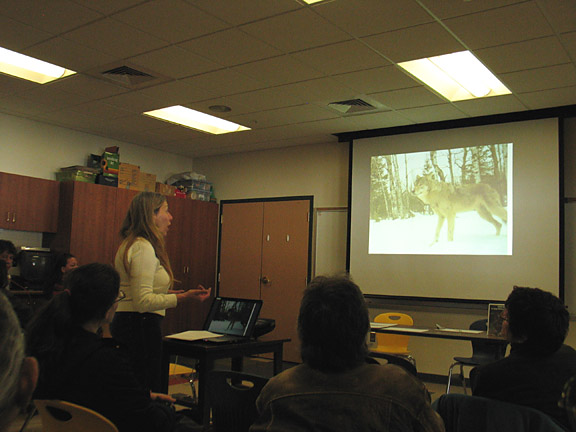
Nancy Warren, Volunteer Speakers Bureau coordinator for the Timber Wolf Alliance (TWA) and National Wolfwatcher Coalition Great Lakes Regional director, presents "Co-Existing with Wolves" at the Portage Lake District Library on Feb. 9, 2013. She is projecting here a photo of a wolf taken near her driveway at her home near Ewen, Mich. (File photo by Keweenaw Now)

"At the March 14th NRC meeting it was decided to step up the timeline regarding a public wolf hunting season," Warren writes in her letter. "The National Wolfwatcher Coalition serves on the Wolf Management Advisory Council (WMAC) and although we have met three times since June 2012, we never had the opportunity to discuss or even review this proposal, leaving the WMAC out of the process.

"Questions raised during the March public meetings were to be answered and posted to the DNR website along with the most current depredation and conflict information. As of this writing, this has not been done. A survey was conducted at each of the meetings; however survey results have not yet been tabulated or shared with the public."

Warren notes her disappointment that the NRC has ignored scientific evidence that questions the need for a wolf hunt in Michigan.

"It is disappointing that the April NRC agenda did not include two leading Michigan wolf researchers, Rolf Peterson and John Vucetich," Warren adds. "It seems apparent that the NRC is only interested in input from those who support a hunting season."*****

During the Feb. 9, 2013, presentation on wolves and petition signing event at Portage Lake District Library in Houghton, wildlife biologist Leah Vucetich reads a message from her husband, John Vucetich, Michigan Tech professor and co-director of the Isle Royale Wolf-Moose Study, in which he gives reasons why a general wolf hunt does not target an offending animal and is not based on scientific knowledge about wolves. (Photo by Keweenaw Now)

In her letter to NRC, Warren cites scientific studies in Michigan, Wisconsin and Minnesota -- refuting claims that wolves have caused a decline in deer populations.

"Data compiled by Mississippi State University, over a three year period, in Menominee County [Michigan] shows the coyote as the leading predator of deer, including fawns and adult females, followed by the bobcat," Warren notes as one example.

Warren also notes that Michigan's Wolf Management Plan states wolf-related conflicts should be handled on an individual basis.

She writes, "The recommending guidelines approved by the Michigan wolf roundtable states, 'In recent years, Michigan wolves have been killed on a case-by-case basis by government personnel for the purpose of addressing wolf-related conflicts. All reason suggests wolves will continue to be killed for this purpose. The DNR can use hunters for this [emphasis added] management need. Satisfying, in part, the interest to recreationally hunt would be an outcome of killing wolves to address wolf-related conflicts.'  This was the only use of hunters that was agreed upon by the Roundtable."

Warren adds that the proposed regulations conflict with the Wolf Management Plan because they expand the use of hunters and trappers as a management tool.

She gives the following summary of points she wishes the NRC will consider:
  • "The proposed wolf regulations have been submitted  without the input of the WMAC
  • The Wolf Management Units are too large and must be reduced to target the few packs that may be responsible for depredation
  • This proposal essentially creates a recreational hunting/trapping season because it includes wolf packs not directly responsible for livestock depredation
  • We do not support baiting, trapping or night hunting
  • DNR has not provided the data to support this proposal and has not established that a hunting /trapping season will reduce conflicts."
At their Apr. 11 meeting, immediately following a conservation award presentation, the NRC will hear comments from the public. Those wishing to make public comments before the NRC should contact Deb Whipple, executive assistant to the NRC, at 517-373-2352 or whippled1@michigan.gov to register. If unable to attend the meeting, the public may also submit written comments to Deb Whipple via email or to Natural Resources Commission, P.O. Box 30028, Lansing, MI 48909.**

Petition could suspend implementation of wolf hunting law

More than 2,000 Michigan residents volunteered for Keep Michigan Wolves Protected, a coalition of animal welfare groups, conservationists, veterinarians, Native American tribes and faith leaders -- to gather signatures during sub-freezing temperatures. The volunteers participated in more than 700 events statewide, most of them outdoors.

By the time Keep Michigan Wolves Protected received approval for the wording by the Board of State Canvassers and printed petitions, the 90-day petition period prescribed by law had dwindled down to only 67 days to complete the task. The most common response heard by signature gatherers -- whether they were in Houghton, Marquette, Detroit, Kalamazoo, Petoskey or Lansing -- was "Thank you for being here and speaking up for our wolves."

Once submitted, the Board of State Canvassers has 60 days, with an option of 15 additional days, to determine if the petitions contain enough valid signatures. If so, implementation of Public Act 520, the wolf hunting law, will be suspended pending the outcome of the November 2014 vote.

Wolves have been protected in Michigan for almost 50 years after being hunted to the brink of extinction. After more than four decades of protection, there are fewer than 700 wolves in Michigan. Despite the wolf population's fragile status, the Michigan legislature rushed a bill through last year’s session authorizing a sport hunting season for wolves -- opening the door to the same practices that virtually eradicated their population in the first place.

It’s already legal in Michigan to kill wolves in order to protect livestock or dogs, making a sport hunting and trapping season unnecessary. People don’t eat wolves, and it’s just pointless trophy hunting for no good purpose. Wolf hunting may involve especially cruel and unfair practices, such as painful steel-jawed leghold traps, hunting over bait, and even using packs of dogs to chase down and kill wolves.

Michigan residents interested in volunteering, donating or learning more about the issue can visit KeepWolvesProtected.com.

* Click here for PA 520, the wolf hunt bill, introduced by Michigan Sen. Tom Casperson (R-Escanaba).

** Click here for the Natural Resources Commission agenda for their Apr. 11, 2013, meeting.

*** See our Feb. 15, 2013, article, "Video report: Presentation on wolves offers facts, petition signing opportunity" and the March 10, 2013, article, "Petition signing to protect wolves continues in Marquette," by Greg Peterson. See also our Jan. 29, 2013, article, "KBIC Elder speaks against wolf hunt at DNR Citizens' Advisory Council meeting."

**** Click here for the DNR Memorandum to the Natural Resources Commission, proposing a public harvest of wolves, to be presented to the NRC at their Apr. 11 meeting.

***** Click here to read a statement by John Vucetich, "Some Reasons to Oppose Wolf Hunting in Michigan."